Unit III: Stages of Development
1.Discuss characteristics of the Life-Span perspective.
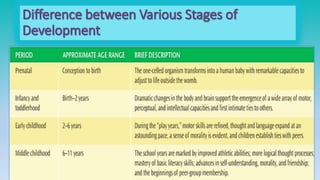
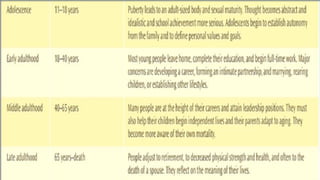
2.Differentiate between various stages of development.
3. Explain the following major aspects of development.
(i). Cognitive aspect
(ii). Social aspect
(iii). Personality aspect
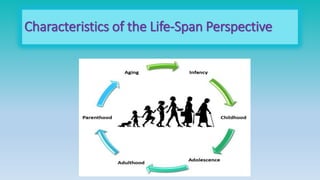
Characteristics of the Life-Span Perspective
• The period of time between the birth and death of an
organism.
• Developmental psychology is concerned with the scientific
understanding of age-related changes in experience and
behavior.
Characteristics of the Life-Span Perspective
• The life-span approach emphasizes developmental change
throughout adulthood as well as childhood
• Life-span perspective views development as:
lifelong, multidimensional, multidirectional, plastic,
multidisciplinary, and contextual, and as a process that
involves growth, maintenance, and regulation of loss. (Paul
Baltes 1939–2006)
1.Development Is Lifelong: Early adulthood is not the
endpoint of development, rather, no age period dominates
development.
2.Development Is Multidimensional: Whatever your age, your
body, mind, emotions, and relationships are changing and
affecting each other.
• Development consists of biological, cognitive, and
socioemotional dimensions.
3.Development Is Multidirectional: Development of certain
traits can be characterized as having the capacity for both an
increase and decrease in efficacy over the course of an
individual’s life.
During late adulthood, older adults might become wiser by
being able to call on experience to guide their intellectual
decision making, but they perform more poorly on tasks that
require speed in processing information.
4.Development Is Plastic: Plasticity means the capacity for
change.
5.Development Is Multidisciplinary: Lifespan development is
multidisciplinary because it encompasses several:
 Academic specialties
 Healthcare
 Educational
 Social science, etc.
• Various disciplines study lifespan development because each
of them are influenced and intertwined with the others.
6.Development Is Contextual: Development occurs within a context, or
setting.
• Contexts include:
 Families
 Schools
 Peer groups
 Churches
 Cities
 Neighborhoods
 University laboratories
 Countries, and so on.
• These settings is influenced by historical, economic, social, and
cultural factors.
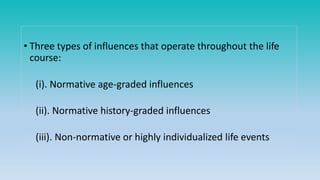
• Three types of influences that operate throughout the life
course:
(i). Normative age-graded influences
(ii). Normative history-graded influences
(iii). Non-normative or highly individualized life events
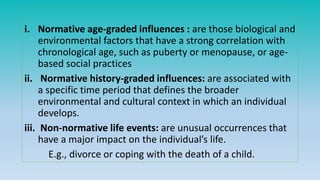
i. Normative age-graded influences : are those biological and
environmental factors that have a strong correlation with
chronological age, such as puberty or menopause, or age-
based social practices
ii. Normative history-graded influences: are associated with
a specific time period that defines the broader
environmental and cultural context in which an individual
develops.
iii. Non-normative life events: are unusual occurrences that
have a major impact on the individual’s life.
E.g., divorce or coping with the death of a child.
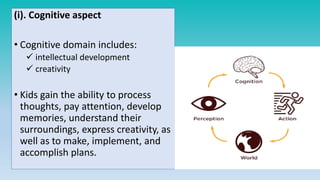
(i). Cognitive aspect
• Cognitive domain includes:
 intellectual development
 creativity
• Kids gain the ability to process
thoughts, pay attention, develop
memories, understand their
surroundings, express creativity, as
well as to make, implement, and
accomplish plans.
Piaget’s Cognitive Development Theory
• Piaget’s theory states that children go through four stages of cognitive
development as they actively construct their understanding of the
world.
1. The sensorimotor stage
2. The preoperational stage
3. The concrete operational stage
4. The formal operational stage
(ii). Social aspect
Socialization between parents and children is not a one-way process.
Parents do socialize children, but socialization in families is reciprocal.
Reciprocal socialization is socialization that is bidirectional; children
socialize parents just as parents socialize children.
Synchrony in parentchild relationships was positively related to
children’s social competence (Harrist, 1993).
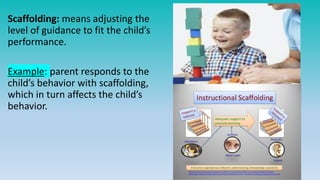
Scaffolding: means adjusting the
level of guidance to fit the child’s
performance.
Example: parent responds to the
child’s behavior with scaffolding,
which in turn affects the child’s
behavior.
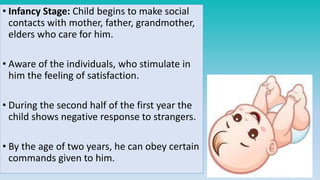
• Infancy Stage: Child begins to make social
contacts with mother, father, grandmother,
elders who care for him.
• Aware of the individuals, who stimulate in
him the feeling of satisfaction.
• During the second half of the first year the
child shows negative response to strangers.
• By the age of two years, he can obey certain
commands given to him.
• Early Childhood Stage: Child selects his playmates of his own
age from his immediate neighbourhood.
• Later Childhood Stage: Child enters, the school and wants to
have many friends.
• Interested in playing.
• Desires to be in the group of friends of his own age and sex.
• Responsibility, self-control, self-reliance, obedience,
discipline etc, develop in this stage.
• Adolescence Stage: Adolescent acquires:
habits, attitudes, ideals and social skills.
• At the later adolescent period, one usually tries to seek
friendship with a member of the opposite gender.
(iii). Personality aspect
• Emotions and temperament form key aspects of personality, the enduring
personal characteristics of individuals.
• Freud’s theory of personality development
• Erik Erikson first proposed that personality development is a lifelong process
• The security of attachment leads to:
 social and personality development,
 Infants and young children who ave secured attachment developed:
 stronger friendships with peers,
more advanced emotional understanding
and more positive self-concepts, compared with insecurely attached
children
(Thompson, 2008).
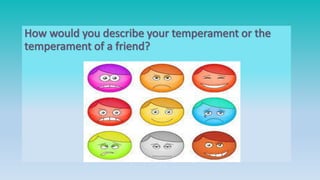
• Temperamental characteristics
emerge and change over time.
• Temperament is an inborn quality
noticeable soon after birth.
• Temperament include:
 Activity level
 Regularity (or predictability),
Sensitivity thresholds,
Mood,
Persistence
Distractibility
Chess and Thomas’ Classification of temperament:
• Psychiatrists Alexander Chess and Stella Thomas (Chess &
Thomas, 1977; Thomas & Chess, 1991) identified three basic
types temperament:
1)An easy child is generally in a positive mood, quickly establishes
regular routines in infancy, and adapts easily to new experiences.
2)A difficult child reacts negatively and cries frequently, engages in
irregular daily routines, and is slow to accept change.
3)A slow-to-warm-up child has a low activity level, is somewhat
negative, and displays a low intensity of mood.
• Children inherit a physiology that biases them to have a
particular type of temperament.
• Through experience they may learn to modify their
temperament to some degree.
Example: Infants Fear
Grown up child reduce this fear
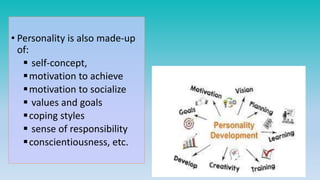
• Personality is also made-up
of:
 self-concept,
motivation to achieve
motivation to socialize
 values and goals
coping styles
 sense of responsibility
conscientiousness, etc.
Recommended Reading
 A topical approach to life-span development by John W.
Santrock
 John-Santrock-Life-Span-Development-13th-Edition-2010
 The life span human development for helping professionals
by Broderick, Patricia C Blewitt, Pamela

4 # stages of development

  • 1.
    Unit III: Stagesof Development
  • 2.
    1.Discuss characteristics ofthe Life-Span perspective. 2.Differentiate between various stages of development. 3. Explain the following major aspects of development. (i). Cognitive aspect (ii). Social aspect (iii). Personality aspect
  • 3.
    Characteristics of theLife-Span Perspective
  • 4.
    • The periodof time between the birth and death of an organism. • Developmental psychology is concerned with the scientific understanding of age-related changes in experience and behavior.
  • 5.
    Characteristics of theLife-Span Perspective • The life-span approach emphasizes developmental change throughout adulthood as well as childhood • Life-span perspective views development as: lifelong, multidimensional, multidirectional, plastic, multidisciplinary, and contextual, and as a process that involves growth, maintenance, and regulation of loss. (Paul Baltes 1939–2006)
  • 6.
    1.Development Is Lifelong:Early adulthood is not the endpoint of development, rather, no age period dominates development. 2.Development Is Multidimensional: Whatever your age, your body, mind, emotions, and relationships are changing and affecting each other. • Development consists of biological, cognitive, and socioemotional dimensions.
  • 7.
    3.Development Is Multidirectional:Development of certain traits can be characterized as having the capacity for both an increase and decrease in efficacy over the course of an individual’s life. During late adulthood, older adults might become wiser by being able to call on experience to guide their intellectual decision making, but they perform more poorly on tasks that require speed in processing information. 4.Development Is Plastic: Plasticity means the capacity for change.
  • 8.
    5.Development Is Multidisciplinary:Lifespan development is multidisciplinary because it encompasses several:  Academic specialties  Healthcare  Educational  Social science, etc. • Various disciplines study lifespan development because each of them are influenced and intertwined with the others.
  • 9.
    6.Development Is Contextual:Development occurs within a context, or setting. • Contexts include:  Families  Schools  Peer groups  Churches  Cities  Neighborhoods  University laboratories  Countries, and so on. • These settings is influenced by historical, economic, social, and cultural factors.
  • 10.
    • Three typesof influences that operate throughout the life course: (i). Normative age-graded influences (ii). Normative history-graded influences (iii). Non-normative or highly individualized life events
  • 11.
    i. Normative age-gradedinfluences : are those biological and environmental factors that have a strong correlation with chronological age, such as puberty or menopause, or age- based social practices ii. Normative history-graded influences: are associated with a specific time period that defines the broader environmental and cultural context in which an individual develops. iii. Non-normative life events: are unusual occurrences that have a major impact on the individual’s life. E.g., divorce or coping with the death of a child.
  • 15.
    (i). Cognitive aspect •Cognitive domain includes:  intellectual development  creativity • Kids gain the ability to process thoughts, pay attention, develop memories, understand their surroundings, express creativity, as well as to make, implement, and accomplish plans.
  • 16.
    Piaget’s Cognitive DevelopmentTheory • Piaget’s theory states that children go through four stages of cognitive development as they actively construct their understanding of the world. 1. The sensorimotor stage 2. The preoperational stage 3. The concrete operational stage 4. The formal operational stage
  • 17.
    (ii). Social aspect Socializationbetween parents and children is not a one-way process. Parents do socialize children, but socialization in families is reciprocal. Reciprocal socialization is socialization that is bidirectional; children socialize parents just as parents socialize children. Synchrony in parentchild relationships was positively related to children’s social competence (Harrist, 1993).
  • 18.
    Scaffolding: means adjustingthe level of guidance to fit the child’s performance. Example: parent responds to the child’s behavior with scaffolding, which in turn affects the child’s behavior.
  • 19.
    • Infancy Stage:Child begins to make social contacts with mother, father, grandmother, elders who care for him. • Aware of the individuals, who stimulate in him the feeling of satisfaction. • During the second half of the first year the child shows negative response to strangers. • By the age of two years, he can obey certain commands given to him.
  • 20.
    • Early ChildhoodStage: Child selects his playmates of his own age from his immediate neighbourhood. • Later Childhood Stage: Child enters, the school and wants to have many friends. • Interested in playing. • Desires to be in the group of friends of his own age and sex. • Responsibility, self-control, self-reliance, obedience, discipline etc, develop in this stage.
  • 21.
    • Adolescence Stage:Adolescent acquires: habits, attitudes, ideals and social skills. • At the later adolescent period, one usually tries to seek friendship with a member of the opposite gender.
  • 22.
    (iii). Personality aspect •Emotions and temperament form key aspects of personality, the enduring personal characteristics of individuals. • Freud’s theory of personality development • Erik Erikson first proposed that personality development is a lifelong process • The security of attachment leads to:  social and personality development,  Infants and young children who ave secured attachment developed:  stronger friendships with peers, more advanced emotional understanding and more positive self-concepts, compared with insecurely attached children (Thompson, 2008).
  • 23.
    • Temperamental characteristics emergeand change over time. • Temperament is an inborn quality noticeable soon after birth. • Temperament include:  Activity level  Regularity (or predictability), Sensitivity thresholds, Mood, Persistence Distractibility
  • 24.
    Chess and Thomas’Classification of temperament: • Psychiatrists Alexander Chess and Stella Thomas (Chess & Thomas, 1977; Thomas & Chess, 1991) identified three basic types temperament: 1)An easy child is generally in a positive mood, quickly establishes regular routines in infancy, and adapts easily to new experiences. 2)A difficult child reacts negatively and cries frequently, engages in irregular daily routines, and is slow to accept change. 3)A slow-to-warm-up child has a low activity level, is somewhat negative, and displays a low intensity of mood.
  • 25.
    • Children inherita physiology that biases them to have a particular type of temperament. • Through experience they may learn to modify their temperament to some degree. Example: Infants Fear Grown up child reduce this fear
  • 26.
    • Personality isalso made-up of:  self-concept, motivation to achieve motivation to socialize  values and goals coping styles  sense of responsibility conscientiousness, etc.
  • 28.
    Recommended Reading  Atopical approach to life-span development by John W. Santrock  John-Santrock-Life-Span-Development-13th-Edition-2010  The life span human development for helping professionals by Broderick, Patricia C Blewitt, Pamela