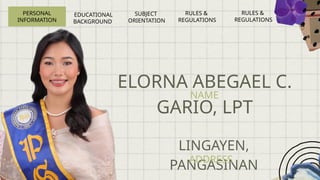
NAME
PERSONAL
INFORMATION
ELORNA ABEGAEL C.
GARIO, LPT
LINGAYEN,
PANGASINAN
ADDRESS
EDUCATIONAL
BACKGROUND
SUBJECT
ORIENTATION
RULES &
REGULATIONS
RULES &
REGULATIONS
EDUCATIONAL
BACKGROUND
BACHELOR OF SECONDARY EDUCATION
MAJOR IN SOCIAL STUDIES
• PANGASINAN STATE UNIVERSITY
• THE ADELPHI COLLEGE, INC.
ELEMENTARY- SENIOR HIGH SCHOOL
EDUCATIONAL
BACKGROUND
PERSONAL
INFORMATION
SUBJECT
ORIENTATION
RULES &
REGULATIONS
CONTACT
INFORMATION
EDUCATIONAL
BACKGROUND
PERSONAL
INFORMATION
SUBJECT
ORIENTATION
RULES &
REGULATIONS
CONTACT
INFORMATION
SUBJECT
ORIENTATION
THE CHILD AND ADOLESCENT
LRNS & LRNG PRIN.
This course explores the physical, cognitive, emotional,
social, and moral development of children and
adolescents. It introduces key learning theories and
principles to help future educators design age-
appropriate, inclusive, and supportive learning
experiences.
• Understand the stages of child and adolescent development in physical,
cognitive, emotional, social, and moral domains.
• Analyze the various factors that influence the learning and development of
young learners.
• Apply developmentally appropriate and learner-centered strategies in planning
and delivering instruction.
• Demonstrate sensitivity to individual differences and diverse backgrounds in
promoting inclusive and supportive learning environments.
GENERAL
OBJECTIVES
THINGS YOU NEED TO EXPECT
DURING A SCHOOL TERM
QUIZ/recitation
group reporting
assignments
group project/
performnace
Opportunities to grow
course requirements
1.Summative Quizzes
2.Examinations
3.Performance
4.Outputs
5.Portfolio and Journal
EDUCATIONAL
BACKGROUND
PERSONAL
INFORMATION
SUBJECT
ORIENTATION
RULES &
REGULATIONS
CONTACT
INFORMATION
RULES &
REGULATIONS
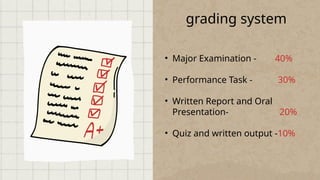
grading system
• Major Examination - 40%
• Performance Task - 30%
• Written Report and Oral
Presentation- 20%
• Quiz and written output -10%
1.Be respectful
2.Listen attentively
3.Come prepared
4.Participate actively
5.3 consecutive absents-drop
"WHO AM I?"
• N A M E
• A G E
• A D D R E S S
• H O B B I E S
• C O U R S E E X P E C TAT I O N S
WHO AM I?
• N A M E
• A G E
• A D D R E S S
• W H Y E D U C AT I O N ?
• E X P E C TAT I O N
PERSONAL
INFORMATION
elornagario7@gma
il.com
EDUCATIONAL
BACKGROUND
SUBJECT
ORIENTATION
RULES &
REGULATIONS
Elorna
Gario
CONTACT
INFORMATION
BY: ELORNA GARIO
HUMAN
DEVELOP
MENT
OBJECTIV
ES
Explain the stages and major theories of human
development across the lifespan,
Demonstrate appreciation and respect for the uniqueness of
individuals at different stages of development by engaging in
reflective discussions, and
Perform a role-play that portrays the behaviors,
challenges, and interactions characteristic of individuals
at different stages of human development.
• the pattern of movement or change that begins at
conception and continues through the life span.
• includes growth and decline.
• can be positive or negative.
HUMAN DEVELOPMENT
PRINCIPL
ES OF
HUMAN
DEVELOP
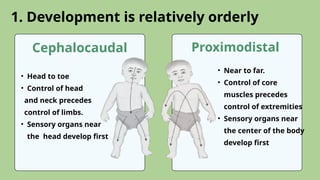
1. Development is relatively orderly
Cephalocaudal Proximodistal
• Head to toe
• Control of head
and neck precedes
control of limbs.
• Sensory organs near
the head develop first
• Near to far.
• Control of core
muscles precedes
control of extremities
• Sensory organs near
the center of the body
develop first
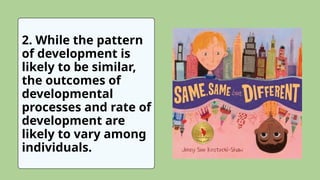
2. While the pattern
of development is
likely to be similar,
the outcomes of
developmental
processes and rate of
development are
likely to vary among
individuals.
3. Development takes place gradually.
• Slow and
continuous
• Takes time to
master
-Development doesn’t happen
overnight
• Builds on earlier
stages -Each new skill or ability usually depends on what has
been
learned before.
-Skills like thinking critically, managing emotions, or forming
relationships develop slowly as a person gains more
experiences and matures.
4. Development as a process is complex
because it is the product of;
• BIOLOGICAL PROCESS
-These involve physical changes in the body, such as growth in
height and weight, brain development, puberty, and motor
skills.
• COGNITIVE PROCESS
-These relate to thinking, problem-solving, learning, and
memory.
• SOCIO-EMOTIONAL PROCESS
-These involve emotions, relationships, personality, and
how
people interact with others.
APPROAC
HES
TO
HUMAN
Believes that individuals will show
extensive change from birth to
adolescence,little or no change in
adulthood and decline in late old
age
TRADITIONAL
PERSPECTIVE
LIFE-SPAN
APPROACH
Believes that even in adulthood,
developmental change takes
place as it does during childhood
• Development is LIFELONG
• MULTIDIMENSIONAL
• PLASTIC
• CONTEXTUAL
• GROWTH, MAINTENANCE,
and REGULATION
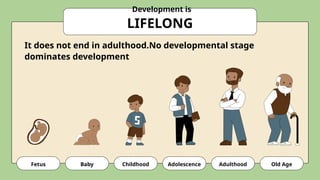
Fetus Baby Childhood Adolescence Adulthood Old Age
LIFELONG
It does not end in adulthood.No developmental stage
dominates development
Development is
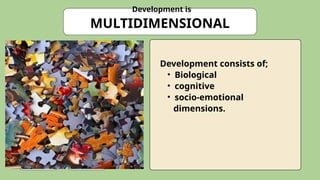
Fetus Baby
MULTIDIMENSIONAL
Development consists of;
• Biological
• cognitive
• socio-emotional
dimensions.
Development is
PLASTIC
Plasticity means that
people can change.
Abilities, behaviors, and
even the brain can adapt
and improve, even in
adulthood.
Development is
CONTEXTUAL
Development happens in
response to contexts—the
situations, environments, and
cultures we live in.
Development is
GROWTH, MAINTENANCE,
REGULATION
• GROWTH
– Developing new skills and abilities
(common in childhood).
• MAINTENANCE
– Keeping current abilities stable
(common in adulthood).
• REGULATION
– Adjusting to losses or challenges
(important in later life).
Development is
THE STAGES OF
HUMAN
DEVELOPMENT
& DEVELOPMENT TASK
OBJECTIV
ES
Explain the stages and major theories of human
development across the lifespan,
Demonstrate appreciation and respect for the uniqueness of
individuals at different stages of development by engaging in
reflective discussions, and
Perform a role-play that portrays the behaviors,
challenges, and interactions characteristic of individuals
at different stages of human development.
PRE-NATAL
4 WEEKS EMBYRO
8 WEEKS HUMAN EMBYRO
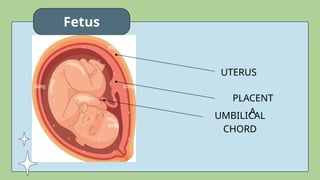
PRE-NATAL
Fetus
UMBILICAL
CHORD
UTERUS
PLACENT
A
INFANCY
Babies have limited
abilities to control their
emotions. They
communicate through
crying.
Locomotion established;
rudimentary language;
social attachment
Over the first year, they learn
to reach, touch and hold
objects, crawl and walk.
FROM BIRTH- 2 YEARS
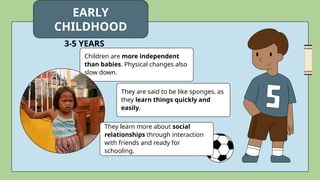
Children are more independent
than babies. Physical changes also
slow down.
EARLY
CHILDHOOD
They are said to be like sponges, as
they learn things quickly and
easily.
They learn more about social
relationships through interaction
with friends and ready for
schooling.
3-5 YEARS
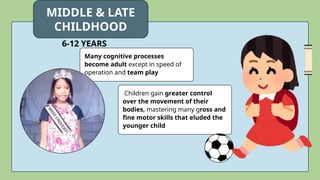
Many cognitive processes
become adult except in speed of
operation and team play
MIDDLE & LATE
CHILDHOOD
Children gain greater control
over the movement of their
bodies, mastering many gross and
fine motor skills that eluded the
younger child
6-12 YEARS
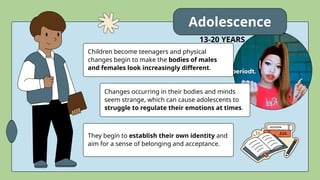
Children become teenagers and physical
changes begin to make the bodies of males
and females look increasingly different.
Changes occurring in their bodies and minds
seem strange, which can cause adolescents to
struggle to regulate their emotions at times.
They begin to establish their own identity and
aim for a sense of belonging and acceptance.
Adolescence
13-20 YEARS
Adult bodies are fully developed
and physical changes are very few
and slow, if any at all.
This is also the stage where some
may have their own babies,
starting the human life cycle again.
A lot of adults get jobs and live
independently. They are also expected to
know how to manage their emotions well.
Adulthood
20-45 YEARS
It is the central period
of a person's life, characterized by f
eelings of discontent, restlessness,
and reflection on
aging, mortality, and purpose.
Career reaches highest level: self
assessment, “empty nest” crisis;
retirement.
MIDLIFE
45-65 YEARS
They are not as strong as when
they were younger but can still
have fun and stay active.
As the body ages, muscle mass reduces,
bones become more brittle and skin may
begin to wrinkle.
Sadly, old age can bring some decline in
memory and thinking as connections in the
brain become broken or weak over time.
LATE LIFE
65- death
• Is development due more to Genetics
or environment?

• Does development occur slowly and
smoothly, or do changes happen in
stages?
• Do early childhood experiences have
the greatest impact on development or
are later events equally important?
Developmental
Psychology Issues
and Debates
NATURE NURTURE
PLATO AND DESCARTES JOHN LOCKE
• They supported the idea
that some ideas are inborn.
• Nature refers to the biological
or genetic factors that
influence who we are —
including our physical
appearance, personality
traits, and intelligence
• He argued for the concept of
“tabularasa”—a belief that
the mind is a blank slate at
birth, with experience
determining our knowledge
• Nurture refers to the
environmental influences —
like our upbringing,
experiences, culture, and
education — that shape our
development.
EARLY EXPERIENCE LATE EXPERIENCE
PLATO AND DESCARTES JOHN LOCKE
• They supported the idea
that some ideas are inborn.
• Nature refers to the biological
or genetic factors that
influence who we are —
including our physical
appearance, personality
traits, and intelligence
• He argued for the concept of
“tabularasa”—a belief that
the mind is a blank slate at
birth, with experience
determining our knowledge
• Nurture refers to the
environmental influences —
like our upbringing,
experiences, culture, and
education — that shape our
development.
Staying Healthy
Our body isn’t made to sit around. It
needs regular exercise to keep the
joints and muscles in good condition.
Sleep allows our bodies to rest and
prepare for the next day. It also helps
the brain sort and process all the
information it receives throughout the
day.
Stay active Get enough sleep
Which does not belong?
Go for a family
walk and bike ride.
Eat fruits and
vegetables.
Drink a lot of water
during summer.
Eat food that is
high in nutritional
value.
Watch TV until late
at night.
Get enough sleep
at night.
Place an on the item that does not promote good health.
Which does not belong?
Watch TV until late
at night.
Answer Key
Place an on the item that does not promote good health.
Go for a family
walk and bike ride.
Eat fruits and
vegetables.
Drink a lot of water
during summer.
Eat food that is
high in nutritional
value.
Get enough sleep
at night.
• The six key life stages in humans are:
fetus, baby, childhood, adolescence,
adulthood, and old age.
• Each life stage has its own set of
changes—some occur quickly, while
others occur slowly.
Review
Stages in the Human
Life Cycle
Staying Healthy
• Healthy habits, from a young age,
give rise to healthy adults.
• Some of the things you need to do to
stay healthy include eating nutritious
foods, drinking plenty of water,
exercising, and getting enough sleep.
What healthy
habit can you
start today?
Consider a new healthy habit
that you can start today. Find a
habit tracker on Canva,
download or print it, and start
working towards a brighter and
healthier future!
Widget title (optional) + one-line function + expected output
Background + colors and fonts + details
Create an interactive widget that illustrates the human life cycle, allowing students to drag and drop rounded boxes
representing each life stage into the correct sequence. The stages—fetus, Baby, Childhood, Adolescence, Adulthood,
and Old Age—must be arranged into six labeled slots (Stage 1 to Stage 6). As students rearrange the boxes, the widget
provides live visual feedback indicating whether the current order is correct. When all stages are in the proper order, a
success indicator confirms completion. The tool is self-contained, requiring no data from external sources, and all buttons
and drag interactions respond smoothly and reliably.
The widget features a centered, responsive layout with rounded corners and a modern, clean aesthetic. The
background uses a soft #afd198 tone, complemented by #f5ead0, #000000, and #c4e1ed for visual accents. Each
stage of life appears in a draggable, pill-shaped box with a subtle 1.5pt stroke outline, and a glowy effect. The drop zones
for each stage are clearly marked with labels (Stage 1 through Stage 6) above each slot. Text styling uses Montserrat
Bold for stage titles and headers, and Montserrat Light for supporting copy. Transitions are smooth and intuitive,
ensuring the experience is visually appealing and accessible on various screen sizes.
How it works
How it looks
1
1
2
2
Prompt like a pro!
Use this 2-part prompt as a formula to make your own widgets.
Try Canva
Code
Go to the Canva Home page, select
Canva AI, then type your ideas or
use one of the ready-to-use prompts
and select </> Code for me to bring
your concepts to life.
Don’t forget to delete this page
before presenting.
Sample prompt for this template’s widget:
Resource Page
Use these icons and illustrations in your Canva Presentation.
Happy designing! Don't forget to delete this page before presenting.
Try this background for online class.
*Please delete this section before downloading.
for blur for confetti for a drumroll
for mic drop for bubbles for quiet
for unveil Any number from 0-9 for a timer
Press these keys while
on Present mode!
B C D
M O Q
U 0-9

CHILD AND ADOLESCENT POWERPOINT ..........

  • 2.
    NAME PERSONAL INFORMATION ELORNA ABEGAEL C. GARIO,LPT LINGAYEN, PANGASINAN ADDRESS EDUCATIONAL BACKGROUND SUBJECT ORIENTATION RULES & REGULATIONS RULES & REGULATIONS
  • 3.
    EDUCATIONAL BACKGROUND BACHELOR OF SECONDARYEDUCATION MAJOR IN SOCIAL STUDIES • PANGASINAN STATE UNIVERSITY • THE ADELPHI COLLEGE, INC. ELEMENTARY- SENIOR HIGH SCHOOL EDUCATIONAL BACKGROUND PERSONAL INFORMATION SUBJECT ORIENTATION RULES & REGULATIONS CONTACT INFORMATION
  • 4.
  • 5.
    THE CHILD ANDADOLESCENT LRNS & LRNG PRIN. This course explores the physical, cognitive, emotional, social, and moral development of children and adolescents. It introduces key learning theories and principles to help future educators design age- appropriate, inclusive, and supportive learning experiences.
  • 6.
    • Understand thestages of child and adolescent development in physical, cognitive, emotional, social, and moral domains. • Analyze the various factors that influence the learning and development of young learners. • Apply developmentally appropriate and learner-centered strategies in planning and delivering instruction. • Demonstrate sensitivity to individual differences and diverse backgrounds in promoting inclusive and supportive learning environments. GENERAL OBJECTIVES
  • 7.
    THINGS YOU NEEDTO EXPECT DURING A SCHOOL TERM QUIZ/recitation group reporting assignments group project/ performnace Opportunities to grow
  • 8.
  • 9.
  • 10.
    grading system • MajorExamination - 40% • Performance Task - 30% • Written Report and Oral Presentation- 20% • Quiz and written output -10%
  • 11.
    1.Be respectful 2.Listen attentively 3.Comeprepared 4.Participate actively 5.3 consecutive absents-drop
  • 12.
    "WHO AM I?" •N A M E • A G E • A D D R E S S • H O B B I E S • C O U R S E E X P E C TAT I O N S
  • 13.
    WHO AM I? •N A M E • A G E • A D D R E S S • W H Y E D U C AT I O N ? • E X P E C TAT I O N
  • 14.
  • 15.
  • 16.
    OBJECTIV ES Explain the stagesand major theories of human development across the lifespan, Demonstrate appreciation and respect for the uniqueness of individuals at different stages of development by engaging in reflective discussions, and Perform a role-play that portrays the behaviors, challenges, and interactions characteristic of individuals at different stages of human development.
  • 17.
    • the patternof movement or change that begins at conception and continues through the life span. • includes growth and decline. • can be positive or negative. HUMAN DEVELOPMENT
  • 18.
  • 19.
    1. Development isrelatively orderly Cephalocaudal Proximodistal • Head to toe • Control of head and neck precedes control of limbs. • Sensory organs near the head develop first • Near to far. • Control of core muscles precedes control of extremities • Sensory organs near the center of the body develop first
  • 20.
    2. While thepattern of development is likely to be similar, the outcomes of developmental processes and rate of development are likely to vary among individuals.
  • 21.
    3. Development takesplace gradually. • Slow and continuous • Takes time to master -Development doesn’t happen overnight • Builds on earlier stages -Each new skill or ability usually depends on what has been learned before. -Skills like thinking critically, managing emotions, or forming relationships develop slowly as a person gains more experiences and matures.
  • 22.
    4. Development asa process is complex because it is the product of; • BIOLOGICAL PROCESS -These involve physical changes in the body, such as growth in height and weight, brain development, puberty, and motor skills. • COGNITIVE PROCESS -These relate to thinking, problem-solving, learning, and memory. • SOCIO-EMOTIONAL PROCESS -These involve emotions, relationships, personality, and how people interact with others.
  • 23.
  • 24.
    Believes that individualswill show extensive change from birth to adolescence,little or no change in adulthood and decline in late old age TRADITIONAL PERSPECTIVE
  • 25.
    LIFE-SPAN APPROACH Believes that evenin adulthood, developmental change takes place as it does during childhood • Development is LIFELONG • MULTIDIMENSIONAL • PLASTIC • CONTEXTUAL • GROWTH, MAINTENANCE, and REGULATION
  • 26.
    Fetus Baby ChildhoodAdolescence Adulthood Old Age LIFELONG It does not end in adulthood.No developmental stage dominates development Development is
  • 27.
    Fetus Baby MULTIDIMENSIONAL Development consistsof; • Biological • cognitive • socio-emotional dimensions. Development is
  • 28.
    PLASTIC Plasticity means that peoplecan change. Abilities, behaviors, and even the brain can adapt and improve, even in adulthood. Development is
  • 29.
    CONTEXTUAL Development happens in responseto contexts—the situations, environments, and cultures we live in. Development is
  • 30.
    GROWTH, MAINTENANCE, REGULATION • GROWTH –Developing new skills and abilities (common in childhood). • MAINTENANCE – Keeping current abilities stable (common in adulthood). • REGULATION – Adjusting to losses or challenges (important in later life). Development is
  • 31.
  • 32.
    OBJECTIV ES Explain the stagesand major theories of human development across the lifespan, Demonstrate appreciation and respect for the uniqueness of individuals at different stages of development by engaging in reflective discussions, and Perform a role-play that portrays the behaviors, challenges, and interactions characteristic of individuals at different stages of human development.
  • 33.
    PRE-NATAL 4 WEEKS EMBYRO 8WEEKS HUMAN EMBYRO
  • 34.
  • 35.
  • 36.
    INFANCY Babies have limited abilitiesto control their emotions. They communicate through crying. Locomotion established; rudimentary language; social attachment Over the first year, they learn to reach, touch and hold objects, crawl and walk. FROM BIRTH- 2 YEARS
  • 37.
    Children are moreindependent than babies. Physical changes also slow down. EARLY CHILDHOOD They are said to be like sponges, as they learn things quickly and easily. They learn more about social relationships through interaction with friends and ready for schooling. 3-5 YEARS
  • 38.
    Many cognitive processes becomeadult except in speed of operation and team play MIDDLE & LATE CHILDHOOD Children gain greater control over the movement of their bodies, mastering many gross and fine motor skills that eluded the younger child 6-12 YEARS
  • 39.
    Children become teenagersand physical changes begin to make the bodies of males and females look increasingly different. Changes occurring in their bodies and minds seem strange, which can cause adolescents to struggle to regulate their emotions at times. They begin to establish their own identity and aim for a sense of belonging and acceptance. Adolescence 13-20 YEARS
  • 40.
    Adult bodies arefully developed and physical changes are very few and slow, if any at all. This is also the stage where some may have their own babies, starting the human life cycle again. A lot of adults get jobs and live independently. They are also expected to know how to manage their emotions well. Adulthood 20-45 YEARS
  • 41.
    It is thecentral period of a person's life, characterized by f eelings of discontent, restlessness, and reflection on aging, mortality, and purpose. Career reaches highest level: self assessment, “empty nest” crisis; retirement. MIDLIFE 45-65 YEARS
  • 42.
    They are notas strong as when they were younger but can still have fun and stay active. As the body ages, muscle mass reduces, bones become more brittle and skin may begin to wrinkle. Sadly, old age can bring some decline in memory and thinking as connections in the brain become broken or weak over time. LATE LIFE 65- death
  • 43.
    • Is developmentdue more to Genetics or environment?  • Does development occur slowly and smoothly, or do changes happen in stages? • Do early childhood experiences have the greatest impact on development or are later events equally important?
  • 44.
  • 45.
    NATURE NURTURE PLATO ANDDESCARTES JOHN LOCKE • They supported the idea that some ideas are inborn. • Nature refers to the biological or genetic factors that influence who we are — including our physical appearance, personality traits, and intelligence • He argued for the concept of “tabularasa”—a belief that the mind is a blank slate at birth, with experience determining our knowledge • Nurture refers to the environmental influences — like our upbringing, experiences, culture, and education — that shape our development.
  • 46.
    EARLY EXPERIENCE LATEEXPERIENCE PLATO AND DESCARTES JOHN LOCKE • They supported the idea that some ideas are inborn. • Nature refers to the biological or genetic factors that influence who we are — including our physical appearance, personality traits, and intelligence • He argued for the concept of “tabularasa”—a belief that the mind is a blank slate at birth, with experience determining our knowledge • Nurture refers to the environmental influences — like our upbringing, experiences, culture, and education — that shape our development.
  • 47.
    Staying Healthy Our bodyisn’t made to sit around. It needs regular exercise to keep the joints and muscles in good condition. Sleep allows our bodies to rest and prepare for the next day. It also helps the brain sort and process all the information it receives throughout the day. Stay active Get enough sleep
  • 48.
    Which does notbelong? Go for a family walk and bike ride. Eat fruits and vegetables. Drink a lot of water during summer. Eat food that is high in nutritional value. Watch TV until late at night. Get enough sleep at night. Place an on the item that does not promote good health.
  • 49.
    Which does notbelong? Watch TV until late at night. Answer Key Place an on the item that does not promote good health. Go for a family walk and bike ride. Eat fruits and vegetables. Drink a lot of water during summer. Eat food that is high in nutritional value. Get enough sleep at night.
  • 50.
    • The sixkey life stages in humans are: fetus, baby, childhood, adolescence, adulthood, and old age. • Each life stage has its own set of changes—some occur quickly, while others occur slowly. Review Stages in the Human Life Cycle Staying Healthy • Healthy habits, from a young age, give rise to healthy adults. • Some of the things you need to do to stay healthy include eating nutritious foods, drinking plenty of water, exercising, and getting enough sleep.
  • 51.
    What healthy habit canyou start today? Consider a new healthy habit that you can start today. Find a habit tracker on Canva, download or print it, and start working towards a brighter and healthier future!
  • 52.
    Widget title (optional)+ one-line function + expected output Background + colors and fonts + details Create an interactive widget that illustrates the human life cycle, allowing students to drag and drop rounded boxes representing each life stage into the correct sequence. The stages—fetus, Baby, Childhood, Adolescence, Adulthood, and Old Age—must be arranged into six labeled slots (Stage 1 to Stage 6). As students rearrange the boxes, the widget provides live visual feedback indicating whether the current order is correct. When all stages are in the proper order, a success indicator confirms completion. The tool is self-contained, requiring no data from external sources, and all buttons and drag interactions respond smoothly and reliably. The widget features a centered, responsive layout with rounded corners and a modern, clean aesthetic. The background uses a soft #afd198 tone, complemented by #f5ead0, #000000, and #c4e1ed for visual accents. Each stage of life appears in a draggable, pill-shaped box with a subtle 1.5pt stroke outline, and a glowy effect. The drop zones for each stage are clearly marked with labels (Stage 1 through Stage 6) above each slot. Text styling uses Montserrat Bold for stage titles and headers, and Montserrat Light for supporting copy. Transitions are smooth and intuitive, ensuring the experience is visually appealing and accessible on various screen sizes. How it works How it looks 1 1 2 2 Prompt like a pro! Use this 2-part prompt as a formula to make your own widgets. Try Canva Code Go to the Canva Home page, select Canva AI, then type your ideas or use one of the ready-to-use prompts and select </> Code for me to bring your concepts to life. Don’t forget to delete this page before presenting. Sample prompt for this template’s widget:
  • 53.
    Resource Page Use theseicons and illustrations in your Canva Presentation. Happy designing! Don't forget to delete this page before presenting.
  • 54.
    Try this backgroundfor online class. *Please delete this section before downloading.
  • 55.
    for blur forconfetti for a drumroll for mic drop for bubbles for quiet for unveil Any number from 0-9 for a timer Press these keys while on Present mode! B C D M O Q U 0-9