Psychology
Unit: Developmental Psychology
By Timothy Bradley
Lesson 1:
• Nature
• Nurture
• Monozygotic Twins
• Dizygotic Twins
• Reflex
• Maturation
• Imprinting
• Critical Period
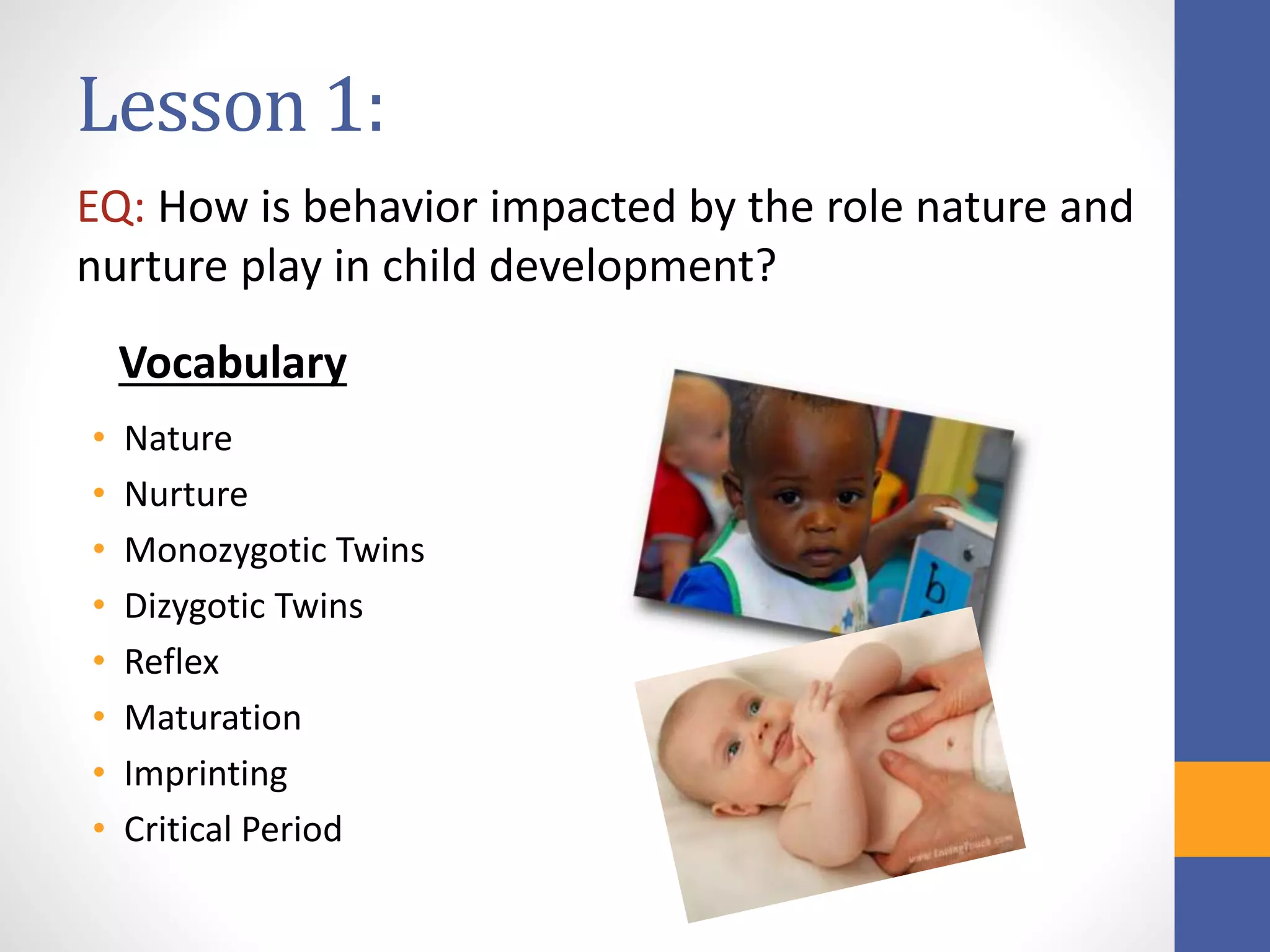
EQ: How is behavior impacted by the role nature and
nurture play in child development?
Vocabulary
Domains of Development
Development is described in three domains, but growth
in one domain influences the other domains.
• Physical Domain:
• body size, body proportions, appearance, brain development, motor
development, perception capacities, physical health.
• Cognitive Domain:
• thought processes and intellectual abilities including attention,
memory, problem solving, imagination, creativity, academic and
everyday knowledge, metacognition, and language.
• Social/Emotional Domain:
• self-knowledge (self-esteem, metacognition, sexual identity, ethnic
identity), moral reasoning, understanding and expression of
emotions, self-regulation, temperament, understanding others,
interpersonal skills, and friendships.
“Heredi “Enviro
Twins: Monozygotic vs. Dizygotic
Messinger&Henderson
6
Defining Temperament
• Underlying, biologically based (heritable)
individual differences in the behavioral
characteristics of the individual that is
relatively invariant over time and across
situations
Messinger&Henderson
7
But…
• Calling something temperament does not make
it any more ‘biological’ or inherited than any
other construct
• Temperament is a measured construct with
particular characteristics
• Stable/Unstable
• More heritable/Less heritable
Messinger&Henderson
8
Thomas & Chess: Early
temperamental types
• Difficult Child(10%)
• irritable, irregular biological rhythms
• intense response to new situations
• Easy Child (40%)
• happy, regular biological rhythms
• accept new situations
• Slow to warm up, inhibited, child (15%)
• Reluctant/hesitant in new situations
• New York Longitudinal Study (Thomas & Chess, 1984)
• Which one are you?
Messinger&Henderson
9
Physical Development: Maturation
Definition: The automatic and sequential process of development
that results from genetic signals
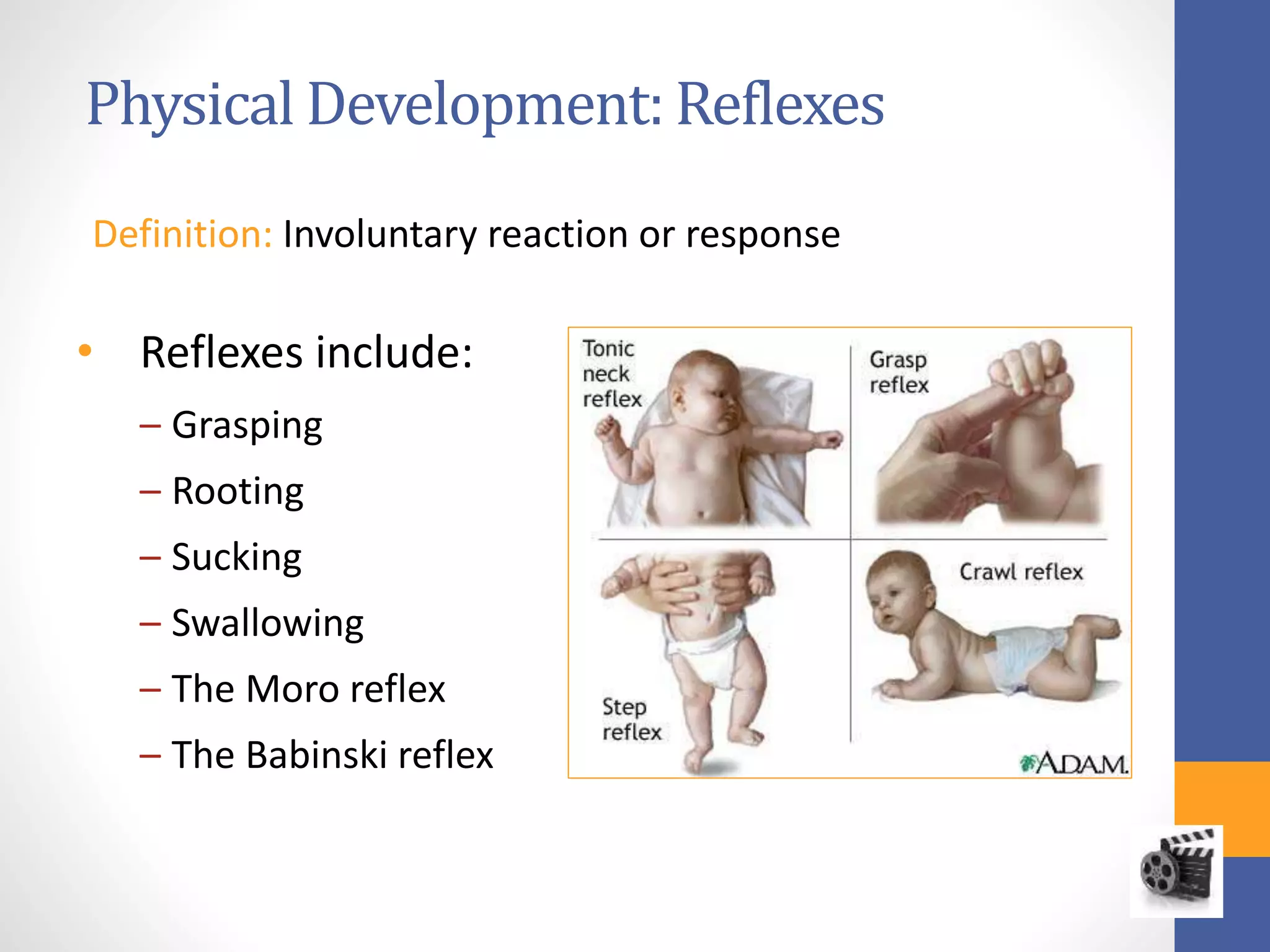
Physical Development: Reflexes
Definition: Involuntary reaction or response
• Reflexes include:
– Grasping
– Rooting
– Sucking
– Swallowing
– The Moro reflex
– The Babinski reflex
Perceptual Development: Visual Cliff
Children under 9 months
were unafraid
Children over 9 months
(about the age of
crawling) most respond
with fear to the drop-off
and refuse to go onto the
glass.
Critical Periods
Definition: A time frame
during which a stimulus must
be experienced in order for a
certain stage of development
to be achieved
Imprinting: the eliciting of
behavior due to exposure of a
certain stimulus
Language Acquisition
Case Study: Genie
Lesson 2:
• Alfred Adler
• Birth Order
• Inferiority Complex
• Fictional Finalism
• Compensation
Vocabulary
EQ 1: How does Alfred Adler explain human behavior?
EQ 2: How does birth order affect behavior?
Feelings of
Inferiority
Lesson 3: Parenting
• Authoritarian Parenting
• Authoritative Parenting
• Permissive Parenting
• Uninvolved (Rejecting-
Neglecting) Parenting
• Attachment
• Contact Comfort
Vocabulary
EQ: How do parenting styles affect a child’s psychological
development?
Parenting Styles
Assignment: Role Play
• Create a parenting role play (5 min. minimum) which displays
the characteristics associated with a parenting style (permissive,
authoritarian, or authoritative) and the characteristics of the
children of each style.
Parenting Role Play Rubric
Criteria Excellent (4) Good (3) Limited (2) Inadequate (1)
Works
Cooperatively
with Group
Always willing and
focused during
assigned tasks.
Usually willing and
focused during
assigned tasks.
Sometimes
willing and
focused during
assigned tasks.
Rarely willing and
focused during
assigned tasks.
Presentation of
Perspective
Convincing
communication of
understanding of
the assigned role.
Competent
communication of
understanding of
the assigned role.
Limited
communication
of understanding
of the assigned
role.
Inadequate
communication of
understanding of
the assigned role.
Use of Non-
Verbal Cues
(voice, gestures,
eye contact,
props, costumes)
An impressive
variety of non-
verbal cues were
used in an
exemplary way.
Good variety (3 or
more) verbal cues
were used in a
competent way.
A Limited variety
of non-verbal
cues were used
in an adequate
way.
Inadequate
variety of non-
verbal cues were
used in a
developing way.
Time > 1:15 minute 1. minute >45 seconds < 45 seconds
Rubric
Parenting Outcomes
HARLOW’S ATTACHMENT EXPERIMENT
• Attachment: Emotional ties that form between people
• Contact Comfort: the instinctual need to touch and be
touched by something soft, such as skin/fur.
What were Harlow’s findings according to the video
provided? (Summarize in writing)
Ainsworth on Attachment
• Definition: emotional ties that form between
people
• Mary Ainsworth
• Initially infants prefer being held
• 4 months-attachment to primary caregiver
• 6 months-cry or complain when separated
• Beginning at 8 months
• Stranger Anxiety: fear of strangers.
This is less when being held by those
they are attached to.
• Separation Anxiety: child
demonstrates distress when primary
caregiver leaves
Mary Ainsworth on Attachment
Separation
Anxiety
Stranger
Anxiety
Reunion
Behavior
Other % of
Infants
Secure
Attachment
Distressed
when mother
leaves.
Avoidant of
stranger when
alone but friendly
when mother
present
Positive and
happy when
mother
returns.
Will use the
mother as a safe
base to explore
their
environment.
70
Ambivalent
Attachment
Infant shows
signs of
intense
distress when
mother
leaves.
Infant avoids the
stranger - shows
fear of stranger.
Child
approaches
mother but
resists contact,
may even push
her away.
Infant cries more
and explores less
than the other 2
types.
15
Avoidant
Attachment
Infant shows
no sign of
distress when
mother
leaves.
Infant is okay with
the stranger and
plays normally
when stranger is
present.
Infant shows
little interest
when mother
returns.
Mother and
stranger are able
to comfort infant
equally well.
15
Self Esteem
• Carl Rogers noted that there two types
of support parents give to their
children.
• Unconditional Positive Regard: Parents
demonstrate love and affection
regardless of a child’s behavior
• Children develop high self esteem
• Conditional Positive Regard: Parents
demonstrate love and affection when
child behaves in an acceptable manner
• Child feels worthwhile when pleasing
authority figures
• A sense of competence in cognitive,
physical, and social tasks also increases
self esteem.
Lesson 5: Piaget
• Jean Piaget
• Cognitive
• Scheme
• Assimilation
• Accommodatio
n
EQ: According to Piaget, how do individuals cognitively
develop?
Vocabulary
• Sensorimotor
• Object Permanence
• Conservation
• Egocentrism
• Concrete Thinking
Schema (According to Piaget)
• Generalizations that form as people experience the world.
• Basic units of knowledge
• Building blocks of intellectual development
• They organize past experiences and provide a framework for
understanding future experiences.
• Involve
• Behaviors (sucking on fingers)
• Mental Symbols (words & images)
• Mental Activities (doing math in our head)
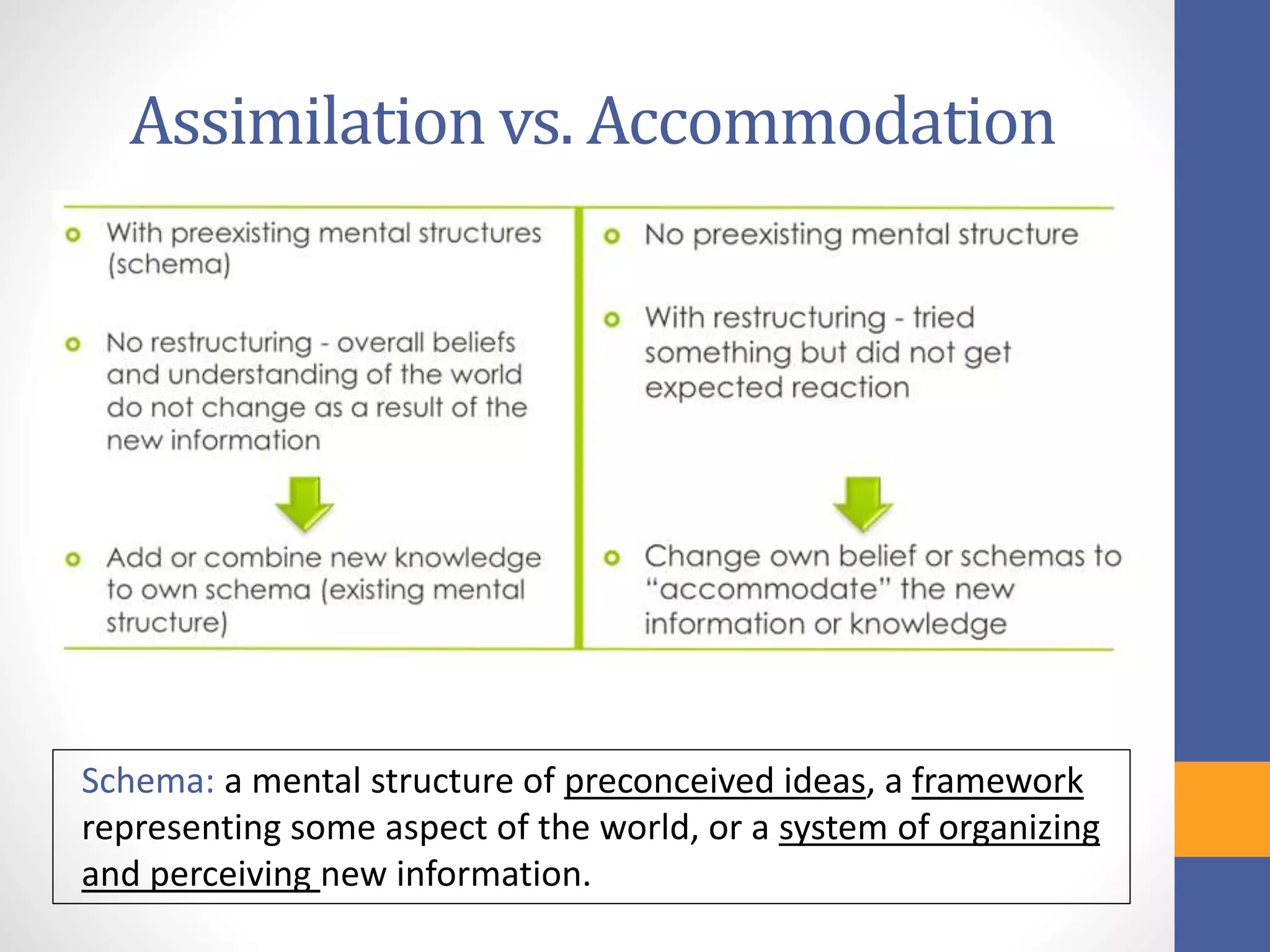
Assimilation vs. Accommodation
Schema: a mental structure of preconceived ideas, a framework
representing some aspect of the world, or a system of organizing
and perceiving new information.
Cognitive Task: Assimilation
Assimilation involves taking in new information into our
previously existing schemas is known as assimilation.
Cognitive Task: Accommodation
Accommodation involves altering existing schemas, or
ideas, as a result of new information or new experiences.
New schemas may also be developed during this process.
Child calls this four-
legged animal a
“cow”.
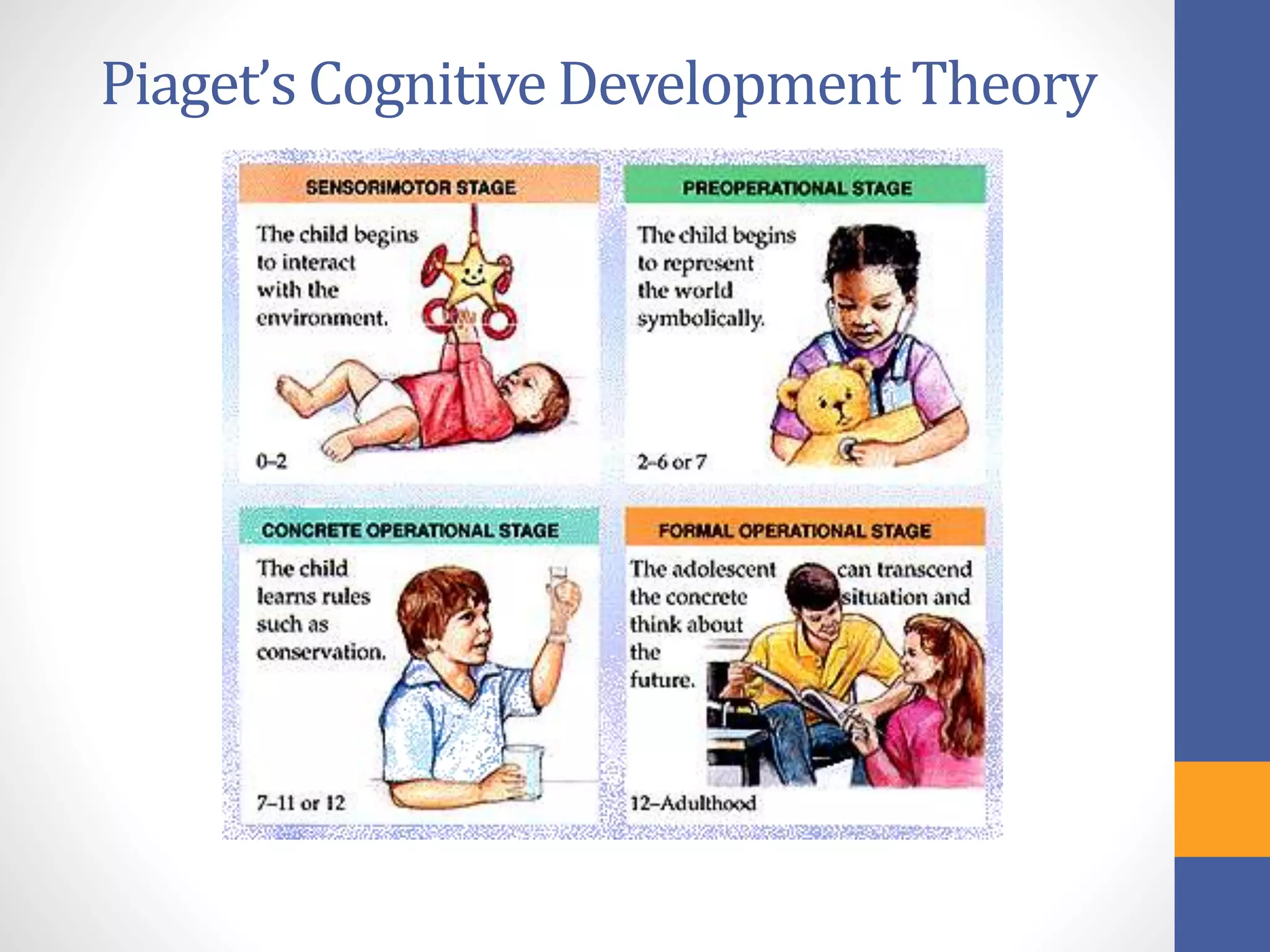
Piaget’s Cognitive Development Theory
Terms:
• Object Permanence: refers to a child's
ability to understand that objects still
exist after they are no longer in sight.
• Conservation: the child understands
that changing the form of a substance
or object does not change its amount,
overall volume, or mass.
• Egocentrism: refers to the belief that
others see the world from the same
point of view as you.
WithwhichcognitivetaskisHobbes(tiger) struggling?
Lev Vygotsky
Socio-Cultural Theory
• Agreed that children are active
learners, but their knowledge is
socially constructed.
• Cultural values and customs
dictate what is important to learn.
• Children learn from more expert
members of the society.
• Vygotsky described the "zone of
proximal development", where
learning occurs.
ced.ncsc.edu/hyy/devtheories.htm
Vocabulary
• Lawrence Kohlberg
• Carol Gilligan
• Morals
• Preconventional reasoning
• Conventional reasoning
• Postconventional reasoning
• Social Contract
EQ: According to Kohlberg, how do individuals
morally develop?
Activity:
Kohlberg’s Stages of Moral Development
Limitationsand Bias to Kohlberg’s Theory
• First four stages have appeared in twenty-seven cultures
• Stages 5-6 don’t always appear in cultures
• Collectivist cultures are told to consider community over the
individual
• Carol Gilligan argues that gender plays a role (biased toward boys)
• Males focused on justice (taught to use reason)
• Women focused on relationships and caring (taught to use empathy)
• Differences in how boys are girls are raised
• Others have found there is no substantial difference in how males
and females reason about hypothetical moral dilemmas
• Moral reasoning doesn’t always match moral action.
• Conclusion: Moral development is an adaptation to our culture
and experience.
Lesson
EQ: According to Erik Erikson, what role does each period of life
play in individual’s development?
Vocabulary:
• Identity
• Generativity
• Midlife crisis
• Menopause
• Ego integrity
• Epigenic Principles
James Marcia
• Refining and extending Erik Erikson’s work,
James Marcia came up with four Identity
Statuses/States of psychological identity
development.
• The main idea is that one’s sense of identity is
determined largely by the choices and
commitments made regarding certain personal
and social traits.
Marcia’s Identity Status
Identity Diffusion
• The status in which the adolescent does no have
a sense of having choices; he or she has not yet
made (nor is attempting/willing to make) a
commitment
Identity Foreclosure
• The status in which the adolescent seems willing to
commit to some relevant roles, values, or goals for the
future. Adolescents in this stage have not experienced an
identity crisis. They tend to conform to the expectations
of others regarding their future (e. g. allowing a parent to
determine a career direction) As such, these individuals
have not explored a range of options.
Identity Moratorium
• The status in which
the adolescent is
currently in a crisis,
exploring various
commitments and is
ready to make
choices, but has not
made a commitment
to these choices yet.
Identity Achievement
• The status in which adolescent has gone through
a identity crisis and has made a commitment to a
sense of identity (i.e. certain role or value) that
he or she has chosen
Kubler-Ross Stages of
Dying(Grief)
Questions to Consider:
1)Do you recognize these reactions to change in yourself?
2)Have you seen it in others?
3) Are there other important stages in your own reaction to change?
Study for the
Early Childhood
Exam
Lesson Activator
Any questions prior to the Early Childhood Exam?

Developmental Psychology

  • 1.
  • 2.
    Lesson 1: • Nature •Nurture • Monozygotic Twins • Dizygotic Twins • Reflex • Maturation • Imprinting • Critical Period EQ: How is behavior impacted by the role nature and nurture play in child development? Vocabulary
  • 3.
    Domains of Development Developmentis described in three domains, but growth in one domain influences the other domains. • Physical Domain: • body size, body proportions, appearance, brain development, motor development, perception capacities, physical health. • Cognitive Domain: • thought processes and intellectual abilities including attention, memory, problem solving, imagination, creativity, academic and everyday knowledge, metacognition, and language. • Social/Emotional Domain: • self-knowledge (self-esteem, metacognition, sexual identity, ethnic identity), moral reasoning, understanding and expression of emotions, self-regulation, temperament, understanding others, interpersonal skills, and friendships.
  • 4.
  • 5.
  • 6.
    Messinger&Henderson 6 Defining Temperament • Underlying,biologically based (heritable) individual differences in the behavioral characteristics of the individual that is relatively invariant over time and across situations
  • 7.
    Messinger&Henderson 7 But… • Calling somethingtemperament does not make it any more ‘biological’ or inherited than any other construct • Temperament is a measured construct with particular characteristics • Stable/Unstable • More heritable/Less heritable
  • 8.
    Messinger&Henderson 8 Thomas & Chess:Early temperamental types • Difficult Child(10%) • irritable, irregular biological rhythms • intense response to new situations • Easy Child (40%) • happy, regular biological rhythms • accept new situations • Slow to warm up, inhibited, child (15%) • Reluctant/hesitant in new situations • New York Longitudinal Study (Thomas & Chess, 1984) • Which one are you?
  • 9.
  • 10.
    Physical Development: Maturation Definition:The automatic and sequential process of development that results from genetic signals
  • 11.
    Physical Development: Reflexes Definition:Involuntary reaction or response • Reflexes include: – Grasping – Rooting – Sucking – Swallowing – The Moro reflex – The Babinski reflex
  • 12.
    Perceptual Development: VisualCliff Children under 9 months were unafraid Children over 9 months (about the age of crawling) most respond with fear to the drop-off and refuse to go onto the glass.
  • 13.
    Critical Periods Definition: Atime frame during which a stimulus must be experienced in order for a certain stage of development to be achieved Imprinting: the eliciting of behavior due to exposure of a certain stimulus
  • 14.
  • 15.
  • 16.
    Lesson 2: • AlfredAdler • Birth Order • Inferiority Complex • Fictional Finalism • Compensation Vocabulary EQ 1: How does Alfred Adler explain human behavior? EQ 2: How does birth order affect behavior?
  • 17.
  • 19.
    Lesson 3: Parenting •Authoritarian Parenting • Authoritative Parenting • Permissive Parenting • Uninvolved (Rejecting- Neglecting) Parenting • Attachment • Contact Comfort Vocabulary EQ: How do parenting styles affect a child’s psychological development?
  • 20.
  • 21.
    Assignment: Role Play •Create a parenting role play (5 min. minimum) which displays the characteristics associated with a parenting style (permissive, authoritarian, or authoritative) and the characteristics of the children of each style.
  • 22.
    Parenting Role PlayRubric Criteria Excellent (4) Good (3) Limited (2) Inadequate (1) Works Cooperatively with Group Always willing and focused during assigned tasks. Usually willing and focused during assigned tasks. Sometimes willing and focused during assigned tasks. Rarely willing and focused during assigned tasks. Presentation of Perspective Convincing communication of understanding of the assigned role. Competent communication of understanding of the assigned role. Limited communication of understanding of the assigned role. Inadequate communication of understanding of the assigned role. Use of Non- Verbal Cues (voice, gestures, eye contact, props, costumes) An impressive variety of non- verbal cues were used in an exemplary way. Good variety (3 or more) verbal cues were used in a competent way. A Limited variety of non-verbal cues were used in an adequate way. Inadequate variety of non- verbal cues were used in a developing way. Time > 1:15 minute 1. minute >45 seconds < 45 seconds Rubric
  • 23.
  • 24.
    HARLOW’S ATTACHMENT EXPERIMENT •Attachment: Emotional ties that form between people • Contact Comfort: the instinctual need to touch and be touched by something soft, such as skin/fur. What were Harlow’s findings according to the video provided? (Summarize in writing)
  • 25.
    Ainsworth on Attachment •Definition: emotional ties that form between people • Mary Ainsworth • Initially infants prefer being held • 4 months-attachment to primary caregiver • 6 months-cry or complain when separated • Beginning at 8 months • Stranger Anxiety: fear of strangers. This is less when being held by those they are attached to. • Separation Anxiety: child demonstrates distress when primary caregiver leaves
  • 26.
    Mary Ainsworth onAttachment Separation Anxiety Stranger Anxiety Reunion Behavior Other % of Infants Secure Attachment Distressed when mother leaves. Avoidant of stranger when alone but friendly when mother present Positive and happy when mother returns. Will use the mother as a safe base to explore their environment. 70 Ambivalent Attachment Infant shows signs of intense distress when mother leaves. Infant avoids the stranger - shows fear of stranger. Child approaches mother but resists contact, may even push her away. Infant cries more and explores less than the other 2 types. 15 Avoidant Attachment Infant shows no sign of distress when mother leaves. Infant is okay with the stranger and plays normally when stranger is present. Infant shows little interest when mother returns. Mother and stranger are able to comfort infant equally well. 15
  • 27.
    Self Esteem • CarlRogers noted that there two types of support parents give to their children. • Unconditional Positive Regard: Parents demonstrate love and affection regardless of a child’s behavior • Children develop high self esteem • Conditional Positive Regard: Parents demonstrate love and affection when child behaves in an acceptable manner • Child feels worthwhile when pleasing authority figures • A sense of competence in cognitive, physical, and social tasks also increases self esteem.
  • 28.
    Lesson 5: Piaget •Jean Piaget • Cognitive • Scheme • Assimilation • Accommodatio n EQ: According to Piaget, how do individuals cognitively develop? Vocabulary • Sensorimotor • Object Permanence • Conservation • Egocentrism • Concrete Thinking
  • 29.
    Schema (According toPiaget) • Generalizations that form as people experience the world. • Basic units of knowledge • Building blocks of intellectual development • They organize past experiences and provide a framework for understanding future experiences. • Involve • Behaviors (sucking on fingers) • Mental Symbols (words & images) • Mental Activities (doing math in our head)
  • 30.
    Assimilation vs. Accommodation Schema:a mental structure of preconceived ideas, a framework representing some aspect of the world, or a system of organizing and perceiving new information.
  • 31.
    Cognitive Task: Assimilation Assimilationinvolves taking in new information into our previously existing schemas is known as assimilation.
  • 32.
    Cognitive Task: Accommodation Accommodationinvolves altering existing schemas, or ideas, as a result of new information or new experiences. New schemas may also be developed during this process. Child calls this four- legged animal a “cow”.
  • 33.
  • 34.
    Terms: • Object Permanence:refers to a child's ability to understand that objects still exist after they are no longer in sight. • Conservation: the child understands that changing the form of a substance or object does not change its amount, overall volume, or mass. • Egocentrism: refers to the belief that others see the world from the same point of view as you.
  • 35.
  • 36.
    Lev Vygotsky Socio-Cultural Theory •Agreed that children are active learners, but their knowledge is socially constructed. • Cultural values and customs dictate what is important to learn. • Children learn from more expert members of the society. • Vygotsky described the "zone of proximal development", where learning occurs. ced.ncsc.edu/hyy/devtheories.htm
  • 37.
    Vocabulary • Lawrence Kohlberg •Carol Gilligan • Morals • Preconventional reasoning • Conventional reasoning • Postconventional reasoning • Social Contract EQ: According to Kohlberg, how do individuals morally develop?
  • 38.
  • 39.
    Kohlberg’s Stages ofMoral Development
  • 40.
    Limitationsand Bias toKohlberg’s Theory • First four stages have appeared in twenty-seven cultures • Stages 5-6 don’t always appear in cultures • Collectivist cultures are told to consider community over the individual • Carol Gilligan argues that gender plays a role (biased toward boys) • Males focused on justice (taught to use reason) • Women focused on relationships and caring (taught to use empathy) • Differences in how boys are girls are raised • Others have found there is no substantial difference in how males and females reason about hypothetical moral dilemmas • Moral reasoning doesn’t always match moral action. • Conclusion: Moral development is an adaptation to our culture and experience.
  • 41.
    Lesson EQ: According toErik Erikson, what role does each period of life play in individual’s development? Vocabulary: • Identity • Generativity • Midlife crisis • Menopause • Ego integrity • Epigenic Principles
  • 43.
    James Marcia • Refiningand extending Erik Erikson’s work, James Marcia came up with four Identity Statuses/States of psychological identity development. • The main idea is that one’s sense of identity is determined largely by the choices and commitments made regarding certain personal and social traits.
  • 44.
  • 45.
    Identity Diffusion • Thestatus in which the adolescent does no have a sense of having choices; he or she has not yet made (nor is attempting/willing to make) a commitment
  • 46.
    Identity Foreclosure • Thestatus in which the adolescent seems willing to commit to some relevant roles, values, or goals for the future. Adolescents in this stage have not experienced an identity crisis. They tend to conform to the expectations of others regarding their future (e. g. allowing a parent to determine a career direction) As such, these individuals have not explored a range of options.
  • 47.
    Identity Moratorium • Thestatus in which the adolescent is currently in a crisis, exploring various commitments and is ready to make choices, but has not made a commitment to these choices yet.
  • 48.
    Identity Achievement • Thestatus in which adolescent has gone through a identity crisis and has made a commitment to a sense of identity (i.e. certain role or value) that he or she has chosen
  • 49.
    Kubler-Ross Stages of Dying(Grief) Questionsto Consider: 1)Do you recognize these reactions to change in yourself? 2)Have you seen it in others? 3) Are there other important stages in your own reaction to change?
  • 50.
    Study for the EarlyChildhood Exam
  • 51.
    Lesson Activator Any questionsprior to the Early Childhood Exam?