Infancy: Cognitive 
Development 
September 29, 2014
Cognitive development: Jean Piaget 
 COGNITIVE DEVELOPMENT: 
Focuses on the development of 
children’s ways of perceiving and 
mentally representing the world. 
 Schemes – children’s concepts 
of the world (mental structure)
 Assimilation: Incorporation of 
new events or knowledge into 
existing schemes. 
 Accommodation: modification 
of existing schemes in order to 
incorporate new events or 
knowledge.
FOUR STAGES OF COGNITIVE DEVELOPMENT 
 THE SENSORY STAGE 
 First 2 years of cognitive development 
 Trial and error method 
1. Simple reflexes (0-1 month) 
 This is dominated by the assimilation of 
sources of stimulation into inborn 
reflexes such as grasping, visual tracking, 
crying, sucking, and crudely turning the 
head toward a sound.
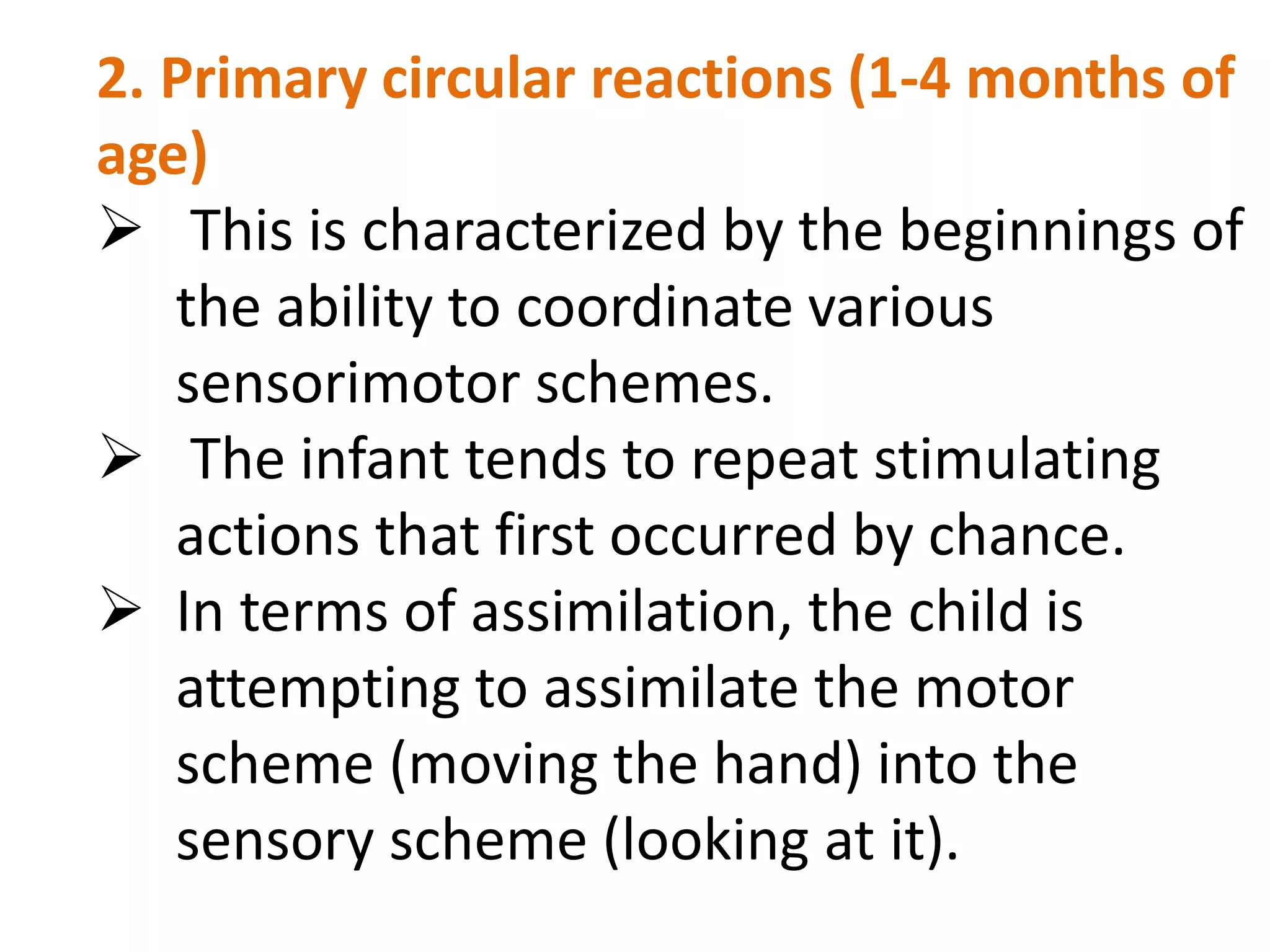
2. Primary circular reactions (1-4 months of 
age) 
 This is characterized by the beginnings of 
the ability to coordinate various 
sensorimotor schemes. 
 The infant tends to repeat stimulating 
actions that first occurred by chance. 
 In terms of assimilation, the child is 
attempting to assimilate the motor 
scheme (moving the hand) into the 
sensory scheme (looking at it).
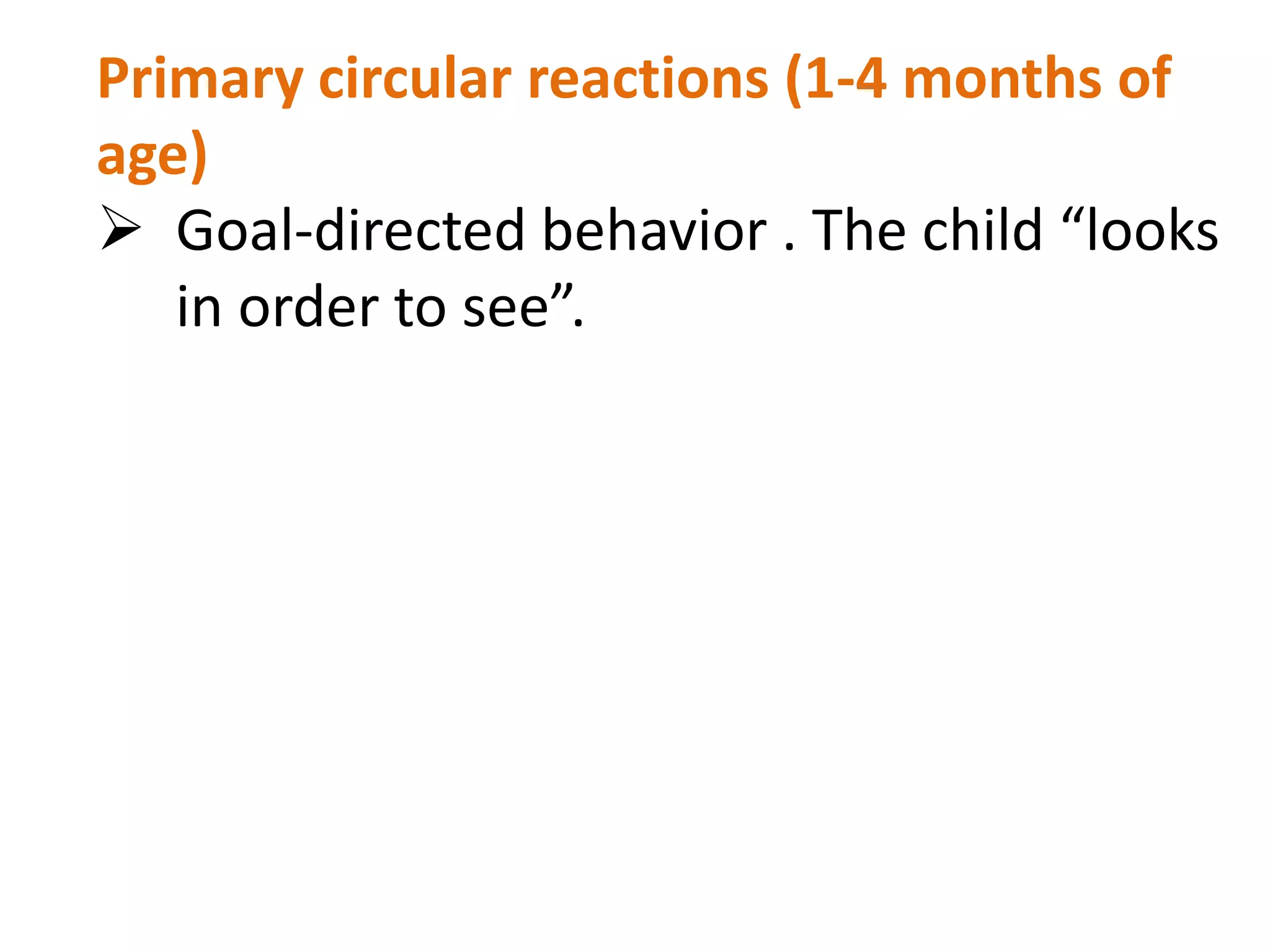
Primary circular reactions (1-4 months of 
age) 
 Goal-directed behavior . The child “looks 
in order to see”.
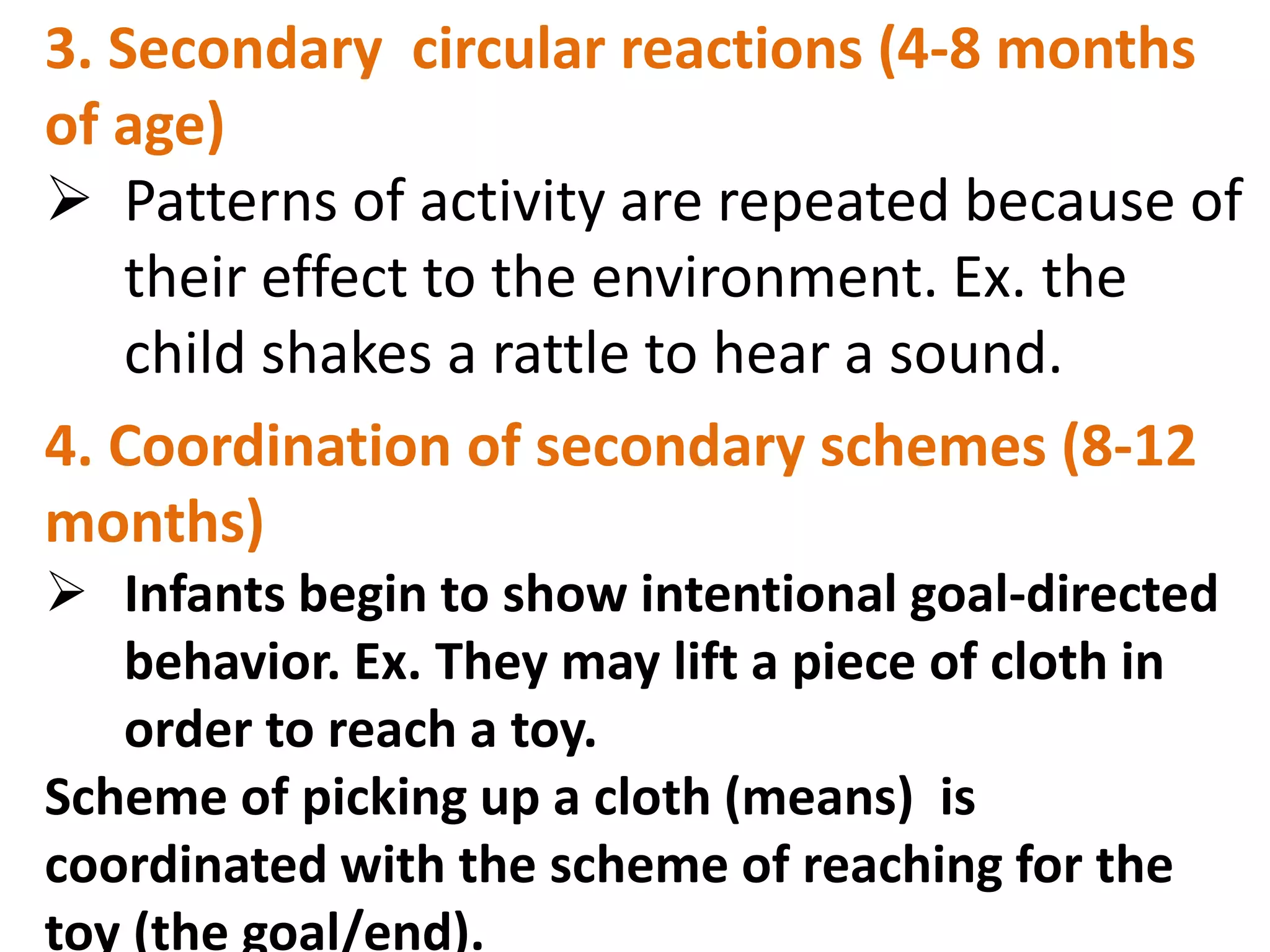
3. Secondary circular reactions (4-8 months 
of age) 
 Patterns of activity are repeated because of 
their effect to the environment. Ex. the 
child shakes a rattle to hear a sound. 
4. Coordination of secondary schemes (8-12 
months) 
 Infants begin to show intentional goal-directed 
behavior. Ex. They may lift a piece of cloth in 
order to reach a toy. 
Scheme of picking up a cloth (means) is 
coordinated with the scheme of reaching for the 
toy (the goal/end).
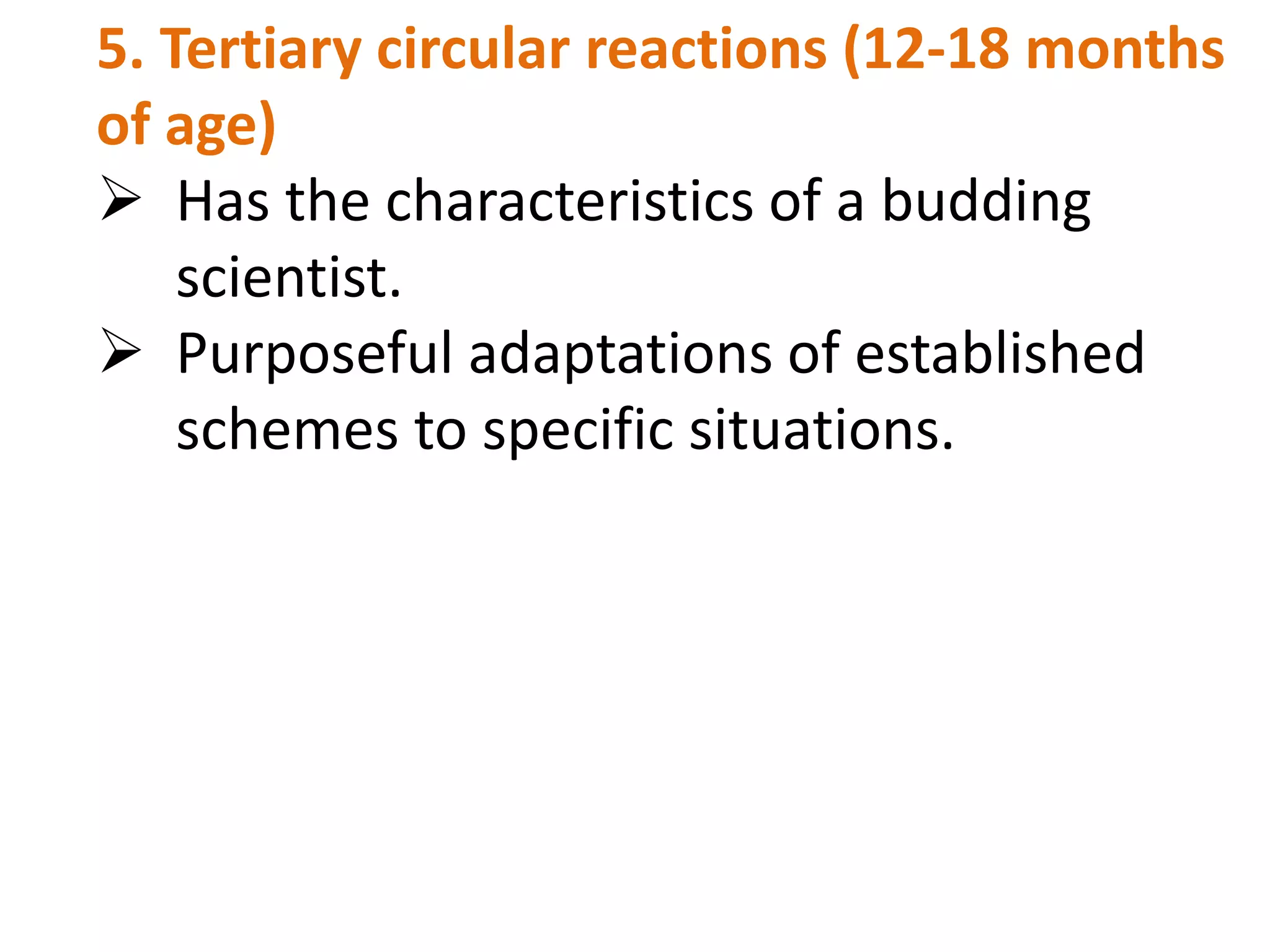
5. Tertiary circular reactions (12-18 months 
of age) 
 Has the characteristics of a budding 
scientist. 
 Purposeful adaptations of established 
schemes to specific situations.
6. Invention of new means through mental 
combinations (18-24 months of age) 
 This serves as the transitory period 
between the sensorimotor development 
and the development of symbolic 
thought.
DEVELOPMENT OF OBJECT PERMANENCE 
INFORMATION PROCESSING – The imitation 
of people and events that were encountered 
or experienced hours, days, or weeks in the 
past.
MILESTONES IN LANGUAGE DEVELOPMENT IN 
INFANCY 
Approximate Age 
Birth - 
 Cries 
Approximate Age 
12 weeks - 
 Cries less 
 Smiles when talked to and nodded at. 
 Engages in squealing and gurgling sound 
 Sustains cooing for 15-20 seconds.
MILESTONES IN LANGUAGE DEVELOPMENT IN 
INFANCY 
Approximate Age 
16 weeks - 
 Responds to human sounds more definitely. 
 Turns head, searching for the speaker. 
 chuckles occasionally.
MILESTONES IN LANGUAGE DEVELOPMENT IN 
INFANCY 
Approximate Age 
20 weeks - 
 Cooing becomes interspersed with 
consonant like sounds. 
 Vocalization differs from the sounds of 
mature language.
MILESTONES IN LANGUAGE DEVELOPMENT IN 
INFANCY 
Approximate Age 
6 months - 
 Cooing changes to single-syllable babbling. 
 Common utterances sound somewhat like 
ma, mu, da, or di.
MILESTONES IN LANGUAGE DEVELOPMENT IN 
INFANCY 
Approximate Age 
8 months - 
 Patterns of intonation become distinct 
 Utterances can signal emphasis and 
emotion.
MILESTONES IN LANGUAGE DEVELOPMENT IN 
INFANCY 
Approximate Age 
10 months - 
 Makes effort to imitate sounds made by 
other people.
MILESTONES IN LANGUAGE DEVELOPMENT IN 
INFANCY 
Approximate Age 
12 months - 
 Words emerge 
 Many words are understood
MILESTONES IN LANGUAGE DEVELOPMENT IN 
INFANCY 
Approximate Age 
18 months - 
 Repertoire of 3-50 words 
 Explosive vocabulary growth 
 Understands nearly everything spoken.
MILESTONES IN LANGUAGE DEVELOPMENT IN 
INFANCY 
Approximate Age 
24 months - 
 Naming everything in the environment 
 Spontaneous creation of two-word 
sentences. 
 Clear efforts to communicate
THANK YOU!!!

Infancy Cognitive Development (Jean Piaget)

  • 1.
    Infancy: Cognitive Development September 29, 2014
  • 2.
    Cognitive development: JeanPiaget  COGNITIVE DEVELOPMENT: Focuses on the development of children’s ways of perceiving and mentally representing the world.  Schemes – children’s concepts of the world (mental structure)
  • 3.
     Assimilation: Incorporationof new events or knowledge into existing schemes.  Accommodation: modification of existing schemes in order to incorporate new events or knowledge.
  • 4.
    FOUR STAGES OFCOGNITIVE DEVELOPMENT  THE SENSORY STAGE  First 2 years of cognitive development  Trial and error method 1. Simple reflexes (0-1 month)  This is dominated by the assimilation of sources of stimulation into inborn reflexes such as grasping, visual tracking, crying, sucking, and crudely turning the head toward a sound.
  • 5.
    2. Primary circularreactions (1-4 months of age)  This is characterized by the beginnings of the ability to coordinate various sensorimotor schemes.  The infant tends to repeat stimulating actions that first occurred by chance.  In terms of assimilation, the child is attempting to assimilate the motor scheme (moving the hand) into the sensory scheme (looking at it).
  • 6.
    Primary circular reactions(1-4 months of age)  Goal-directed behavior . The child “looks in order to see”.
  • 7.
    3. Secondary circularreactions (4-8 months of age)  Patterns of activity are repeated because of their effect to the environment. Ex. the child shakes a rattle to hear a sound. 4. Coordination of secondary schemes (8-12 months)  Infants begin to show intentional goal-directed behavior. Ex. They may lift a piece of cloth in order to reach a toy. Scheme of picking up a cloth (means) is coordinated with the scheme of reaching for the toy (the goal/end).
  • 8.
    5. Tertiary circularreactions (12-18 months of age)  Has the characteristics of a budding scientist.  Purposeful adaptations of established schemes to specific situations.
  • 9.
    6. Invention ofnew means through mental combinations (18-24 months of age)  This serves as the transitory period between the sensorimotor development and the development of symbolic thought.
  • 10.
    DEVELOPMENT OF OBJECTPERMANENCE INFORMATION PROCESSING – The imitation of people and events that were encountered or experienced hours, days, or weeks in the past.
  • 11.
    MILESTONES IN LANGUAGEDEVELOPMENT IN INFANCY Approximate Age Birth -  Cries Approximate Age 12 weeks -  Cries less  Smiles when talked to and nodded at.  Engages in squealing and gurgling sound  Sustains cooing for 15-20 seconds.
  • 12.
    MILESTONES IN LANGUAGEDEVELOPMENT IN INFANCY Approximate Age 16 weeks -  Responds to human sounds more definitely.  Turns head, searching for the speaker.  chuckles occasionally.
  • 13.
    MILESTONES IN LANGUAGEDEVELOPMENT IN INFANCY Approximate Age 20 weeks -  Cooing becomes interspersed with consonant like sounds.  Vocalization differs from the sounds of mature language.
  • 14.
    MILESTONES IN LANGUAGEDEVELOPMENT IN INFANCY Approximate Age 6 months -  Cooing changes to single-syllable babbling.  Common utterances sound somewhat like ma, mu, da, or di.
  • 15.
    MILESTONES IN LANGUAGEDEVELOPMENT IN INFANCY Approximate Age 8 months -  Patterns of intonation become distinct  Utterances can signal emphasis and emotion.
  • 16.
    MILESTONES IN LANGUAGEDEVELOPMENT IN INFANCY Approximate Age 10 months -  Makes effort to imitate sounds made by other people.
  • 17.
    MILESTONES IN LANGUAGEDEVELOPMENT IN INFANCY Approximate Age 12 months -  Words emerge  Many words are understood
  • 18.
    MILESTONES IN LANGUAGEDEVELOPMENT IN INFANCY Approximate Age 18 months -  Repertoire of 3-50 words  Explosive vocabulary growth  Understands nearly everything spoken.
  • 19.
    MILESTONES IN LANGUAGEDEVELOPMENT IN INFANCY Approximate Age 24 months -  Naming everything in the environment  Spontaneous creation of two-word sentences.  Clear efforts to communicate
  • 20.

Editor's Notes

  • #5 Assimilation first.. Then accommodation