MODULE:12
INFANCY
AND
TODDLERHOOD
SUBMITTED BY: ALLYSA JEAN B. TAGAMA
SUBMITTED TO: MS.KRISTEL ANNE CARZA
Physical Development of Infants and Toddlers
“A baby is god’s opinion
that
life should go on.”
-Carl Sandburg
America Historian, Poet & Novelist
INFANTS
• Baby- A very young child that
can nether walk or talk.
• In an early stage of
developments just the
beginning.
TODDLERS
• Young child ; a young
child who is learning to
walk.
https://circulodeamigoschildcare.com/http://www.fanpop.com/clubs/babies/images/104
28997/title/infants-d-photo
CEPHALOCAUDAL
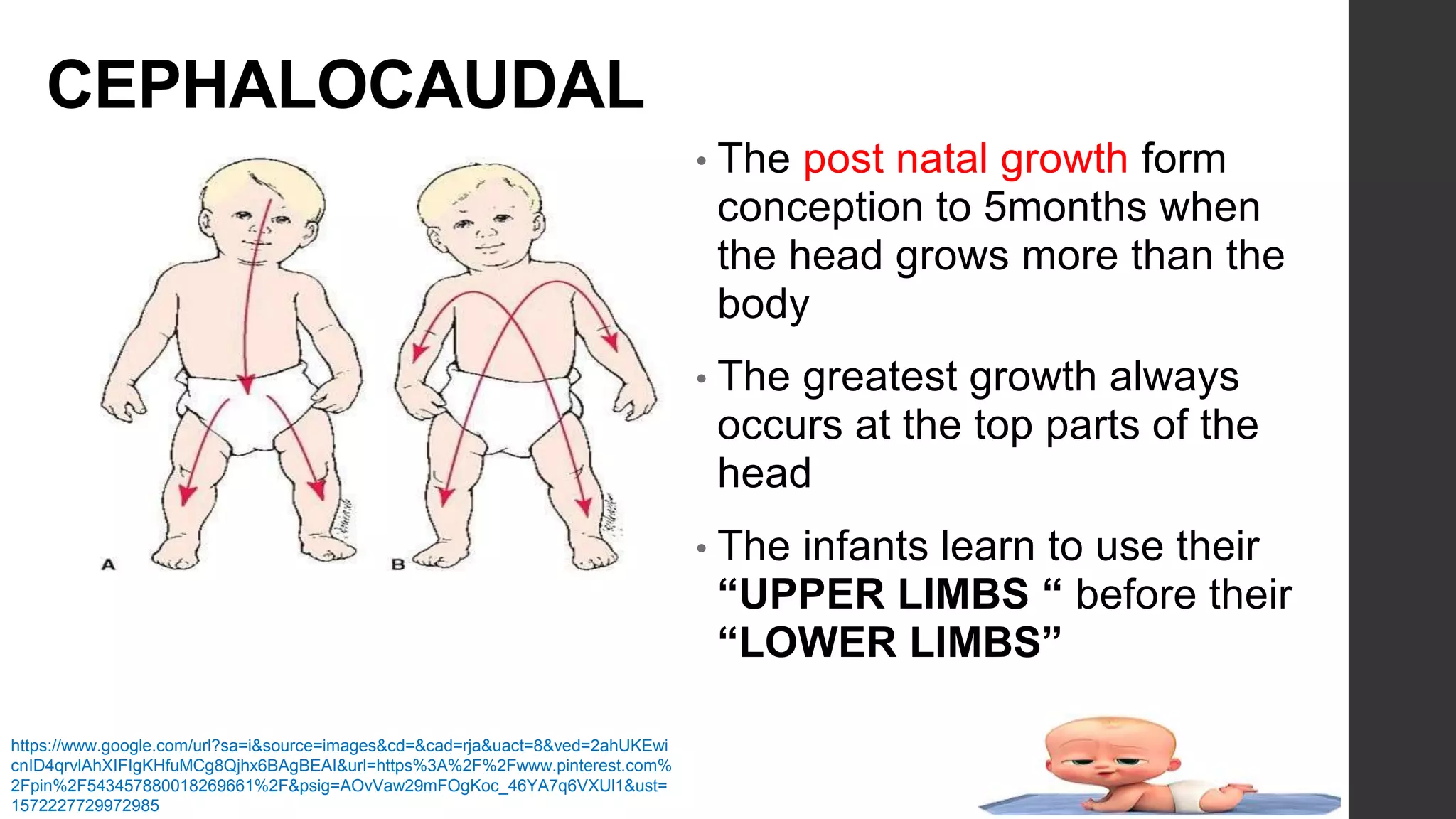
• The post natal growth form
conception to 5months when
the head grows more than the
body
• The greatest growth always
occurs at the top parts of the
head
• The infants learn to use their
“UPPER LIMBS “ before their
“LOWER LIMBS”
https://www.google.com/url?sa=i&source=images&cd=&cad=rja&uact=8&ved=2ahUKEwi
cnID4qrvlAhXIFIgKHfuMCg8Qjhx6BAgBEAI&url=https%3A%2F%2Fwww.pinterest.com%
2Fpin%2F543457880018269661%2F&psig=AOvVaw29mFOgKoc_46YA7q6VXUl1&ust=
1572227729972985
PROXIMODISTAL
MOTOR DEVELOPMENT
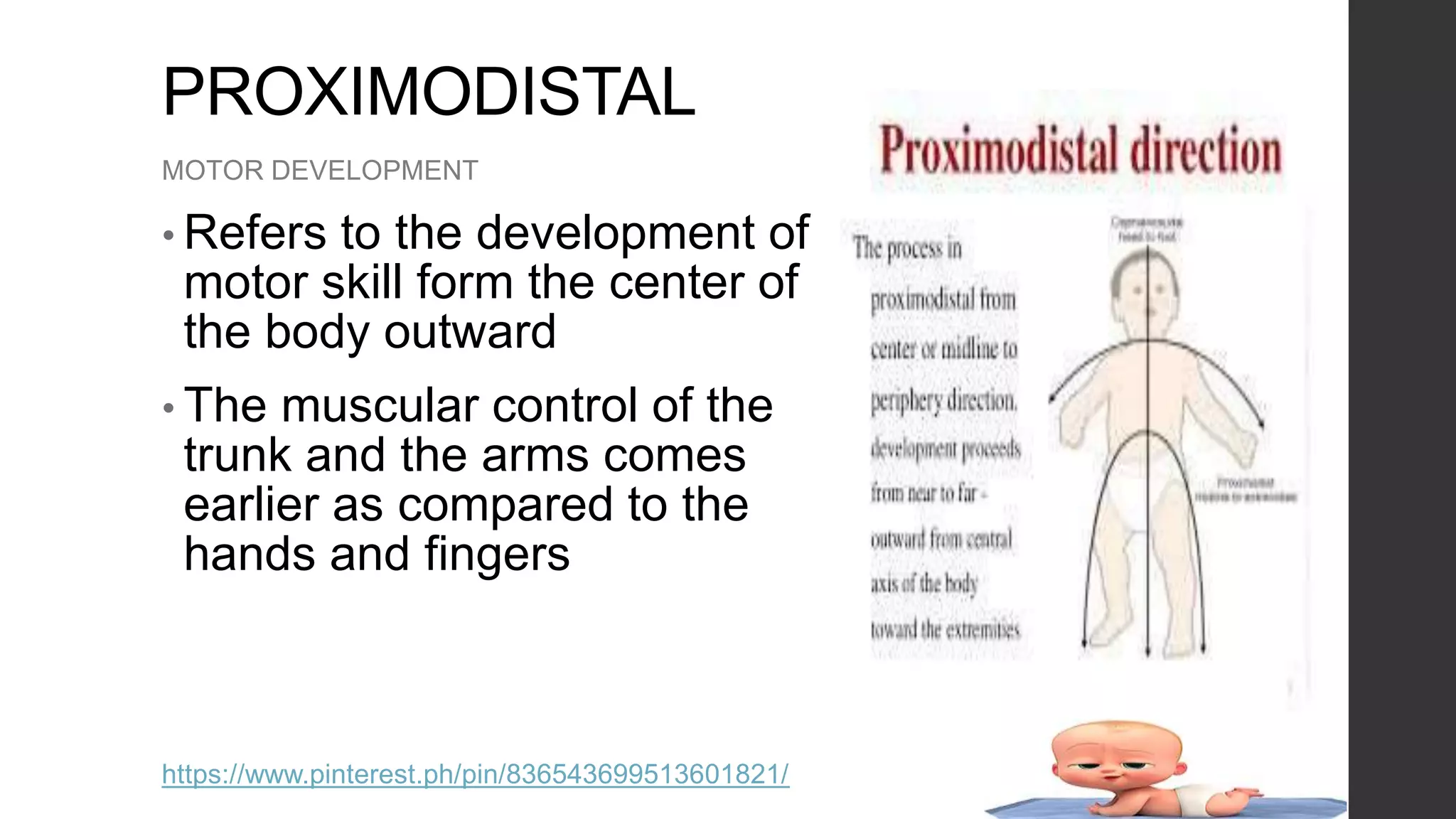
• Refers to the development of
motor skill form the center of
the body outward
• The muscular control of the
trunk and the arms comes
earlier as compared to the
hands and fingers
https://www.pinterest.ph/pin/836543699513601821/
HEIGTH
• Is an adaptive process
composed of multiple
transactions between
these context and the
biobehavioral regulatory
system that define human
functions.
WEIGTH
• It’s normal for newborn
babies to drop 5 to 10
percent of their body weigth
within a couple of week of
birth.
• Breastfed babies are
typically heavier than bottle-
fed babies through the first
six month.
Brain Development
- Among the most dramatic in the brain in the first two years
of life the spreading connections of dendrites to each other.
MYELINATION
• The process by
which the axons are
covered and
insulated by layers of
fat cells, begins
prenatally and
continues after birth.
MYELINIZATION
• The process of
MYELINATION or
MYELINIZATION
increases the speed at
w/c information travels
through the nervous
system.
https://www.pinterest.ph/pin/442900944578092886/
MOTOR DEVELOPMENT
Along this aspect of motor development , infants and toddlers
begin from reflexes, to gross motor skills and fine motor skill.
REFLEXES
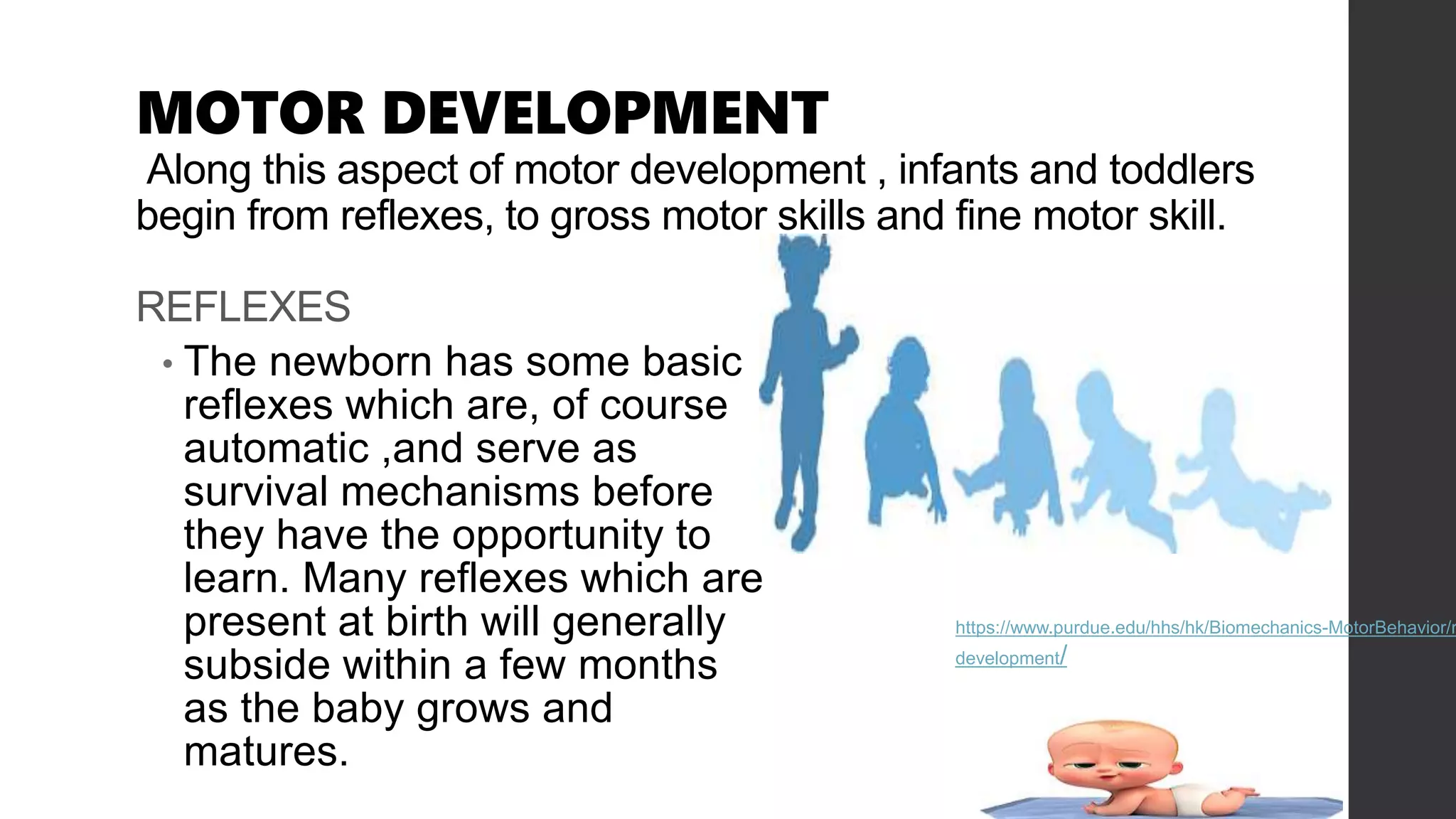
• The newborn has some basic
reflexes which are, of course
automatic ,and serve as
survival mechanisms before
they have the opportunity to
learn. Many reflexes which are
present at birth will generally
subside within a few months
as the baby grows and
matures.
https://www.purdue.edu/hhs/hk/Biomechanics-MotorBehavior/r
development/
Common Reflexes:
• Sucking Reflex: The sucking reflex is initiated when something touches the roof of
an infant’s month .
• Rooting Reflex: The rooting reflex is most evident when an infant’s cheek id stroked.
• Gripping Reflex: Babies will grasp anything that is placed in their palm. The strength
of this grip is strong, and babies can support their entire weight in their grip.
• Curling Reflex: When the inner sole of a baby’s foot is stroked , the infant
respond by curling his or her toes.
• Startle/Moro Reflex: Infants will respond to sudden sounds or movements by
throwing their arms and legs out, and throwing their heads back.
• Galant Reflex: The galant reflex is shown when an infant’s middle or lower back is
stoked next to the spinal cord.
• Tonic Neck Reflex: The tonic neck reflex is demonstrated in infants who are
placed on their abdomens.
LIFESPANDEVELOPMENT
OFINFANTSANDTODDLERS
https://www.factretriever.com/health-facts
Gross Motor Skills
• It is always a source of
excitement for parents to
witness dramatic changes in
the infant’s first year of life.
This dramatic motor
development is shown in
babies unable to even lift their
heads to being able to grab
thing off the cabinet, to chase
the ball and to walk away
form parents.
Fine Motor Skills
• Fine motor skills, are skills
that involve a refined use of
the small muscles controlling
the hand, fingers, and thumb.
• The development of these
skills allows one to be able to
complete task such as writing,
drawing, and buttoning.
Sensory and Perceptual Development
• The newborn senses the world into which he/
she is born through his/her sense of vision,
hearing, touch, taste, and smell, As he / she
advances physically his / her sensory and
perceptual abilities also develop.
What Infants and Toddlers can do
Physically?
• DOMAIN: Physical Health , Well-Being and Motor Development
PHYSICAL HEALTH
0-6 MONTHS
>Startles to loud sounds
>Visually follows a moving object from side to side
>Visually follows a moving object up and down
>React to pain by crying
>Withdraws or cries when in contact with something hot
Motor Skills Development
(Gross Motor Skills) (Fine Motor Skills)
• STANDARD 1 :
• The child control in
coordination of body
movements involving large
muscle groups.
STANDARD 1 :
The child can control and coordination hand
and finger movements.
https://learningboxpreschool.com/blog/developing-preschoolers-fine-and-
gross-motor-skills/
https://thefocusfoundation.org/dexys-corner-february-fine-motor-skills/
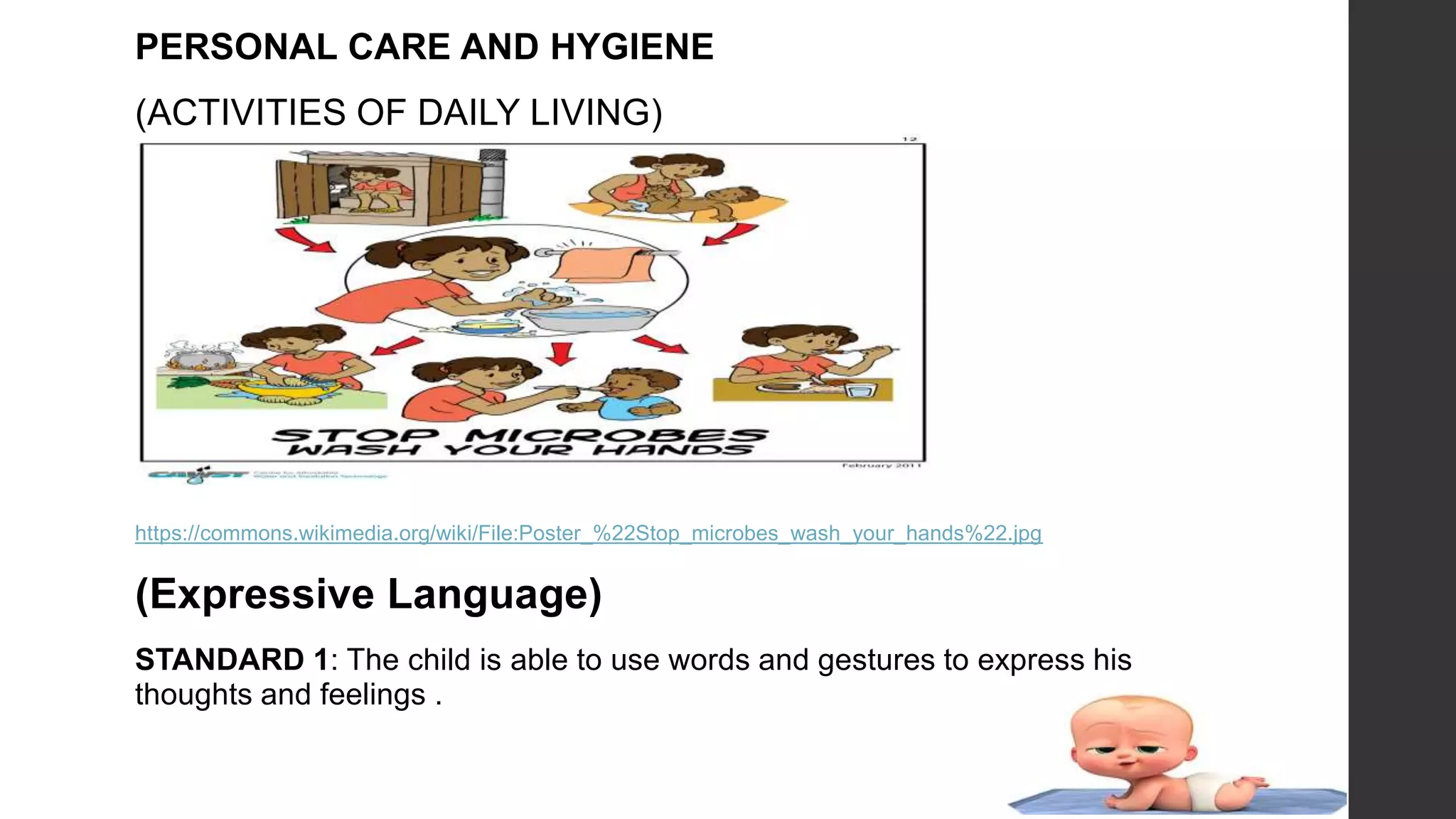
PERSONAL CARE AND HYGIENE
(ACTIVITIES OF DAILY LIVING)
https://commons.wikimedia.org/wiki/File:Poster_%22Stop_microbes_wash_your_hands%22.jpg
(Expressive Language)
STANDARD 1: The child is able to use words and gestures to express his
thoughts and feelings .
• PRE-READING AND PRE –MATH (MATCHING )
Standard 1 The child is able to match identical objects, colors , shapes, symbols.
http.com/maartisaneducationth-and-pre-reading/
Presented by: ALLYSA JEAN B. TAGAMA
BEED 1 (PANPACIFIC UNIVERSITY)

Module 12 INFANCY AND TODDLERHOOD

  • 1.
    MODULE:12 INFANCY AND TODDLERHOOD SUBMITTED BY: ALLYSAJEAN B. TAGAMA SUBMITTED TO: MS.KRISTEL ANNE CARZA
  • 2.
    Physical Development ofInfants and Toddlers “A baby is god’s opinion that life should go on.” -Carl Sandburg America Historian, Poet & Novelist
  • 3.
    INFANTS • Baby- Avery young child that can nether walk or talk. • In an early stage of developments just the beginning. TODDLERS • Young child ; a young child who is learning to walk. https://circulodeamigoschildcare.com/http://www.fanpop.com/clubs/babies/images/104 28997/title/infants-d-photo
  • 4.
    CEPHALOCAUDAL • The postnatal growth form conception to 5months when the head grows more than the body • The greatest growth always occurs at the top parts of the head • The infants learn to use their “UPPER LIMBS “ before their “LOWER LIMBS” https://www.google.com/url?sa=i&source=images&cd=&cad=rja&uact=8&ved=2ahUKEwi cnID4qrvlAhXIFIgKHfuMCg8Qjhx6BAgBEAI&url=https%3A%2F%2Fwww.pinterest.com% 2Fpin%2F543457880018269661%2F&psig=AOvVaw29mFOgKoc_46YA7q6VXUl1&ust= 1572227729972985
  • 5.
    PROXIMODISTAL MOTOR DEVELOPMENT • Refersto the development of motor skill form the center of the body outward • The muscular control of the trunk and the arms comes earlier as compared to the hands and fingers https://www.pinterest.ph/pin/836543699513601821/
  • 6.
    HEIGTH • Is anadaptive process composed of multiple transactions between these context and the biobehavioral regulatory system that define human functions. WEIGTH • It’s normal for newborn babies to drop 5 to 10 percent of their body weigth within a couple of week of birth. • Breastfed babies are typically heavier than bottle- fed babies through the first six month.
  • 7.
    Brain Development - Amongthe most dramatic in the brain in the first two years of life the spreading connections of dendrites to each other. MYELINATION • The process by which the axons are covered and insulated by layers of fat cells, begins prenatally and continues after birth. MYELINIZATION • The process of MYELINATION or MYELINIZATION increases the speed at w/c information travels through the nervous system. https://www.pinterest.ph/pin/442900944578092886/
  • 8.
    MOTOR DEVELOPMENT Along thisaspect of motor development , infants and toddlers begin from reflexes, to gross motor skills and fine motor skill. REFLEXES • The newborn has some basic reflexes which are, of course automatic ,and serve as survival mechanisms before they have the opportunity to learn. Many reflexes which are present at birth will generally subside within a few months as the baby grows and matures. https://www.purdue.edu/hhs/hk/Biomechanics-MotorBehavior/r development/
  • 9.
    Common Reflexes: • SuckingReflex: The sucking reflex is initiated when something touches the roof of an infant’s month . • Rooting Reflex: The rooting reflex is most evident when an infant’s cheek id stroked. • Gripping Reflex: Babies will grasp anything that is placed in their palm. The strength of this grip is strong, and babies can support their entire weight in their grip. • Curling Reflex: When the inner sole of a baby’s foot is stroked , the infant respond by curling his or her toes. • Startle/Moro Reflex: Infants will respond to sudden sounds or movements by throwing their arms and legs out, and throwing their heads back. • Galant Reflex: The galant reflex is shown when an infant’s middle or lower back is stoked next to the spinal cord. • Tonic Neck Reflex: The tonic neck reflex is demonstrated in infants who are placed on their abdomens.
  • 10.
  • 11.
    Gross Motor Skills •It is always a source of excitement for parents to witness dramatic changes in the infant’s first year of life. This dramatic motor development is shown in babies unable to even lift their heads to being able to grab thing off the cabinet, to chase the ball and to walk away form parents. Fine Motor Skills • Fine motor skills, are skills that involve a refined use of the small muscles controlling the hand, fingers, and thumb. • The development of these skills allows one to be able to complete task such as writing, drawing, and buttoning.
  • 12.
    Sensory and PerceptualDevelopment • The newborn senses the world into which he/ she is born through his/her sense of vision, hearing, touch, taste, and smell, As he / she advances physically his / her sensory and perceptual abilities also develop.
  • 13.
    What Infants andToddlers can do Physically? • DOMAIN: Physical Health , Well-Being and Motor Development PHYSICAL HEALTH 0-6 MONTHS >Startles to loud sounds >Visually follows a moving object from side to side >Visually follows a moving object up and down >React to pain by crying >Withdraws or cries when in contact with something hot
  • 14.
    Motor Skills Development (GrossMotor Skills) (Fine Motor Skills) • STANDARD 1 : • The child control in coordination of body movements involving large muscle groups. STANDARD 1 : The child can control and coordination hand and finger movements. https://learningboxpreschool.com/blog/developing-preschoolers-fine-and- gross-motor-skills/ https://thefocusfoundation.org/dexys-corner-february-fine-motor-skills/
  • 15.
    PERSONAL CARE ANDHYGIENE (ACTIVITIES OF DAILY LIVING) https://commons.wikimedia.org/wiki/File:Poster_%22Stop_microbes_wash_your_hands%22.jpg (Expressive Language) STANDARD 1: The child is able to use words and gestures to express his thoughts and feelings .
  • 16.
    • PRE-READING ANDPRE –MATH (MATCHING ) Standard 1 The child is able to match identical objects, colors , shapes, symbols. http.com/maartisaneducationth-and-pre-reading/
  • 17.
    Presented by: ALLYSAJEAN B. TAGAMA BEED 1 (PANPACIFIC UNIVERSITY)