Lifespan Development
Chapter 4
Areas of lifespan Development
• Physical development: changes in the body
  and its various systems.
• Social Development: involves changes in an
  individual’s relationships with other people and
  their skills in interacting with others
• Cognitive development: involves changes in an
  individual’s mental ability
• Emotional development: involves changes in
  how an individual experiences different
  feelings and how these feelings are expressed.
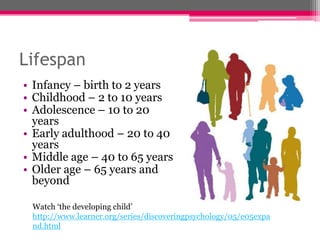
Lifespan
• Infancy – birth to 2 years
• Childhood – 2 to 10 years
• Adolescence – 10 to 20
  years
• Early adulthood – 20 to 40
  years
• Middle age – 40 to 65 years
• Older age – 65 years and
  beyond

 Watch ‘the developing child’
 http://www.learner.org/series/discoveringpsychology/05/e05expa
 nd.html
Human development
                                   is influenced by
                                   simultaneously
                                   occurring changes in
              Social
                                   each area
              Development


Cognitive                    Emotional
Development                  Development


               Physical
               Development
Cognitive – eg: Language
Social & Emotional
Movement & coordination


Example:
http://brianne-
thompson.com/ED
TECH/506/summ
ary.php
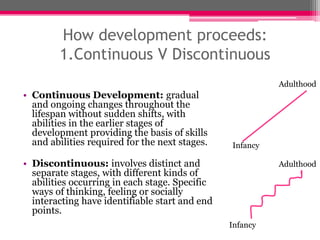
How development proceeds:
        1.Continuous V Discontinuous
                                                          Adulthood
• Continuous Development: gradual
  and ongoing changes throughout the
  lifespan without sudden shifts, with
  abilities in the earlier stages of
  development providing the basis of skills
  and abilities required for the next stages.   Infancy

• Discontinuous: involves distinct and                    Adulthood
  separate stages, with different kinds of
  abilities occurring in each stage. Specific
  ways of thinking, feeling or socially
  interacting have identifiable start and end
  points.
                                                Infancy
2. Sequential nature of Development

• The development of many thoughts, feelings and
  behaviours occur in an orderly sequence. Sequences
  of development usually begin with simple
  thoughts, feeling and behaviours and progress to
  more complex ones.

For example:
  -A baby moves from squealing and gurgling through
  to uttering individual words and then onto using
  sentences
 - A child learning to count and then progressing to
  adding numbers together
These can be Quantitative and
qualitative changes
• Quantitative changes: changes which are
  variations in the quantity (or amount) of a
  thought, feeling or behaviour. These are usually
  described in numbers.
-For example the number of words spoken in relation
  to age. As one grows older, their vocabulary grows.

Qualitative changes: Changes which vary in
  ‘quality’, ‘kind’ or ‘type’. These are usually described
  in words.
-For example, as a child you don’t understand the
  concept of honesty, but now as adolescence you do.
3. Individual Differences in
               Development
• No two individuals develop at exactly the same
  rate or in exactly the same way, even if they are
  identical twins

 What does that tell us about ‘Nature vs Nurture’?


                  Discuss activity 4.5
Hereditary & Environment
• Hereditary- characteristics are passed on from
  parents to off-spring via genes.

• Environment – all the experiences, objects &
  events to which we are exposed in our life times

• Heredity? Environment? Mixture of both?
   Create a table with two columns ‘environment’ and ‘hereditary’. While
   watching the clip on the ‘wild child’ list all the characteristics that are
   influenced by either heredity or environment.
   http://www.youtube.com/watch?v=dEnkY2iaKis
Maturation
• Sequential changes in the nervous system &
  other bodily structures
• Automatic, internal
• Controlled by our genes

• ‘Principle of readiness’
  ▫ Nerves, bones, muscles need to be developed
    enough for the behaviour to occur
Examples of
maturation of
nerves & bones
Examples of Maturational
developments
• Sit before stand
• Sounds before words
• Adding numbers before starting algebra


• When should a child start school?
  www.theage.com.au/articles/2002/05/29/1022
  569786596.html
Sensitive Periods
• Periods of rapid change when individual is more
  vulnerable to the environment
• Eg: second 6 months of life sensitive to
  attachment
• Eg: 1.5-3 years sensitive to language acquisition
Biological            Cognitive


Different Perspectives on Development


    Behavioural          Socio-cultural
Research methods in development
Longitudinal study
repeated observations of the same variables over long
periods of time
to study developmental trends across the life span

Advantages                     Disadvantages
• Permanence in development    • Expensive
  over time                    • Takes time with participants
                                 (and researchers) not being
                                 available
Cross-sectional study
  designed to look at a variable at a particular point in
  time.
  To study developmental differences/similarities
  between groups eg: memory at different ages
  Advantages:                  Disadvantages:
  • relatively inexpensive     • Differences maybe due to
  • easy to undertake            other variables
  • not too time-consuming.      ▫ Eg: generational influences
Twin Studies
• using identical (mono-zygotic) and non-identical
  (fraternal/di-zygotic) twins as participants.
• Identical especially for nature vs nurture BUT
  danger (eg more likely to be treated the same by
  parents)
• Personality and intelligence investigations


                                        Discuss 4.17 ranking
Adoption Studies
• Children raised by different parents – nature vs
  nurture
• IQ score studies indicate heredity plays a large
  role

Selective Breeding
• Using animals with short gestations to study
  traits longitudinally, with control of genes
• Unethical in humans but can use
Ethics in developmental research
Remember:
• Fully informed
• Consent – how with a child? How with a
  dementia patient?
• Confidentiality
• Safety
• Debrief
Resources
Complete the handout using this website

• Discovering Psychology

http://www.learner.org/discoveringpsychology/d
evelopment/dev_flash.html

Chap 4 lifespan development 2012

  • 1.
  • 2.
    Areas of lifespanDevelopment • Physical development: changes in the body and its various systems. • Social Development: involves changes in an individual’s relationships with other people and their skills in interacting with others • Cognitive development: involves changes in an individual’s mental ability • Emotional development: involves changes in how an individual experiences different feelings and how these feelings are expressed.
  • 3.
    Lifespan • Infancy –birth to 2 years • Childhood – 2 to 10 years • Adolescence – 10 to 20 years • Early adulthood – 20 to 40 years • Middle age – 40 to 65 years • Older age – 65 years and beyond Watch ‘the developing child’ http://www.learner.org/series/discoveringpsychology/05/e05expa nd.html
  • 4.
    Human development is influenced by simultaneously occurring changes in Social each area Development Cognitive Emotional Development Development Physical Development
  • 5.
  • 6.
  • 7.
  • 9.
  • 10.
    How development proceeds: 1.Continuous V Discontinuous Adulthood • Continuous Development: gradual and ongoing changes throughout the lifespan without sudden shifts, with abilities in the earlier stages of development providing the basis of skills and abilities required for the next stages. Infancy • Discontinuous: involves distinct and Adulthood separate stages, with different kinds of abilities occurring in each stage. Specific ways of thinking, feeling or socially interacting have identifiable start and end points. Infancy
  • 11.
    2. Sequential natureof Development • The development of many thoughts, feelings and behaviours occur in an orderly sequence. Sequences of development usually begin with simple thoughts, feeling and behaviours and progress to more complex ones. For example: -A baby moves from squealing and gurgling through to uttering individual words and then onto using sentences - A child learning to count and then progressing to adding numbers together
  • 12.
    These can beQuantitative and qualitative changes • Quantitative changes: changes which are variations in the quantity (or amount) of a thought, feeling or behaviour. These are usually described in numbers. -For example the number of words spoken in relation to age. As one grows older, their vocabulary grows. Qualitative changes: Changes which vary in ‘quality’, ‘kind’ or ‘type’. These are usually described in words. -For example, as a child you don’t understand the concept of honesty, but now as adolescence you do.
  • 13.
    3. Individual Differencesin Development • No two individuals develop at exactly the same rate or in exactly the same way, even if they are identical twins What does that tell us about ‘Nature vs Nurture’? Discuss activity 4.5
  • 14.
    Hereditary & Environment •Hereditary- characteristics are passed on from parents to off-spring via genes. • Environment – all the experiences, objects & events to which we are exposed in our life times • Heredity? Environment? Mixture of both? Create a table with two columns ‘environment’ and ‘hereditary’. While watching the clip on the ‘wild child’ list all the characteristics that are influenced by either heredity or environment. http://www.youtube.com/watch?v=dEnkY2iaKis
  • 15.
    Maturation • Sequential changesin the nervous system & other bodily structures • Automatic, internal • Controlled by our genes • ‘Principle of readiness’ ▫ Nerves, bones, muscles need to be developed enough for the behaviour to occur
  • 16.
  • 17.
    Examples of Maturational developments •Sit before stand • Sounds before words • Adding numbers before starting algebra • When should a child start school? www.theage.com.au/articles/2002/05/29/1022 569786596.html
  • 18.
    Sensitive Periods • Periodsof rapid change when individual is more vulnerable to the environment • Eg: second 6 months of life sensitive to attachment • Eg: 1.5-3 years sensitive to language acquisition
  • 19.
    Biological Cognitive Different Perspectives on Development Behavioural Socio-cultural
  • 20.
    Research methods indevelopment Longitudinal study repeated observations of the same variables over long periods of time to study developmental trends across the life span Advantages Disadvantages • Permanence in development • Expensive over time • Takes time with participants (and researchers) not being available
  • 21.
    Cross-sectional study designed to look at a variable at a particular point in time. To study developmental differences/similarities between groups eg: memory at different ages Advantages: Disadvantages: • relatively inexpensive • Differences maybe due to • easy to undertake other variables • not too time-consuming. ▫ Eg: generational influences
  • 22.
    Twin Studies • usingidentical (mono-zygotic) and non-identical (fraternal/di-zygotic) twins as participants. • Identical especially for nature vs nurture BUT danger (eg more likely to be treated the same by parents) • Personality and intelligence investigations Discuss 4.17 ranking
  • 23.
    Adoption Studies • Childrenraised by different parents – nature vs nurture • IQ score studies indicate heredity plays a large role Selective Breeding • Using animals with short gestations to study traits longitudinally, with control of genes • Unethical in humans but can use
  • 24.
    Ethics in developmentalresearch Remember: • Fully informed • Consent – how with a child? How with a dementia patient? • Confidentiality • Safety • Debrief
  • 25.
    Resources Complete the handoutusing this website • Discovering Psychology http://www.learner.org/discoveringpsychology/d evelopment/dev_flash.html