
DEVELOPMENTAL PSYCHOLOGY Week 2: Foundations of Development DEVELOPMENTAL PSYCHOLOGY
Influences on development Genetic foundations Environmental context
Genetic foundations  of development  Genetic code conveyed in deoxyribonucleic acid (DNA) Gene: segment of DNA along length of chromosome Allele: viable DNA (deoxyribonucleic acid) coding that occupies a given locus (position) on a chromosome.
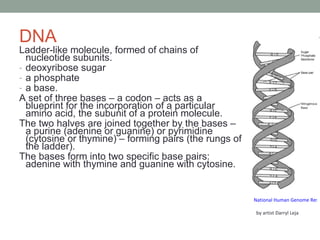
DNA Ladder-like molecule, formed of chains of nucleotide subunits.  deoxyribose sugar a phosphate a base.  A set of three bases – a codon – acts as a blueprint for the incorporation of a particular amino acid, the subunit of a protein molecule.  The two halves are joined together by the bases – a purine (adenine or guanine) or pyrimidine (cytosine or thymine) – forming pairs (the rungs of the ladder).  The bases form into two specific base pairs: adenine with thymine and guanine with cytosine.  National Human Genome Research Institute (NHGRI)   http://www.genome.gov/12514471      by artist Darryl Leja  
Genes Length of a gene varies greatly Gene concordance between human and chimpanzee is high (98% - 99%) Only one base pair change is enough to influence human traits and capacities
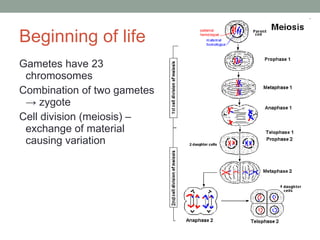
Beginning of life Gametes have 23 chromosomes Combination of two gametes  ->  zygote Cell division (meiosis) – exchange of material causing variation
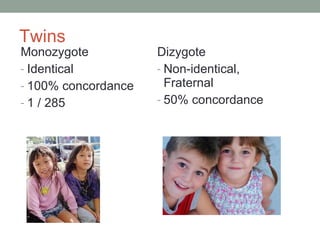
Twins Monozygote Identical 100% concordance  1 / 285  Dizygote Non-identical, Fraternal 50% concordance
Patterns of genetic inheritance An organism in which the two copies of the gene are identical — that is, have the same allele — is called homozygous for that gene. An organism which has two different alleles of the gene is called heterozygous.
Class Activity
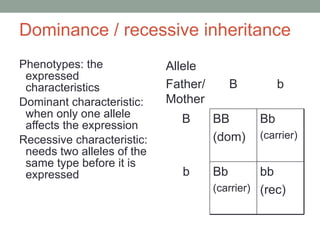
Dominance / recessive inheritance Phenotypes: the expressed characteristics Dominant characteristic: when only one allele affects the expression Recessive characteristic: needs two alleles of the same type before it is expressed Allele Father/Mother B b B BB (dom) Bb (carrier) b Bb (carrier) bb  (rec)
Importance of genetic inheritance  Understanding of how we express physical characteristics Understanding of how some diseases/defects are transmitted e.g. PKU, an inability to metabolise amino acid phenylalanine, causing CNS damage in first year of life, is a recessive code, that strikes 1 / 8k births. Both parents must have recessive allele for child to get PKU
Incomplete dominance Cases where the pattern of inheritance in which both alleles are expressed, resulting in a combined trait or one that is intermediate between the two For example, red flower and blue flower, after cross pollination, we get purple flowers
X-linked inheritance In cases where the harmful allele is carried on the X chromosome, there is greater chance of the male expressing the disorder due to the fact that males only have one X chromosome  Usually is passed on by mother to son Hemophilia, muscular dystrophy, adrenoleukodystrophy, green colourblindness, fragile-x syndrome
Genetic imprinting This refers to the chemical marking of a particular allele, such that the trait is always expressed Genetic imprinting is a vaguely similar to monosomy but with different sequelae.  Genetic imprinting is the process by which certain mammalian genes are switched off during early embryo development, according to whether they were inherited from the father or mother.
Mutation  Sudden changes in the DNA which may affect one, two, or many genes. Such mutations could occur spontaneously or as by-product of harmful environmental agent (tetragenic)
Chromosomal abnormalities Abnormalities within the chromosomes – give rise to developmental problems Down syndrome: consequences include MR, memory and speech problems, slow motor development Sex chromosome abnormalities: XYY syndrome, Klinefelter syndrome, Turner Syndrome
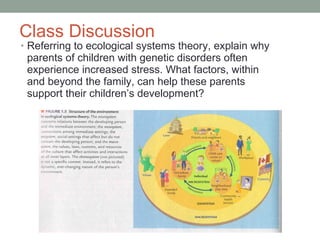
Class Discussion Referring to ecological systems theory, explain why parents of children with genetic disorders often experience increased stress. What factors, within and beyond the family, can help these parents support their children’s development?
Genetic counselling Process by which to help ensure healthy babies Maternal age, family background
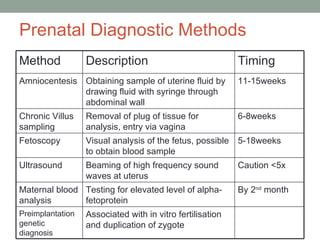
Prenatal Diagnostic Methods Method Description  Timing Amniocentesis Obtaining sample of uterine fluid by drawing fluid with syringe through abdominal wall 11-15weeks Chronic Villus sampling Removal of plug of tissue for analysis, entry via vagina 6-8weeks Fetoscopy Visual analysis of the fetus, possible to obtain blood sample 5-18weeks Ultrasound Beaming of high frequency sound waves at uterus Caution <5x Maternal blood analysis Testing for elevated level of alpha-fetoprotein By 2 nd  month Preimplantation genetic diagnosis Associated with in vitro fertilisation and duplication of zygote
Advantages of GC Improving chances of healthy babies  Better prepared for what may come to pass Prenatal diagnosis has led to advances in fetal medicine – administration of drugs, surgery, blood transfusions for fetus.
Environmental context  for development (1) Family – having family support gives potential for social interaction Direct influence: parents, grandparents Indirect influence: third party effects such as emotional influences
Environmental context  for development (2) Socioeconomic status – affects duration and timing of phases of family life cycle Early Vs late marriage Number of children Family interactions
Environmental context  for development (3) Affluence and poverty Collectivist Vs individualistic societies Legal system and society support
Policies for the family MCDYS Promoting marriages Supporting families Nurturing and protecting the young National family week – “ eat with your family day ”
Relationship between  hereditary and environment Hereditary estimate: extent to which individual differences in complex traits in a specific population are due to genetic factors Kinship studies compare characteristics of family members Concordance rate: refers to the percentage of instances in which both twins show a trait when it is present in one twin
LifeSpan Development Name the times in life that come to your mind What is lifespan development? When does lifespan development start?
Life Span Perspective Leading dynamic systems approach Lifelong  Multidimensional and multidirectional Highly plastic Affected by multiple interacting forces
Stages in development Conception  Embryonic development Fetal development Infant  Toddler Childhood Adolescence Young adulthood Middle adulthood Late adulthood
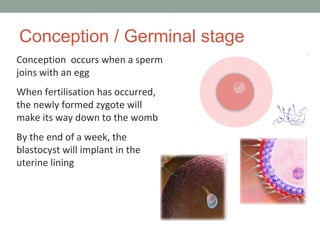
Conception / Germinal stage Conception  occurs when a sperm joins with an egg When fertilisation has occurred, the newly formed zygote will make its way down to the womb By the end of a week, the blastocyst will implant in the uterine lining
Period of Zygote First two weeks, within first trimester  Single cell zygote will multiply and form blastocyst
Embryonic period 3 – 8 weeks (first trimester) Many major organs developed e.g. CNS, heart, muscles, ribs, backbone, digestive track, arms, legs, feet, toes, fingers
Period of the Fetus This is the time of physical growth Organs now get connected  New behaviours are learned 9 – 12 weeks – still within first trimester, lasts until birth of the infant
Teratogens Any environmental agent that causes damage during the prenatal period Effect is dependent on a few factors Age Dose Heredity Other negative influences
Teratogens Substances that can produce birth defects Especially harmful during embryonic period E.g., Alcohol Use may cause Fetal Alcohol Syndrome (leading cause of preventable Mental Retardation) -- Smoking during pregnancy restricts oxygen to the unborn: greater risks for several problems
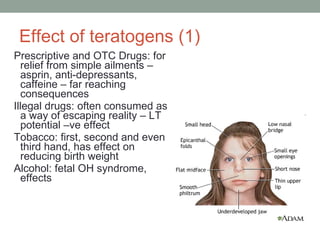
Effect of teratogens (1) Prescriptive and OTC Drugs: for relief from simple ailments – asprin, anti-depressants, caffeine – far reaching consequences Illegal drugs: often consumed as a way of escaping reality – LT potential –ve effect Tobacco: first, second and even third hand, has effect on reducing birth weight Alcohol: fetal OH syndrome, effects
Radiation: possibility of physical defects, LBW, miscarriage, etc. Environmental pollution: increased chance of life threatening diseases and future health problems Infectious diseases: possible correlation with cataracts, deafness, heart, genital, urinary and intestinal abnormalities, and even MR Effect of teratogens (2)
Effect of Maternal Factors Maternal nutrition Emotional stress Rh factor incompatibility Maternal age and previous birth experience
Group Discussion If you had to choose five environmental influences to publicize in a campaign aimed at promoting healthy prenatal development, which ones would you choose, and why?
Stages of Childbirth Dilation and effacement of the cervix (12 – 14 hours 1 st  birth) to Transition Delivery of the baby (pushing and birth) Delivery of the placenta
Developmental scales Apgar scales: measures physical condition Five different scales: Appearance (colour), Pulse (heartrate), Grimace (reflex/irritability), Activity (muscle tone), Respiration (breathing) Score 0, 1, 2
New-born Baby’s Capacities Newborn Reflexes Eye blink Rooting Sucking Moro Palmer grasp Tonic neck Stepping Babinski
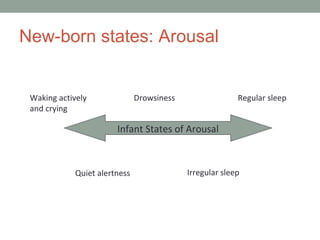
New-born states: Arousal Infant States of Arousal Regular sleep Irregular sleep Quiet alertness Drowsiness Waking actively and crying
New-born states: Senses Touch – highly sensitive to pain Taste – able to distinguish basic tastes Smell – shows distinct preference  Hearing – preference for complex tones Vision – least developed in the newborn

Psy205wk2

  • 1.
    DEVELOPMENTAL PSYCHOLOGY Week2: Foundations of Development DEVELOPMENTAL PSYCHOLOGY
  • 2.
    Influences on developmentGenetic foundations Environmental context
  • 3.
    Genetic foundations of development Genetic code conveyed in deoxyribonucleic acid (DNA) Gene: segment of DNA along length of chromosome Allele: viable DNA (deoxyribonucleic acid) coding that occupies a given locus (position) on a chromosome.
  • 4.
    DNA Ladder-like molecule,formed of chains of nucleotide subunits. deoxyribose sugar a phosphate a base. A set of three bases – a codon – acts as a blueprint for the incorporation of a particular amino acid, the subunit of a protein molecule. The two halves are joined together by the bases – a purine (adenine or guanine) or pyrimidine (cytosine or thymine) – forming pairs (the rungs of the ladder). The bases form into two specific base pairs: adenine with thymine and guanine with cytosine. National Human Genome Research Institute (NHGRI)   http://www.genome.gov/12514471      by artist Darryl Leja  
  • 5.
    Genes Length ofa gene varies greatly Gene concordance between human and chimpanzee is high (98% - 99%) Only one base pair change is enough to influence human traits and capacities
  • 6.
    Beginning of lifeGametes have 23 chromosomes Combination of two gametes -> zygote Cell division (meiosis) – exchange of material causing variation
  • 7.
    Twins Monozygote Identical100% concordance 1 / 285 Dizygote Non-identical, Fraternal 50% concordance
  • 8.
    Patterns of geneticinheritance An organism in which the two copies of the gene are identical — that is, have the same allele — is called homozygous for that gene. An organism which has two different alleles of the gene is called heterozygous.
  • 9.
  • 10.
    Dominance / recessiveinheritance Phenotypes: the expressed characteristics Dominant characteristic: when only one allele affects the expression Recessive characteristic: needs two alleles of the same type before it is expressed Allele Father/Mother B b B BB (dom) Bb (carrier) b Bb (carrier) bb (rec)
  • 11.
    Importance of geneticinheritance Understanding of how we express physical characteristics Understanding of how some diseases/defects are transmitted e.g. PKU, an inability to metabolise amino acid phenylalanine, causing CNS damage in first year of life, is a recessive code, that strikes 1 / 8k births. Both parents must have recessive allele for child to get PKU
  • 12.
    Incomplete dominance Caseswhere the pattern of inheritance in which both alleles are expressed, resulting in a combined trait or one that is intermediate between the two For example, red flower and blue flower, after cross pollination, we get purple flowers
  • 13.
    X-linked inheritance Incases where the harmful allele is carried on the X chromosome, there is greater chance of the male expressing the disorder due to the fact that males only have one X chromosome Usually is passed on by mother to son Hemophilia, muscular dystrophy, adrenoleukodystrophy, green colourblindness, fragile-x syndrome
  • 14.
    Genetic imprinting Thisrefers to the chemical marking of a particular allele, such that the trait is always expressed Genetic imprinting is a vaguely similar to monosomy but with different sequelae. Genetic imprinting is the process by which certain mammalian genes are switched off during early embryo development, according to whether they were inherited from the father or mother.
  • 15.
    Mutation Suddenchanges in the DNA which may affect one, two, or many genes. Such mutations could occur spontaneously or as by-product of harmful environmental agent (tetragenic)
  • 16.
    Chromosomal abnormalities Abnormalitieswithin the chromosomes – give rise to developmental problems Down syndrome: consequences include MR, memory and speech problems, slow motor development Sex chromosome abnormalities: XYY syndrome, Klinefelter syndrome, Turner Syndrome
  • 17.
    Class Discussion Referringto ecological systems theory, explain why parents of children with genetic disorders often experience increased stress. What factors, within and beyond the family, can help these parents support their children’s development?
  • 18.
    Genetic counselling Processby which to help ensure healthy babies Maternal age, family background
  • 19.
    Prenatal Diagnostic MethodsMethod Description Timing Amniocentesis Obtaining sample of uterine fluid by drawing fluid with syringe through abdominal wall 11-15weeks Chronic Villus sampling Removal of plug of tissue for analysis, entry via vagina 6-8weeks Fetoscopy Visual analysis of the fetus, possible to obtain blood sample 5-18weeks Ultrasound Beaming of high frequency sound waves at uterus Caution <5x Maternal blood analysis Testing for elevated level of alpha-fetoprotein By 2 nd month Preimplantation genetic diagnosis Associated with in vitro fertilisation and duplication of zygote
  • 20.
    Advantages of GCImproving chances of healthy babies Better prepared for what may come to pass Prenatal diagnosis has led to advances in fetal medicine – administration of drugs, surgery, blood transfusions for fetus.
  • 21.
    Environmental context for development (1) Family – having family support gives potential for social interaction Direct influence: parents, grandparents Indirect influence: third party effects such as emotional influences
  • 22.
    Environmental context for development (2) Socioeconomic status – affects duration and timing of phases of family life cycle Early Vs late marriage Number of children Family interactions
  • 23.
    Environmental context for development (3) Affluence and poverty Collectivist Vs individualistic societies Legal system and society support
  • 24.
    Policies for thefamily MCDYS Promoting marriages Supporting families Nurturing and protecting the young National family week – “ eat with your family day ”
  • 25.
    Relationship between hereditary and environment Hereditary estimate: extent to which individual differences in complex traits in a specific population are due to genetic factors Kinship studies compare characteristics of family members Concordance rate: refers to the percentage of instances in which both twins show a trait when it is present in one twin
  • 26.
    LifeSpan Development Namethe times in life that come to your mind What is lifespan development? When does lifespan development start?
  • 27.
    Life Span PerspectiveLeading dynamic systems approach Lifelong Multidimensional and multidirectional Highly plastic Affected by multiple interacting forces
  • 28.
    Stages in developmentConception Embryonic development Fetal development Infant Toddler Childhood Adolescence Young adulthood Middle adulthood Late adulthood
  • 29.
    Conception / Germinalstage Conception occurs when a sperm joins with an egg When fertilisation has occurred, the newly formed zygote will make its way down to the womb By the end of a week, the blastocyst will implant in the uterine lining
  • 30.
    Period of ZygoteFirst two weeks, within first trimester Single cell zygote will multiply and form blastocyst
  • 31.
    Embryonic period 3– 8 weeks (first trimester) Many major organs developed e.g. CNS, heart, muscles, ribs, backbone, digestive track, arms, legs, feet, toes, fingers
  • 32.
    Period of theFetus This is the time of physical growth Organs now get connected New behaviours are learned 9 – 12 weeks – still within first trimester, lasts until birth of the infant
  • 33.
    Teratogens Any environmentalagent that causes damage during the prenatal period Effect is dependent on a few factors Age Dose Heredity Other negative influences
  • 34.
    Teratogens Substances thatcan produce birth defects Especially harmful during embryonic period E.g., Alcohol Use may cause Fetal Alcohol Syndrome (leading cause of preventable Mental Retardation) -- Smoking during pregnancy restricts oxygen to the unborn: greater risks for several problems
  • 35.
    Effect of teratogens(1) Prescriptive and OTC Drugs: for relief from simple ailments – asprin, anti-depressants, caffeine – far reaching consequences Illegal drugs: often consumed as a way of escaping reality – LT potential –ve effect Tobacco: first, second and even third hand, has effect on reducing birth weight Alcohol: fetal OH syndrome, effects
  • 36.
    Radiation: possibility ofphysical defects, LBW, miscarriage, etc. Environmental pollution: increased chance of life threatening diseases and future health problems Infectious diseases: possible correlation with cataracts, deafness, heart, genital, urinary and intestinal abnormalities, and even MR Effect of teratogens (2)
  • 37.
    Effect of MaternalFactors Maternal nutrition Emotional stress Rh factor incompatibility Maternal age and previous birth experience
  • 38.
    Group Discussion Ifyou had to choose five environmental influences to publicize in a campaign aimed at promoting healthy prenatal development, which ones would you choose, and why?
  • 39.
    Stages of ChildbirthDilation and effacement of the cervix (12 – 14 hours 1 st birth) to Transition Delivery of the baby (pushing and birth) Delivery of the placenta
  • 40.
    Developmental scales Apgarscales: measures physical condition Five different scales: Appearance (colour), Pulse (heartrate), Grimace (reflex/irritability), Activity (muscle tone), Respiration (breathing) Score 0, 1, 2
  • 41.
    New-born Baby’s CapacitiesNewborn Reflexes Eye blink Rooting Sucking Moro Palmer grasp Tonic neck Stepping Babinski
  • 42.
    New-born states: ArousalInfant States of Arousal Regular sleep Irregular sleep Quiet alertness Drowsiness Waking actively and crying
  • 43.
    New-born states: SensesTouch – highly sensitive to pain Taste – able to distinguish basic tastes Smell – shows distinct preference Hearing – preference for complex tones Vision – least developed in the newborn

Editor's Notes

  • #5 Structure first described by Watson and Crick in 1953 The structure of DNA is illustrated by a right handed double helix, with about 10 nucleotide pairs per helical turn. Each spiral strand, composed of a sugar phosphate backbone and attached bases, is connected to a complementary strand by hydrogen bonding (non- covalent) between paired bases, adenine (A) with thymine (T) and guanine (G) with cytosine (C). Adenine and thymine are connected by two hydrogen bonds (non-covalent) while guanine and cytosine are connected by three.
  • #7 http://www.youtube.com/watch?v=D1_-mQS_FZ0
  • #14 Adrenoleukodystrophy (ALD) falls into a group of disorders known as leukodystrophies .    This disease is diagnosed with a plasma test to determine the level of very long chain fatty acids, regardless of symptomatology.  It is a very specialized test, so it is only performed in a few laboratories worldwide.  These very long chain fatty acids accumulate, due to absence of peroxisomes in the liver, and damage the ability of the adrenal gland to convert cholesterol to steroid hormones.  The characteristic of the disease is progressive cognitive and behavioral impairment.  This impairment is due to the myelin degeneration that occurs within these patients&apos; central nervous system.  Without the myelin sheath, nerve fibers are damaged and cease to function properly.
  • #17 XYY syndrome is a rare chromosomal disorder that affects males. It is caused by the presence of an extra Y chromosome. Males normally have one X and one Y chromosome. However, individuals with this syndrome have one X and two Y chromosome. Affected individuals are usually very tall and thin. Many experience severe acne during adolescence. Additional symptoms may include antisocial or behavioral problems and learning disabilities. Intelligence is usually normal, although IQ, on average, is 10 to 15 points lower than siblings. Klinefelter syndrome, also known as the XXY condition, is a term used to describe males who have an extra X chromosome in most of their cells. Instead of having the usual XY chromosome pattern that most males have, these men have an XXY pattern.
  • #30 http://www.youtube.com/watch?v=vP3Ag95bzm8&amp;feature=related
  • #36 Prescriptive and OTC Drugs: molecules small enough to enter the embryonic/fetal bloodstream e.g. asprin, anti-depressants, caffeine Illegal drugs: often consumed as a way of escaping reality Tobacco: first, second and even third hand, has effect on birth weight FAS, FAE =low birthweight, heart defects, mild cognitive impairments
  • #42 Another name for palmer grasping reflex is darwinian