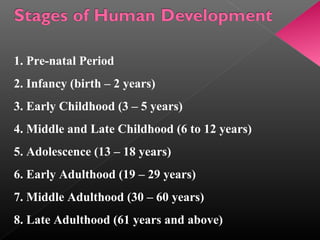




1. Pre-natal Period 
2. Infancy (birth – 2 years) 
3. Early Childhood (3 – 5 years) 
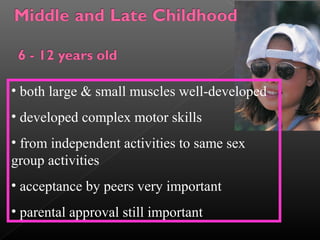
4. Middle and Late Childhood (6 to 12 years) 
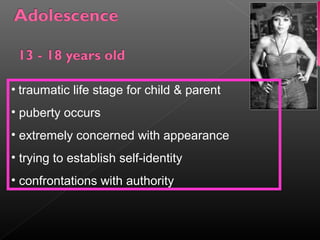
5. Adolescence (13 – 18 years) 
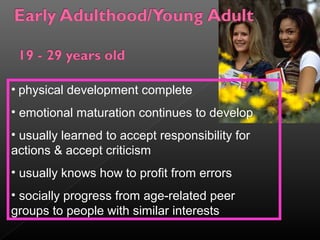
6. Early Adulthood (19 – 29 years) 
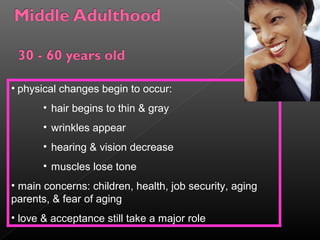
7. Middle Adulthood (30 – 60 years) 
8. Late Adulthood (61 years and above)
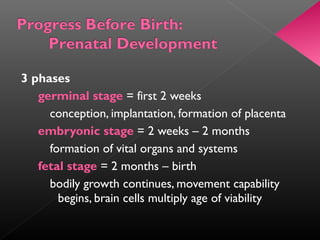
3 phases 
germinal stage = first 2 weeks 
conception, implantation, formation of placenta 
embryonic stage = 2 weeks – 2 months 
formation of vital organs and systems 
fetal stage = 2 months – birth 
bodily growth continues, movement capability 
begins, brain cells multiply age of viability
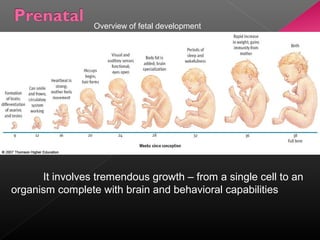
Overview of fetal development 
It involves tremendous growth – from a single cell to an 
organism complete with brain and behavioral capabilities
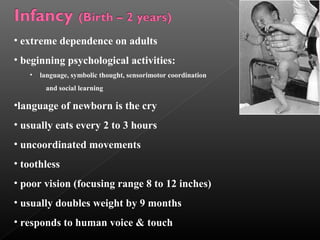
• extreme dependence on adults 
• beginning psychological activities: 
• language, symbolic thought, sensorimotor coordination 
and social learning 
•language of newborn is the cry 
• usually eats every 2 to 3 hours 
• uncoordinated movements 
• toothless 
• poor vision (focusing range 8 to 12 inches) 
• usually doubles weight by 9 months 
• responds to human voice & touch
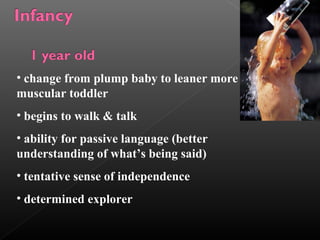
• change from plump baby to leaner more 
muscular toddler 
• begins to walk & talk 
• ability for passive language (better 
understanding of what’s being said) 
• tentative sense of independence 
• determined explorer
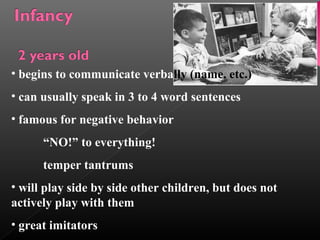
• begins to communicate verbally (name, etc.) 
• can usually speak in 3 to 4 word sentences 
• famous for negative behavior 
“NO!” to everything! 
temper tantrums 
• will play side by side other children, but does not 
actively play with them 
• great imitators
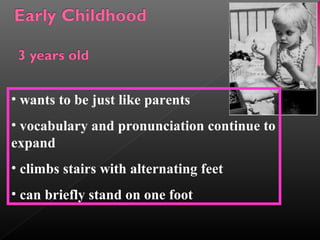
• wants to be just like parents 
• vocabulary and pronunciation continue to 
expand 
• climbs stairs with alternating feet 
• can briefly stand on one foot
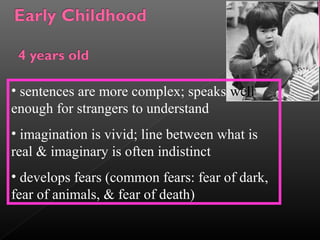
• sentences are more complex; speaks well 
enough for strangers to understand 
• imagination is vivid; line between what is 
real & imaginary is often indistinct 
• develops fears (common fears: fear of dark, 
fear of animals, & fear of death)
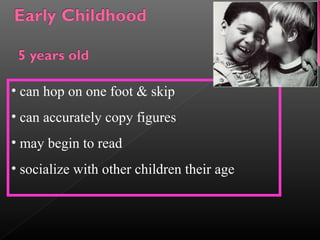
• can hop on one foot & skip 
• can accurately copy figures 
• may begin to read 
• socialize with other children their age
• both large & small muscles well-developed 
• developed complex motor skills 
• from independent activities to same sex 
group activities 
• acceptance by peers very important 
• parental approval still important
• traumatic life stage for child & parent 
• puberty occurs 
• extremely concerned with appearance 
• trying to establish self-identity 
• confrontations with authority
• physical development complete 
• emotional maturation continues to develop 
• usually learned to accept responsibility for 
actions & accept criticism 
• usually knows how to profit from errors 
• socially progress from age-related peer 
groups to people with similar interests
• physical changes begin to occur: 
• hair begins to thin & gray 
• wrinkles appear 
• hearing & vision decrease 
• muscles lose tone 
• main concerns: children, health, job security, aging 
parents, & fear of aging 
• love & acceptance still take a major role
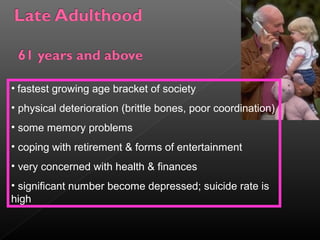
• fastest growing age bracket of society 
• physical deterioration (brittle bones, poor coordination) 
• some memory problems 
• coping with retirement & forms of entertainment 
• very concerned with health & finances 
• significant number become depressed; suicide rate is 
high
DDeevveellooppmmeennttaall TTaasskkss 
› One that “arises at a certain period in our life, 
the successful achievement of which leads to 
happiness and success with later tasks while 
failure leads to unhappiness, social disapproval, 
and difficulty with later tasks.” by Robert 
Havighurst , 1972
DDeevveellooppmmeennttaall TTaasskkss 
› What is an outstanding trait or behavior of 
each stage? 
› What task/s is/are expected of each 
development stage? 
› Does a developmental task in a higher level 
require accomplishment of the lower level of 
developmental tasks?
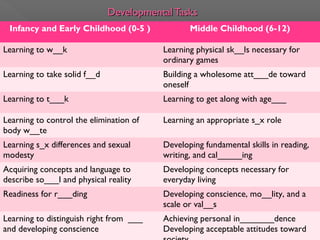
DDeevveellooppmmeennttaall TTaasskkss 
Infancy and Early Childhood (0-5 ) Middle Childhood (6-12) 
Learning to w__k Learning physical sk__ls necessary for 
ordinary games 
Learning to take solid f__d Building a wholesome att___de toward 
oneself 
Learning to t___k Learning to get along with age___ 
Learning to control the elimination of 
Learning an appropriate s_x role 
body w__te 
Learning s_x differences and sexual 
modesty 
Developing fundamental skills in reading, 
writing, and cal_____ing 
Acquiring concepts and language to 
describe so___l and physical reality 
Developing concepts necessary for 
everyday living 
Readiness for r___ding Developing conscience, mo__lity, and a 
scale or val__s 
Learning to distinguish right from ___ 
and developing conscience 
Achieving personal in_______dence 
Developing acceptable attitudes toward 
society
DDeevveellooppmmeennttaall TTaasskkss 
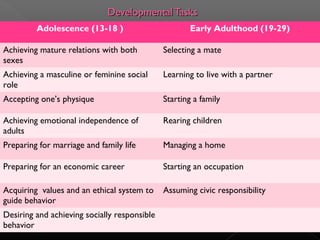
Adolescence (13-18 ) Early Adulthood (19-29) 
Achieving mature relations with both 
sexes 
Selecting a mate 
Achieving a masculine or feminine social 
role 
Learning to live with a partner 
Accepting one’s physique Starting a family 
Achieving emotional independence of 
adults 
Rearing children 
Preparing for marriage and family life Managing a home 
Preparing for an economic career Starting an occupation 
Acquiring values and an ethical system to 
guide behavior 
Assuming civic responsibility 
Desiring and achieving socially responsible 
behavior
DDeevveellooppmmeennttaall TTaasskkss 
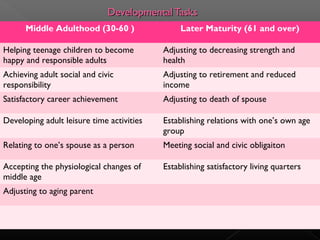
Middle Adulthood (30-60 ) Later Maturity (61 and over) 
Helping teenage children to become 
happy and responsible adults 
Adjusting to decreasing strength and 
health 
Achieving adult social and civic 
responsibility 
Adjusting to retirement and reduced 
income 
Satisfactory career achievement Adjusting to death of spouse 
Developing adult leisure time activities Establishing relations with one’s own age 
group 
Relating to one’s spouse as a person Meeting social and civic obligaiton 
Accepting the physiological changes of 
middle age 
Establishing satisfactory living quarters 
Adjusting to aging parent
Stages of Development and Developmental Tasks

Stages of Development and Developmental Tasks

  • 2.
    1. Pre-natal Period 2. Infancy (birth – 2 years) 3. Early Childhood (3 – 5 years) 4. Middle and Late Childhood (6 to 12 years) 5. Adolescence (13 – 18 years) 6. Early Adulthood (19 – 29 years) 7. Middle Adulthood (30 – 60 years) 8. Late Adulthood (61 years and above)
  • 3.
    3 phases germinalstage = first 2 weeks conception, implantation, formation of placenta embryonic stage = 2 weeks – 2 months formation of vital organs and systems fetal stage = 2 months – birth bodily growth continues, movement capability begins, brain cells multiply age of viability
  • 4.
    Overview of fetaldevelopment It involves tremendous growth – from a single cell to an organism complete with brain and behavioral capabilities
  • 5.
    • extreme dependenceon adults • beginning psychological activities: • language, symbolic thought, sensorimotor coordination and social learning •language of newborn is the cry • usually eats every 2 to 3 hours • uncoordinated movements • toothless • poor vision (focusing range 8 to 12 inches) • usually doubles weight by 9 months • responds to human voice & touch
  • 6.
    • change fromplump baby to leaner more muscular toddler • begins to walk & talk • ability for passive language (better understanding of what’s being said) • tentative sense of independence • determined explorer
  • 7.
    • begins tocommunicate verbally (name, etc.) • can usually speak in 3 to 4 word sentences • famous for negative behavior “NO!” to everything! temper tantrums • will play side by side other children, but does not actively play with them • great imitators
  • 9.
    • wants tobe just like parents • vocabulary and pronunciation continue to expand • climbs stairs with alternating feet • can briefly stand on one foot
  • 10.
    • sentences aremore complex; speaks well enough for strangers to understand • imagination is vivid; line between what is real & imaginary is often indistinct • develops fears (common fears: fear of dark, fear of animals, & fear of death)
  • 11.
    • can hopon one foot & skip • can accurately copy figures • may begin to read • socialize with other children their age
  • 13.
    • both large& small muscles well-developed • developed complex motor skills • from independent activities to same sex group activities • acceptance by peers very important • parental approval still important
  • 14.
    • traumatic lifestage for child & parent • puberty occurs • extremely concerned with appearance • trying to establish self-identity • confrontations with authority
  • 15.
    • physical developmentcomplete • emotional maturation continues to develop • usually learned to accept responsibility for actions & accept criticism • usually knows how to profit from errors • socially progress from age-related peer groups to people with similar interests
  • 16.
    • physical changesbegin to occur: • hair begins to thin & gray • wrinkles appear • hearing & vision decrease • muscles lose tone • main concerns: children, health, job security, aging parents, & fear of aging • love & acceptance still take a major role
  • 17.
    • fastest growingage bracket of society • physical deterioration (brittle bones, poor coordination) • some memory problems • coping with retirement & forms of entertainment • very concerned with health & finances • significant number become depressed; suicide rate is high
  • 18.
    DDeevveellooppmmeennttaall TTaasskkss ›One that “arises at a certain period in our life, the successful achievement of which leads to happiness and success with later tasks while failure leads to unhappiness, social disapproval, and difficulty with later tasks.” by Robert Havighurst , 1972
  • 19.
    DDeevveellooppmmeennttaall TTaasskkss ›What is an outstanding trait or behavior of each stage? › What task/s is/are expected of each development stage? › Does a developmental task in a higher level require accomplishment of the lower level of developmental tasks?
  • 20.
    DDeevveellooppmmeennttaall TTaasskkss Infancyand Early Childhood (0-5 ) Middle Childhood (6-12) Learning to w__k Learning physical sk__ls necessary for ordinary games Learning to take solid f__d Building a wholesome att___de toward oneself Learning to t___k Learning to get along with age___ Learning to control the elimination of Learning an appropriate s_x role body w__te Learning s_x differences and sexual modesty Developing fundamental skills in reading, writing, and cal_____ing Acquiring concepts and language to describe so___l and physical reality Developing concepts necessary for everyday living Readiness for r___ding Developing conscience, mo__lity, and a scale or val__s Learning to distinguish right from ___ and developing conscience Achieving personal in_______dence Developing acceptable attitudes toward society
  • 21.
    DDeevveellooppmmeennttaall TTaasskkss Adolescence(13-18 ) Early Adulthood (19-29) Achieving mature relations with both sexes Selecting a mate Achieving a masculine or feminine social role Learning to live with a partner Accepting one’s physique Starting a family Achieving emotional independence of adults Rearing children Preparing for marriage and family life Managing a home Preparing for an economic career Starting an occupation Acquiring values and an ethical system to guide behavior Assuming civic responsibility Desiring and achieving socially responsible behavior
  • 22.
    DDeevveellooppmmeennttaall TTaasskkss MiddleAdulthood (30-60 ) Later Maturity (61 and over) Helping teenage children to become happy and responsible adults Adjusting to decreasing strength and health Achieving adult social and civic responsibility Adjusting to retirement and reduced income Satisfactory career achievement Adjusting to death of spouse Developing adult leisure time activities Establishing relations with one’s own age group Relating to one’s spouse as a person Meeting social and civic obligaiton Accepting the physiological changes of middle age Establishing satisfactory living quarters Adjusting to aging parent