C
DEVELOPMENT
ACROSS THE
LIFESPAN
By: Louisa Du
Psy1170
C
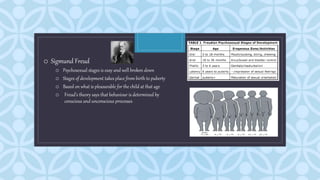
o Sigmund Freud
o Psychosexual stages is easy and well broken down
o Stages of development takes place from birth to puberty
o Based on what is pleasurable for the child at that age
o Freud’s theory says that behaviour is determined by
conscious and unconscious processes
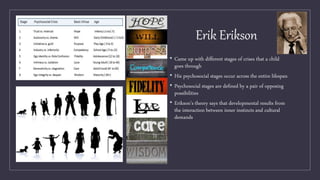
Erik Erikson
• Came up with different stages of crises that a child
goes through
• His psychosocial stages occur across the entire lifespan
• Psychosocial stages are defined by a pair of opposing
possibilities
• Erikson’s theory says that developmental results from
the interaction between inner instincts and cultural
demands
C
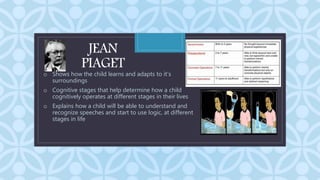
JEAN
PIAGET
o Shows how the child learns and adapts to it’s
surroundings
o Cognitive stages that help determine how a child
cognitively operates at different stages in their lives
o Explains how a child will be able to understand and
recognize speeches and start to use logic, at different
stages in life
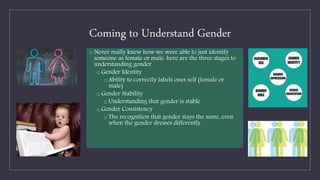
Coming to Understand Gender
o Never really knew how we were able to just identify
someone as female or male, here are the three stages to
understanding gender
o Gender Identity
o Ability to correctly labels ones self (female or
male)
o Gender Stability
o Understanding that gender is stable
o Gender Consistency
o The recognition that gender stays the same, even
when the gender dresses differently
C
LATE ADULTHOOD
o Erikson’s Theory (The Last Stage)
o Ego Integrity
o Serenity and contentment
o Despair
o Bitter and unaccepting of coming
death
o Reminiscence
o Self-focus which can deepen
despair
o Life Review
o Considering the meaning of past
experiences
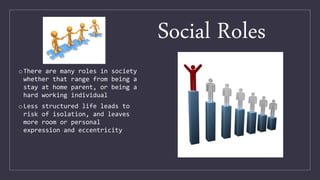
Social Roles
oThere are many roles in society
whether that range from being a
stay at home parent, or being a
hard working individual
oLess structured life leads to
risk of isolation, and leaves
more room or personal
expression and eccentricity
C
INTELLIGENCE
Robert Sternberg
o Three components of intelligence
o Componential
o Experiential
o Contextual
Daniel Goleman
o Emotional Intelligence
o Awareness of own emotions
o Ability to express emotions
o Ability to channel emotions and achieve goals
C
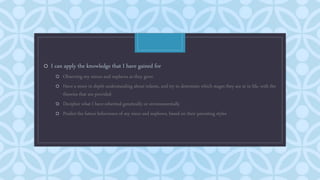
o I can apply the knowledge that I have gained for
o Observing my nieces and nephews as they grow
o Have a more in depth understanding about infants, and try to determine which stages they are at in life, with the
theories that are provided
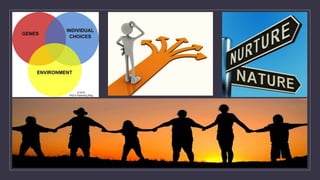
o Decipher what I have inherited genetically or environmentally
o Predict the future behaviours of my niece and nephews, based on their parenting styles
C
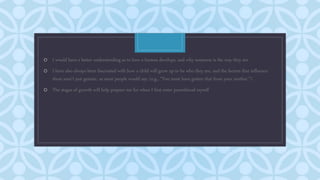
o I would have a better understanding as to how a human develops, and why someone is the way they are
o I have also always been fascinated with how a child will grow up to be who they are, and the factors that influence
them aren’t just genetic, as most people would say. (e.g., “You must have gotten that from your mother.”)
o The stages of growth will help prepare me for when I first enter parenthood myself
C
o The knowledge I have gained will help me professionally
because:
o I plan on being a Child and Youth Care Worker, in a school
setting. I chose a school setting because, I believe that it’s critical
to help a child when they are still young, so they have time to
adapt and grow.
o Being a Child and Youth Care worker, I will be exposed to a
bunch of kids, with different personalities and behaviours, because
I will be exposed to a bunch a diverse group of kids, I get the
chance to witness whether they adapt to certain environments or
not.
C
o Being a Child and Youth Care worker, it is my duty to figure out
their behaviour, and track it from start to present. This means
that I am to look at their family behaviours, and past experiences
and relationships
o I will be able to decipher the type of parenting they had growing
up, and be aware as to how I should approach/talk to them
Human Development

Human Development

  • 1.
  • 3.
    C o Sigmund Freud oPsychosexual stages is easy and well broken down o Stages of development takes place from birth to puberty o Based on what is pleasurable for the child at that age o Freud’s theory says that behaviour is determined by conscious and unconscious processes
  • 4.
    Erik Erikson • Cameup with different stages of crises that a child goes through • His psychosocial stages occur across the entire lifespan • Psychosocial stages are defined by a pair of opposing possibilities • Erikson’s theory says that developmental results from the interaction between inner instincts and cultural demands
  • 5.
    C JEAN PIAGET o Shows howthe child learns and adapts to it’s surroundings o Cognitive stages that help determine how a child cognitively operates at different stages in their lives o Explains how a child will be able to understand and recognize speeches and start to use logic, at different stages in life
  • 6.
    Coming to UnderstandGender o Never really knew how we were able to just identify someone as female or male, here are the three stages to understanding gender o Gender Identity o Ability to correctly labels ones self (female or male) o Gender Stability o Understanding that gender is stable o Gender Consistency o The recognition that gender stays the same, even when the gender dresses differently
  • 7.
    C LATE ADULTHOOD o Erikson’sTheory (The Last Stage) o Ego Integrity o Serenity and contentment o Despair o Bitter and unaccepting of coming death o Reminiscence o Self-focus which can deepen despair o Life Review o Considering the meaning of past experiences
  • 8.
    Social Roles oThere aremany roles in society whether that range from being a stay at home parent, or being a hard working individual oLess structured life leads to risk of isolation, and leaves more room or personal expression and eccentricity
  • 9.
    C INTELLIGENCE Robert Sternberg o Threecomponents of intelligence o Componential o Experiential o Contextual Daniel Goleman o Emotional Intelligence o Awareness of own emotions o Ability to express emotions o Ability to channel emotions and achieve goals
  • 11.
    C o I canapply the knowledge that I have gained for o Observing my nieces and nephews as they grow o Have a more in depth understanding about infants, and try to determine which stages they are at in life, with the theories that are provided o Decipher what I have inherited genetically or environmentally o Predict the future behaviours of my niece and nephews, based on their parenting styles
  • 12.
    C o I wouldhave a better understanding as to how a human develops, and why someone is the way they are o I have also always been fascinated with how a child will grow up to be who they are, and the factors that influence them aren’t just genetic, as most people would say. (e.g., “You must have gotten that from your mother.”) o The stages of growth will help prepare me for when I first enter parenthood myself
  • 15.
    C o The knowledgeI have gained will help me professionally because: o I plan on being a Child and Youth Care Worker, in a school setting. I chose a school setting because, I believe that it’s critical to help a child when they are still young, so they have time to adapt and grow. o Being a Child and Youth Care worker, I will be exposed to a bunch of kids, with different personalities and behaviours, because I will be exposed to a bunch a diverse group of kids, I get the chance to witness whether they adapt to certain environments or not.
  • 16.
    C o Being aChild and Youth Care worker, it is my duty to figure out their behaviour, and track it from start to present. This means that I am to look at their family behaviours, and past experiences and relationships o I will be able to decipher the type of parenting they had growing up, and be aware as to how I should approach/talk to them