Reminders:
❌Do not reproduce,modify, or distribute without permission.
❌Do not share the lecture deck with others outside the class.
❌Do not upload to public platforms or third-party websites.
✅Use for personal study only and refer to it responsibly.
✅Respect copyright and intellectual property of the materials.
✅Contact the instructor for clarifications or additional references.
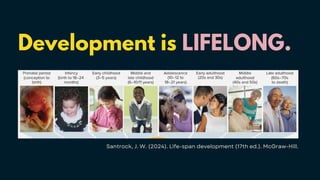
Development is LIFELONG.
Eachperiod of the life span is affected by
what happened before and will affect what is
to come. No period is more important than the
other.
14.
What are theseperiods of
Lifespan?
Divisions of Lifespan into periods is as
SOCIAL
CONSTRUCTION.
Is a concept or practice that is an invention
of a particular culture or society.
SOCIAL
CONSTRUCTION.
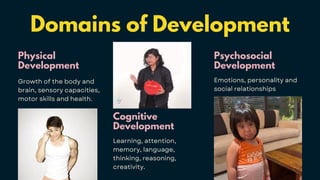
Domains of Development
Physical
Development
Growthof the body and
brain, sensory capacities,
motor skills and health.
Cognitive
Development
Learning, attention,
memory, language,
thinking, reasoning,
creativity.
Psychosocial
Development
Emotions, personality and
social relationships
Relative influences of
biologyand culture shift
over the life span.
Biological abilities weaken as we age while
cultural support help compensate with losses.
20.
Heredity
inborn traits orcharacteristics inherited from
biological parents
Maturation
Unfolding of natural sequence of phyical changes and behavior
patterns
Environment
totality of nonheriditary, experiential
influences
Development is influenced
bythe historical and
cultural context.
All development occurs within a context or
setting. As contexts are ever changing, so as the
individuals.
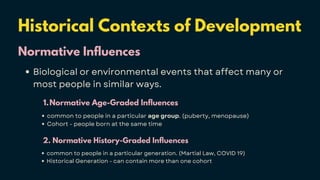
Historical Contexts ofDevelopment
Normative Influences
Biological or environmental events that affect many or
most people in similar ways.
Normative Age-Graded Influences
1.
common to people in a particular age group. (puberty, menopause)
Cohort - people born at the same time
2. Normative History-Graded Influences
common to people in a particular generation. (Martial Law, COVID 19)
Historical Generation - can contain more than one cohort
27.
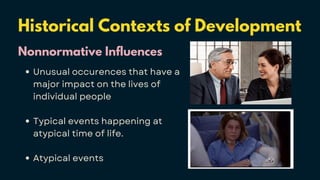
Historical Contexts ofDevelopment
Nonnormative Influences
Unusual occurences that have a
major impact on the lives of
individual people
Typical events happening at
atypical time of life.
Atypical events
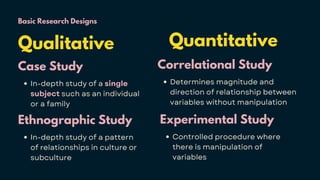
Basic Research Designs
Qualitative
CaseStudy
In-depth study of a single
subject such as an individual
or a family
Quantitative
Ethnographic Study
In-depth study of a pattern
of relationships in culture or
subculture
Correlational Study
Determines magnitude and
direction of relationship between
variables without manipulation
Experimental Study
Controlled procedure where
there is manipulation of
variables
33.
Developmental Research Designs
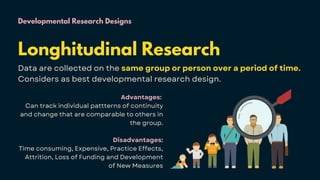
Dataare collected on the same group or person over a period of time.
Considers as best developmental research design.
Advantages:
Can track individual pattterns of continuity
and change that are comparable to others in
the group.
Disadvantages:
Time consuming, Expensive, Practice Effects,
Attrition, Loss of Funding and Development
of New Measures
Longhitudinal Research
34.
Developmental Research Designs
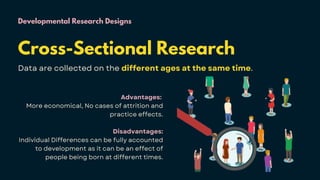
Dataare collected on the different ages at the same time.
Advantages:
More economical, No cases of attrition and
practice effects.
Disadvantages:
Individual Differences can be fully accounted
to development as it can be an effect of
people being born at different times.
Cross-Sectional Research
35.
Developmental Research Designs
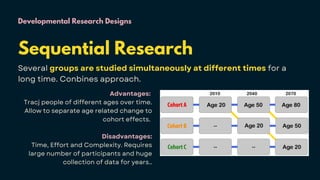
Severalgroups are studied simultaneously at different times for a
long time. Conbines approach.
Advantages:
Tracj people of different ages over time.
Allow to separate age related change to
cohort effects.
Disadvantages:
Time, Effort and Complexity. Requires
large number of participants and huge
collection of data for years..
Sequential Research
Nature VS Nurture
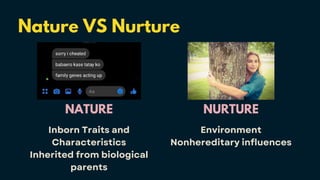
NATURE
InbornTraits and
Characteristics
Inherited from biological
parents
NURTURE
Environment
Nonhereditary influences
39.
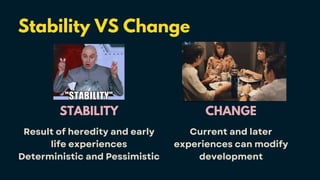
Stability VS Change
STABILITY
Resultof heredity and early
life experiences
Deterministic and Pessimistic
CHANGE
Current and later
experiences can modify
development
40.
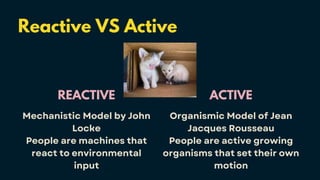
Reactive VS Active
REACTIVE
MechanisticModel by John
Locke
People are machines that
react to environmental
input
ACTIVE
Organismic Model of Jean
Jacques Rousseau
People are active growing
organisms that set their own
motion
41.
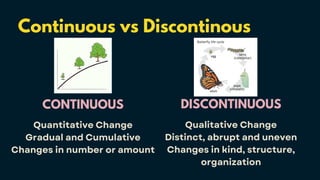
Continuous vs Discontinous
CONTINUOUS
QuantitativeChange
Gradual and Cumulative
Changes in number or amount
DISCONTINUOUS
Qualitative Change
Distinct, abrupt and uneven
Changes in kind, structure,
organization
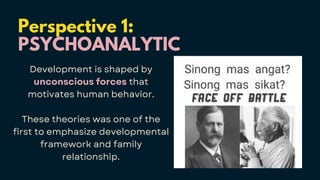
Perspective 1:
PSYCHOANALYTIC
Development isshaped by
unconscious forces that
motivates human behavior.
These theories was one of the
first to emphasize developmental
framework and family
relationship.
44.
Perspective 1: PSYCHOANALYTIC
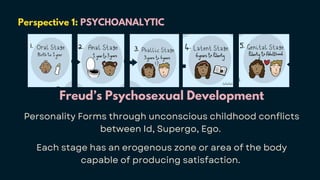
Freud’sPsychosexual Development
Personality Forms through unconscious childhood conflicts
between Id, Supergo, Ego.
Each stage has an erogenous zone or area of the body
capable of producing satisfaction.
45.
Perspective 1: PSYCHOANALYTIC
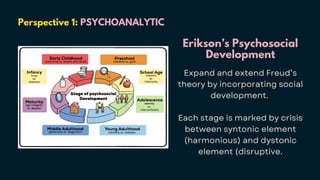
Erikson’sPsychosocial
Development
Expand and extend Freud’s
theory by incorporating social
development.
Each stage is marked by crisis
between syntonic element
(harmonious) and dystonic
element (disruptive.
46.
Perspective 1: PSYCHOANALYTIC
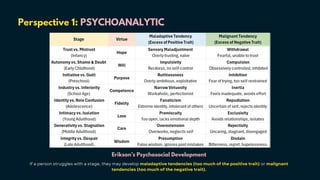
Erikson’sPsychosocial Development
If a person struggles with a stage, they may develop maladaptive tendencies (too much of the positive trait) or malignant
tendencies (too much of the negative trait).
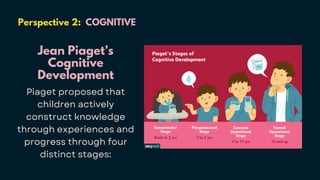
Perspective 2: COGNITIVE
JeanPiaget’s
Cognitive
Development
Piaget proposed that
children actively
construct knowledge
through experiences and
progress through four
distinct stages:
49.
Perspective 2: COGNITIVE
JeanPiaget’s Cognitive Development
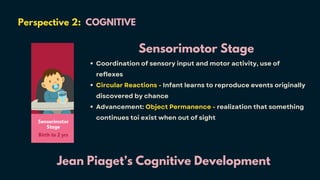
Sensorimotor Stage
Coordination of sensory input and motor activity, use of
reflexes
Circular Reactions - Infant learns to reproduce events originally
discovered by chance
Advancement: Object Permanence - realization that something
continues toi exist when out of sight
50.
Perspective 2: COGNITIVE
JeanPiaget’s Cognitive Development
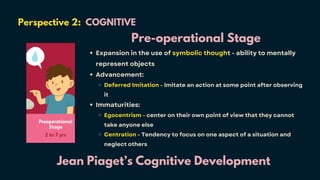
Pre-operational Stage
Expansion in the use of symbolic thought - ability to mentally
represent objects
Advancement:
Deferred Imitation - Imitate an action at some point after observing
it
Immaturities:
Egocentrism - center on their own point of view that they cannot
take anyone else
Centration - Tendency to focus on one aspect of a situation and
neglect others
51.
Perspective 2: COGNITIVE
JeanPiaget’s Cognitive Development
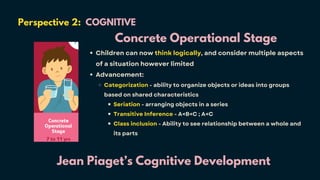
Concrete Operational Stage
Children can now think logically, and consider multiple aspects
of a situation however limited
Advancement:
Categorization - ability to organize objects or ideas into groups
based on shared characteristics
Seriation - arranging objects in a series
Transitive Inference - A<B<C ; A<C
Class inclusion - Ability to see relationship between a whole and
its parts
52.
Perspective 2: COGNITIVE
JeanPiaget’s Cognitive Development
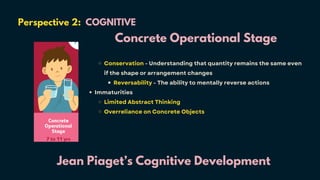
Concrete Operational Stage
Conservation - Understanding that quantity remains the same even
if the shape or arrangement changes
Reversability - The ability to mentally reverse actions
Immaturities
Limited Abstract Thinking
Overreliance on Concrete Objects
53.
Perspective 2: COGNITIVE
JeanPiaget’s Cognitive Development
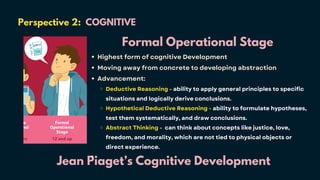
Formal Operational Stage
Highest form of cognitive Development
Moving away from concrete to developing abstraction
Advancement:
Deductive Reasoning - ability to apply general principles to specific
situations and logically derive conclusions.
Hypothetical Deductive Reasoning - ability to formulate hypotheses,
test them systematically, and draw conclusions.
Abstract Thinking - can think about concepts like justice, love,
freedom, and morality, which are not tied to physical objects or
direct experience.
54.
Perspective 2: COGNITIVE
JeanPiaget’s Cognitive Development
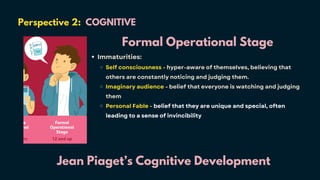
Formal Operational Stage
Immaturities:
Self consciousness - hyper-aware of themselves, believing that
others are constantly noticing and judging them.
Imaginary audience - belief that everyone is watching and judging
them
Personal Fable - belief that they are unique and special, often
leading to a sense of invincibility
55.
Perspective 2: COGNITIVE
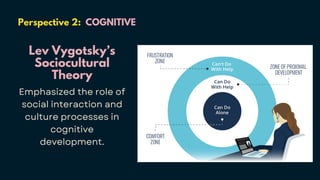
LevVygotsky’s
Sociocultural
Theory
Emphasized the role of
social interaction and
culture processes in
cognitive
development.
56.
Perspective 2: COGNITIVE
Zone2: Zone of Proximal Development - ZPD
gap between what a learner can do alone and what they can
do with help from a More Knowledgeable Others (MKO).
Zone 1: Zone of Actual Development - ZAD
what the learner can actually do alone without help
Zone 3: Out of Reach Zone - ORZ
what the learner can actually do alone without help
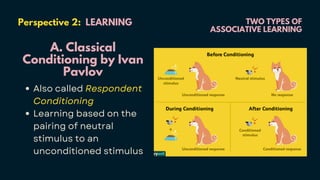
TWO TYPES OF
ASSOCIATIVELEARNING
Perspective 2: LEARNING
A. Classical
Conditioning by Ivan
Pavlov
Also called Respondent
Conditioning
Learning based on the
pairing of neutral
stimulus to an
unconditioned stimulus
60.
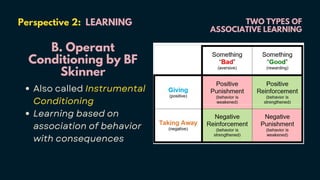
TWO TYPES OF
ASSOCIATIVELEARNING
Perspective 2: LEARNING
B. Operant
Conditioning by BF
Skinner
Also called Instrumental
Conditioning
Learning based on
association of behavior
with consequences
61.
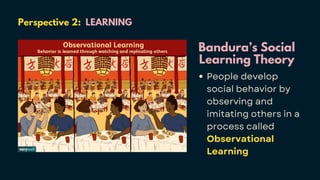
Perspective 2: LEARNING
Bandura’sSocial
Learning Theory
People develop
social behavior by
observing and
imitating others in a
process called
Observational
Learning
62.
Perspective 4:
CONTEXTUAL
Development cannotbe understood in isolation—it is shaped
by the interaction between an individual and their social,
cultural, and environmental context.
63.
Perspective 4: CONTEXTUAL
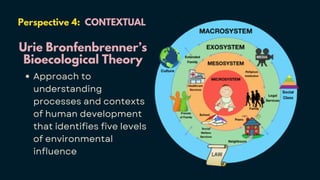
UrieBronfenbrenner’s
Bioecological Theory
Approach to
understanding
processes and contexts
of human development
that identifies five levels
of environmental
influence
64.
Perspective 4: CONTEXTUAL
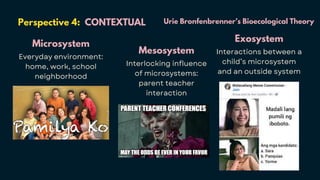
Microsystem
Everydayenvironment:
home, work, school
neighborhood
Mesosystem
Interlocking influence
of microsystems:
parent teacher
interaction
Exosystem
Interactions between a
child’s microsystem
and an outside system
Urie Bronfenbrenner’s Bioecological Theory
65.
Perspective 4: CONTEXTUAL
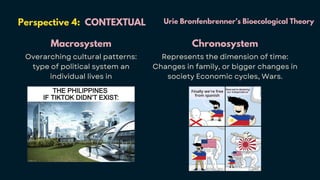
Macrosystem
Overarchingcultural patterns:
type of political system an
individual lives in
Urie Bronfenbrenner’s Bioecological Theory
Chronosystem
Represents the dimension of time:
Changes in family, or bigger changes in
society Economic cycles, Wars.
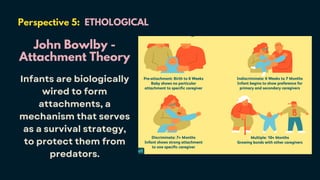
Perspective 5: ETHOLOGICAL
JohnBowlby -
Attachment Theory
Infants are biologically
wired to form
attachments, a
mechanism that serves
as a survival strategy,
to protect them from
predators.
LOVESTORYOFFLEABAG
LOVESTORYOFFLEABAG
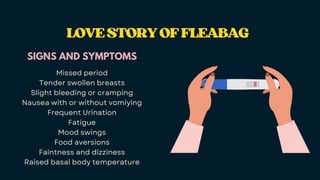
SIGNS AND SYMPTOMS
Missedperiod
Tender swollen breasts
Slight bleeding or cramping
Nausea with or without vomiying
Frequent Urination
Fatigue
Mood swings
Food aversions
Faintness and dizziness
Raised basal body temperature
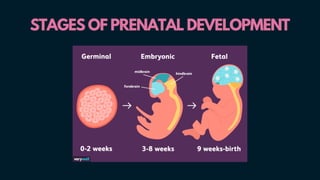
STAGES OF PRENATALDEVELOPMENT
STAGES OF PRENATAL DEVELOPMENT
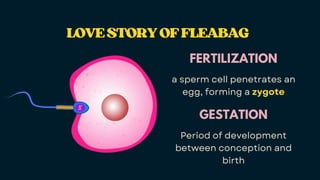
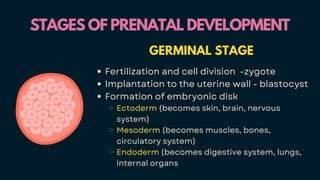
GERMINAL STAGE
Fertilization and cell division -zygote
Implantation to the uterine wall - blastocyst
Formation of embryonic disk
Ectoderm (becomes skin, brain, nervous
system)
Mesoderm (becomes muscles, bones,
circulatory system)
Endoderm (becomes digestive system, lungs,
internal organs
76.
STAGES OF PRENATALDEVELOPMENT
STAGES OF PRENATAL DEVELOPMENT
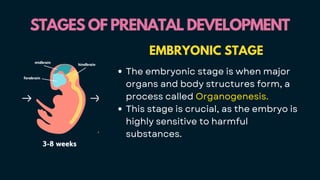
EMBRYONIC STAGE
The embryonic stage is when major
organs and body structures form, a
process called Organogenesis.
This stage is crucial, as the embryo is
highly sensitive to harmful
substances.
77.
STAGES OF PRENATALDEVELOPMENT
STAGES OF PRENATAL DEVELOPMENT
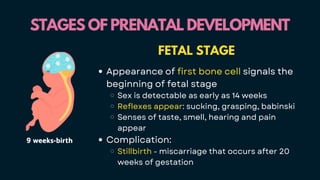
FETAL STAGE
Appearance of first bone cell signals the
beginning of fetal stage
Sex is detectable as early as 14 weeks
Reflexes appear: sucking, grasping, babinski
Senses of taste, smell, hearing and pain
appear
Complication:
Stillbirth - miscarriage that occurs after 20
weeks of gestation
CONTRACTIONS
BRAXTON HICKS
CONTRACTIONS
False Contractions
Mildand irregular
Often felt in the front of the
abdomen
May stop with a change in
activity level
REAL LABOR
CONTRACTIONS
More frequent
Become stronger and more
painful over time
Start in the midback and
wrap around the abdomen
Continue and may even
become stronger with
movement
81.
MEDICATED VS NON
MEDICATEDDELIVERY
NON-MEDICATED
CHILDBIRTH
Method that seeks to
eliminate mother’s
fear by education and
training in breathing
and relaxation
(Lamaze Method)
MEDICATED CHIDBIRTH
Include use of pain relief
Pudendal Block - local vaginal anesthesia
Analgesic - painkiller that reduce
perception of pain
Epidural anesthesia - injected in the space
in the spinal cord to block nerve pathways
that would carry pain sensation to the brain
82.
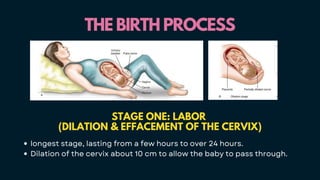
THE BIRTH PROCESS
THEBIRTH PROCESS
STAGE ONE: LABOR
(DILATION & EFFACEMENT OF THE CERVIX)
longest stage, lasting from a few hours to over 24 hours.
Dilation of the cervix about 10 cm to allow the baby to pass through.
83.
THE BIRTH PROCESS
THEBIRTH PROCESS
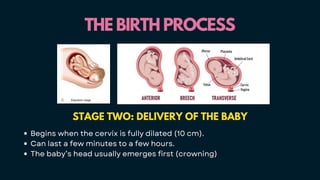
STAGE TWO: DELIVERY OF THE BABY
Begins when the cervix is fully dilated (10 cm).
Can last a few minutes to a few hours.
The baby’s head usually emerges first (crowning)
84.
THE BIRTH PROCESS
THEBIRTH PROCESS
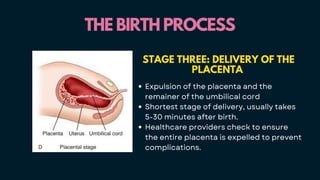
STAGE THREE: DELIVERY OF THE
PLACENTA
Expulsion of the placenta and the
remainer of the umbilical cord
Shortest stage of delivery, usually takes
5-30 minutes after birth.
Healthcare providers check to ensure
the entire placenta is expelled to prevent
complications.
85.
NEONATAL MEDICAL AND
NEONATALMEDICAL AND
BEHAVIORAL ASSESSMENT
BEHAVIORAL ASSESSMENT
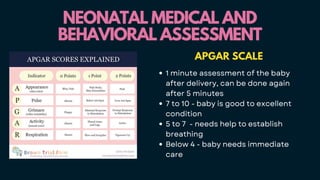
APGAR SCALE
1 minute assessment of the baby
after delivery, can be done again
after 5 minutes
7 to 10 - baby is good to excellent
condition
5 to 7 - needs help to establish
breathing
Below 4 - baby needs immediate
care
86.
NEONATAL MEDICAL AND
NEONATALMEDICAL AND
BEHAVIORAL ASSESSMENT
BEHAVIORAL ASSESSMENT
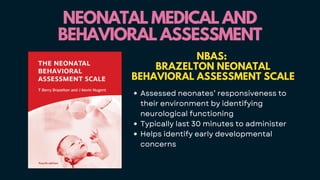
NBAS:
BRAZELTON NEONATAL
BEHAVIORAL ASSESSMENT SCALE
Assessed neonates’ responsiveness to
their environment by identifying
neurological functioning
Typically last 30 minutes to administer
Helps identify early developmental
concerns
IMPORTANT CONCEPTS
IMPORTANT CONCEPTS
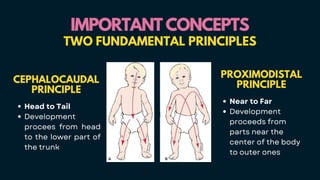
TWOFUNDAMENTAL PRINCIPLES
CEPHALOCAUDAL
PRINCIPLE
Head to Tail
Development
procees from head
to the lower part of
the trunk
PROXIMODISTAL
PRINCIPLE
Near to Far
Development
proceeds from
parts near the
center of the body
to outer ones
89.
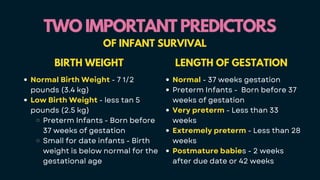
TWO IMPORTANT PREDICTORS
TWOIMPORTANT PREDICTORS
OF INFANT SURVIVAL
BIRTH WEIGHT
Normal Birth Weight - 7 1/2
pounds (3.4 kg)
Low Birth Weight - less tan 5
pounds (2.5 kg)
Preterm Infants - Born before
37 weeks of gestation
Small for date infants - Birth
weight is below normal for the
gestational age
LENGTH OF GESTATION
Normal - 37 weeks gestation
Preterm Infants - Born before 37
weeks of gestation
Very preterm - Less than 33
weeks
Extremely preterm - Less than 28
weeks
Postmature babies - 2 weeks
after due date or 42 weeks
90.
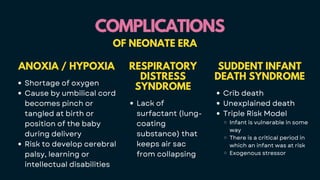
COMPLICATIONS
COMPLICATIONS
OF NEONATE ERA
ANOXIA/ HYPOXIA
Shortage of oxygen
Cause by umbilical cord
becomes pinch or
tangled at birth or
position of the baby
during delivery
Risk to develop cerebral
palsy, learning or
intellectual disabilities
RESPIRATORY
DISTRESS
SYNDROME
Lack of
surfactant (lung-
coating
substance) that
keeps air sac
from collapsing
SUDDENT INFANT
DEATH SYNDROME
Crib death
Unexplained death
Triple Risk Model
Infant is vulnerable in some
way
There is a critical period in
which an infant was at risk
Exogenous stressor
91.
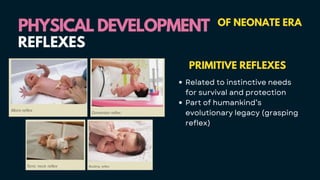
PHYSICAL DEVELOPMENT
PHYSICAL DEVELOPMENTOF NEONATE ERA
PRIMITIVE REFLEXES
Related to instinctive needs
for survival and protection
Part of humankind’s
evolutionary legacy (grasping
reflex)
REFLEXES
92.
PHYSICAL DEVELOPMENT
PHYSICAL DEVELOPMENTOF NEONATE ERA
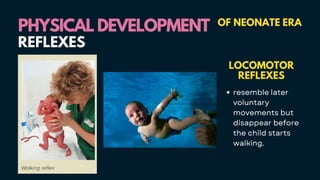
LOCOMOTOR
REFLEXES
resemble later
voluntary
movements but
disappear before
the child starts
walking.
REFLEXES
93.
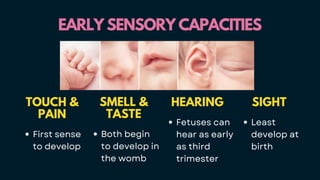
EARLY SENSORY CAPACITIES
EARLYSENSORY CAPACITIES
TOUCH &
PAIN
First sense
to develop
SMELL &
TASTE
Both begin
to develop in
the womb
HEARING
Fetuses can
hear as early
as third
trimester
SIGHT
Least
develop at
birth
94.
PHYSICAL DEVELOPMENT
PHYSICAL DEVELOPMENTOF NEONATE ERA
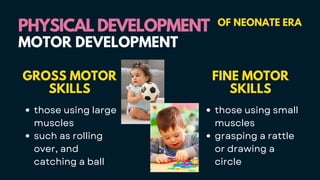
GROSS MOTOR
SKILLS
those using large
muscles
such as rolling
over, and
catching a ball
MOTOR DEVELOPMENT
FINE MOTOR
SKILLS
those using small
muscles
grasping a rattle
or drawing a
circle
95.
COGNITIVE DEVELOPMENT
COGNITIVE DEVELOPMENTOF NEONATE ERA
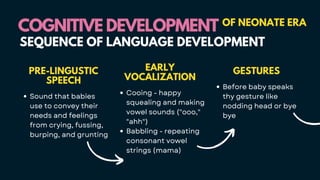
SEQUENCE OF LANGUAGE DEVELOPMENT
PRE-LINGUSTIC
SPEECH
Sound that babies
use to convey their
needs and feelings
from crying, fussing,
burping, and grunting
EARLY
VOCALIZATION
Cooing - happy
squealing and making
vowel sounds ("ooo,"
"ahh")
Babbling - repeating
consonant vowel
strings (mama)
GESTURES
Before baby speaks
thy gesture like
nodding head or bye
bye
96.
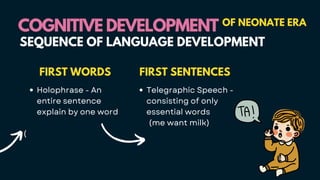
FIRST WORDS
Holophrase -An
entire sentence
explain by one word
(
COGNITIVE DEVELOPMENT
COGNITIVE DEVELOPMENT OF NEONATE ERA
SEQUENCE OF LANGUAGE DEVELOPMENT
FIRST SENTENCES
Telegraphic Speech -
consisting of only
essential words
(me want milk)
97.
OVERREGULARIZATION
Applying grammar rulestoo rigidly, leading to errors.
"Ako ay lumakad-ed"
COGNITIVE DEVELOPMENT
COGNITIVE DEVELOPMENT OF NEONATE ERA
CHARACTERISTICS OF EARLY SPEECH
UNDEREXTENDING
Using a word too narrowly,
applying it only to one object.
Thinking "sapatos" refers only to
their own shoes, not all shoes.
OVEREXTENDING
Using one word to refer to a
broad category of things.
Calling man with long hair as
Jesus
98.
PRIVATE SPEECH
talking aloudto oneself with no intent to communicate
with others
COGNITIVE DEVELOPMENT
COGNITIVE DEVELOPMENT OF NEONATE ERA
IMPORTANT CONCEPTS
SOCIAL SPEECH
speech intended to be
understood by a listener
PRAGMATICS
Practical knowledge needed
to use language for
communicative purposes
PHYSICAL DEVELOPMENT
PHYSICAL DEVELOPMENTOF EARLY CHILDHOOD
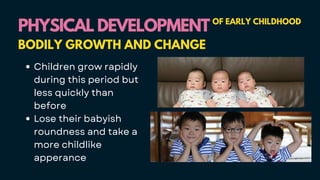
BODILY GROWTH AND CHANGE
Children grow rapidly
during this period but
less quickly than
before
Lose their babyish
roundness and take a
more childlike
apperance
104.
PHYSICAL DEVELOPMENT
PHYSICAL DEVELOPMENTOF EARLY CHILDHOOD
SLEEP
Children begun to experience problems with sleeping
Night Terror - abrupt awakening from deep sleep in
a state of agitation
Sleepwalking - walking aroung and performing other
functions while asleep
Nightmare - a bad dream brought upon
overexcitement or eating heavy meal before bedtime
Enuresis - repeated urination in clothing or bed
105.
PHYSICAL DEVELOPMENT
PHYSICAL DEVELOPMENTOF EARLY CHILDHOOD
NUTRITION
OBESITY AND
OVERWEIGHT
Young children’s
exposure to
saturated foods
can lead to
concerning
increase in cases
of overweight and
obesity
MALNUTRITION
Food Insecurity - when families do not have
dependable access to adequate amounts of food
Stunted Children - abnormal height, normal
weight for their age
Wasted Children - abnormal weight, normal height
Food Deserts - Rural communities with no access
to vegetables and more access to processed food
106.
COGNITIVE DEVELOPMENT
COGNITIVE DEVELOPMENTOF EARLY
CHILDHOOD
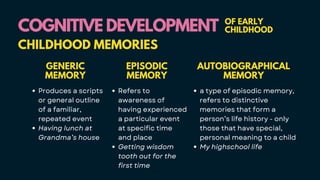
CHILDHOOD MEMORIES
GENERIC
MEMORY
Produces a scripts
or general outline
of a familiar,
repeated event
Having lunch at
Grandma’s house
EPISODIC
MEMORY
Refers to
awareness of
having experienced
a particular event
at specific time
and place
Getting wisdom
tooth out for the
first time
AUTOBIOGRAPHICAL
MEMORY
a type of episodic memory,
refers to distinctive
memories that form a
person’s life history - only
those that have special,
personal meaning to a child
My highschool life
107.
COGNITIVE DEVELOPMENT
COGNITIVE DEVELOPMENTOF EARLY
CHILDHOOD
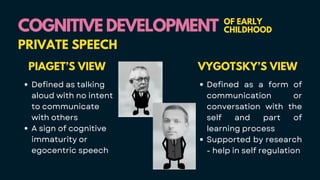
PRIVATE SPEECH
PIAGET’S VIEW
Defined as talking
aloud with no intent
to communicate
with others
A sign of cognitive
immaturity or
egocentric speech
VYGOTSKY’S VIEW
Defined as a form of
communication or
conversation with the
self and part of
learning process
Supported by research
- help in self regulation
108.
COGNITIVE DEVELOPMENT
COGNITIVE DEVELOPMENTOF EARLY
CHILDHOOD
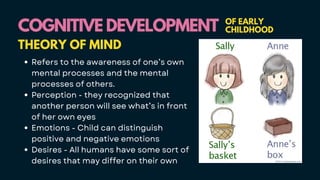
THEORY OF MIND
Refers to the awareness of one’s own
mental processes and the mental
processes of others.
Perception - they recognized that
another person will see what’s in front
of her own eyes
Emotions - Child can distinguish
positive and negative emotions
Desires - All humans have some sort of
desires that may differ on their own
PSYCHOSOCIAL DEVELOPLENT
PSYCHOSOCIAL DEVELOPLENTOF EARLY
CHILDHOOD
PLAY
Enables children to engage with the world around them
use their imagination and discover flexible ways to use
objects, solve problems, and prepare for adult rules
COGNITIVE
LEVELS OF PLAY
by Smilansky
SOCIAL DIMENTIONS
OF PLAY
by Mildred Parten
111.
PSYCHOSOCIAL DEVELOPLENT
PSYCHOSOCIAL DEVELOPLENTOF EARLY
CHILDHOOD
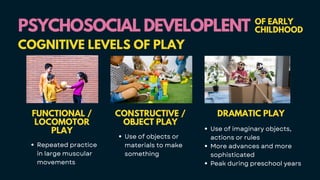
COGNITIVE LEVELS OF PLAY
FUNCTIONAL /
LOCOMOTOR
PLAY
Repeated practice
in large muscular
movements
CONSTRUCTIVE /
OBJECT PLAY
Use of objects or
materials to make
something
DRAMATIC PLAY
Use of imaginary objects,
actions or rules
More advances and more
sophisticated
Peak during preschool years
112.
PSYCHOSOCIAL DEVELOPLENT
PSYCHOSOCIAL DEVELOPLENTOF EARLY
CHILDHOOD
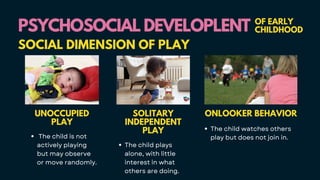
SOCIAL DIMENSION OF PLAY
UNOCCUPIED
PLAY
The child is not
actively playing
but may observe
or move randomly.
SOLITARY
INDEPENDENT
PLAY
The child plays
alone, with little
interest in what
others are doing.
ONLOOKER BEHAVIOR
The child watches others
play but does not join in.
113.
PSYCHOSOCIAL DEVELOPLENT
PSYCHOSOCIAL DEVELOPLENTOF EARLY
CHILDHOOD
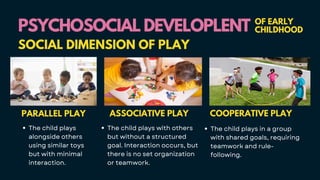
SOCIAL DIMENSION OF PLAY
PARALLEL PLAY
The child plays
alongside others
using similar toys
but with minimal
interaction.
ASSOCIATIVE PLAY
The child plays with others
but without a structured
goal. Interaction occurs, but
there is no set organization
or teamwork.
COOPERATIVE PLAY
The child plays in a group
with shared goals, requiring
teamwork and rule-
following.
114.
PSYCHOSOCIAL DEVELOPLENT
PSYCHOSOCIAL DEVELOPLENTOF EARLY
CHILDHOOD
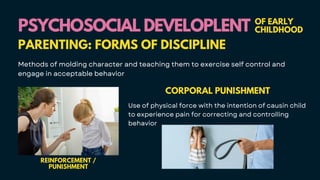
PARENTING: FORMS OF DISCIPLINE
Methods of molding character and teaching them to exercise self control and
engage in acceptable behavior
REINFORCEMENT /
PUNISHMENT
CORPORAL PUNISHMENT
Use of physical force with the intention of causin child
to experience pain for correcting and controlling
behavior
115.
PSYCHOSOCIAL DEVELOPLENT
PSYCHOSOCIAL DEVELOPLENTOF EARLY
CHILDHOOD
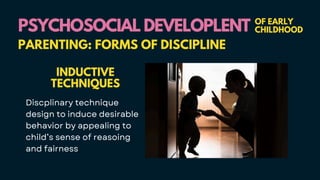
PARENTING: FORMS OF DISCIPLINE
INDUCTIVE
TECHNIQUES
Discplinary technique
design to induce desirable
behavior by appealing to
child’s sense of reasoing
and fairness
116.
PSYCHOSOCIAL DEVELOPLENT
PSYCHOSOCIAL DEVELOPLENTOF EARLY
CHILDHOOD
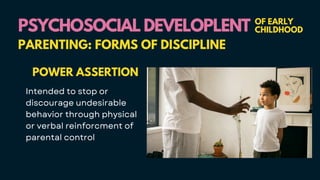
PARENTING: FORMS OF DISCIPLINE
POWER ASSERTION
Intended to stop or
discourage undesirable
behavior through physical
or verbal reinforcment of
parental control
117.
PSYCHOSOCIAL DEVELOPLENT
PSYCHOSOCIAL DEVELOPLENTOF EARLY
CHILDHOOD
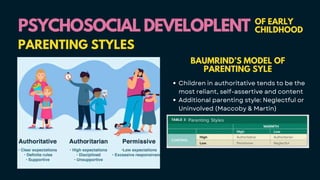
PARENTING STYLES
BAUMRIND’S MODEL OF
PARENTING SYLE
Children in authoritative tends to be the
most reliant, self-assertive and content
Additional parenting style: Neglectful or
Uninvolved (Maccoby & Martin)
PHYSICAL DEVELOPMENT
PHYSICAL DEVELOPMENTOF MIDDLE CHILHOOD
MEDICAL CONDITIONS
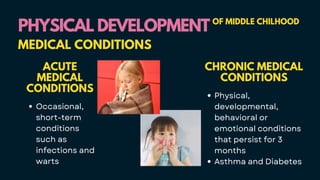
ACUTE
MEDICAL
CONDITIONS
Occasional,
short-term
conditions
such as
infections and
warts
CHRONIC MEDICAL
CONDITIONS
Physical,
developmental,
behavioral or
emotional conditions
that persist for 3
months
Asthma and Diabetes
121.
PHYSICAL DEVELOPMENT
PHYSICAL DEVELOPMENTOF MIDDLE CHILHOOD
MOTOR DEVELOPMENT
ROUGH AND TUMBLE
PLAY
Vigorous play involving
wresting, and chasing
accompanied by laughing
and scream
May look like fighting but
actually done playfully with
friends
RECESS
Associated with improvements in
academic performance
ORGANIZED SPORTS
Play games with more flexible
rules with shorter instruction time
and more free time for practice
122.
COGNITIVE DEVELOPMENT
COGNITIVE DEVELOPMENTOF MIDDLE
CHILHOOD
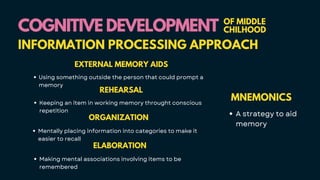
INFORMATION PROCESSING APPROACH
MNEMONICS
A strategy to aid
memory
EXTERNAL MEMORY AIDS
Using something outside the person that could prompt a
memory
REHEARSAL
Keeping an item in working memory throught conscious
repetition
ORGANIZATION
Mentally placing information into categories to make it
easier to recall
ELABORATION
Making mental associations involving items to be
remembered
123.
COGNITIVE DEVELOPMENT
COGNITIVE DEVELOPMENTOF MIDDLE
CHILHOOD
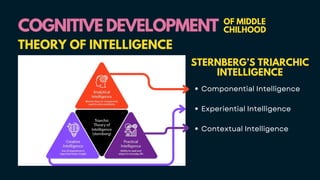
THEORY OF INTELLIGENCE
STERNBERG’S TRIARCHIC
INTELLIGENCE
Componential Intelligence
Experiential Intelligence
Contextual Intelligence
124.
PSYCHOSOCIAL DEVELOPMENT
PSYCHOSOCIAL DEVELOPMENTOF MIDDLE
CHILHOOD
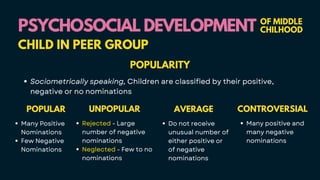
CHILD IN PEER GROUP
POPULARITY
Sociometrically speaking, Children are classified by their positive,
negative or no nominations
POPULAR
Many Positive
Nominations
Few Negative
Nominations
UNPOPULAR
Rejected - Large
number of negative
nominations
Neglected - Few to no
nominations
AVERAGE
Do not receive
unusual number of
either positive or
of negative
nominations
CONTROVERSIAL
Many positive and
many negative
nominations
125.
PSYCHOSOCIAL DEVELOPMENT
PSYCHOSOCIAL DEVELOPMENTOF MIDDLE
CHILHOOD
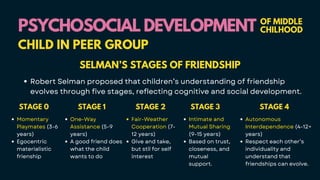
CHILD IN PEER GROUP
SELMAN’S STAGES OF FRIENDSHIP
Robert Selman proposed that children’s understanding of friendship
evolves through five stages, reflecting cognitive and social development.
STAGE 0
Momentary
Playmates (3-6
years)
Egocentric
materialistic
frienship
STAGE 1
One-Way
Assistance (5-9
years)
A good friend does
what the child
wants to do
STAGE 2
Fair-Weather
Cooperation (7-
12 years)
Give and take,
but stil for self
interest
STAGE 3
Intimate and
Mutual Sharing
(9-15 years)
Based on trust,
closeness, and
mutual
support.
STAGE 4
Autonomous
Interdependence (4-12+
years)
Respect each other’s
individuality and
understand that
friendships can evolve.
126.
PSYCHOSOCIAL DEVELOPMENT
PSYCHOSOCIAL DEVELOPMENTOF MIDDLE
CHILHOOD
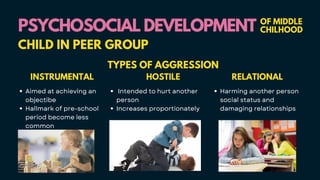
CHILD IN PEER GROUP
TYPES OF AGGRESSION
INSTRUMENTAL
Aimed at achieving an
objectibe
Hallmark of pre-school
period become less
common
HOSTILE
Intended to hurt another
person
Increases proportionately
RELATIONAL
Harming another person
social status and
damaging relationships
PHYSICAL DEVELOPMENT
PHYSICAL DEVELOPMENTOF ADOLESCENCE
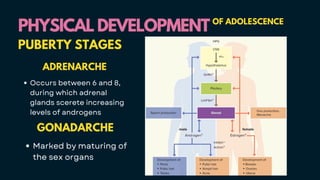
PUBERTY STAGES
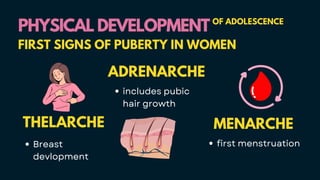
ADRENARCHE
Occurs between 6 and 8,
during which adrenal
glands scerete increasing
levels of androgens
GONADARCHE
Marked by maturing of
the sex organs
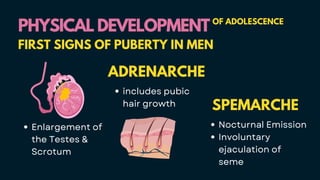
Enlargement of
the Testes&
Scrotum
ADRENARCHE
includes pubic
hair growth
PHYSICAL DEVELOPMENT
PHYSICAL DEVELOPMENT OF ADOLESCENCE
FIRST SIGNS OF PUBERTY IN MEN
SPEMARCHE
Nocturnal Emission
Involuntary
ejaculation of
seme
132.
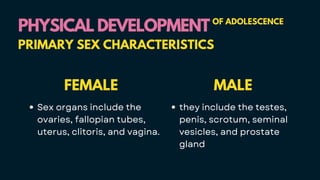
FEMALE
Sex organs includethe
ovaries, fallopian tubes,
uterus, clitoris, and vagina.
PHYSICAL DEVELOPMENT
PHYSICAL DEVELOPMENT OF ADOLESCENCE
PRIMARY SEX CHARACTERISTICS
MALE
they include the testes,
penis, scrotum, seminal
vesicles, and prostate
gland
133.
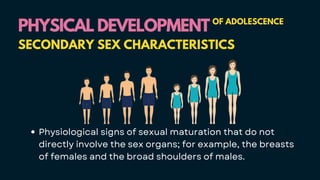
Physiological signs ofsexual maturation that do not
directly involve the sex organs; for example, the breasts
of females and the broad shoulders of males.
PHYSICAL DEVELOPMENT
PHYSICAL DEVELOPMENT OF ADOLESCENCE
SECONDARY SEX CHARACTERISTICS
134.
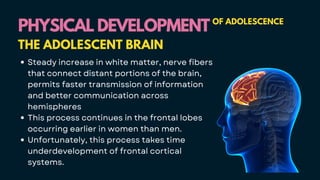
Steady increase inwhite matter, nerve fibers
that connect distant portions of the brain,
permits faster transmission of information
and better communication across
hemispheres
This process continues in the frontal lobes
occurring earlier in women than men.
Unfortunately, this process takes time
underdevelopment of frontal cortical
systems.
PHYSICAL DEVELOPMENT
PHYSICAL DEVELOPMENT OF ADOLESCENCE
THE ADOLESCENT BRAIN
135.
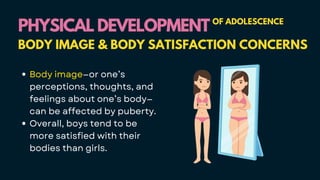
Body image—or one’s
perceptions,thoughts, and
feelings about one’s body—
can be affected by puberty.
Overall, boys tend to be
more satisfied with their
bodies than girls.
PHYSICAL DEVELOPMENT
PHYSICAL DEVELOPMENT OF ADOLESCENCE
BODY IMAGE & BODY SATISFACTION CONCERNS
COGNITIVE DEVELOPMENT
COGNITIVE DEVELOPMENTOF
ADOLESCENCE
IDENTITY FORMATION
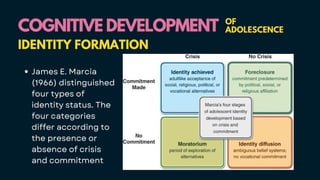
James E. Marcia
(1966) distinguished
four types of
identity status. The
four categories
differ according to
the presence or
absence of crisis
and commitment
PSYCHOLOGICAL DEVELOPMENT
PSYCHOLOGICAL DEVELOPMENTOF
ADOLESCENCE
STERNBERG’S TRIANGULAR THEORY OF LOVE
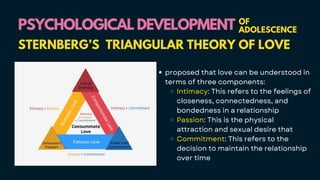
proposed that love can be understood in
terms of three components:
Intimacy: This refers to the feelings of
closeness, connectedness, and
bondedness in a relationship
Passion: This is the physical
attraction and sexual desire that
Commitment: This refers to the
decision to maintain the relationship
over time