Life-Span Development,
Twelfth Edition
Chapter 1: Introduction
The Life-Span Perspective
 Development: the pattern of movement or change
that begins at conception and continues through the
human life span
 Involves growth and decline
 Traditional Approach: emphasizes extensive
change from birth to adolescence, little to no
change in adulthood, and decline in old age
 Life-Span Approach: emphasizes developmental
change throughout childhood and adulthood
The Life-Span Perspective
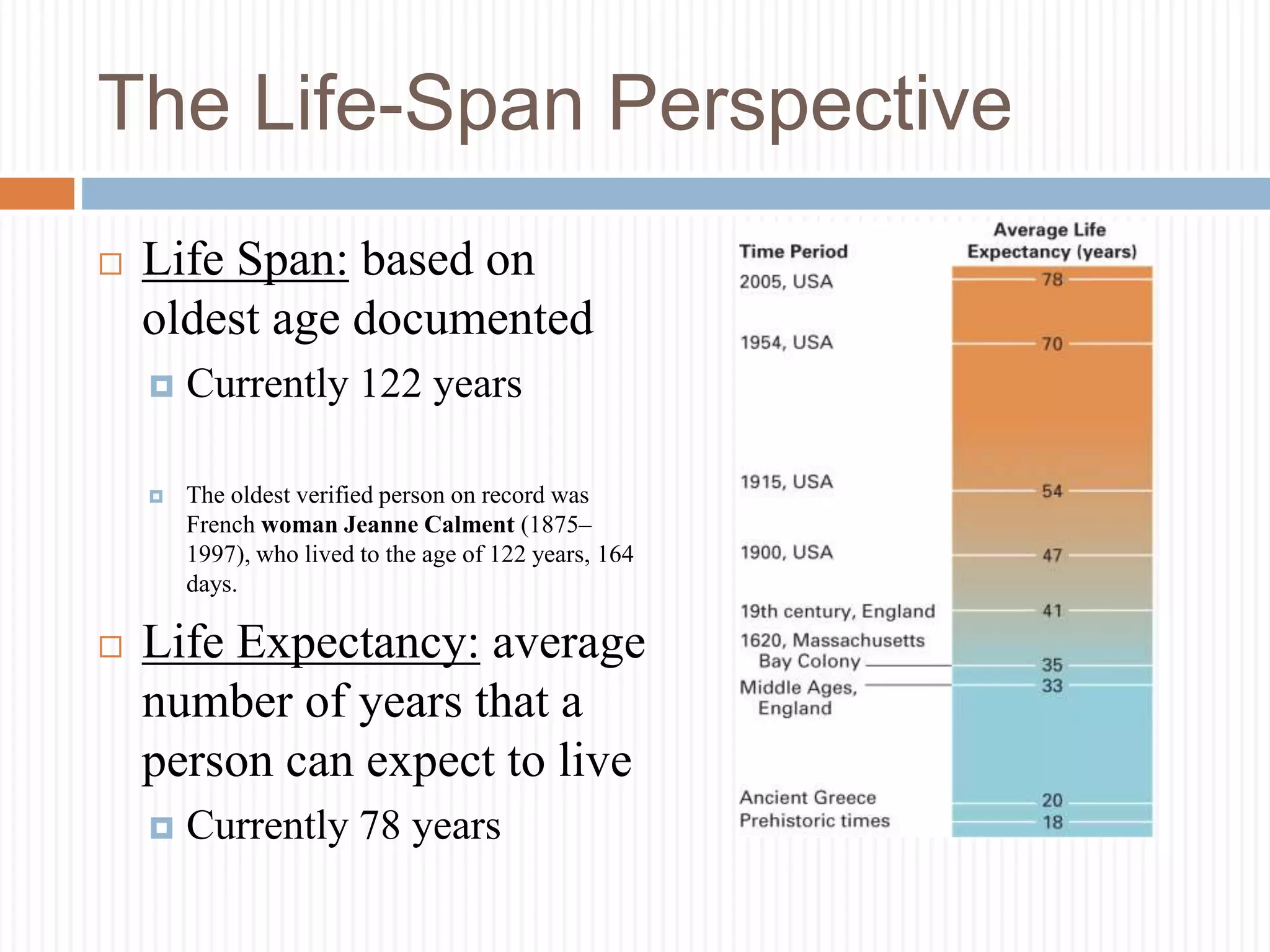
 Life Span: based on
oldest age documented
 Currently 122 years
 The oldest verified person on record was
French woman Jeanne Calment (1875–
1997), who lived to the age of 122 years, 164
days.
 Life Expectancy: average
number of years that a
person can expect to live
 Currently 78 years
The Life-Span Perspective
 Life-Span Perspective views development as:
 Lifelong
 Multidimensional
 Multidirectional
 Plastic
 Multidisciplinary
 Contextual
 Development is a process that involves growth,
maintenance, and regulation of loss
 Development is constructed through biological,
sociocultural, and individual factors working together
The Life-Span Perspective
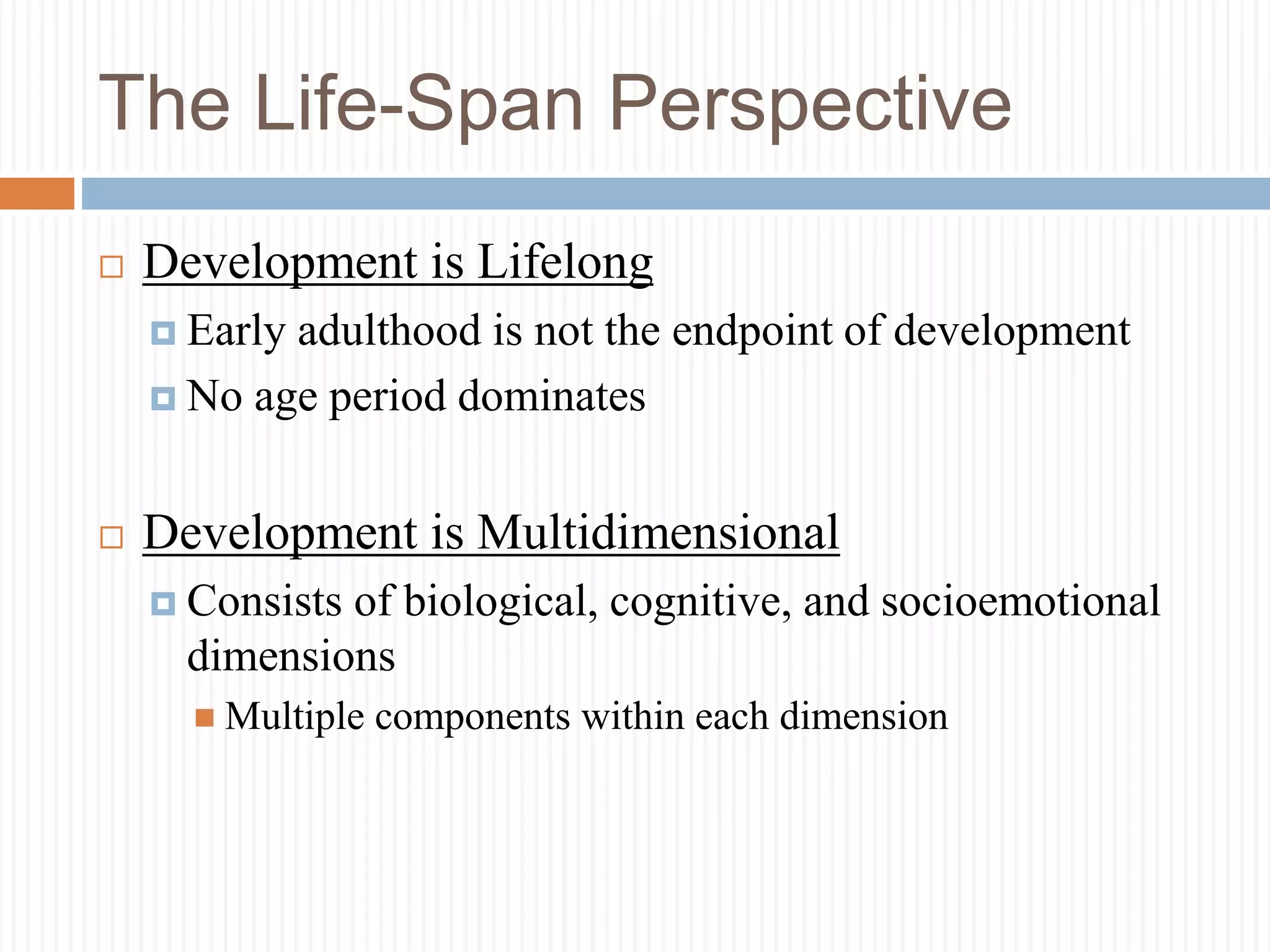
 Development is Lifelong
 Early adulthood is not the endpoint of development
 No age period dominates
 Development is Multidimensional
 Consists of biological, cognitive, and socioemotional
dimensions
 Multiple components within each dimension
The Life-Span Perspective
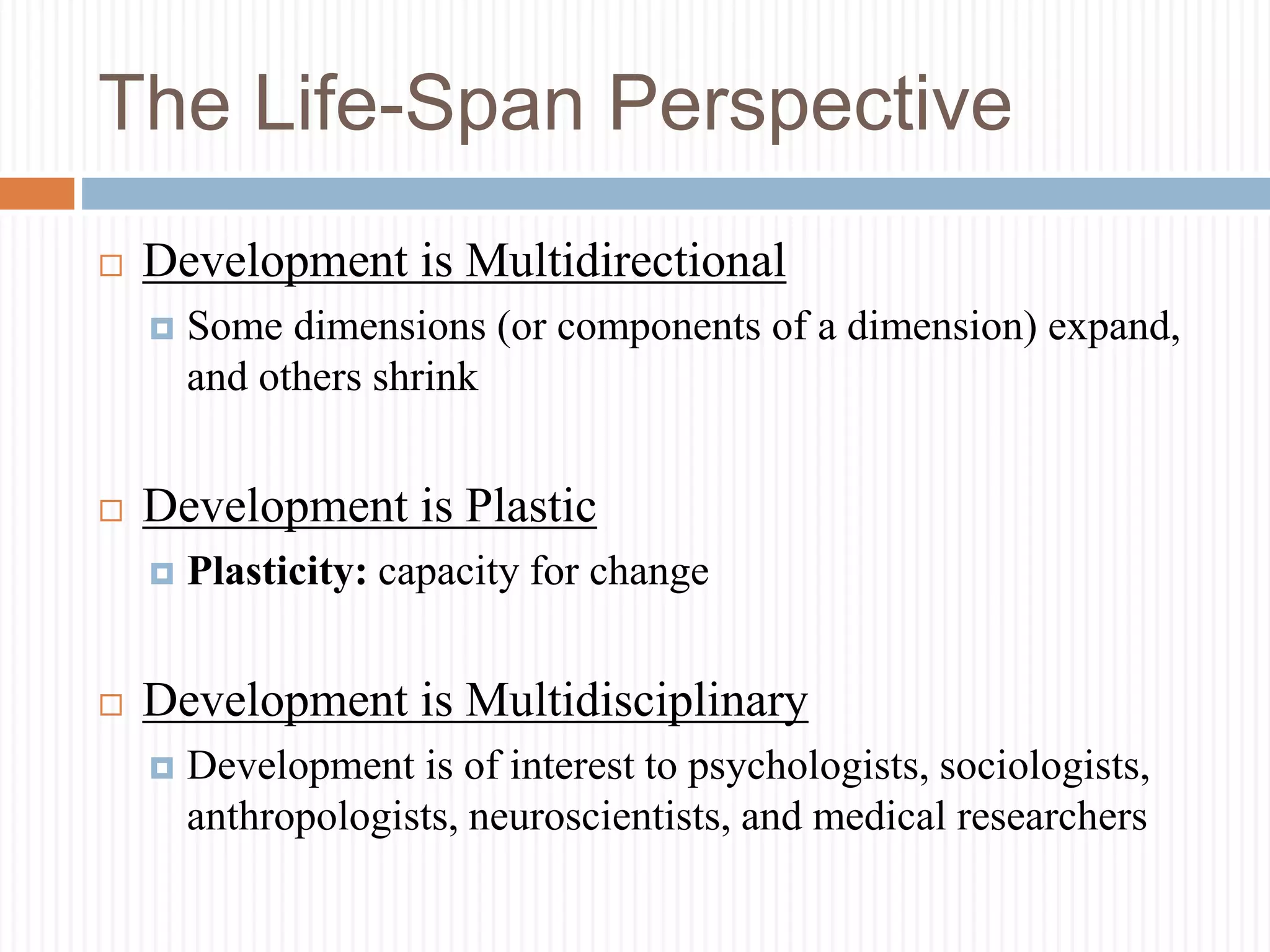
 Development is Multidirectional
 Some dimensions (or components of a dimension) expand,
and others shrink
 Development is Plastic
 Plasticity: capacity for change
 Development is Multidisciplinary
 Development is of interest to psychologists, sociologists,
anthropologists, neuroscientists, and medical researchers
The Life-Span Perspective
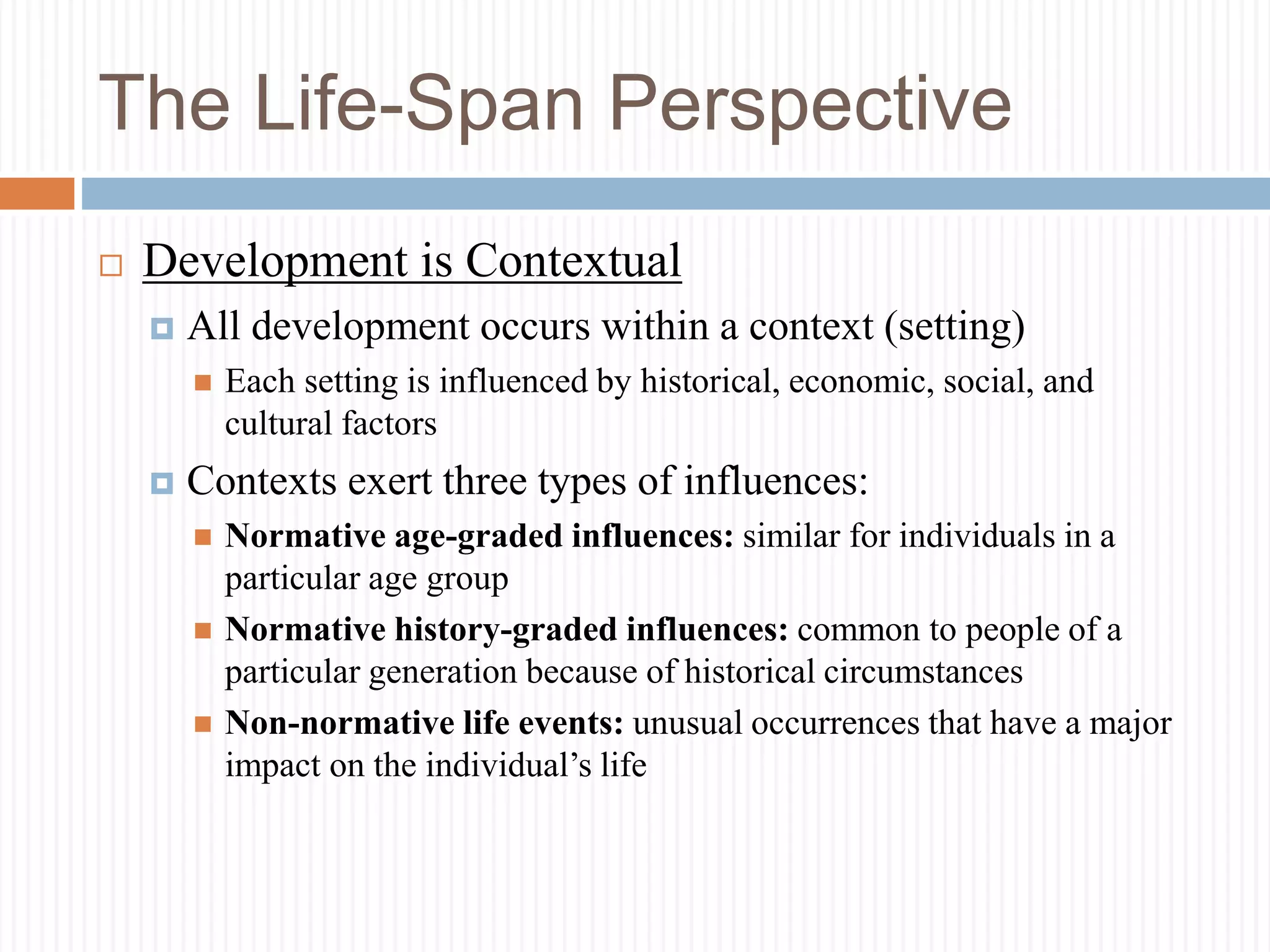
 Development is Contextual
 All development occurs within a context (setting)
 Each setting is influenced by historical, economic, social, and
cultural factors
 Contexts exert three types of influences:
 Normative age-graded influences: similar for individuals in a
particular age group
 Normative history-graded influences: common to people of a
particular generation because of historical circumstances
 Non-normative life events: unusual occurrences that have a major
impact on the individual’s life
The Life-Span Perspective
 Development Involves Growth, Maintenance, and
Regulation of Loss
 Development is a Co-Construction of Biology,
Culture, and the Individual
Some Contemporary Concerns
 Health and Well-Being
 Parenting and Education
 Sociocultural Contexts and Diversity
 Culture: behavior patterns, beliefs, and all other products
of a particular group of people that are passed on from
generation to generation
 Ethnicity: cultural heritage, nationality, race, religion, and
language
 Socioeconomic Status: a person’s position within society
based on occupational, educational, and economic
characteristics.
Social Policy Issues
 Social Policy: a government’s course of action
designed to promote the welfare of its citizens
The Nature of Development
 Development is the product of biological,
cognitive, and socioemotional processes
 Biological: changes in an individual’s physical nature
 Cognitive: changes in thought, intelligence, and
language
 Socioemotional: changes in relationships with other
people, changes in emotions, and changes in
personality
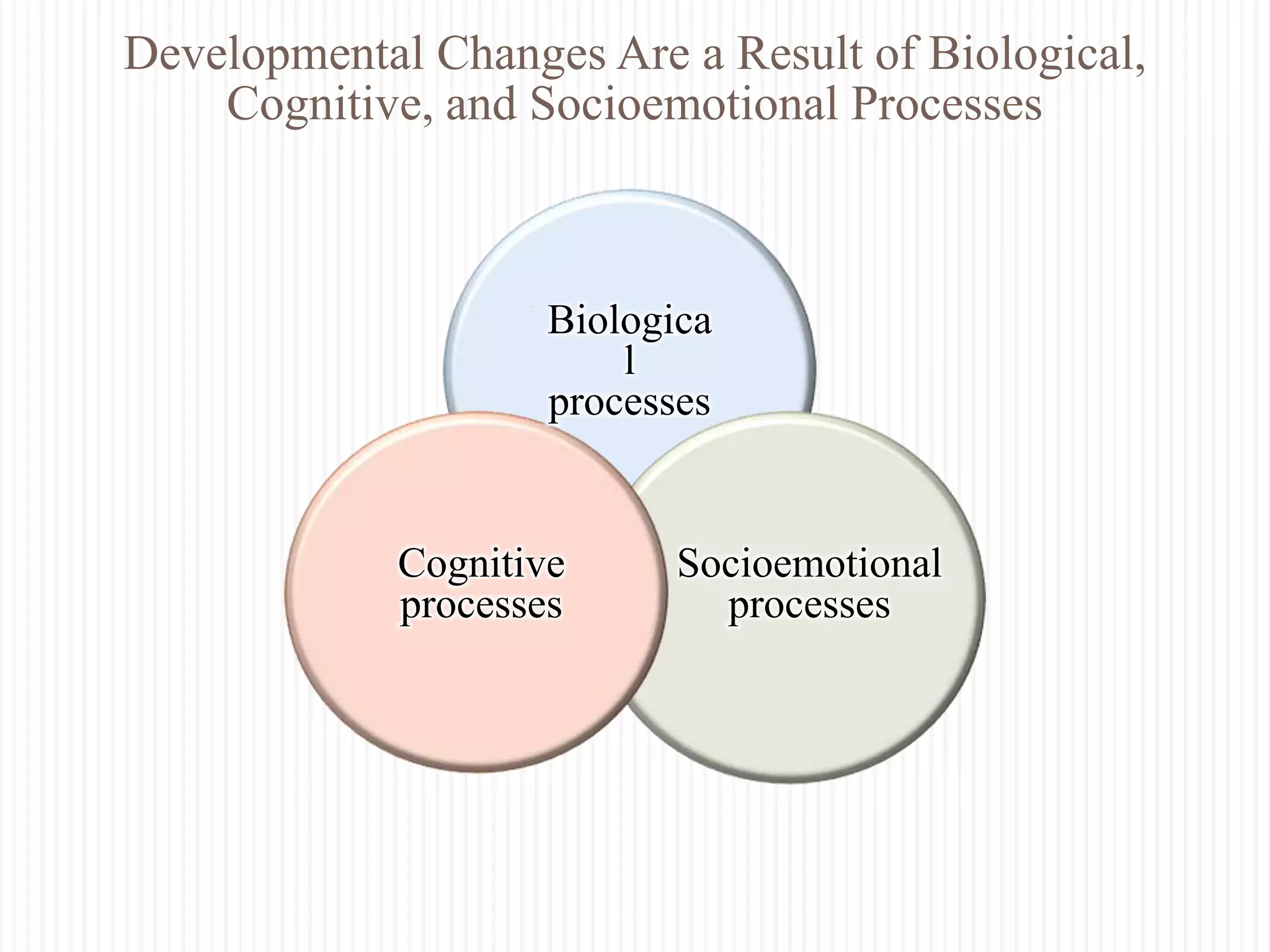
Biologica
l
processes
Socioemotional
processes
Cognitive
processes
Developmental Changes Are a Result of Biological,
Cognitive, and Socioemotional Processes
The Nature of Development
 Developmental Period: a time frame in a person’s
life that is characterized by certain features
 Prenatal period: conception to birth (9 months)
 Tremendous growth
 Infancy: birth to 18-24 months
 Dependence upon adults
 Development of many psychological activities
 Early childhood: end of infancy to 5-6 years
 Preschool years
 Self-sufficiency and increased play
The Nature of Development
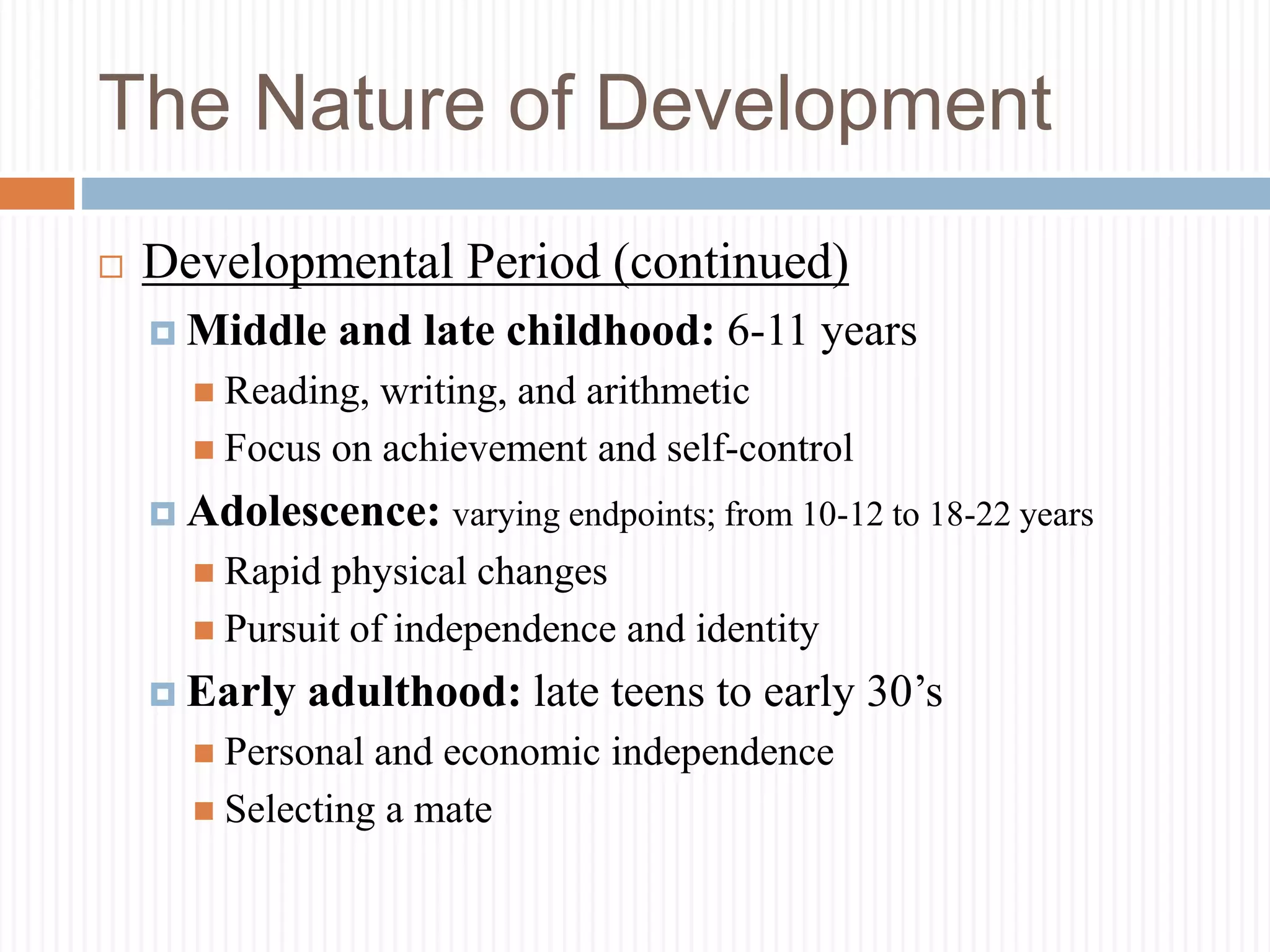
 Developmental Period (continued)
 Middle and late childhood: 6-11 years
 Reading, writing, and arithmetic
 Focus on achievement and self-control
 Adolescence: varying endpoints; from 10-12 to 18-22 years
 Rapid physical changes
 Pursuit of independence and identity
 Early adulthood: late teens to early 30’s
 Personal and economic independence
 Selecting a mate
The Nature of Development
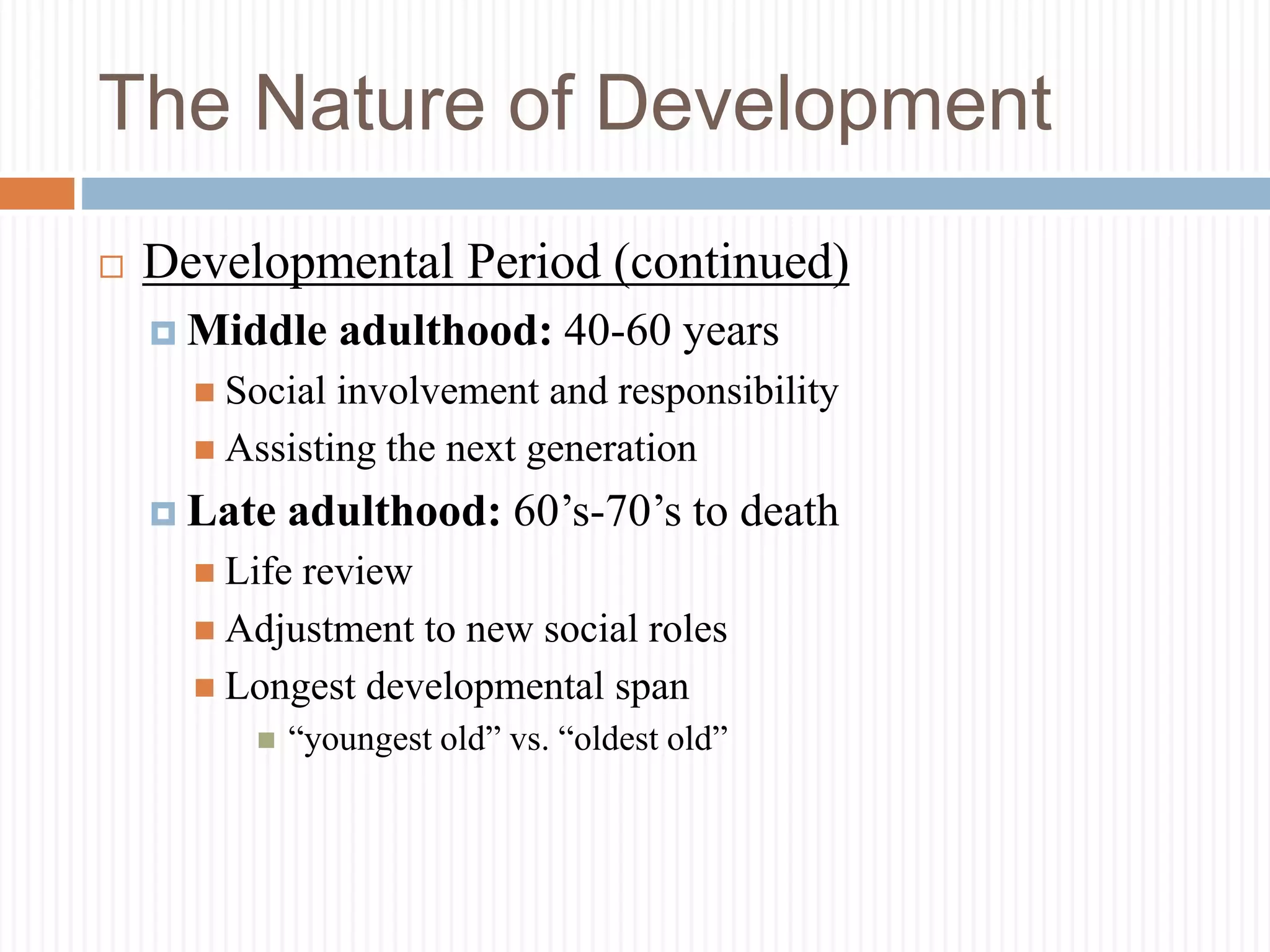
 Developmental Period (continued)
 Middle adulthood: 40-60 years
 Social involvement and responsibility
 Assisting the next generation
 Late adulthood: 60’s-70’s to death
 Life review
 Adjustment to new social roles
 Longest developmental span
 “youngest old” vs. “oldest old”
The Nature of Development
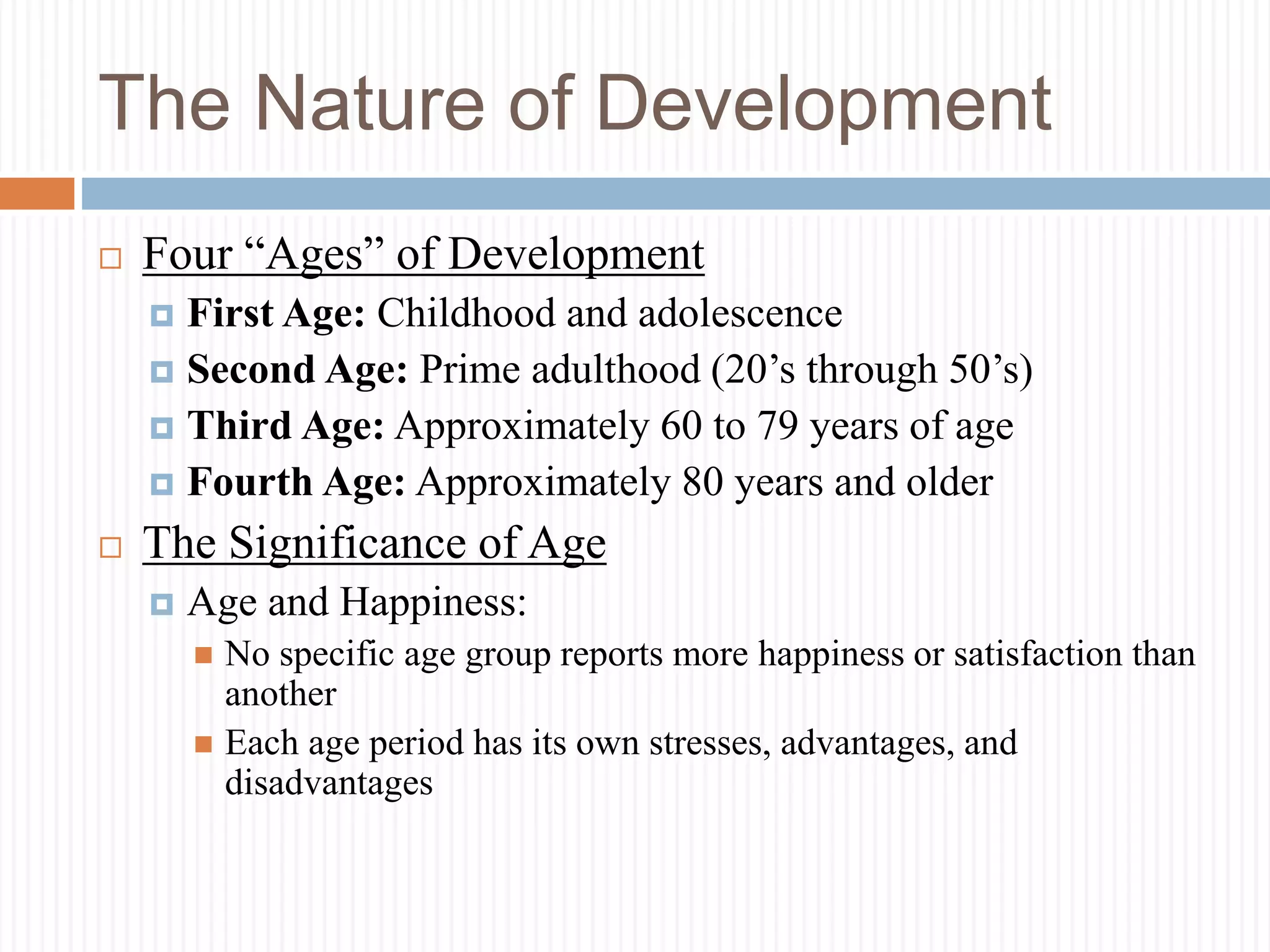
 Four “Ages” of Development
 First Age: Childhood and adolescence
 Second Age: Prime adulthood (20’s through 50’s)
 Third Age: Approximately 60 to 79 years of age
 Fourth Age: Approximately 80 years and older
 The Significance of Age
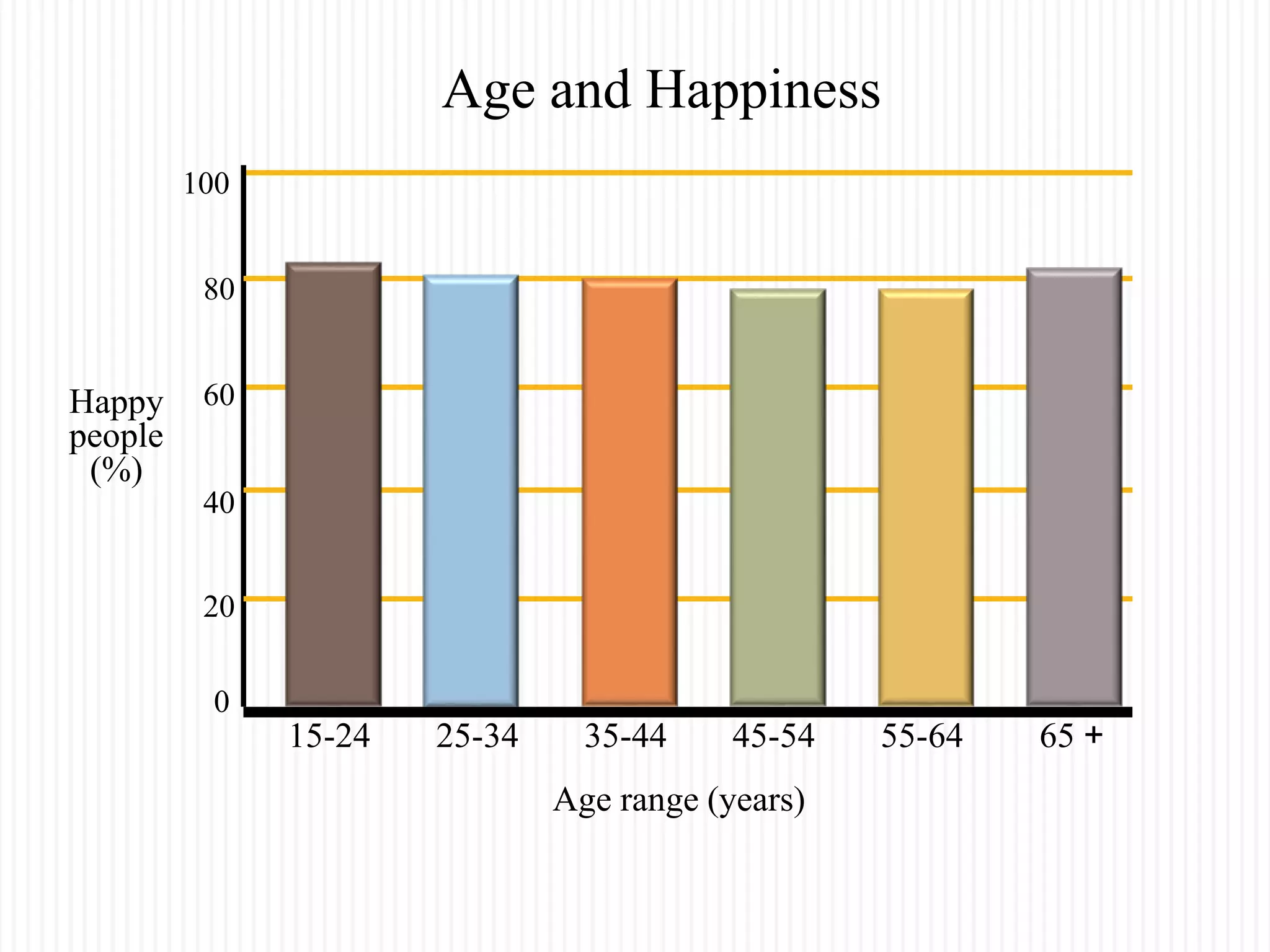
 Age and Happiness:
 No specific age group reports more happiness or satisfaction than
another
 Each age period has its own stresses, advantages, and
disadvantages
100
0
20
40
80
60
Happy
people
(%)
Age range (years)
Age and Happiness
65 +
15-24 25-34 35-44 45-54 55-64
The Nature of Development
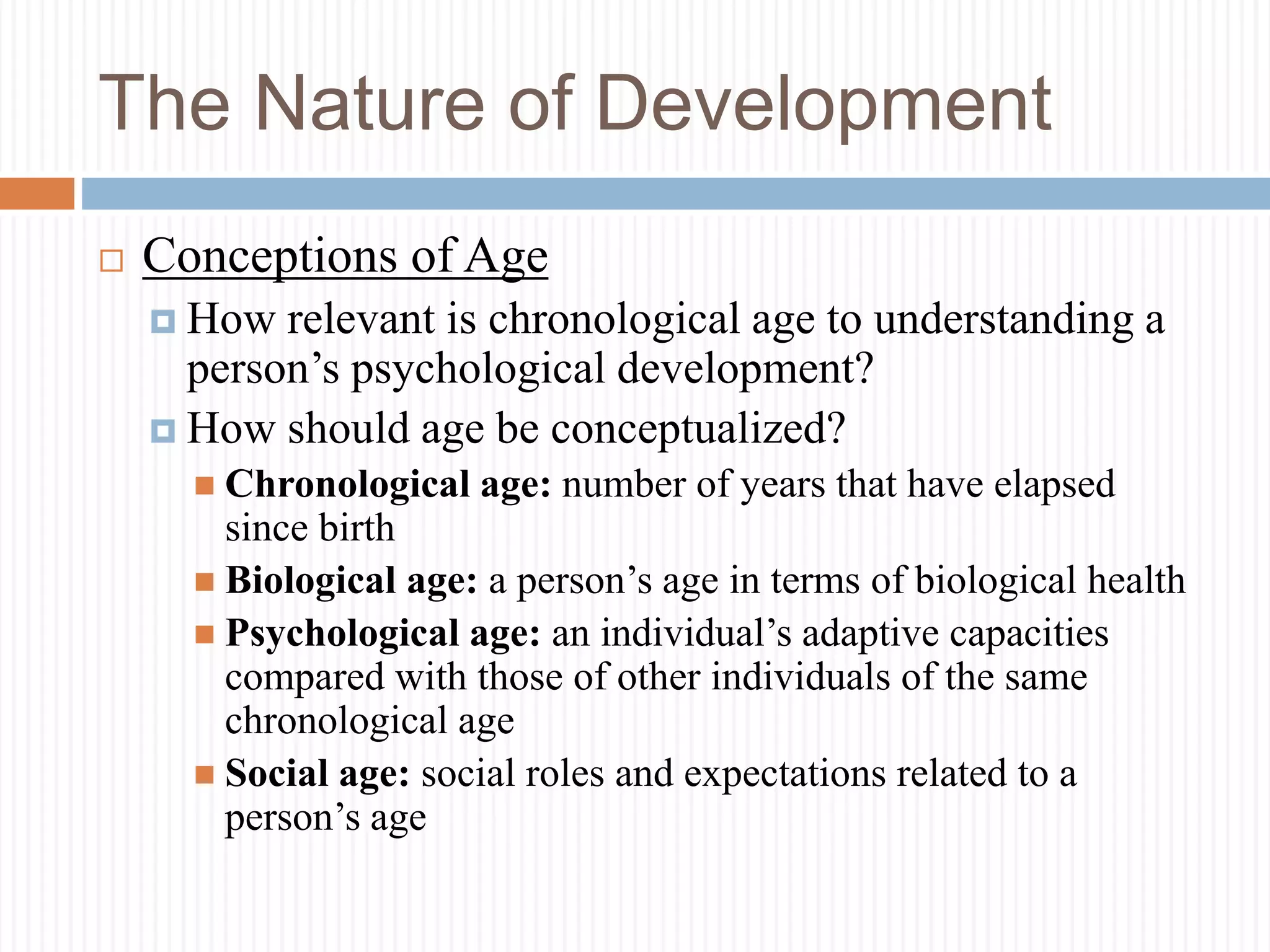
 Conceptions of Age
 How relevant is chronological age to understanding a
person’s psychological development?
 How should age be conceptualized?
 Chronological age: number of years that have elapsed
since birth
 Biological age: a person’s age in terms of biological health
 Psychological age: an individual’s adaptive capacities
compared with those of other individuals of the same
chronological age
 Social age: social roles and expectations related to a
person’s age
Developmental Issues
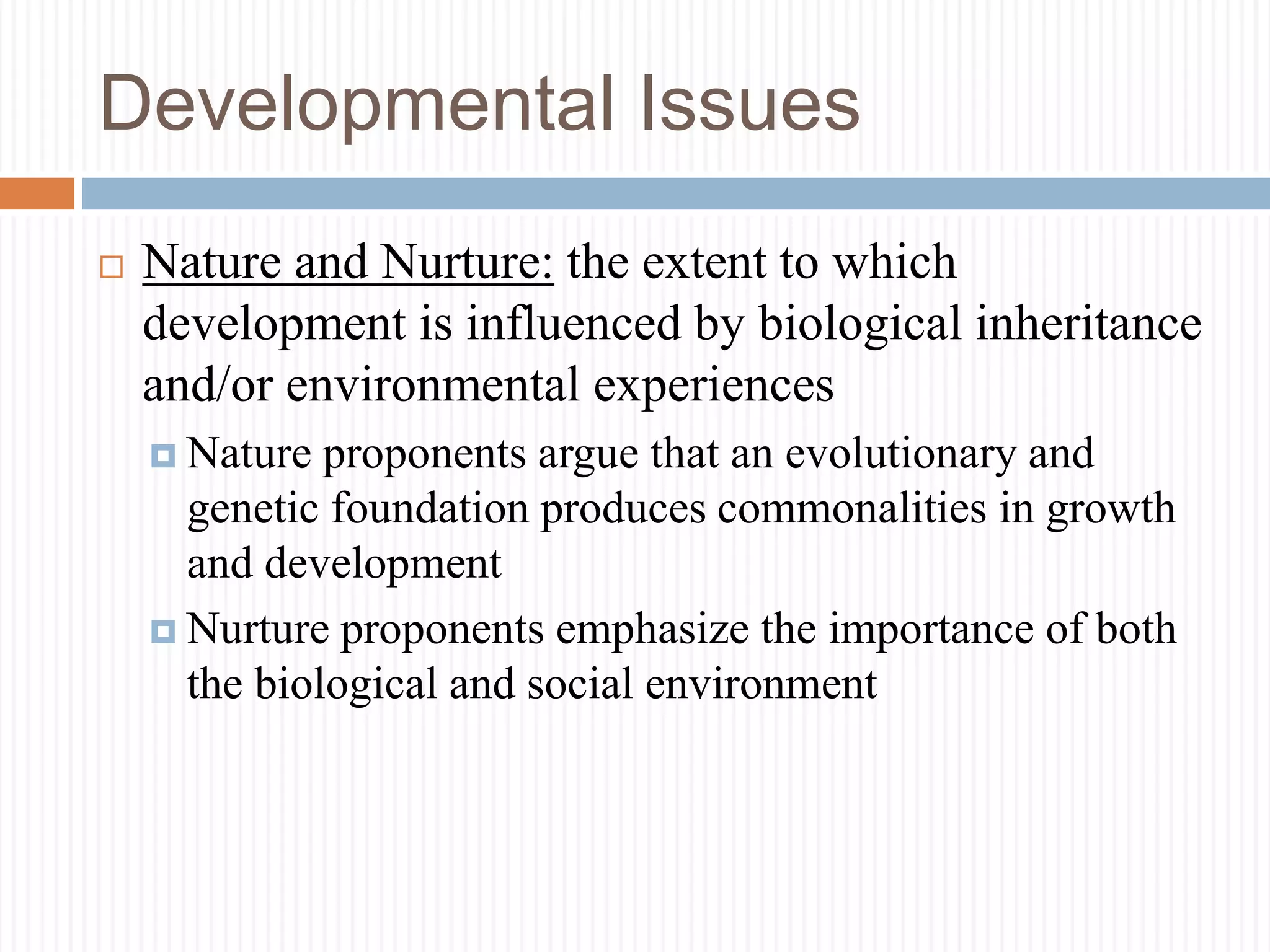
 Nature and Nurture: the extent to which
development is influenced by biological inheritance
and/or environmental experiences
 Nature proponents argue that an evolutionary and
genetic foundation produces commonalities in growth
and development
 Nurture proponents emphasize the importance of both
the biological and social environment
Developmental Issues
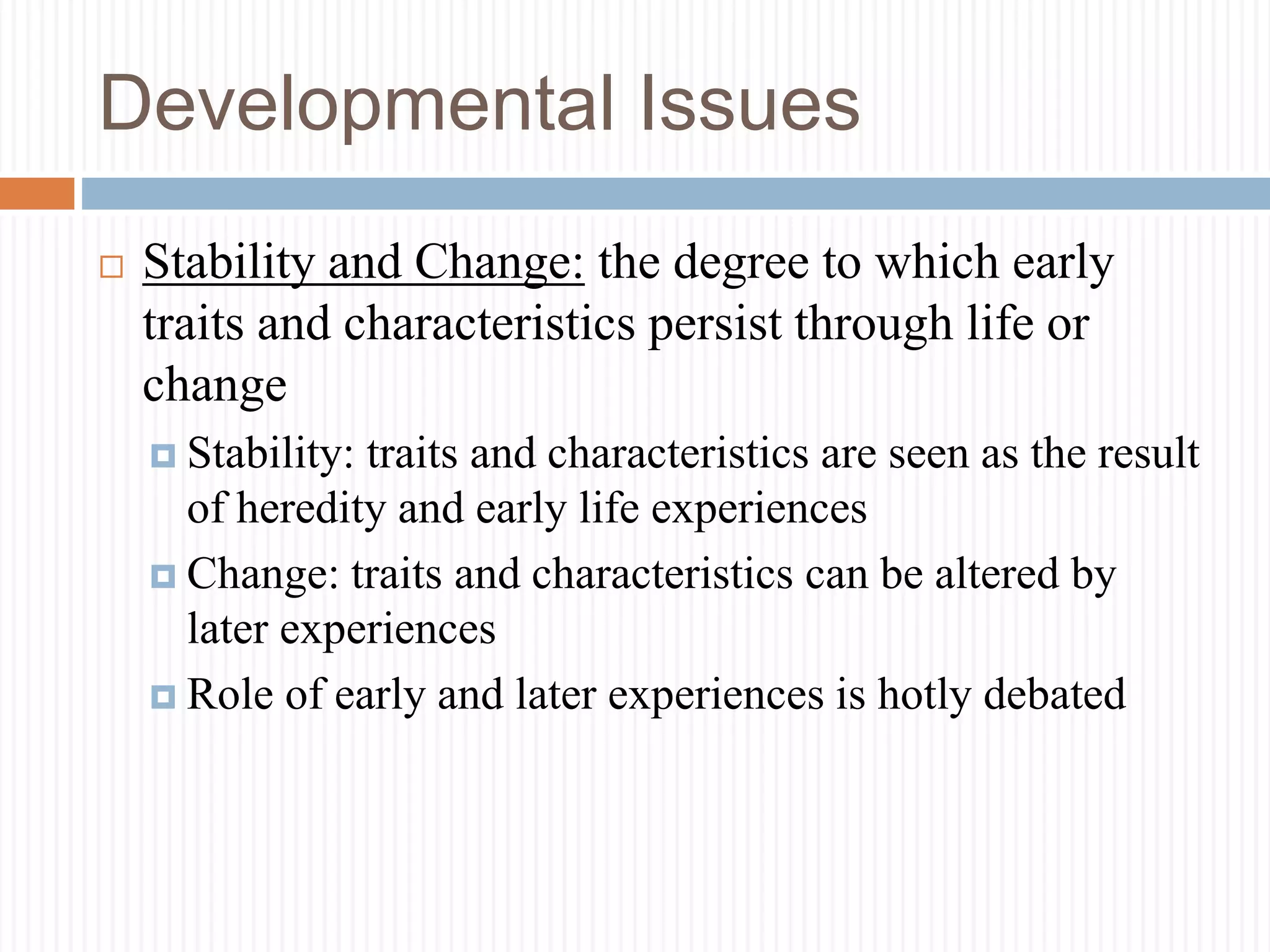
 Stability and Change: the degree to which early
traits and characteristics persist through life or
change
 Stability: traits and characteristics are seen as the result
of heredity and early life experiences
 Change: traits and characteristics can be altered by
later experiences
 Role of early and later experiences is hotly debated
Developmental Issues
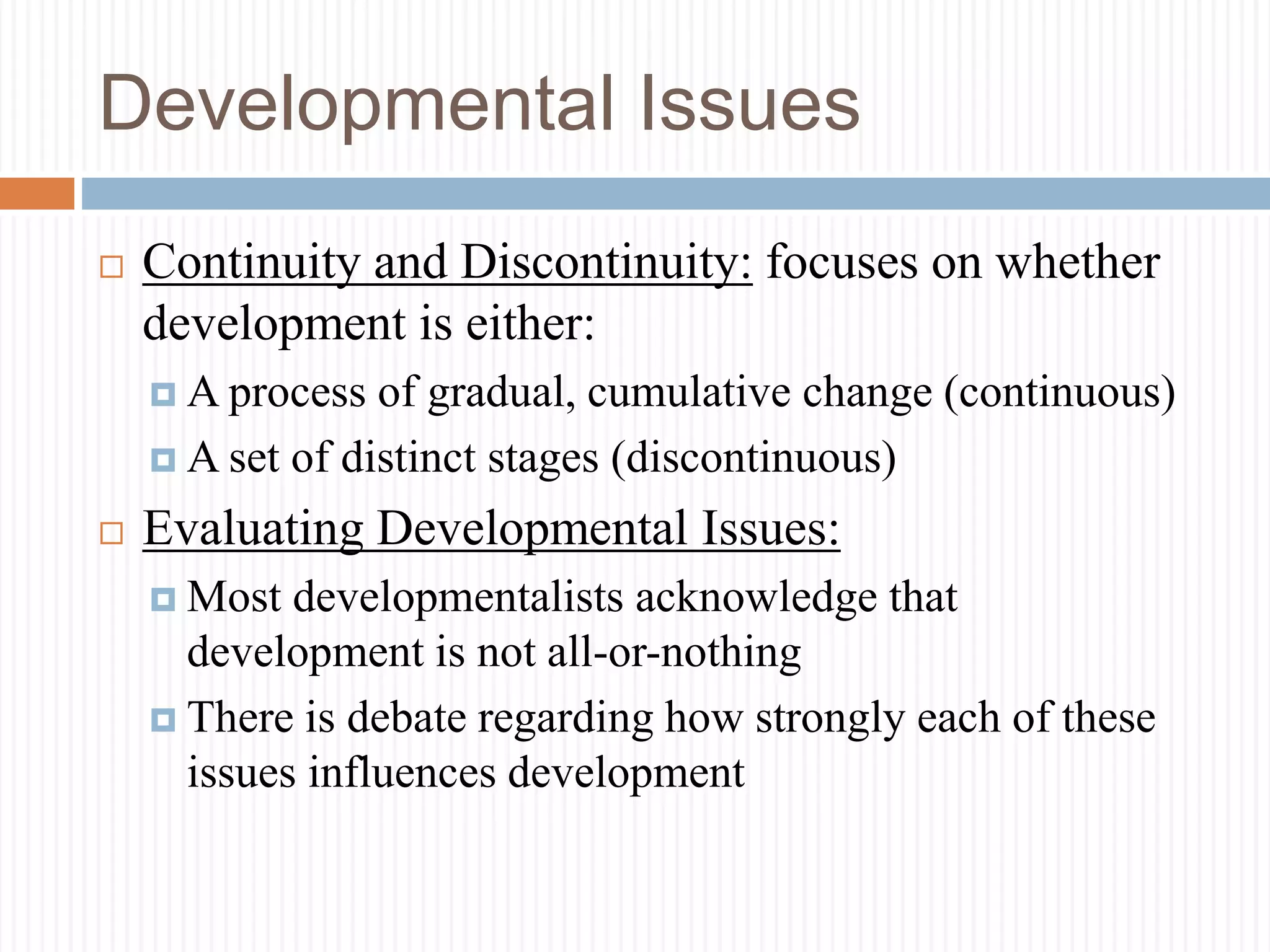
 Continuity and Discontinuity: focuses on whether
development is either:
 A process of gradual, cumulative change (continuous)
 A set of distinct stages (discontinuous)
 Evaluating Developmental Issues:
 Most developmentalists acknowledge that
development is not all-or-nothing
 There is debate regarding how strongly each of these
issues influences development
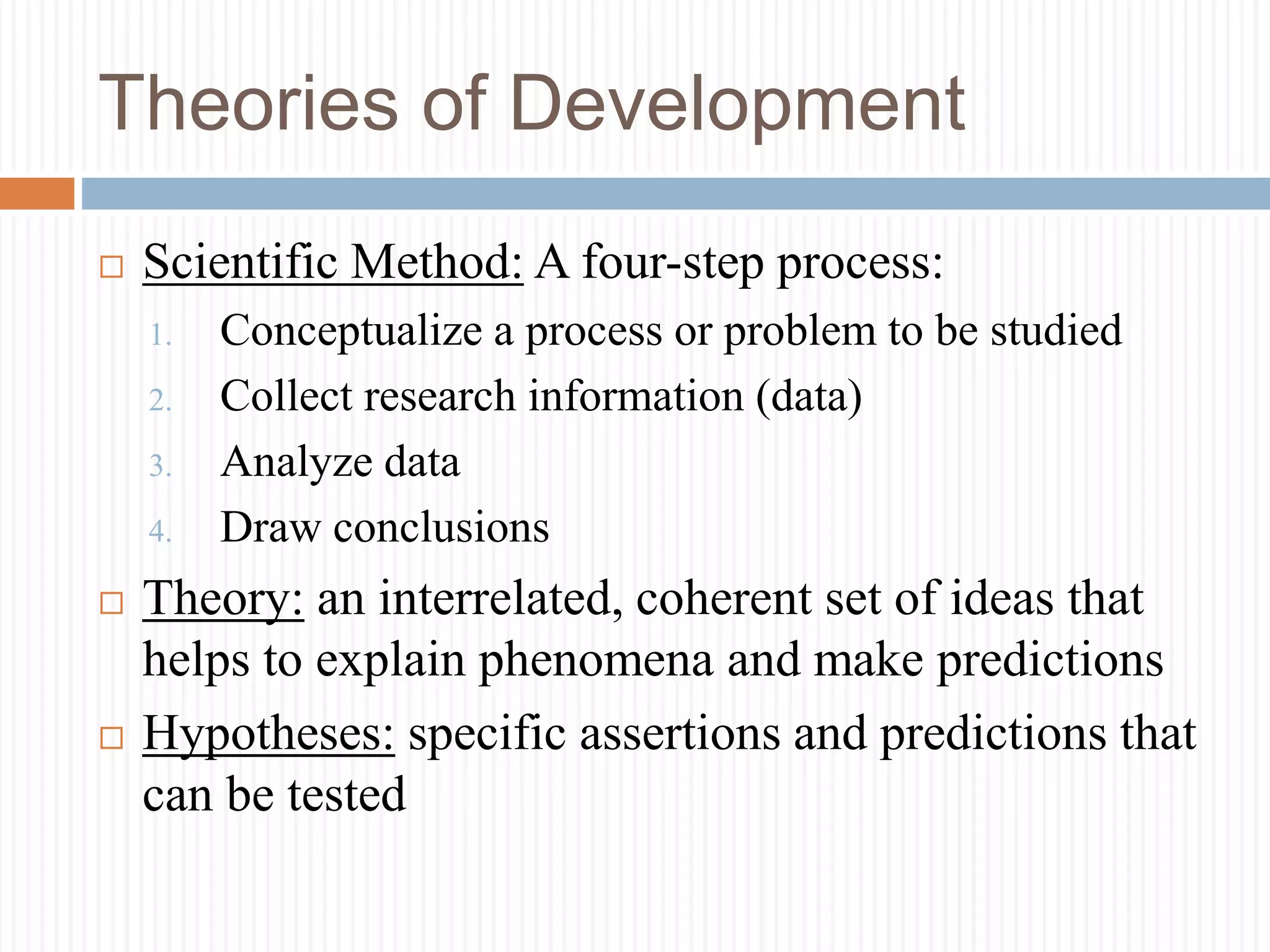
Theories of Development
 Scientific Method: A four-step process:
1. Conceptualize a process or problem to be studied
2. Collect research information (data)
3. Analyze data
4. Draw conclusions
 Theory: an interrelated, coherent set of ideas that
helps to explain phenomena and make predictions
 Hypotheses: specific assertions and predictions that
can be tested
Theories of Development
 Diverse but complementary theories are used for
explaining life-span development:
 Psychoanalytic theories
 Cognitive theories
 Behavioral and social cognitive theories
 Ethological theory
 Ecological theory
Psychoanalytic Theories
 Psychoanalytic Theories: describe development as
primarily unconscious
 True understanding requires analyzing the symbolic
meanings of behavior
 Early experiences with parents extensively shape
development
Psychoanalytic Theories
 Freud’s Theory:
 Focus of sexual impulses changes throughout
development
 Five stages of psychosexual development (oral, anal,
phallic, latency, genital)
 Adult personality is determined by the way we resolve
conflict within each stage
 Modern theorists place less emphasis on sexual
instincts and more on cultural experiences
Psychoanalytic Theories
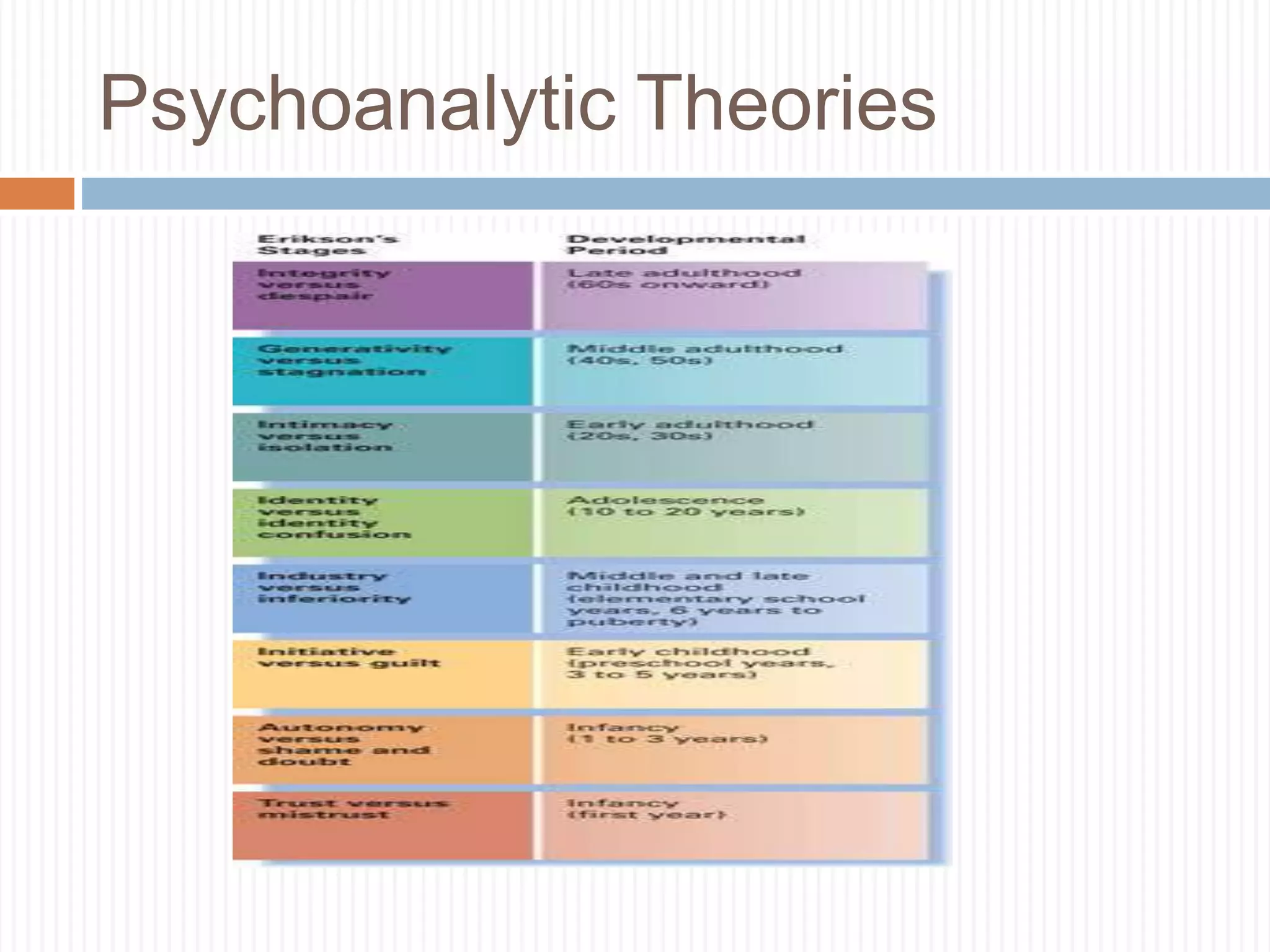
 Erikson’s Psychosocial Theory:
 Focused on our desire to affiliate with other people
 Believed that developmental change occurs throughout
the life span
 Proposed eight stages of development
 Each stage comprises a crisis that must be resolved
Psychoanalytic Theories
 Evaluating Psychoanalytic Theories:
 Contributions:
 Emphasis on a developmental framework, family
relationships, and unconscious aspects of the mind
 Criticisms:
 Lack of scientific support
 Too much emphasis on sexual underpinnings
 Negative image of people
Cognitive Theories
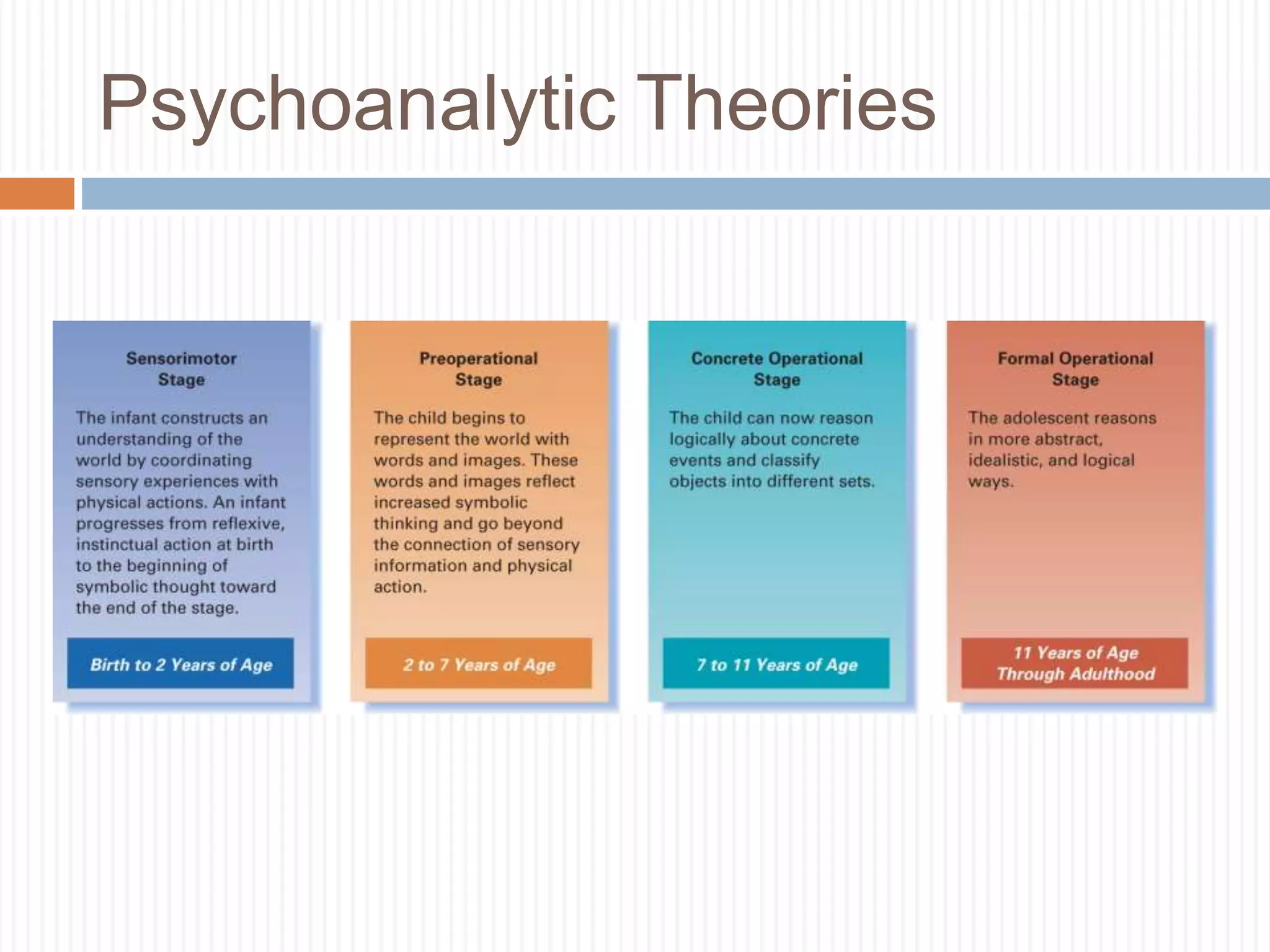
 Piaget’s Cognitive Developmental Theory:
 Stresses conscious thoughts
 Emphasizes the processes of organization and
adaptation
 Four stages of cognitive development in children
 Each stage represents a qualitatively different way of
understanding the world
Cognitive Theories
Psychoanalytic Theories
Cognitive Theories
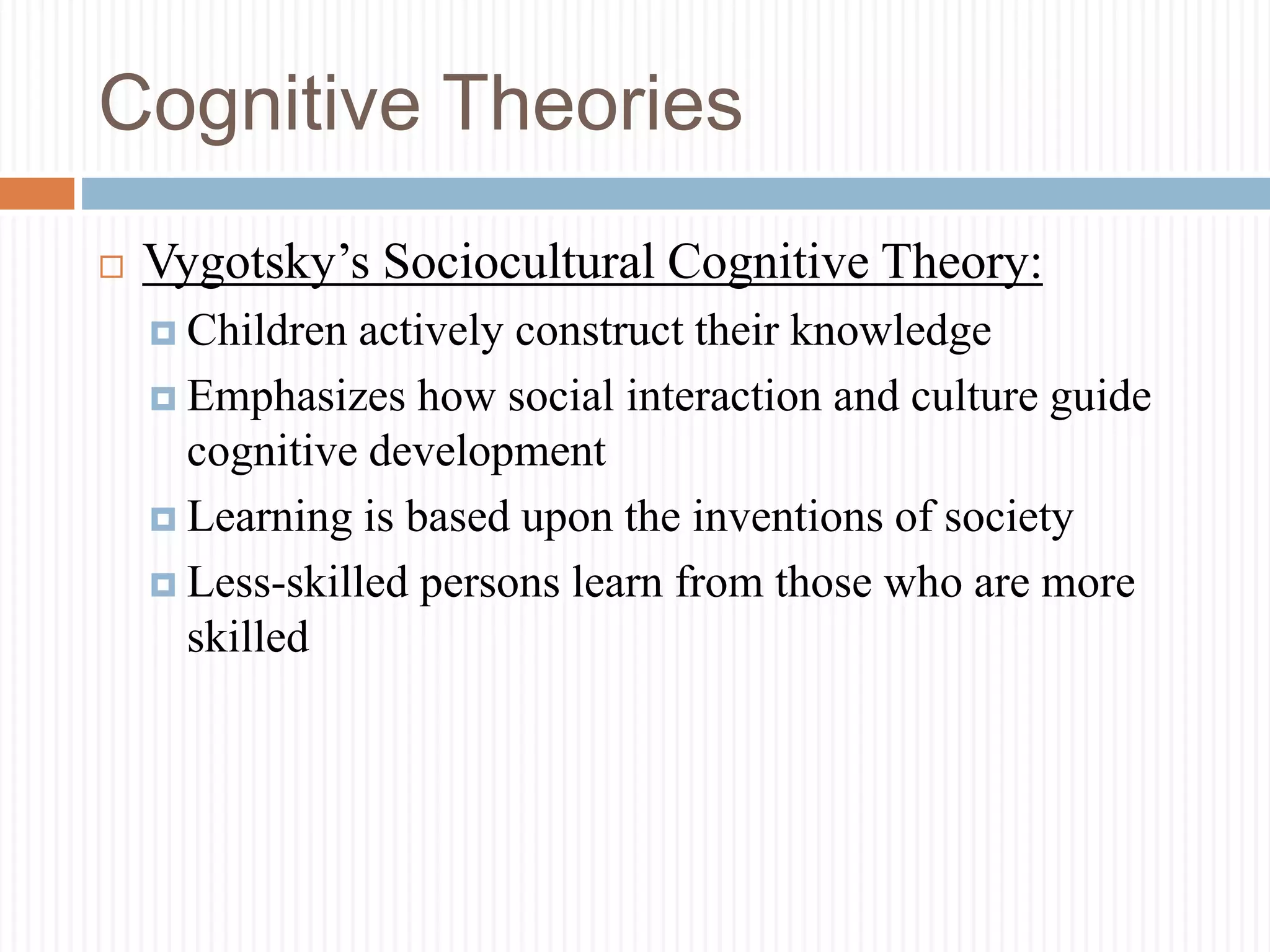
 Vygotsky’s Sociocultural Cognitive Theory:
 Children actively construct their knowledge
 Emphasizes how social interaction and culture guide
cognitive development
 Learning is based upon the inventions of society
 Less-skilled persons learn from those who are more
skilled
Cognitive Theories
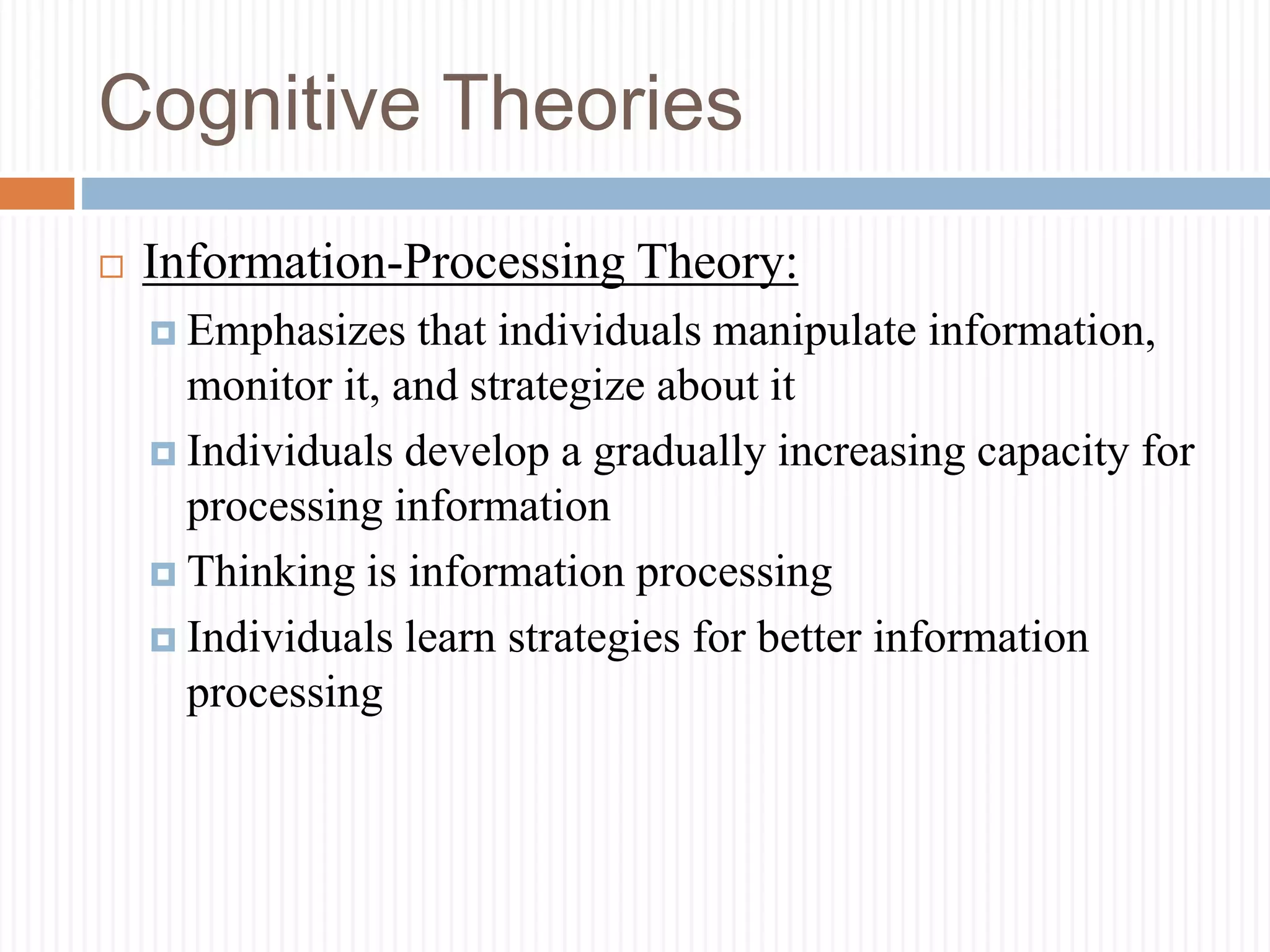
 Information-Processing Theory:
 Emphasizes that individuals manipulate information,
monitor it, and strategize about it
 Individuals develop a gradually increasing capacity for
processing information
 Thinking is information processing
 Individuals learn strategies for better information
processing
Cognitive Theories
 Evaluating Cognitive Theories:
 Contributions:
 Positive view on development
 Emphasis on the active construction of understanding
 Criticisms:
 Skepticism about the pureness of Piaget’s stages
 Too little attention to individual variations
Behavioral & Social Cognitive Theories
 Behavioral and Social Cognitive Theories:
 Behaviorism: we can study scientifically only what
can be directly observed and measured
 Development is observable behavior that can be learned
through experience
 Skinner’s Operant Conditioning:
 Consequences of a behavior produce changes in the
probability of the behavior’s occurrence
 A reward increases likelihood of behavior
 A punishment decreases likelihood of behavior
Behavioral & Social Cognitive Theories
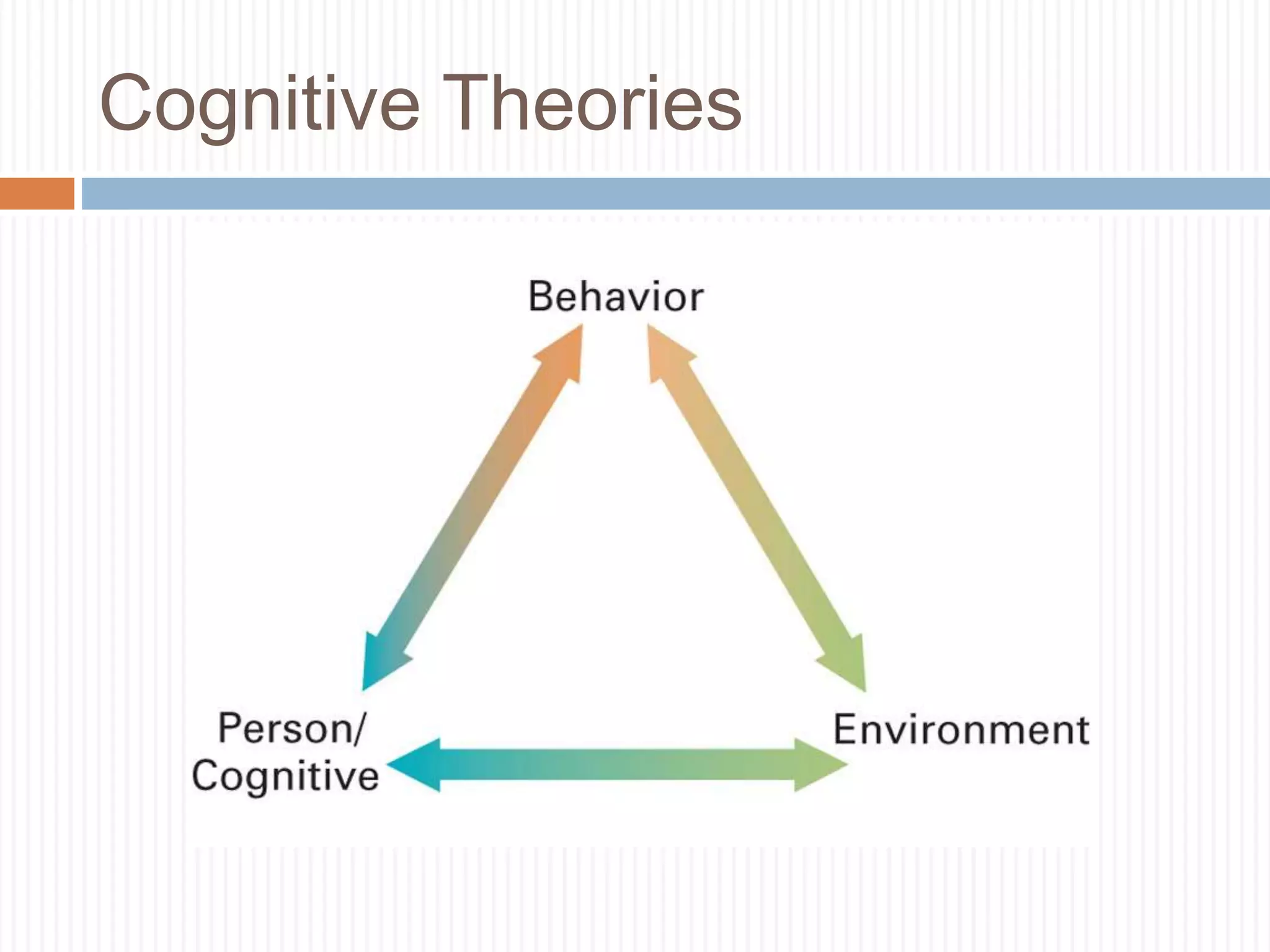
 Bandura’s Social Cognitive
Theory:
 Behavior, environment, and
cognition are key factors in
development
 Observational learning:
learning through observation
 People cognitively represent
the behavior of others
Behavioral & Social Cognitive Theories
 Evaluating Behavioral and Social Cognitive
Theories:
 Contributions:
 Emphasis on scientific research and environmental
determinants of behavior
 Criticisms:
 Little emphasis on cognition (Skinner)
 Inadequate attention given to developmental changes
Ethological Theory
 Ethology: stresses that behavior is strongly
influenced by biology and evolution
 Bowlby stressed the importance of human attachment
during the first year of life
Ethological Theory
 Evaluating Ethological Theory:
 Contributions:
 A focus on the biological and evolutionary basis of
development
 Use of careful observations in naturalistic settings
 Criticisms:
 Too much emphasis on biological foundations
 Critical and sensitive period concepts may be too rigid
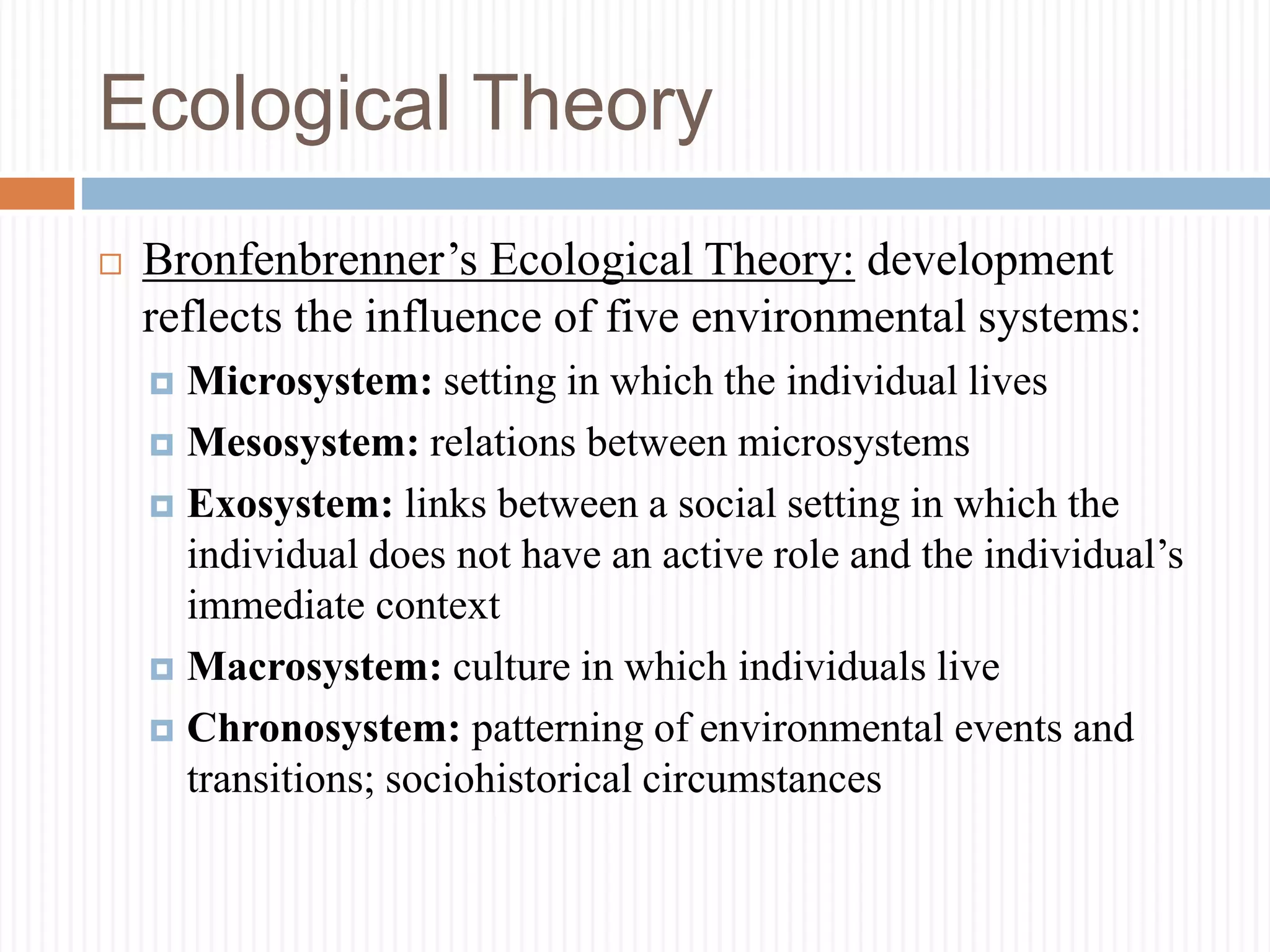
Ecological Theory
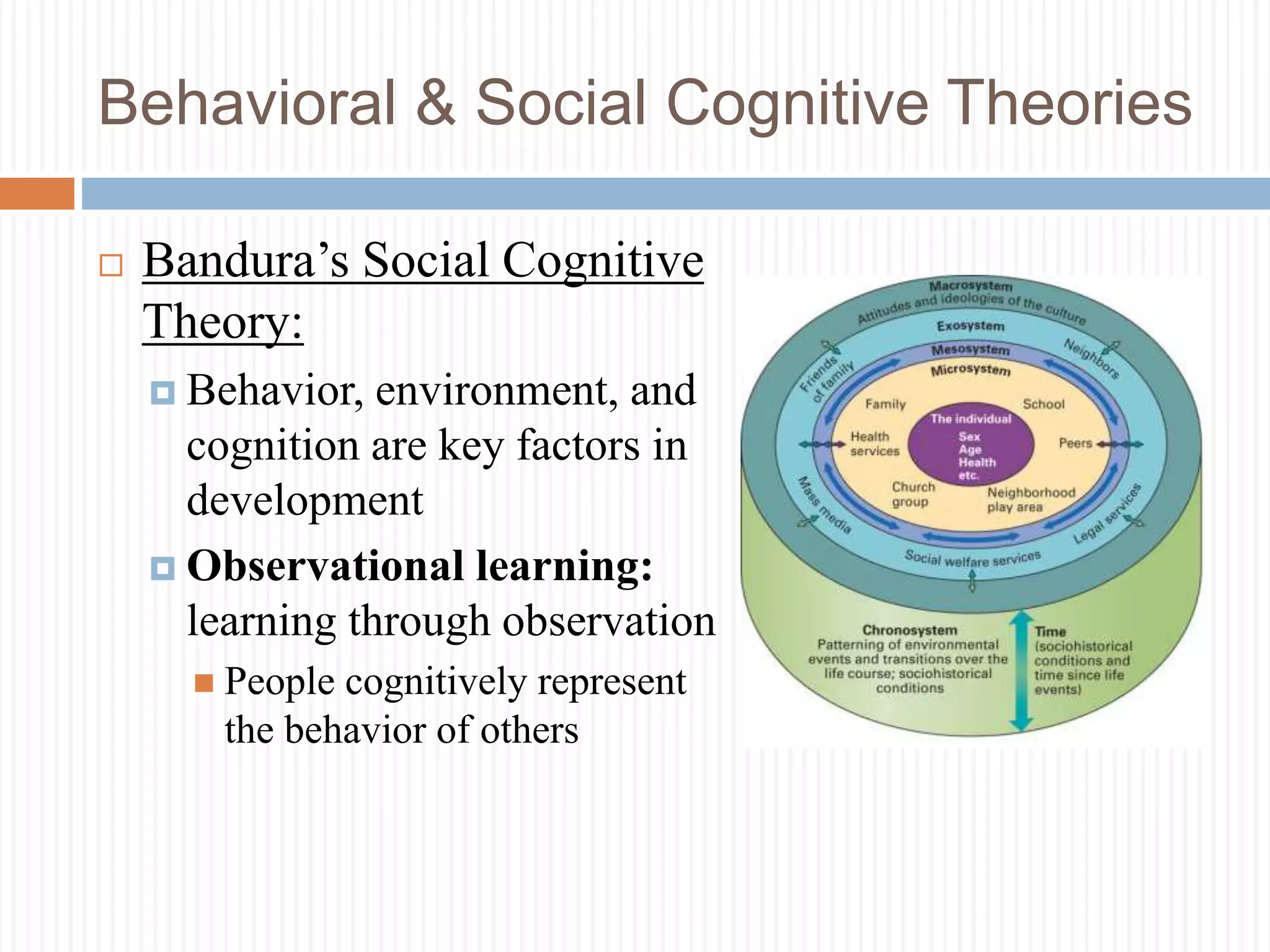
 Bronfenbrenner’s Ecological Theory: development
reflects the influence of five environmental systems:
 Microsystem: setting in which the individual lives
 Mesosystem: relations between microsystems
 Exosystem: links between a social setting in which the
individual does not have an active role and the individual’s
immediate context
 Macrosystem: culture in which individuals live
 Chronosystem: patterning of environmental events and
transitions; sociohistorical circumstances
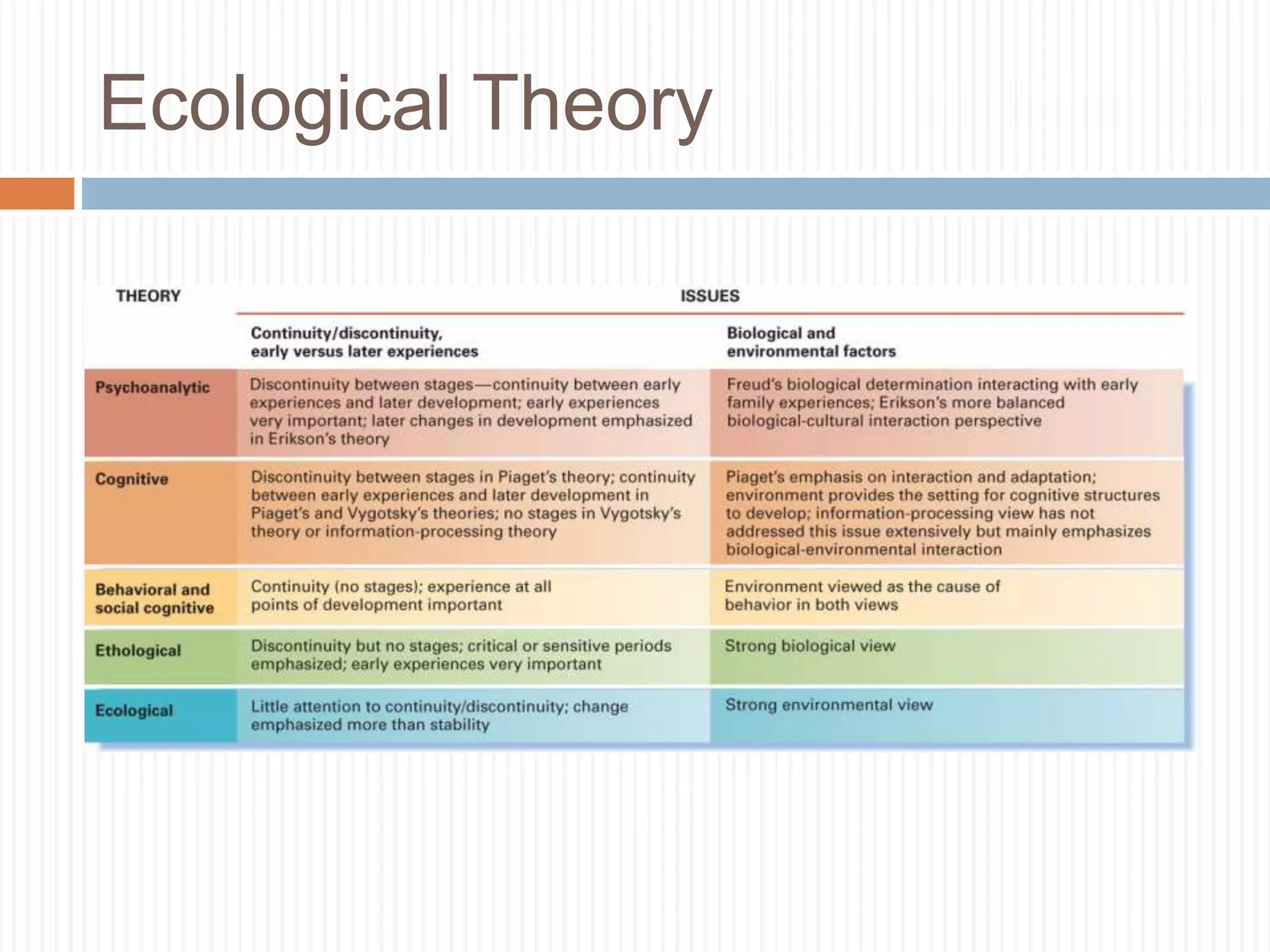
Ecological Theory
Ecological Theory
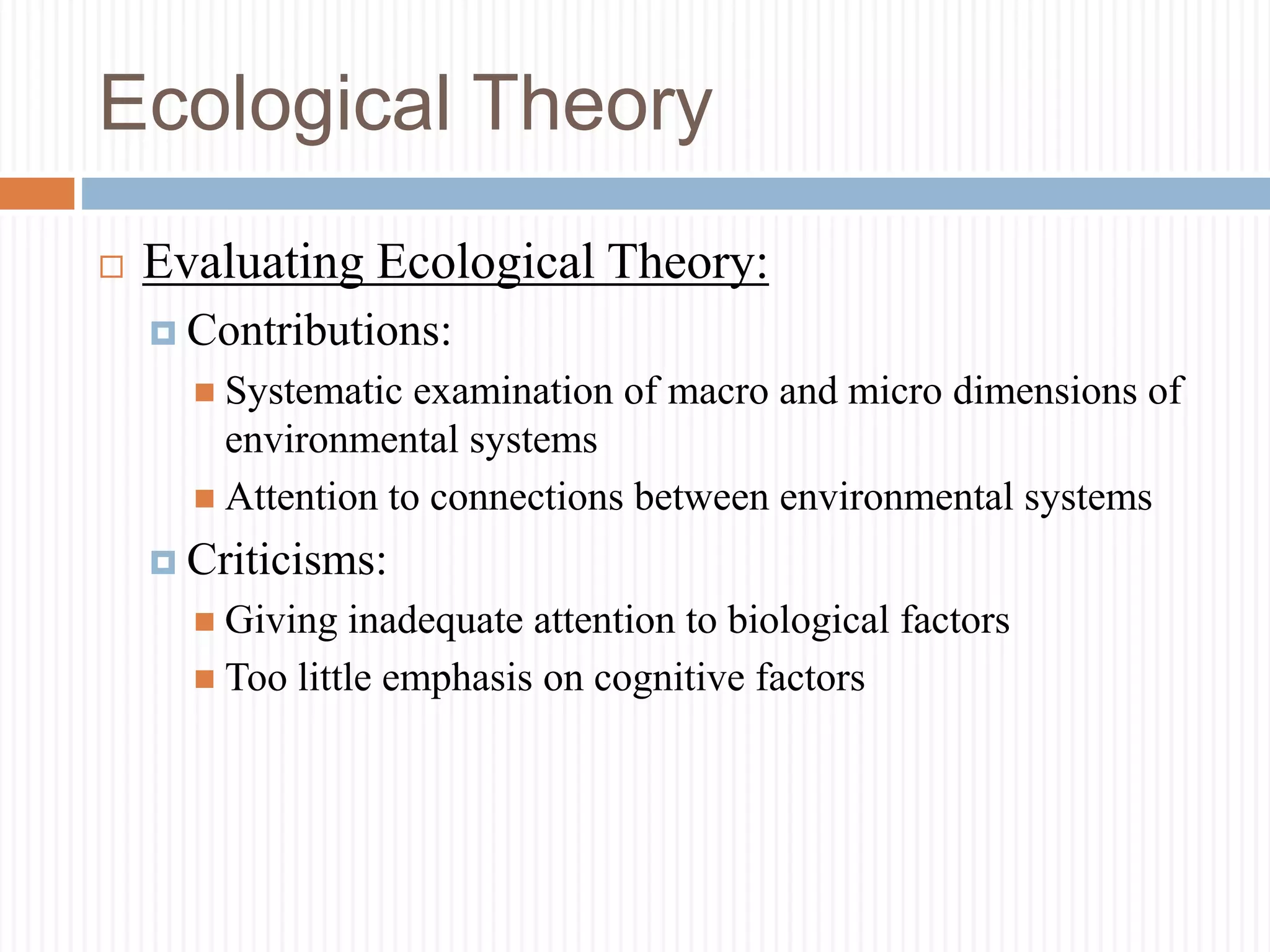
 Evaluating Ecological Theory:
 Contributions:
 Systematic examination of macro and micro dimensions of
environmental systems
 Attention to connections between environmental systems
 Criticisms:
 Giving inadequate attention to biological factors
 Too little emphasis on cognitive factors
Eclectic Theoretical Orientation
 Eclectic Theoretical Orientation:
 No single theory can explain all of development
 Every theory has contributed to our understanding
 Eclectic orientation does not follow any one theoretical
approach
 Instead, it selects from each theory whatever is considered
its best features
Research Methods
 Methods for Collecting Data:
 Observation:
 Laboratory: controlled setting that eliminates many
complex “real-world” variables
 Participants typically know they are being studied
 Setting is unnatural
 May not represent general population
 Some individuals may be intimidated by laboratory setting
 Naturalistic: observing behavior in real-world settings
 Researcher makes no effort to manipulate or control the situation
Research Methods
 Methods for Collecting Data:
 Survey and Interviews:
 Standard sets of questions are used to obtain people’s
attitudes or beliefs about a particular topic
 Can be used to study a wide variety of topics
 Participants may answer in a way that is considered socially
desirable and acceptable
Research Methods
 Methods for Collecting Data:
 Standardized Test:
 Uniform procedures for administration and scoring
 Most allow a person’s performance to be compared with
that of others
 Assumes consistency and stability across time and
situations
 Case Study:
 In-depth look at a single individual
 Difficult to generalize to others
 May not be reliable
Research Methods
 Methods for Collecting
Data:
 Physiological Measures:
 Many uses; technology is
constantly improving
 Functional magnetic
resonance imaging (fMRI):
uses electromagnetic waves to
construct images of brain
tissue and biochemical
activity
Research Designs
 Three main types: descriptive, correlational, and
experimental
 Descriptive: aims to observe and record behavior
 Methods discussed so far are descriptive
 Cannot prove causation, but can reveal important
information
Research Designs
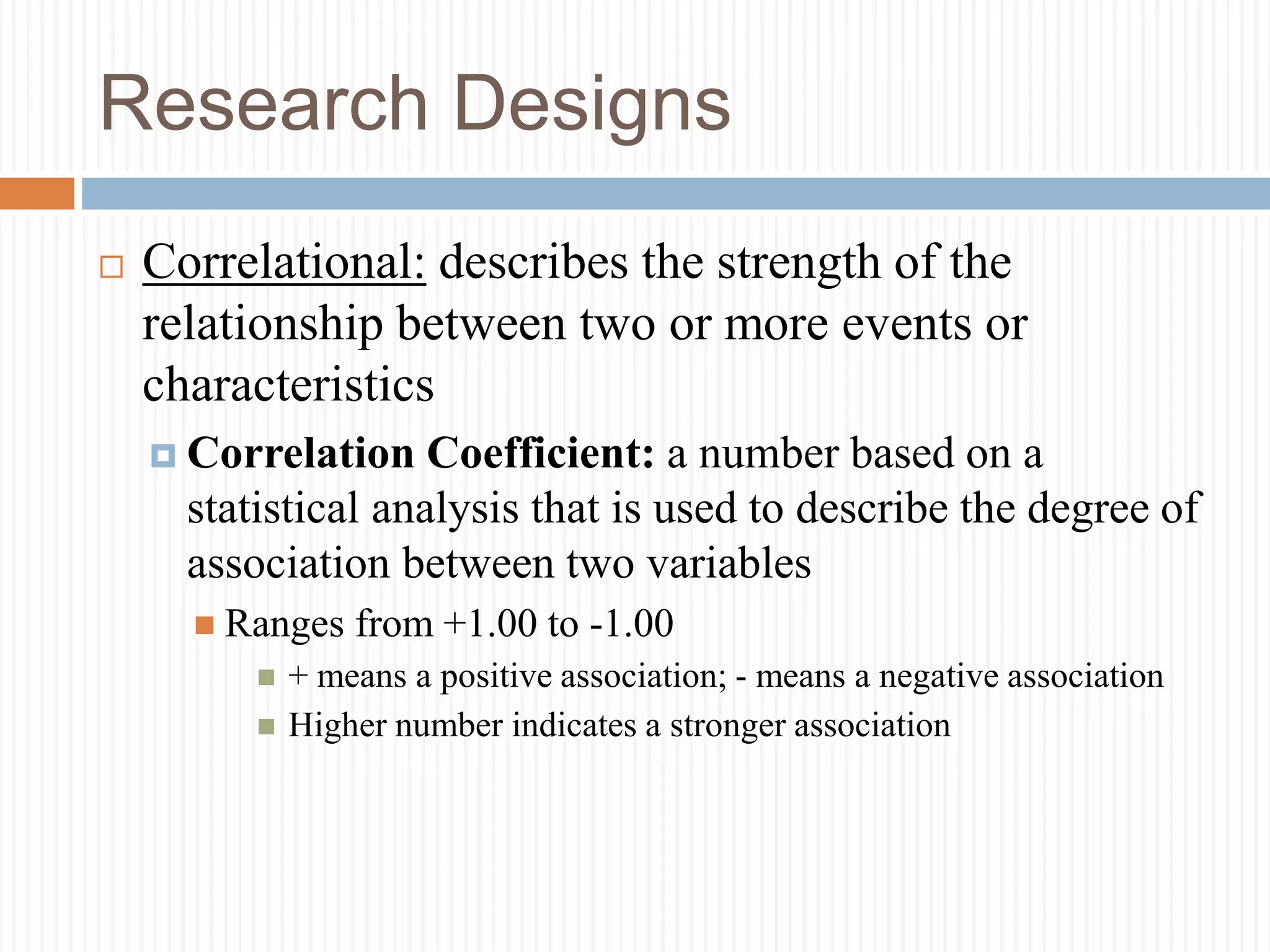
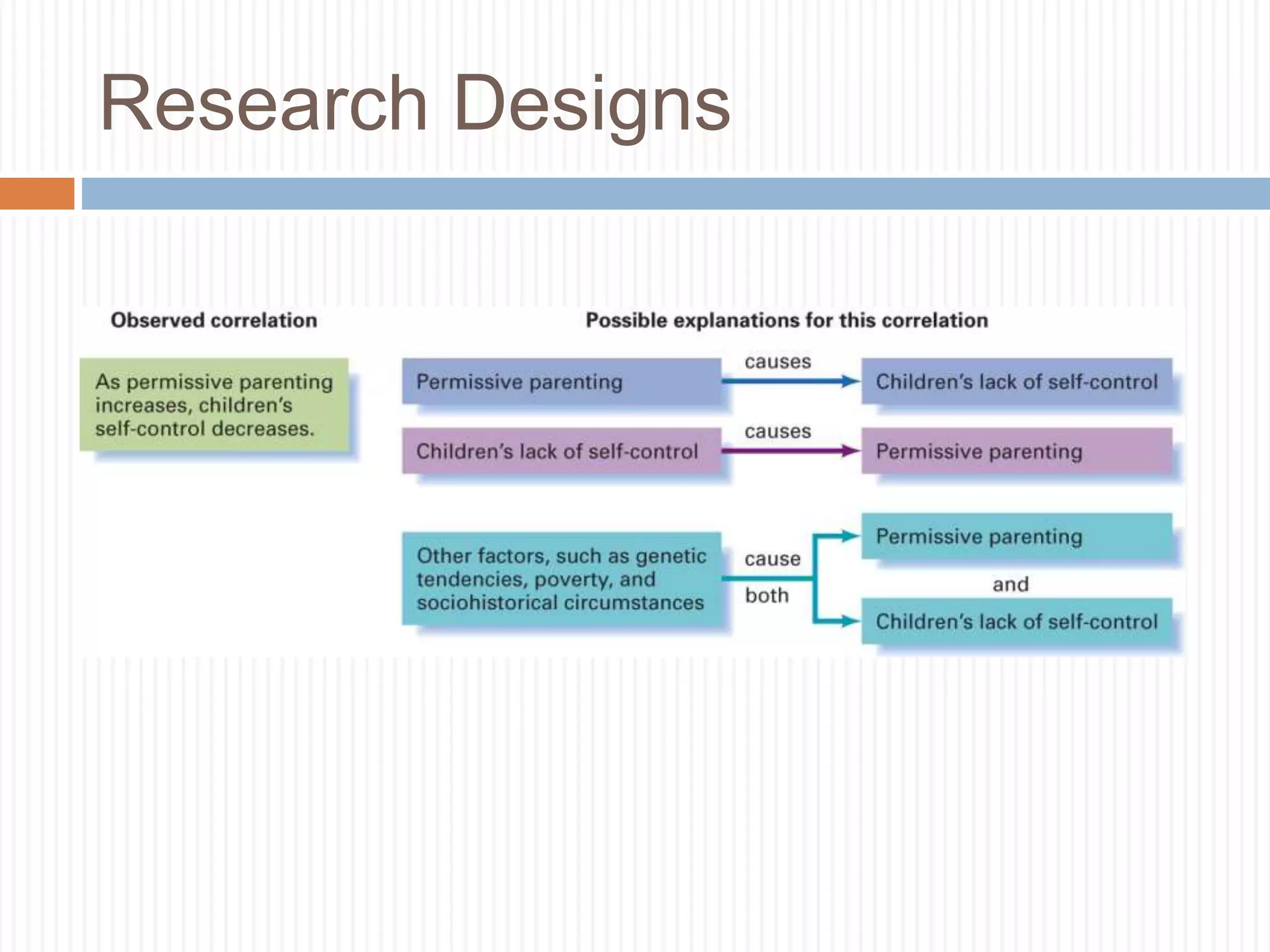
 Correlational: describes the strength of the
relationship between two or more events or
characteristics
 Correlation Coefficient: a number based on a
statistical analysis that is used to describe the degree of
association between two variables
 Ranges from +1.00 to -1.00
 + means a positive association; - means a negative association
 Higher number indicates a stronger association
Research Designs
Research Designs
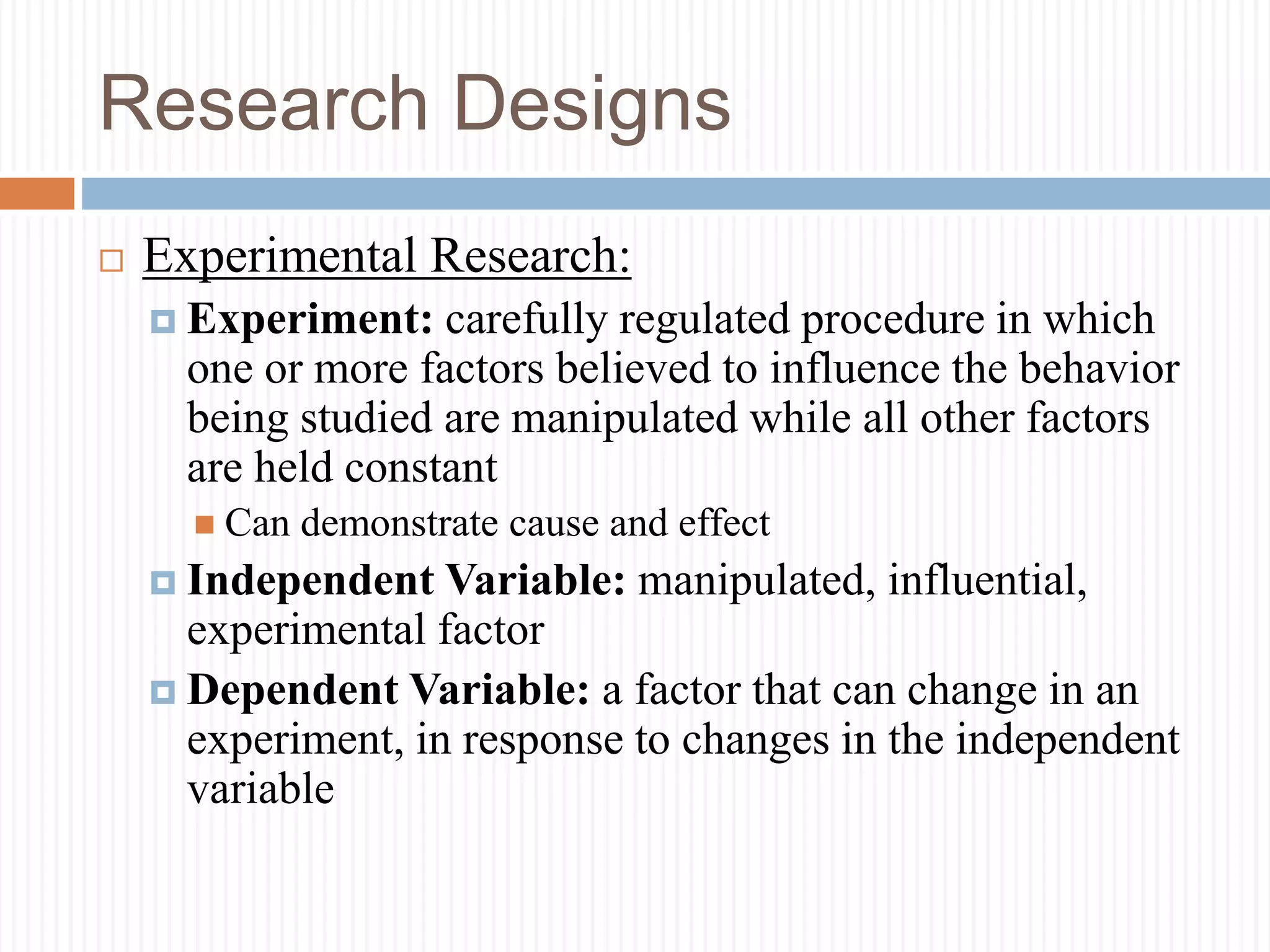
 Experimental Research:
 Experiment: carefully regulated procedure in which
one or more factors believed to influence the behavior
being studied are manipulated while all other factors
are held constant
 Can demonstrate cause and effect
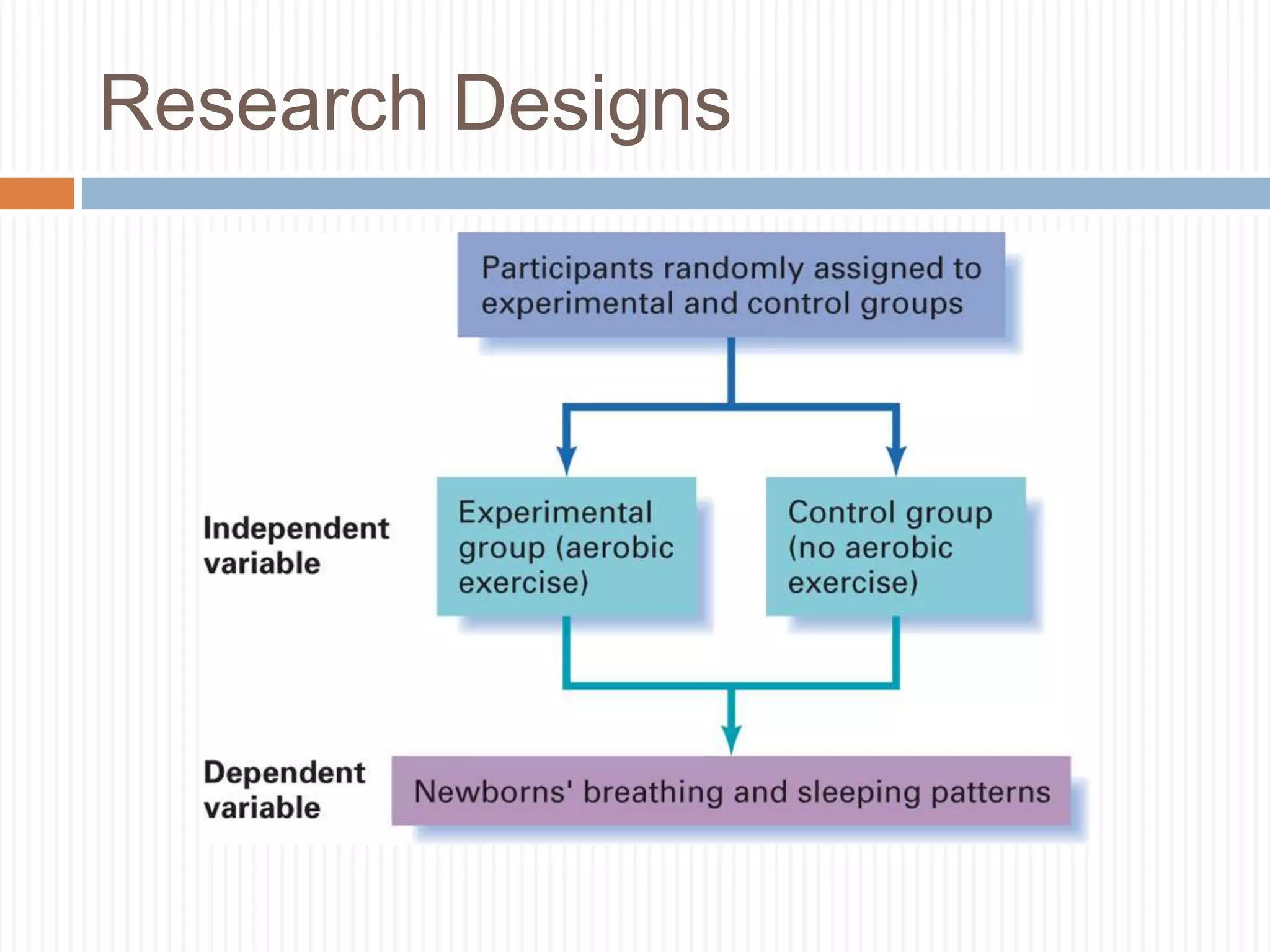
 Independent Variable: manipulated, influential,
experimental factor
 Dependent Variable: a factor that can change in an
experiment, in response to changes in the independent
variable
Research Designs
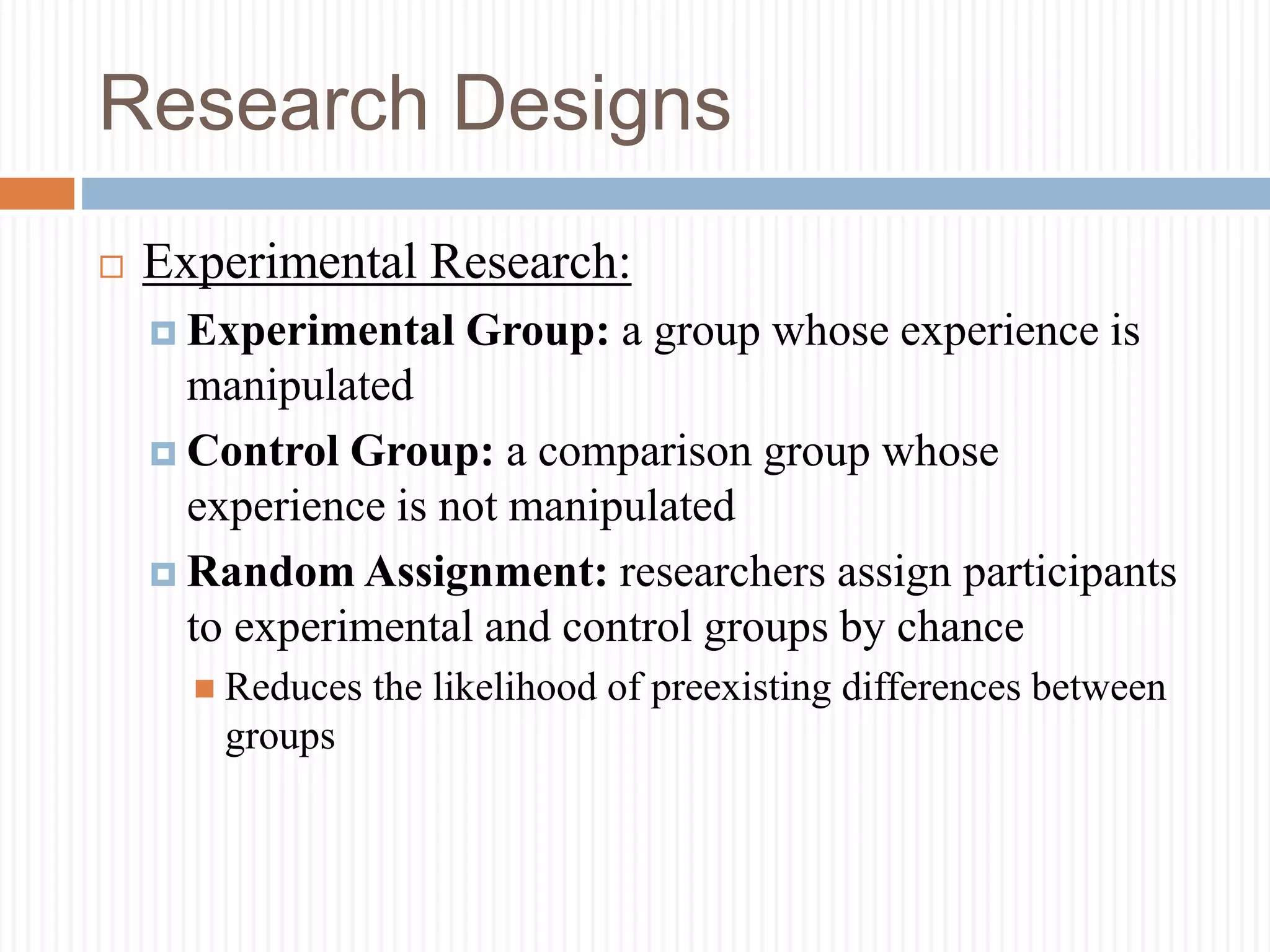
 Experimental Research:
 Experimental Group: a group whose experience is
manipulated
 Control Group: a comparison group whose
experience is not manipulated
 Random Assignment: researchers assign participants
to experimental and control groups by chance
 Reduces the likelihood of preexisting differences between
groups
Research Designs
Research Designs
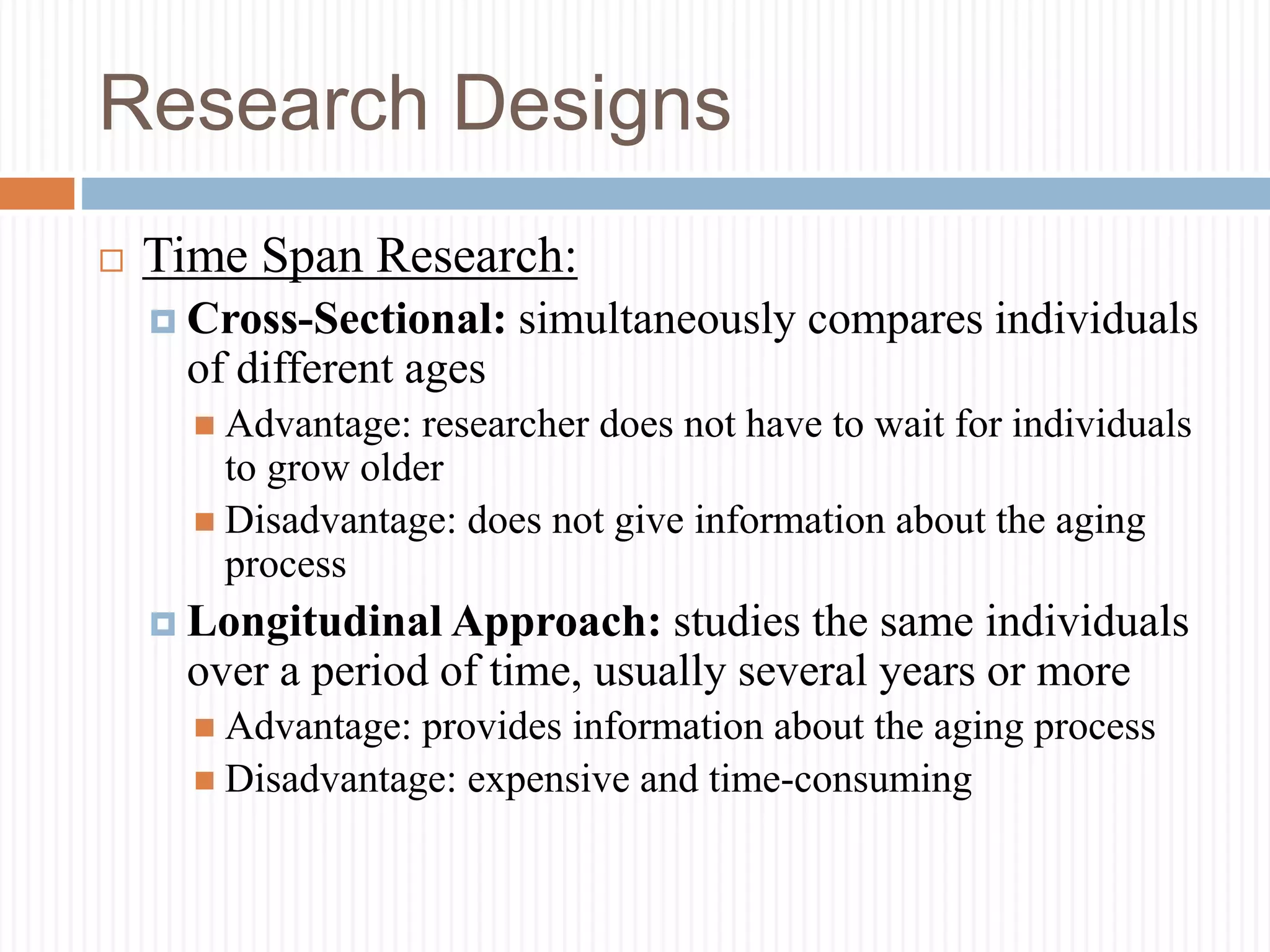
 Time Span Research:
 Cross-Sectional: simultaneously compares individuals
of different ages
 Advantage: researcher does not have to wait for individuals
to grow older
 Disadvantage: does not give information about the aging
process
 Longitudinal Approach: studies the same individuals
over a period of time, usually several years or more
 Advantage: provides information about the aging process
 Disadvantage: expensive and time-consuming
Research Designs
 Time Span Research:
 Cohort Effects:
 Cohort: a group of people who are born at a similar point in
history and share similar experiences
 Cohort effects: differences due to a person’s time of birth,
era, or generation, but not to actual age
 Cross-sectional studies can show how different cohorts respond,
but they may confuse age effects and cohort effects
 Longitudinal research can study age changes, but only within
one cohort
Conducting Ethical Research
 Informed Consent: all participants must know what
their research participation will involve and what
risks might develop
 Confidentiality: researchers are responsible for
keeping the data completely confidential and, if
possible, anonymous
Conducting Ethical Research
 Debriefing: after the study, participants should be
informed of the study’s purpose and methods that
were used
 Deception: researchers must ensure that deception
will not harm participants, and that participants are
fully debriefed
Conducting Ethical Research
 Minimizing Bias:
 Gender Bias: preconceived notions about the abilities
of women and men
 Research can affect how people think about gender
differences
 Cultural and Ethnic Bias:
 Life-span research needs to include more people from
diverse ethnic groups
 Ethnic gloss: using an ethnic label in a superficial way that
portrays an ethnic group as being more homogenous than it
really is

Developmeantal psychology Introduction.ppt

  • 1.
  • 2.
    The Life-Span Perspective Development: the pattern of movement or change that begins at conception and continues through the human life span  Involves growth and decline  Traditional Approach: emphasizes extensive change from birth to adolescence, little to no change in adulthood, and decline in old age  Life-Span Approach: emphasizes developmental change throughout childhood and adulthood
  • 3.
    The Life-Span Perspective Life Span: based on oldest age documented  Currently 122 years  The oldest verified person on record was French woman Jeanne Calment (1875– 1997), who lived to the age of 122 years, 164 days.  Life Expectancy: average number of years that a person can expect to live  Currently 78 years
  • 4.
    The Life-Span Perspective Life-Span Perspective views development as:  Lifelong  Multidimensional  Multidirectional  Plastic  Multidisciplinary  Contextual  Development is a process that involves growth, maintenance, and regulation of loss  Development is constructed through biological, sociocultural, and individual factors working together
  • 5.
    The Life-Span Perspective Development is Lifelong  Early adulthood is not the endpoint of development  No age period dominates  Development is Multidimensional  Consists of biological, cognitive, and socioemotional dimensions  Multiple components within each dimension
  • 6.
    The Life-Span Perspective Development is Multidirectional  Some dimensions (or components of a dimension) expand, and others shrink  Development is Plastic  Plasticity: capacity for change  Development is Multidisciplinary  Development is of interest to psychologists, sociologists, anthropologists, neuroscientists, and medical researchers
  • 7.
    The Life-Span Perspective Development is Contextual  All development occurs within a context (setting)  Each setting is influenced by historical, economic, social, and cultural factors  Contexts exert three types of influences:  Normative age-graded influences: similar for individuals in a particular age group  Normative history-graded influences: common to people of a particular generation because of historical circumstances  Non-normative life events: unusual occurrences that have a major impact on the individual’s life
  • 8.
    The Life-Span Perspective Development Involves Growth, Maintenance, and Regulation of Loss  Development is a Co-Construction of Biology, Culture, and the Individual
  • 9.
    Some Contemporary Concerns Health and Well-Being  Parenting and Education  Sociocultural Contexts and Diversity  Culture: behavior patterns, beliefs, and all other products of a particular group of people that are passed on from generation to generation  Ethnicity: cultural heritage, nationality, race, religion, and language  Socioeconomic Status: a person’s position within society based on occupational, educational, and economic characteristics.
  • 10.
    Social Policy Issues Social Policy: a government’s course of action designed to promote the welfare of its citizens
  • 11.
    The Nature ofDevelopment  Development is the product of biological, cognitive, and socioemotional processes  Biological: changes in an individual’s physical nature  Cognitive: changes in thought, intelligence, and language  Socioemotional: changes in relationships with other people, changes in emotions, and changes in personality
  • 12.
    Biologica l processes Socioemotional processes Cognitive processes Developmental Changes Area Result of Biological, Cognitive, and Socioemotional Processes
  • 13.
    The Nature ofDevelopment  Developmental Period: a time frame in a person’s life that is characterized by certain features  Prenatal period: conception to birth (9 months)  Tremendous growth  Infancy: birth to 18-24 months  Dependence upon adults  Development of many psychological activities  Early childhood: end of infancy to 5-6 years  Preschool years  Self-sufficiency and increased play
  • 14.
    The Nature ofDevelopment  Developmental Period (continued)  Middle and late childhood: 6-11 years  Reading, writing, and arithmetic  Focus on achievement and self-control  Adolescence: varying endpoints; from 10-12 to 18-22 years  Rapid physical changes  Pursuit of independence and identity  Early adulthood: late teens to early 30’s  Personal and economic independence  Selecting a mate
  • 15.
    The Nature ofDevelopment  Developmental Period (continued)  Middle adulthood: 40-60 years  Social involvement and responsibility  Assisting the next generation  Late adulthood: 60’s-70’s to death  Life review  Adjustment to new social roles  Longest developmental span  “youngest old” vs. “oldest old”
  • 16.
    The Nature ofDevelopment  Four “Ages” of Development  First Age: Childhood and adolescence  Second Age: Prime adulthood (20’s through 50’s)  Third Age: Approximately 60 to 79 years of age  Fourth Age: Approximately 80 years and older  The Significance of Age  Age and Happiness:  No specific age group reports more happiness or satisfaction than another  Each age period has its own stresses, advantages, and disadvantages
  • 17.
    100 0 20 40 80 60 Happy people (%) Age range (years) Ageand Happiness 65 + 15-24 25-34 35-44 45-54 55-64
  • 18.
    The Nature ofDevelopment  Conceptions of Age  How relevant is chronological age to understanding a person’s psychological development?  How should age be conceptualized?  Chronological age: number of years that have elapsed since birth  Biological age: a person’s age in terms of biological health  Psychological age: an individual’s adaptive capacities compared with those of other individuals of the same chronological age  Social age: social roles and expectations related to a person’s age
  • 19.
    Developmental Issues  Natureand Nurture: the extent to which development is influenced by biological inheritance and/or environmental experiences  Nature proponents argue that an evolutionary and genetic foundation produces commonalities in growth and development  Nurture proponents emphasize the importance of both the biological and social environment
  • 20.
    Developmental Issues  Stabilityand Change: the degree to which early traits and characteristics persist through life or change  Stability: traits and characteristics are seen as the result of heredity and early life experiences  Change: traits and characteristics can be altered by later experiences  Role of early and later experiences is hotly debated
  • 21.
    Developmental Issues  Continuityand Discontinuity: focuses on whether development is either:  A process of gradual, cumulative change (continuous)  A set of distinct stages (discontinuous)  Evaluating Developmental Issues:  Most developmentalists acknowledge that development is not all-or-nothing  There is debate regarding how strongly each of these issues influences development
  • 22.
    Theories of Development Scientific Method: A four-step process: 1. Conceptualize a process or problem to be studied 2. Collect research information (data) 3. Analyze data 4. Draw conclusions  Theory: an interrelated, coherent set of ideas that helps to explain phenomena and make predictions  Hypotheses: specific assertions and predictions that can be tested
  • 23.
    Theories of Development Diverse but complementary theories are used for explaining life-span development:  Psychoanalytic theories  Cognitive theories  Behavioral and social cognitive theories  Ethological theory  Ecological theory
  • 24.
    Psychoanalytic Theories  PsychoanalyticTheories: describe development as primarily unconscious  True understanding requires analyzing the symbolic meanings of behavior  Early experiences with parents extensively shape development
  • 25.
    Psychoanalytic Theories  Freud’sTheory:  Focus of sexual impulses changes throughout development  Five stages of psychosexual development (oral, anal, phallic, latency, genital)  Adult personality is determined by the way we resolve conflict within each stage  Modern theorists place less emphasis on sexual instincts and more on cultural experiences
  • 26.
    Psychoanalytic Theories  Erikson’sPsychosocial Theory:  Focused on our desire to affiliate with other people  Believed that developmental change occurs throughout the life span  Proposed eight stages of development  Each stage comprises a crisis that must be resolved
  • 27.
  • 28.
    Psychoanalytic Theories  EvaluatingPsychoanalytic Theories:  Contributions:  Emphasis on a developmental framework, family relationships, and unconscious aspects of the mind  Criticisms:  Lack of scientific support  Too much emphasis on sexual underpinnings  Negative image of people
  • 29.
    Cognitive Theories  Piaget’sCognitive Developmental Theory:  Stresses conscious thoughts  Emphasizes the processes of organization and adaptation  Four stages of cognitive development in children  Each stage represents a qualitatively different way of understanding the world
  • 30.
  • 31.
  • 32.
    Cognitive Theories  Vygotsky’sSociocultural Cognitive Theory:  Children actively construct their knowledge  Emphasizes how social interaction and culture guide cognitive development  Learning is based upon the inventions of society  Less-skilled persons learn from those who are more skilled
  • 33.
    Cognitive Theories  Information-ProcessingTheory:  Emphasizes that individuals manipulate information, monitor it, and strategize about it  Individuals develop a gradually increasing capacity for processing information  Thinking is information processing  Individuals learn strategies for better information processing
  • 34.
    Cognitive Theories  EvaluatingCognitive Theories:  Contributions:  Positive view on development  Emphasis on the active construction of understanding  Criticisms:  Skepticism about the pureness of Piaget’s stages  Too little attention to individual variations
  • 35.
    Behavioral & SocialCognitive Theories  Behavioral and Social Cognitive Theories:  Behaviorism: we can study scientifically only what can be directly observed and measured  Development is observable behavior that can be learned through experience  Skinner’s Operant Conditioning:  Consequences of a behavior produce changes in the probability of the behavior’s occurrence  A reward increases likelihood of behavior  A punishment decreases likelihood of behavior
  • 36.
    Behavioral & SocialCognitive Theories  Bandura’s Social Cognitive Theory:  Behavior, environment, and cognition are key factors in development  Observational learning: learning through observation  People cognitively represent the behavior of others
  • 37.
    Behavioral & SocialCognitive Theories  Evaluating Behavioral and Social Cognitive Theories:  Contributions:  Emphasis on scientific research and environmental determinants of behavior  Criticisms:  Little emphasis on cognition (Skinner)  Inadequate attention given to developmental changes
  • 38.
    Ethological Theory  Ethology:stresses that behavior is strongly influenced by biology and evolution  Bowlby stressed the importance of human attachment during the first year of life
  • 39.
    Ethological Theory  EvaluatingEthological Theory:  Contributions:  A focus on the biological and evolutionary basis of development  Use of careful observations in naturalistic settings  Criticisms:  Too much emphasis on biological foundations  Critical and sensitive period concepts may be too rigid
  • 40.
    Ecological Theory  Bronfenbrenner’sEcological Theory: development reflects the influence of five environmental systems:  Microsystem: setting in which the individual lives  Mesosystem: relations between microsystems  Exosystem: links between a social setting in which the individual does not have an active role and the individual’s immediate context  Macrosystem: culture in which individuals live  Chronosystem: patterning of environmental events and transitions; sociohistorical circumstances
  • 41.
  • 42.
    Ecological Theory  EvaluatingEcological Theory:  Contributions:  Systematic examination of macro and micro dimensions of environmental systems  Attention to connections between environmental systems  Criticisms:  Giving inadequate attention to biological factors  Too little emphasis on cognitive factors
  • 43.
    Eclectic Theoretical Orientation Eclectic Theoretical Orientation:  No single theory can explain all of development  Every theory has contributed to our understanding  Eclectic orientation does not follow any one theoretical approach  Instead, it selects from each theory whatever is considered its best features
  • 44.
    Research Methods  Methodsfor Collecting Data:  Observation:  Laboratory: controlled setting that eliminates many complex “real-world” variables  Participants typically know they are being studied  Setting is unnatural  May not represent general population  Some individuals may be intimidated by laboratory setting  Naturalistic: observing behavior in real-world settings  Researcher makes no effort to manipulate or control the situation
  • 45.
    Research Methods  Methodsfor Collecting Data:  Survey and Interviews:  Standard sets of questions are used to obtain people’s attitudes or beliefs about a particular topic  Can be used to study a wide variety of topics  Participants may answer in a way that is considered socially desirable and acceptable
  • 46.
    Research Methods  Methodsfor Collecting Data:  Standardized Test:  Uniform procedures for administration and scoring  Most allow a person’s performance to be compared with that of others  Assumes consistency and stability across time and situations  Case Study:  In-depth look at a single individual  Difficult to generalize to others  May not be reliable
  • 47.
    Research Methods  Methodsfor Collecting Data:  Physiological Measures:  Many uses; technology is constantly improving  Functional magnetic resonance imaging (fMRI): uses electromagnetic waves to construct images of brain tissue and biochemical activity
  • 48.
    Research Designs  Threemain types: descriptive, correlational, and experimental  Descriptive: aims to observe and record behavior  Methods discussed so far are descriptive  Cannot prove causation, but can reveal important information
  • 49.
    Research Designs  Correlational:describes the strength of the relationship between two or more events or characteristics  Correlation Coefficient: a number based on a statistical analysis that is used to describe the degree of association between two variables  Ranges from +1.00 to -1.00  + means a positive association; - means a negative association  Higher number indicates a stronger association
  • 50.
  • 51.
    Research Designs  ExperimentalResearch:  Experiment: carefully regulated procedure in which one or more factors believed to influence the behavior being studied are manipulated while all other factors are held constant  Can demonstrate cause and effect  Independent Variable: manipulated, influential, experimental factor  Dependent Variable: a factor that can change in an experiment, in response to changes in the independent variable
  • 52.
    Research Designs  ExperimentalResearch:  Experimental Group: a group whose experience is manipulated  Control Group: a comparison group whose experience is not manipulated  Random Assignment: researchers assign participants to experimental and control groups by chance  Reduces the likelihood of preexisting differences between groups
  • 53.
  • 54.
    Research Designs  TimeSpan Research:  Cross-Sectional: simultaneously compares individuals of different ages  Advantage: researcher does not have to wait for individuals to grow older  Disadvantage: does not give information about the aging process  Longitudinal Approach: studies the same individuals over a period of time, usually several years or more  Advantage: provides information about the aging process  Disadvantage: expensive and time-consuming
  • 55.
    Research Designs  TimeSpan Research:  Cohort Effects:  Cohort: a group of people who are born at a similar point in history and share similar experiences  Cohort effects: differences due to a person’s time of birth, era, or generation, but not to actual age  Cross-sectional studies can show how different cohorts respond, but they may confuse age effects and cohort effects  Longitudinal research can study age changes, but only within one cohort
  • 56.
    Conducting Ethical Research Informed Consent: all participants must know what their research participation will involve and what risks might develop  Confidentiality: researchers are responsible for keeping the data completely confidential and, if possible, anonymous
  • 57.
    Conducting Ethical Research Debriefing: after the study, participants should be informed of the study’s purpose and methods that were used  Deception: researchers must ensure that deception will not harm participants, and that participants are fully debriefed
  • 58.
    Conducting Ethical Research Minimizing Bias:  Gender Bias: preconceived notions about the abilities of women and men  Research can affect how people think about gender differences  Cultural and Ethnic Bias:  Life-span research needs to include more people from diverse ethnic groups  Ethnic gloss: using an ethnic label in a superficial way that portrays an ethnic group as being more homogenous than it really is