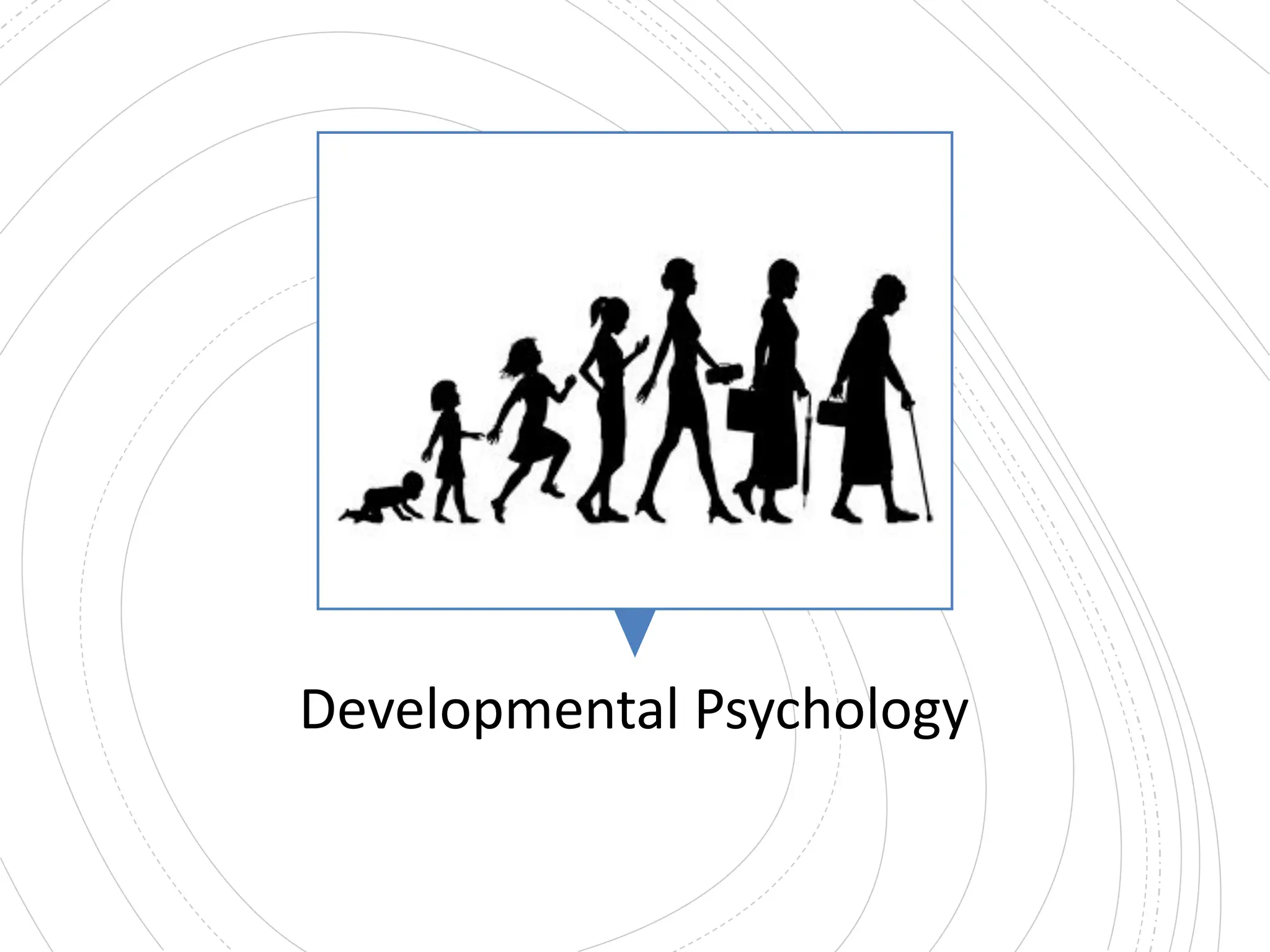
Developmental Psychology
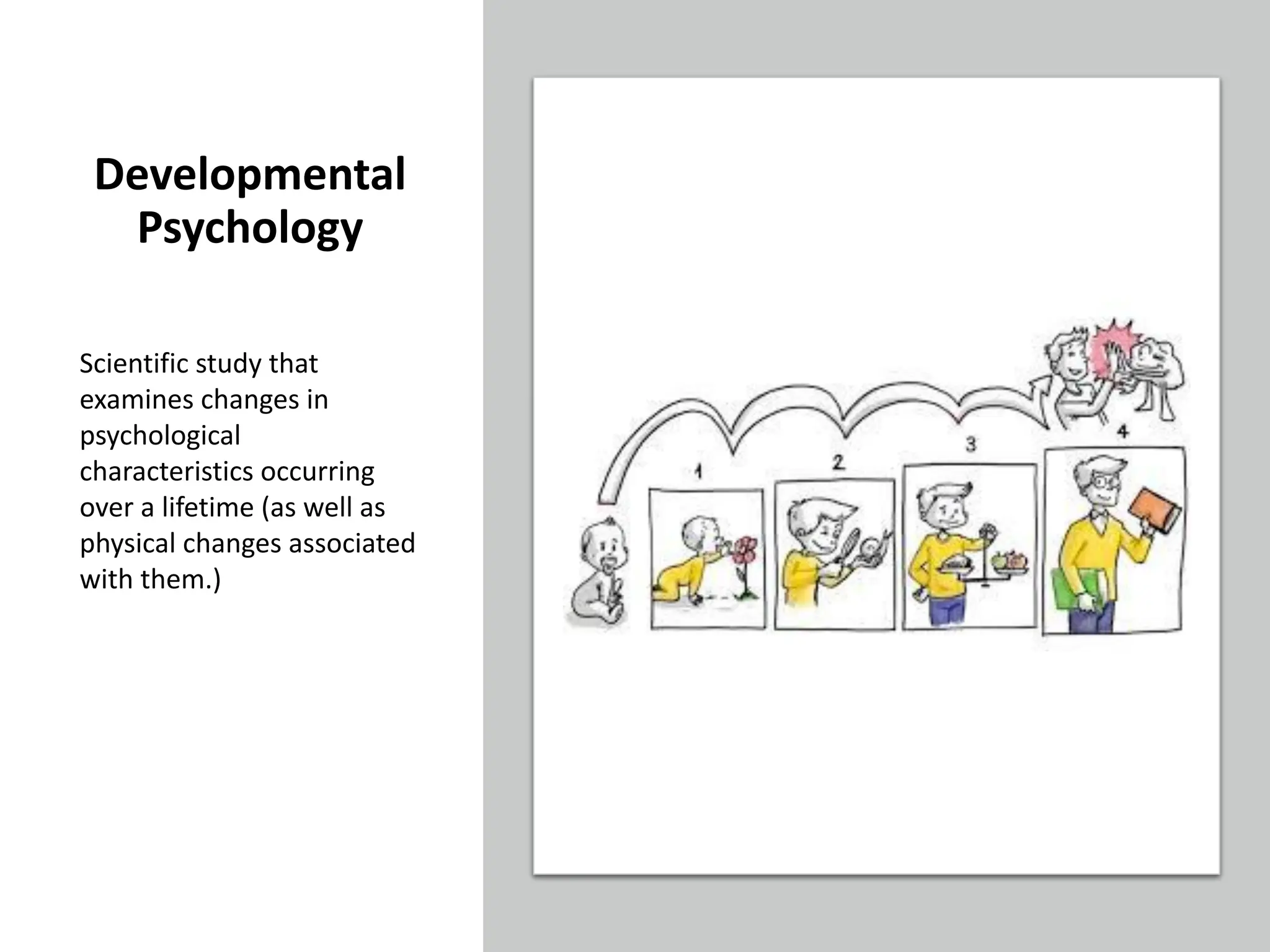
Developmental
Psychology
Scientific study that
examines changes in
psychological
characteristics occurring
over a lifetime (as well as
physical changes associated
with them.)
LIFE-SPAN
PERSPECTIVE
LIFE-SPAN
PERSPECTIVE
Human Development is
multiply determined and
cannot be understood within a
scope of single framework.
Human Development must be
viewed from the
biopsychosocial framework
(Riley,1979).
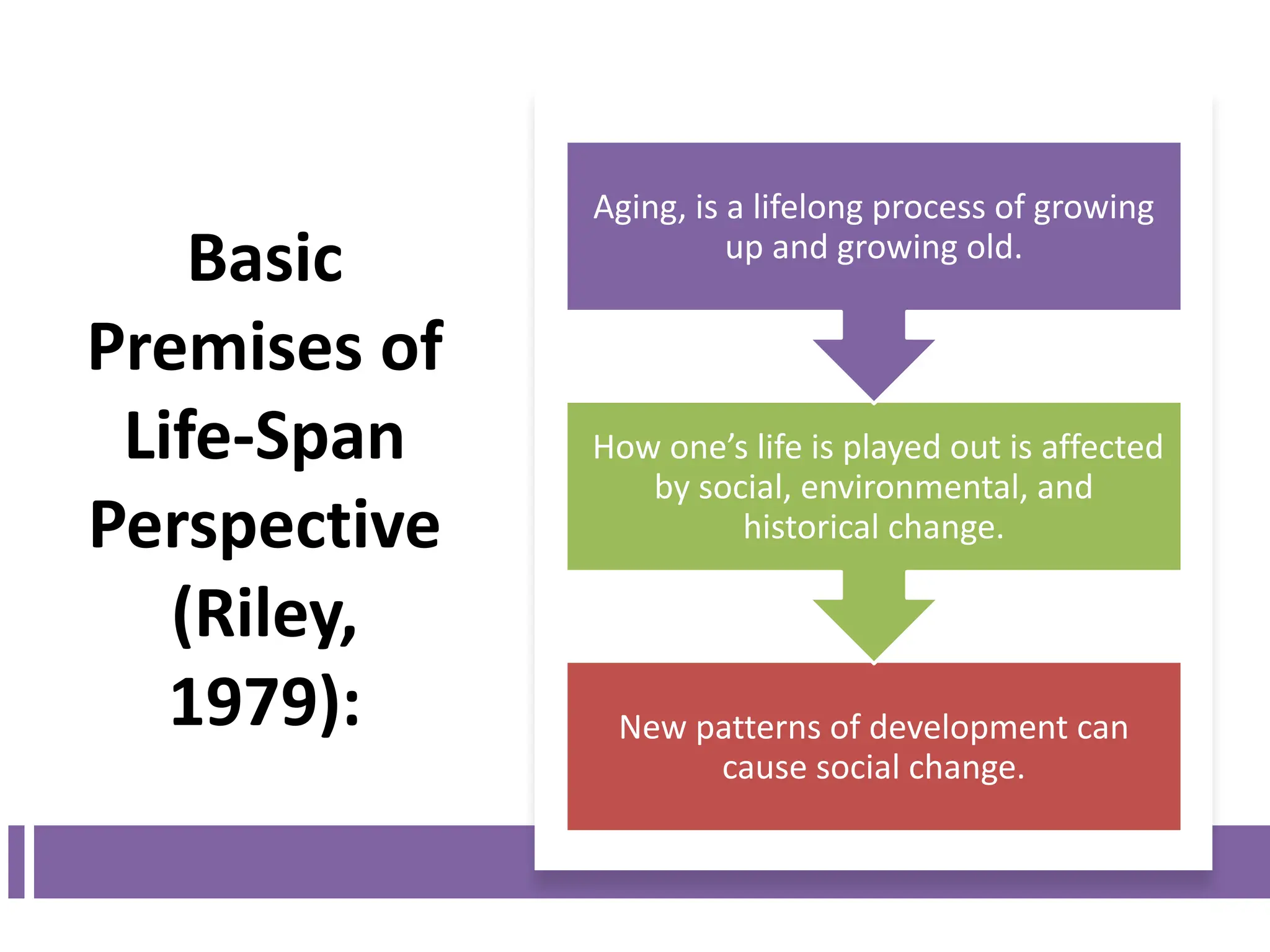
Basic
Premises of
Life-Span
Perspective
(Riley,
1979): New patterns of development can
cause social change.
How one’s life is played out is affected
by social, environmental, and
historical change.
Aging, is a lifelong process of growing
up and growing old.
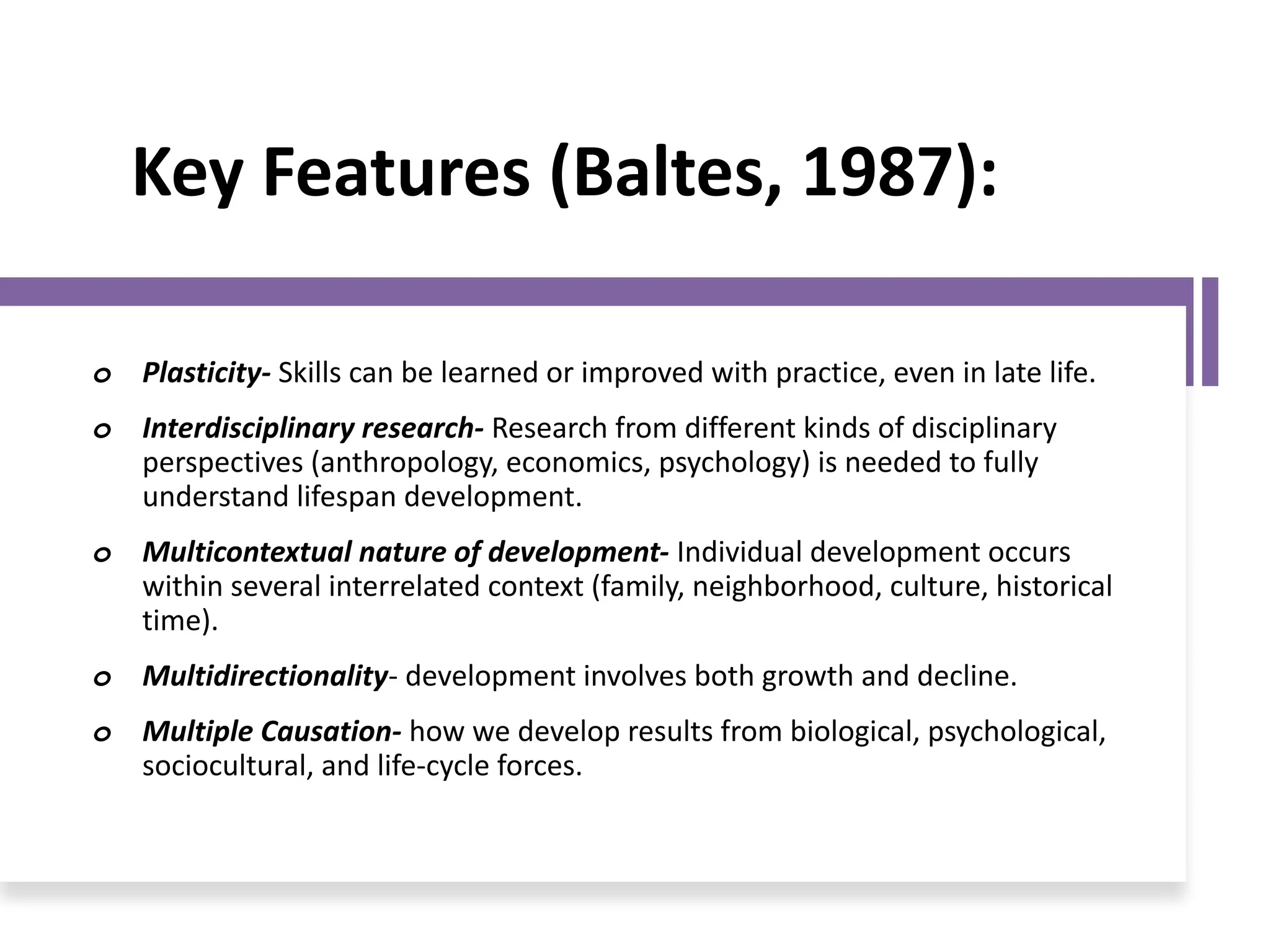
Key Features (Baltes, 1987):
o Plasticity- Skills can be learned or improved with practice, even in late life.
o Interdisciplinary research- Research from different kinds of disciplinary
perspectives (anthropology, economics, psychology) is needed to fully
understand lifespan development.
o Multicontextual nature of development- Individual development occurs
within several interrelated context (family, neighborhood, culture, historical
time).
o Multidirectionality- development involves both growth and decline.
o Multiple Causation- how we develop results from biological, psychological,
sociocultural, and life-cycle forces.
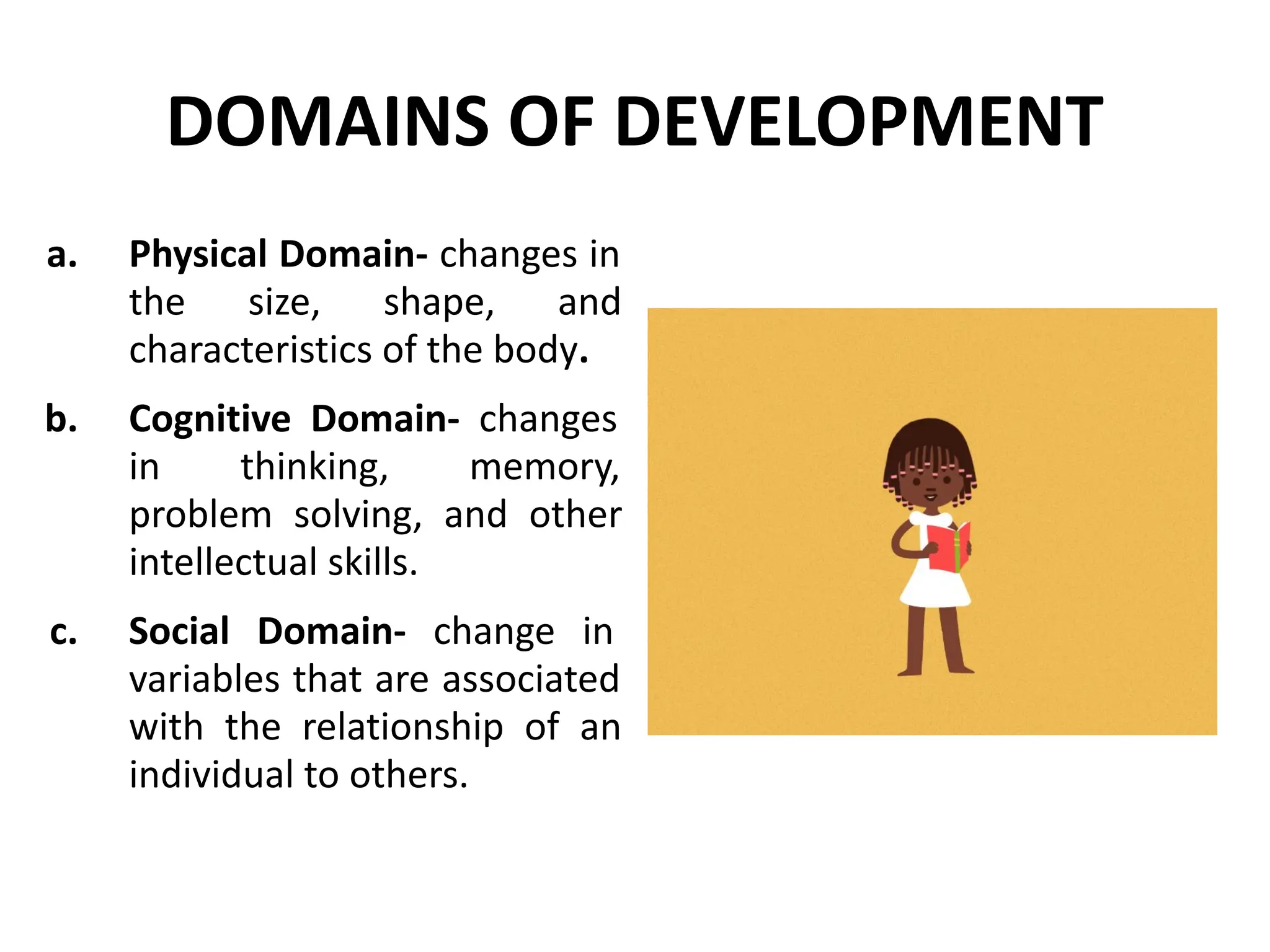
DOMAINS OF DEVELOPMENT
a. Physical Domain- changes in
the size, shape, and
characteristics of the body.
b. Cognitive Domain- changes
in thinking, memory,
problem solving, and other
intellectual skills.
c. Social Domain- change in
variables that are associated
with the relationship of an
individual to others.
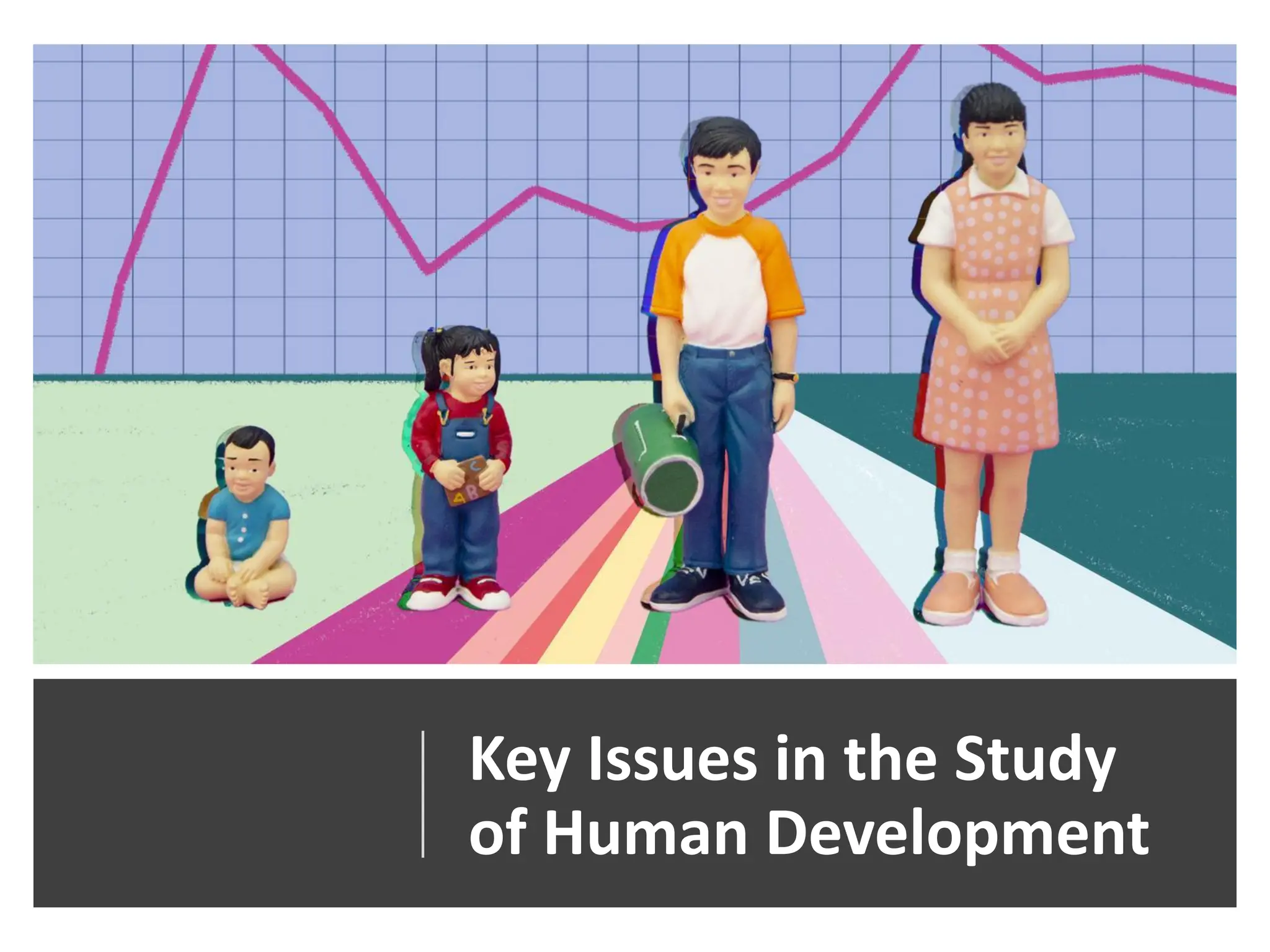
Key Issues in the Study
of Human Development
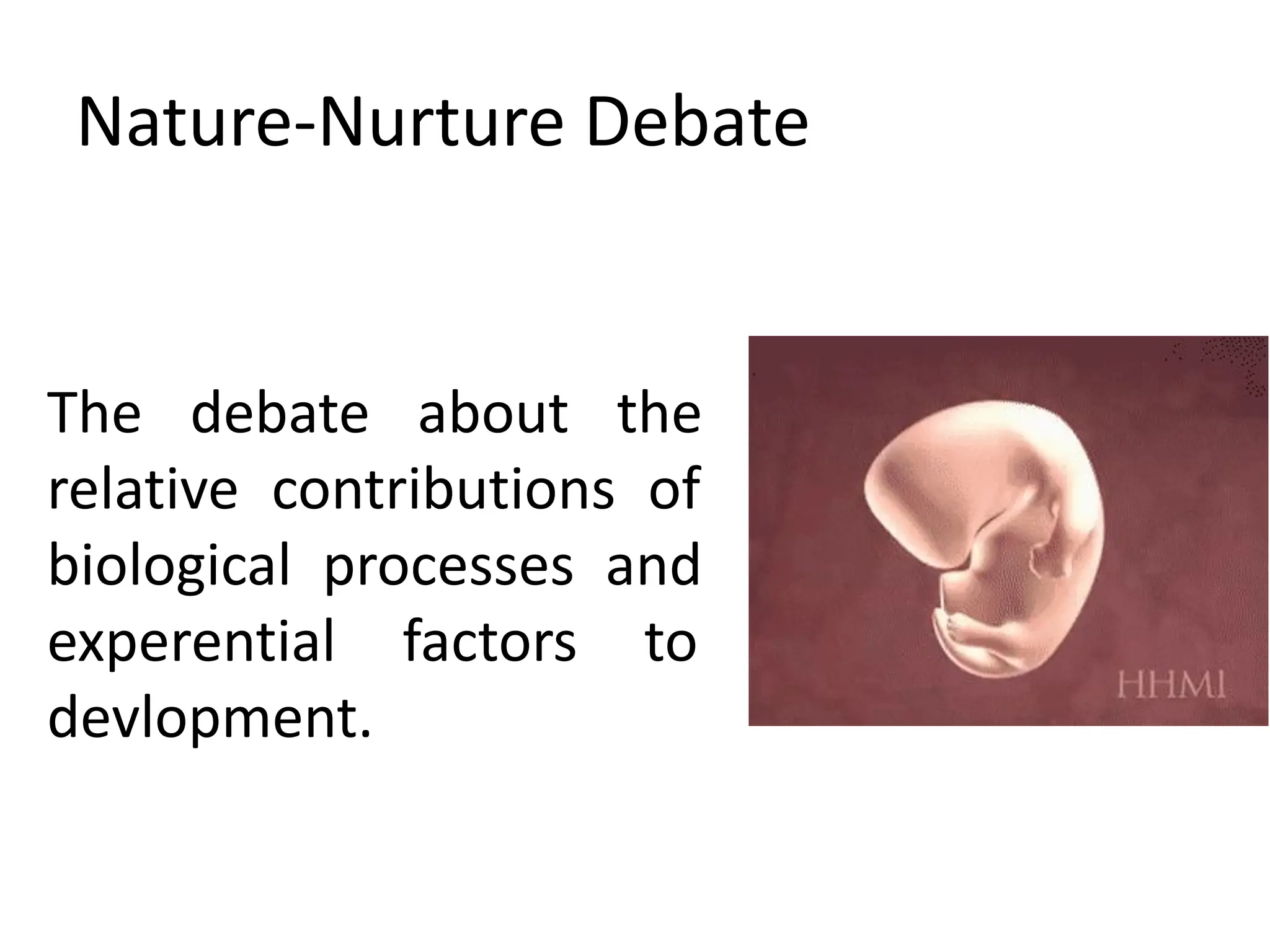
Nature-Nurture Debate
The debate about the
relative contributions of
biological processes and
experential factors to
devlopment.
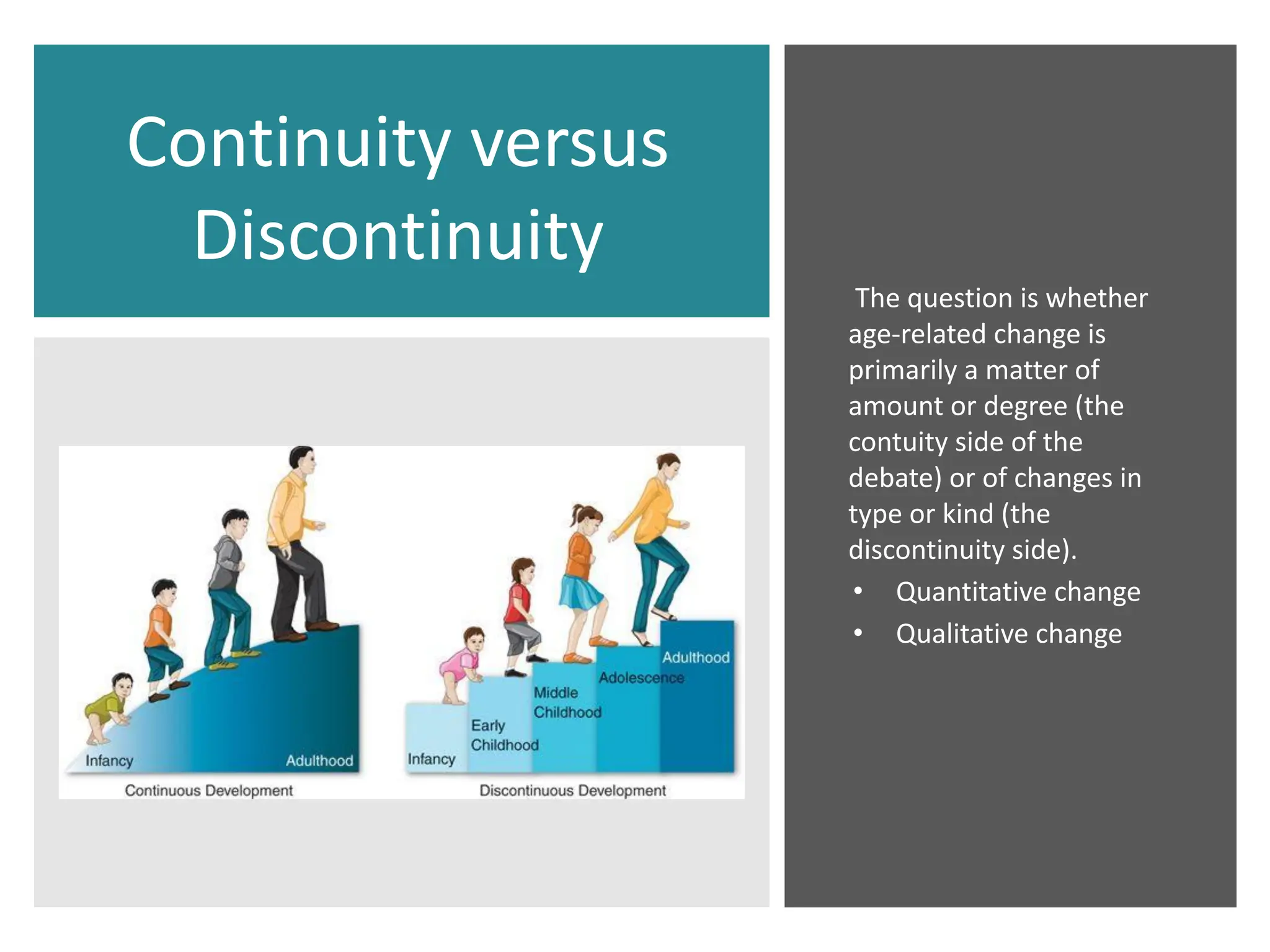
Continuity versus
Discontinuity
The question is whether
age-related change is
primarily a matter of
amount or degree (the
contuity side of the
debate) or of changes in
type or kind (the
discontinuity side).
• Quantitative change
• Qualitative change
THREE KINDS OF CHANGE
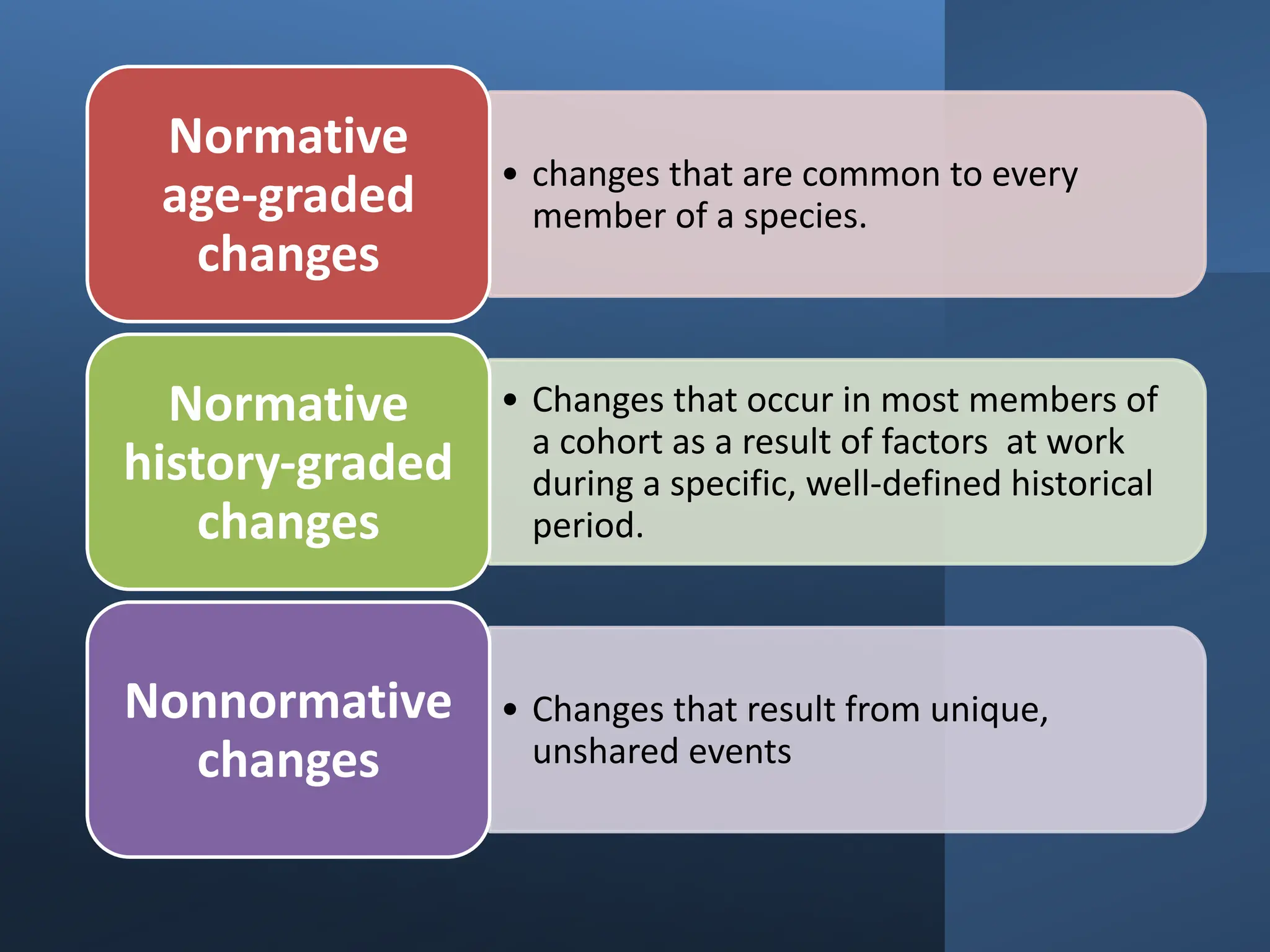
• changes that are common to every
member of a species.
Normative
age-graded
changes
• Changes that occur in most members of
a cohort as a result of factors at work
during a specific, well-defined historical
period.
Normative
history-graded
changes
• Changes that result from unique,
unshared events
Nonnormative
changes
Psychoanalyctic Theories
• Freud’s Psychosexual
– Personality develops in five stages from birth to
adolescence; in each stage, the need for physical
pleasure is focused on a different part of the body.
Strengths
- Emphasizes the importance of experiences in
infancy and early childhood; provide psychological
explanations for mental illness.
• Weaknesses
- Sexual feelings are not as important in
personality development as Freud claimed.
• Erikson’s psychosocial theory
- Personality develops through eight life crises
across he entire lifespan; a person finishes
each crisis with either good or poor
resolution.
Strengths
- Helps explain the role of culture in personality
development; important in lifespan psychology;
useful description of major themes of
personality development at different ages.
• Weaknesses
• - Describing each period in terms of a single
crisis is probably an oversimplification
LEARNING THEORIES
• Pavlov’s classical conditioning
• learning happens when neutral stimuli
becomes so strongly associated with natural
stimuli that they elicit the same response.
• Strength- Useful in explaining how emotional
response such as phobias are learned.
Weakness- explanation of behavior change too
limited to serve a comprehensive theory.
Skinner’s Operant conditioning
- Development involves behavior changes
that are shaped by reinforment and punishment.
Strength- Basis of many useful strategies for
managing and changing human behavior.
Weaknesses- Humans are not as passive as
Skinner claimed; the theory ignores hereditary,
cognitive, emotional, and social factors in
development.
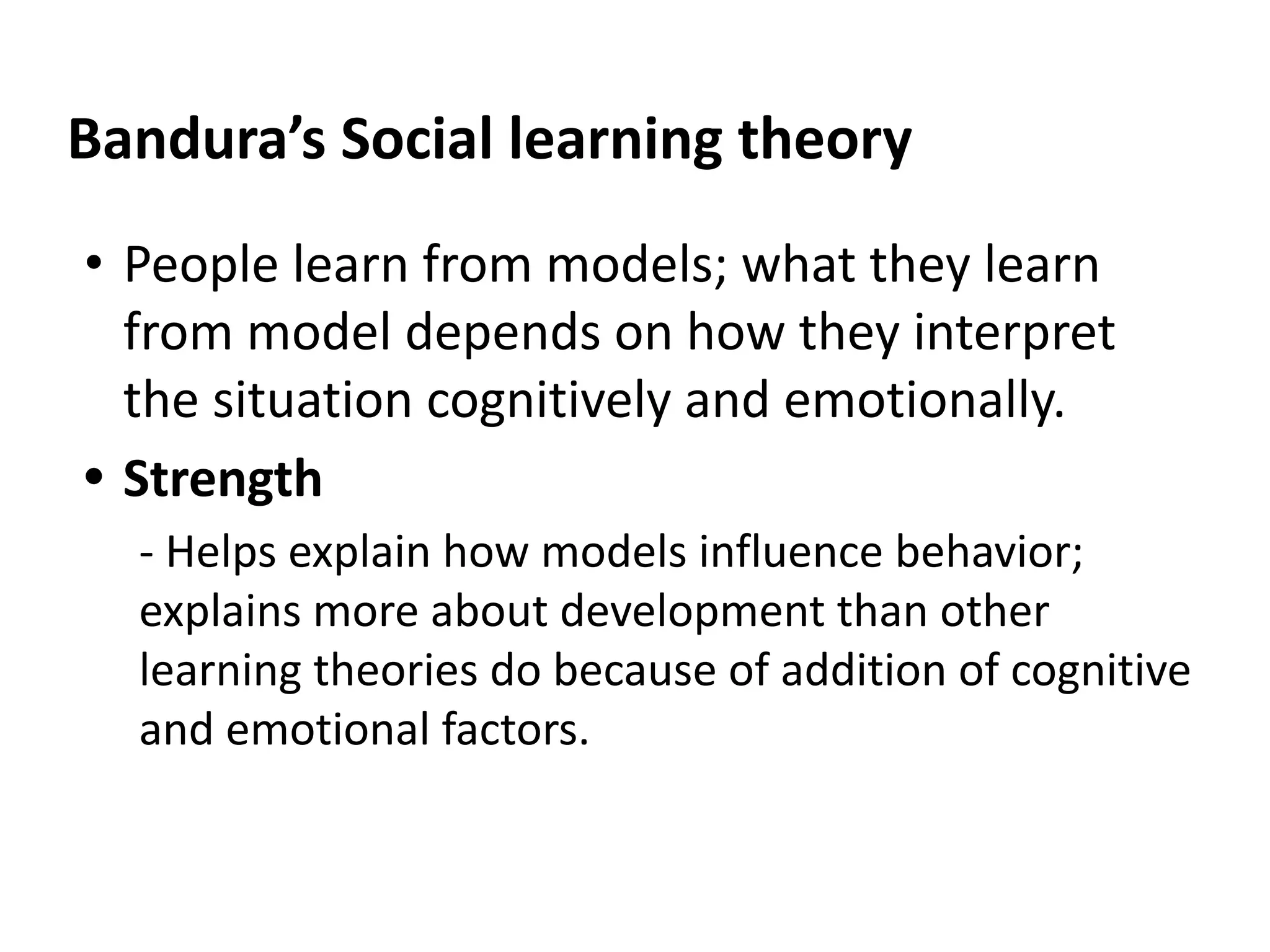
Bandura’s Social learning theory
• People learn from models; what they learn
from model depends on how they interpret
the situation cognitively and emotionally.
• Strength
- Helps explain how models influence behavior;
explains more about development than other
learning theories do because of addition of cognitive
and emotional factors.
Weaknesses
• Does not provide an overall picture of
development.
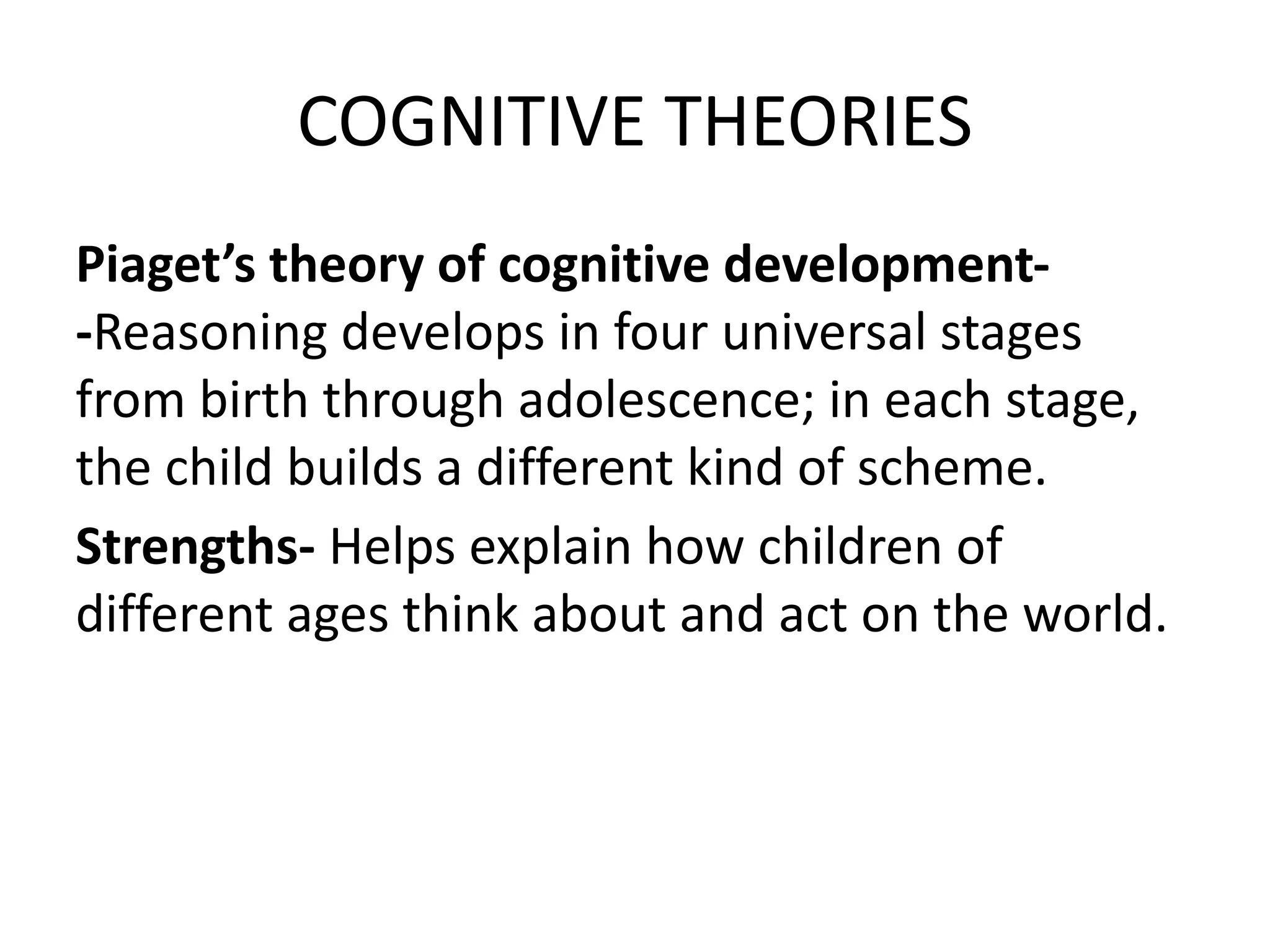
COGNITIVE THEORIES
Piaget’s theory of cognitive development-
-Reasoning develops in four universal stages
from birth through adolescence; in each stage,
the child builds a different kind of scheme.
Strengths- Helps explain how children of
different ages think about and act on the world.
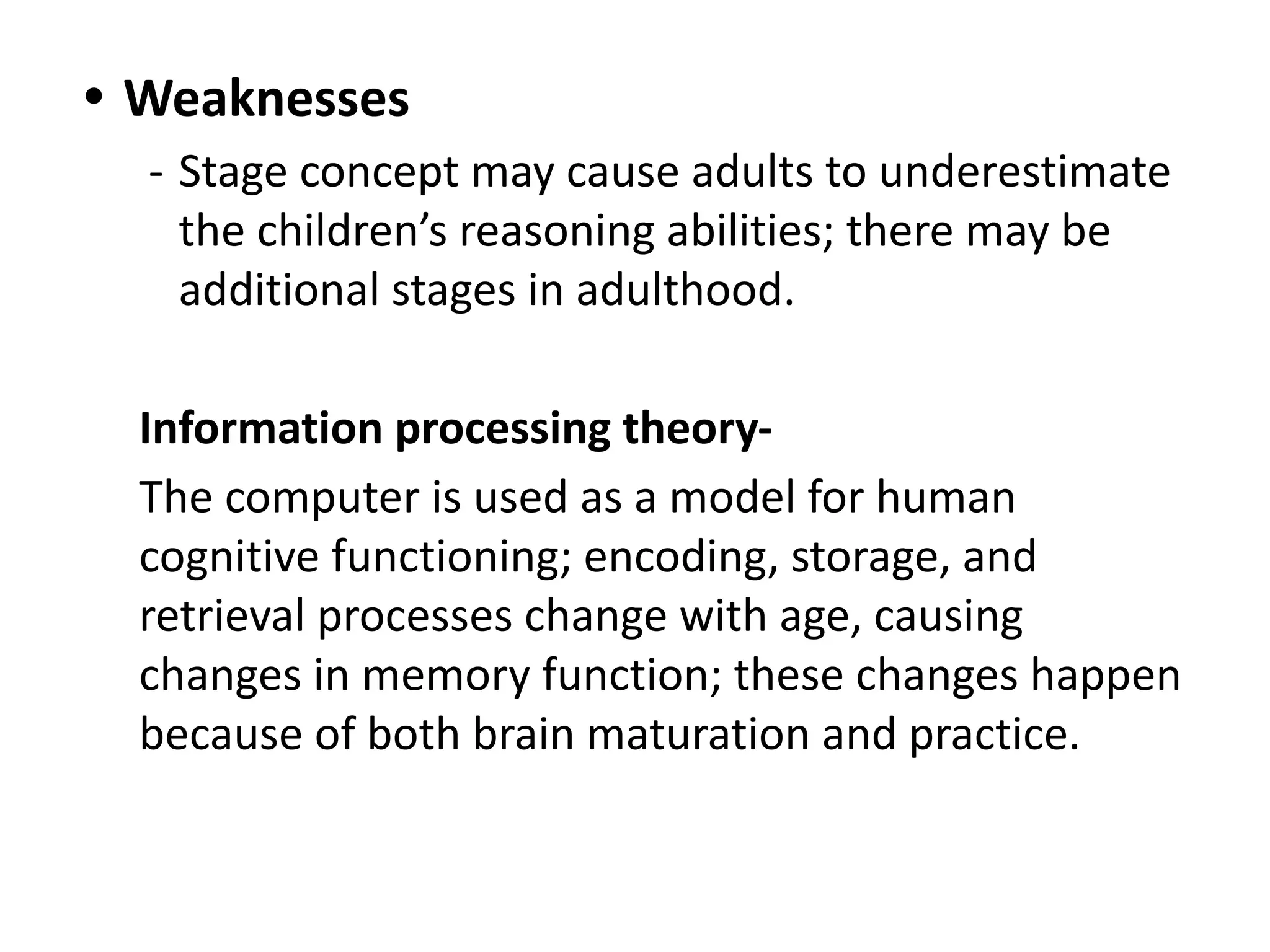
• Weaknesses
- Stage concept may cause adults to underestimate
the children’s reasoning abilities; there may be
additional stages in adulthood.
Information processing theory-
The computer is used as a model for human
cognitive functioning; encoding, storage, and
retrieval processes change with age, causing
changes in memory function; these changes happen
because of both brain maturation and practice.
• Strengths
- helps explain how much information people
of different ages can manage at one time and
how they process it; provides a useful
framework for studying individual differences in
people of the same age.
Weaknesses
- Human information processing is much
more complex than that of a computer; the
theory does not provide a overall picture of
development
Vygotsky’s Sociocultural theory
- Emphasizes linguistic and social factors in
cognitive development.
Strengths
- Incorporates group learning processes into
explanations of individual cognitive
development.
• Weaknesses
- Insufficient evidence to support most ideas.
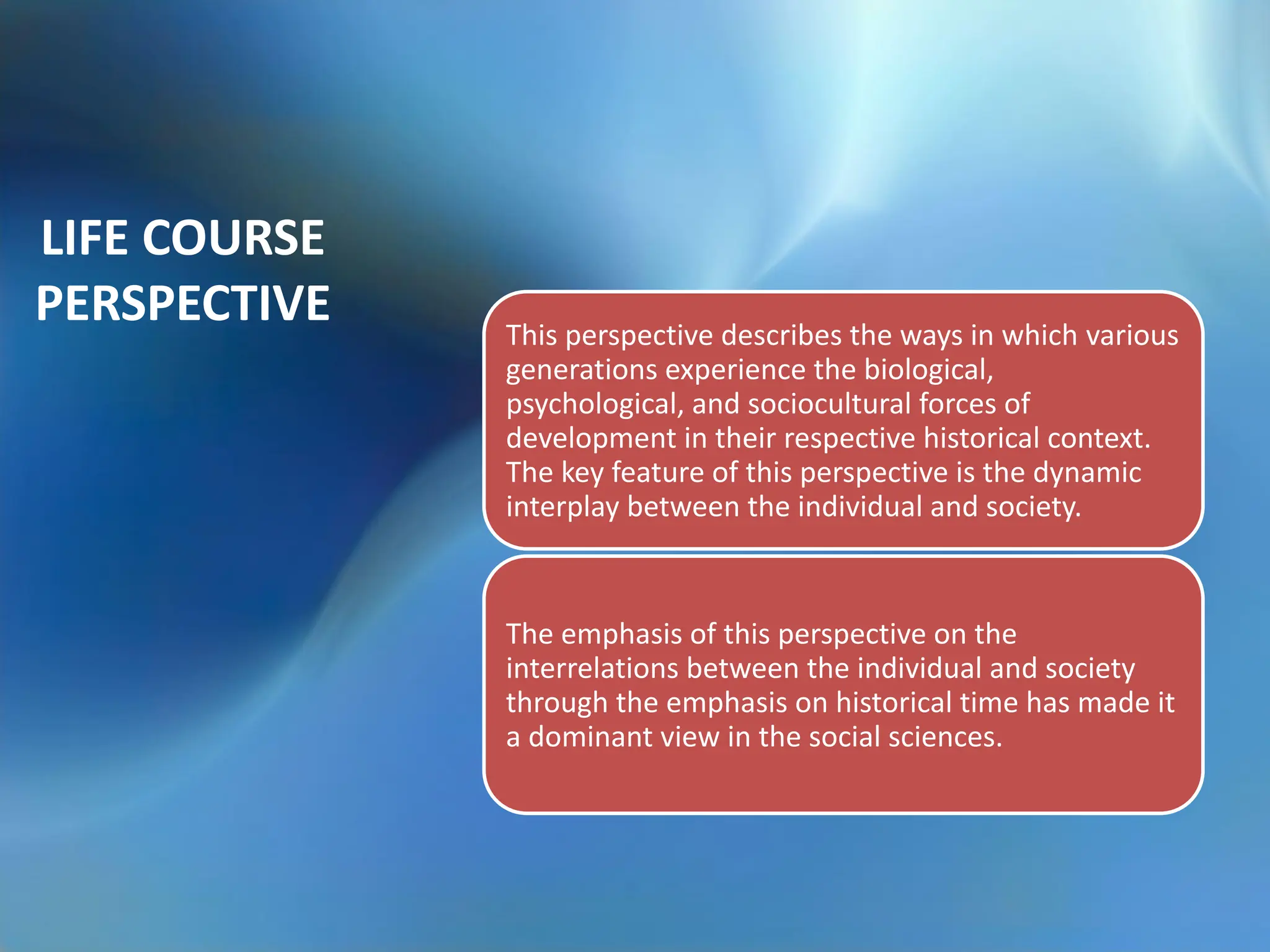
LIFE COURSE
PERSPECTIVE
LIFE COURSE
PERSPECTIVE This perspective describes the ways in which various
generations experience the biological,
psychological, and sociocultural forces of
development in their respective historical context.
The key feature of this perspective is the dynamic
interplay between the individual and society.
The emphasis of this perspective on the
interrelations between the individual and society
through the emphasis on historical time has made it
a dominant view in the social sciences.
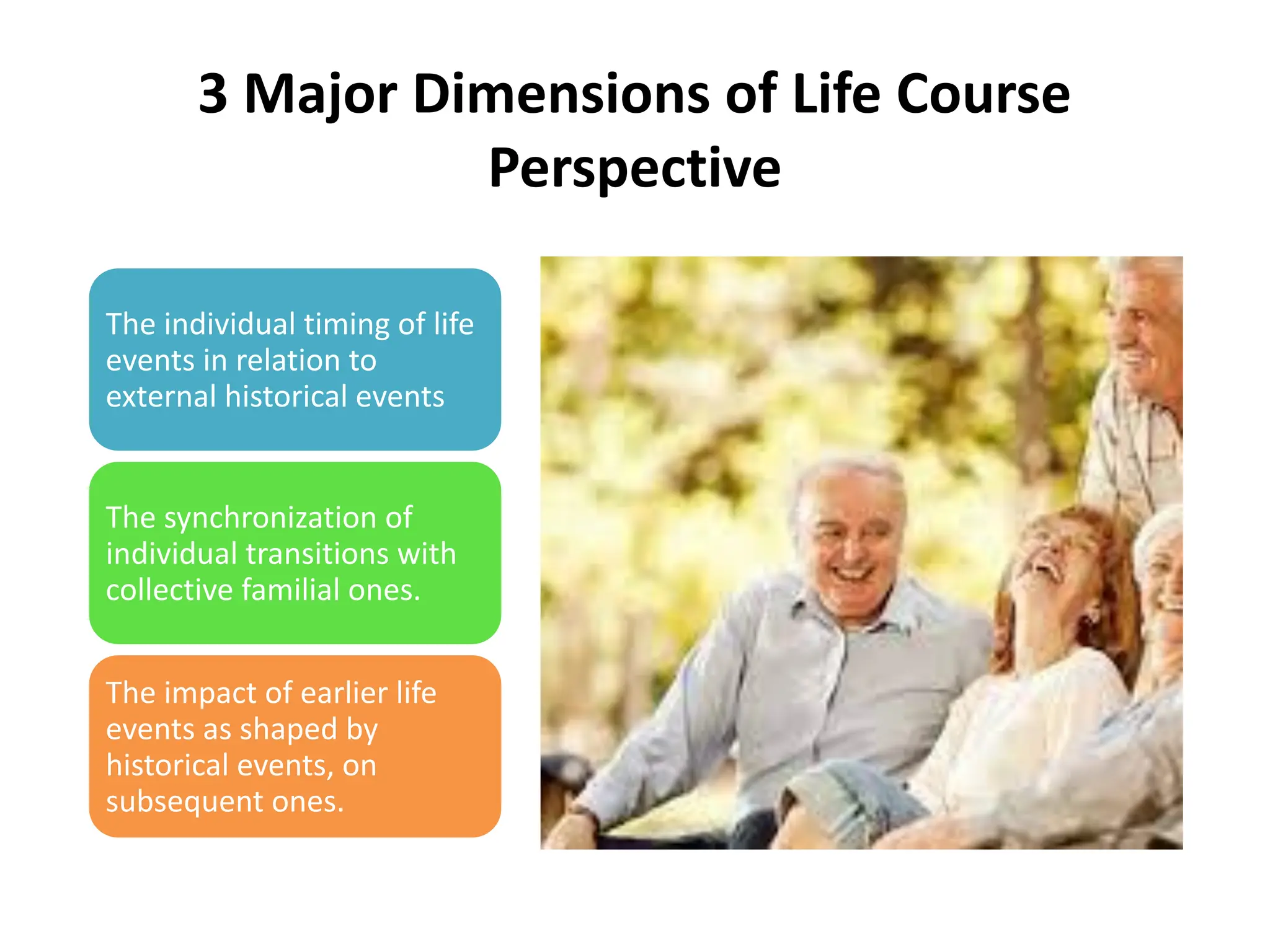
3 Major Dimensions of Life Course
Perspective
The individual timing of life
events in relation to
external historical events
The synchronization of
individual transitions with
collective familial ones.
The impact of earlier life
events as shaped by
historical events, on
subsequent ones.
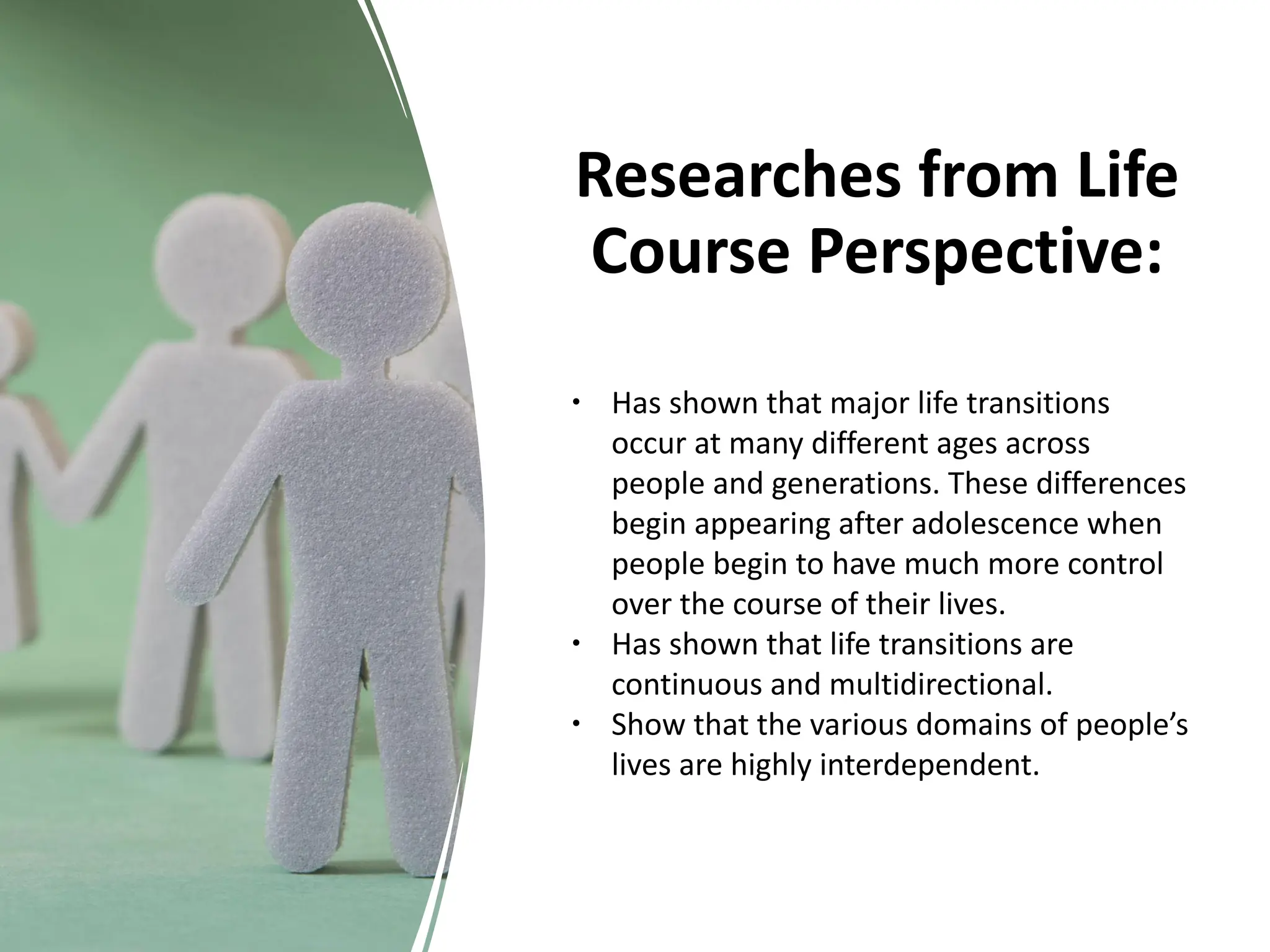
Researches from Life
Course Perspective:
∙ Has shown that major life transitions
occur at many different ages across
people and generations. These differences
begin appearing after adolescence when
people begin to have much more control
over the course of their lives.
∙ Has shown that life transitions are
continuous and multidirectional.
∙ Show that the various domains of people’s
lives are highly interdependent.
THE
ECOLOGICAL
SYSTEMS
APPROACH
Ecological Theory
From branch of Biology
Dealing with the relation of living things to
their environment and to one another
human development is inseparable from
the environmental contexts in which a
person develops
Urie Bronfenbrenner
Best-known proponent of this approach
Assumed that natural environments are the major
source of influence on developing persons
Proposed that the developing person is embedded
in a series of complex and interactive system
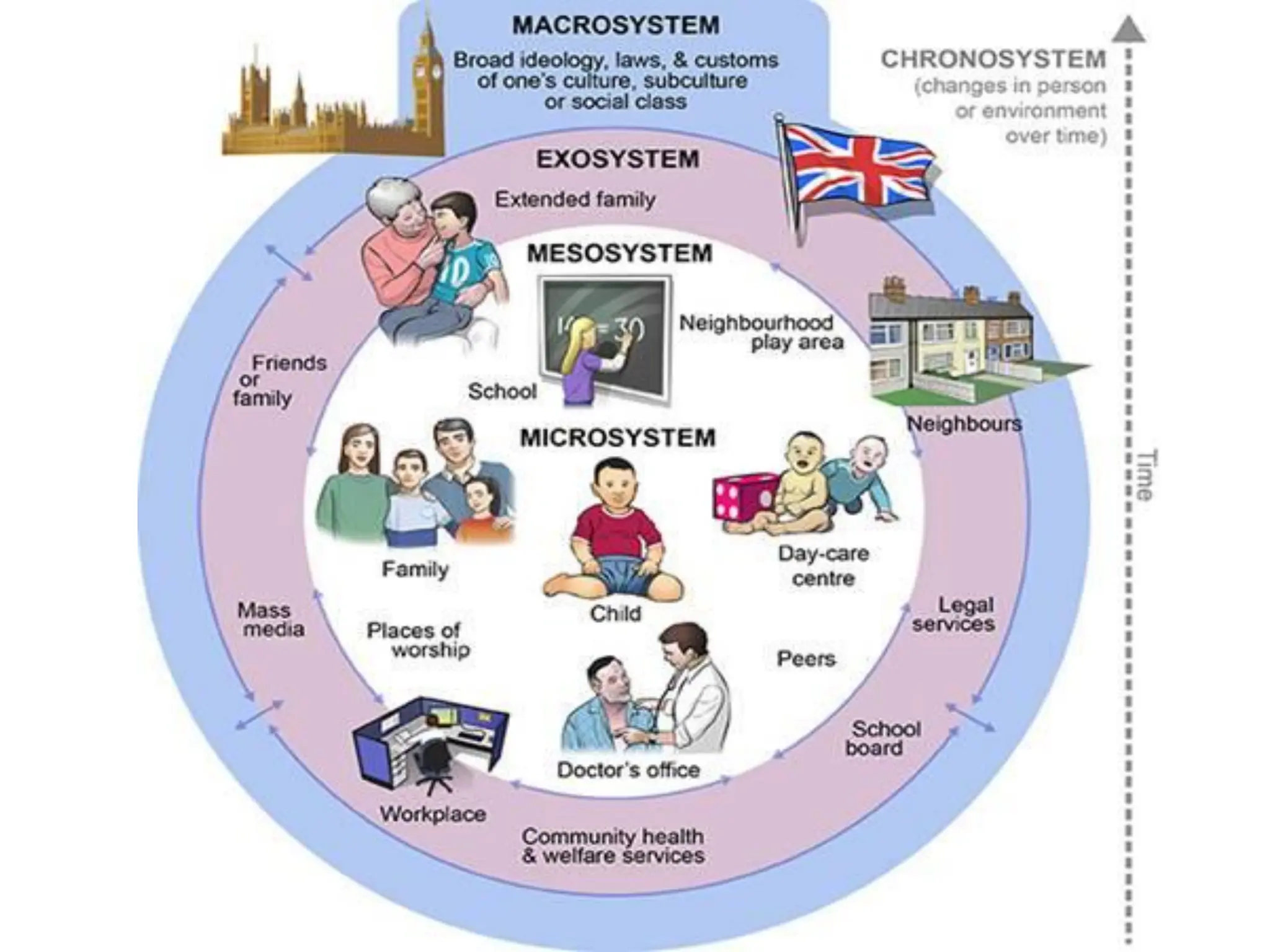
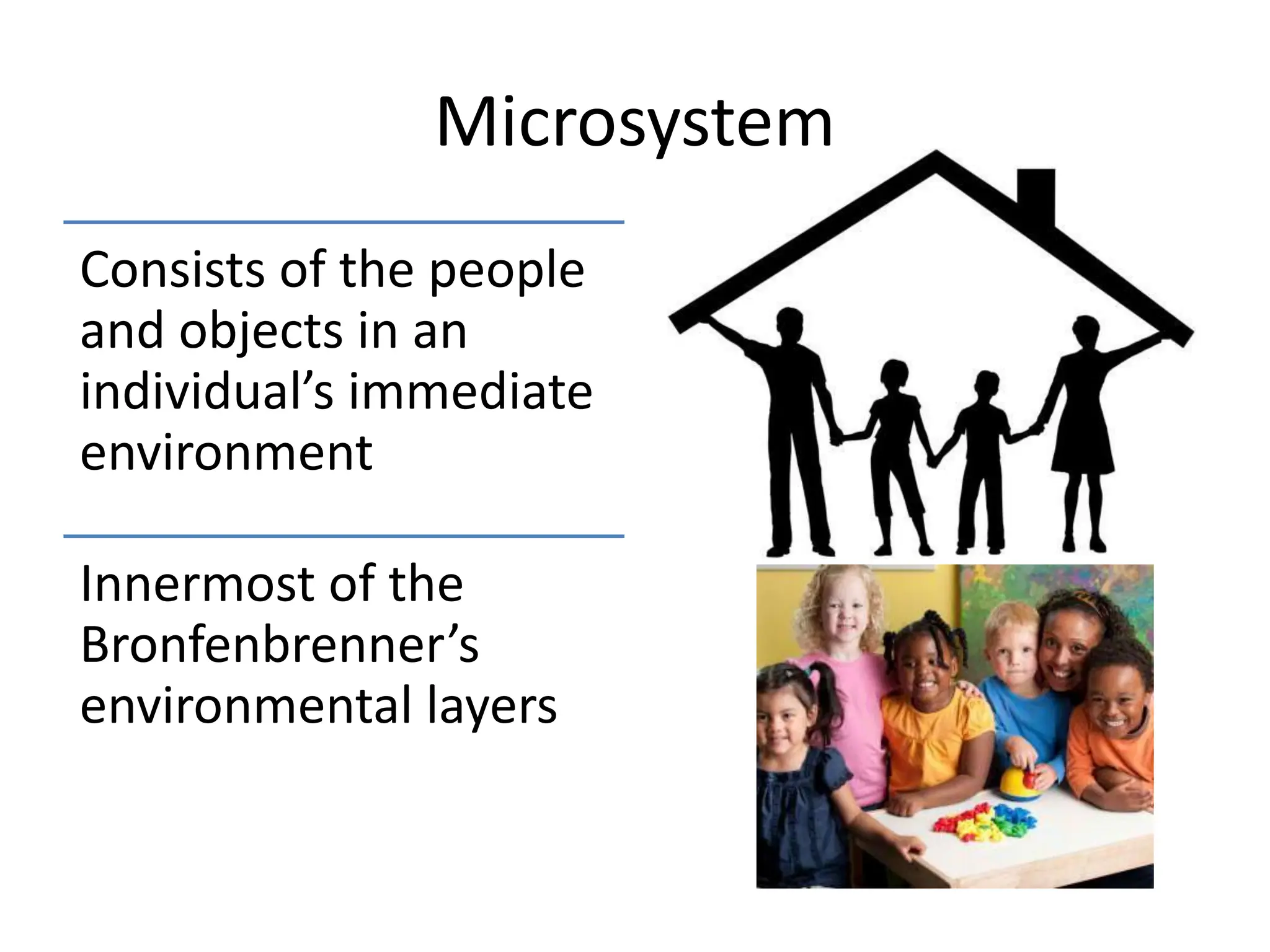
Microsystem
Consists of the people
and objects in an
individual’s immediate
environment
Innermost of the
Bronfenbrenner’s
environmental layers
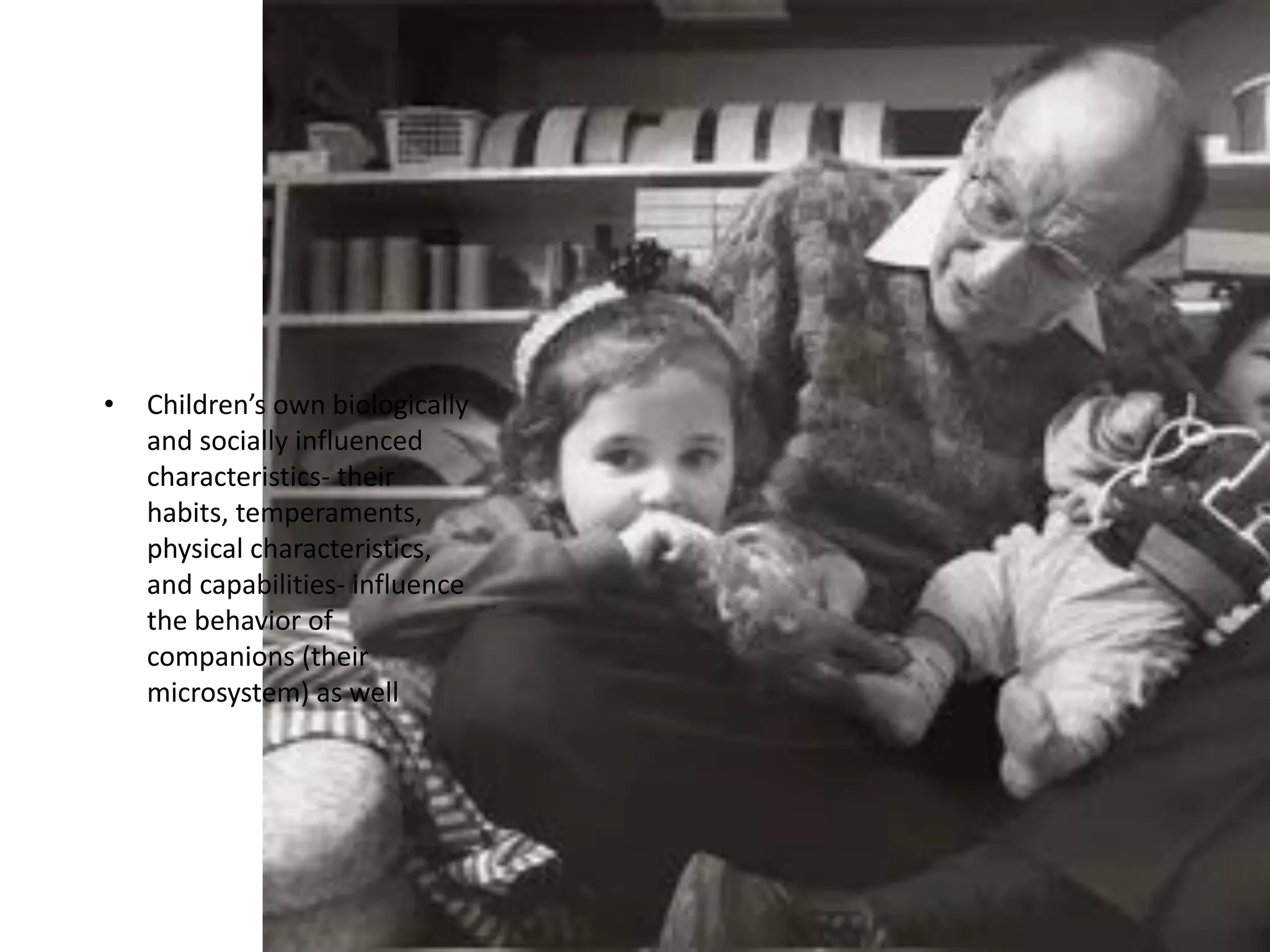
• Children’s own biologically
and socially influenced
characteristics- their
habits, temperaments,
physical characteristics,
and capabilities- influence
the behavior of
companions (their
microsystem) as well
Mesosystem
• Provides connections across microsystems,
because what happens in one microsystem is
likely to influence others
• Development is likely to be optimized by
strong, supportive links between
microsystems
• The second of Brofenbrenner’s
environmental layers
Exosystem
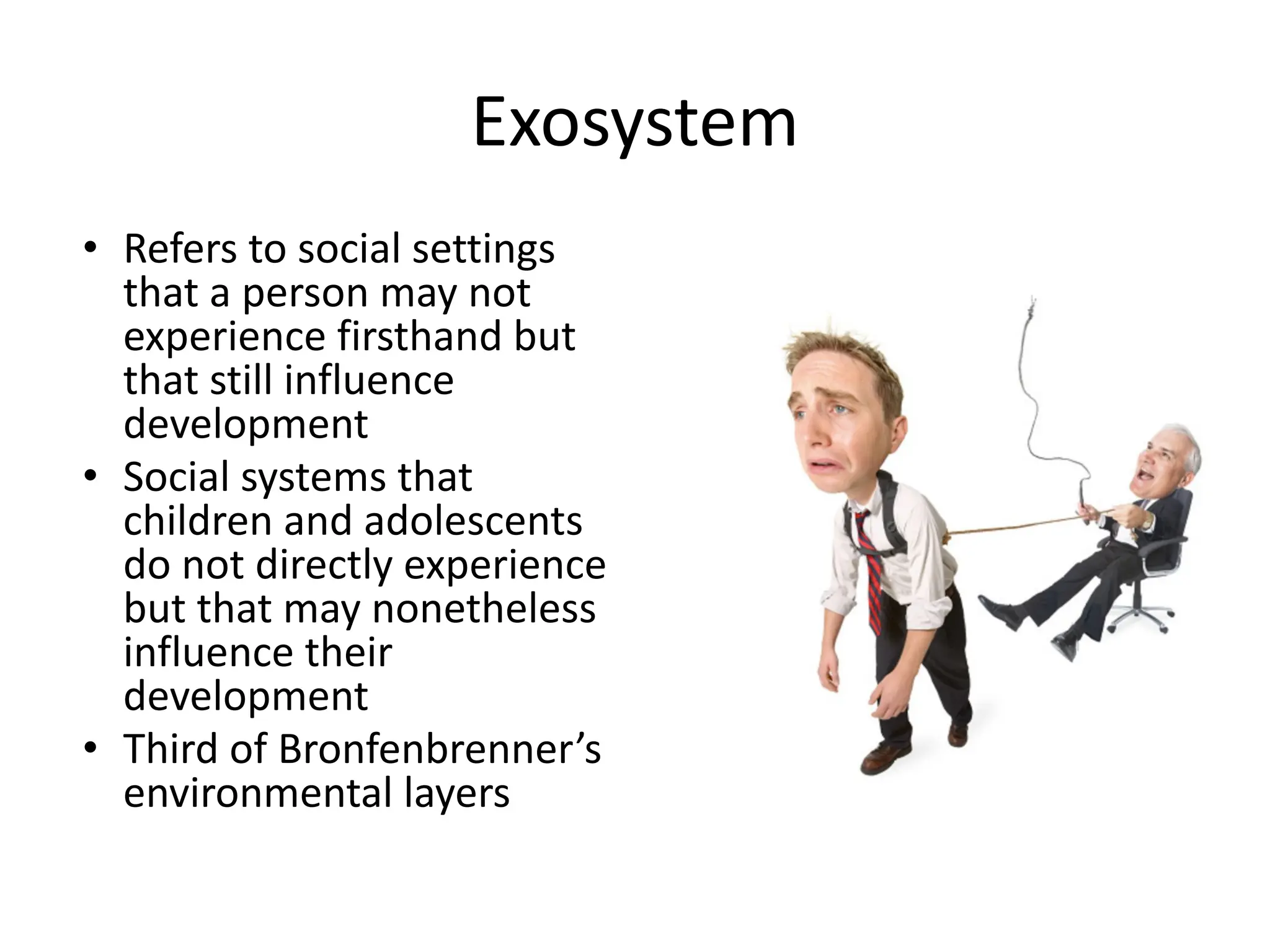
• Refers to social settings
that a person may not
experience firsthand but
that still influence
development
• Social systems that
children and adolescents
do not directly experience
but that may nonetheless
influence their
development
• Third of Bronfenbrenner’s
environmental layers
Macrosystem
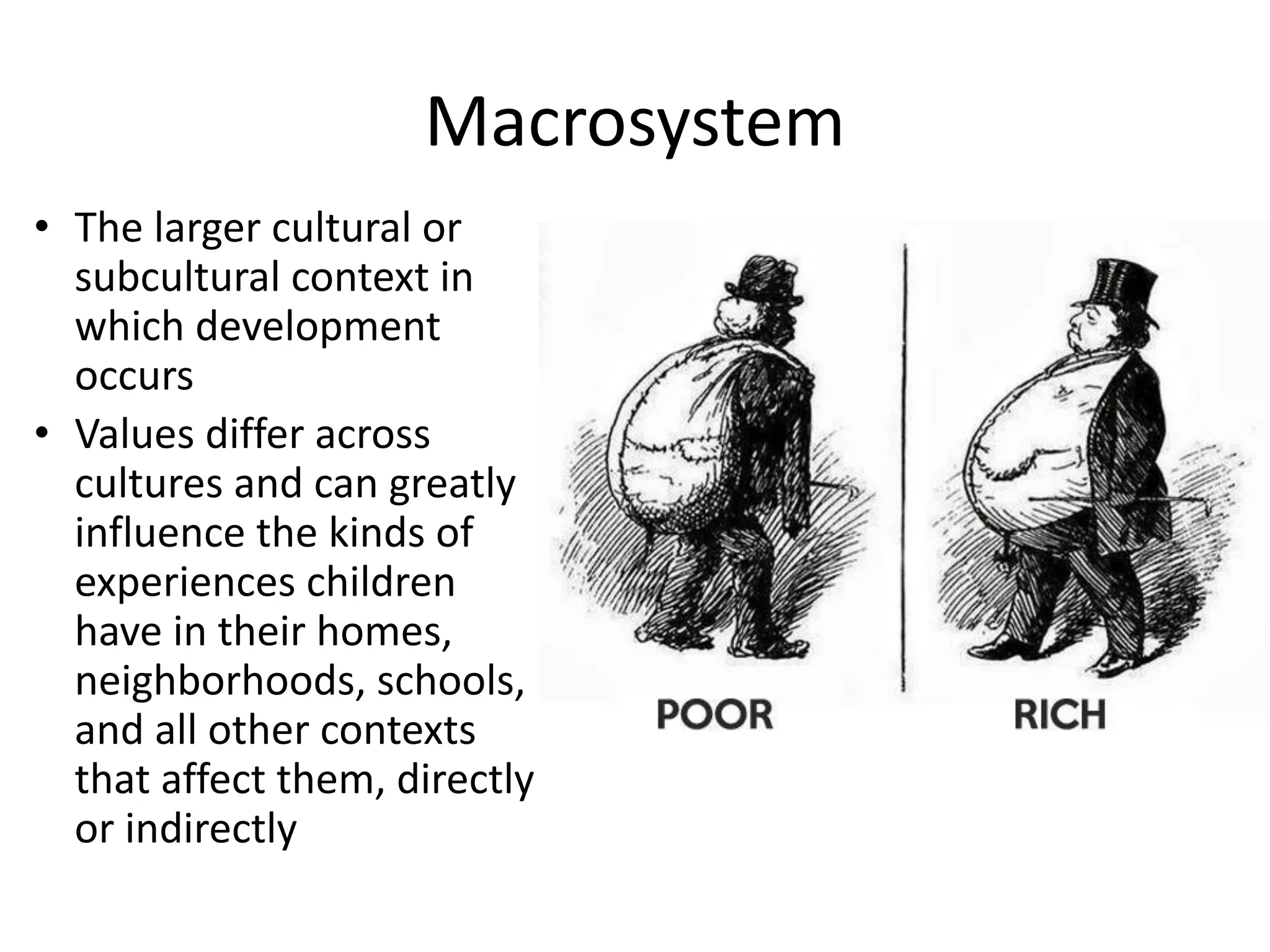
• The larger cultural or
subcultural context in
which development
occurs
• Values differ across
cultures and can greatly
influence the kinds of
experiences children
have in their homes,
neighborhoods, schools,
and all other contexts
that affect them, directly
or indirectly
Chronosystem
A temporal dimension
Emphasizes that changes in the child or in any of the
ecological contexts of development can affect the direction
that is likely to take
This include changes in family structure, place of residence,
or employment
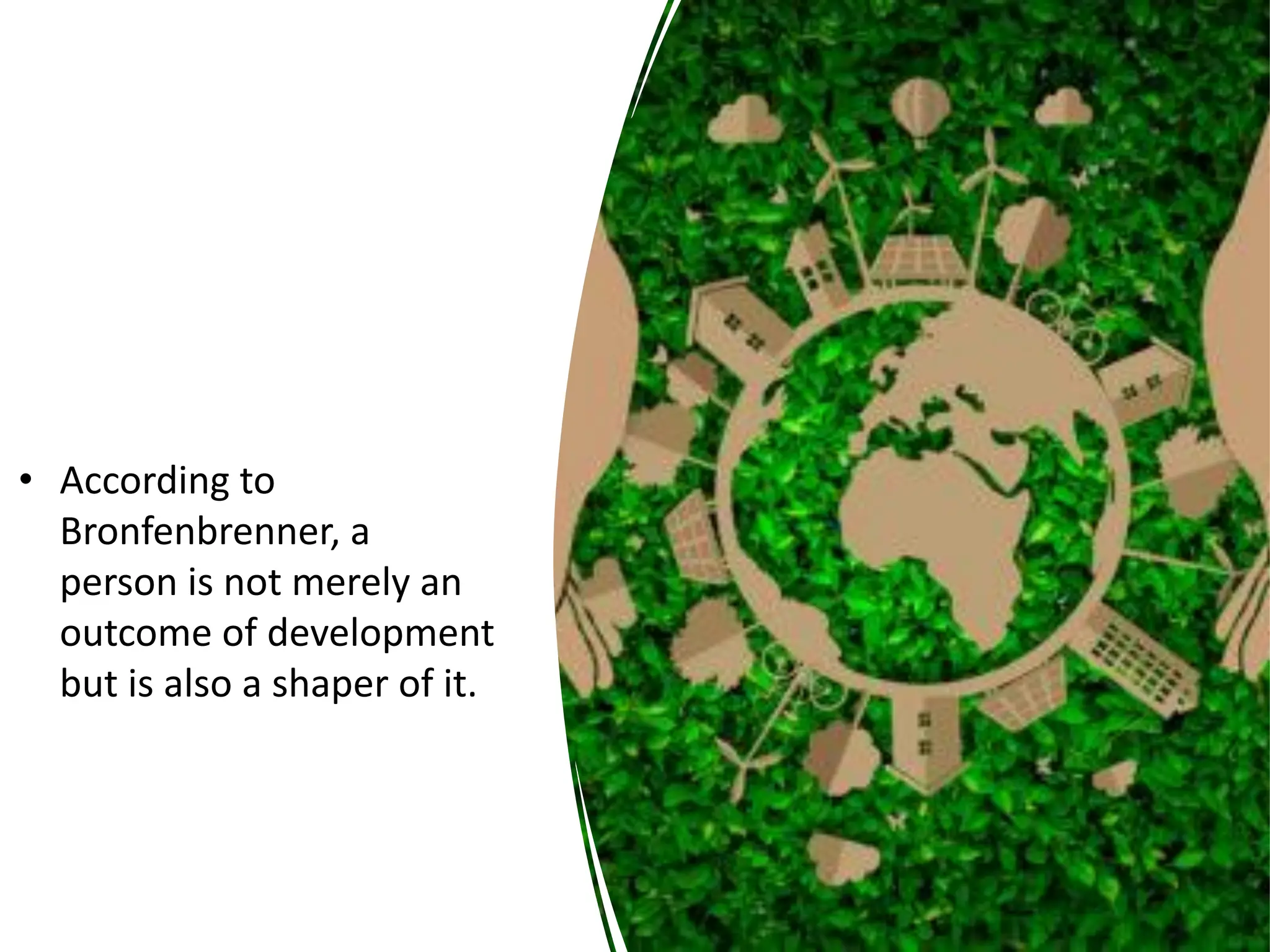
• According to
Bronfenbrenner, a
person is not merely an
outcome of development
but is also a shaper of it.
Family
“Two or more persons
related by birth, marriage,
adoption, or choice” who
have emotional ties and
responsibilities to each
other (Allen, Fine, &
Demo, 2000)
• Children influence the behavior and childrearing practices of their
parents
• Families are complex social systems- that is, networks of reciprocal
relationships and alliances (microsystem) that are constantly evolving
(chronosystem) and are greatly affected by community (exosystem)
and cultural influences (macrosystem.
Family as Social
System
• Holistic structure
• Reciprocal influence
• One implication of viewing the family as a system in that
interactions between any two family members are likely to be
influenced by attitudes and behaviors of a third family member.
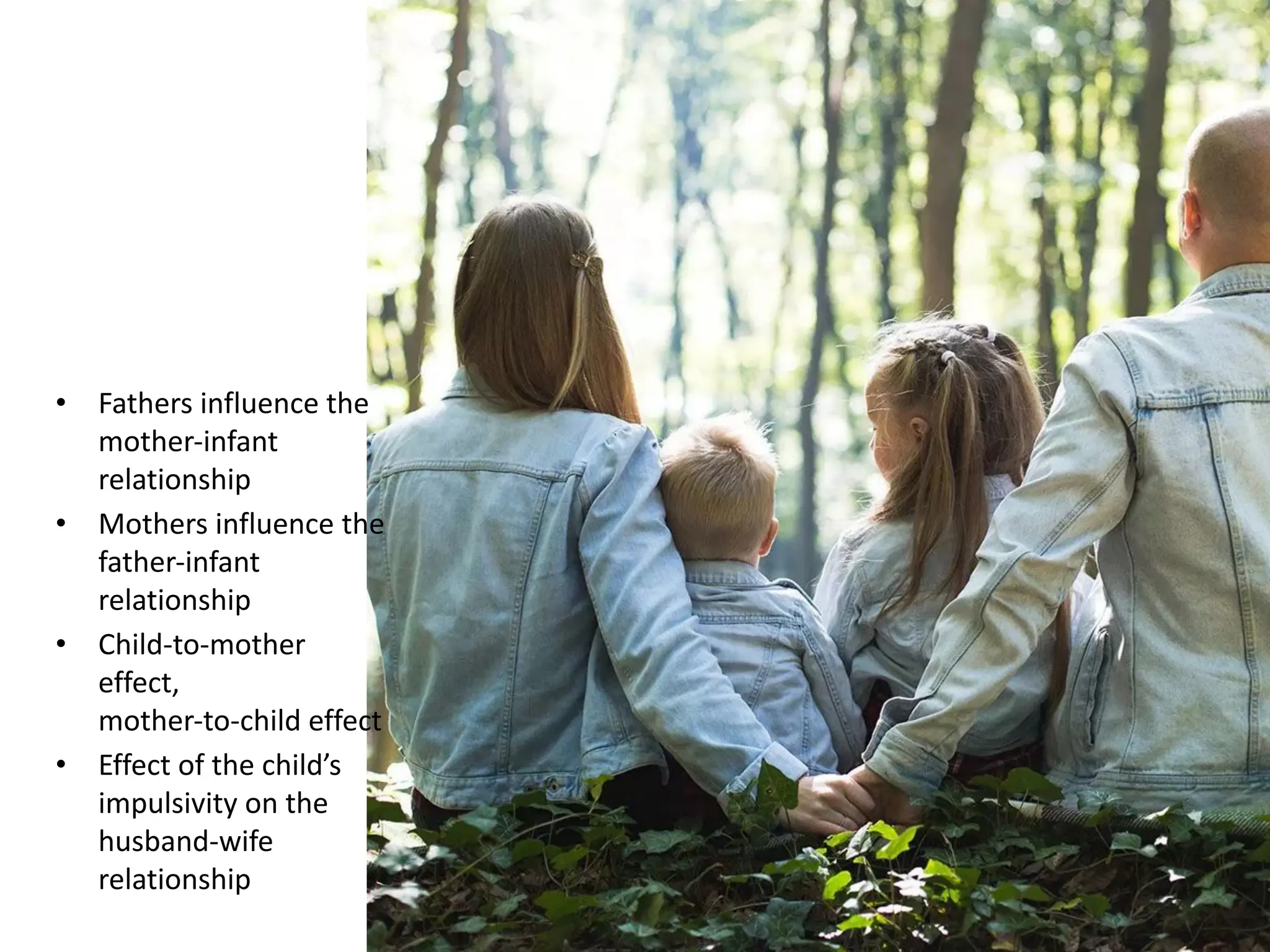
• Fathers influence the
mother-infant
relationship
• Mothers influence the
father-infant
relationship
• Child-to-mother
effect,
mother-to-child effect
• Effect of the child’s
impulsivity on the
husband-wife
relationship
SELECTIVE OPTIMIZATION WITH
COMPENSATION
Selective Optimization
with Compensation
• The three processes form a system of
behavioral action that generates and
regulates development and aging.
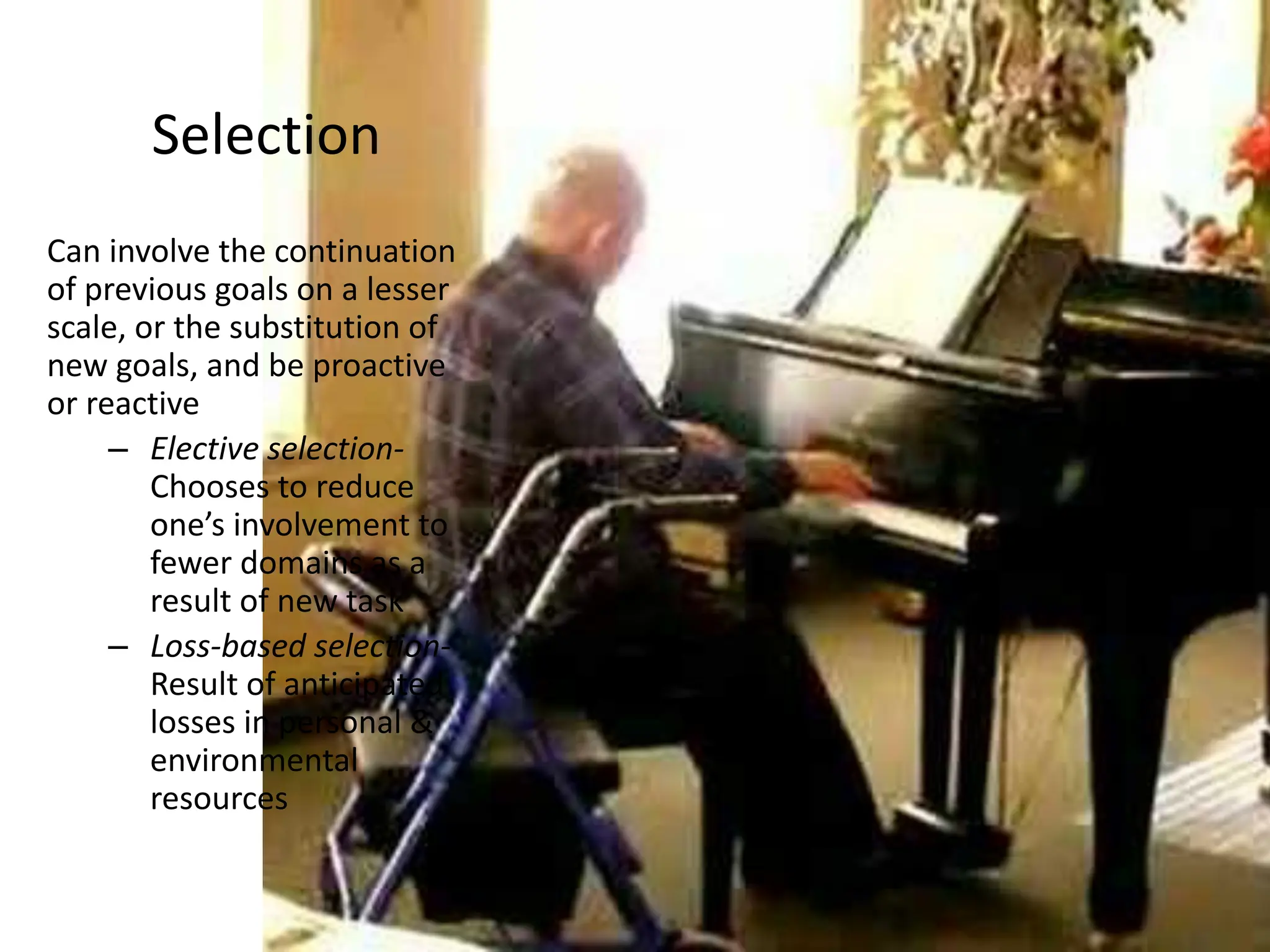
Selection
Can involve the continuation
of previous goals on a lesser
scale, or the substitution of
new goals, and be proactive
or reactive
– Elective selection-
Chooses to reduce
one’s involvement to
fewer domains as a
result of new task
– Loss-based selection-
Result of anticipated
losses in personal &
environmental
resources
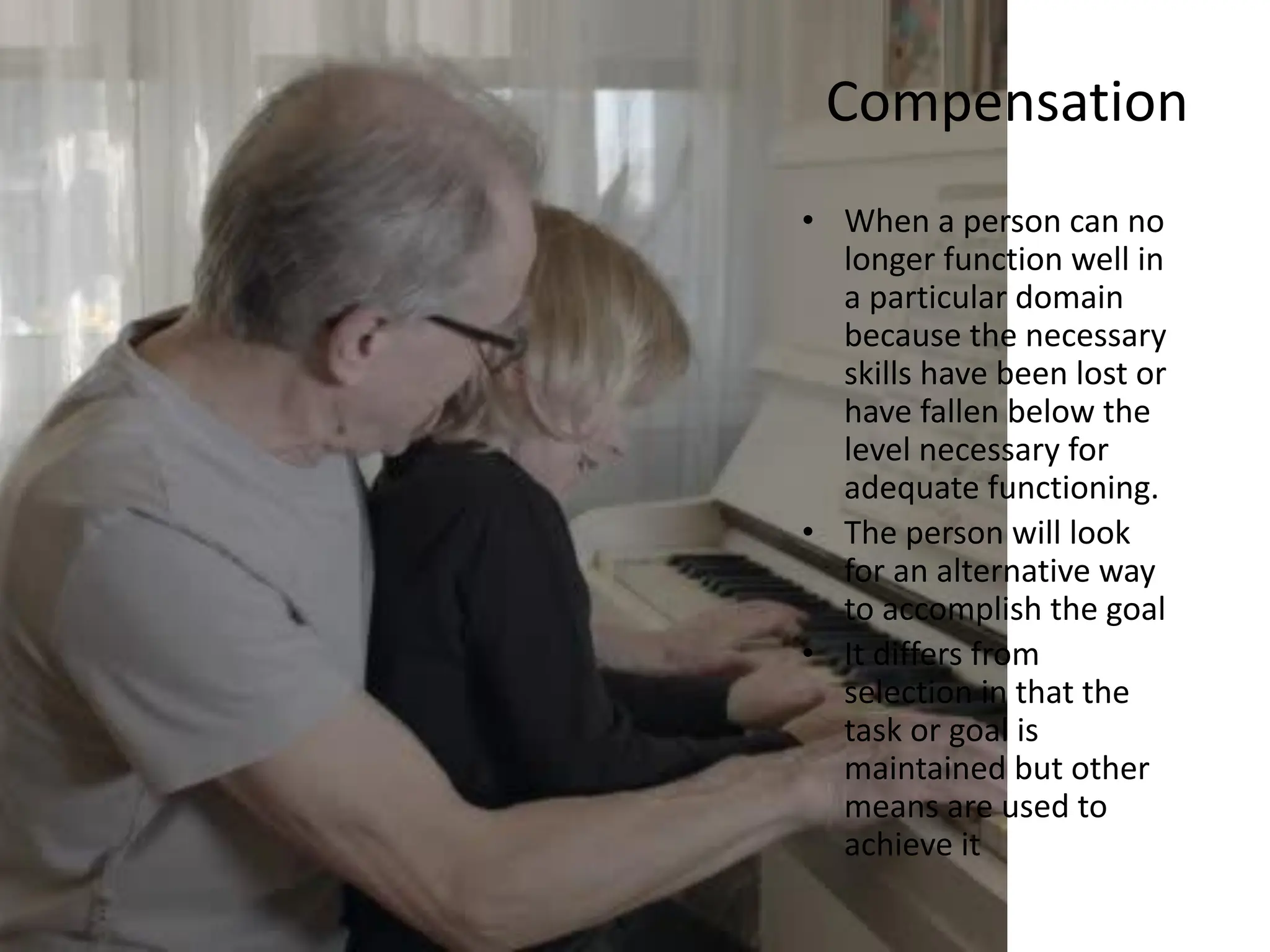
Compensation
• When a person can no
longer function well in
a particular domain
because the necessary
skills have been lost or
have fallen below the
level necessary for
adequate functioning.
• The person will look
for an alternative way
to accomplish the goal
• It differs from
selection in that the
task or goal is
maintained but other
means are used to
achieve it
Optimization
• The minimization of losses and
maximization of gains
• Best matching one’s resources and one’s
desired goals
• Balancing process between selecting the
right goals and compensating, when
possible, to help them maximize the
odds of achieving them.

Chapter 1 Developmental Psychology.pdf

  • 1.
  • 2.
    Developmental Psychology Scientific study that examineschanges in psychological characteristics occurring over a lifetime (as well as physical changes associated with them.)
  • 3.
  • 4.
    LIFE-SPAN PERSPECTIVE Human Development is multiplydetermined and cannot be understood within a scope of single framework. Human Development must be viewed from the biopsychosocial framework (Riley,1979).
  • 5.
    Basic Premises of Life-Span Perspective (Riley, 1979): Newpatterns of development can cause social change. How one’s life is played out is affected by social, environmental, and historical change. Aging, is a lifelong process of growing up and growing old.
  • 6.
    Key Features (Baltes,1987): o Plasticity- Skills can be learned or improved with practice, even in late life. o Interdisciplinary research- Research from different kinds of disciplinary perspectives (anthropology, economics, psychology) is needed to fully understand lifespan development. o Multicontextual nature of development- Individual development occurs within several interrelated context (family, neighborhood, culture, historical time). o Multidirectionality- development involves both growth and decline. o Multiple Causation- how we develop results from biological, psychological, sociocultural, and life-cycle forces.
  • 7.
  • 8.
    DOMAINS OF DEVELOPMENT a.Physical Domain- changes in the size, shape, and characteristics of the body. b. Cognitive Domain- changes in thinking, memory, problem solving, and other intellectual skills. c. Social Domain- change in variables that are associated with the relationship of an individual to others.
  • 9.
    Key Issues inthe Study of Human Development
  • 10.
    Nature-Nurture Debate The debateabout the relative contributions of biological processes and experential factors to devlopment.
  • 11.
    Continuity versus Discontinuity The questionis whether age-related change is primarily a matter of amount or degree (the contuity side of the debate) or of changes in type or kind (the discontinuity side). • Quantitative change • Qualitative change
  • 12.
  • 13.
    • changes thatare common to every member of a species. Normative age-graded changes • Changes that occur in most members of a cohort as a result of factors at work during a specific, well-defined historical period. Normative history-graded changes • Changes that result from unique, unshared events Nonnormative changes
  • 15.
    Psychoanalyctic Theories • Freud’sPsychosexual – Personality develops in five stages from birth to adolescence; in each stage, the need for physical pleasure is focused on a different part of the body. Strengths - Emphasizes the importance of experiences in infancy and early childhood; provide psychological explanations for mental illness.
  • 16.
    • Weaknesses - Sexualfeelings are not as important in personality development as Freud claimed.
  • 17.
    • Erikson’s psychosocialtheory - Personality develops through eight life crises across he entire lifespan; a person finishes each crisis with either good or poor resolution. Strengths - Helps explain the role of culture in personality development; important in lifespan psychology; useful description of major themes of personality development at different ages.
  • 18.
    • Weaknesses • -Describing each period in terms of a single crisis is probably an oversimplification
  • 19.
    LEARNING THEORIES • Pavlov’sclassical conditioning • learning happens when neutral stimuli becomes so strongly associated with natural stimuli that they elicit the same response. • Strength- Useful in explaining how emotional response such as phobias are learned.
  • 20.
    Weakness- explanation ofbehavior change too limited to serve a comprehensive theory. Skinner’s Operant conditioning - Development involves behavior changes that are shaped by reinforment and punishment. Strength- Basis of many useful strategies for managing and changing human behavior.
  • 21.
    Weaknesses- Humans arenot as passive as Skinner claimed; the theory ignores hereditary, cognitive, emotional, and social factors in development.
  • 22.
    Bandura’s Social learningtheory • People learn from models; what they learn from model depends on how they interpret the situation cognitively and emotionally. • Strength - Helps explain how models influence behavior; explains more about development than other learning theories do because of addition of cognitive and emotional factors.
  • 23.
    Weaknesses • Does notprovide an overall picture of development.
  • 24.
    COGNITIVE THEORIES Piaget’s theoryof cognitive development- -Reasoning develops in four universal stages from birth through adolescence; in each stage, the child builds a different kind of scheme. Strengths- Helps explain how children of different ages think about and act on the world.
  • 25.
    • Weaknesses - Stageconcept may cause adults to underestimate the children’s reasoning abilities; there may be additional stages in adulthood. Information processing theory- The computer is used as a model for human cognitive functioning; encoding, storage, and retrieval processes change with age, causing changes in memory function; these changes happen because of both brain maturation and practice.
  • 26.
    • Strengths - helpsexplain how much information people of different ages can manage at one time and how they process it; provides a useful framework for studying individual differences in people of the same age. Weaknesses - Human information processing is much more complex than that of a computer; the theory does not provide a overall picture of development
  • 27.
    Vygotsky’s Sociocultural theory -Emphasizes linguistic and social factors in cognitive development. Strengths - Incorporates group learning processes into explanations of individual cognitive development.
  • 28.
    • Weaknesses - Insufficientevidence to support most ideas.
  • 29.
  • 30.
    LIFE COURSE PERSPECTIVE Thisperspective describes the ways in which various generations experience the biological, psychological, and sociocultural forces of development in their respective historical context. The key feature of this perspective is the dynamic interplay between the individual and society. The emphasis of this perspective on the interrelations between the individual and society through the emphasis on historical time has made it a dominant view in the social sciences.
  • 31.
    3 Major Dimensionsof Life Course Perspective The individual timing of life events in relation to external historical events The synchronization of individual transitions with collective familial ones. The impact of earlier life events as shaped by historical events, on subsequent ones.
  • 32.
    Researches from Life CoursePerspective: ∙ Has shown that major life transitions occur at many different ages across people and generations. These differences begin appearing after adolescence when people begin to have much more control over the course of their lives. ∙ Has shown that life transitions are continuous and multidirectional. ∙ Show that the various domains of people’s lives are highly interdependent.
  • 33.
  • 34.
    Ecological Theory From branchof Biology Dealing with the relation of living things to their environment and to one another human development is inseparable from the environmental contexts in which a person develops
  • 35.
    Urie Bronfenbrenner Best-known proponentof this approach Assumed that natural environments are the major source of influence on developing persons Proposed that the developing person is embedded in a series of complex and interactive system
  • 37.
    Microsystem Consists of thepeople and objects in an individual’s immediate environment Innermost of the Bronfenbrenner’s environmental layers
  • 38.
    • Children’s ownbiologically and socially influenced characteristics- their habits, temperaments, physical characteristics, and capabilities- influence the behavior of companions (their microsystem) as well
  • 39.
    Mesosystem • Provides connectionsacross microsystems, because what happens in one microsystem is likely to influence others • Development is likely to be optimized by strong, supportive links between microsystems • The second of Brofenbrenner’s environmental layers
  • 40.
    Exosystem • Refers tosocial settings that a person may not experience firsthand but that still influence development • Social systems that children and adolescents do not directly experience but that may nonetheless influence their development • Third of Bronfenbrenner’s environmental layers
  • 41.
    Macrosystem • The largercultural or subcultural context in which development occurs • Values differ across cultures and can greatly influence the kinds of experiences children have in their homes, neighborhoods, schools, and all other contexts that affect them, directly or indirectly
  • 42.
    Chronosystem A temporal dimension Emphasizesthat changes in the child or in any of the ecological contexts of development can affect the direction that is likely to take This include changes in family structure, place of residence, or employment
  • 43.
    • According to Bronfenbrenner,a person is not merely an outcome of development but is also a shaper of it.
  • 44.
    Family “Two or morepersons related by birth, marriage, adoption, or choice” who have emotional ties and responsibilities to each other (Allen, Fine, & Demo, 2000)
  • 45.
    • Children influencethe behavior and childrearing practices of their parents • Families are complex social systems- that is, networks of reciprocal relationships and alliances (microsystem) that are constantly evolving (chronosystem) and are greatly affected by community (exosystem) and cultural influences (macrosystem.
  • 46.
    Family as Social System •Holistic structure • Reciprocal influence • One implication of viewing the family as a system in that interactions between any two family members are likely to be influenced by attitudes and behaviors of a third family member.
  • 47.
    • Fathers influencethe mother-infant relationship • Mothers influence the father-infant relationship • Child-to-mother effect, mother-to-child effect • Effect of the child’s impulsivity on the husband-wife relationship
  • 48.
  • 49.
    Selective Optimization with Compensation •The three processes form a system of behavioral action that generates and regulates development and aging.
  • 50.
    Selection Can involve thecontinuation of previous goals on a lesser scale, or the substitution of new goals, and be proactive or reactive – Elective selection- Chooses to reduce one’s involvement to fewer domains as a result of new task – Loss-based selection- Result of anticipated losses in personal & environmental resources
  • 51.
    Compensation • When aperson can no longer function well in a particular domain because the necessary skills have been lost or have fallen below the level necessary for adequate functioning. • The person will look for an alternative way to accomplish the goal • It differs from selection in that the task or goal is maintained but other means are used to achieve it
  • 52.
    Optimization • The minimizationof losses and maximization of gains • Best matching one’s resources and one’s desired goals • Balancing process between selecting the right goals and compensating, when possible, to help them maximize the odds of achieving them.