M.Pharm 1st Semester Seminar
Subject : Biostatistics
Topic :Probability
By:
Manas Kumar Das
M.Pharm 1st Year (Pharmacology)
Regd. No. : 1661613001
Probability is the likelihood of something
happening in the future. It is expressed as a
number between zero (can never happen)
to 1 (will always happen). It can be
expressed as a fraction, a decimal, a
percent, or as "odds".
Probability
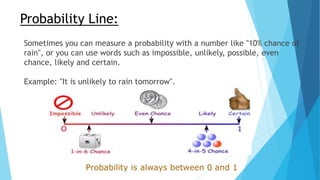
Sometimes you can measure a probability with a number like "10% chance of
rain", or you can use words such as impossible, unlikely, possible, even
chance, likely and certain.
Example: "It is unlikely to rain tomorrow".
Probability is always between 0 and 1
Probability Line:
Some common terms related to
probability :
Experiment: Is a situation involving chance or probability that
leads to results called outcomes
Outcome: A possible result of a random experiment.
Equally likely outcomes: All outcomes with equal probability.
Some common terms related to probability
(contd.)
 Sample space: The possible set of outcomes of an experiment is
known as sample space.
. Example: choosing a card from a deck
 There are 52 cards in a deck (not including Jokers)
 So the Sample Space is all 52 possible cards: {Ace of Hearts, 2
of Hearts, etc... }.
Event: One or more outcomes in an experiment.
Sample point: Each element of the sample space is
called a sample point.
Ex:
 the 5 of Clubs is a sample point
 the King of Hearts is a sample point.
Types of Probability :
Three types of probability are there
Classical definition of probability
Statistical or Empirical definition of
probability
Subjective probability
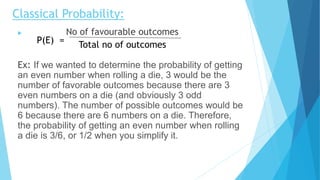
Classical Probability:
 No of favourable outcomes
Ex: If we wanted to determine the probability of getting
an even number when rolling a die, 3 would be the
number of favorable outcomes because there are 3
even numbers on a die (and obviously 3 odd
numbers). The number of possible outcomes would be
6 because there are 6 numbers on a die. Therefore,
the probability of getting an even number when rolling
a die is 3/6, or 1/2 when you simplify it.
Total no of outcomesP(E) =
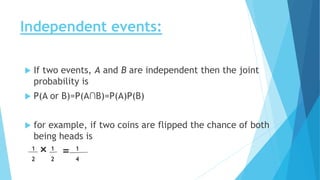
Independent events:
 If two events, A and B are independent then the joint
probability is
 P(A or B)=P(A∩B)=P(A)P(B)
 for example, if two coins are flipped the chance of both
being heads is
1 1 1
2 2 4
×
=
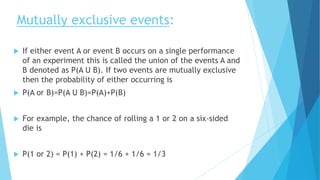
Mutually exclusive events:
 If either event A or event B occurs on a single performance
of an experiment this is called the union of the events A and
B denoted as P(A U B). If two events are mutually exclusive
then the probability of either occurring is
 P(A or B)=P(A U B)=P(A)+P(B)
 For example, the chance of rolling a 1 or 2 on a six-sided
die is
 P(1 or 2) = P(1) + P(2) = 1/6 + 1/6 = 1/3
Not mutually exclusive events :
 If the events are not mutually exclusive then
 P(A or B) = P(A) + P(B) – P(A) and P(B)
 Example - when drawing a single card at random from a regular deck of
cards, the chance of getting a heart or a face card (J,Q,K) (or one that is
both) is 13/52 + 12/52 - 3/52 = 11/26
 because of the 52 cards of a deck 13 are hearts, 12 are face cards, and 3
are both: here the possibilities included in the "3 that are both" are
included in each of the "13 hearts" and the "12 face cards" but should only
be counted once
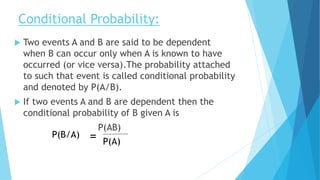
Conditional Probability:
 Two events A and B are said to be dependent
when B can occur only when A is known to have
occurred (or vice versa).The probability attached
to such that event is called conditional probability
and denoted by P(A/B).
 If two events A and B are dependent then the
conditional probability of B given A is
P(AB)
P(A)
P(B/A) =
 EX: A bag contain 5 white balls and 3 black balls. Two balls are drawn
at random one after the other without replacement. Find the
probability that both ball drawn are black.
 Sol : Probability of drawing a black ball in the first attempt is
P(A) =3/5+3 =3/8
. Probability of drawing the second black ball given that first ball drawn
is black
P(B/A) = 2/5+2 = 2/7
The probability that both balls drawn are black is given by
P(AB) = P(A) × P(B/A) = 3/8 × 2/7 = 3/28
Bayes’ Theorem :
Application of Probability:
 Applications of probability in analysis.
 Point processes, random sets, and other spatial models.
 -Branching processes and other models of population growth.
 -Genetics and other stochastic models in biology.
 -Information theory and signal processing
 -Communication networks
 -Stochastic models in operations research.
Reference:
 S C Gupta; Statistical Method; Sultan Chand & Sons Educational
Publishers New Delhi; 2010; P.753-803
 P N Arora, S Arora, S Arora; Comprehensive Statistical Method;
S Chand & Company LTD; 2012; P. 11.3-11.101
 Journal of Probability and Statistics,8th Edition. Page 26-27.
 William Feller, "An Introduction to Probability Theory and Its
Applications", (Vol 1), 3rd Ed, (1968)
PROBABILITY

PROBABILITY

  • 1.
    M.Pharm 1st SemesterSeminar Subject : Biostatistics Topic :Probability By: Manas Kumar Das M.Pharm 1st Year (Pharmacology) Regd. No. : 1661613001
  • 2.
    Probability is thelikelihood of something happening in the future. It is expressed as a number between zero (can never happen) to 1 (will always happen). It can be expressed as a fraction, a decimal, a percent, or as "odds". Probability
  • 3.
    Sometimes you canmeasure a probability with a number like "10% chance of rain", or you can use words such as impossible, unlikely, possible, even chance, likely and certain. Example: "It is unlikely to rain tomorrow". Probability is always between 0 and 1 Probability Line:
  • 4.
    Some common termsrelated to probability : Experiment: Is a situation involving chance or probability that leads to results called outcomes Outcome: A possible result of a random experiment. Equally likely outcomes: All outcomes with equal probability.
  • 5.
    Some common termsrelated to probability (contd.)  Sample space: The possible set of outcomes of an experiment is known as sample space. . Example: choosing a card from a deck  There are 52 cards in a deck (not including Jokers)  So the Sample Space is all 52 possible cards: {Ace of Hearts, 2 of Hearts, etc... }.
  • 6.
    Event: One ormore outcomes in an experiment. Sample point: Each element of the sample space is called a sample point. Ex:  the 5 of Clubs is a sample point  the King of Hearts is a sample point.
  • 7.
    Types of Probability: Three types of probability are there Classical definition of probability Statistical or Empirical definition of probability Subjective probability
  • 8.
    Classical Probability:  Noof favourable outcomes Ex: If we wanted to determine the probability of getting an even number when rolling a die, 3 would be the number of favorable outcomes because there are 3 even numbers on a die (and obviously 3 odd numbers). The number of possible outcomes would be 6 because there are 6 numbers on a die. Therefore, the probability of getting an even number when rolling a die is 3/6, or 1/2 when you simplify it. Total no of outcomesP(E) =
  • 12.
    Independent events:  Iftwo events, A and B are independent then the joint probability is  P(A or B)=P(A∩B)=P(A)P(B)  for example, if two coins are flipped the chance of both being heads is 1 1 1 2 2 4 × =
  • 13.
    Mutually exclusive events: If either event A or event B occurs on a single performance of an experiment this is called the union of the events A and B denoted as P(A U B). If two events are mutually exclusive then the probability of either occurring is  P(A or B)=P(A U B)=P(A)+P(B)  For example, the chance of rolling a 1 or 2 on a six-sided die is  P(1 or 2) = P(1) + P(2) = 1/6 + 1/6 = 1/3
  • 14.
    Not mutually exclusiveevents :  If the events are not mutually exclusive then  P(A or B) = P(A) + P(B) – P(A) and P(B)  Example - when drawing a single card at random from a regular deck of cards, the chance of getting a heart or a face card (J,Q,K) (or one that is both) is 13/52 + 12/52 - 3/52 = 11/26  because of the 52 cards of a deck 13 are hearts, 12 are face cards, and 3 are both: here the possibilities included in the "3 that are both" are included in each of the "13 hearts" and the "12 face cards" but should only be counted once
  • 15.
    Conditional Probability:  Twoevents A and B are said to be dependent when B can occur only when A is known to have occurred (or vice versa).The probability attached to such that event is called conditional probability and denoted by P(A/B).  If two events A and B are dependent then the conditional probability of B given A is P(AB) P(A) P(B/A) =
  • 16.
     EX: Abag contain 5 white balls and 3 black balls. Two balls are drawn at random one after the other without replacement. Find the probability that both ball drawn are black.  Sol : Probability of drawing a black ball in the first attempt is P(A) =3/5+3 =3/8 . Probability of drawing the second black ball given that first ball drawn is black P(B/A) = 2/5+2 = 2/7 The probability that both balls drawn are black is given by P(AB) = P(A) × P(B/A) = 3/8 × 2/7 = 3/28
  • 17.
  • 19.
    Application of Probability: Applications of probability in analysis.  Point processes, random sets, and other spatial models.  -Branching processes and other models of population growth.  -Genetics and other stochastic models in biology.  -Information theory and signal processing  -Communication networks  -Stochastic models in operations research.
  • 20.
    Reference:  S CGupta; Statistical Method; Sultan Chand & Sons Educational Publishers New Delhi; 2010; P.753-803  P N Arora, S Arora, S Arora; Comprehensive Statistical Method; S Chand & Company LTD; 2012; P. 11.3-11.101  Journal of Probability and Statistics,8th Edition. Page 26-27.  William Feller, "An Introduction to Probability Theory and Its Applications", (Vol 1), 3rd Ed, (1968)