

Standard Deviation &Variance
Dr. Harinatha Reddy
Sri Krishnadevaraya University
Department of microbiology
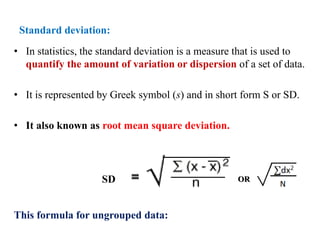
Standard deviation:
• In statistics, the standard deviation is a measure that is used to
quantify the amount of variation or dispersion of a set of data.
• It is represented by Greek symbol (s) and in short form S or SD.
• It also known as root mean square deviation.
This formula for ungrouped data:
SD OR
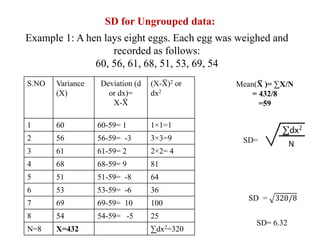
SD for Ungrouped data:
Example 1: A hen lays eight eggs. Each egg was weighed and
recorded as follows:
60, 56, 61, 68, 51, 53, 69, 54
S.NO Variance
(X)
Deviation (d
or dx)=
X-X
̅
(X-X
̅ )2 or
dx2
1 60 60-59= 1 1×1=1
2 56 56-59= -3 3×3=9
3 61 61-59= 2 2×2= 4
4 68 68-59= 9 81
5 51 51-59= -8 64
6 53 53-59= -6 36
7 69 69-59= 10 100
8 54 54-59= -5 25
N=8 X=432 ∑dx2=320
Mean(X
̅ )= ∑X/N
= 432/8
=59
SD=
SD = 320/8
SD= 6.32
Exercise 1: Calculate SD for ungrouped data:
• 10,15,20,25,4,8
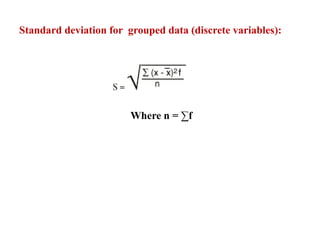
Standard deviation for grouped data (discrete variables):
Where n = ∑f
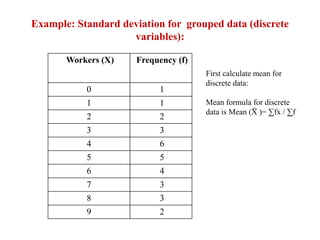
Example: Standard deviation for grouped data (discrete
variables):
Workers (X) Frequency (f)
0 1
1 1
2 2
3 3
4 6
5 5
6 4
7 3
8 3
9 2
First calculate mean for
discrete data:
Mean formula for discrete
data is Mean (X
̅ )= ∑fx / ∑f
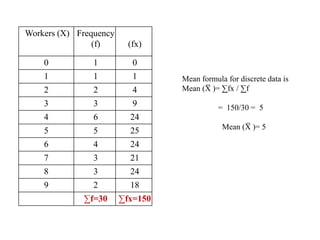
Workers (X) Frequency
(f) (fx)
0 1 0
1 1 1
2 2 4
3 3 9
4 6 24
5 5 25
6 4 24
7 3 21
8 3 24
9 2 18
∑f=30 ∑fx=150
Mean formula for discrete data is
Mean (X
̅ )= ∑fx / ∑f
= 150/30 = 5
Mean (X
̅ )= 5
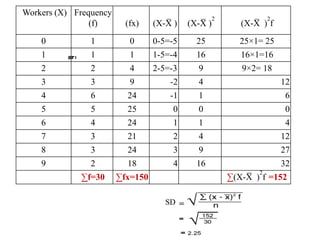
Workers (X) Frequency
(f) (fx) (X-X
̅ ) (X-X
̅ )
2
(X-X
̅ )
2
f
0 1 0 0-5=-5 25 25×1= 25
1 1 1 1-5=-4 16 16×1=16
2 2 4 2-5=-3 9 9×2= 18
3 3 9 -2 4 12
4 6 24 -1 1 6
5 5 25 0 0 0
6 4 24 1 1 4
7 3 21 2 4 12
8 3 24 3 9 27
9 2 18 4 16 32
∑f=30 ∑fx=150 ∑(X-X
̅ )
2
f =152
SD
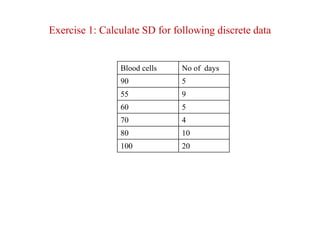
Exercise 1: Calculate SD for following discrete data
Blood cells No of days
90 5
55 9
60 5
70 4
80 10
100 20
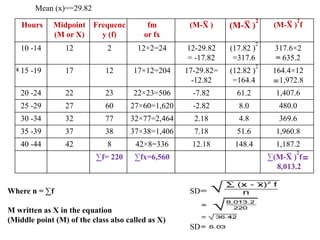
Standard deviation for grouped Data
(Continuous serious)
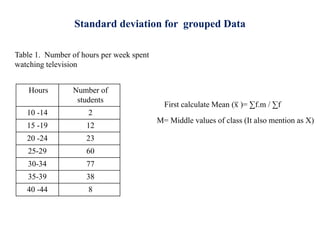
Standard deviation for grouped Data
Hours Number of
students
10 -14 2
15 -19 12
20 -24 23
25-29 60
30-34 77
35-39 38
40 -44 8
Table 1. Number of hours per week spent
watching television
First calculate Mean (x
̅ )= ∑f.m / ∑f
M= Middle values of class (It also mention as X)
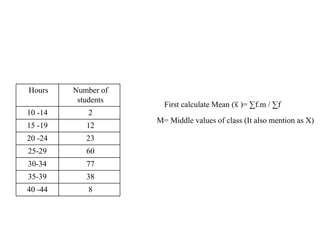
Hours Number of
students
10 -14 2
15 -19 12
20 -24 23
25-29 60
30-34 77
35-39 38
40 -44 8
First calculate Mean (x
̅ )= ∑f.m / ∑f
M= Middle values of class (It also mention as X)
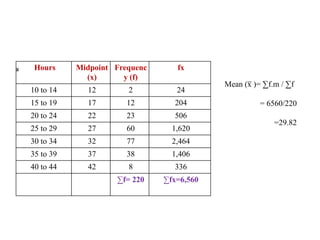
Hours Midpoint
(x)
Frequenc
y (f)
fx
10 to 14 12 2 24
15 to 19 17 12 204
20 to 24 22 23 506
25 to 29 27 60 1,620
30 to 34 32 77 2,464
35 to 39 37 38 1,406
40 to 44 42 8 336
∑f= 220 ∑fx=6,560
Mean (x
̅ )= ∑f.m / ∑f
= 6560/220
=29.82
Hours Midpoint
(M or X)
Frequenc
y (f)
fm
or fx
(M-X
̅ ) (M-X
̅ )
2
(M-X
̅ )
2
f
10 -14 12 2 12×2=24 12-29.82
= -17.82
(17.82 )
2
=317.6
317.6×2
= 635.2
15 -19 17 12 17×12=204 17-29.82=
-12.82
(12.82 )
2
=164.4
164.4×12
=1,972.8
20 -24 22 23 22×23=506 -7.82 61.2 1,407.6
25 -29 27 60 27×60=1,620 -2.82 8.0 480.0
30 -34 32 77 32×77=2,464 2.18 4.8 369.6
35 -39 37 38 37×38=1,406 7.18 51.6 1,960.8
40 -44 42 8 42×8=336 12.18 148.4 1,187.2
∑f= 220 ∑fx=6,560 ∑(M-X
̅ )
2
f=
8,013.2
Mean (x)==29.82
SD
Where n = ∑f
M written as X in the equation
(Middle point (M) of the class also called as X)
SD
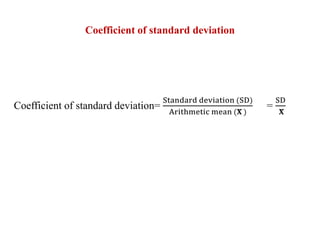
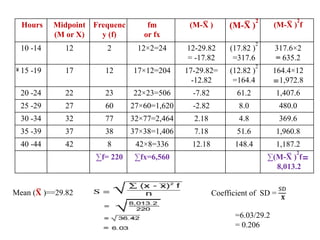
Coefficient of standard deviation
Coefficient of standard deviation=
Standard deviation (SD)
Arithmetic mean (𝐗̅ )
=
SD
𝐗̅
Hours Midpoint
(M or X)
Frequenc
y (f)
fm
or fx
(M-X
̅ ) (M-X
̅ )
2
(M-X
̅ )
2
f
10 -14 12 2 12×2=24 12-29.82
= -17.82
(17.82 )
2
=317.6
317.6×2
= 635.2
15 -19 17 12 17×12=204 17-29.82=
-12.82
(12.82 )
2
=164.4
164.4×12
=1,972.8
20 -24 22 23 22×23=506 -7.82 61.2 1,407.6
25 -29 27 60 27×60=1,620 -2.82 8.0 480.0
30 -34 32 77 32×77=2,464 2.18 4.8 369.6
35 -39 37 38 37×38=1,406 7.18 51.6 1,960.8
40 -44 42 8 42×8=336 12.18 148.4 1,187.2
∑f= 220 ∑fx=6,560 ∑(M-X
̅ )
2
f=
8,013.2
Mean (X
̅ )==29.82 Coefficient of SD =
SD
𝐗̅
=6.03/29.2
= 0.206
Uses of Standard deviation:
• Standard deviation is based on all the observations.
• Of all the measures of dispersion, standard deviation is best
because it is least effected by fluctuations.
• It used in the finding of standard error.
Variance
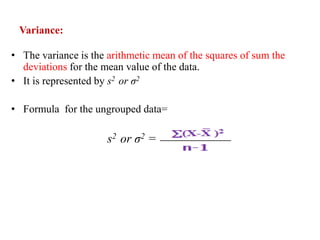
Variance:
• The variance is the arithmetic mean of the squares of sum the
deviations for the mean value of the data.
• It is represented by s2 or σ2
• Formula for the ungrouped data=
s2 or σ2 =
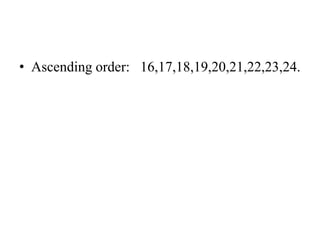
• Ascending order: 16,17,18,19,20,21,22,23,24.
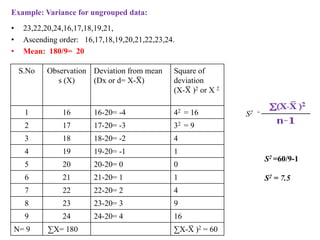
Example: Variance for ungrouped data:
• 23,22,20,24,16,17,18,19,21,
• Ascending order: 16,17,18,19,20,21,22,23,24.
• Mean: 180/9= 20
S.No Observation
s (X)
Deviation from mean
(Dx or d= X-X
̅ )
Square of
deviation
(X-X
̅ )2 or X 2
1 16 16-20= -4 42 = 16
2 17 17-20= -3 32 = 9
3 18 18-20= -2 4
4 19 19-20= -1 1
5 20 20-20= 0 0
6 21 21-20= 1 1
7 22 22-20= 2 4
8 23 23-20= 3 9
9 24 24-20= 4 16
N= 9 ∑X= 180 ∑X-X
̅ )2 = 60
S2 =
S2 =60/9-1
S2 = 7.5
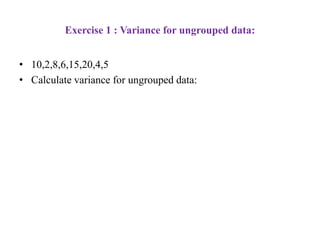
Exercise 1 : Variance for ungrouped data:
• 10,2,8,6,15,20,4,5
• Calculate variance for ungrouped data:
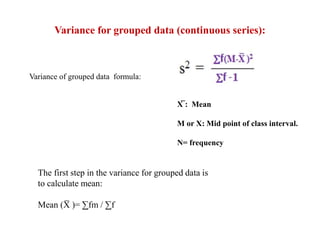
Variance for grouped data (continuous series):
Variance of grouped data formula:
X̅ : Mean
M or X: Mid point of class interval.
N= frequency
The first step in the variance for grouped data is
to calculate mean:
Mean (X
̅ )= ∑fm / ∑f
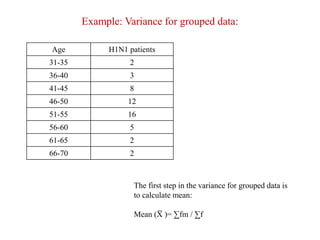
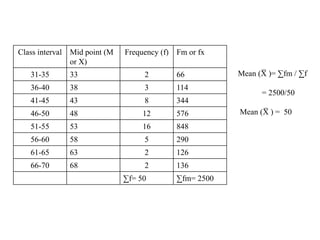
Example: Variance for grouped data:
Age H1N1 patients
31-35 2
36-40 3
41-45 8
46-50 12
51-55 16
56-60 5
61-65 2
66-70 2
The first step in the variance for grouped data is
to calculate mean:
Mean (X
̅ )= ∑fm / ∑f
Class interval Mid point (M
or X)
Frequency (f) Fm or fx
31-35 33 2 66
36-40 38 3 114
41-45 43 8 344
46-50 48 12 576
51-55 53 16 848
56-60 58 5 290
61-65 63 2 126
66-70 68 2 136
∑f= 50 ∑fm= 2500
Mean (X
̅ )= ∑fm / ∑f
= 2500/50
Mean (X
̅ ) = 50
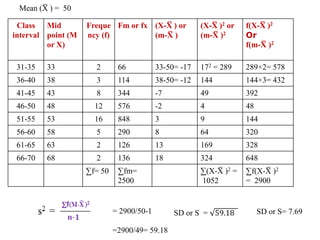
Mean (X
̅ ) = 50
Class
interval
Mid
point (M
or X)
Freque
ncy (f)
Fm or fx (X-X
̅ ) or
(m-X
̅ )
(X-X
̅ )2 or
(m-X
̅ )2
f(X-X
̅ )2
Or
f(m-X
̅ )2
31-35 33 2 66 33-50= -17 172 = 289 289×2= 578
36-40 38 3 114 38-50= -12 144 144×3= 432
41-45 43 8 344 -7 49 392
46-50 48 12 576 -2 4 48
51-55 53 16 848 3 9 144
56-60 58 5 290 8 64 320
61-65 63 2 126 13 169 328
66-70 68 2 136 18 324 648
∑f= 50 ∑fm=
2500
∑(X-X
̅ )2 =
1052
∑f(X-X
̅ )2
= 2900
= 2900/50-1
=2900/49= 59.18
SD or S = 59.18 SD or S= 7.69
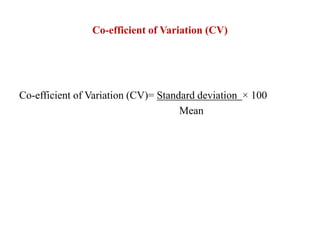
Co-efficient of Variation (CV)
Co-efficient of Variation (CV)= Standard deviation × 100
Mean
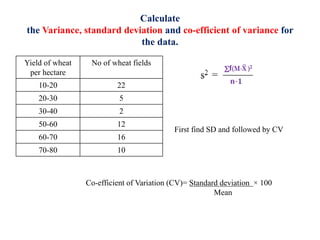
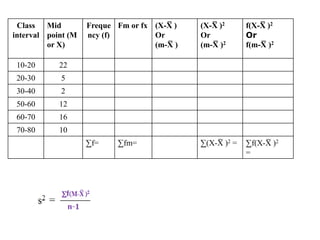
Calculate
the Variance, standard deviation and co-efficient of variance for
the data.
Yield of wheat
per hectare
No of wheat fields
10-20 22
20-30 5
30-40 2
50-60 12
60-70 16
70-80 10
First find SD and followed by CV
Co-efficient of Variation (CV)= Standard deviation × 100
Mean
Class
interval
Mid
point (M
or X)
Freque
ncy (f)
Fm or fx (X-X
̅ )
Or
(m-X
̅ )
(X-X
̅ )2
Or
(m-X
̅ )2
f(X-X
̅ )2
Or
f(m-X
̅ )2
10-20 22
20-30 5
30-40 2
50-60 12
60-70 16
70-80 10
∑f= ∑fm= ∑(X-X
̅ )2 = ∑f(X-X
̅ )2
=
Significance of Variance:
• It is easy to calculate.
• It indicates the variability clearly.
• The variance is the most informative among the measures of
dispersion for populations.
• It is most frequently used measure of variation in data especially
with normal, binomial or Poisson distribution.
Biostatistics Standard deviation and variance