Percentage Rank


            By: Nikkie G.
Maristela
Percentage Rank
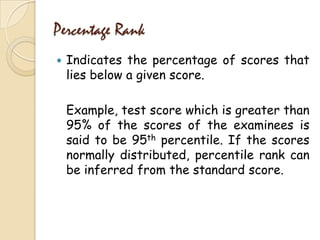
   Indicates the percentage of scores that
    lies below a given score.

    Example, test score which is greater than
    95% of the scores of the examinees is
    said to be 95th percentile. If the scores
    normally distributed, percentile rank can
    be inferred from the standard score.
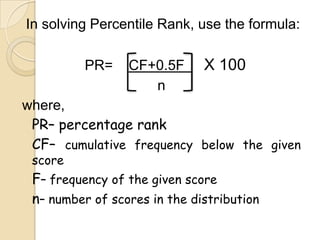
In solving Percentile Rank, use the formula:

          PR=    CF+0.5F      X 100
                    n
where,
 PR– percentage rank
 CF– cumulative frequency below the given
 score
 F– frequency of the given score
 n– number of scores in the distribution
Steps in solving Percentile
Rank
1. Arrange the test scores (TS) from
   highest to lowest.
2. Make a frequency distribution of each
   score and the number of students
   obtaining each score. (F)
3. Find the cumulative frequency (CF) by
   adding the frequency in each score
   from the bottom upward.
4. Find the percentile rank (PR) in each
   score using the formula and the result
   as indicated in column 4.
Example: the table belowshows the summary of the scores of
  the 40 students in a 45 item multiple choice of test. Find the
  percentile ranks of the score in the distribution.
       TS       F             TS      F
      45        1             30      3
      43        2             29      4
      42        2             28      1

      41        1             27      1
                              25      2
      40        1
                              24      1
      39        2
                              22      2
      37        3
                              21      2
      36        2
                              19      1
      34        1
                              18      2
      33        2             16      1
      32        2             15      1
Find the cumulative frequency of the frequency
distribution. Third column represents the cumulative
property
      TS   F    CF            TS   F    CF
      45    1   40            30   3    21
      43    2   39            29   4    18
      42    2   37            28   1    14
      41    1   35            27   1    13
      40    1   34            25   2    12
      39    2   33            24   1    10
      37    3   31            22   2    9
      36    2   28            21   2    7
      34    1   26            19   1    5
      33    2   25            18   2    4
      32    2   23            16   1    2
                              15   1    1
                                   40
Find the percentile rank of each score.
a. Solution:
 score=45 ;    CF=39;         F=1;      n=40
                PR= CF+0.5F X 100
                            n
               PR=     39+0.5(1)    X 100
                           40
                PR=      39+0.5    X 100
                           40
                 PR=0.9875 X 100
                     PR= 98.75 or 99
Analysis: A raw score of 45 is equal to
  percentile rank of 99. this means that
  99% of the students who took examination
  had raw scores equal to or lower than
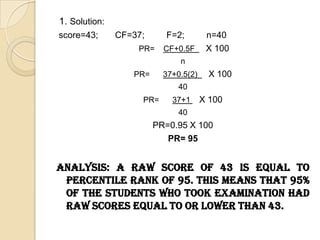
1. Solution:
score=43;      CF=37;     F=2;         n=40
                   PR=    CF+0.5F      X 100
                              n
                  PR=     37+0.5(2)     X 100
                              40
                    PR=     37+1      X 100
                              40
                        PR=0.95 X 100
                           PR= 95


Analysis: A raw score of 43 is equal to
 percentile rank of 95. This means that 95%
 of the students who took examination had
 raw scores equal to or lower than 43.
2. Solution:
score=42;       CF=35;     F=2;        n=40
                PR= CF+0.5F X 100
                          n
               PR=   35+0.5(2) X 100
                         40
                 PR=   35+1 X 100
                         40
                   PR=0.9 X 100
                     PR= 90

Analysis: A raw score of 42 is
 equal to percentile rank of 90.
 This means that 90% of the
 students who took examination
 had raw scores equal to or lower
 than 42.
When converting the raw
scores to a percentile
rank, the raw scores are
put on a scale that has
the same meaning with
different    number   of
groups and for different
lenghts of tests.
Frequency and percentile
ranks distribution of a 45-item
multiple choice of test conducted to
40 studentsPR
 TS  F  CF            TS  F  CF PR
 45   1   40   99    29   4     18   40
 43   2   39   95    28   1     14   34
 42   2   37   90    27   1     13   31
 41   1   35   86    25   2     12   28
 40   1   34   84    24   1     10   24
 39   2   33   80    22   2     9    20
 37   3   31   74    21   2     7    15
 36   2   28   68    19   1     5    11
 34   1   26   64    18   2     4    8
 33   2   25   60    16   1     2    4
 32   2   23   55    15   1     1    1
 30   3   21   49         n=4
                           0

Percentage Rank

  • 1.
    Percentage Rank By: Nikkie G. Maristela
  • 2.
    Percentage Rank  Indicates the percentage of scores that lies below a given score. Example, test score which is greater than 95% of the scores of the examinees is said to be 95th percentile. If the scores normally distributed, percentile rank can be inferred from the standard score.
  • 3.
    In solving PercentileRank, use the formula: PR= CF+0.5F X 100 n where, PR– percentage rank CF– cumulative frequency below the given score F– frequency of the given score n– number of scores in the distribution
  • 4.
    Steps in solvingPercentile Rank 1. Arrange the test scores (TS) from highest to lowest. 2. Make a frequency distribution of each score and the number of students obtaining each score. (F) 3. Find the cumulative frequency (CF) by adding the frequency in each score from the bottom upward. 4. Find the percentile rank (PR) in each score using the formula and the result as indicated in column 4.
  • 5.
    Example: the tablebelowshows the summary of the scores of the 40 students in a 45 item multiple choice of test. Find the percentile ranks of the score in the distribution. TS F TS F 45 1 30 3 43 2 29 4 42 2 28 1 41 1 27 1 25 2 40 1 24 1 39 2 22 2 37 3 21 2 36 2 19 1 34 1 18 2 33 2 16 1 32 2 15 1
  • 6.
    Find the cumulativefrequency of the frequency distribution. Third column represents the cumulative property TS F CF TS F CF 45 1 40 30 3 21 43 2 39 29 4 18 42 2 37 28 1 14 41 1 35 27 1 13 40 1 34 25 2 12 39 2 33 24 1 10 37 3 31 22 2 9 36 2 28 21 2 7 34 1 26 19 1 5 33 2 25 18 2 4 32 2 23 16 1 2 15 1 1 40
  • 7.
    Find the percentilerank of each score. a. Solution: score=45 ; CF=39; F=1; n=40 PR= CF+0.5F X 100 n PR= 39+0.5(1) X 100 40 PR= 39+0.5 X 100 40 PR=0.9875 X 100 PR= 98.75 or 99 Analysis: A raw score of 45 is equal to percentile rank of 99. this means that 99% of the students who took examination had raw scores equal to or lower than
  • 8.
    1. Solution: score=43; CF=37; F=2; n=40 PR= CF+0.5F X 100 n PR= 37+0.5(2) X 100 40 PR= 37+1 X 100 40 PR=0.95 X 100 PR= 95 Analysis: A raw score of 43 is equal to percentile rank of 95. This means that 95% of the students who took examination had raw scores equal to or lower than 43.
  • 9.
    2. Solution: score=42; CF=35; F=2; n=40 PR= CF+0.5F X 100 n PR= 35+0.5(2) X 100 40 PR= 35+1 X 100 40 PR=0.9 X 100 PR= 90 Analysis: A raw score of 42 is equal to percentile rank of 90. This means that 90% of the students who took examination had raw scores equal to or lower than 42.
  • 10.
    When converting theraw scores to a percentile rank, the raw scores are put on a scale that has the same meaning with different number of groups and for different lenghts of tests.
  • 11.
    Frequency and percentile ranksdistribution of a 45-item multiple choice of test conducted to 40 studentsPR TS F CF TS F CF PR 45 1 40 99 29 4 18 40 43 2 39 95 28 1 14 34 42 2 37 90 27 1 13 31 41 1 35 86 25 2 12 28 40 1 34 84 24 1 10 24 39 2 33 80 22 2 9 20 37 3 31 74 21 2 7 15 36 2 28 68 19 1 5 11 34 1 26 64 18 2 4 8 33 2 25 60 16 1 2 4 32 2 23 55 15 1 1 1 30 3 21 49 n=4 0