STERILIZATION
AND DISINFECTION
Dr. Ashish Jawarkar
M.D.
Parul Sevashram Hospital
INTRODUCTION
Microorganisms are the agents of
contamination, infection, and decay.


Hence it becomes necessary to remove
them from materials and areas.


Early civilization practiced salting,
smoking, pickling and exposure to
sunlight .

In mid 1800s Lister developed
Aseptic techniques to prevent
contamination of surgical wounds. Prior
to this development:
• Nosocomial infections caused death in
10% of surgeries.
• Up to 25% mothers delivering in
hospitals died due to infection.
DEFINITION
STERILIZATION
The process of freeing an article from
microorganisms including their spores.
DISINFECTION:
Reducing the number of pathogenic
microorganisms to the point where
they no longer cause diseases.
Sepsis: Comes from Greek for decay or
putrid. Indicates bacterial contamination.
Asepsis: Absence of significant
contamination.
 Aseptic techniques are used to prevent
contamination of surgical instruments,
medical personnel, and the patient during
surgery.
 Aseptic techniques are also used to
prevent bacterial contamination in food
industry.
Bacteriostatic Agent:
An agent that inhibits the growth of
bacteria, but does not necessarily kill
them.
Bactericide:
An agent that kills bacteria. Most do not kill
Endospores.

Sporicide:
An agent that kills spores.
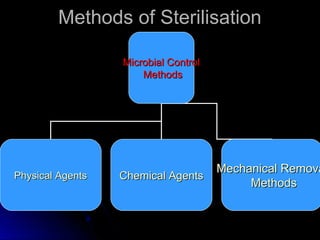
Methods of Sterilisation
Microbial Control
Methods

Physical Agents

Chemical Agents

Mechanical Remova
Methods
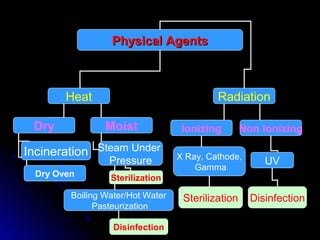
Physical Agents

Heat
Dry

Radiation
Moist

Incineration Steam Under
Pressure

Dry Oven

Ionizing

Non Ionizing

X Ray, Cathode,
Gamma

UV

Sterilization

Boiling Water/Hot Water
Pasteurization
Disinfection

Sterilization

Disinfection
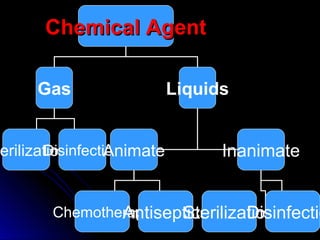
Chemical Agent
Gas

Disinfection
erilization
Animate

Liquids
Inanimate

Chemotherapy
Antiseptics
Sterilization
Disinfectio
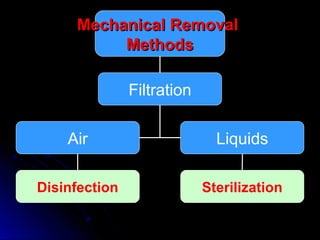
Mechanical Removal
Methods
Filtration
Air

Liquids

Disinfection

Sterilization
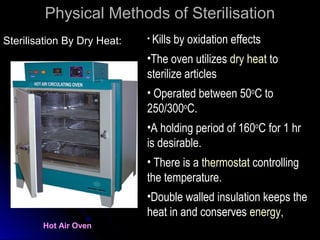
Physical Methods of Sterilisation
Sterilisation By Dry Heat:

• Kills

by oxidation effects

•The oven utilizes dry heat to
sterilize articles
• Operated between 50oC to
250/300oC.
•A holding period of 160oC for 1 hr
is desirable.
• There is a thermostat controlling
the temperature.
•Double walled insulation keeps the
heat in and conserves energy,
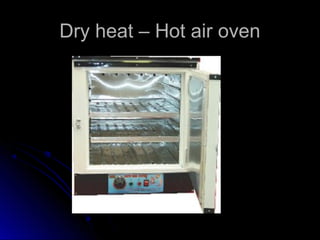
Hot Air Oven
Uses:
 To sterilise Forceps, Scissors, Scalpels, Swabs.

 Pharmaceuticals products like Liquid paraffin,

dusting powder, fats and grease.
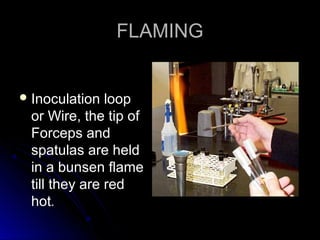
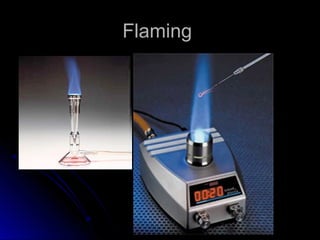
FLAMING
 Inoculation

loop
or Wire, the tip of
Forceps and
spatulas are held
in a bunsen flame
till they are red
hot.
Flaming
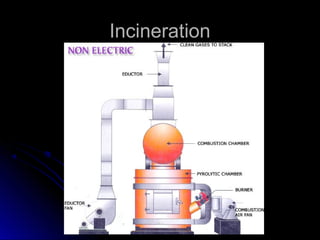
INCINERATION
This is an excellent method of
destroying materials such as
contaminated cloth, animal
carcasses and pathological
materials.
Incineration
Dry heat - HOT AIR OVEN
 Holding

temp & time: 1600C for 1 hr
 Used for glassware, forceps, swabs, water
impermeable oils, waxes & powders
 Before placing in hot air oven
 Dry

glassware completely
 Plug test tubes with cotton wool
 Wrap glassware in Kraft papers
 Don’t

over load the oven
 Allow free circulation of air between the material
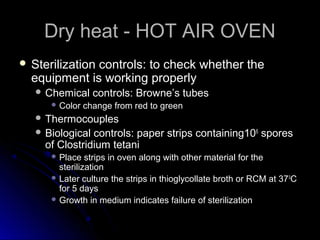
Dry heat - HOT AIR OVEN
 Sterilization

controls: to check whether the
equipment is working properly
 Chemical
 Color

controls: Browne’s tubes

change from red to green

 Thermocouples
 Biological

controls: paper strips containing106 spores
of Clostridium tetani
 Place

strips in oven along with other material for the
sterilization
 Later culture the strips in thioglycollate broth or RCM at 37 0C
for 5 days
 Growth in medium indicates failure of sterilization
Dry heat – Hot air oven
MOIST HEAT STERILIZATION

Kills microorganisms by coagulating their
proteins.
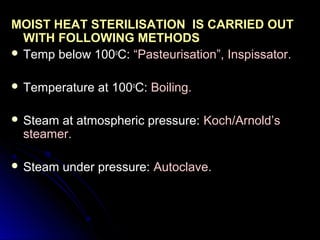
MOIST HEAT STERILISATION IS CARRIED OUT
WITH FOLLOWING METHODS
 Temp below 100oC: “Pasteurisation”, Inspissator.
 Temperature

at 100oC: Boiling.

 Steam

at atmospheric pressure: Koch/Arnold’s
steamer.

 Steam

under pressure: Autoclave.
Pasteurisation
 Process

of killing of pathogens in the milk but
does not sterilize it .

 Milk

is heated at 63oC for 30 mins.
(HOLDER METHOD)

 At

72oC for 15-20 Sec. Rapid cooling to 13oC
(FLASH PROCESS)
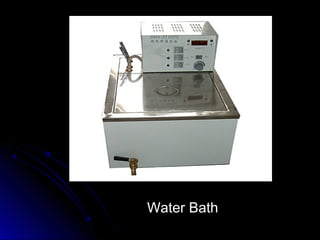
Water Bath
HOT WATER BATH
 To

inactivate non sporing bacteria for the
preparation of vaccines - Special vaccine
bath at 60oC for one hour is used

 Serum

or body fluids containing
coagulable proteins can be sterilized by
heating for 1 hr at 56oC in a water bath for
several successive days.
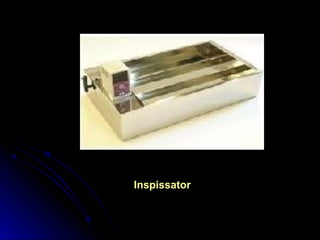
Inspissator
INSPISSATOR
 Sterilizes

by heating at 80-85oC for half an
hour for 3 successive days

 Used

to sterilize media such as
Lowenstein-Jensen & Loefller’s serum
TEMPERATURE AT 100OC
Boiling:
Kills vegetative forms of bacterial
pathogens.
 Hepatitis virus: Can survive up to 30
minutes of boiling.
Endospores: Can survive up to 20 hours or
more of boiling
Steam Sterilizer
STEAM AT ATMOSPHERIC PRESSURE
 Steam

is generated using a steamer
(Koch/ Arnold)
 Consists of a Tin cabinet
 Has a conical lid to enable the drainage of
condensed steam
 Perforated tray above ensures materials
are surrounded by steam.
 For routine sterilization exposure of 90
mins is used
 For

media containing sugar and gelatin
exposure of 100oC for 20 min for 3
successive days is used

 The

process is termed as
Tyndallisation /Intermittent Sterilization
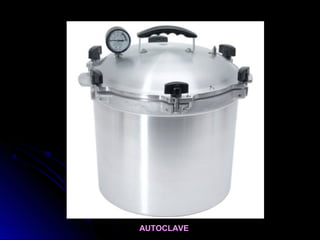
STEAM UNDER PRESSURE - AUTOCLAVE

 Works

on the principle of Steam under
pressure

 Invented

by Charles Chamberland in 1879.
AUTOCLAVE
 Autoclave

consists of a vertical or a
horizontal cylinder.
 One end has an opening which is meant
for keeping materials to be sterilised.
 The lid is provided with a Pressure gauge,
to measure the pressure
 A safety valve is present to permit the
escape of steam from the chamber
 Articles

to be sterilised are placed in the
basket provided
 Sterilisation is carried out under pressure
at 121º for 15 mnts.
CHEMICAL AGENTS
Chemical agents act by
 Protein coagulation
 Disruption of the cell membrane
 Removal of Sulphydryl groups
 Substrate competition
ALCOHOLS
 Ethanol

/Isopropyl alcohol are frequently

used
 No action on spores
 Concentration recommended 60-90% in
water
Uses
 Disinfection of clinical thermometer.
 Disinfection of the skin – Venupuncture
ALDEHYDES
 Formaldehyde

& Glutaraldehyde are
frequently used
 Formaldehyde is bactericidal, sporicidal &
has a lethal effect on viruses.
 Glutaraldehyde is effective against
Tubercle bacilli, fungi and viruses
USES
FORMALDEHYDE
 To preserve anatomical specimens
 Destroying Anthrax spores in hair and
wool
 10% Formalin+0.5% Sodium tetra borate
is used to sterilise metal instruments
USES
GLUTARALDEHYDE
 Used to treat corrugated rubber
anesthetic tubes, Face masks, Plastic
endotracheal tubes, Metal instruments
and polythene tubing
DYES
Two groups of dyes are used
Aniline dyes
Acridine dyes
ANILINE DYES
 Are

Brilliant green, Malachite green &
Crystal violet

 Active
 No

against Gram positive bacteria

activity against tubercle bacilli
ACRIDINE DYES
 Acridine

dyes in use are orange in colour

 Effective

against Gram positive than Gram

negative
 Important

dyes are Proflavine,
Acriflavine,Euflavine
HALOGENS
 Iodine

in aqueous and alcoholic solution
has been used widely as a skin
disinfectant
 Actively bactericidal with moderate against
spores
 Chlorine and its compounds have been
used as disinfectants in water supplies &
swimming pools
PHENOLS
 Obtained

by distillation of coal tar
 Phenols are powerful microbicidal
substances
 Phenolic derivatives have been widely
used as disinfectants for various purposes
in hospitals
 Eg: Lysol, cresol
USES
 Various

combinations are used in the
control of pyogenic cocci in surgical &
neonatal units in hospitals.

 Aqueous

solutions are used in treatment
of wounds
GASES
Ethylene Oxide
Colourless ,Highly penetrating gas
with a sweet ethereal smell.
Effective against all types of
microorganisms including viruses
and spores
USES
 Specially

used for sterilising heart-lung
machines,respirators,sutures,dental
equipments, books and clothing.
 Also used to sterilise Glass, metal and
paper surfaces ,plastics, oil,some foods
and tobacco.
FORMALDEHYDE GAS
 Widely

employed for fumigation of
operation theatres and other rooms
BETA PROPIOLACTONE
 Used
 For

in fumigation

sterilisation 0.2% BPL is used

 Has

a rapid biocidal activity

 Very

effective against viruses
SURFACE ACTIVE AGENTS AND
METALLIC SALTS

Substances which reduce the surface
tension –
Surface active agents
 Cations

are widely used in the form of
quaternary ammonium compounds.

 Markedly

bactericidal, active against Gram
positive organisms.

 No

action on spores, tubercle bacilli,
viruses
METALLIC SALTS
 The

salts of silver, copper and mercury are
used as disinfectants.

 Act

by coagulating proteins

 Marked

bacteriostatic, weak bactericidal
and limited fungicidal activity
Sterilisation by filtration
Filtration helps to remove bacteria from heat
labile liquids such as sera and solutions of
sugar, Antibiotics.
The following filters are used
Candle filters
Asbestos filters
Sintered glass filter
Membrane filters
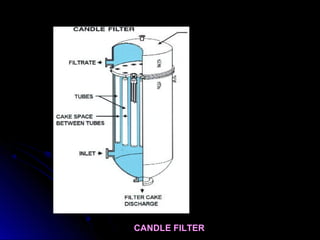
CANDLE FILTER
CANDLE FILTERS
 Widely

used for purification of water
Two types
(a) Unglazed ceramic filter – Chamberland
filter
(b) Diatomaceous earth filters – Berkefeld
filter
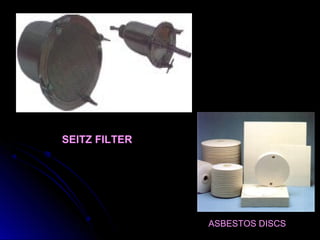
SEITZ FILTER

ASBESTOS DISCS
ASBESTOS FILTER
 Disposable
 High

single use discs

adsorbing tendency

 Carcinogenic

Eg: Seitz filter
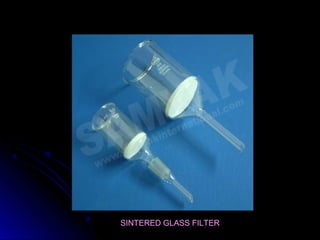
SINTERED GLASS FILTER
 Prepared

by heat fusing powdered glass
particles of graded size

 Cleaned

easily, brittle, expensive.
MEMBRANE FILTER
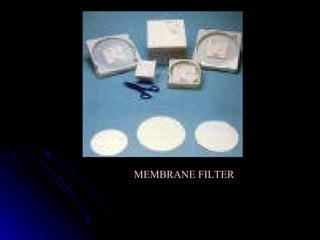
MEMBRANE FILTERS
 Made

of cellulose esters or other polymers

Uses
 Water purification & analysis
 Sterilization & sterility testing
 Preparation of solutions for parenteral use
RADIATION
Two types of radiations are used
NON –IONISING
IONISING
Non- Ionising radiation:
 Electromagnetic
 Absorbed
 Can

rays with longer wavelength

as heat

be considered as hot air sterilisation

 Used

in rapid mass sterilisation of prepacked
Syringes and catheters

Eg: UV rays
IONISING RADIATIONS
 X-

rays, gamma rays & cosmic rays.

 High

penetrative power

 No

appreciable increase in the
temperature – COLD STERILISATION

 Sterilise

plastics Syringes, catheters,
grease fabrics metal foils
ULTRASONIC AND SONIC VIBRATION
 Bactericidal
 Microorganisms

vary in their sensitivity,
hence no practical value in sterilisation
and disinfection
THANK YOU

sterilization and disinfection

  • 1.
    STERILIZATION AND DISINFECTION Dr. AshishJawarkar M.D. Parul Sevashram Hospital
  • 2.
    INTRODUCTION Microorganisms are theagents of contamination, infection, and decay.  Hence it becomes necessary to remove them from materials and areas.  Early civilization practiced salting, smoking, pickling and exposure to sunlight . 
  • 3.
    In mid 1800sLister developed Aseptic techniques to prevent contamination of surgical wounds. Prior to this development: • Nosocomial infections caused death in 10% of surgeries. • Up to 25% mothers delivering in hospitals died due to infection.
  • 4.
    DEFINITION STERILIZATION The process offreeing an article from microorganisms including their spores.
  • 5.
    DISINFECTION: Reducing the numberof pathogenic microorganisms to the point where they no longer cause diseases.
  • 6.
    Sepsis: Comes fromGreek for decay or putrid. Indicates bacterial contamination. Asepsis: Absence of significant contamination.  Aseptic techniques are used to prevent contamination of surgical instruments, medical personnel, and the patient during surgery.  Aseptic techniques are also used to prevent bacterial contamination in food industry.
  • 7.
    Bacteriostatic Agent: An agentthat inhibits the growth of bacteria, but does not necessarily kill them.
  • 8.
    Bactericide: An agent thatkills bacteria. Most do not kill Endospores. Sporicide: An agent that kills spores.
  • 9.
    Methods of Sterilisation MicrobialControl Methods Physical Agents Chemical Agents Mechanical Remova Methods
  • 10.
    Physical Agents Heat Dry Radiation Moist Incineration SteamUnder Pressure Dry Oven Ionizing Non Ionizing X Ray, Cathode, Gamma UV Sterilization Boiling Water/Hot Water Pasteurization Disinfection Sterilization Disinfection
  • 11.
  • 12.
  • 13.
    Physical Methods ofSterilisation Sterilisation By Dry Heat: • Kills by oxidation effects •The oven utilizes dry heat to sterilize articles • Operated between 50oC to 250/300oC. •A holding period of 160oC for 1 hr is desirable. • There is a thermostat controlling the temperature. •Double walled insulation keeps the heat in and conserves energy, Hot Air Oven
  • 14.
    Uses:  To steriliseForceps, Scissors, Scalpels, Swabs.  Pharmaceuticals products like Liquid paraffin, dusting powder, fats and grease.
  • 15.
    FLAMING  Inoculation loop or Wire,the tip of Forceps and spatulas are held in a bunsen flame till they are red hot.
  • 16.
  • 17.
    INCINERATION This is anexcellent method of destroying materials such as contaminated cloth, animal carcasses and pathological materials.
  • 18.
  • 19.
    Dry heat -HOT AIR OVEN  Holding temp & time: 1600C for 1 hr  Used for glassware, forceps, swabs, water impermeable oils, waxes & powders  Before placing in hot air oven  Dry glassware completely  Plug test tubes with cotton wool  Wrap glassware in Kraft papers  Don’t over load the oven  Allow free circulation of air between the material
  • 20.
    Dry heat -HOT AIR OVEN  Sterilization controls: to check whether the equipment is working properly  Chemical  Color controls: Browne’s tubes change from red to green  Thermocouples  Biological controls: paper strips containing106 spores of Clostridium tetani  Place strips in oven along with other material for the sterilization  Later culture the strips in thioglycollate broth or RCM at 37 0C for 5 days  Growth in medium indicates failure of sterilization
  • 21.
    Dry heat –Hot air oven
  • 22.
    MOIST HEAT STERILIZATION Killsmicroorganisms by coagulating their proteins.
  • 23.
    MOIST HEAT STERILISATIONIS CARRIED OUT WITH FOLLOWING METHODS  Temp below 100oC: “Pasteurisation”, Inspissator.  Temperature at 100oC: Boiling.  Steam at atmospheric pressure: Koch/Arnold’s steamer.  Steam under pressure: Autoclave.
  • 24.
    Pasteurisation  Process of killingof pathogens in the milk but does not sterilize it .  Milk is heated at 63oC for 30 mins. (HOLDER METHOD)  At 72oC for 15-20 Sec. Rapid cooling to 13oC (FLASH PROCESS)
  • 25.
  • 26.
    HOT WATER BATH To inactivate non sporing bacteria for the preparation of vaccines - Special vaccine bath at 60oC for one hour is used  Serum or body fluids containing coagulable proteins can be sterilized by heating for 1 hr at 56oC in a water bath for several successive days.
  • 27.
  • 28.
    INSPISSATOR  Sterilizes by heatingat 80-85oC for half an hour for 3 successive days  Used to sterilize media such as Lowenstein-Jensen & Loefller’s serum
  • 29.
    TEMPERATURE AT 100OC Boiling: Killsvegetative forms of bacterial pathogens.  Hepatitis virus: Can survive up to 30 minutes of boiling. Endospores: Can survive up to 20 hours or more of boiling
  • 30.
  • 31.
    STEAM AT ATMOSPHERICPRESSURE  Steam is generated using a steamer (Koch/ Arnold)  Consists of a Tin cabinet  Has a conical lid to enable the drainage of condensed steam  Perforated tray above ensures materials are surrounded by steam.  For routine sterilization exposure of 90 mins is used
  • 32.
     For media containingsugar and gelatin exposure of 100oC for 20 min for 3 successive days is used  The process is termed as Tyndallisation /Intermittent Sterilization
  • 33.
    STEAM UNDER PRESSURE- AUTOCLAVE  Works on the principle of Steam under pressure  Invented by Charles Chamberland in 1879.
  • 34.
  • 35.
     Autoclave consists ofa vertical or a horizontal cylinder.  One end has an opening which is meant for keeping materials to be sterilised.  The lid is provided with a Pressure gauge, to measure the pressure  A safety valve is present to permit the escape of steam from the chamber
  • 36.
     Articles to besterilised are placed in the basket provided  Sterilisation is carried out under pressure at 121º for 15 mnts.
  • 37.
    CHEMICAL AGENTS Chemical agentsact by  Protein coagulation  Disruption of the cell membrane  Removal of Sulphydryl groups  Substrate competition
  • 38.
    ALCOHOLS  Ethanol /Isopropyl alcoholare frequently used  No action on spores  Concentration recommended 60-90% in water Uses  Disinfection of clinical thermometer.  Disinfection of the skin – Venupuncture
  • 39.
    ALDEHYDES  Formaldehyde & Glutaraldehydeare frequently used  Formaldehyde is bactericidal, sporicidal & has a lethal effect on viruses.  Glutaraldehyde is effective against Tubercle bacilli, fungi and viruses
  • 40.
    USES FORMALDEHYDE  To preserveanatomical specimens  Destroying Anthrax spores in hair and wool  10% Formalin+0.5% Sodium tetra borate is used to sterilise metal instruments
  • 41.
    USES GLUTARALDEHYDE  Used totreat corrugated rubber anesthetic tubes, Face masks, Plastic endotracheal tubes, Metal instruments and polythene tubing
  • 42.
    DYES Two groups ofdyes are used Aniline dyes Acridine dyes
  • 43.
    ANILINE DYES  Are Brilliantgreen, Malachite green & Crystal violet  Active  No against Gram positive bacteria activity against tubercle bacilli
  • 44.
    ACRIDINE DYES  Acridine dyesin use are orange in colour  Effective against Gram positive than Gram negative  Important dyes are Proflavine, Acriflavine,Euflavine
  • 45.
    HALOGENS  Iodine in aqueousand alcoholic solution has been used widely as a skin disinfectant  Actively bactericidal with moderate against spores  Chlorine and its compounds have been used as disinfectants in water supplies & swimming pools
  • 46.
    PHENOLS  Obtained by distillationof coal tar  Phenols are powerful microbicidal substances  Phenolic derivatives have been widely used as disinfectants for various purposes in hospitals  Eg: Lysol, cresol
  • 47.
    USES  Various combinations areused in the control of pyogenic cocci in surgical & neonatal units in hospitals.  Aqueous solutions are used in treatment of wounds
  • 48.
    GASES Ethylene Oxide Colourless ,Highlypenetrating gas with a sweet ethereal smell. Effective against all types of microorganisms including viruses and spores
  • 49.
    USES  Specially used forsterilising heart-lung machines,respirators,sutures,dental equipments, books and clothing.  Also used to sterilise Glass, metal and paper surfaces ,plastics, oil,some foods and tobacco.
  • 50.
    FORMALDEHYDE GAS  Widely employedfor fumigation of operation theatres and other rooms
  • 51.
    BETA PROPIOLACTONE  Used For in fumigation sterilisation 0.2% BPL is used  Has a rapid biocidal activity  Very effective against viruses
  • 52.
    SURFACE ACTIVE AGENTSAND METALLIC SALTS Substances which reduce the surface tension – Surface active agents
  • 53.
     Cations are widelyused in the form of quaternary ammonium compounds.  Markedly bactericidal, active against Gram positive organisms.  No action on spores, tubercle bacilli, viruses
  • 54.
    METALLIC SALTS  The saltsof silver, copper and mercury are used as disinfectants.  Act by coagulating proteins  Marked bacteriostatic, weak bactericidal and limited fungicidal activity
  • 55.
    Sterilisation by filtration Filtrationhelps to remove bacteria from heat labile liquids such as sera and solutions of sugar, Antibiotics. The following filters are used Candle filters Asbestos filters Sintered glass filter Membrane filters
  • 56.
  • 57.
    CANDLE FILTERS  Widely usedfor purification of water Two types (a) Unglazed ceramic filter – Chamberland filter (b) Diatomaceous earth filters – Berkefeld filter
  • 58.
  • 59.
    ASBESTOS FILTER  Disposable High single use discs adsorbing tendency  Carcinogenic Eg: Seitz filter
  • 60.
  • 61.
    SINTERED GLASS FILTER Prepared by heat fusing powdered glass particles of graded size  Cleaned easily, brittle, expensive.
  • 62.
  • 63.
    MEMBRANE FILTERS  Made ofcellulose esters or other polymers Uses  Water purification & analysis  Sterilization & sterility testing  Preparation of solutions for parenteral use
  • 64.
    RADIATION Two types ofradiations are used NON –IONISING IONISING
  • 65.
    Non- Ionising radiation: Electromagnetic  Absorbed  Can rays with longer wavelength as heat be considered as hot air sterilisation  Used in rapid mass sterilisation of prepacked Syringes and catheters Eg: UV rays
  • 66.
    IONISING RADIATIONS  X- rays,gamma rays & cosmic rays.  High penetrative power  No appreciable increase in the temperature – COLD STERILISATION  Sterilise plastics Syringes, catheters, grease fabrics metal foils
  • 67.
    ULTRASONIC AND SONICVIBRATION  Bactericidal  Microorganisms vary in their sensitivity, hence no practical value in sterilisation and disinfection
  • 68.

Editor's Notes