ANTISEPTIC MAJID MOHIUDDIN
Antiseptic – are antimicrobial substances that are applied to living tissue/skin to reduce the possibility of infection, sepsis, or putrefaction. Antibacterial are antiseptics.
Use in surgery: Antiseptic Principle of the Practice of Surgery  in 1867 by Joseph Lister. (Carbolic acid) Inspired by Louis Pasteur’s germ theory of putrefaction. Dr. George H Tichenor – was working with use of alcohol on wounds  (1861-1863)  -  Dr. Tichnenor’s Patent Medicine” Ignaz Semmelweis – published – “The cause, Concept and Prophylaxis of childbed Fever” in 1861. (observations since 1847) Florence Nightingale – “The Royal Commission on the Health of the Army (1856-1857)”. Oliver Wendell Holmes – “The Contagiousness of Puerperal Fever” – 1843.
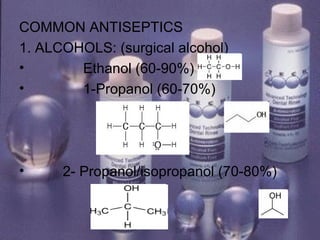
COMMON ANTISEPTICS 1. ALCOHOLS: (surgical alcohol) Ethanol (60-90%) 1-Propanol (60-70%) 2- Propanol/isopropanol (70-80%)
Alcohols referred as “Surgical alcohol” To disinfect the skin before injections cationic surfactants (benzalkonium chloride 0.05 – 0.5%, Chlorhexidine 0.2 – 4.0% or octenidine dihydrochloride 0.1 -2.0%)
2. QUATERNARY AMMONIUM COMPOUNDS: (Quats or QAC’s)  Benzalkonium chloride (BAC) Cetyl trimethylammonium bromide  (CTMB) Cetylpyridinum chloride (Cetrim, CPC) Benzethonium chloride (BZT) (0.05 –  0.5% pre-operative skin disinfectants  and antiseptic towels) Inactivated by anionic surfactant –  soaps. Cationic surfactants.
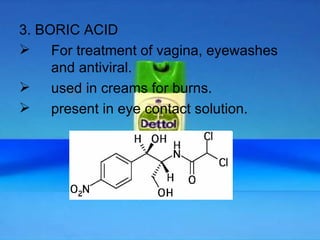
3. BORIC ACID For treatment of vagina, eyewashes  and antiviral. used in creams for burns. present in eye contact solution.
4. CHLORHEXIDINE GLUCONATE   Bignuanidine derivative – 0.5 – 4.0%    Skin antiseptic   To treat inflammation of the gums      (gingivitis).   Cationic surfactants.
5. HYDROGEN PEROXIDE 6% to clean and deodorize wounds and  ulcers. 1% or 2% solutions for household first  aid for scrapes, etc.
6. IODINE   Tincture of Iodine or Lugol’s iodine    solution pre and post-operative antiseptic Disinfectants Antiseptics
7. OCTENIDINE DIHYDROCHLORIDE A Cationic surfactant and bis-  (dihydropyridinyl)- decane derivative 0.1-2.0%.  Mucosa and Wound antiseptic. Potentiated with addition of 2- phenoxyethanol.
8. PHENOL (CARBOLIC ACID) COMPOUNDS. Germicide in strong solution inhibitory in weaker ones. used as Scrub powder – antiseptic baby powder Mouthwashes and throat lozenges
9. SODIUM CHLORIDE   General cleanser   Mouthwash  10. SODIUM HYPOCHLORITE   Diluted, neutralized and combined with potassium permanganate in the Daquin’s solution. Now only disinfectant.
  Thanks     MAJID MOHIUDDIN

ANTISEPTIC

  • 1.
  • 2.
    Antiseptic – areantimicrobial substances that are applied to living tissue/skin to reduce the possibility of infection, sepsis, or putrefaction. Antibacterial are antiseptics.
  • 3.
    Use in surgery:Antiseptic Principle of the Practice of Surgery in 1867 by Joseph Lister. (Carbolic acid) Inspired by Louis Pasteur’s germ theory of putrefaction. Dr. George H Tichenor – was working with use of alcohol on wounds (1861-1863) - Dr. Tichnenor’s Patent Medicine” Ignaz Semmelweis – published – “The cause, Concept and Prophylaxis of childbed Fever” in 1861. (observations since 1847) Florence Nightingale – “The Royal Commission on the Health of the Army (1856-1857)”. Oliver Wendell Holmes – “The Contagiousness of Puerperal Fever” – 1843.
  • 4.
    COMMON ANTISEPTICS 1.ALCOHOLS: (surgical alcohol) Ethanol (60-90%) 1-Propanol (60-70%) 2- Propanol/isopropanol (70-80%)
  • 5.
    Alcohols referred as“Surgical alcohol” To disinfect the skin before injections cationic surfactants (benzalkonium chloride 0.05 – 0.5%, Chlorhexidine 0.2 – 4.0% or octenidine dihydrochloride 0.1 -2.0%)
  • 6.
    2. QUATERNARY AMMONIUMCOMPOUNDS: (Quats or QAC’s) Benzalkonium chloride (BAC) Cetyl trimethylammonium bromide (CTMB) Cetylpyridinum chloride (Cetrim, CPC) Benzethonium chloride (BZT) (0.05 – 0.5% pre-operative skin disinfectants and antiseptic towels) Inactivated by anionic surfactant – soaps. Cationic surfactants.
  • 7.
    3. BORIC ACIDFor treatment of vagina, eyewashes and antiviral. used in creams for burns. present in eye contact solution.
  • 8.
    4. CHLORHEXIDINE GLUCONATE Bignuanidine derivative – 0.5 – 4.0% Skin antiseptic To treat inflammation of the gums (gingivitis). Cationic surfactants.
  • 9.
    5. HYDROGEN PEROXIDE6% to clean and deodorize wounds and ulcers. 1% or 2% solutions for household first aid for scrapes, etc.
  • 10.
    6. IODINE Tincture of Iodine or Lugol’s iodine solution pre and post-operative antiseptic Disinfectants Antiseptics
  • 11.
    7. OCTENIDINE DIHYDROCHLORIDEA Cationic surfactant and bis- (dihydropyridinyl)- decane derivative 0.1-2.0%. Mucosa and Wound antiseptic. Potentiated with addition of 2- phenoxyethanol.
  • 12.
    8. PHENOL (CARBOLICACID) COMPOUNDS. Germicide in strong solution inhibitory in weaker ones. used as Scrub powder – antiseptic baby powder Mouthwashes and throat lozenges
  • 13.
    9. SODIUM CHLORIDE General cleanser Mouthwash 10. SODIUM HYPOCHLORITE Diluted, neutralized and combined with potassium permanganate in the Daquin’s solution. Now only disinfectant.
  • 14.
    Thanks MAJID MOHIUDDIN