Universities Press© Universities Press (India) Private Limited
STERILISATION
AND
DISINFECTION
Universities Press© Universities Press (India) Private Limited
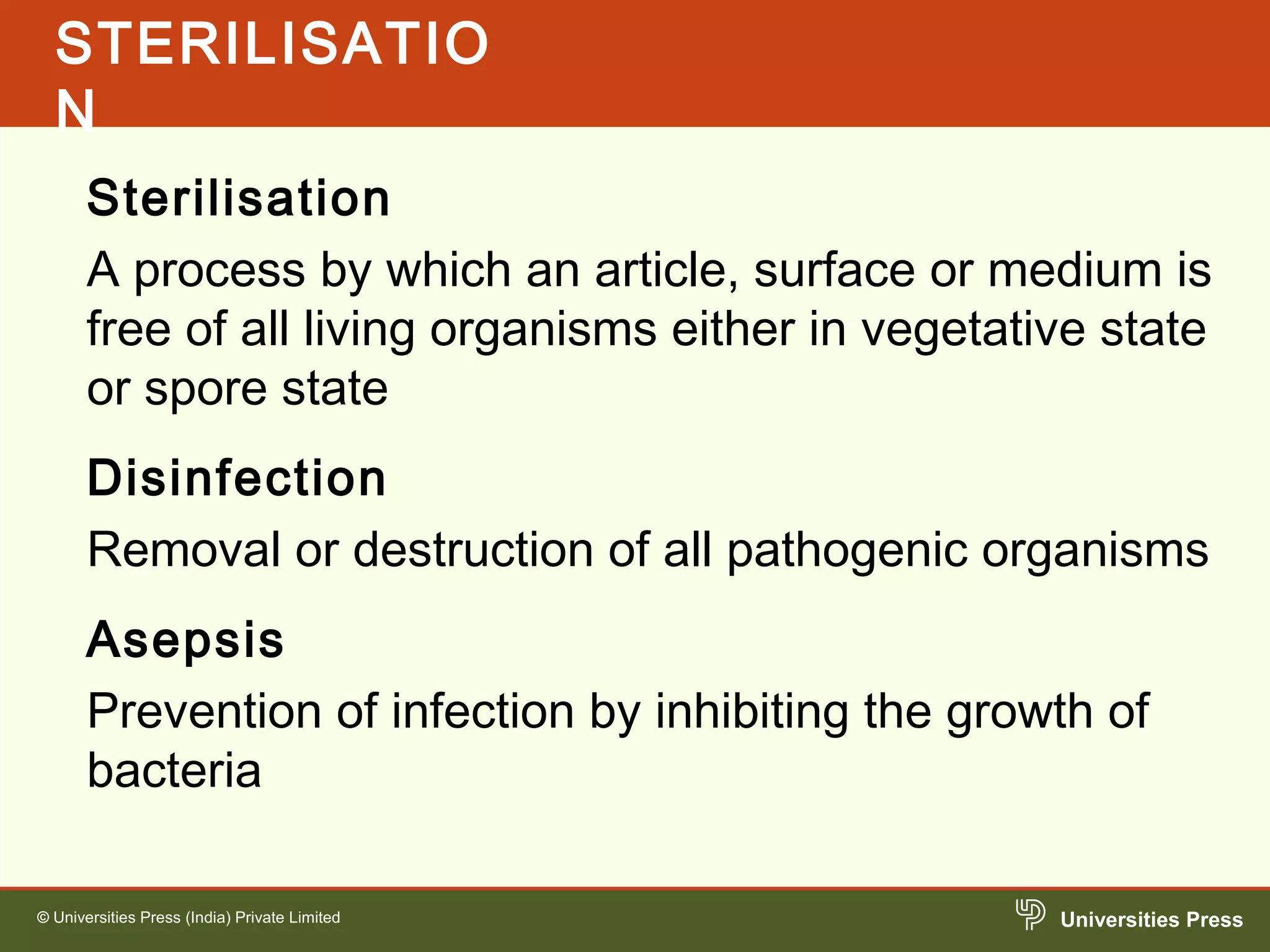
Sterilisation
A process by which an article, surface or medium is
free of all living organisms either in vegetative state
or spore state
Disinfection
Removal or destruction of all pathogenic organisms
Asepsis
Prevention of infection by inhibiting the growth of
bacteria
STERILISATIO
N
Universities Press© Universities Press (India) Private Limited
Cleaning

Removal of soil and dirt to reduce microbial
burden and to make sterilisation more effective
Decontamination

The process of rendering an article or an area free
of contamination including microbial, chemical,
radioactive, etc.
Bactericidal agents: Agents that kill bacteria
Bacteriostatic agents: Agents that prevent
multiplication of bacteria
STERILISATIO
N
Universities Press© Universities Press (India) Private Limited
Objective: To destroy microorganisms from
materials and areas
Choice of method depends on: Purpose for which
it is carried out, nature of microorganisms, material to
be sterilised
Uses of sterilisation: To prevent contamination by
extraneous organisms, to prevent sepsis in surgery, for
safety in food and drugs
STERILISATIO
N
Universities Press© Universities Press (India) Private Limited
CLASSIFICATI
ON
Physical methods
Sunlight, drying, Heat
Dry heat - flaming- incineration, hot air oven
Moist heat- Pasteurisation, boiling
- Steam under normal pressure
- Steam under pressure
Filteration,
Radiation
Ultrasonic and sonic vibration
Universities Press© Universities Press (India) Private Limited
Chemical methods
Alcohols - Ethyl alcohol, isopropyl alcohol
Aldehydes - Formaldehyde, glutaraldehyde
Dyes
Halogens
Phenols
Surface active agents
Metallic salts
Gases: ETO, formaldehyde,betapropiolactone
CLASSIFICATI
ON
Universities Press© Universities Press (India) Private Limited
DRY HEAT
Universities Press© Universities Press (India) Private Limited
Drying
MoiMoisture is essential for the growth of bacteria.
Four fifths of weight is due to water.Hence drying
has a deleterious effect on bacteria but is not a
reliable method
Spores are unaffected by drying
Universities Press© Universities Press (India) Private Limited
FLAMING
• Flaming: Exposing the articles to be
sterilised to blue flame of the burner till it
becomes red hot.
• Inoculating loops, wires, tip of forceps,
scalpels,scissors and edges of test tubes,
Universities Press© Universities Press (India) Private Limited
Temperatures >1000c
Excellent method for destroying contaminated cloth,
animal carcasses, pathological materials, infectious
hospital waste
Plastics such as PVC and polythene can be dealt with
but polyesterine materials emits dense clouds of
black smoke
INCINERATION
Universities Press© Universities Press (India) Private Limited
Holding period – 160°C for 1 hour
- Glassware, instruments, liquid paraffin, dusting
powder, fats, grease, etc.
- Rubber, cotton avoided
Controls - C.tetani spores and Browne’s tubes
HOT AIR OVEN
Universities Press© Universities Press (India) Private Limited
HOT AIR OVEN
Hot air oven
Universities Press© Universities Press (India) Private Limited
STERILISATION CONTROL
Physical

Temperature monitoring and thermocouples
Chemical

Browne’s tube (green spot)
Biological

Non-toxigenic strain of Clostridium tetani or
Bacillus subtilis

Paper strips impregnated with 106
spores
inserted in pack to be sterilised
Universities Press© Universities Press (India) Private Limited
MOIST HEAT
Temp <100°C

Pasteurisation
– Holder method- 63°C – 30 min
– Flash method – 72°C – 20 sec
Followed by quickly cooling to 13°C

Vaccine bath: Heat inactivation – 60°C – 1 hr

Inspissation: 80–85°C 30 min on 3 days
Universities Press© Universities Press (India) Private Limited
Temperature at 100°C

Boiling

Koch & Arnold steam steriliser:
media –90 min

Tyndalisation: sugars, gelatin

100°C – 20 min - 3 successive days
MOIST HEAT
Universities Press© Universities Press (India) Private Limited
STEAMER
Steamer
Universities Press© Universities Press (India) Private Limited

Temp >100°C : (Steam under pressure)
Autoclaves
MOIST HEAT
A simple autoclave; 1. release valve; 2. safety valve; 3. pressure gauge; 4.
tightening screws; 5. cover; 6. body; 7. bin containing material; 8. heating
element; 9. stand
Universities Press© Universities Press (India) Private Limited
STERILISATION CONTROL
Physical

Temperature and pressure monitoring
gauges, thermocouples
Chemical

Bowie–Dick tapes

Biological

Bacillus stearothermophilus 106
spores
Universities Press© Universities Press (India) Private Limited
FILTRATION
- Heat labile fluids - sera, antibiotics, enzymes,
toxins
- Separation of virus from bacteria
Types of filters:
Candle filters
Berkfeld & Mandler: Made of kieselghur, graded
porosity, sterilised by steaming or autoclave
Chamberland or Doulton: Made of unglazed
ceramic
Universities Press© Universities Press (India) Private Limited
FILTERS

Asbestos filters:
Seitz filter: - pad of asbestos - inserted into
metal holder - discarded after use
Asbestos filter
Universities Press© Universities Press (India) Private Limited
FILTERS

Sintered glass filters:
Used for air filtration, made of finely
ground
glass
Glass filter
Universities Press© Universities Press (India) Private Limited
Membrane filters:
Cellulose nitrate
- Also called gradacol MEM
- To separate viruses, to know their size
Cellulose acetate or millipore filters or oxoid MEM
filters
HEPA: High efficacy particulate air filters
Membrane filter
FILTERS
Universities Press© Universities Press (India) Private Limited
RADIATION
Non-ionising radiation - Infrared and ultraviolet
rays - low energy type ,low penetrating power
- Control of closed environment with UV lamp
- Bacteriological laboratory, inoculation hoods,
laminar flow
Universities Press© Universities Press (India) Private Limited
RADIATION
Ionising radiation - Gamma rays, X rays and
cosmic rays lethal to DNA, have high
penetrative power
No appreciable increase in temperature –
‘cold sterilisation’
Use: Sterilising pharmaceuticals, medical, dental
equipment, sterilising plastics, syringes, swabs,
catheters, oil grease
Universities Press© Universities Press (India) Private Limited
CHEMICAL METHODS
Universities Press© Universities Press (India) Private Limited
Alcohols

Protein denaturation and lipid dissolution

Bactericidal, fungicidal

Not effective on spores and viruses

Commonly used - Ethyl alcohol, isopropyl
alcohol

Concentration 60-90% in water
CHEMICAL METHODS
Universities Press© Universities Press (India) Private Limited
Aldehydes
Active against amino group in protein molecule
Formaldehyde
Used for sterilising instruments, heat-sensitive
catheters, fumigation of wards, sick rooms and
laboratories
Glutaraldehyde

Disinfection of medical equipment like cystoscopes
and bronchoscope

Effective against tubercle bacilli, fungi and viruses
CHEMICAL METHODS
Universities Press© Universities Press (India) Private Limited
DYES
Aniline dyes

Brilliant green, malachite green and crystal
violet

Non-toxic, non-irritant

Active against Gram-positive organisms

Used as selective agents in culture media
Acridine dyes

Proflavine, acriflavine and euflavine

Impair DNA, destroy the reproductive
capacity of the cell
Universities Press© Universities Press (India) Private Limited
Phenols

Lister - antiseptic surgery

Distillation of tar between 170°C and 270°C

Damage to cell membrane, release cell
contents and cell lysis

Cresols, chlorhexidine, hexachloraphane

Disinfection of floors, excreta, preoperative
disinfection of skin
CHEMICAL METHODS
Universities Press© Universities Press (India) Private Limited
Halogens
Iodine – Skin disinfectant

Bactericidal, sporicidal

Iodophores more active
Chlorine – Used as hypochlorite

Bactericidal

Disinfect water supplies, swimming pools and
used in diary industries
CHEMICAL METHODS
Universities Press© Universities Press (India) Private Limited
GASES
Ethylene oxide
- Kills microorganisms by altering their DNA by
alkylation of amino carboxyl, hydroxyl and
sulphydryl groups in protein molecules
- Used in sterilising packaged and heat-sensitive
devices
- Respirators, heart–lung machines, dental
equipment, sutures, books and clothing
Universities Press© Universities Press (India) Private Limited
GASES
Formaldehyde

Fumigation of theatres and rooms
 150 g of KMnO4 to 280 ml formalin for every
1000 cu ft.

Doors sealed, opened after 48 hrs
Betapropiolactone (BPL)

Condensation product of ketane and
formaldehyde

Hydrogen peroxide fogging

Short cycle time, non-toxic
Universities Press© Universities Press (India) Private Limited
GAS PLASMA STERILISATION

Plasma is known as the fourth state of
matter.Plasma consists of ions, electrons and
neutral particles.

Radio frequency energy is applied to create an
electromagnetic field- into this Hydrogen
peroxide vapours are introduced which
generates a state of plasma containing free
radicles of hydrogen and oxygen

Used for arthroscopes, urethroscopes
Universities Press© Universities Press (India) Private Limited
SURFACE ACTIVE AGENTS

Act by altering energy relationship at
interfaces - reduction in surface tension
Classification

Anionic, cationic, amphoteric, non-ionic

Antibacterial, fungicidal, virucidal

Cetavlon, cetrimide
Universities Press© Universities Press (India) Private Limited

Copper, silver, mercury

Combine with sulphydryl groups of cell
enzymes, denaturation of enzymes

Highly toxic

Thiomersal, mercurochrome less toxic, used
as mild antiseptics

Copper salts - fungicide
SALTS OF HEAVY METALS
Universities Press© Universities Press (India) Private Limited
Spaulding Classification

Eagle H Spaulding believed that the method
used to disinfect an object will depend on the
object’s intended use
DISINFECTION
Universities Press© Universities Press (India) Private Limited
WHICH PROCEDURE TO USE?
Category Items in each category Procedure
Critical Items that: (1) enter the tissue; (2) Enter
vascular system; (3) through which
blood flows
High level
disinfection
Semi-critical Items that: (1) touch mucous
membranes; (2) touch non-intact skin
(e.g. endoscopes, respiratory therapy
equipment, thermometer)
Intermediate
level disinfection
Non-critical Items such as bedpans, blood pressure
cuffs, and bedside tables
Low level
disinfection

Sterilisation and disinfection

  • 1.
    Universities Press© UniversitiesPress (India) Private Limited STERILISATION AND DISINFECTION
  • 2.
    Universities Press© UniversitiesPress (India) Private Limited Sterilisation A process by which an article, surface or medium is free of all living organisms either in vegetative state or spore state Disinfection Removal or destruction of all pathogenic organisms Asepsis Prevention of infection by inhibiting the growth of bacteria STERILISATIO N
  • 3.
    Universities Press© UniversitiesPress (India) Private Limited Cleaning  Removal of soil and dirt to reduce microbial burden and to make sterilisation more effective Decontamination  The process of rendering an article or an area free of contamination including microbial, chemical, radioactive, etc. Bactericidal agents: Agents that kill bacteria Bacteriostatic agents: Agents that prevent multiplication of bacteria STERILISATIO N
  • 4.
    Universities Press© UniversitiesPress (India) Private Limited Objective: To destroy microorganisms from materials and areas Choice of method depends on: Purpose for which it is carried out, nature of microorganisms, material to be sterilised Uses of sterilisation: To prevent contamination by extraneous organisms, to prevent sepsis in surgery, for safety in food and drugs STERILISATIO N
  • 5.
    Universities Press© UniversitiesPress (India) Private Limited CLASSIFICATI ON Physical methods Sunlight, drying, Heat Dry heat - flaming- incineration, hot air oven Moist heat- Pasteurisation, boiling - Steam under normal pressure - Steam under pressure Filteration, Radiation Ultrasonic and sonic vibration
  • 6.
    Universities Press© UniversitiesPress (India) Private Limited Chemical methods Alcohols - Ethyl alcohol, isopropyl alcohol Aldehydes - Formaldehyde, glutaraldehyde Dyes Halogens Phenols Surface active agents Metallic salts Gases: ETO, formaldehyde,betapropiolactone CLASSIFICATI ON
  • 7.
    Universities Press© UniversitiesPress (India) Private Limited DRY HEAT
  • 8.
    Universities Press© UniversitiesPress (India) Private Limited Drying MoiMoisture is essential for the growth of bacteria. Four fifths of weight is due to water.Hence drying has a deleterious effect on bacteria but is not a reliable method Spores are unaffected by drying
  • 9.
    Universities Press© UniversitiesPress (India) Private Limited FLAMING • Flaming: Exposing the articles to be sterilised to blue flame of the burner till it becomes red hot. • Inoculating loops, wires, tip of forceps, scalpels,scissors and edges of test tubes,
  • 10.
    Universities Press© UniversitiesPress (India) Private Limited Temperatures >1000c Excellent method for destroying contaminated cloth, animal carcasses, pathological materials, infectious hospital waste Plastics such as PVC and polythene can be dealt with but polyesterine materials emits dense clouds of black smoke INCINERATION
  • 11.
    Universities Press© UniversitiesPress (India) Private Limited Holding period – 160°C for 1 hour - Glassware, instruments, liquid paraffin, dusting powder, fats, grease, etc. - Rubber, cotton avoided Controls - C.tetani spores and Browne’s tubes HOT AIR OVEN
  • 12.
    Universities Press© UniversitiesPress (India) Private Limited HOT AIR OVEN Hot air oven
  • 13.
    Universities Press© UniversitiesPress (India) Private Limited STERILISATION CONTROL Physical  Temperature monitoring and thermocouples Chemical  Browne’s tube (green spot) Biological  Non-toxigenic strain of Clostridium tetani or Bacillus subtilis  Paper strips impregnated with 106 spores inserted in pack to be sterilised
  • 14.
    Universities Press© UniversitiesPress (India) Private Limited MOIST HEAT Temp <100°C  Pasteurisation – Holder method- 63°C – 30 min – Flash method – 72°C – 20 sec Followed by quickly cooling to 13°C  Vaccine bath: Heat inactivation – 60°C – 1 hr  Inspissation: 80–85°C 30 min on 3 days
  • 15.
    Universities Press© UniversitiesPress (India) Private Limited Temperature at 100°C  Boiling  Koch & Arnold steam steriliser: media –90 min  Tyndalisation: sugars, gelatin  100°C – 20 min - 3 successive days MOIST HEAT
  • 16.
    Universities Press© UniversitiesPress (India) Private Limited STEAMER Steamer
  • 17.
    Universities Press© UniversitiesPress (India) Private Limited  Temp >100°C : (Steam under pressure) Autoclaves MOIST HEAT A simple autoclave; 1. release valve; 2. safety valve; 3. pressure gauge; 4. tightening screws; 5. cover; 6. body; 7. bin containing material; 8. heating element; 9. stand
  • 18.
    Universities Press© UniversitiesPress (India) Private Limited STERILISATION CONTROL Physical  Temperature and pressure monitoring gauges, thermocouples Chemical  Bowie–Dick tapes  Biological  Bacillus stearothermophilus 106 spores
  • 19.
    Universities Press© UniversitiesPress (India) Private Limited FILTRATION - Heat labile fluids - sera, antibiotics, enzymes, toxins - Separation of virus from bacteria Types of filters: Candle filters Berkfeld & Mandler: Made of kieselghur, graded porosity, sterilised by steaming or autoclave Chamberland or Doulton: Made of unglazed ceramic
  • 20.
    Universities Press© UniversitiesPress (India) Private Limited FILTERS  Asbestos filters: Seitz filter: - pad of asbestos - inserted into metal holder - discarded after use Asbestos filter
  • 21.
    Universities Press© UniversitiesPress (India) Private Limited FILTERS  Sintered glass filters: Used for air filtration, made of finely ground glass Glass filter
  • 22.
    Universities Press© UniversitiesPress (India) Private Limited Membrane filters: Cellulose nitrate - Also called gradacol MEM - To separate viruses, to know their size Cellulose acetate or millipore filters or oxoid MEM filters HEPA: High efficacy particulate air filters Membrane filter FILTERS
  • 23.
    Universities Press© UniversitiesPress (India) Private Limited RADIATION Non-ionising radiation - Infrared and ultraviolet rays - low energy type ,low penetrating power - Control of closed environment with UV lamp - Bacteriological laboratory, inoculation hoods, laminar flow
  • 24.
    Universities Press© UniversitiesPress (India) Private Limited RADIATION Ionising radiation - Gamma rays, X rays and cosmic rays lethal to DNA, have high penetrative power No appreciable increase in temperature – ‘cold sterilisation’ Use: Sterilising pharmaceuticals, medical, dental equipment, sterilising plastics, syringes, swabs, catheters, oil grease
  • 25.
    Universities Press© UniversitiesPress (India) Private Limited CHEMICAL METHODS
  • 26.
    Universities Press© UniversitiesPress (India) Private Limited Alcohols  Protein denaturation and lipid dissolution  Bactericidal, fungicidal  Not effective on spores and viruses  Commonly used - Ethyl alcohol, isopropyl alcohol  Concentration 60-90% in water CHEMICAL METHODS
  • 27.
    Universities Press© UniversitiesPress (India) Private Limited Aldehydes Active against amino group in protein molecule Formaldehyde Used for sterilising instruments, heat-sensitive catheters, fumigation of wards, sick rooms and laboratories Glutaraldehyde  Disinfection of medical equipment like cystoscopes and bronchoscope  Effective against tubercle bacilli, fungi and viruses CHEMICAL METHODS
  • 28.
    Universities Press© UniversitiesPress (India) Private Limited DYES Aniline dyes  Brilliant green, malachite green and crystal violet  Non-toxic, non-irritant  Active against Gram-positive organisms  Used as selective agents in culture media Acridine dyes  Proflavine, acriflavine and euflavine  Impair DNA, destroy the reproductive capacity of the cell
  • 29.
    Universities Press© UniversitiesPress (India) Private Limited Phenols  Lister - antiseptic surgery  Distillation of tar between 170°C and 270°C  Damage to cell membrane, release cell contents and cell lysis  Cresols, chlorhexidine, hexachloraphane  Disinfection of floors, excreta, preoperative disinfection of skin CHEMICAL METHODS
  • 30.
    Universities Press© UniversitiesPress (India) Private Limited Halogens Iodine – Skin disinfectant  Bactericidal, sporicidal  Iodophores more active Chlorine – Used as hypochlorite  Bactericidal  Disinfect water supplies, swimming pools and used in diary industries CHEMICAL METHODS
  • 31.
    Universities Press© UniversitiesPress (India) Private Limited GASES Ethylene oxide - Kills microorganisms by altering their DNA by alkylation of amino carboxyl, hydroxyl and sulphydryl groups in protein molecules - Used in sterilising packaged and heat-sensitive devices - Respirators, heart–lung machines, dental equipment, sutures, books and clothing
  • 32.
    Universities Press© UniversitiesPress (India) Private Limited GASES Formaldehyde  Fumigation of theatres and rooms  150 g of KMnO4 to 280 ml formalin for every 1000 cu ft.  Doors sealed, opened after 48 hrs Betapropiolactone (BPL)  Condensation product of ketane and formaldehyde  Hydrogen peroxide fogging  Short cycle time, non-toxic
  • 33.
    Universities Press© UniversitiesPress (India) Private Limited GAS PLASMA STERILISATION  Plasma is known as the fourth state of matter.Plasma consists of ions, electrons and neutral particles.  Radio frequency energy is applied to create an electromagnetic field- into this Hydrogen peroxide vapours are introduced which generates a state of plasma containing free radicles of hydrogen and oxygen  Used for arthroscopes, urethroscopes
  • 34.
    Universities Press© UniversitiesPress (India) Private Limited SURFACE ACTIVE AGENTS  Act by altering energy relationship at interfaces - reduction in surface tension Classification  Anionic, cationic, amphoteric, non-ionic  Antibacterial, fungicidal, virucidal  Cetavlon, cetrimide
  • 35.
    Universities Press© UniversitiesPress (India) Private Limited  Copper, silver, mercury  Combine with sulphydryl groups of cell enzymes, denaturation of enzymes  Highly toxic  Thiomersal, mercurochrome less toxic, used as mild antiseptics  Copper salts - fungicide SALTS OF HEAVY METALS
  • 36.
    Universities Press© UniversitiesPress (India) Private Limited Spaulding Classification  Eagle H Spaulding believed that the method used to disinfect an object will depend on the object’s intended use DISINFECTION
  • 37.
    Universities Press© UniversitiesPress (India) Private Limited WHICH PROCEDURE TO USE? Category Items in each category Procedure Critical Items that: (1) enter the tissue; (2) Enter vascular system; (3) through which blood flows High level disinfection Semi-critical Items that: (1) touch mucous membranes; (2) touch non-intact skin (e.g. endoscopes, respiratory therapy equipment, thermometer) Intermediate level disinfection Non-critical Items such as bedpans, blood pressure cuffs, and bedside tables Low level disinfection

Editor's Notes

  • #2 Nayab: The blue at the bottom is not very readable. Can we change?
  • #10 Nayab: Do we have copyright for this image?
  • #13 Nayab: Empty slide? Please delete
  • #17 Delete?
  • #18 Seems rather incomplete. Please add text
  • #26 Nayab: Why is this blank?