Dr. Imran Aslam
Assistant Professor
North Surgical Ward
 Hemostasis is the process of forming clots in
the walls of damaged blood vessels and
preventing blood loss while maintaining blood
in the fluid state within the
vascular system.
 Coagulation is combination of
1. Stasis of blood
2. Endothelial injury
3. Hypercoagulability
 Hemostasis means prevention of ‘Blood Loss’. Hemostasis is achieved by several
mechanism:-
 Vascular constriction
 Formation of platelet plug
 Formation of blood clot
 Growth of fibrous tissue into the clot.
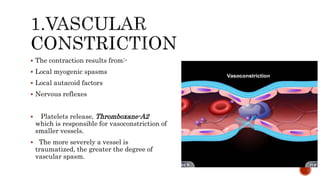
 The contraction results from:-
 Local myogenic spasms
 Local autacoid factors
 Nervous reflexes
 Platelets release, Thromboxane-A2
which is responsible for vasoconstriction of
smaller vessels.
 The more severely a vessel is
traumatized, the greater the degree of
vascular spasm.
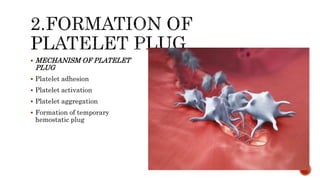
 MECHANISM OF PLATELET
PLUG
 Platelet adhesion
 Platelet activation
 Platelet aggregation
 Formation of temporary
hemostatic plug
 Third mechanism for hemostasis is formation of blood clot
 Clot begins to develop-
 severe trauma-15 to 20 sec
 minor trauma-1 to 2 min
 These mechanisms are set into play by:-
 Trauma to the vascular wall and the adjacent tissues
 Contact of the blood with damaged endothelial cells
 a) Extrinsic pathway for initiating blood clotting
 b) Intrinsic pathway for initiating blood clotting
In response to rupture of the vessel or damage to the blood
itself-formation of prothrombin activator
Prothrombin activator catalyzes conversion of prothrombin to
thrombin
Thrombin catalyzes fibrinogen into fibrin fibers.
 The clot is a meshwork
 Fibrin fibers also adhere to damaged surfaces of blood vessels.
 As the clot contracts, the edges are further pulled together, contributing ultimate
state of Hemostasis.
FIBRINOGEN
ACTION OF THROMBIN ON FIBRINOGEN TO FORM FIBRIN
BLOOD CLOT
CLOT RETRACTION-SERUM
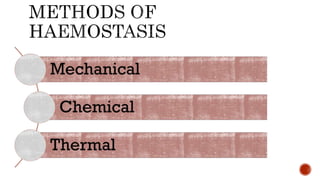
Direct pressure
Gauze pack
Suture and ligation
Staples
 First choice to control bleeding
 Fast and simplest
 Small Arterial bleeding
 Venous bleeding
 15-20 sec
 Not recommended in major artery and veins.
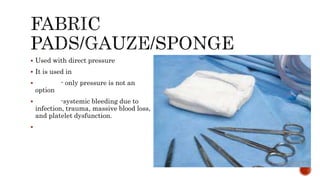
 Used with direct pressure
 It is used in
 - only pressure is not an
option
 -systemic bleeding due to
infection, trauma, massive blood loss,
and platelet dysfunction.

 Suture – used in major arteries and veins
 Ligation of facial artery, lingual artery, and external carotid artery
Stick Tie:
 Also called as transfixation.
 Used for High Blood pressure
 Proximal part of the vessels
Regular Tie
 Used for Distal part of the vessels
 Also used for tubectomy .
Staples- sterile and disposable
 titanium staples
Ligating clips-
 quick and easy
 decrease foreign body reaction
 various size
 Hemostats (Mosquito and Artery) are designed to catch bleeders.
 Can be straight or curved.
 Is a mixture of Beeswax (70%) and Vaseline (30%).
 It is a non-absorbable material , becoming soft and malleable in the hand when
warmed
 Its Hemostatic effect is based on physical rather than biochemical properties.
 It has been used in bone surgeries
 -Restricts tumors blood supply .
 -Arterial embolization preferentially interrupts tumors blood supply and stalls
growth until neovascularization
 - Used to control bleeding in Hemangiomas
 Heat (Cautery)
 Electro cautery: it is the use of high frequency alternating current for cutting,
coagulating, dessication or fulgurating tissue in both open and laparoscopic
procedure
 monopolar electro surgery
 bipolar electro surgery
 bipolar electrosurgery vessel sealing technology
 argon enhanced coagulation technology
 Ultrasonic device
 Lasers
 Most frequently used
 Two electodes- active (the pencil)
 - dispersive
 Modes - coagulation mode
 - cutting mode
 - blend mode
 Current flows through the patient from electrode (active) to electrode (dispersive)
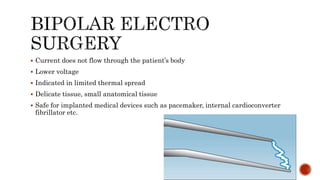
 Current does not flow through the patient’s body
 Lower voltage
 Indicated in limited thermal spread
 Delicate tissue, small anatomical tissue
 Safe for implanted medical devices such as pacemaker, internal cardioconverter
fibrillator etc.
 Pharmacological agents
 Topical haemostatic agent
 Passive
 active
 Sterile haemocoagulase solution
 Epinephrine
 Vitamin k
 Protamine
 Desmopressin
 Lysin analogs
 Etamsylate
 Causes direct vasoconstriction
 Can be applied topically and can be injected with LA
 Prolong analgesic effect
 Reduces bleeding during surgery
 Topical - The drug is applied with the help of gauze pack in concentration of
1:1000 over a oozing
 It is also injected along with local anesthetics in concentration of 1:80,000 and
1:2,00,000.
 Plays important role in coagulation process
 Helps in production of fibrinogen and prothrombin in liver
 Route- orally and IV(slow)
 IM and subcutaneous is not recommended because irratic absorption
 Dose- Males: 120 mcg/day PO
 Females: 90 mcg/day PO
 5-10 mg IV (dilute in 50 mL IV fluid and infuse over 20 min
 Reverse heparin anticoagulation activity
 Adverse effect- anaphylaxis, acute pulmonary vasoconstriction, right ventricular
failure
 Contraindication
 -diabetic
 -pt undergone vasectomy
 -drug allergy
 -previous protamine exposure
 Dose -1.0 -to- 1.5 mg protamine sulfate IV for every 100 IU of active heparin
Tranexamic acid- loading dose 2-7gm
 Follwed by 20-250 mg hourly
 Total dose of 3-10gm
 Oral dose; 500 mg 6-8 hrly
 Children; 1.25g/5 ml of syrup
 Inj- 0.5-1g slow i.v infusion TID
 Passive- collagen based product
 - oxidised regenerated cellulose
 - gelatine

 Active haemostat
 - thrombin product
 - pooled human plasma thrombin
 - recombinant thrombin
Hemostasis and methods to control bleeding

Hemostasis and methods to control bleeding

  • 1.
    Dr. Imran Aslam AssistantProfessor North Surgical Ward
  • 2.
     Hemostasis isthe process of forming clots in the walls of damaged blood vessels and preventing blood loss while maintaining blood in the fluid state within the vascular system.
  • 3.
     Coagulation iscombination of 1. Stasis of blood 2. Endothelial injury 3. Hypercoagulability
  • 4.
     Hemostasis meansprevention of ‘Blood Loss’. Hemostasis is achieved by several mechanism:-  Vascular constriction  Formation of platelet plug  Formation of blood clot  Growth of fibrous tissue into the clot.
  • 5.
     The contractionresults from:-  Local myogenic spasms  Local autacoid factors  Nervous reflexes  Platelets release, Thromboxane-A2 which is responsible for vasoconstriction of smaller vessels.  The more severely a vessel is traumatized, the greater the degree of vascular spasm.
  • 6.
     MECHANISM OFPLATELET PLUG  Platelet adhesion  Platelet activation  Platelet aggregation  Formation of temporary hemostatic plug
  • 7.
     Third mechanismfor hemostasis is formation of blood clot  Clot begins to develop-  severe trauma-15 to 20 sec  minor trauma-1 to 2 min
  • 8.
     These mechanismsare set into play by:-  Trauma to the vascular wall and the adjacent tissues  Contact of the blood with damaged endothelial cells  a) Extrinsic pathway for initiating blood clotting  b) Intrinsic pathway for initiating blood clotting
  • 11.
    In response torupture of the vessel or damage to the blood itself-formation of prothrombin activator Prothrombin activator catalyzes conversion of prothrombin to thrombin Thrombin catalyzes fibrinogen into fibrin fibers.
  • 13.
     The clotis a meshwork  Fibrin fibers also adhere to damaged surfaces of blood vessels.  As the clot contracts, the edges are further pulled together, contributing ultimate state of Hemostasis.
  • 14.
    FIBRINOGEN ACTION OF THROMBINON FIBRINOGEN TO FORM FIBRIN BLOOD CLOT CLOT RETRACTION-SERUM
  • 18.
  • 19.
     First choiceto control bleeding  Fast and simplest  Small Arterial bleeding  Venous bleeding  15-20 sec  Not recommended in major artery and veins.
  • 20.
     Used withdirect pressure  It is used in  - only pressure is not an option  -systemic bleeding due to infection, trauma, massive blood loss, and platelet dysfunction. 
  • 21.
     Suture –used in major arteries and veins  Ligation of facial artery, lingual artery, and external carotid artery
  • 22.
    Stick Tie:  Alsocalled as transfixation.  Used for High Blood pressure  Proximal part of the vessels Regular Tie  Used for Distal part of the vessels  Also used for tubectomy .
  • 23.
    Staples- sterile anddisposable  titanium staples Ligating clips-  quick and easy  decrease foreign body reaction  various size
  • 24.
     Hemostats (Mosquitoand Artery) are designed to catch bleeders.  Can be straight or curved.
  • 25.
     Is amixture of Beeswax (70%) and Vaseline (30%).  It is a non-absorbable material , becoming soft and malleable in the hand when warmed  Its Hemostatic effect is based on physical rather than biochemical properties.  It has been used in bone surgeries
  • 26.
     -Restricts tumorsblood supply .  -Arterial embolization preferentially interrupts tumors blood supply and stalls growth until neovascularization  - Used to control bleeding in Hemangiomas
  • 28.
     Heat (Cautery) Electro cautery: it is the use of high frequency alternating current for cutting, coagulating, dessication or fulgurating tissue in both open and laparoscopic procedure  monopolar electro surgery  bipolar electro surgery  bipolar electrosurgery vessel sealing technology  argon enhanced coagulation technology  Ultrasonic device  Lasers
  • 29.
     Most frequentlyused  Two electodes- active (the pencil)  - dispersive  Modes - coagulation mode  - cutting mode  - blend mode  Current flows through the patient from electrode (active) to electrode (dispersive)
  • 30.
     Current doesnot flow through the patient’s body  Lower voltage  Indicated in limited thermal spread  Delicate tissue, small anatomical tissue  Safe for implanted medical devices such as pacemaker, internal cardioconverter fibrillator etc.
  • 32.
     Pharmacological agents Topical haemostatic agent  Passive  active
  • 33.
     Sterile haemocoagulasesolution  Epinephrine  Vitamin k  Protamine  Desmopressin  Lysin analogs  Etamsylate
  • 34.
     Causes directvasoconstriction  Can be applied topically and can be injected with LA  Prolong analgesic effect  Reduces bleeding during surgery  Topical - The drug is applied with the help of gauze pack in concentration of 1:1000 over a oozing  It is also injected along with local anesthetics in concentration of 1:80,000 and 1:2,00,000.
  • 35.
     Plays importantrole in coagulation process  Helps in production of fibrinogen and prothrombin in liver  Route- orally and IV(slow)  IM and subcutaneous is not recommended because irratic absorption  Dose- Males: 120 mcg/day PO  Females: 90 mcg/day PO  5-10 mg IV (dilute in 50 mL IV fluid and infuse over 20 min
  • 36.
     Reverse heparinanticoagulation activity  Adverse effect- anaphylaxis, acute pulmonary vasoconstriction, right ventricular failure  Contraindication  -diabetic  -pt undergone vasectomy  -drug allergy  -previous protamine exposure  Dose -1.0 -to- 1.5 mg protamine sulfate IV for every 100 IU of active heparin
  • 37.
    Tranexamic acid- loadingdose 2-7gm  Follwed by 20-250 mg hourly  Total dose of 3-10gm  Oral dose; 500 mg 6-8 hrly  Children; 1.25g/5 ml of syrup  Inj- 0.5-1g slow i.v infusion TID
  • 38.
     Passive- collagenbased product  - oxidised regenerated cellulose  - gelatine   Active haemostat  - thrombin product  - pooled human plasma thrombin  - recombinant thrombin