BY
SRIDARSHINI CHANDRA
AMINO ACID
CONTENTS
Introduction
Classification of amino acid
Physical properties of amino acids
Chemical properties of amino acids
Functions of amino acids
What is amino acid?
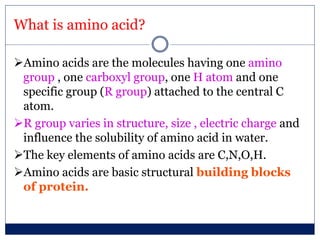
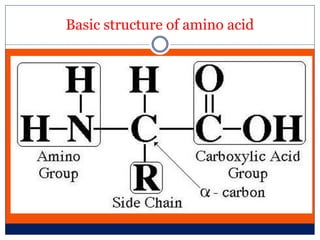
Amino acids are the molecules having one amino
group , one carboxyl group, one H atom and one
specific group (R group) attached to the central C
atom.
R group varies in structure, size , electric charge and
influence the solubility of amino acid in water.
The key elements of amino acids are C,N,O,H.
Amino acids are basic structural building blocks
of protein.
Basic structure of amino acid
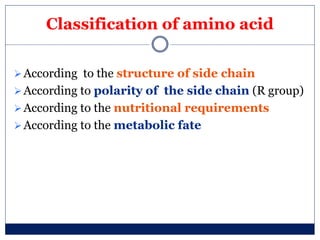
Classification of amino acid
According to the structure of side chain
According to polarity of the side chain (R group)
According to the nutritional requirements
According to the metabolic fate
Amino acids with aliphatic side chains
Name of
Amino acid
Structure of the
amino acid
Special group
present
Symbol
( 3 letters )
Symbol
(1 letter)
Glycine Hydrogen
atom
Gly G
Alanine Methyl group Ala A
Valine Isopropyl
group
Val V
Leucine Isobutyl group Leu L
Isoleucine Sec-butyl
group
IIe I
Amino acids containing Hydroxyl(-OH) group
Name of
amino acid
Structure
of amino
acid
Special group
present
Symbol
(3
letter)
Symbol
(1 letter)
Serine Hydroxymethyl
group
Ser
S
Threonine 1-Hydroxyethyl
group
Thr
T
Tyrosine 4-Hydroxybenzyl
group
Tyr
Y
Amino acids containing Sulfur
Name of amino
acid
Structure of
amino acid
Special group
present
Symbol
(3
letter)
Symbol
(1
letter)
Cysteine Sulfhydryl Cys C
Cystine Disulfide _ _
Methionine Thioether Met M
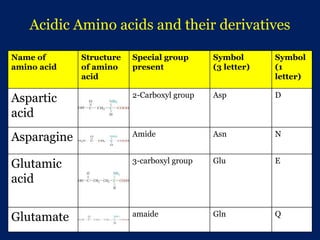
Acidic Amino acids and their derivatives
Name of
amino acid
Structure
of amino
acid
Special group
present
Symbol
(3 letter)
Symbol
(1
letter)
Aspartic
acid
2-Carboxyl group Asp D
Asparagine Amide Asn N
Glutamic
acid
3-carboxyl group Glu E
Glutamate amaide Gln Q
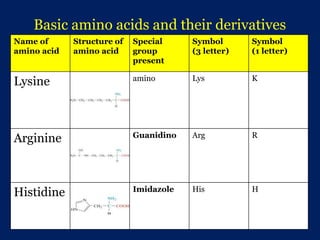
Basic amino acids and their derivatives
Name of
amino acid
Structure of
amino acid
Special
group
present
Symbol
(3 letter)
Symbol
(1 letter)
Lysine amino Lys K
Arginine Guanidino Arg R
Histidine Imidazole His H
Aromatic amino acids
Name of amino
acid
Structure of
amino acid
Special group
present
Symbol
(3 letter)
Symb
ol
(1
letter
)
Phenylalanine Benzylyl group Phe F
Tyrosine 4-hydroxybenzyl
group
Tyr Y
tryptophan Indole Trp W
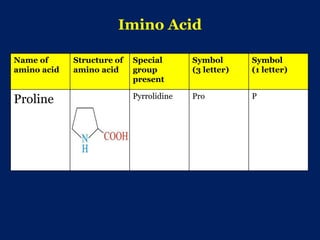
Imino Acid
Name of
amino acid
Structure of
amino acid
Special
group
present
Symbol
(3 letter)
Symbol
(1 letter)
Proline Pyrrolidine Pro P
Nutritional classification of amino acid
Essential or indispensable amino acid
Non-essential or dispensable amino acid amino acid
Essential amino acid
 Essential amino acids are not synthesized
by the body.
 Need to be supplied through diet.
 Required for proper growth and maintainance
of individual.
Arginine,Valine,Histidine,Isoleucine,Leucine,
Lysine, Methionine, Threonine, Tryptophan,
Phenylalanine
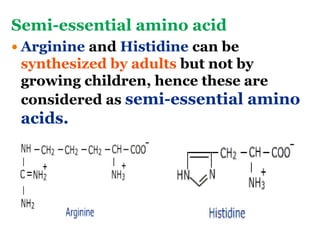
Semi-essential amino acid
 Arginine and Histidine can be
synthesized by adults but not by
growing children, hence these are
considered as semi-essential amino
acids.
Non-essential amino acid
 These can be synthesized by the body to meet
the biological needs.
 need not to be consumed through the diet.
Glycine, Alanine, Serine, Cysteine, Aspartate,
Asparagine, Glutamate, Glutamine, Proline,
Tyrosine.
Classification of amino acid based on polarity
Non-Polar, aliphatic amino acid
Aromatic amino acid
Polar uncharged( R group) amino acid
Polar positively charged amino acid
Polar negatively charged amino acid
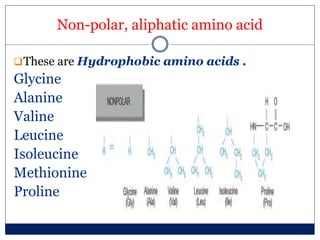
Non-polar, aliphatic amino acid
These are Hydrophobic amino acids .
Glycine
Alanine
Valine
Leucine
Isoleucine
Methionine
Proline
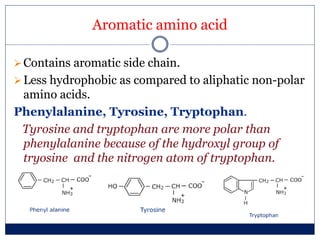
Aromatic amino acid
Contains aromatic side chain.
Less hydrophobic as compared to aliphatic non-polar
amino acids.
Phenylalanine, Tyrosine, Tryptophan.
Tyrosine and tryptophan are more polar than
phenylalanine because of the hydroxyl group of
tryosine and the nitrogen atom of tryptophan.
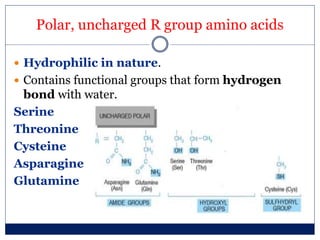
Polar, uncharged R group amino acids
 Hydrophilic in nature.
 Contains functional groups that form hydrogen
bond with water.
Serine
Threonine
Cysteine
Asparagine
Glutamine
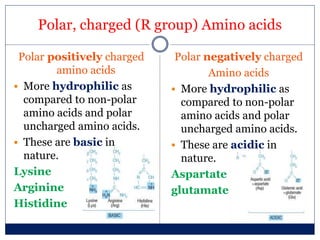
Polar, charged (R group) Amino acids
Polar positively charged
amino acids
 More hydrophilic as
compared to non-polar
amino acids and polar
uncharged amino acids.
 These are basic in
nature.
Lysine
Arginine
Histidine
Polar negatively charged
Amino acids
 More hydrophilic as
compared to non-polar
amino acids and polar
uncharged amino acids.
 These are acidic in
nature.
Aspartate
glutamate
Classification of amino acid according to
metabolic fate
 Both Glycogenic and Ketogenic amino acid:
Isoleucine, Tyrosine, Phenylalanine, Tryptophan
 Purely Ketogenic amino acids:
Leucine, Lysine
 Purely Glycogenic amino acids:
Alanine, Valine, Serine, Threonine, Glycine,
Methionine, Asparagine, Glutamine, Cysteine,
Cystine, Aspartic acid, Glutamic acid, Histidine,
Arginine.
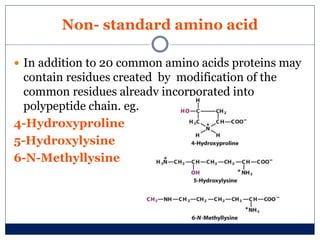
Non- standard amino acid
 In addition to 20 common amino acids proteins may
contain residues created by modification of the
common residues already incorporated into
polypeptide chain. eg.
4-Hydroxyproline
5-Hydroxylysine
6-N-Methyllysine
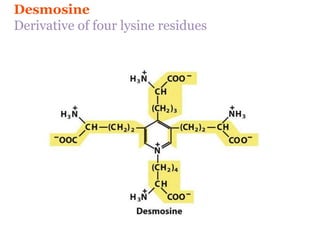
Desmosine
Derivative of four lysine residues
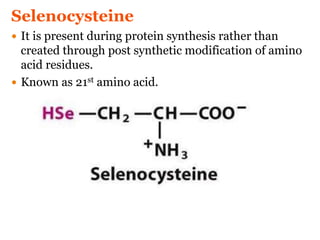
Selenocysteine
 It is present during protein synthesis rather than
created through post synthetic modification of amino
acid residues.
 Known as 21st amino acid.
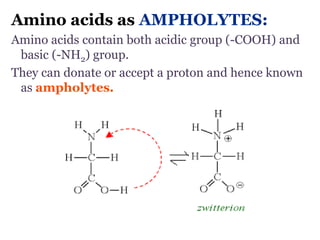
Amino acids as AMPHOLYTES:
Amino acids contain both acidic group (-COOH) and
basic (-NH2) group.
They can donate or accept a proton and hence known
as ampholytes.
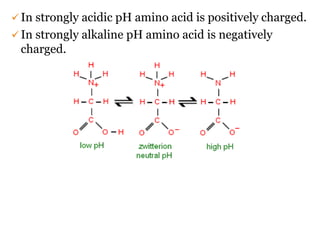
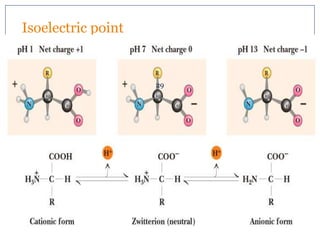
 In strongly acidic pH amino acid is positively charged.
 In strongly alkaline pH amino acid is negatively
charged.
Isoelectric pH
Isoelectric pH may be defined as a pH at which a
molecule exist as a zwitter ion or dipolar ion
and carries no net charge.
Molecule is electrically neutral at isoelectric pH.
Isoelectric point
7/5/2012
29
Biochemistry For Medics
Physical properties of amino acids
Solubility : most of the amino acids are soluble in
water but insoluble in organic solvents.
Melting point: Amino acids generally melt at high
temperature , often above 2000 c.
Taste: Amino acids may be sweet(Gly , Ala, Val);
tasteless (Arg, Ile);
Monosodium glutamate(MSG ; ajinamoto) is
used as flavoring agent in food industry. In
some individuals intolerant to MSG Chinese
restaurant syndrome (flu like) is observed.
Stereochemistry of Amino acids
All AMINO ACIDS ARE OPTICALLY
ACTIVE(EXCEPT GLYCINE)
All amino acids (except Glycine) have one
asymmetrical carbon or chiral carbon, to
which four different groups are
attached(carboxyl group, amino group,
hydrogen atom, R group)
 The mirror images of a molecule of amino acid
are non-superimposable to each other.
Amino acids do not have plane of
symmetry.
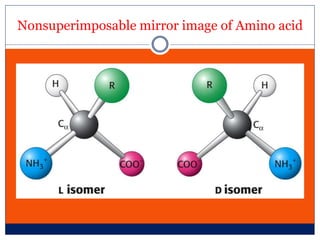
Nonsuperimposable mirror image of Amino acid
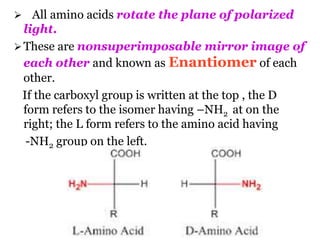
 All amino acids rotate the plane of polarized
light.
These are nonsuperimposable mirror image of
each other and known as Enantiomer of each
other.
If the carboxyl group is written at the top , the D
form refers to the isomer having –NH2 at on the
right; the L form refers to the amino acid having
-NH2 group on the left.
Reactions of amino acids
1) Reactions due to amino group.
2) Reactions due to carboxyl group.
3) Reactions due to side chain.
4) Reaction due to both amino and carboxyl
groups.
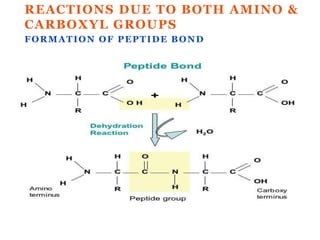
REACTIONS DUE TO BOTH AMINO &
CARBOXYL GROUPS
FORMATION OF PEPTIDE BOND
7/5/2012Biochemistry For Medics
Functions of amino acids
1) Provide the monomer units from which the long
polypeptide chain of proteins are synthesized.
(Condensation of two molecules of amino acids forms a
peptide bond)
2) L-amino acids and their derivatives participate in
cellular functions as diverse as nerve transmission and
the biosynthesis of porphyrins, purines,
pyrimidines, and urea.
3) Short polymers of amino acids called polypeptide
perform prominent roles in the neuroendocrine system
as hormones, hormone-releasing factors,
neurotransmitters
Functions of amino acids
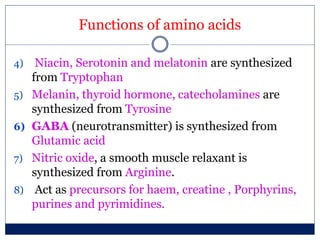
4) Niacin, Serotonin and melatonin are synthesized
from Tryptophan
5) Melanin, thyroid hormone, catecholamines are
synthesized from Tyrosine
6) GABA (neurotransmitter) is synthesized from
Glutamic acid
7) Nitric oxide, a smooth muscle relaxant is
synthesized from Arginine.
8) Act as precursors for haem, creatine , Porphyrins,
purines and pyrimidines.
Reference
 Principle of Biochemistry
Albert L. Lehninger, David L. Nelson, Michael M.Cox
6th edition,chapter-3,amino acid and protein,
page no- 75-85.
 Biochemistry, U.Satyanarayana, U.Chakrapani
3rd edition, chapter- 3, proteins and amino acids ,
page no-43-57
 Outlines of Biochemistry, Eric E. Conn & P.K.Stumpf 3rd
edition, chapter3,amino acid and proteins ,page no-55-67
 Harper’s Illustrated Biochemistry,
Murry,Bender,Botham,Kennelly,Rodwell,Weil,
28th edition, amino acids, page no-14-25.
THANK YOU