Dr. Shagufta Akmal
Biochemistry Deptt.
QAMC,Bahawalpur.
AMINO ACIDS
AMINO ACID
 An amino acid is bi functional organic
molecule that contains both a carboxyl
group, –COOH as well as an amine group,
–NH2. Amino acids derived from proteins
have the amino group on the alpha (α)
carbon i.e; the carbon atom next to the
carboxyl group.
 Amino acids are the building blocks of
proteins. There are 300 amino acids that
occur in nature. Among these only 22 are
known as standard amino acids that
commonly occur in proteins.
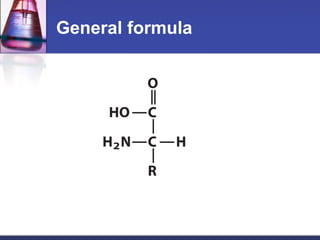
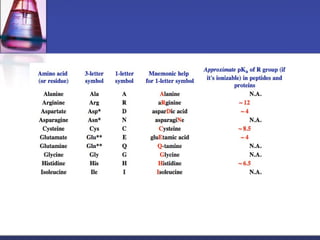
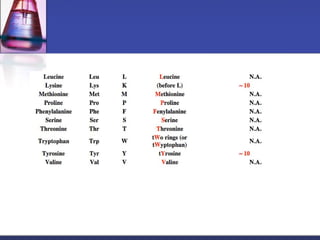
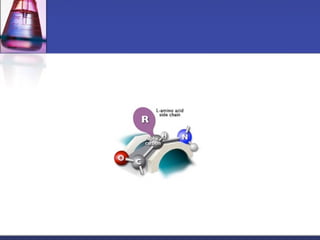
 The amino acids differ in the nature of R-
group attached to α carbon atom. The
nature of R-group determines the properties
of proteins.
General formula
 Amino acids are the structural units that
make up proteins. They join together to form
short polymer chains called peptides or
longer chains called either polypeptides or
proteins. These polymers are linear and un
branched, with each amino acid within the
chain attached to two neighboring amino
acids.
 The process of making proteins is called
translation and involves the step-by-step
addition of amino acids to a growing protein
chain by a ribozyme that is called a
ribosome. The order in which the amino
acids are added is read through the
genetic code from a mRNA template, which
is a RNA copy of one of the organism's
genes.
 Twenty-two amino acids are naturally
incorporated into polypeptides and are
called proteinogenic or natural amino
acids.Of these, 20 are encoded by the
universal genetic code. The remaining 2,
selenocysteine and pyrrolysine, are
incorporated into proteins by unique
synthetic mechanisms. Selenocysteine is
incorporated when the mRNA being
translated includes a SECIS.
Nomenclature of Amino Acids
 All amino acids have trivial names.
 e.g; NH2 CH2COOH is better known as
glycine rather then a-amino acetic acid or 2-
amino ethanoic acid.
 These trivial names usually reflect the
property of that compound or its source.
Example: Glycine is so named since it has
sweet taste (in Greek glykos means sweet)
and tyrosine was first obtained from cheese
(in Greek, tyros means cheese).
Peptide Bond Formation
 Proteins are formed by joining the carboxyl
group of one amino acid to the a-amino
group of another amino acid. The bond
formed between two amino acids by the
elimination of a water molecule is called a
peptide linkage or bond.
The product formed by linking amino acid
molecules through peptide linkages, – CO –
NH –, is called a peptide.
 Peptides are further designated as di, tri,
tetra or penta peptides accordingly as they
contain two, three, four or five amino acid
molecules, same or different, joined
together.
Classification
 Amino acids are classified into different
ways based on polarity, structure, nutritional
requirement, metabolic fate, etc. Generally
used classification is based on polarity.
Amino acid polarity chart shows the polarity
of amino acids.
Classification on polarity
basis
Based on polarity, amino acids are classified
into four groups as follows,
 Non-polar amino acids.
 Polar amino acids with no charge.
 Polar amino acids with positive charge.
 Polar amino acids with negative charge.
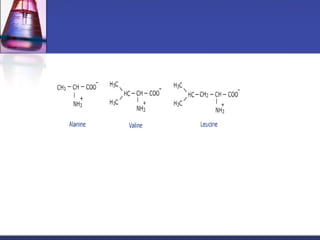
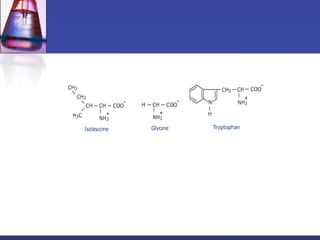
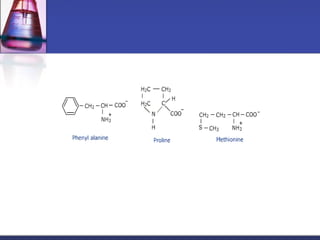
Non Polar Amino Acids
Non Polar Amino Acids have equal number
of amino and carboxyl groups and are
neutral. These amino acids are hydrophobic
and have no charge on the 'R' group. The
amino acids in this group are alanine, valine,
leucine, isoleucine, phenyl alanine, glycine,
tryptophan, methionine and proline.
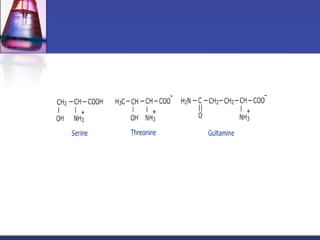
Polar Amino Acids with no
Charge
These amino acids do not have any charge
on the 'R' group. These amino acids
participate in hydrogen bonding of protein
structure. The amino acids in this group are
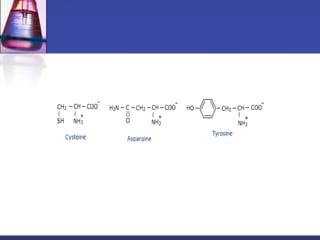
serine, threonine, tyrosine, cysteine,
glutamine and aspargine.
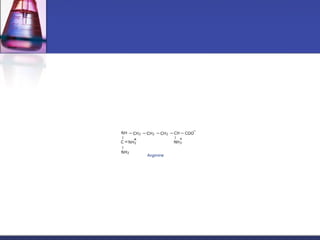
Polar Amino Acids with Positive
Charge
Polar amino acids with positive charge have
more amino groups as compared to carboxyl
groups making it basic. The amino acids,
which have positive charge on the 'R' group
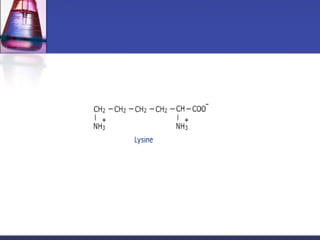
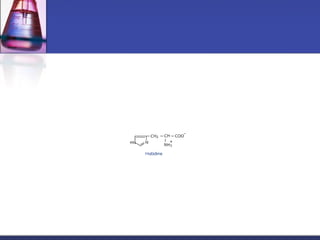
are placed in this category. They are lysine,
arginine and histidine.
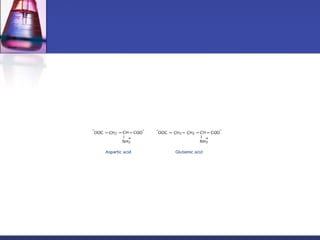
Polar Amino Acids with Negative
Charge
Polar amino acids with negative charge
have more carboxyl groups than amino
groups making them acidic. The amino
acids, which have negative charge on the 'R'
group are placed in this category. They are
called as dicarboxylic mono-amino acids.
They are aspartic acid and glutamic acid.
Classification on side chain
basis
 Aliphatic side chains
 Aromatic side chains
 Hydroxyl-containing side chains
 Sulfur-containing side chains
 Basic side chains
 Acidic side chains
 Amide side chains
 Imino acids
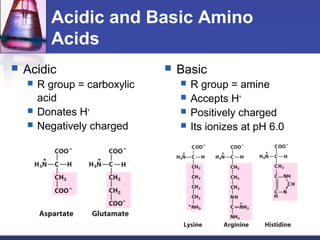
Acidic and Basic Amino
Acids
 Acidic
 R group = carboxylic
acid
 Donates H+
 Negatively charged
 Basic
 R group = amine
 Accepts H+
 Positively charged
 Its ionizes at pH 6.0
Branched-chain amino acid
(BCAA)
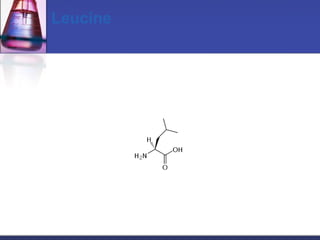
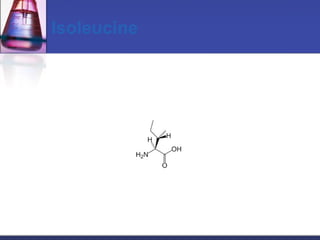
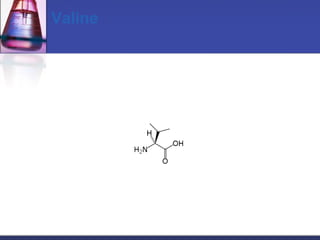
 A branched-chain amino acid (BCAA) is
an amino acid having aliphatic side-chains
with a branch i.e; a carbon atom bound to
more than two other carbon atoms. Among
the proteinogenic amino acids, there are
three BCAAs: leucine, isoleucine and valine.
Leucine
Isoleucine
Valine
 The BCAAs are among the essential amino
acids for humans, accounting for 35% of the
essential amino acids in muscle proteins
and 40% of the preformed amino acids
required by mammals. BCAA’s have been
used clinically to aid in the recovery of burn
victims. They are also used in the treatment
in some cases of hepatic encephalopathy.
MAPLE SYRUP URINE DISEASE
 Degradation of branched-chain amino acids
involves the
branched-chain alpha-keto acid dehydrogenase
(BCKDH). A deficiency of this complex
leads to a buildup of the branched-chain
amino acid (leucine, isoleucine, and valine)
and their toxic by products in the blood and
urine, giving the condition the name
maple syrup urine disease.
STANDARD AMINO ACIDS
 >300 amino acids.
 Only 22 form all proteins in plants as well as
animals. Humans can produce 10 of the 20
amino acids. The others must be supplied in
the food. Failure to obtain enough of even 1
of the essential amino acids, those that we
cannot make, results in degradation of the
body's proteins.
Nutritional Classification
 According to the classification based on
nutrition, they are divided into 3 types:
 They are:
 1-Essential amino acids, those that we
cannot make, results in degradation of the
body's proteins.
 2- Conditional amino acids.
 3- Non essential amino acids.
Essential Amino Acids
The amino acids that are to be supplied
through diet are called as essential amino
acids. They cannot be produced by the
body. The essential amino acids are valine,
isoleucine, leucine, lysine, methionine,
phenylalanine, threonine and tryptophan.
Non-essential Amino Acids
The amino acids that can be synthesized by
the body are called non essential amino
acids. They are: Glycine, alanine, serine,
cysteine, aspartic acid, glutamic acid,
aspargine, glutamine and proline.
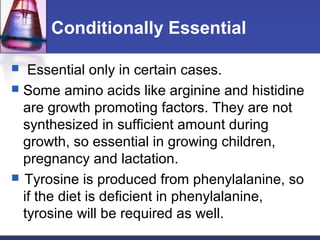
Conditionally Essential
 Essential only in certain cases.
 Some amino acids like arginine and histidine
are growth promoting factors. They are not
synthesized in sufficient amount during
growth, so essential in growing children,
pregnancy and lactation.
 Tyrosine is produced from phenylalanine, so
if the diet is deficient in phenylalanine,
tyrosine will be required as well.
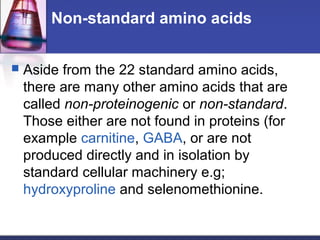
Non-standard amino acids
 Aside from the 22 standard amino acids,
there are many other amino acids that are
called non-proteinogenic or non-standard.
Those either are not found in proteins (for
example carnitine, GABA, or are not
produced directly and in isolation by
standard cellular machinery e.g;
hydroxyproline and selenomethionine.
 Non-standard amino acids that are found in
proteins are formed by
post-translational modification, which is
modification after translation during protein
synthesis. These modifications are often
essential for the function or regulation of a
protein e.g; the carboxylation of glutamate
allows for better binding of calcium cations,
and the hydroxylation of proline is critical for
maintaining connective tissues.
Some nonstandard amino acids are not
found in proteins. Examples include
lanthionine, 2-aminoisobutyric acid,
dehydroalanine, and the neurotransmitter
gamma-aminobutyric acid. Nonstandard
amino acids often occur as intermediates in
the metabolic pathways for standard amino
acids — for example, ornithine and
citrulline occur in the urea cycle, part of
amino acid catabolism.
 A rare exception to the dominance of α-
amino acids in biology is the β-amino acid
beta alanine (3-aminopropanoic acid), which
is used in plants and microorganisms in the
synthesis of pantothenic acid (vitamin B5), a
component of coenzyme A.
 1.Citrulline.
 2.Ornithine.
 3.Arginosuccinic acid.
 4. beta alaninne.
 5.Pantothenic acid.
 6.GABA.
 7.DOPA.
 8.Homocysteine.
 9.Iodinated amino acids:
MIT,DIT,T3 & T4.
Zwitterions
 The amine and carboxylic acid functional
groups found in amino acids allow them to
have amphiprotic properties. Carboxylic acid
groups (-CO2H) can be deprotonated to
become negative carboxylates (-CO2
-
),and
α-amino groups (NH2-) can be protonated to
become positive α-ammonium groups(+
NH3).
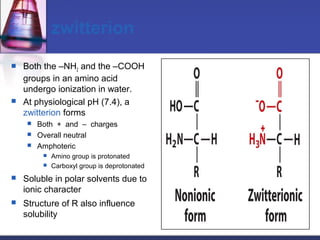
zwitterion
 Both the –NH2 and the –COOH
groups in an amino acid
undergo ionization in water.
 At physiological pH (7.4), a
zwitterion forms
 Both + and – charges
 Overall neutral
 Amphoteric
 Amino group is protonated
 Carboxyl group is deprotonated
 Soluble in polar solvents due to
ionic character
 Structure of R also influence
solubility
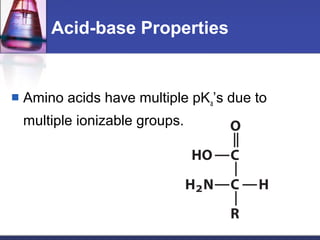
Acid-base Properties
 Amino acids have multiple pKa’s due to
multiple ionizable groups.
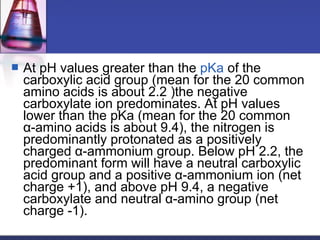
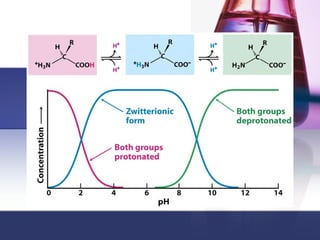
 At pH values greater than the pKa of the
carboxylic acid group (mean for the 20 common
amino acids is about 2.2 )the negative
carboxylate ion predominates. At pH values
lower than the pKa (mean for the 20 common
α-amino acids is about 9.4), the nitrogen is
predominantly protonated as a positively
charged α-ammonium group. Below pH 2.2, the
predominant form will have a neutral carboxylic
acid group and a positive α-ammonium ion (net
charge +1), and above pH 9.4, a negative
carboxylate and neutral α-amino group (net
charge -1).
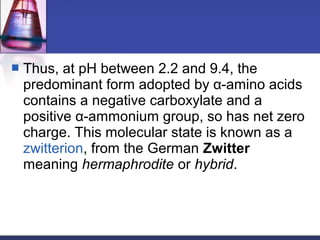
 Thus, at pH between 2.2 and 9.4, the
predominant form adopted by α-amino acids
contains a negative carboxylate and a
positive α-ammonium group, so has net zero
charge. This molecular state is known as a
zwitterion, from the German Zwitter
meaning hermaphrodite or hybrid.
Isomerism
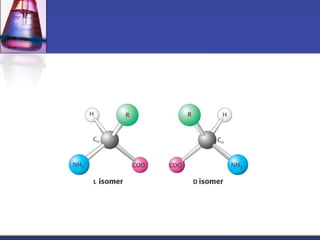
 Of the standard α-amino acids, all but glycine
can exist in either of two optical isomers, called
L or D amino acids, which are mirror images of
each other. While L-amino acids represent all of
the amino acids found in proteins during
translation in the ribosome, D-amino acids are
found in some proteins produced by
post translational modifications . They are also
abundant components of the peptidoglycan
cell walls of bacteria, and D-serine may act as a
neurotransmitter in the brain.
STEREOISOMERISM:
 Stereoisomers are isomeric molecules that
have the same molecular formula and
sequence of bonded atoms (constitution),
but that differ only in the three-dimensional
orientations of their atoms in space. This
contrasts with structural isomers, which
share the same molecular formula, but the
bond connections and/or their order differ(s)
between different atoms/groups.
 Enantiomers are stereoisomers that are
related to each other by a reflection.
 Mirror image but not superimposeable.
Isoelectric point
 At pH values between the two pKa values,
the zwitterion predominates, but coexists in
dynamic equilibrium with small amounts of
net negative and net positive ions. At the
exact midpoint between the two pKa values,
the trace amount of net negative and trace
of net positive ions exactly balance, so that
average net charge of all forms present is
zero. This pH is known as the
isoelectric point.
 The individual amino acids all have slightly
different pKa values, so have different
isoelectric points. For amino acids with
charged side-chains, the pKa of the side-
chain is involved.
 Amino acids have zero mobility in
electrophoresis at their isoelectric point,
although this behaviour is more usually
exploited for peptides and proteins than
single amino acids. Zwitterions have
minimum solubility at their isolectric point
and some amino acids (in particular, with
non-polar side-chains) can be isolated by
precipitation from water by adjusting the pH
to the required isoelectric point.
FUNCTIONS
 Non-protein functions
 In humans, non-protein amino acids also have
important roles as metabolic intermediates, such as
in the biosynthesis of the neurotransmitter
gamma-aminobutyric acid. Many amino acids are
used to synthesize other molecules, for example:
 Tryptophan is a precursor of the neurotransmitter
serotonin.
 Tyrosine is a precursor of the neurotransmitter
dopamine.
 Glycine is a precursor of porphyrins such as heme.
 Arginine is a precursor of nitric oxide.
 Ornithine and S-adenosylmethionine are
precursors of polyamines.
 Aspartate, glycine, and glutamine are
precursors of nucleotides.
 Phenylalanine is a precursor of various
phenylpropanoids, which are important in
plant metabolism
Protein functions
 Enzymes (catalytic proteins) Lactase, ribonuclease,
pyruvate dehydrogenase, fumarase, proteinase
 Structural proteins Collagen, elastin, keratin
 Regulatory or hormonal proteins Insulin, adrenaline
 Transport proteins Hemoglobin, myoglobin
 Genetic proteins Nucleoproteins, histones
 Immune Proteins Gamma Globulin, Ig's, (Ab's)
 Contractile Proteins Actin, myosin
 Storage Proteins Zein, ovalbumin, casein

Amino acids

  • 1.
    Dr. Shagufta Akmal BiochemistryDeptt. QAMC,Bahawalpur. AMINO ACIDS
  • 2.
    AMINO ACID  Anamino acid is bi functional organic molecule that contains both a carboxyl group, –COOH as well as an amine group, –NH2. Amino acids derived from proteins have the amino group on the alpha (α) carbon i.e; the carbon atom next to the carboxyl group.
  • 3.
     Amino acidsare the building blocks of proteins. There are 300 amino acids that occur in nature. Among these only 22 are known as standard amino acids that commonly occur in proteins.
  • 4.
     The aminoacids differ in the nature of R- group attached to α carbon atom. The nature of R-group determines the properties of proteins.
  • 5.
  • 6.
     Amino acidsare the structural units that make up proteins. They join together to form short polymer chains called peptides or longer chains called either polypeptides or proteins. These polymers are linear and un branched, with each amino acid within the chain attached to two neighboring amino acids.
  • 7.
     The processof making proteins is called translation and involves the step-by-step addition of amino acids to a growing protein chain by a ribozyme that is called a ribosome. The order in which the amino acids are added is read through the genetic code from a mRNA template, which is a RNA copy of one of the organism's genes.
  • 8.
     Twenty-two aminoacids are naturally incorporated into polypeptides and are called proteinogenic or natural amino acids.Of these, 20 are encoded by the universal genetic code. The remaining 2, selenocysteine and pyrrolysine, are incorporated into proteins by unique synthetic mechanisms. Selenocysteine is incorporated when the mRNA being translated includes a SECIS.
  • 9.
    Nomenclature of AminoAcids  All amino acids have trivial names.  e.g; NH2 CH2COOH is better known as glycine rather then a-amino acetic acid or 2- amino ethanoic acid.  These trivial names usually reflect the property of that compound or its source. Example: Glycine is so named since it has sweet taste (in Greek glykos means sweet) and tyrosine was first obtained from cheese (in Greek, tyros means cheese).
  • 10.
    Peptide Bond Formation Proteins are formed by joining the carboxyl group of one amino acid to the a-amino group of another amino acid. The bond formed between two amino acids by the elimination of a water molecule is called a peptide linkage or bond. The product formed by linking amino acid molecules through peptide linkages, – CO – NH –, is called a peptide.
  • 11.
     Peptides arefurther designated as di, tri, tetra or penta peptides accordingly as they contain two, three, four or five amino acid molecules, same or different, joined together.
  • 12.
    Classification  Amino acidsare classified into different ways based on polarity, structure, nutritional requirement, metabolic fate, etc. Generally used classification is based on polarity. Amino acid polarity chart shows the polarity of amino acids.
  • 13.
    Classification on polarity basis Basedon polarity, amino acids are classified into four groups as follows,  Non-polar amino acids.  Polar amino acids with no charge.  Polar amino acids with positive charge.  Polar amino acids with negative charge.
  • 14.
    Non Polar AminoAcids Non Polar Amino Acids have equal number of amino and carboxyl groups and are neutral. These amino acids are hydrophobic and have no charge on the 'R' group. The amino acids in this group are alanine, valine, leucine, isoleucine, phenyl alanine, glycine, tryptophan, methionine and proline.
  • 18.
    Polar Amino Acidswith no Charge These amino acids do not have any charge on the 'R' group. These amino acids participate in hydrogen bonding of protein structure. The amino acids in this group are serine, threonine, tyrosine, cysteine, glutamine and aspargine.
  • 22.
    Polar Amino Acidswith Positive Charge Polar amino acids with positive charge have more amino groups as compared to carboxyl groups making it basic. The amino acids, which have positive charge on the 'R' group are placed in this category. They are lysine, arginine and histidine.
  • 25.
    Polar Amino Acidswith Negative Charge Polar amino acids with negative charge have more carboxyl groups than amino groups making them acidic. The amino acids, which have negative charge on the 'R' group are placed in this category. They are called as dicarboxylic mono-amino acids. They are aspartic acid and glutamic acid.
  • 27.
    Classification on sidechain basis  Aliphatic side chains  Aromatic side chains  Hydroxyl-containing side chains  Sulfur-containing side chains  Basic side chains  Acidic side chains  Amide side chains  Imino acids
  • 28.
    Acidic and BasicAmino Acids  Acidic  R group = carboxylic acid  Donates H+  Negatively charged  Basic  R group = amine  Accepts H+  Positively charged  Its ionizes at pH 6.0
  • 29.
    Branched-chain amino acid (BCAA) A branched-chain amino acid (BCAA) is an amino acid having aliphatic side-chains with a branch i.e; a carbon atom bound to more than two other carbon atoms. Among the proteinogenic amino acids, there are three BCAAs: leucine, isoleucine and valine.
  • 30.
  • 31.
  • 32.
  • 33.
     The BCAAsare among the essential amino acids for humans, accounting for 35% of the essential amino acids in muscle proteins and 40% of the preformed amino acids required by mammals. BCAA’s have been used clinically to aid in the recovery of burn victims. They are also used in the treatment in some cases of hepatic encephalopathy.
  • 34.
    MAPLE SYRUP URINEDISEASE  Degradation of branched-chain amino acids involves the branched-chain alpha-keto acid dehydrogenase (BCKDH). A deficiency of this complex leads to a buildup of the branched-chain amino acid (leucine, isoleucine, and valine) and their toxic by products in the blood and urine, giving the condition the name maple syrup urine disease.
  • 35.
    STANDARD AMINO ACIDS >300 amino acids.  Only 22 form all proteins in plants as well as animals. Humans can produce 10 of the 20 amino acids. The others must be supplied in the food. Failure to obtain enough of even 1 of the essential amino acids, those that we cannot make, results in degradation of the body's proteins.
  • 36.
    Nutritional Classification  Accordingto the classification based on nutrition, they are divided into 3 types:  They are:  1-Essential amino acids, those that we cannot make, results in degradation of the body's proteins.  2- Conditional amino acids.  3- Non essential amino acids.
  • 37.
    Essential Amino Acids Theamino acids that are to be supplied through diet are called as essential amino acids. They cannot be produced by the body. The essential amino acids are valine, isoleucine, leucine, lysine, methionine, phenylalanine, threonine and tryptophan.
  • 38.
    Non-essential Amino Acids Theamino acids that can be synthesized by the body are called non essential amino acids. They are: Glycine, alanine, serine, cysteine, aspartic acid, glutamic acid, aspargine, glutamine and proline.
  • 39.
    Conditionally Essential  Essentialonly in certain cases.  Some amino acids like arginine and histidine are growth promoting factors. They are not synthesized in sufficient amount during growth, so essential in growing children, pregnancy and lactation.  Tyrosine is produced from phenylalanine, so if the diet is deficient in phenylalanine, tyrosine will be required as well.
  • 42.
    Non-standard amino acids Aside from the 22 standard amino acids, there are many other amino acids that are called non-proteinogenic or non-standard. Those either are not found in proteins (for example carnitine, GABA, or are not produced directly and in isolation by standard cellular machinery e.g; hydroxyproline and selenomethionine.
  • 43.
     Non-standard aminoacids that are found in proteins are formed by post-translational modification, which is modification after translation during protein synthesis. These modifications are often essential for the function or regulation of a protein e.g; the carboxylation of glutamate allows for better binding of calcium cations, and the hydroxylation of proline is critical for maintaining connective tissues.
  • 44.
    Some nonstandard aminoacids are not found in proteins. Examples include lanthionine, 2-aminoisobutyric acid, dehydroalanine, and the neurotransmitter gamma-aminobutyric acid. Nonstandard amino acids often occur as intermediates in the metabolic pathways for standard amino acids — for example, ornithine and citrulline occur in the urea cycle, part of amino acid catabolism.
  • 45.
     A rareexception to the dominance of α- amino acids in biology is the β-amino acid beta alanine (3-aminopropanoic acid), which is used in plants and microorganisms in the synthesis of pantothenic acid (vitamin B5), a component of coenzyme A.
  • 46.
     1.Citrulline.  2.Ornithine. 3.Arginosuccinic acid.  4. beta alaninne.  5.Pantothenic acid.  6.GABA.  7.DOPA.  8.Homocysteine.
  • 47.
     9.Iodinated aminoacids: MIT,DIT,T3 & T4.
  • 48.
    Zwitterions  The amineand carboxylic acid functional groups found in amino acids allow them to have amphiprotic properties. Carboxylic acid groups (-CO2H) can be deprotonated to become negative carboxylates (-CO2 - ),and α-amino groups (NH2-) can be protonated to become positive α-ammonium groups(+ NH3).
  • 49.
    zwitterion  Both the–NH2 and the –COOH groups in an amino acid undergo ionization in water.  At physiological pH (7.4), a zwitterion forms  Both + and – charges  Overall neutral  Amphoteric  Amino group is protonated  Carboxyl group is deprotonated  Soluble in polar solvents due to ionic character  Structure of R also influence solubility
  • 50.
    Acid-base Properties  Aminoacids have multiple pKa’s due to multiple ionizable groups.
  • 51.
     At pHvalues greater than the pKa of the carboxylic acid group (mean for the 20 common amino acids is about 2.2 )the negative carboxylate ion predominates. At pH values lower than the pKa (mean for the 20 common α-amino acids is about 9.4), the nitrogen is predominantly protonated as a positively charged α-ammonium group. Below pH 2.2, the predominant form will have a neutral carboxylic acid group and a positive α-ammonium ion (net charge +1), and above pH 9.4, a negative carboxylate and neutral α-amino group (net charge -1).
  • 52.
     Thus, atpH between 2.2 and 9.4, the predominant form adopted by α-amino acids contains a negative carboxylate and a positive α-ammonium group, so has net zero charge. This molecular state is known as a zwitterion, from the German Zwitter meaning hermaphrodite or hybrid.
  • 54.
    Isomerism  Of thestandard α-amino acids, all but glycine can exist in either of two optical isomers, called L or D amino acids, which are mirror images of each other. While L-amino acids represent all of the amino acids found in proteins during translation in the ribosome, D-amino acids are found in some proteins produced by post translational modifications . They are also abundant components of the peptidoglycan cell walls of bacteria, and D-serine may act as a neurotransmitter in the brain.
  • 55.
    STEREOISOMERISM:  Stereoisomers areisomeric molecules that have the same molecular formula and sequence of bonded atoms (constitution), but that differ only in the three-dimensional orientations of their atoms in space. This contrasts with structural isomers, which share the same molecular formula, but the bond connections and/or their order differ(s) between different atoms/groups.
  • 56.
     Enantiomers arestereoisomers that are related to each other by a reflection.  Mirror image but not superimposeable.
  • 59.
    Isoelectric point  AtpH values between the two pKa values, the zwitterion predominates, but coexists in dynamic equilibrium with small amounts of net negative and net positive ions. At the exact midpoint between the two pKa values, the trace amount of net negative and trace of net positive ions exactly balance, so that average net charge of all forms present is zero. This pH is known as the isoelectric point.
  • 60.
     The individualamino acids all have slightly different pKa values, so have different isoelectric points. For amino acids with charged side-chains, the pKa of the side- chain is involved.
  • 61.
     Amino acidshave zero mobility in electrophoresis at their isoelectric point, although this behaviour is more usually exploited for peptides and proteins than single amino acids. Zwitterions have minimum solubility at their isolectric point and some amino acids (in particular, with non-polar side-chains) can be isolated by precipitation from water by adjusting the pH to the required isoelectric point.
  • 62.
    FUNCTIONS  Non-protein functions In humans, non-protein amino acids also have important roles as metabolic intermediates, such as in the biosynthesis of the neurotransmitter gamma-aminobutyric acid. Many amino acids are used to synthesize other molecules, for example:  Tryptophan is a precursor of the neurotransmitter serotonin.  Tyrosine is a precursor of the neurotransmitter dopamine.  Glycine is a precursor of porphyrins such as heme.
  • 63.
     Arginine isa precursor of nitric oxide.  Ornithine and S-adenosylmethionine are precursors of polyamines.  Aspartate, glycine, and glutamine are precursors of nucleotides.  Phenylalanine is a precursor of various phenylpropanoids, which are important in plant metabolism
  • 64.
    Protein functions  Enzymes(catalytic proteins) Lactase, ribonuclease, pyruvate dehydrogenase, fumarase, proteinase  Structural proteins Collagen, elastin, keratin  Regulatory or hormonal proteins Insulin, adrenaline  Transport proteins Hemoglobin, myoglobin  Genetic proteins Nucleoproteins, histones  Immune Proteins Gamma Globulin, Ig's, (Ab's)  Contractile Proteins Actin, myosin  Storage Proteins Zein, ovalbumin, casein