Dr.S.Sethupathy,M.D.,Ph.D.,
Rajah Muthiah Medical College,
Annamalai University.
Proteins
 Greek word – proteios which means of supreme
importance.
 ¾ of the the total dry body weight.
 Composed of mainly carbon, hydrogen, oxygen and
nitrogen
 Sulphur and phosphorus as minor constituents.
 Nitrogen content of proteins is 16% by weight
 The proteins are polymers of amino acids.
Amino acids
They have a carboxylic group (-COOH)
and primary amino group (-NH2)
attached to alpha carbon - carbon next
to carboxyl carbon .
 Based on R group the amino acids vary
from each other.
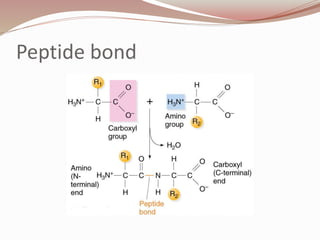
Peptide bond
Amino acids in proteins are linked
by peptide bonds.
α- carboxyl group of one amino
acid reacts with α- amino group of
another to form a peptide bond by
removal of water. ie : - CO- NH –
bridge.
Peptides and proteins
Two amino acids form dipeptide and
three amino acids form tripeptide.
10-50 amino acids form polypeptide
More than 50 amino acids form
proteins.
The sequence of amino acids
determine the structure of proteins .
Neutral amino acids
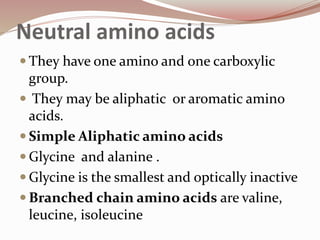
 They have one amino and one carboxylic
group.
 They may be aliphatic or aromatic amino
acids.
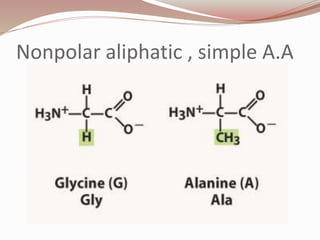
 Simple Aliphatic amino acids
 Glycine and alanine .
 Glycine is the smallest and optically inactive
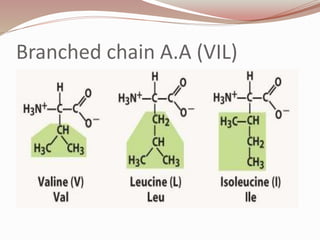
 Branched chain amino acids are valine,
leucine, isoleucine
Nonpolar aliphatic , simple A.A
Branched chain A.A (VIL)
Neutral amino acids
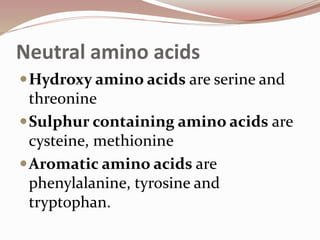
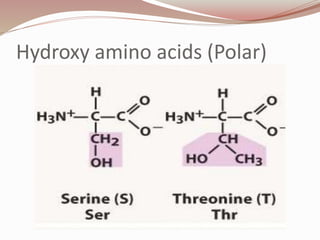
Hydroxy amino acids are serine and
threonine
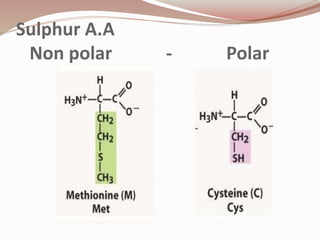
Sulphur containing amino acids are
cysteine, methionine
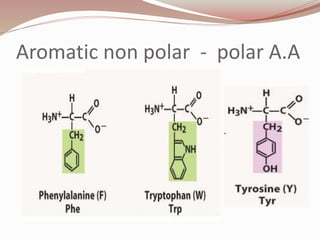
Aromatic amino acids are
phenylalanine, tyrosine and
tryptophan.
Hydroxy amino acids (Polar)
Sulphur A.A
Non polar - Polar
Aromatic non polar - polar A.A
Acidic amino acids and their
amides
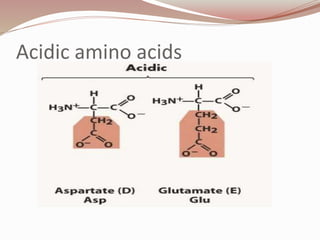
Aspartic acid glutamic acid – they
have one amino and two carboxyl
groups
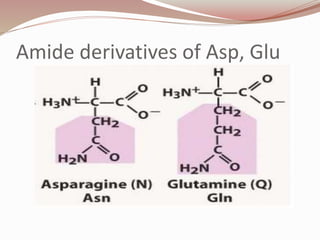
The amide derivatives of these
acidic amino acids are asparagine
and glutamine respectively.
Acidic amino acids
Amide derivatives of Asp, Glu
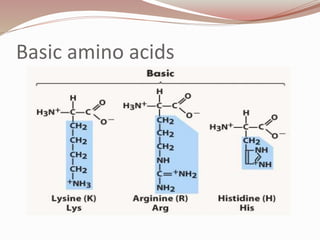
Basic amino acids are lysine
(two-NH2 group), arginine (has a
guanidino group) in the aliphatic
chain and histidine has an
imidazole group.
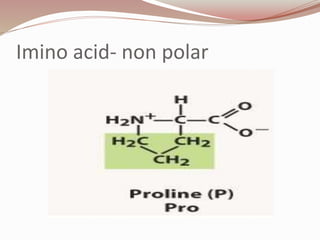
Imino acids: proline is an imino
acid. It has a secondary imino
group (-NH-)
Basic amino acids
Imino acid- non polar
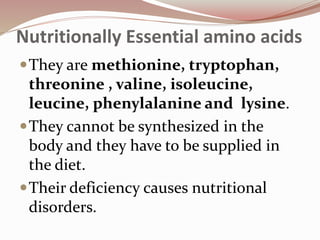
Nutritionally Essential amino acids
They are methionine, tryptophan,
threonine , valine, isoleucine,
leucine, phenylalanine and lysine.
They cannot be synthesized in the
body and they have to be supplied in
the diet.
Their deficiency causes nutritional
disorders.
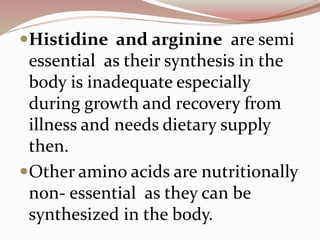
Histidine and arginine are semi
essential as their synthesis in the
body is inadequate especially
during growth and recovery from
illness and needs dietary supply
then.
Other amino acids are nutritionally
non- essential as they can be
synthesized in the body.
Glucogenic and ketogenic A.A
 The amino acids which can be converted to
glucose are called glucogenic amino acids. Eg.
Glycine, alanine, glutamate etc.
 The amino acids which cannot be converted to
glucose but can form acetyl units are called
ketogenic amino acids
 The only ketogenic amino acid is leucine
whereas Phenylalanine, tyrosine, tryptophan,
and lysine are both ketogonic and glucogenic.
 Derived amino acids present in proteins
 Hydroxy proline and hydroxy lysine do not
have genetic code .
 They are important constituents of collagen.
 Non protein amino acids
 Derived amino acids are found free in the
cells.
 They are produced during metabolism of
amino acids. Ex : Ornithine, citrulline and
homocysteine.
 Non alpha amino acids
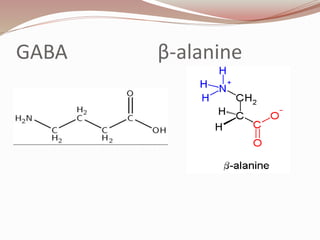
 Gamma amino butyric acid is derived from
glutamic acid.
 Beta alanine is a constituent of pantothenic
acid.
 Amino acids having non polar side
chains
 Alanine , valine , isoleucine , leucine
,methionine , proline, phenyl alanine and
tryptophan .
 They have hydrophobic groups.
GABA β-alanine
 Amino acids having non-ionic polar side
chains
 Glycine, serine, threonine, cysteine,
tyrosine, glutamine and asparagine are
hydrophilic in nature.
 Amino acids having ionic polar side
chains
 Acidic amino acids are aspartic acid and
glutamic acid. Basic amino acids are lysine,
arginine and histidine. They are hydrophilic
in nature.
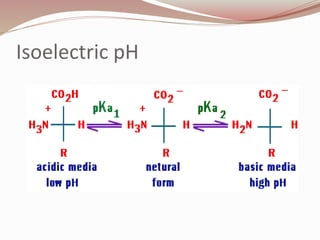
 Amino acids
 Exist as NH3
+ - cationic form at acidic pH
 Exist as COO- - anionic form at alkaline pH
 Isoelectric pH (pI)
 It is the pH at which amino acids or proteins
having equal number of positive and negative
charges – zwitterionic form
 Do not move in electric field due to zero net
charge.
Isoelectric pH
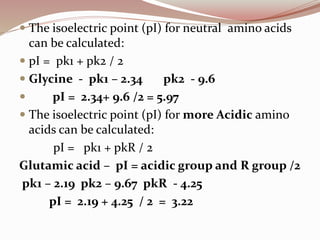
 The isoelectric point (pI) for neutral amino acids
can be calculated:
 pI = pk1 + pk2 / 2
 Glycine - pk1 – 2.34 pk2 - 9.6
 pI = 2.34+ 9.6 /2 = 5.97
 The isoelectric point (pI) for more Acidic amino
acids can be calculated:
pI = pk1 + pkR / 2
Glutamic acid – pI = acidic group and R group /2
pk1 – 2.19 pk2 – 9.67 pkR - 4.25
pI = 2.19 + 4.25 / 2 = 3.22
Dibasic amino acids -pI
 The isoelectric point (pI) for more amino,
monocarboxylic amino acids can be calculated:
pI = pk2 + pkR / 2
Lysine – pk1-2.2, pk2- 8.9 , pkR- 10.5
pI = 8.9+ 10.5 = 9.7
 pK1=Dissociation constant of (-COOH) group
 pK2=Association constant of (-NH2) group
 pKR=Dissociation (or) Association constant of “R”
side chain
Isoelectic pH (pI)
 pK 1 is due to carboxyl group and pK2 is due
to amino group.
 pI can be calculated from the pK values.
 Eg : glycine pI = pk1 + pk2 /2 ie : 2.4 +9.8
/ 2 = 6.1. Buffering capacity is minimum at
pI. The pK value of histidine is 6.4 and is an
effective buffer at physiological pH of 7.4.
 Optical activity
 Except glycine all amino acids have
asymmetric carbon and are optically active.
 With reference to alpha carbon, D,L isomers
are formed.
 Natural amino acids are L- isomers.
 D-amino acids are constituents of certain
antibiotics - Actinomycin-D, valinomycin
and bacterial cell wall peptidiglycans.
Decarboxylation
 The amino acids will undergo alpha
decarboxylation to form amines.
 Histidine Histamine + CO2
 Tyrosine tyramine + CO2
 Tryptophan tryptamine + CO2
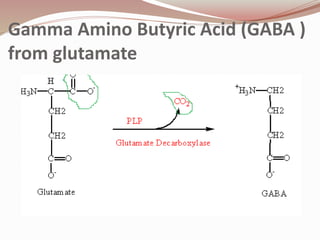
 glutamic acid GABA + CO2
(gamma amino butyric acid)
Gamma Amino Butyric Acid (GABA )
from glutamate
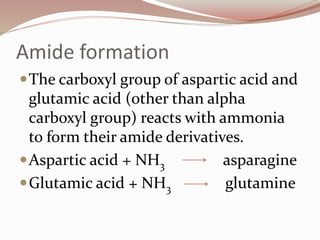
Amide formation
The carboxyl group of aspartic acid and
glutamic acid (other than alpha
carboxyl group) reacts with ammonia
to form their amide derivatives.
Aspartic acid + NH3 asparagine
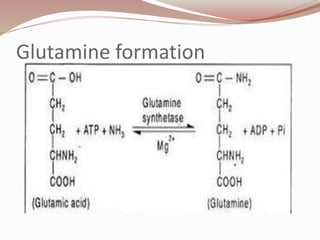
Glutamic acid + NH3 glutamine
Glutamine formation
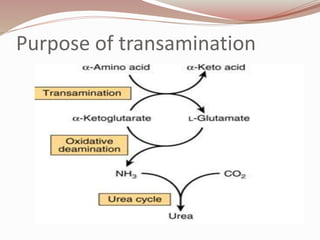
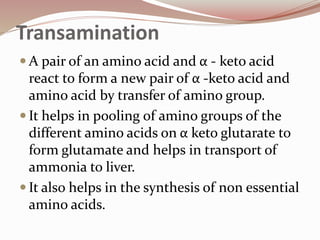
Transamination
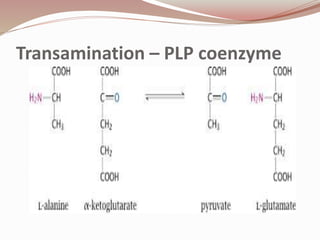
 A pair of an amino acid and α - keto acid
react to form a new pair of α -keto acid and
amino acid by transfer of amino group.
 It helps in pooling of amino groups of the
different amino acids on α keto glutarate to
form glutamate and helps in transport of
ammonia to liver.
 It also helps in the synthesis of non essential
amino acids.
Transamination – PLP coenzyme
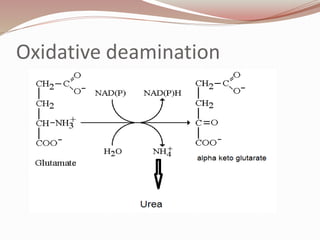
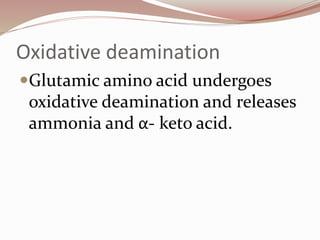
Oxidative deamination
Glutamic amino acid undergoes
oxidative deamination and releases
ammonia and α- keto acid.
Oxidative deamination
Carbamino compound
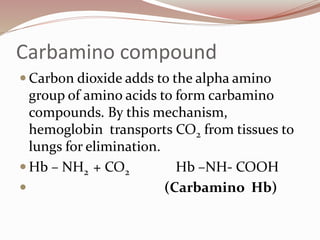
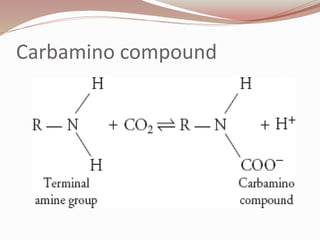
 Carbon dioxide adds to the alpha amino
group of amino acids to form carbamino
compounds. By this mechanism,
hemoglobin transports CO2 from tissues to
lungs for elimination.
 Hb – NH2 + CO2 Hb –NH- COOH
 (Carbamino Hb)
Carbamino compound
Transmethylation
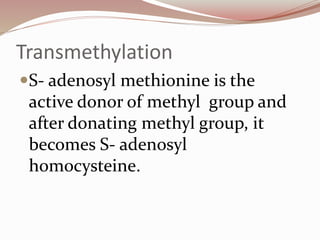
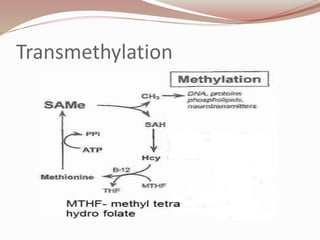
S- adenosyl methionine is the
active donor of methyl group and
after donating methyl group, it
becomes S- adenosyl
homocysteine.
Transmethylation
Ester formation
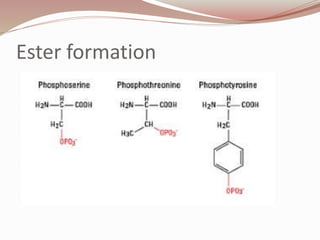
Serine ,threonine residues can form
ester linkage with phosphoric acid.
It plays a role in the regulation of many
enzyme activities by phosphorylation
and dephosphorylation of serine or
threonine residues in them.
Ester formation
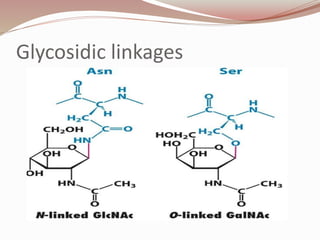
Glycosidic linkage
Hydroxyl groups of serine and threnoine
can form O-glycosidic bonds with
carbohydrate residues in glycoproteins.
Amide group of asparagine and
glutamine can form N-glycosidic bonds
with carbohydrate residues in
glycoproteins.
Glycosidic linkages
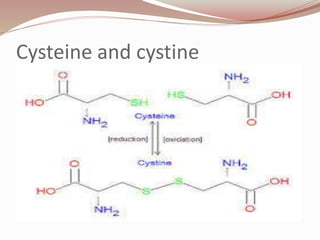
Cysteine and cystine
Reaction of SH group of cysteine
 It can form disulphide linkage in peptides
which may be either intra chain or inter
chain .
 Two molecules of cysteine react to form
Cystine or dicysteine.
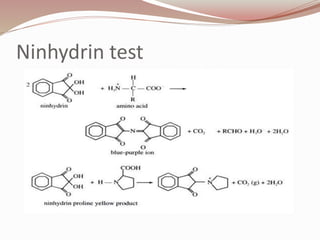
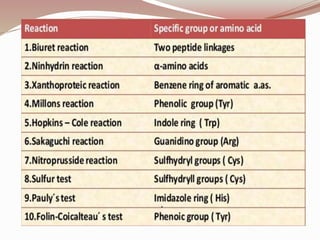
Ninhydrin test
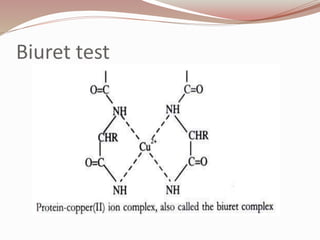
Biuret test
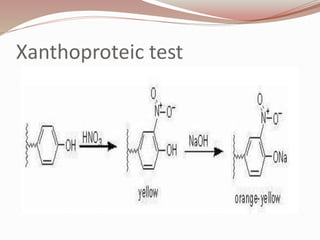
Xanthoproteic test
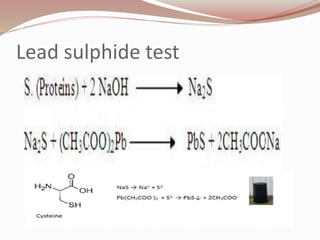
Lead sulphide test
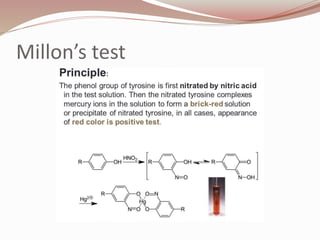
Millon’s test
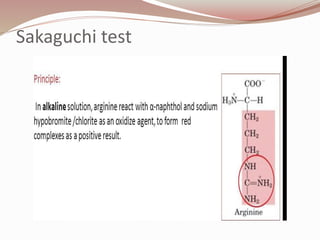
Sakaguchi test
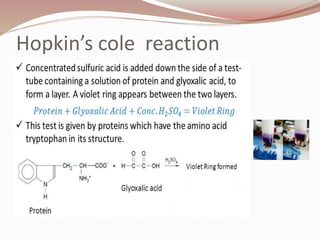
Hopkin’s cole reaction
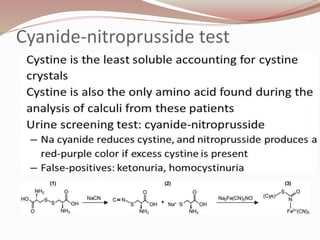
Cyanide-nitroprusside test
Methionine - negative
 Cysteine and cystine give this test positive
but methionine gives negative because
sulphur in methionine is not released due
to methyl group attached to it.
 Casein and gelatin contains methionine and
insignificant amount of cysteine , gives the
cyanide –nitroprusside test negative.
Purpose of transamination
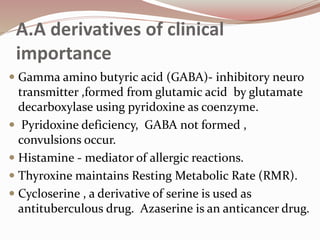
A.A derivatives of clinical
importance
 Gamma amino butyric acid (GABA)- inhibitory neuro
transmitter ,formed from glutamic acid by glutamate
decarboxylase using pyridoxine as coenzyme.
 Pyridoxine deficiency, GABA not formed ,
convulsions occur.
 Histamine - mediator of allergic reactions.
 Thyroxine maintains Resting Metabolic Rate (RMR).
 Cycloserine , a derivative of serine is used as
antituberculous drug. Azaserine is an anticancer drug.
Proteins
 Proteins are polymers of amino acids linked by
peptide bond.
 Alpha amino group of one amino acid reacts with
alpha carboxyl group of another amino acid
forming a peptide linkage with removal of water.
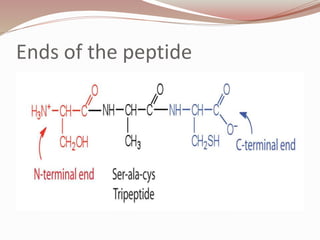
 Peptides have amino terminal (Free alpha amino
group) and carboxyl terminal (Free alpha
carboxyl group) .
 Biologically important peptides are glutathione,
oxytocin , antidiuretic hormone, insulin etc.
Peptide bond
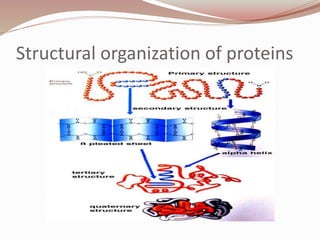
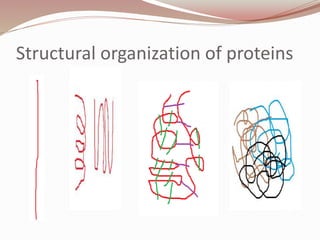
Structural organization of proteins
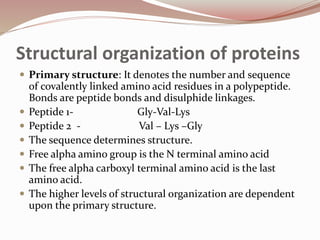
 Primary structure: It denotes the number and sequence
of covalently linked amino acid residues in a polypeptide.
Bonds are peptide bonds and disulphide linkages.
 Peptide 1- Gly-Val-Lys
 Peptide 2 - Val – Lys –Gly
 The sequence determines structure.
 Free alpha amino group is the N terminal amino acid
 The free alpha carboxyl terminal amino acid is the last
amino acid.
 The higher levels of structural organization are dependent
upon the primary structure.
Structural organization of proteins
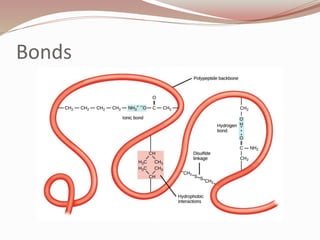
Bonds responsible for protein
structure
Covalent bonds are peptide and
disulphide linkages .
Non covalent bonds are Hydrogen
bonds, Hydrophobic bond,
electrostatic or ionic bonds and
weak Van der Waals’ forces.
Bonds
Structural organization of proteins
Secondary structure
 It is the folding and twisting of polypeptide
chain forming a two dimensional structure due
to interaction between adjacent amino acid
residues in the linear sequence of the peptide.
 Eg. Alpha – helix is a right handed helix
 Beta pleated sheet is mainly due to inter or
intra chain interactions which may be
antiparallel or parallel sheets.
Tertiary structure
 Peptides further fold into a three dimensional
structure due to interaction between amino
acid residues which are far away in the linear
sequence of the peptide.
 Non-covalent forces-Hydrogen bonds,
electrostatic bonds, hydrophobic bonds and
weak van der Waals forces - secondary and
tertiary structure
 Domain is the compact functional unit of a
protein. Eg : catalytic domain of an enzyme ,
regulatory domain of a protein.
Quaternary structure
 More than one polypeptides interact and form
a single functional assembly. Eg : Hemoglobin
is a tetramer. (α2β2 - four polypeptides) .
 Each polypeptide chain is called as subunit or
monomer.
 Creatine kinase is a dimer .If a dimer is
composed of similar copies of polypeptides, it is
called as homodimer. Eg: CK-MM.
 If both copies are different, they are called as
heterodimers Eg : CK-MB.
Classification of proteins
 Based on its functions
 Structural proteins Eg: collagen is the most
abundant protein in mammals.
 Pepsin as an enzyme , Transferrin as a
Transport protein, Ferritin as a Storage
protein and insulin as hormone and
immunoglobulis as the mediator of
immunity are examples.
Based on shape
 Globular proteins: They are oval in shape
and are easily soluble. Eg: albumin,
globulin.
 Fibrous proteins: They are elongated and
resist digestion . Their solubility is
minimum. Eg; collagen, keratin, elastin.
 Axial ratio (Length/Breadth) is more than 10
for fibrous proteins and for globular proteins
it is less than 10.
Based on nutritional value
 Nutritionally rich proteins: Complete
proteins or first class proteins and with all
essential amino acids in required
proportions. Eg: Egg white , Casein of milk.
 Incomplete proteins: Lack one essential
amino acid. Eg: Cereals lack lysine and
pulses lack methionine.
 Poor proteins: Lack many essential
amino acids .Eg: Zein from corn lacks
tryptophan and lysine.
Based on compostion
Simple proteins : They are made up of
amino acids only.
Eg . Albumin and Globulins are soluble
in water and heat coagulable proteins.
Histones,, Protamines.
Conjugated proteins
 They are proteins combined with the non-
protein substance called prosthetic group.
 Eg. Glycoproteins- blood group antigens,
lipoproteins- chylomicrons,
nucleoproteins – histones with DNA,
phosphoproteins – casein of milk and vitellin
of egg yolk,
metalloproteins – hemoglobin , cytochrome.
Derived proteins
Derived proteins: They are derived
from simple and conjugated proteins.
 Denatured or coagulated proteins are
called primary derivatives.
 Partial hydrolysis of proteins leads to
secondary derivatives - proteoses,
peptones and peptides.
Biologically important peptides
 Thyrotropin releasing hormone (TRH) is a tripeptide
and releases thyroid stimulating hormone.
 Glutathione is a tripeptide and helps in the maintenance
of RBC membrane integrity and keeping certain
enzymes in an active state.
 Oxytocin and antidiuretic hormone (ADH or
Vassopressin) , Angiotensin I are peptide hormones.
 Gramicidin S is an antibiotic produced by Bacillus brevis
 It is circular ,composed of 10 amino acids and has D-
phenyl alanine.
Estimation of proteins
 The protein sample is digested by boiling
with concentrated sulfuric acid at 360o C in
the presence of copper sulfate and sodium
sulfate as catalysts.
 Ammonia liberated is measured. Proteins
contain 16% nitrogen, it can be calculated.
 ie Weight of nitrogen x 100 /16 or nitrogen x
6.25.
 Accurate procedure but it is tedious and
takes longer time.
Biuret method
 Cupric ions chelate with peptide bonds in
alkaline medium to produce violet color and
measured colorimetrically.
 Compared with known concentration of
protein standard treated similarly with
Biuret reagent.
 It is simple and widely used in clinical
laboratory.
 But its sensitivity is less and not suitable for
estimation of mg quantities.
Lowry’s method
 Reduction of Folin - Ciocalteau reagent ( Phospho
molybdic acid and phosphotungstic acid ) by the
tyrosine and tryptophan residues of protein.
 A blue color is developed and can be compared with a
known standard.
 This is very sensitive and microgram quantity can be
measured.
 If the tryptophan and tyrosine content is different
between test protein and standard protein, the
accuracy is lost.
Spectrophotometric method
 Proteins absorb UV light at 280 nm.
 This is due to tyrosine and tryptophan content.
 It is compared with known standard protein
solution.
 The method is accurate, simple and sensitive up
to micrograms.
 Since reagent is not added, the sample can be
used for other tests.
 But the instrument is expensive.
Nephelometry
 The detection of scattered light by turbid particles in
solution.
 Antigen-antibody complexes can be detected.
 A beam of light is passed through the solution and the
scattered light detected at an angle of 30-90 o
(preferably 60 o ).
 This is rapid and suitable for automation but the
instrument is expensive.
 Microgram quantity can be measured.
Turbidimetry
 The proteins in biological fluids such as urine, CSF can
be estimated by adding precipitating agents such as
sulfosalicylic acid and the turbidity is measured.
 It is simple, cheaper but less accurate.
 Detector is kept at an angle of 180 o.
 RIA and ELISA: Protein of Nanogram and picogram
quantities can be estimated by Radio immuno assay
(RIA) and Enzyme linked immuno sorbent assay
(ELISA).
Steps for determination of
primary structure
 N-Terminal amino acid determination
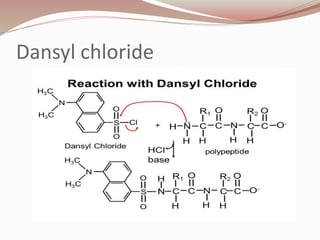
 Dansyl chloride combines with N-terminal amino acid
 The tagged polypeptides are hydrolyzed by boiling at
110 o C in 6H HCl for 18- 36 hours.
 The number of dansyl amino acids indicate the
number of polypeptides.
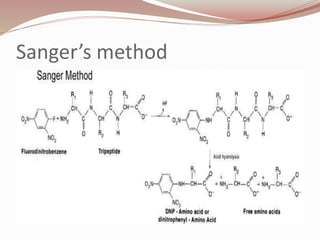
 N- terminal amino acid can also be determined using
Sanger’s reagent –1, Fluoro 2,4-dinitro bezene(1-F, 2,4-
DNB).
Ends of the peptide
Dansyl chloride
Sanger’s method
C-terminal amino acid
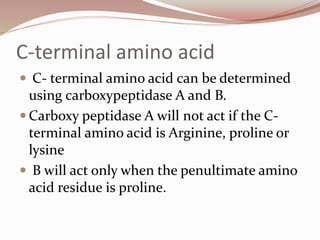
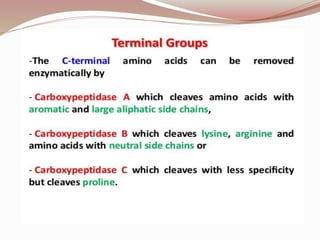
 C- terminal amino acid can be determined
using carboxypeptidase A and B.
 Carboxy peptidase A will not act if the C-
terminal amino acid is Arginine, proline or
lysine
 B will act only when the penultimate amino
acid residue is proline.
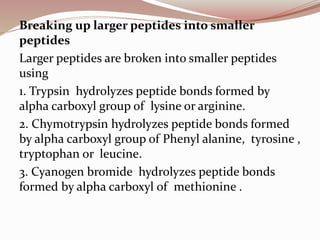
Breaking up larger peptides into smaller
peptides
Larger peptides are broken into smaller peptides
using
1. Trypsin hydrolyzes peptide bonds formed by
alpha carboxyl group of lysine or arginine.
2. Chymotrypsin hydrolyzes peptide bonds formed
by alpha carboxyl group of Phenyl alanine, tyrosine ,
tryptophan or leucine.
3. Cyanogen bromide hydrolyzes peptide bonds
formed by alpha carboxyl of methionine .
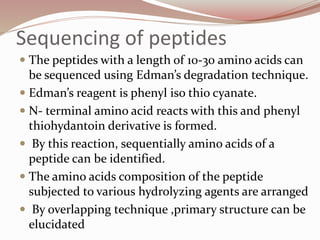
Sequencing of peptides
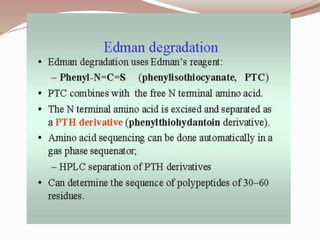
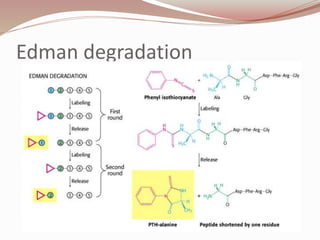
 The peptides with a length of 10-30 amino acids can
be sequenced using Edman’s degradation technique.
 Edman’s reagent is phenyl iso thio cyanate.
 N- terminal amino acid reacts with this and phenyl
thiohydantoin derivative is formed.
 By this reaction, sequentially amino acids of a
peptide can be identified.
 The amino acids composition of the peptide
subjected to various hydrolyzing agents are arranged
 By overlapping technique ,primary structure can be
elucidated
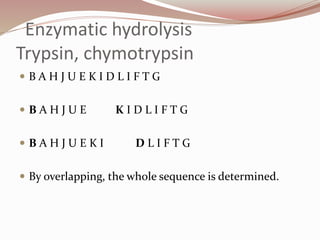
Enzymatic hydrolysis
Trypsin, chymotrypsin
 B A H J U E K I D L I F T G
 By overlapping, the whole sequence is determined.
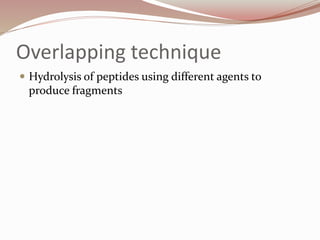
Overlapping technique
 Hydrolysis of peptides using different agents to
produce fragments
Edman degradation
NMR
 Nuclear magnetic resonance (NMR) Spectroscopy is
useful in determining functional group and change in
conformation after binding with ligand.
 X- ray diffraction study is useful in studying the
structure of pure , crystallized protein.
 Chemical synthesis of peptides by solid phase
technique: Here the carboxy terminal amino acid is
attached to insoluble polystyrene beads so that
washing between reactions is rapid. The other amino
acids are added sequentially.
 Insulin was first synthesized by this method.
Precipitation of proteins
 Salting out: When a neutral salt such as
ammonium sulphate or sodium sulphate is
added to protein solution, the shell of
hydration is removed and protein gets
precipitated.
 The globulins are precipitated by half
saturation with ammonium sulphate where
as albumin is precipitated by full saturation
because it is more hydrated than globulin.
 Proteins are least soluble at iso electric pH.
 Organic solvents such as alcohol cause
precipitation of proteins by removing water from
their shell.
 Precipitation by heavy metal ions
 In alkaline solution, heavy metal ions are cations
and combine with anionic proteins to form metal
proteinates and get precipitated.
 Salts of Copper, zinc, cadmium, mercury, lead are
toxic because they precipitate proteins. Based on
this principle , raw egg can be used as antidote for
mercury poisoning.
 Precipitation by alkaloidal agents
 Tungstic acid, phosphotungstic acid, tannic acid,
picric acid, trichloro acetic acid and sulphosalicylic
acid are powerful protein precipitating agents.
 Tannic acid is useful in tanning process in leather
industry.
 Techniques of protein separation
 Chromatography
 It is a physical method of separation in which the
components to be separated are continuously
distributed between two phases
 stationary phase and mobile phase
Paper chromatography
 Paper (cellulose) acts as supporting medium.
 Water adsorbed to paper acts as stationary phase and the
non polar solvent such as butanol act as mobile phase.
 When the mobile phase moves, non polar compounds are
carried by them where as polar compounds are retained by
polar stationary phase.
 Rf value (ratio of fronts) = distance traveled by solute /
distance traveled by solvent
 Other types are thin layer Chromatography, ion exchange
Chromatography, Gas Chromatography, affinity
Chromatography, high performance liquid
Chromatography ,gel filtration Chromatography, etc.
Electrophorsis
 It is a technique for the separation of the
charged particles by means of electric
current.
 In an electric field, a charged particle
migrates towards cathode or anode based
on its net charges.
 Paper, agar, polyacrylmide gel
electrophoresis are the different types.
Biological significance of A.A
 They are involved in protein synthesis.
 Energy yield is 4 kcal / gm.
 Glycine is required for purine, haem,
creatine, glutathione synthesis.
 Cysteine is needed for glutathione synthesis.
Methionine is involved is one carbon
transfer reactions.
Tyrosine is the precursor of thyroid
hormones, catecholamines ,dopamine,
melanin pigment.
Tryptophan is the precursor for niacin,
serotonin and melatonin.
Glutamic acid is the precursor of
gamma amino butyic acid (GABA).
Aspartate , glutamine are needed for
purines and pyrimidines synthesis.
Denaturation
 Change in native conformation of proteins
due to altered non covalent forces is called
denaturation.
 There will be loss of activity of the proteins.
 Primary structure is not altered.
 Denaturation involves the secondary,
tertiary, quaternary structure of the
molecules.
Causes of denaturation
 Chemical agents such as Acid, alkali,
mercury, lead, alcohol
 Physical agents such as heat, UV rays,
ionizing radiation
 Mechanical means like vigorous shaking,
grinding etc.
 It can be reversible some times.
uses
 Denaturation causes unfolding of proteins.
 It helps in the digestion of dietary proteins
by proteolytic enzymes.
 Denatured proteins form aggregates and
precipitation occurs.
 Helps in the isolation of proteins of interest.
 Ex: Precipitation of proteins by ammonium
sulfate in the initial stages of isolation of
proteins.
 Floccculation
 Denatured protein at isoelectric pH gets
more precipitated forming floccules which
still can be reversible.
 Coagulation
 If the proteins are permanently and
irreversibly disorganized, it results heavy
precipitates called as coagulum and
coagulation is irreversible. Eg: Heat
coagulation.
Ultracentrifugation
 Proteins can be separated based on size, shape and
molecular weight based on their sedimentation
velocities.
 Using ultracentrifuge-lipoproteins can be separated
by high speed centrifugation.
 The ultracentrifuge - high as 2,00,000 g.
 Preparative ultracentrifuge is used to separate cellular
organelles.
 Analytical centrifuge is used to obtain information
about the shape, conformation and size distribution
of the molecules.
Thank you

Protein chemistry

  • 1.
  • 2.
    Proteins  Greek word– proteios which means of supreme importance.  ¾ of the the total dry body weight.  Composed of mainly carbon, hydrogen, oxygen and nitrogen  Sulphur and phosphorus as minor constituents.  Nitrogen content of proteins is 16% by weight  The proteins are polymers of amino acids.
  • 3.
    Amino acids They havea carboxylic group (-COOH) and primary amino group (-NH2) attached to alpha carbon - carbon next to carboxyl carbon .  Based on R group the amino acids vary from each other.
  • 4.
    Peptide bond Amino acidsin proteins are linked by peptide bonds. α- carboxyl group of one amino acid reacts with α- amino group of another to form a peptide bond by removal of water. ie : - CO- NH – bridge.
  • 5.
    Peptides and proteins Twoamino acids form dipeptide and three amino acids form tripeptide. 10-50 amino acids form polypeptide More than 50 amino acids form proteins. The sequence of amino acids determine the structure of proteins .
  • 6.
    Neutral amino acids They have one amino and one carboxylic group.  They may be aliphatic or aromatic amino acids.  Simple Aliphatic amino acids  Glycine and alanine .  Glycine is the smallest and optically inactive  Branched chain amino acids are valine, leucine, isoleucine
  • 7.
  • 8.
  • 9.
    Neutral amino acids Hydroxyamino acids are serine and threonine Sulphur containing amino acids are cysteine, methionine Aromatic amino acids are phenylalanine, tyrosine and tryptophan.
  • 10.
  • 11.
  • 12.
    Aromatic non polar- polar A.A
  • 13.
    Acidic amino acidsand their amides Aspartic acid glutamic acid – they have one amino and two carboxyl groups The amide derivatives of these acidic amino acids are asparagine and glutamine respectively.
  • 14.
  • 15.
  • 16.
    Basic amino acidsare lysine (two-NH2 group), arginine (has a guanidino group) in the aliphatic chain and histidine has an imidazole group. Imino acids: proline is an imino acid. It has a secondary imino group (-NH-)
  • 17.
  • 18.
  • 19.
    Nutritionally Essential aminoacids They are methionine, tryptophan, threonine , valine, isoleucine, leucine, phenylalanine and lysine. They cannot be synthesized in the body and they have to be supplied in the diet. Their deficiency causes nutritional disorders.
  • 20.
    Histidine and arginineare semi essential as their synthesis in the body is inadequate especially during growth and recovery from illness and needs dietary supply then. Other amino acids are nutritionally non- essential as they can be synthesized in the body.
  • 21.
    Glucogenic and ketogenicA.A  The amino acids which can be converted to glucose are called glucogenic amino acids. Eg. Glycine, alanine, glutamate etc.  The amino acids which cannot be converted to glucose but can form acetyl units are called ketogenic amino acids  The only ketogenic amino acid is leucine whereas Phenylalanine, tyrosine, tryptophan, and lysine are both ketogonic and glucogenic.
  • 22.
     Derived aminoacids present in proteins  Hydroxy proline and hydroxy lysine do not have genetic code .  They are important constituents of collagen.  Non protein amino acids  Derived amino acids are found free in the cells.  They are produced during metabolism of amino acids. Ex : Ornithine, citrulline and homocysteine.
  • 23.
     Non alphaamino acids  Gamma amino butyric acid is derived from glutamic acid.  Beta alanine is a constituent of pantothenic acid.  Amino acids having non polar side chains  Alanine , valine , isoleucine , leucine ,methionine , proline, phenyl alanine and tryptophan .  They have hydrophobic groups.
  • 24.
  • 25.
     Amino acidshaving non-ionic polar side chains  Glycine, serine, threonine, cysteine, tyrosine, glutamine and asparagine are hydrophilic in nature.  Amino acids having ionic polar side chains  Acidic amino acids are aspartic acid and glutamic acid. Basic amino acids are lysine, arginine and histidine. They are hydrophilic in nature.
  • 26.
     Amino acids Exist as NH3 + - cationic form at acidic pH  Exist as COO- - anionic form at alkaline pH  Isoelectric pH (pI)  It is the pH at which amino acids or proteins having equal number of positive and negative charges – zwitterionic form  Do not move in electric field due to zero net charge.
  • 27.
  • 28.
     The isoelectricpoint (pI) for neutral amino acids can be calculated:  pI = pk1 + pk2 / 2  Glycine - pk1 – 2.34 pk2 - 9.6  pI = 2.34+ 9.6 /2 = 5.97  The isoelectric point (pI) for more Acidic amino acids can be calculated: pI = pk1 + pkR / 2 Glutamic acid – pI = acidic group and R group /2 pk1 – 2.19 pk2 – 9.67 pkR - 4.25 pI = 2.19 + 4.25 / 2 = 3.22
  • 29.
    Dibasic amino acids-pI  The isoelectric point (pI) for more amino, monocarboxylic amino acids can be calculated: pI = pk2 + pkR / 2 Lysine – pk1-2.2, pk2- 8.9 , pkR- 10.5 pI = 8.9+ 10.5 = 9.7  pK1=Dissociation constant of (-COOH) group  pK2=Association constant of (-NH2) group  pKR=Dissociation (or) Association constant of “R” side chain
  • 30.
    Isoelectic pH (pI) pK 1 is due to carboxyl group and pK2 is due to amino group.  pI can be calculated from the pK values.  Eg : glycine pI = pk1 + pk2 /2 ie : 2.4 +9.8 / 2 = 6.1. Buffering capacity is minimum at pI. The pK value of histidine is 6.4 and is an effective buffer at physiological pH of 7.4.
  • 31.
     Optical activity Except glycine all amino acids have asymmetric carbon and are optically active.  With reference to alpha carbon, D,L isomers are formed.  Natural amino acids are L- isomers.  D-amino acids are constituents of certain antibiotics - Actinomycin-D, valinomycin and bacterial cell wall peptidiglycans.
  • 32.
    Decarboxylation  The aminoacids will undergo alpha decarboxylation to form amines.  Histidine Histamine + CO2  Tyrosine tyramine + CO2  Tryptophan tryptamine + CO2  glutamic acid GABA + CO2 (gamma amino butyric acid)
  • 33.
    Gamma Amino ButyricAcid (GABA ) from glutamate
  • 34.
    Amide formation The carboxylgroup of aspartic acid and glutamic acid (other than alpha carboxyl group) reacts with ammonia to form their amide derivatives. Aspartic acid + NH3 asparagine Glutamic acid + NH3 glutamine
  • 35.
  • 36.
    Transamination  A pairof an amino acid and α - keto acid react to form a new pair of α -keto acid and amino acid by transfer of amino group.  It helps in pooling of amino groups of the different amino acids on α keto glutarate to form glutamate and helps in transport of ammonia to liver.  It also helps in the synthesis of non essential amino acids.
  • 37.
  • 38.
    Oxidative deamination Glutamic aminoacid undergoes oxidative deamination and releases ammonia and α- keto acid.
  • 39.
  • 41.
    Carbamino compound  Carbondioxide adds to the alpha amino group of amino acids to form carbamino compounds. By this mechanism, hemoglobin transports CO2 from tissues to lungs for elimination.  Hb – NH2 + CO2 Hb –NH- COOH  (Carbamino Hb)
  • 42.
  • 43.
    Transmethylation S- adenosyl methionineis the active donor of methyl group and after donating methyl group, it becomes S- adenosyl homocysteine.
  • 44.
  • 45.
    Ester formation Serine ,threonineresidues can form ester linkage with phosphoric acid. It plays a role in the regulation of many enzyme activities by phosphorylation and dephosphorylation of serine or threonine residues in them.
  • 46.
  • 47.
    Glycosidic linkage Hydroxyl groupsof serine and threnoine can form O-glycosidic bonds with carbohydrate residues in glycoproteins. Amide group of asparagine and glutamine can form N-glycosidic bonds with carbohydrate residues in glycoproteins.
  • 48.
  • 49.
  • 50.
    Reaction of SHgroup of cysteine  It can form disulphide linkage in peptides which may be either intra chain or inter chain .  Two molecules of cysteine react to form Cystine or dicysteine.
  • 51.
  • 52.
  • 53.
  • 54.
  • 55.
  • 57.
  • 58.
  • 59.
  • 60.
    Methionine - negative Cysteine and cystine give this test positive but methionine gives negative because sulphur in methionine is not released due to methyl group attached to it.  Casein and gelatin contains methionine and insignificant amount of cysteine , gives the cyanide –nitroprusside test negative.
  • 61.
  • 62.
    A.A derivatives ofclinical importance  Gamma amino butyric acid (GABA)- inhibitory neuro transmitter ,formed from glutamic acid by glutamate decarboxylase using pyridoxine as coenzyme.  Pyridoxine deficiency, GABA not formed , convulsions occur.  Histamine - mediator of allergic reactions.  Thyroxine maintains Resting Metabolic Rate (RMR).  Cycloserine , a derivative of serine is used as antituberculous drug. Azaserine is an anticancer drug.
  • 63.
    Proteins  Proteins arepolymers of amino acids linked by peptide bond.  Alpha amino group of one amino acid reacts with alpha carboxyl group of another amino acid forming a peptide linkage with removal of water.  Peptides have amino terminal (Free alpha amino group) and carboxyl terminal (Free alpha carboxyl group) .  Biologically important peptides are glutathione, oxytocin , antidiuretic hormone, insulin etc.
  • 64.
  • 65.
    Structural organization ofproteins  Primary structure: It denotes the number and sequence of covalently linked amino acid residues in a polypeptide. Bonds are peptide bonds and disulphide linkages.  Peptide 1- Gly-Val-Lys  Peptide 2 - Val – Lys –Gly  The sequence determines structure.  Free alpha amino group is the N terminal amino acid  The free alpha carboxyl terminal amino acid is the last amino acid.  The higher levels of structural organization are dependent upon the primary structure.
  • 66.
  • 67.
    Bonds responsible forprotein structure Covalent bonds are peptide and disulphide linkages . Non covalent bonds are Hydrogen bonds, Hydrophobic bond, electrostatic or ionic bonds and weak Van der Waals’ forces.
  • 68.
  • 69.
  • 70.
    Secondary structure  Itis the folding and twisting of polypeptide chain forming a two dimensional structure due to interaction between adjacent amino acid residues in the linear sequence of the peptide.  Eg. Alpha – helix is a right handed helix  Beta pleated sheet is mainly due to inter or intra chain interactions which may be antiparallel or parallel sheets.
  • 71.
    Tertiary structure  Peptidesfurther fold into a three dimensional structure due to interaction between amino acid residues which are far away in the linear sequence of the peptide.  Non-covalent forces-Hydrogen bonds, electrostatic bonds, hydrophobic bonds and weak van der Waals forces - secondary and tertiary structure  Domain is the compact functional unit of a protein. Eg : catalytic domain of an enzyme , regulatory domain of a protein.
  • 72.
    Quaternary structure  Morethan one polypeptides interact and form a single functional assembly. Eg : Hemoglobin is a tetramer. (α2β2 - four polypeptides) .  Each polypeptide chain is called as subunit or monomer.  Creatine kinase is a dimer .If a dimer is composed of similar copies of polypeptides, it is called as homodimer. Eg: CK-MM.  If both copies are different, they are called as heterodimers Eg : CK-MB.
  • 73.
    Classification of proteins Based on its functions  Structural proteins Eg: collagen is the most abundant protein in mammals.  Pepsin as an enzyme , Transferrin as a Transport protein, Ferritin as a Storage protein and insulin as hormone and immunoglobulis as the mediator of immunity are examples.
  • 74.
    Based on shape Globular proteins: They are oval in shape and are easily soluble. Eg: albumin, globulin.  Fibrous proteins: They are elongated and resist digestion . Their solubility is minimum. Eg; collagen, keratin, elastin.  Axial ratio (Length/Breadth) is more than 10 for fibrous proteins and for globular proteins it is less than 10.
  • 75.
    Based on nutritionalvalue  Nutritionally rich proteins: Complete proteins or first class proteins and with all essential amino acids in required proportions. Eg: Egg white , Casein of milk.  Incomplete proteins: Lack one essential amino acid. Eg: Cereals lack lysine and pulses lack methionine.  Poor proteins: Lack many essential amino acids .Eg: Zein from corn lacks tryptophan and lysine.
  • 76.
    Based on compostion Simpleproteins : They are made up of amino acids only. Eg . Albumin and Globulins are soluble in water and heat coagulable proteins. Histones,, Protamines.
  • 77.
    Conjugated proteins  Theyare proteins combined with the non- protein substance called prosthetic group.  Eg. Glycoproteins- blood group antigens, lipoproteins- chylomicrons, nucleoproteins – histones with DNA, phosphoproteins – casein of milk and vitellin of egg yolk, metalloproteins – hemoglobin , cytochrome.
  • 78.
    Derived proteins Derived proteins:They are derived from simple and conjugated proteins.  Denatured or coagulated proteins are called primary derivatives.  Partial hydrolysis of proteins leads to secondary derivatives - proteoses, peptones and peptides.
  • 79.
    Biologically important peptides Thyrotropin releasing hormone (TRH) is a tripeptide and releases thyroid stimulating hormone.  Glutathione is a tripeptide and helps in the maintenance of RBC membrane integrity and keeping certain enzymes in an active state.  Oxytocin and antidiuretic hormone (ADH or Vassopressin) , Angiotensin I are peptide hormones.  Gramicidin S is an antibiotic produced by Bacillus brevis  It is circular ,composed of 10 amino acids and has D- phenyl alanine.
  • 80.
    Estimation of proteins The protein sample is digested by boiling with concentrated sulfuric acid at 360o C in the presence of copper sulfate and sodium sulfate as catalysts.  Ammonia liberated is measured. Proteins contain 16% nitrogen, it can be calculated.  ie Weight of nitrogen x 100 /16 or nitrogen x 6.25.  Accurate procedure but it is tedious and takes longer time.
  • 81.
    Biuret method  Cupricions chelate with peptide bonds in alkaline medium to produce violet color and measured colorimetrically.  Compared with known concentration of protein standard treated similarly with Biuret reagent.  It is simple and widely used in clinical laboratory.  But its sensitivity is less and not suitable for estimation of mg quantities.
  • 82.
    Lowry’s method  Reductionof Folin - Ciocalteau reagent ( Phospho molybdic acid and phosphotungstic acid ) by the tyrosine and tryptophan residues of protein.  A blue color is developed and can be compared with a known standard.  This is very sensitive and microgram quantity can be measured.  If the tryptophan and tyrosine content is different between test protein and standard protein, the accuracy is lost.
  • 83.
    Spectrophotometric method  Proteinsabsorb UV light at 280 nm.  This is due to tyrosine and tryptophan content.  It is compared with known standard protein solution.  The method is accurate, simple and sensitive up to micrograms.  Since reagent is not added, the sample can be used for other tests.  But the instrument is expensive.
  • 84.
    Nephelometry  The detectionof scattered light by turbid particles in solution.  Antigen-antibody complexes can be detected.  A beam of light is passed through the solution and the scattered light detected at an angle of 30-90 o (preferably 60 o ).  This is rapid and suitable for automation but the instrument is expensive.  Microgram quantity can be measured.
  • 85.
    Turbidimetry  The proteinsin biological fluids such as urine, CSF can be estimated by adding precipitating agents such as sulfosalicylic acid and the turbidity is measured.  It is simple, cheaper but less accurate.  Detector is kept at an angle of 180 o.  RIA and ELISA: Protein of Nanogram and picogram quantities can be estimated by Radio immuno assay (RIA) and Enzyme linked immuno sorbent assay (ELISA).
  • 86.
    Steps for determinationof primary structure  N-Terminal amino acid determination  Dansyl chloride combines with N-terminal amino acid  The tagged polypeptides are hydrolyzed by boiling at 110 o C in 6H HCl for 18- 36 hours.  The number of dansyl amino acids indicate the number of polypeptides.  N- terminal amino acid can also be determined using Sanger’s reagent –1, Fluoro 2,4-dinitro bezene(1-F, 2,4- DNB).
  • 87.
    Ends of thepeptide
  • 88.
  • 89.
  • 90.
    C-terminal amino acid C- terminal amino acid can be determined using carboxypeptidase A and B.  Carboxy peptidase A will not act if the C- terminal amino acid is Arginine, proline or lysine  B will act only when the penultimate amino acid residue is proline.
  • 92.
    Breaking up largerpeptides into smaller peptides Larger peptides are broken into smaller peptides using 1. Trypsin hydrolyzes peptide bonds formed by alpha carboxyl group of lysine or arginine. 2. Chymotrypsin hydrolyzes peptide bonds formed by alpha carboxyl group of Phenyl alanine, tyrosine , tryptophan or leucine. 3. Cyanogen bromide hydrolyzes peptide bonds formed by alpha carboxyl of methionine .
  • 93.
    Sequencing of peptides The peptides with a length of 10-30 amino acids can be sequenced using Edman’s degradation technique.  Edman’s reagent is phenyl iso thio cyanate.  N- terminal amino acid reacts with this and phenyl thiohydantoin derivative is formed.  By this reaction, sequentially amino acids of a peptide can be identified.  The amino acids composition of the peptide subjected to various hydrolyzing agents are arranged  By overlapping technique ,primary structure can be elucidated
  • 94.
    Enzymatic hydrolysis Trypsin, chymotrypsin B A H J U E K I D L I F T G  B A H J U E K I D L I F T G  B A H J U E K I D L I F T G  By overlapping, the whole sequence is determined.
  • 95.
    Overlapping technique  Hydrolysisof peptides using different agents to produce fragments
  • 97.
  • 98.
    NMR  Nuclear magneticresonance (NMR) Spectroscopy is useful in determining functional group and change in conformation after binding with ligand.  X- ray diffraction study is useful in studying the structure of pure , crystallized protein.  Chemical synthesis of peptides by solid phase technique: Here the carboxy terminal amino acid is attached to insoluble polystyrene beads so that washing between reactions is rapid. The other amino acids are added sequentially.  Insulin was first synthesized by this method.
  • 99.
    Precipitation of proteins Salting out: When a neutral salt such as ammonium sulphate or sodium sulphate is added to protein solution, the shell of hydration is removed and protein gets precipitated.  The globulins are precipitated by half saturation with ammonium sulphate where as albumin is precipitated by full saturation because it is more hydrated than globulin.
  • 100.
     Proteins areleast soluble at iso electric pH.  Organic solvents such as alcohol cause precipitation of proteins by removing water from their shell.  Precipitation by heavy metal ions  In alkaline solution, heavy metal ions are cations and combine with anionic proteins to form metal proteinates and get precipitated.  Salts of Copper, zinc, cadmium, mercury, lead are toxic because they precipitate proteins. Based on this principle , raw egg can be used as antidote for mercury poisoning.
  • 101.
     Precipitation byalkaloidal agents  Tungstic acid, phosphotungstic acid, tannic acid, picric acid, trichloro acetic acid and sulphosalicylic acid are powerful protein precipitating agents.  Tannic acid is useful in tanning process in leather industry.  Techniques of protein separation  Chromatography  It is a physical method of separation in which the components to be separated are continuously distributed between two phases  stationary phase and mobile phase
  • 102.
    Paper chromatography  Paper(cellulose) acts as supporting medium.  Water adsorbed to paper acts as stationary phase and the non polar solvent such as butanol act as mobile phase.  When the mobile phase moves, non polar compounds are carried by them where as polar compounds are retained by polar stationary phase.  Rf value (ratio of fronts) = distance traveled by solute / distance traveled by solvent  Other types are thin layer Chromatography, ion exchange Chromatography, Gas Chromatography, affinity Chromatography, high performance liquid Chromatography ,gel filtration Chromatography, etc.
  • 103.
    Electrophorsis  It isa technique for the separation of the charged particles by means of electric current.  In an electric field, a charged particle migrates towards cathode or anode based on its net charges.  Paper, agar, polyacrylmide gel electrophoresis are the different types.
  • 104.
    Biological significance ofA.A  They are involved in protein synthesis.  Energy yield is 4 kcal / gm.  Glycine is required for purine, haem, creatine, glutathione synthesis.  Cysteine is needed for glutathione synthesis. Methionine is involved is one carbon transfer reactions.
  • 105.
    Tyrosine is theprecursor of thyroid hormones, catecholamines ,dopamine, melanin pigment. Tryptophan is the precursor for niacin, serotonin and melatonin. Glutamic acid is the precursor of gamma amino butyic acid (GABA). Aspartate , glutamine are needed for purines and pyrimidines synthesis.
  • 106.
    Denaturation  Change innative conformation of proteins due to altered non covalent forces is called denaturation.  There will be loss of activity of the proteins.  Primary structure is not altered.  Denaturation involves the secondary, tertiary, quaternary structure of the molecules.
  • 107.
    Causes of denaturation Chemical agents such as Acid, alkali, mercury, lead, alcohol  Physical agents such as heat, UV rays, ionizing radiation  Mechanical means like vigorous shaking, grinding etc.  It can be reversible some times.
  • 108.
    uses  Denaturation causesunfolding of proteins.  It helps in the digestion of dietary proteins by proteolytic enzymes.  Denatured proteins form aggregates and precipitation occurs.  Helps in the isolation of proteins of interest.  Ex: Precipitation of proteins by ammonium sulfate in the initial stages of isolation of proteins.
  • 109.
     Floccculation  Denaturedprotein at isoelectric pH gets more precipitated forming floccules which still can be reversible.  Coagulation  If the proteins are permanently and irreversibly disorganized, it results heavy precipitates called as coagulum and coagulation is irreversible. Eg: Heat coagulation.
  • 110.
    Ultracentrifugation  Proteins canbe separated based on size, shape and molecular weight based on their sedimentation velocities.  Using ultracentrifuge-lipoproteins can be separated by high speed centrifugation.  The ultracentrifuge - high as 2,00,000 g.  Preparative ultracentrifuge is used to separate cellular organelles.  Analytical centrifuge is used to obtain information about the shape, conformation and size distribution of the molecules.
  • 111.