2D ESSENTIALS

Instructor: Laura Gerold, PE
Catalog #10614113
Class # 22784, 24113, 24136, & 24138
Class Start: January 18, 2012
Class End: May 16, 2012
Reminders

• Final Project is due on May 9th.
• Final Exam is May 16th.
Extra Credit # 4
• For ten extra points, write a question for our upcoming
  final exam (final exam is in one month on May 16th )
• Question can be in any of the following formats
  • Question with a drawing/sketch for an answer
  • Essay Question
  • Fill in the blank question
  • True/False
  • Multiple Choice
• Question can cover any topics we have covered in class
  since Exam 1 (Orthographic, Isometric, Section Views).
  Also can include Auxiliary Views and Dimensioning.
• Please include your answer
• Question & Answer are due in two weeks on May 2nd for
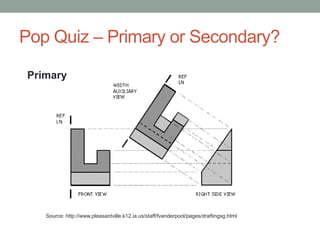
  extra ten points
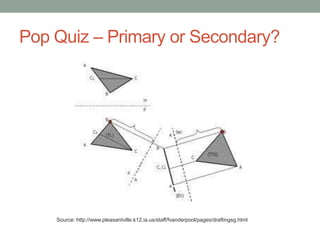
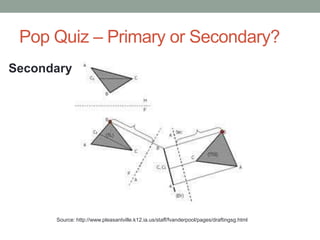
Why Your Instructor Can’t Win . . .
• Thank-you to all who filled out the mid-term survey.


• Don’t like the instructor showing drawing examples that
 are in the book

• Best / most helpful is the instructor explaining the
 examples in the book
Example Competencies
• Identify full sections
• Identify half sections
• Identify the hatch pattern for cast iron
• Create full section sketches of simple objects
• Create half section sketches of simple objects
New Groups!!
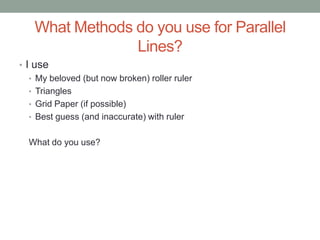
• We are going to mix up the groups in class today.
• Make a new group of 2 to 3 people composed of one
  person from each row.
• Make sure your new group is different than your new
  group was last week.
Homework Problem 3.1 (i)
• Raise your hand if you completed homework problem 3.1
  (i)
• If you didn’t complete this homework problem, partner up
  with someone who did.
• Work out the problem together in a pair or group
• Turn in the problem if you didn’t turn it in before for credit.
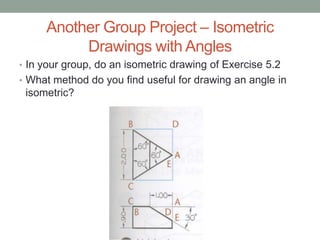
Another Group Project – Isometric
          Drawings with Angles
• In your group, do an isometric drawing of Exercise 5.2
• What method do you find useful for drawing an angle in
 isometric?
LINGERING QUESTIONS
  ABOUT CHAPTER 7 –
    SECTION VIEWS
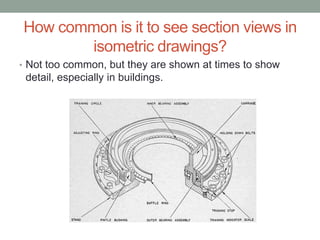
How common is it to see section views in
       isometric drawings?
• Not too common, but they are shown at times to show
 detail, especially in buildings.
How much artistic license can you take on
        a technical drawing?
• Depends on the purpose
  • Representative drawing . . . If you are just trying to create a quick
    sketch to work out details with a colleague, everything doesn’t have
    to be spot on.
  • Otherwise a technical drawing should not be ā€œtoo artisticā€ and
    should be accurate (especially angles and dimensions) to ensure
    that it will be built correctly.
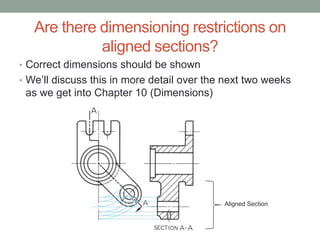
Are there dimensioning restrictions on
             aligned sections?
• Correct dimensions should be shown
• We’ll discuss this in more detail over the next two weeks
 as we get into Chapter 10 (Dimensions)


                                            Aligned Section
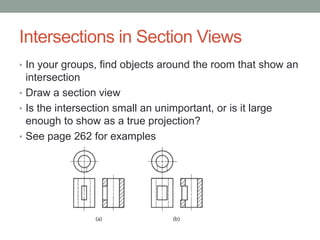
Intersections in Section Views
• In your groups, find objects around the room that show an
  intersection
• Draw a section view
• Is the intersection small an unimportant, or is it large
  enough to show as a true projection?
• See page 262 for examples
CHAPTER 8 –
AUXILIARY VIEWS
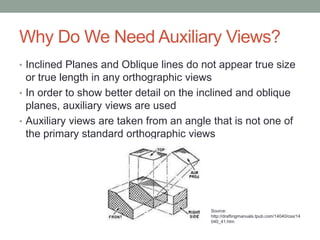
Why Do We Need Auxiliary Views?
• Inclined Planes and Oblique lines do not appear true size
  or true length in any orthographic views
• In order to show better detail on the inclined and oblique
  planes, auxiliary views are used
• Auxiliary views are taken from an angle that is not one of
  the primary standard orthographic views


                                          Source:
                                          http://draftingmanuals.tpub.com/14040/css/14
                                          040_41.htm
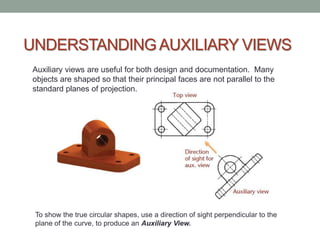
UNDERSTANDING AUXILIARY VIEWS
Auxiliary views are useful for both design and documentation. Many
objects are shaped so that their principal faces are not parallel to the
standard planes of projection.


 To show the true circular shapes, use a direction of sight perpendicular to the
 plane of the curve, to produce an Auxiliary View.
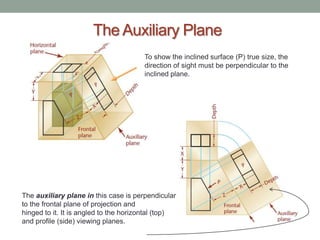
The Auxiliary Plane
                                       To show the inclined surface (P) true size, the
                                       direction of sight must be perpendicular to the
                                       inclined plane.


The auxiliary plane in this case is perpendicular
to the frontal plane of projection and
hinged to it. It is angled to the horizontal (top)
and profile (side) viewing planes.
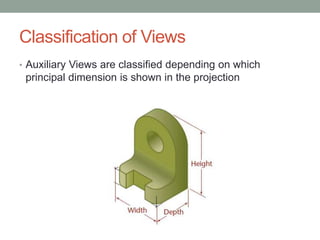
Classification of Views
• Auxiliary Views are classified depending on which
 principal dimension is shown in the projection
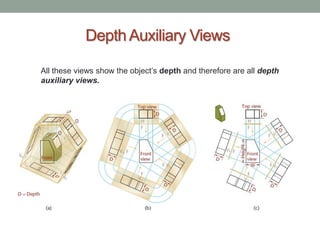
Depth Auxiliary Views

All these views show the object’s depth and therefore are all depth
auxiliary views.
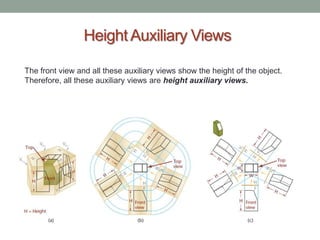
Height Auxiliary Views

The front view and all these auxiliary views show the height of the object.
Therefore, all these auxiliary views are height auxiliary views.
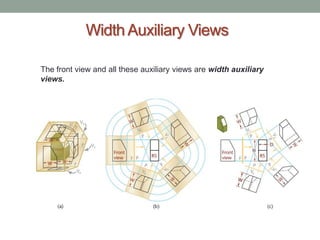
Width Auxiliary Views

The front view and all these auxiliary views are width auxiliary
views.
Group Project – Classify Auxiliary Views
• Draw the necessary views of a simple object with an
  inclined or an oblique surface
• Create a simple auxiliary view
• Classify your view as a depth, height, or width view
• Revolve your object and practice drawing the other two
  types of auxiliary views
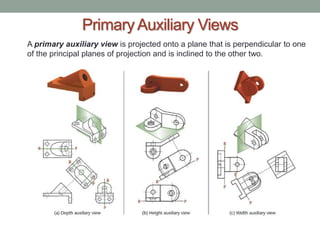
Primary Auxiliary Views
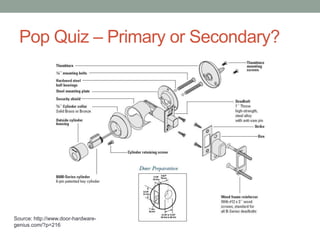
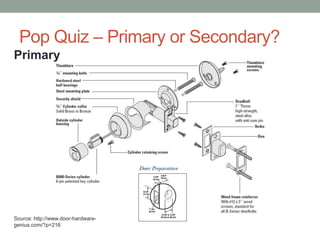
A primary auxiliary view is projected onto a plane that is perpendicular to one
of the principal planes of projection and is inclined to the other two.
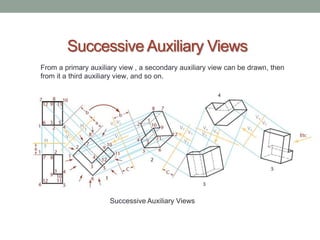
Successive Auxiliary Views
From a primary auxiliary view , a secondary auxiliary view can be drawn, then
from it a third auxiliary view, and so on.


                     Successive Auxiliary Views
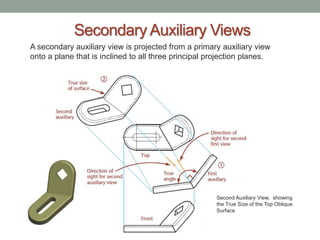
Secondary Auxiliary Views
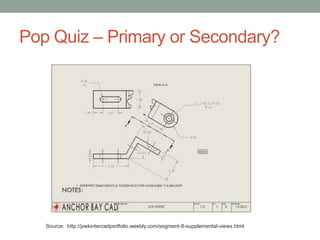
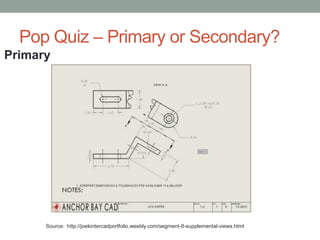
A secondary auxiliary view is projected from a primary auxiliary view
onto a plane that is inclined to all three principal projection planes.


                                                       Second Auxiliary View, showing
                                                       the True Size of the Top Oblique
                                                       Surface
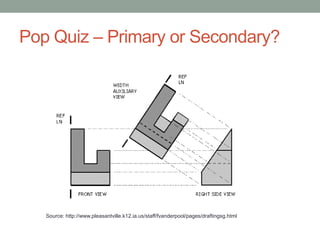
Pop Quiz – Primary or Secondary?


   Source: http://www.pleasantville.k12.ia.us/staff/fvanderpool/pages/draftingsg.html
Pop Quiz – Primary or Secondary?

Primary


   Source: http://www.pleasantville.k12.ia.us/staff/fvanderpool/pages/draftingsg.html
Pop Quiz – Primary or Secondary?


    Source: http://www.pleasantville.k12.ia.us/staff/fvanderpool/pages/draftingsg.html
Pop Quiz – Primary or Secondary?
Secondary


      Source: http://www.pleasantville.k12.ia.us/staff/fvanderpool/pages/draftingsg.html
Pop Quiz – Primary or Secondary?


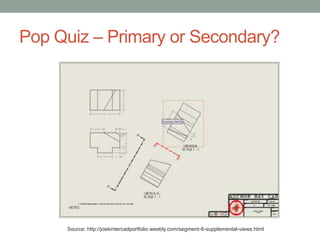
     Source: http://joekintercadportfolio.weebly.com/segment-8-supplemental-views.html
Pop Quiz – Primary or Secondary?
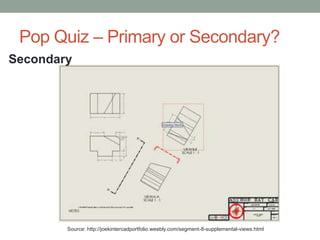
Secondary


        Source: http://joekintercadportfolio.weebly.com/segment-8-supplemental-views.html
Pop Quiz – Primary or Secondary?


   Source: http://joekintercadportfolio.weebly.com/segment-8-supplemental-views.html
Pop Quiz – Primary or Secondary?
Primary


      Source: http://joekintercadportfolio.weebly.com/segment-8-supplemental-views.html
Pop Quiz – Primary or Secondary?


Source: http://www.door-hardware-
genius.com/?p=216
Pop Quiz – Primary or Secondary?
Primary


Source: http://www.door-hardware-
genius.com/?p=216
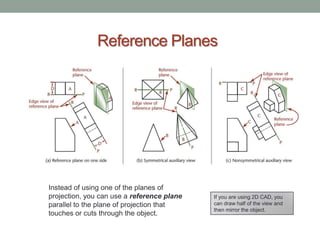
Reference Planes


Instead of using one of the planes of
projection, you can use a reference plane   If you are using 2D CAD, you
parallel to the plane of projection that    can draw half of the view and
                                            then mirror the object.
touches or cuts through the object.
What Methods do you use for Parallel
                 Lines?
• I use
   • My beloved (but now broken) roller ruler
   • Triangles
   • Grid Paper (if possible)
   • Best guess (and inaccurate) with ruler


  What do you use?
Projecting an Auxiliary View
• Let’s practice using a reference plane to draw an auxiliary
  view.
• Practice with the Example on page 286 of the text book
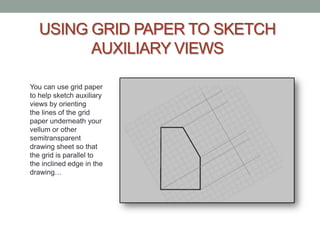
USING GRID PAPER TO SKETCH
         AUXILIARY VIEWS

You can use grid paper
to help sketch auxiliary
views by orienting
the lines of the grid
paper underneath your
vellum or other
semitransparent
drawing sheet so that
the grid is parallel to
the inclined edge in the
drawing…
Group Project – Auxiliary View of an
            Inclined Surface

• Use an inclined surface that you have brought to class,
 one that you see around the classroom, or one that I have
 to create a drawing with necessary views and an auxiliary
 view using a reference plane or the grid paper method
Project Time!
• Share your projects with your group.
• Discuss whether an auxiliary view is necessary for your
  project
• Rough sketch the auxiliary view
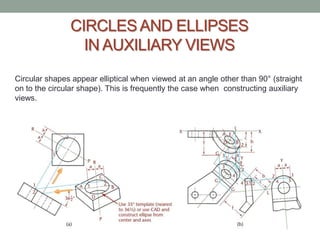
CIRCLES AND ELLIPSES
                 IN AUXILIARY VIEWS
Circular shapes appear elliptical when viewed at an angle other than 90° (straight
on to the circular shape). This is frequently the case when constructing auxiliary
views.
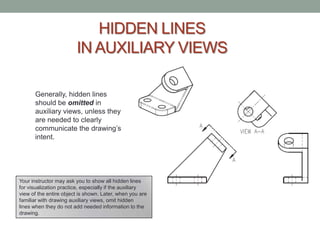
HIDDEN LINES
                        IN AUXILIARY VIEWS

      Generally, hidden lines
      should be omitted in
      auxiliary views, unless they
      are needed to clearly
      communicate the drawing’s
      intent.


Your instructor may ask you to show all hidden lines
for visualization practice, especially if the auxiliary
view of the entire object is shown. Later, when you are
familiar with drawing auxiliary views, omit hidden
lines when they do not add needed information to the
drawing.
Plotting Curves in an Auxiliary View
• Let’s practice plotting curves to draw in an auxiliary view.


• Practice with the Example on page 290 of the text book
Group Project – Plotting Curves
• Use an object in the room or make up the necessary
  views of a curved object.
• Draw a curved auxiliary view
Auxiliary Views on Youtube
• http://www.youtube.com/watch?v=gzq48vBbODg
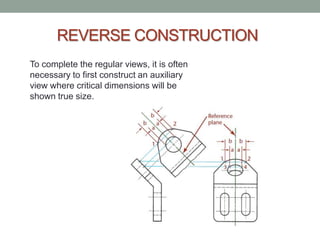
REVERSE CONSTRUCTION
To complete the regular views, it is often
necessary to first construct an auxiliary
view where critical dimensions will be
shown true size.
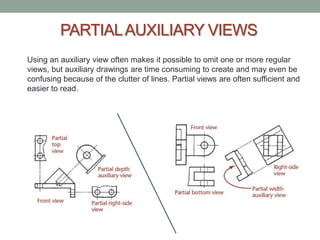
PARTIAL AUXILIARY VIEWS
Using an auxiliary view often makes it possible to omit one or more regular
views, but auxiliary drawings are time consuming to create and may even be
confusing because of the clutter of lines. Partial views are often sufficient and
easier to read.
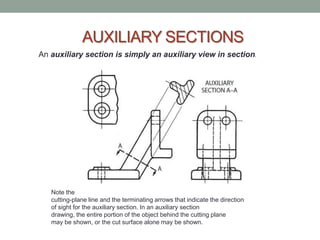
AUXILIARY SECTIONS
An auxiliary section is simply an auxiliary view in section.


   Note the
   cutting-plane line and the terminating arrows that indicate the direction
   of sight for the auxiliary section. In an auxiliary section
   drawing, the entire portion of the object behind the cutting plane
   may be shown, or the cut surface alone may be shown.
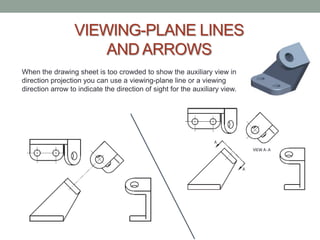
VIEWING-PLANE LINES
                      AND ARROWS
When the drawing sheet is too crowded to show the auxiliary view in
direction projection you can use a viewing-plane line or a viewing
direction arrow to indicate the direction of sight for the auxiliary view.
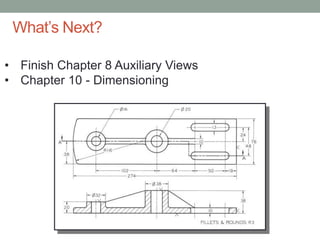
What’s Next?

• Finish Chapter 8 Auxiliary Views
• Chapter 10 - Dimensioning
Questions?
• On one of your sketches, answer the following
 two questions:
  • What was the most useful thing that you
    learned today?
  • What do you still have questions about?
Homework
Read Chapter 10
Chapter 8 Review Questions: 1, 3, 4
Chapter 8 Exercises: 8.5 [Draw necessary views and
auxiliary view (s) ]

Class 12 presentation

  • 1.
    2D ESSENTIALS Instructor: LauraGerold, PE Catalog #10614113 Class # 22784, 24113, 24136, & 24138 Class Start: January 18, 2012 Class End: May 16, 2012
  • 2.
    Reminders • Final Projectis due on May 9th. • Final Exam is May 16th.
  • 3.
    Extra Credit #4 • For ten extra points, write a question for our upcoming final exam (final exam is in one month on May 16th ) • Question can be in any of the following formats • Question with a drawing/sketch for an answer • Essay Question • Fill in the blank question • True/False • Multiple Choice • Question can cover any topics we have covered in class since Exam 1 (Orthographic, Isometric, Section Views). Also can include Auxiliary Views and Dimensioning. • Please include your answer • Question & Answer are due in two weeks on May 2nd for extra ten points
  • 4.
    Why Your InstructorCan’t Win . . . • Thank-you to all who filled out the mid-term survey. • Don’t like the instructor showing drawing examples that are in the book • Best / most helpful is the instructor explaining the examples in the book
  • 5.
    Example Competencies • Identifyfull sections • Identify half sections • Identify the hatch pattern for cast iron • Create full section sketches of simple objects • Create half section sketches of simple objects
  • 6.
    New Groups!! • Weare going to mix up the groups in class today. • Make a new group of 2 to 3 people composed of one person from each row. • Make sure your new group is different than your new group was last week.
  • 7.
    Homework Problem 3.1(i) • Raise your hand if you completed homework problem 3.1 (i) • If you didn’t complete this homework problem, partner up with someone who did. • Work out the problem together in a pair or group • Turn in the problem if you didn’t turn it in before for credit.
  • 8.
    Another Group Project– Isometric Drawings with Angles • In your group, do an isometric drawing of Exercise 5.2 • What method do you find useful for drawing an angle in isometric?
  • 9.
    LINGERING QUESTIONS ABOUT CHAPTER 7 – SECTION VIEWS
  • 10.
    How common isit to see section views in isometric drawings? • Not too common, but they are shown at times to show detail, especially in buildings.
  • 11.
    How much artisticlicense can you take on a technical drawing? • Depends on the purpose • Representative drawing . . . If you are just trying to create a quick sketch to work out details with a colleague, everything doesn’t have to be spot on. • Otherwise a technical drawing should not be ā€œtoo artisticā€ and should be accurate (especially angles and dimensions) to ensure that it will be built correctly.
  • 12.
    Are there dimensioningrestrictions on aligned sections? • Correct dimensions should be shown • We’ll discuss this in more detail over the next two weeks as we get into Chapter 10 (Dimensions) Aligned Section
  • 13.
    Intersections in SectionViews • In your groups, find objects around the room that show an intersection • Draw a section view • Is the intersection small an unimportant, or is it large enough to show as a true projection? • See page 262 for examples
  • 14.
  • 15.
    Why Do WeNeed Auxiliary Views? • Inclined Planes and Oblique lines do not appear true size or true length in any orthographic views • In order to show better detail on the inclined and oblique planes, auxiliary views are used • Auxiliary views are taken from an angle that is not one of the primary standard orthographic views Source: http://draftingmanuals.tpub.com/14040/css/14 040_41.htm
  • 16.
    UNDERSTANDING AUXILIARY VIEWS Auxiliaryviews are useful for both design and documentation. Many objects are shaped so that their principal faces are not parallel to the standard planes of projection. To show the true circular shapes, use a direction of sight perpendicular to the plane of the curve, to produce an Auxiliary View.
  • 17.
    The Auxiliary Plane To show the inclined surface (P) true size, the direction of sight must be perpendicular to the inclined plane. The auxiliary plane in this case is perpendicular to the frontal plane of projection and hinged to it. It is angled to the horizontal (top) and profile (side) viewing planes.
  • 18.
    Classification of Views •Auxiliary Views are classified depending on which principal dimension is shown in the projection
  • 19.
    Depth Auxiliary Views Allthese views show the object’s depth and therefore are all depth auxiliary views.
  • 20.
    Height Auxiliary Views Thefront view and all these auxiliary views show the height of the object. Therefore, all these auxiliary views are height auxiliary views.
  • 21.
    Width Auxiliary Views Thefront view and all these auxiliary views are width auxiliary views.
  • 22.
    Group Project –Classify Auxiliary Views • Draw the necessary views of a simple object with an inclined or an oblique surface • Create a simple auxiliary view • Classify your view as a depth, height, or width view • Revolve your object and practice drawing the other two types of auxiliary views
  • 23.
    Primary Auxiliary Views Aprimary auxiliary view is projected onto a plane that is perpendicular to one of the principal planes of projection and is inclined to the other two.
  • 24.
    Successive Auxiliary Views Froma primary auxiliary view , a secondary auxiliary view can be drawn, then from it a third auxiliary view, and so on. Successive Auxiliary Views
  • 25.
    Secondary Auxiliary Views Asecondary auxiliary view is projected from a primary auxiliary view onto a plane that is inclined to all three principal projection planes. Second Auxiliary View, showing the True Size of the Top Oblique Surface
  • 26.
    Pop Quiz –Primary or Secondary? Source: http://www.pleasantville.k12.ia.us/staff/fvanderpool/pages/draftingsg.html
  • 27.
    Pop Quiz –Primary or Secondary? Primary Source: http://www.pleasantville.k12.ia.us/staff/fvanderpool/pages/draftingsg.html
  • 28.
    Pop Quiz –Primary or Secondary? Source: http://www.pleasantville.k12.ia.us/staff/fvanderpool/pages/draftingsg.html
  • 29.
    Pop Quiz –Primary or Secondary? Secondary Source: http://www.pleasantville.k12.ia.us/staff/fvanderpool/pages/draftingsg.html
  • 30.
    Pop Quiz –Primary or Secondary? Source: http://joekintercadportfolio.weebly.com/segment-8-supplemental-views.html
  • 31.
    Pop Quiz –Primary or Secondary? Secondary Source: http://joekintercadportfolio.weebly.com/segment-8-supplemental-views.html
  • 32.
    Pop Quiz –Primary or Secondary? Source: http://joekintercadportfolio.weebly.com/segment-8-supplemental-views.html
  • 33.
    Pop Quiz –Primary or Secondary? Primary Source: http://joekintercadportfolio.weebly.com/segment-8-supplemental-views.html
  • 34.
    Pop Quiz –Primary or Secondary? Source: http://www.door-hardware- genius.com/?p=216
  • 35.
    Pop Quiz –Primary or Secondary? Primary Source: http://www.door-hardware- genius.com/?p=216
  • 36.
    Reference Planes Instead ofusing one of the planes of projection, you can use a reference plane If you are using 2D CAD, you parallel to the plane of projection that can draw half of the view and then mirror the object. touches or cuts through the object.
  • 37.
    What Methods doyou use for Parallel Lines? • I use • My beloved (but now broken) roller ruler • Triangles • Grid Paper (if possible) • Best guess (and inaccurate) with ruler What do you use?
  • 38.
    Projecting an AuxiliaryView • Let’s practice using a reference plane to draw an auxiliary view. • Practice with the Example on page 286 of the text book
  • 39.
    USING GRID PAPERTO SKETCH AUXILIARY VIEWS You can use grid paper to help sketch auxiliary views by orienting the lines of the grid paper underneath your vellum or other semitransparent drawing sheet so that the grid is parallel to the inclined edge in the drawing…
  • 40.
    Group Project –Auxiliary View of an Inclined Surface • Use an inclined surface that you have brought to class, one that you see around the classroom, or one that I have to create a drawing with necessary views and an auxiliary view using a reference plane or the grid paper method
  • 41.
    Project Time! • Shareyour projects with your group. • Discuss whether an auxiliary view is necessary for your project • Rough sketch the auxiliary view
  • 42.
    CIRCLES AND ELLIPSES IN AUXILIARY VIEWS Circular shapes appear elliptical when viewed at an angle other than 90° (straight on to the circular shape). This is frequently the case when constructing auxiliary views.
  • 43.
    HIDDEN LINES IN AUXILIARY VIEWS Generally, hidden lines should be omitted in auxiliary views, unless they are needed to clearly communicate the drawing’s intent. Your instructor may ask you to show all hidden lines for visualization practice, especially if the auxiliary view of the entire object is shown. Later, when you are familiar with drawing auxiliary views, omit hidden lines when they do not add needed information to the drawing.
  • 44.
    Plotting Curves inan Auxiliary View • Let’s practice plotting curves to draw in an auxiliary view. • Practice with the Example on page 290 of the text book
  • 45.
    Group Project –Plotting Curves • Use an object in the room or make up the necessary views of a curved object. • Draw a curved auxiliary view
  • 46.
    Auxiliary Views onYoutube • http://www.youtube.com/watch?v=gzq48vBbODg
  • 47.
    REVERSE CONSTRUCTION To completethe regular views, it is often necessary to first construct an auxiliary view where critical dimensions will be shown true size.
  • 48.
    PARTIAL AUXILIARY VIEWS Usingan auxiliary view often makes it possible to omit one or more regular views, but auxiliary drawings are time consuming to create and may even be confusing because of the clutter of lines. Partial views are often sufficient and easier to read.
  • 49.
    AUXILIARY SECTIONS An auxiliarysection is simply an auxiliary view in section. Note the cutting-plane line and the terminating arrows that indicate the direction of sight for the auxiliary section. In an auxiliary section drawing, the entire portion of the object behind the cutting plane may be shown, or the cut surface alone may be shown.
  • 50.
    VIEWING-PLANE LINES AND ARROWS When the drawing sheet is too crowded to show the auxiliary view in direction projection you can use a viewing-plane line or a viewing direction arrow to indicate the direction of sight for the auxiliary view.
  • 51.
    What’s Next? • FinishChapter 8 Auxiliary Views • Chapter 10 - Dimensioning
  • 52.
    Questions? • On oneof your sketches, answer the following two questions: • What was the most useful thing that you learned today? • What do you still have questions about?
  • 53.
    Homework Read Chapter 10 Chapter8 Review Questions: 1, 3, 4 Chapter 8 Exercises: 8.5 [Draw necessary views and auxiliary view (s) ]