Auxiliary Views
What are they and why should we care?
What is an Auxiliary view?
 An auxiliary view is an orthographic view
taken in such a manner that the lines of sight
are not parallel to the principal projection
planes (frontal, horizontal, or profile). There
are an infinite number of possible auxiliary
views of any given object.
 In other words: An auxiliary view is an
orthographic view which is projected onto any
plane other than the frontal, horizontal, or
profile plane. An auxiliary view is not one of
the six principal views.
What they are cont…
 There are times when one of the six principal
views will not completely describe an object.
 This is especially true when there are inclined
or oblique planes or features on an object.
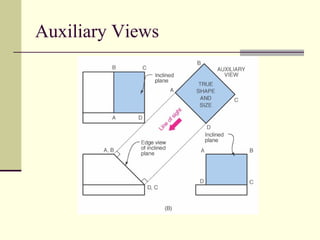
 For these cases, a special orthographic view
called an auxiliary view can be created.
Auxiliary Views
When should we use it?
 When creating engineering drawings, it is often
necessary to show features in a view where they
appear true size so that they can be dimensioned.
 The object is normally positioned such that the major
surfaces and features are either parallel or
perpendicular to the principal planes.
 Views are normally selected so that most of the
features will be visible in the three principal views.
 The front, top, and left or right side views are most
commonly drawn.
Cont.
 Many objects are quite complex, and the
three principal views may not best present the
geometry of the part. Certain features may
not appear true size and shape in those
views, or may be hidden. In this case one or
more auxiliary views typically are drawn.
Primary auxiliary views are projected off one
of the principal views. Secondary auxiliary
views are projected off a primary auxiliary
view.
Definitions
 Auxiliary View- additional view
 Revolution- revolved view
 Auxiliary section- used when cutting plane is
not parallel to any of the normal views
 Edge view- When a cutting plane appears as
an edge or line
 Oblique plane- one that is inclined to all three
normal planes
Classifications:
Auxiliary views are created by positioning a new line of
sight relative to the object. It is possible to create any
number of auxiliary views, including a new auxiliary
view from an existing auxiliary view.
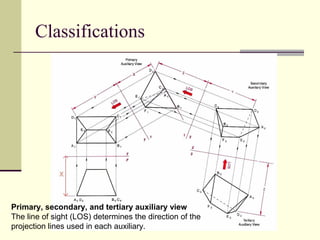
 A primary auxiliary view is a single view projected
from one of the six principal views.
 A secondary auxiliary view is a single view
projected from a primary auxiliary view.
 A tertiary auxiliary view is a single view projected
from a secondary or another tertiary auxiliary view.
Classifications
Primary, secondary, and tertiary auxiliary view
The line of sight (LOS) determines the direction of the
projection lines used in each auxiliary.
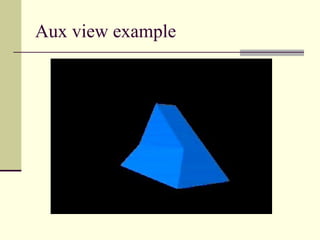
Aux view example
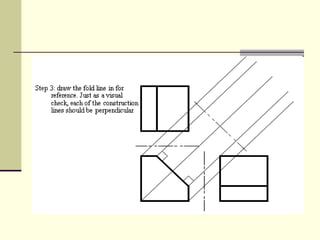
Fold line method:
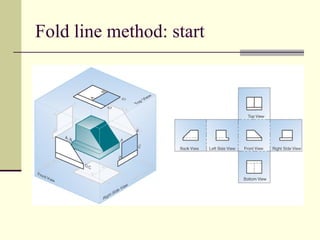
 In fold-line method, the object is suspended
in a glass box to show the six principal views,
created by projecting the object onto the
planes of the box.
 The box is then unfolded, resulting in the six
principal views. However, when the six views
are created, surface ABCD never appears
true size and shape; it always appears either
foreshortened or on edge.
Fold line method: start
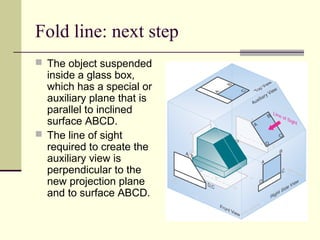
Fold line: next step
 The object suspended
inside a glass box,
which has a special or
auxiliary plane that is
parallel to inclined
surface ABCD.
 The line of sight
required to create the
auxiliary view is
perpendicular to the
new projection plane
and to surface ABCD.
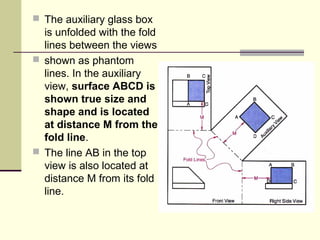
 The auxiliary glass box
is unfolded with the fold
lines between the views
 shown as phantom
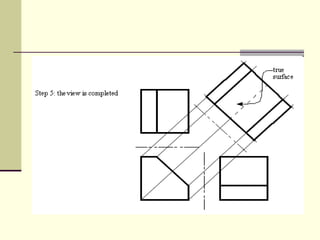
lines. In the auxiliary
view, surface ABCD is
shown true size and
shape and is located
at distance M from the
fold line.
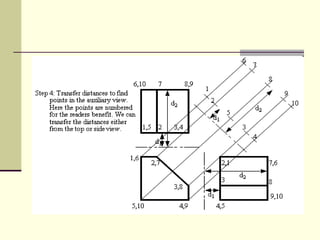
 The line AB in the top
view is also located at
distance M from its fold
line.
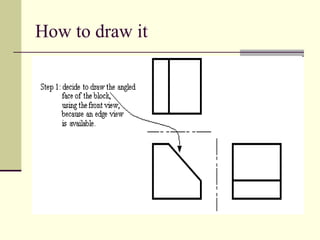
How to draw it
Secondary Aux view
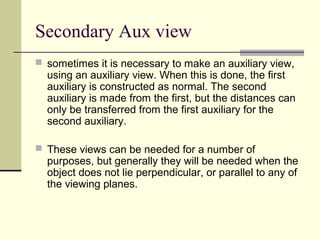
 sometimes it is necessary to make an auxiliary view,
using an auxiliary view. When this is done, the first
auxiliary is constructed as normal. The second
auxiliary is made from the first, but the distances can
only be transferred from the first auxiliary for the
second auxiliary.
 These views can be needed for a number of
purposes, but generally they will be needed when the
object does not lie perpendicular, or parallel to any of
the viewing planes.
Partial Aux views
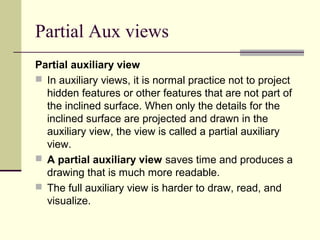
Partial auxiliary view
 In auxiliary views, it is normal practice not to project
hidden features or other features that are not part of
the inclined surface. When only the details for the
inclined surface are projected and drawn in the
auxiliary view, the view is called a partial auxiliary
view.
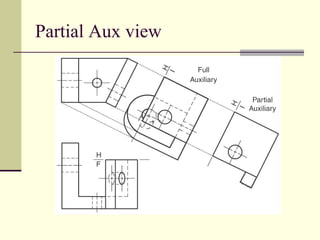
 A partial auxiliary view saves time and produces a
drawing that is much more readable.
 The full auxiliary view is harder to draw, read, and
visualize.
Partial Aux view
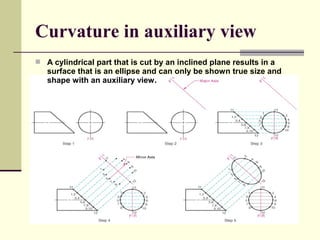
Curvature in auxiliary view
 A cylindrical part that is cut by an inclined plane results in a
surface that is an ellipse and can only be shown true size and
shape with an auxiliary view.
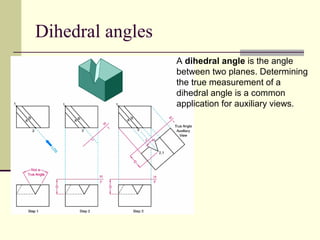
Dihedral angles
A dihedral angle is the angle
between two planes. Determining
the true measurement of a
dihedral angle is a common
application for auxiliary views.
Constructing successive auxiliary views to
determine the true size of an oblique
surfaces.
SUMMARY
 Auxiliary views are a type of orthographic projection
used to determine the true size and shape of inclined
and oblique surfaces of objects.
 Normally, auxiliary views are projected from existing
principal views.
 However, auxiliary views can also be drawn first and
then used to create a principal view. This is done
when a true measurement can only be obtained by
an auxiliary view and that measurement is needed in
order to create a principal view. This technique is
called reverse construction.
 Any number of auxiliary views of an object can be
created. Successive auxiliary views can be created
by projecting from an existing auxiliary view.

Auxiliary views

  • 1.
    Auxiliary Views What arethey and why should we care?
  • 2.
    What is anAuxiliary view?  An auxiliary view is an orthographic view taken in such a manner that the lines of sight are not parallel to the principal projection planes (frontal, horizontal, or profile). There are an infinite number of possible auxiliary views of any given object.  In other words: An auxiliary view is an orthographic view which is projected onto any plane other than the frontal, horizontal, or profile plane. An auxiliary view is not one of the six principal views.
  • 3.
    What they arecont…  There are times when one of the six principal views will not completely describe an object.  This is especially true when there are inclined or oblique planes or features on an object.  For these cases, a special orthographic view called an auxiliary view can be created.
  • 4.
  • 5.
    When should weuse it?  When creating engineering drawings, it is often necessary to show features in a view where they appear true size so that they can be dimensioned.  The object is normally positioned such that the major surfaces and features are either parallel or perpendicular to the principal planes.  Views are normally selected so that most of the features will be visible in the three principal views.  The front, top, and left or right side views are most commonly drawn.
  • 6.
    Cont.  Many objectsare quite complex, and the three principal views may not best present the geometry of the part. Certain features may not appear true size and shape in those views, or may be hidden. In this case one or more auxiliary views typically are drawn. Primary auxiliary views are projected off one of the principal views. Secondary auxiliary views are projected off a primary auxiliary view.
  • 7.
    Definitions  Auxiliary View-additional view  Revolution- revolved view  Auxiliary section- used when cutting plane is not parallel to any of the normal views  Edge view- When a cutting plane appears as an edge or line  Oblique plane- one that is inclined to all three normal planes
  • 8.
    Classifications: Auxiliary views arecreated by positioning a new line of sight relative to the object. It is possible to create any number of auxiliary views, including a new auxiliary view from an existing auxiliary view.  A primary auxiliary view is a single view projected from one of the six principal views.  A secondary auxiliary view is a single view projected from a primary auxiliary view.  A tertiary auxiliary view is a single view projected from a secondary or another tertiary auxiliary view.
  • 9.
    Classifications Primary, secondary, andtertiary auxiliary view The line of sight (LOS) determines the direction of the projection lines used in each auxiliary.
  • 10.
  • 11.
    Fold line method: In fold-line method, the object is suspended in a glass box to show the six principal views, created by projecting the object onto the planes of the box.  The box is then unfolded, resulting in the six principal views. However, when the six views are created, surface ABCD never appears true size and shape; it always appears either foreshortened or on edge.
  • 12.
  • 13.
    Fold line: nextstep  The object suspended inside a glass box, which has a special or auxiliary plane that is parallel to inclined surface ABCD.  The line of sight required to create the auxiliary view is perpendicular to the new projection plane and to surface ABCD.
  • 14.
     The auxiliaryglass box is unfolded with the fold lines between the views  shown as phantom lines. In the auxiliary view, surface ABCD is shown true size and shape and is located at distance M from the fold line.  The line AB in the top view is also located at distance M from its fold line.
  • 15.
  • 20.
    Secondary Aux view sometimes it is necessary to make an auxiliary view, using an auxiliary view. When this is done, the first auxiliary is constructed as normal. The second auxiliary is made from the first, but the distances can only be transferred from the first auxiliary for the second auxiliary.  These views can be needed for a number of purposes, but generally they will be needed when the object does not lie perpendicular, or parallel to any of the viewing planes.
  • 21.
    Partial Aux views Partialauxiliary view  In auxiliary views, it is normal practice not to project hidden features or other features that are not part of the inclined surface. When only the details for the inclined surface are projected and drawn in the auxiliary view, the view is called a partial auxiliary view.  A partial auxiliary view saves time and produces a drawing that is much more readable.  The full auxiliary view is harder to draw, read, and visualize.
  • 22.
  • 23.
    Curvature in auxiliaryview  A cylindrical part that is cut by an inclined plane results in a surface that is an ellipse and can only be shown true size and shape with an auxiliary view.
  • 24.
    Dihedral angles A dihedralangle is the angle between two planes. Determining the true measurement of a dihedral angle is a common application for auxiliary views.
  • 25.
    Constructing successive auxiliaryviews to determine the true size of an oblique surfaces.
  • 26.
    SUMMARY  Auxiliary viewsare a type of orthographic projection used to determine the true size and shape of inclined and oblique surfaces of objects.  Normally, auxiliary views are projected from existing principal views.  However, auxiliary views can also be drawn first and then used to create a principal view. This is done when a true measurement can only be obtained by an auxiliary view and that measurement is needed in order to create a principal view. This technique is called reverse construction.  Any number of auxiliary views of an object can be created. Successive auxiliary views can be created by projecting from an existing auxiliary view.