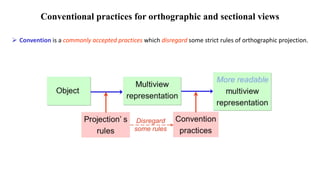
Conventional practices for orthographic and sectional views
 Convention is a commonly accepted practices which disregard some strict rules of orthographic projection.
PURPOSES
 To improve the clarity of a drawing.
 To facilitate the dimensioning.
 To reduce the drafting effort.
 To save or efficiently use a drawing space.
CONVENTION PRACTICE FOR ORTHOGRAPHIC VIEWS
1. Incompleted views
• Incompleted side view
• Partial view
• Half view
• Local view
Incompleted side views are side views that are eliminated a feature
that can not clearly seen from a selected viewing direction.
Principal view
Difficult to read and to dimension.
Left-side view Right-side view
Details are interfered by those
on the opposite view.
Example : Strictly orthographic projection.
Example : Incompleted side views
Incompleted
left-side view
Incompleted
right-side view
Principal view
Better describe an object and
facilitate dimensioning.
Partial view is a view that represents portions of the part that
have a features need to clarify.
Half view is a partial view that is illustrated only half of the part.
Local view is a view that shows only features need to clarify.
Clearly seen
a shape.
Example : Partial view
Symmetry symbol
Left half Right half
Thin line
(4H)
Center line acts as a
line of symmetry.
No continuous line !
Example : Half view
Half view can be made by drawing the views
slightly beyond the line of symmetry.
No symmetry
symbol.
It is allow for writing
a break line.
In this course, we
omit the break line.
Example : Half view : alternative representation
Thin line
(4H)
Example : Half view : two symmetry axes
Example : Local view
Shape of the
slot is completely
shown.
R6
7
Easy for
dimensioning
2. Align view
Align view is a view that is drawn by
imaginarily rotating the object’s features,
appeared in a principle view about
symmetry axis.
Example : Necessity of align view
Waste of time
Confuse
Apply
convention
Clear
Strictly Projection
CONVENTION PRACTICE
For an object that has symmetrical positioned
features, it is advisable to show them on adjacent
view in true size at true radial distance from the
symmetry axis.
Example : Align view of holes
Gives the impression that there
is a hole at the center of the plate.
Given
Apply
aligned
convention
Example : Align view of holes
Given
Gives the impression that holes
are at unsymmetrical position.
Apply
aligned
convention
Example : Align view of holes
Apply
aligned
convention
TERMINOLOGY
Rib and Web are thin, flat feature of an object that acts
as a structural support.
Rib Rib
Web
Rim
Spoke is the rod radiating from the hub to the rim of a
wheel.
Spoke
Spoke
Rim
Hub
TERMINOLOGY
Hub
Lug is an ear which is built as portion of an object for
attachment.
TERMINOLOGY
Lug is an ear which is built as portion of an object for
attachment.
TERMINOLOGY
Example :
Example : Align view of ribs
Apply
aligned
convention
Example : Align view of ribs & holes
Apply
aligned
convention
Example : Align view of ribs & holes & keyway
Make Orthographic Projection
Apply Convention
3. NON-EXISTING LINE OF INTERSECTION
Non-existing line of intersection is the line of intersecting surfaces that are eliminated
by fillets and rounds.
Example of a non-filleted pole (left) and a filleted pole (right)
Conventional practice
When true projection mislead the representation of an
object, it is necessary to show the additional lines that
are projected from the actual intersection of the
surfaces as if the fillets and rounds were not present.
Example : Non-existing line of intersection
Object does not has
rounds and fillets
Edges of the surfaces
are shown as lines in
the top view.
Example : Non-existing line of intersection
The view looks like a plate
with a hole !!
Object has
rounds and fillets
No edge !
(No intersection between surfaces)
Convention practice required !
Construct a non-existing line of
intersection.
Example : Non-existing line of intersection
4. INTERSECTION BETWEEN
FILLET AND ROUND
Runout
Tangent point
TO DRAW A RUNOUT
about 1/8 of circle
R
R/3
R = radius of fillet or round
R
HOLE IN CYLINDER
Large hole : True projection
HOLE IN CYLINDER
Large hole : True projection Small hole : Convention
Auxiliary view
Auxiliary view is needed when it is desirable to show the
true size and shape of a surface that is not parallel to
anyone of the principal planes of projection.
True size can not be observed
from these principal views.
Use of auxiliary view
In practice, an auxiliary view is usually a partial view
showing only the desired information.
Example
d
d
d
d
Complete view Partial view
Types of an auxiliary view
Primary auxiliary views may be classified into 3 types
by their relative to the principal views.
1. Adjacent to front view
2. Adjacent to top view
3. Adjacent to side view
Width & Height
&
True length
of edge view
Width
&
Depth
Height
&
Depth
Auxiliary view adjacent to front view
Glass box and revolution View arrangement
True size
of an inclined plane
Example 1
Do you remember?
Depth dimension of the auxiliary view
can be read from top view or side view.
Auxiliary
plane
Hidden lines of the holes
are omitted for clarity.
Start
Reference
line
A
C
D B
Prefer
distance
A
B
C
D
Example 2
Width
&
Height
Height
&
Depth
Auxiliary view adjacent to top view
Glass box and revolution
Width & Depth
&
True length
of edge view
True size
of an inclined plane
View arrangement
Width
&
Height
Auxiliary view adjacent to side view
Glass box and revolution
Width
&
Depth
True size
of an
inclined plane
View arrangement
Height & Depth
&
True length
of edge view
Example 4
Reference
line
Start
Prefer
distance
A
B
C
A
B
C
CONVENTIONAL PRACTICES IN SECTIONAL VIEWS
Omit the section lines on the section view of
 Rib, Web and Lug, if the cutting plane is
passed flatwise through.
 Spoke, if the cutting plane is passed longwise
through.
EXAMPLE : RIB
Normal multiview drawing
Normal section view
Section view drawing with
convention
EXAMPLE : WEB : flatwise cut
Normal multiview drawing
Normal section view
Section view drawing with
convention
EXAMPLE : WEB : crosswise cut
EXAMPLE : WEB : multiple section view
EXAMPLE : SPOKE
Misleading impression
EXAMPLE : LUG
Aligned Section
DEFINITION
Aligned section is a section view that is drawn
by imaginary rotating the object’s features
appeared in a principal view about symmetry
axis
Example : Hole
Gives the impression that this holes
are at unsymmetrical position.
Example : Hole
Example : Rib
Example : Ribs & Holes
Example : Aligned section of keyway
Example : Spoke & Keyway
Example : Lug
Conventional Break
CONVENTIONAL PRACTICE
For long objects that have to draw in a small scale to
fit them on the paper, it is recommended to remove
its long portion (which contains no important
information) and draw the break lines at the broken
ends.
SCALE 1:1
Example
Example
SCALE 2:1
STANDARD BREAK LINES
Rectangular
cross section
Wood
Metal
Cylindrical
cross section
Tubular
cross section
TO DRAW CYLINDRICAL BREAK
R
R/3 R/3
30o
30o
800
TO DIMENSION A BROKEN PART
Typical
dimensioning
method
f16
not to scale dimensions
f16
800
Broken Section
 In some objects when some important interior detail must be shown, but due to the important exterior features, that
has to be shown, a full or half section is not feasible, showing a broken section is used as an alternative
 The view is made by passing the cutting plane normal to the viewing direction and removing the portion of an object
in front of it.
OFFSET SECTIONS
In sectioning complex objects, it is often desirable to show features that do not lie in a
straight line by “offsetting” or bending the cutting plane. These are called offset sections.
Note the offset cutting plane line
ALIGNED SECTIONS
When parts with angled elements are sectioned, the cutting plane may be
bent to pass through those features. The plane and features are then
imagined to be revolved into the original plane.
Aligned Section
The angle of revolution should
always be less than 90° for
an aligned section.
ASSEMBLY SECTIONS
Section views are often used to create assembly drawings.
Notice that the hatching on different parts has different
hatch patterns or hatch at different angles. When used on
the same part, the hatching is always at the same angle
to help you recognize the parts easily.
 The purpose of an assembly section is to reveal the interior of a machine or structure so that the
separate parts can be clearly shown and identified. However, the separate parts do not need to be
completely described.
Chapter 1
Chapter 1
Chapter 1
Chapter 1

Chapter 1

  • 1.
    Conventional practices fororthographic and sectional views  Convention is a commonly accepted practices which disregard some strict rules of orthographic projection.
  • 2.
    PURPOSES  To improvethe clarity of a drawing.  To facilitate the dimensioning.  To reduce the drafting effort.  To save or efficiently use a drawing space. CONVENTION PRACTICE FOR ORTHOGRAPHIC VIEWS 1. Incompleted views • Incompleted side view • Partial view • Half view • Local view Incompleted side views are side views that are eliminated a feature that can not clearly seen from a selected viewing direction.
  • 3.
    Principal view Difficult toread and to dimension. Left-side view Right-side view Details are interfered by those on the opposite view. Example : Strictly orthographic projection.
  • 4.
    Example : Incompletedside views Incompleted left-side view Incompleted right-side view Principal view Better describe an object and facilitate dimensioning.
  • 5.
    Partial view isa view that represents portions of the part that have a features need to clarify. Half view is a partial view that is illustrated only half of the part. Local view is a view that shows only features need to clarify.
  • 6.
  • 7.
    Symmetry symbol Left halfRight half Thin line (4H) Center line acts as a line of symmetry. No continuous line ! Example : Half view
  • 8.
    Half view canbe made by drawing the views slightly beyond the line of symmetry. No symmetry symbol. It is allow for writing a break line. In this course, we omit the break line. Example : Half view : alternative representation Thin line (4H)
  • 9.
    Example : Halfview : two symmetry axes
  • 10.
    Example : Localview Shape of the slot is completely shown. R6 7 Easy for dimensioning
  • 11.
    2. Align view Alignview is a view that is drawn by imaginarily rotating the object’s features, appeared in a principle view about symmetry axis.
  • 12.
    Example : Necessityof align view Waste of time Confuse Apply convention Clear Strictly Projection
  • 13.
    CONVENTION PRACTICE For anobject that has symmetrical positioned features, it is advisable to show them on adjacent view in true size at true radial distance from the symmetry axis.
  • 14.
    Example : Alignview of holes Gives the impression that there is a hole at the center of the plate. Given Apply aligned convention
  • 15.
    Example : Alignview of holes Given Gives the impression that holes are at unsymmetrical position. Apply aligned convention
  • 16.
    Example : Alignview of holes Apply aligned convention
  • 17.
    TERMINOLOGY Rib and Webare thin, flat feature of an object that acts as a structural support. Rib Rib Web
  • 18.
    Rim Spoke is therod radiating from the hub to the rim of a wheel. Spoke Spoke Rim Hub TERMINOLOGY Hub
  • 19.
    Lug is anear which is built as portion of an object for attachment. TERMINOLOGY
  • 20.
    Lug is anear which is built as portion of an object for attachment. TERMINOLOGY
  • 21.
    Example : Example :Align view of ribs Apply aligned convention
  • 22.
    Example : Alignview of ribs & holes Apply aligned convention
  • 23.
    Example : Alignview of ribs & holes & keyway Make Orthographic Projection Apply Convention
  • 24.
    3. NON-EXISTING LINEOF INTERSECTION Non-existing line of intersection is the line of intersecting surfaces that are eliminated by fillets and rounds. Example of a non-filleted pole (left) and a filleted pole (right) Conventional practice When true projection mislead the representation of an object, it is necessary to show the additional lines that are projected from the actual intersection of the surfaces as if the fillets and rounds were not present.
  • 25.
    Example : Non-existingline of intersection Object does not has rounds and fillets Edges of the surfaces are shown as lines in the top view.
  • 26.
    Example : Non-existingline of intersection The view looks like a plate with a hole !! Object has rounds and fillets No edge ! (No intersection between surfaces) Convention practice required ! Construct a non-existing line of intersection.
  • 27.
    Example : Non-existingline of intersection
  • 28.
  • 29.
    Tangent point TO DRAWA RUNOUT about 1/8 of circle R R/3 R = radius of fillet or round R
  • 30.
    HOLE IN CYLINDER Largehole : True projection
  • 31.
    HOLE IN CYLINDER Largehole : True projection Small hole : Convention
  • 32.
    Auxiliary view Auxiliary viewis needed when it is desirable to show the true size and shape of a surface that is not parallel to anyone of the principal planes of projection. True size can not be observed from these principal views.
  • 33.
    Use of auxiliaryview In practice, an auxiliary view is usually a partial view showing only the desired information. Example d d d d Complete view Partial view
  • 34.
    Types of anauxiliary view Primary auxiliary views may be classified into 3 types by their relative to the principal views. 1. Adjacent to front view 2. Adjacent to top view 3. Adjacent to side view
  • 35.
    Width & Height & Truelength of edge view Width & Depth Height & Depth Auxiliary view adjacent to front view Glass box and revolution View arrangement True size of an inclined plane
  • 36.
    Example 1 Do youremember? Depth dimension of the auxiliary view can be read from top view or side view. Auxiliary plane
  • 37.
    Hidden lines ofthe holes are omitted for clarity. Start Reference line A C D B Prefer distance A B C D Example 2
  • 38.
    Width & Height Height & Depth Auxiliary view adjacentto top view Glass box and revolution Width & Depth & True length of edge view True size of an inclined plane View arrangement
  • 39.
    Width & Height Auxiliary view adjacentto side view Glass box and revolution Width & Depth True size of an inclined plane View arrangement Height & Depth & True length of edge view
  • 40.
  • 41.
    CONVENTIONAL PRACTICES INSECTIONAL VIEWS Omit the section lines on the section view of  Rib, Web and Lug, if the cutting plane is passed flatwise through.  Spoke, if the cutting plane is passed longwise through.
  • 42.
    EXAMPLE : RIB Normalmultiview drawing Normal section view Section view drawing with convention
  • 43.
    EXAMPLE : WEB: flatwise cut Normal multiview drawing Normal section view Section view drawing with convention
  • 44.
    EXAMPLE : WEB: crosswise cut
  • 45.
    EXAMPLE : WEB: multiple section view
  • 46.
  • 47.
  • 48.
  • 49.
    DEFINITION Aligned section isa section view that is drawn by imaginary rotating the object’s features appeared in a principal view about symmetry axis
  • 50.
    Example : Hole Givesthe impression that this holes are at unsymmetrical position.
  • 51.
  • 52.
  • 53.
  • 54.
    Example : Alignedsection of keyway Example : Spoke & Keyway
  • 55.
  • 56.
  • 57.
    CONVENTIONAL PRACTICE For longobjects that have to draw in a small scale to fit them on the paper, it is recommended to remove its long portion (which contains no important information) and draw the break lines at the broken ends.
  • 58.
  • 59.
  • 60.
    STANDARD BREAK LINES Rectangular crosssection Wood Metal Cylindrical cross section Tubular cross section
  • 61.
    TO DRAW CYLINDRICALBREAK R R/3 R/3 30o 30o
  • 62.
    800 TO DIMENSION ABROKEN PART Typical dimensioning method f16 not to scale dimensions f16 800
  • 63.
    Broken Section  Insome objects when some important interior detail must be shown, but due to the important exterior features, that has to be shown, a full or half section is not feasible, showing a broken section is used as an alternative  The view is made by passing the cutting plane normal to the viewing direction and removing the portion of an object in front of it.
  • 71.
    OFFSET SECTIONS In sectioningcomplex objects, it is often desirable to show features that do not lie in a straight line by “offsetting” or bending the cutting plane. These are called offset sections. Note the offset cutting plane line
  • 72.
    ALIGNED SECTIONS When partswith angled elements are sectioned, the cutting plane may be bent to pass through those features. The plane and features are then imagined to be revolved into the original plane. Aligned Section The angle of revolution should always be less than 90° for an aligned section.
  • 73.
    ASSEMBLY SECTIONS Section viewsare often used to create assembly drawings. Notice that the hatching on different parts has different hatch patterns or hatch at different angles. When used on the same part, the hatching is always at the same angle to help you recognize the parts easily.  The purpose of an assembly section is to reveal the interior of a machine or structure so that the separate parts can be clearly shown and identified. However, the separate parts do not need to be completely described.