By: Inst. Dawit W.
ASSOSA UNIVERSITY, DEPARTMENT OFMECHANICAL ENGINEERING [ Assosa,Ethiopia]
AUXILIARY VIEW
AUXILIARY VIEW
BY: INST. DAWIT W. 1
AUXILIARY VIEWS
Definition:
 A view obtained by projection on any plane other than the horizontal, frontal and profile
projection planes is called an Auxiliary view.
Auxiliary view is a type of orthogonal view, but is not principal view as top, front and right side
view. It has a line of sight that is perpendicular to the inclined surface. Auxiliary views are always
projected 90o from the inclined surface.
An auxiliary view serves for three things:
It illustrates the true size of a surfaces.
It illustrates the true shape of a surface, including all true angles.
It is used to project and complete other views.
Note:
 Auxiliary view is projected 90o
from the inclined or slanted plane.
 Hidden lines should be omitted in auxiliary view, unless they are needed for clarity.
Orthographic projections fail to illustrate the true shape of a surface. Hence it is necessary to
further project for auxiliary view. There are two types of auxiliary views. These are:
1. Primary auxiliary view and
2. Secondary auxiliary view
On the other hand, auxiliary views can be projected as:
i. Partial auxiliary view and
ii. Complete auxiliary view.
AUXILIARY VIEW
BY: INST. DAWIT W. 2
PRIMARY AUXILIARY VIEW
 Is projected on a plane that is perpendicular to one of the principal planes of projection and
is inclined to the other two.
During auxiliary view work:
 Projection is 90o
from the inclined surface.
 Reference line is parallel to the inclined surface.
 All distances have to be transferred accurately.
Partial Auxiliary Views:
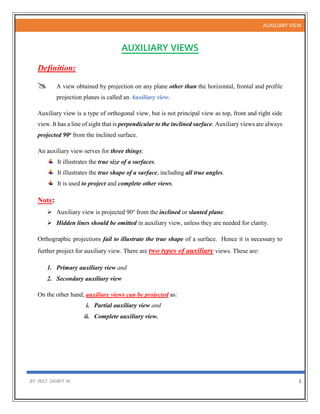
Purpose: To simplify the shape description. It shows only one surface of an object.
Rules:
1. Identify the view in which the surface is shown as a sloped line
2. Place the Reference Plane (RP) line in the other view
3. Draw lines perpendicular at every point on the sloped line
4. Draw RP line in the auxiliary view parallel to the sloped surface and far away to ensure
there is room to draw the object.
5. Draw the auxiliary view point by point starting from the RP and transport the distance
between the points in the true size and shape view.
Auxiliary view from top view:
 Top is expected to possess inclined plane and it is a view where, we project to obtain the
auxiliary view.
Reference Plane (RP)
AUXILIARY VIEW
BY: INST. DAWIT W. 3
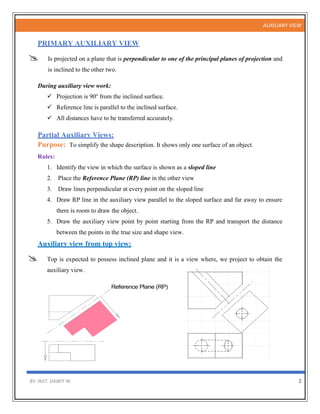
Auxiliary from front view:
Objects with circular features:
Steps:
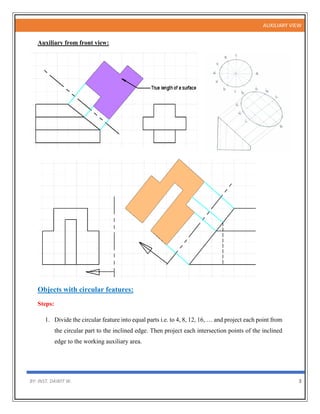
1. Divide the circular feature into equal parts i.e. to 4, 8, 12, 16, … and project each point from
the circular part to the inclined edge. Then project each intersection points of the inclined
edge to the working auxiliary area.
AUXILIARY VIEW
BY: INST. DAWIT W. 4
1. Transfer each dimensions from the circular feature accurately to the auxiliary view.
AUXILIARY VIEW
BY: INST. DAWIT W. 5
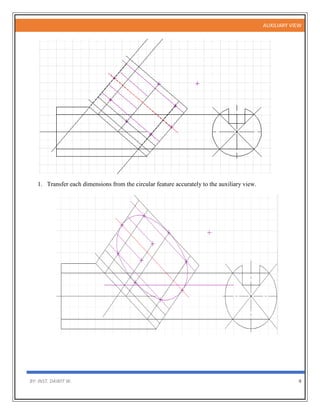
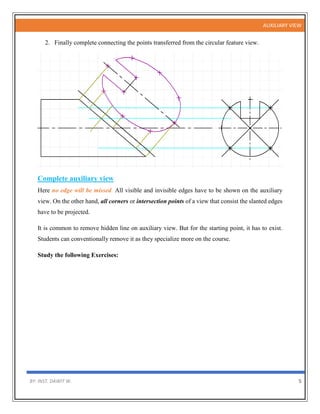
2. Finally complete connecting the points transferred from the circular feature view.
Complete auxiliary view
Here no edge will be missed. All visible and invisible edges have to be shown on the auxiliary
view. On the other hand, all corners or intersection points of a view that consist the slanted edges
have to be projected.
It is common to remove hidden line on auxiliary view. But for the starting point, it has to exist.
Students can conventionally remove it as they specialize more on the course.
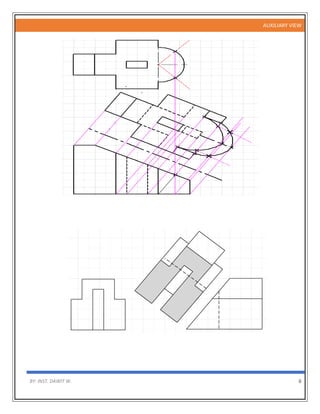
Study the following Exercises:
AUXILIARY VIEW
BY: INST. DAWIT W. 6
AUXILIARY VIEW
BY: INST. DAWIT W. 7
D1
a c
D
3
D
2
a
a
a
b
b
b
c
c
c
D
1
D
3
D
2
Secondary auxiliary view
true shape of oblique plane
Partial primary auxiliary view
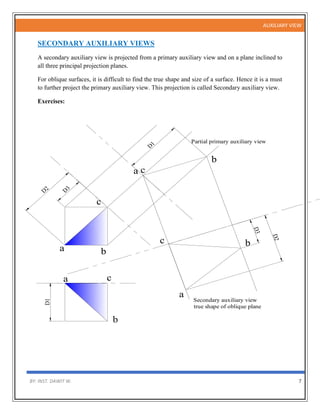
SECONDARY AUXILIARY VIEWS
A secondary auxiliary view is projected from a primary auxiliary view and on a plane inclined to
all three principal projection planes.
For oblique surfaces, it is difficult to find the true shape and size of a surface. Hence it is a must
to further project the primary auxiliary view. This projection is called Secondary auxiliary view.
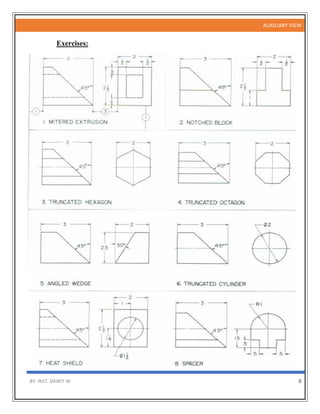
Exercises:
AUXILIARY VIEW
BY: INST. DAWIT W. 8
Exercises:

Auxiliary views

  • 1.
    By: Inst. DawitW. ASSOSA UNIVERSITY, DEPARTMENT OFMECHANICAL ENGINEERING [ Assosa,Ethiopia] AUXILIARY VIEW
  • 2.
    AUXILIARY VIEW BY: INST.DAWIT W. 1 AUXILIARY VIEWS Definition:  A view obtained by projection on any plane other than the horizontal, frontal and profile projection planes is called an Auxiliary view. Auxiliary view is a type of orthogonal view, but is not principal view as top, front and right side view. It has a line of sight that is perpendicular to the inclined surface. Auxiliary views are always projected 90o from the inclined surface. An auxiliary view serves for three things: It illustrates the true size of a surfaces. It illustrates the true shape of a surface, including all true angles. It is used to project and complete other views. Note:  Auxiliary view is projected 90o from the inclined or slanted plane.  Hidden lines should be omitted in auxiliary view, unless they are needed for clarity. Orthographic projections fail to illustrate the true shape of a surface. Hence it is necessary to further project for auxiliary view. There are two types of auxiliary views. These are: 1. Primary auxiliary view and 2. Secondary auxiliary view On the other hand, auxiliary views can be projected as: i. Partial auxiliary view and ii. Complete auxiliary view.
  • 3.
    AUXILIARY VIEW BY: INST.DAWIT W. 2 PRIMARY AUXILIARY VIEW  Is projected on a plane that is perpendicular to one of the principal planes of projection and is inclined to the other two. During auxiliary view work:  Projection is 90o from the inclined surface.  Reference line is parallel to the inclined surface.  All distances have to be transferred accurately. Partial Auxiliary Views: Purpose: To simplify the shape description. It shows only one surface of an object. Rules: 1. Identify the view in which the surface is shown as a sloped line 2. Place the Reference Plane (RP) line in the other view 3. Draw lines perpendicular at every point on the sloped line 4. Draw RP line in the auxiliary view parallel to the sloped surface and far away to ensure there is room to draw the object. 5. Draw the auxiliary view point by point starting from the RP and transport the distance between the points in the true size and shape view. Auxiliary view from top view:  Top is expected to possess inclined plane and it is a view where, we project to obtain the auxiliary view. Reference Plane (RP)
  • 4.
    AUXILIARY VIEW BY: INST.DAWIT W. 3 Auxiliary from front view: Objects with circular features: Steps: 1. Divide the circular feature into equal parts i.e. to 4, 8, 12, 16, … and project each point from the circular part to the inclined edge. Then project each intersection points of the inclined edge to the working auxiliary area.
  • 5.
    AUXILIARY VIEW BY: INST.DAWIT W. 4 1. Transfer each dimensions from the circular feature accurately to the auxiliary view.
  • 6.
    AUXILIARY VIEW BY: INST.DAWIT W. 5 2. Finally complete connecting the points transferred from the circular feature view. Complete auxiliary view Here no edge will be missed. All visible and invisible edges have to be shown on the auxiliary view. On the other hand, all corners or intersection points of a view that consist the slanted edges have to be projected. It is common to remove hidden line on auxiliary view. But for the starting point, it has to exist. Students can conventionally remove it as they specialize more on the course. Study the following Exercises:
  • 7.
  • 8.
    AUXILIARY VIEW BY: INST.DAWIT W. 7 D1 a c D 3 D 2 a a a b b b c c c D 1 D 3 D 2 Secondary auxiliary view true shape of oblique plane Partial primary auxiliary view SECONDARY AUXILIARY VIEWS A secondary auxiliary view is projected from a primary auxiliary view and on a plane inclined to all three principal projection planes. For oblique surfaces, it is difficult to find the true shape and size of a surface. Hence it is a must to further project the primary auxiliary view. This projection is called Secondary auxiliary view. Exercises:
  • 9.
    AUXILIARY VIEW BY: INST.DAWIT W. 8 Exercises: