Instructor: Laura Gerold, PE
               Catalog #10614113
     Class # 22784, 24113, 24136, & 24138
Class Start: January 18, 2012 Class End: May
                    16, 2012
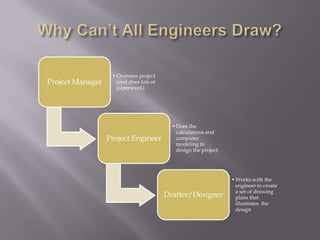
• Oversees project
Project Manager      (and does lots of
                     paperwork)


                                           • Does the
                                             calculations and
                  Project Engineer           computer
                                             modeling to
                                             design the project


                                                                  • Works with the
                                                                    engineer to create
                                                                    a set of drawing
                                         Drafter/Designer           plans that
                                                                    illustrates the
                                                                    design
   Complete the handout
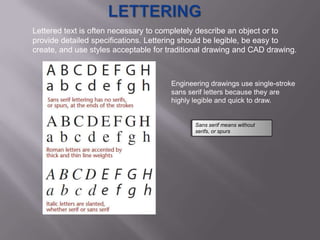
Lettered text is often necessary to completely describe an object or to
provide detailed specifications. Lettering should be legible, be easy to
create, and use styles acceptable for traditional drawing and CAD drawing.


                                      Engineering drawings use single-stroke
                                      sans serif letters because they are
                                      highly legible and quick to draw.


                                             Sans serif means without
                                             serifs, or spurs
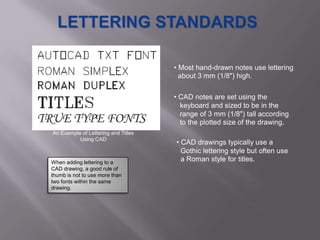
• Most hand-drawn notes use lettering
                                       about 3 mm (1/8") high.

                                     • CAD notes are set using the
                                       keyboard and sized to be in the
                                       range of 3 mm (1/8") tall according
                                       to the plotted size of the drawing.
An Example of Lettering and Titles
          Using CAD
                                     • CAD drawings typically use a
                                       Gothic lettering style but often use
When adding lettering to a
                                       a Roman style for titles.
CAD drawing, a good rule of
thumb is not to use more than
two fonts within the same
drawing.
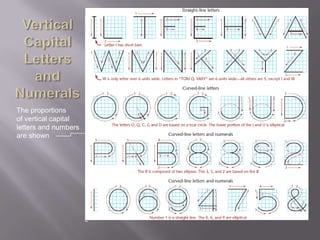
The proportions
of vertical capital
letters and numbers
are shown
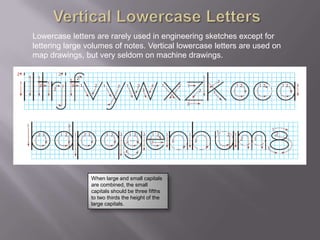
Lowercase letters are rarely used in engineering sketches except for
lettering large volumes of notes. Vertical lowercase letters are used on
map drawings, but very seldom on machine drawings.


                 When large and small capitals
                 are combined, the small
                 capitals should be three fifths
                 to two thirds the height of the
                 large capitals.
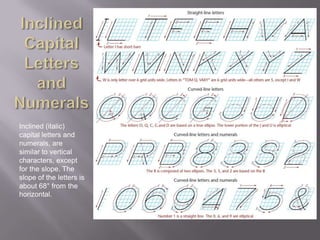
Inclined (italic)
capital letters and
numerals, are
similar to vertical
characters, except
for the slope. The
slope of the letters is
about 68° from the
horizontal.
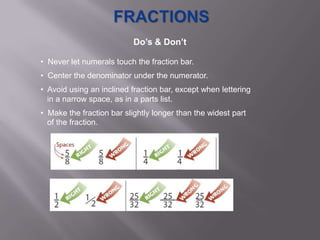
Do’s & Don’t

• Never let numerals touch the fraction bar.
• Center the denominator under the numerator.
• Avoid using an inclined fraction bar, except when lettering
  in a narrow space, as in a parts list.
• Make the fraction bar slightly longer than the widest part
  of the fraction.
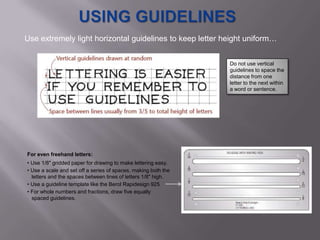
Use extremely light horizontal guidelines to keep letter height uniform…


                                                                Do not use vertical
                                                                guidelines to space the
                                                                distance from one
                                                                letter to the next within
                                                                a word or sentence.


For even freehand letters:
• Use 1/8" gridded paper for drawing to make lettering easy.
• Use a scale and set off a series of spaces, making both the
  letters and the spaces between lines of letters 1/8" high.
• Use a guideline template like the Berol Rapidesign 925
• For whole numbers and fractions, draw five equally
  spaced guidelines.
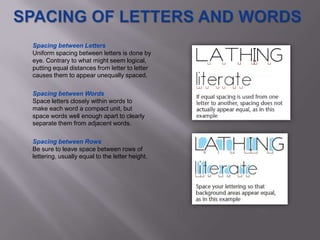
Spacing between Letters
Uniform spacing between letters is done by
eye. Contrary to what might seem logical,
putting equal distances from letter to letter
causes them to appear unequally spaced.

Spacing between Words
Space letters closely within words to
make each word a compact unit, but
space words well enough apart to clearly
separate them from adjacent words.

Spacing between Rows
Be sure to leave space between rows of
lettering, usually equal to the letter height.
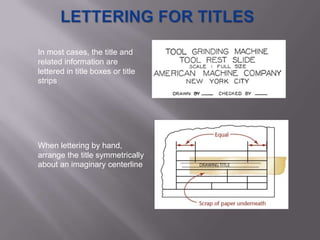
In most cases, the title and
related information are
lettered in title boxes or title
strips


When lettering by hand,
arrange the title symmetrically
about an imaginary centerline
   How to Write Like an Architect
   Use a Ruler for even lines
   Use the Ames Lettering Guide
   Lettering Example (Worksheet 2)
   Lettering Example (Finish Plan)
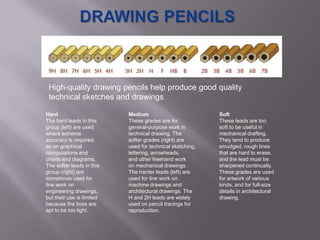
High-quality drawing pencils help produce good quality
 technical sketches and drawings.

Hard                       Medium                          Soft
The hard leads in this     These grades are for            These leads are too
group (left) are used      general-purpose work in         soft to be useful in
where extreme              technical drawing. The          mechanical drafting.
accuracy is required,      softer grades (right) are       They tend to produce
as on graphical            used for technical sketching,   smudged, rough lines
computations and           lettering, arrowheads,          that are hard to erase,
charts and diagrams.       and other freehand work         and the lead must be
The softer leads in this   on mechanical drawings.         sharpened continually.
group (right) are          The harder leads (left) are     These grades are used
sometimes used for         used for line work on           for artwork of various
line work on               machine drawings and            kinds, and for full-size
engineering drawings,      architectural drawings. The     details in architectural
but their use is limited   H and 2H leads are widely       drawing.
because the lines are      used on pencil tracings for
apt to be too light.       reproduction.
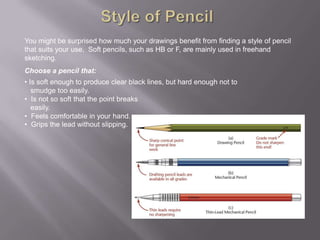
You might be surprised how much your drawings benefit from finding a style of pencil
that suits your use. Soft pencils, such as HB or F, are mainly used in freehand
sketching.
Choose a pencil that:
• Is soft enough to produce clear black lines, but hard enough not to
   smudge too easily.
• Is not so soft that the point breaks
   easily.
• Feels comfortable in your hand.
• Grips the lead without slipping.
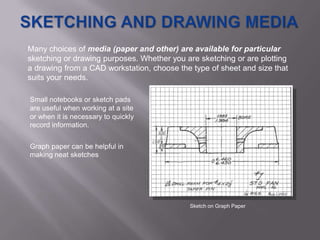
Many choices of media (paper and other) are available for particular
sketching or drawing purposes. Whether you are sketching or are plotting
a drawing from a CAD workstation, choose the type of sheet and size that
suits your needs.

Small notebooks or sketch pads
are useful when working at a site
or when it is necessary to quickly
record information.


Graph paper can be helpful in
making neat sketches


                                            Sketch on Graph Paper
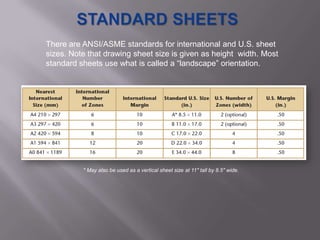
There are ANSI/ASME standards for international and U.S. sheet
sizes. Note that drawing sheet size is given as height width. Most
standard sheets use what is called a “landscape” orientation.


          * May also be used as a vertical sheet size at 11" tall by 8.5" wide.
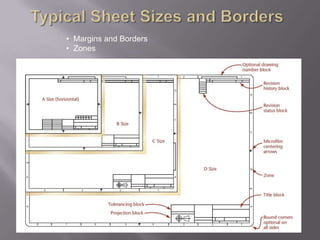
• Margins and Borders
• Zones
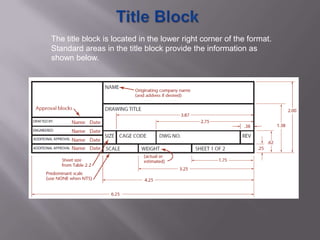
The title block is located in the lower right corner of the format.
Standard areas in the title block provide the information as
shown below.
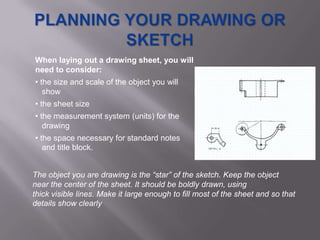
When laying out a drawing sheet, you will
need to consider:
• the size and scale of the object you will
   show
• the sheet size
• the measurement system (units) for the
   drawing
• the space necessary for standard notes
   and title block.


The object you are drawing is the “star” of the sketch. Keep the object
near the center of the sheet. It should be boldly drawn, using
thick visible lines. Make it large enough to fill most of the sheet and so that
details show clearly
Sections 1-5
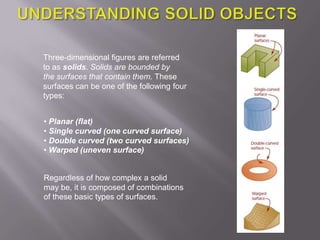
Three-dimensional figures are referred
to as solids. Solids are bounded by
the surfaces that contain them. These
surfaces can be one of the following four
types:


• Planar (flat)
• Single curved (one curved surface)
• Double curved (two curved surfaces)
• Warped (uneven surface)


Regardless of how complex a solid
may be, it is composed of combinations
of these basic types of surfaces.
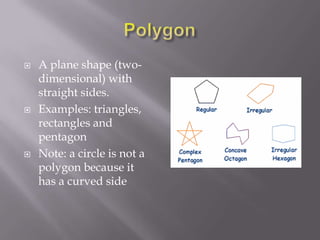
   A plane shape (two-
    dimensional) with
    straight sides.
   Examples: triangles,
    rectangles and
    pentagon
   Note: a circle is not a
    polygon because it
    has a curved side
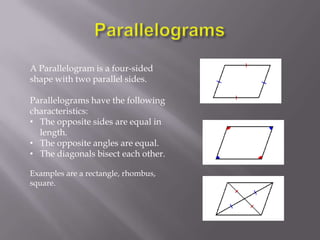
A Parallelogram is a four-sided
shape with two parallel sides.

Parallelograms have the following
characteristics:
• The opposite sides are equal in
  length.
• The opposite angles are equal.
• The diagonals bisect each other.

Examples are a rectangle, rhombus,
square.
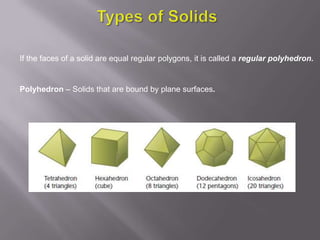
If the faces of a solid are equal regular polygons, it is called a regular polyhedron.


Polyhedron – Solids that are bound by plane surfaces.
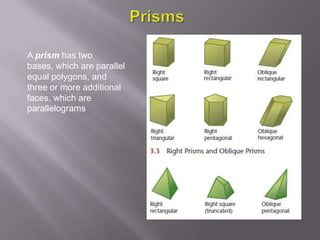
A prism has two
bases, which are parallel
equal polygons, and
three or more additional
faces, which are
parallelograms
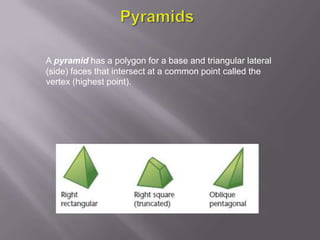
A pyramid has a polygon for a base and triangular lateral
(side) faces that intersect at a common point called the
vertex (highest point).
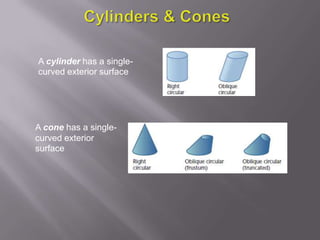
A cylinder has a single-
curved exterior surface


A cone has a single-
curved exterior
surface
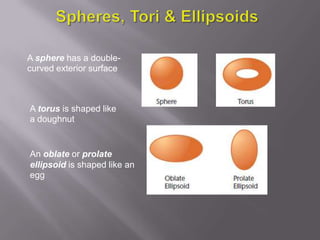
A sphere has a double-
curved exterior surface


A torus is shaped like
a doughnut


An oblate or prolate
ellipsoid is shaped like an
egg
   Name (and sketch) that Solid Object . . .
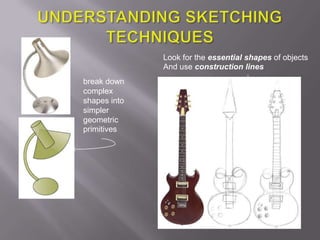
Look for the essential shapes of objects
              And use construction lines
break down
complex
shapes into
simpler
geometric
primitives
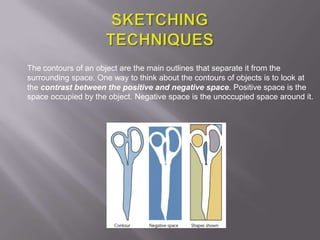
The contours of an object are the main outlines that separate it from the
surrounding space. One way to think about the contours of objects is to look at
the contrast between the positive and negative space. Positive space is the
space occupied by the object. Negative space is the unoccupied space around it.
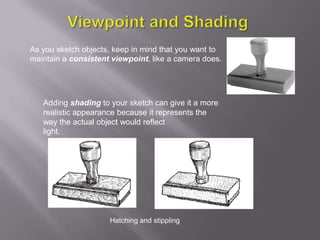
As you sketch objects, keep in mind that you want to
maintain a consistent viewpoint, like a camera does.


   Adding shading to your sketch can give it a more
   realistic appearance because it represents the
   way the actual object would reflect
   light.


                     Hatching and stippling
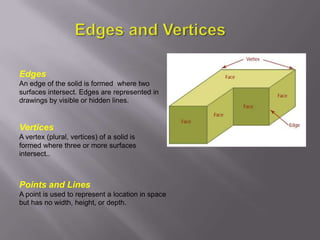
Edges
An edge of the solid is formed where two
surfaces intersect. Edges are represented in
drawings by visible or hidden lines.


Vertices
A vertex (plural, vertices) of a solid is
formed where three or more surfaces
intersect..


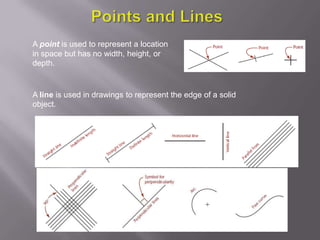
Points and Lines
A point is used to represent a location in space
but has no width, height, or depth.
A point is used to represent a location
in space but has no width, height, or
depth.


A line is used in drawings to represent the edge of a solid
object.
   Build a shape with blocks
   Sketch shape, identify vertices and edges,
    points and lines
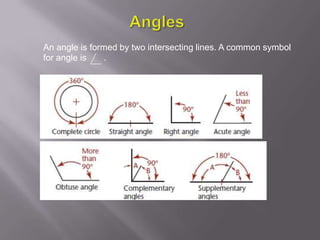
An angle is formed by two intersecting lines. A common symbol
for angle is   .
The following are important skills to keep in mind for sketches
and drawings:

1. Accuracy. No drawing is useful unless it shows the information
   correctly.
2. Speed. Time is money in industry. Work smarter and learn
   to use techniques to speed up your sketching and CAD
   drawings while still producing neat accurate results.
3. Legibility. A drawing is a means of communicating with
   others, so it must be clear and legible. Give attention to details.
   Things that may seem picky and small as you are
   drawing may be significant and save money or even lives
   when the product is built.
4. Neatness. If a drawing is to be accurate and legible, it must
   also be clean.
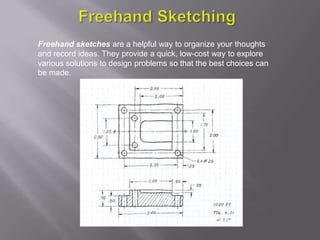
Freehand sketches are a helpful way to organize your thoughts
and record ideas. They provide a quick, low-cost way to explore
various solutions to design problems so that the best choices can
be made.
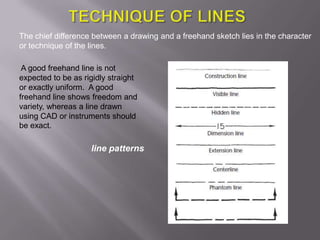
The chief difference between a drawing and a freehand sketch lies in the character
or technique of the lines.

 A good freehand line is not
expected to be as rigidly straight
or exactly uniform. A good
freehand line shows freedom and
variety, whereas a line drawn
using CAD or instruments should
be exact.

                    line patterns
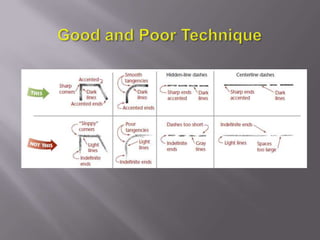
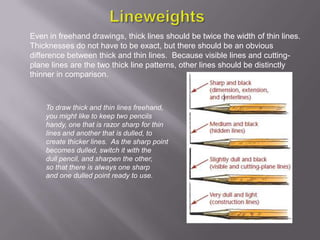
Even in freehand drawings, thick lines should be twice the width of thin lines.
Thicknesses do not have to be exact, but there should be an obvious
difference between thick and thin lines. Because visible lines and cutting-
plane lines are the two thick line patterns, other lines should be distinctly
thinner in comparison.


    To draw thick and thin lines freehand,
    you might like to keep two pencils
    handy, one that is razor sharp for thin
    lines and another that is dulled, to
    create thicker lines. As the sharp point
    becomes dulled, switch it with the
    dull pencil, and sharpen the other,
    so that there is always one sharp
    and one dulled point ready to use.
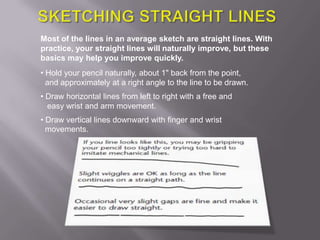
Most of the lines in an average sketch are straight lines. With
practice, your straight lines will naturally improve, but these
basics may help you improve quickly.
• Hold your pencil naturally, about 1" back from the point,
  and approximately at a right angle to the line to be drawn.
• Draw horizontal lines from left to right with a free and
  easy wrist and arm movement.
• Draw vertical lines downward with finger and wrist
  movements.
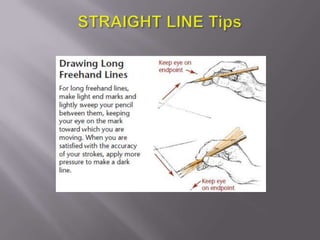
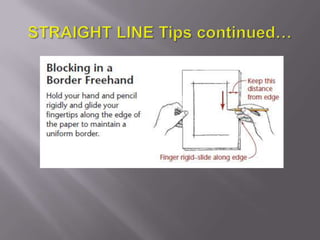
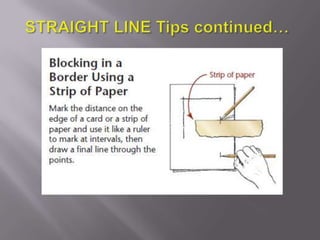
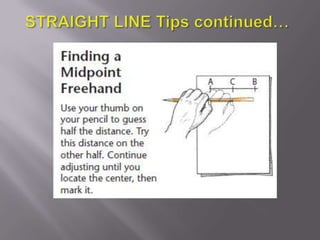
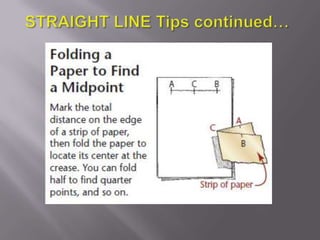
   Use one of the tips to draw a straight line
    without a scale or ruler.
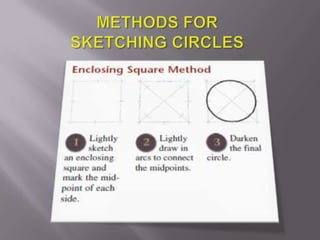
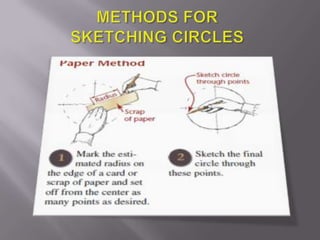
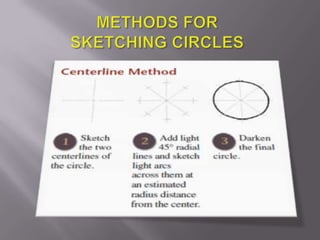
   Draw a freehand circle (without compass or
    circle template) using one of the three methods
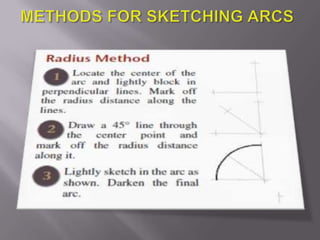
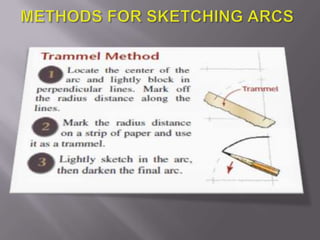
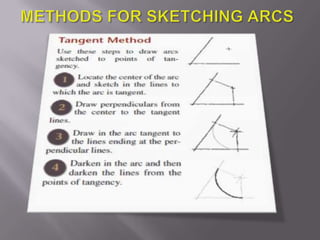
   Freehand sketch an arc using one of the three
    methods
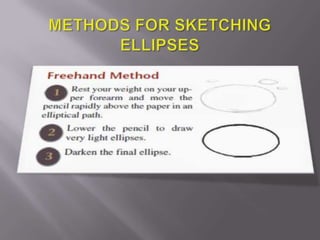
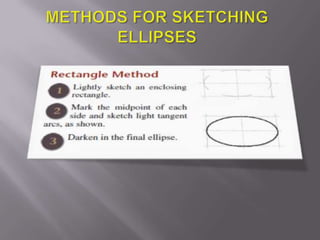
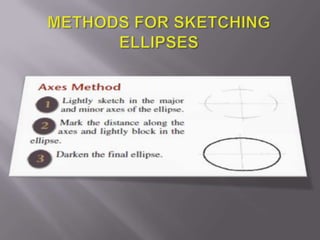
   Freehand sketch an ellipse using one of the
    three methods
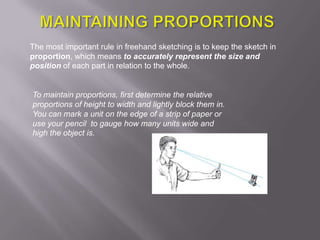
The most important rule in freehand sketching is to keep the sketch in
proportion, which means to accurately represent the size and
position of each part in relation to the whole.


To maintain proportions, first determine the relative
proportions of height to width and lightly block them in.
You can mark a unit on the edge of a strip of paper or
use your pencil to gauge how many units wide and
high the object is.
   Draw coffee mug freehand using discussed
    methods
   Draw an enclosing box and shade in the
    negative space so the contour of the cup
    remains white
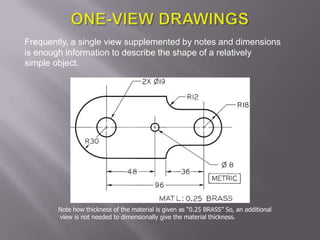
Frequently, a single view supplemented by notes and dimensions
is enough information to describe the shape of a relatively
simple object.


        Note how thickness of the material is given as “0.25 BRASS” So, an additional
        view is not needed to dimensionally give the material thickness.

Class 3 presentation posted

  • 1.
    Instructor: Laura Gerold,PE Catalog #10614113 Class # 22784, 24113, 24136, & 24138 Class Start: January 18, 2012 Class End: May 16, 2012
  • 3.
    • Oversees project ProjectManager (and does lots of paperwork) • Does the calculations and Project Engineer computer modeling to design the project • Works with the engineer to create a set of drawing Drafter/Designer plans that illustrates the design
  • 4.
    Complete the handout
  • 5.
    Lettered text isoften necessary to completely describe an object or to provide detailed specifications. Lettering should be legible, be easy to create, and use styles acceptable for traditional drawing and CAD drawing. Engineering drawings use single-stroke sans serif letters because they are highly legible and quick to draw. Sans serif means without serifs, or spurs
  • 6.
    • Most hand-drawnnotes use lettering about 3 mm (1/8") high. • CAD notes are set using the keyboard and sized to be in the range of 3 mm (1/8") tall according to the plotted size of the drawing. An Example of Lettering and Titles Using CAD • CAD drawings typically use a Gothic lettering style but often use When adding lettering to a a Roman style for titles. CAD drawing, a good rule of thumb is not to use more than two fonts within the same drawing.
  • 7.
    The proportions of verticalcapital letters and numbers are shown
  • 8.
    Lowercase letters arerarely used in engineering sketches except for lettering large volumes of notes. Vertical lowercase letters are used on map drawings, but very seldom on machine drawings. When large and small capitals are combined, the small capitals should be three fifths to two thirds the height of the large capitals.
  • 9.
    Inclined (italic) capital lettersand numerals, are similar to vertical characters, except for the slope. The slope of the letters is about 68° from the horizontal.
  • 10.
    Do’s & Don’t •Never let numerals touch the fraction bar. • Center the denominator under the numerator. • Avoid using an inclined fraction bar, except when lettering in a narrow space, as in a parts list. • Make the fraction bar slightly longer than the widest part of the fraction.
  • 11.
    Use extremely lighthorizontal guidelines to keep letter height uniform… Do not use vertical guidelines to space the distance from one letter to the next within a word or sentence. For even freehand letters: • Use 1/8" gridded paper for drawing to make lettering easy. • Use a scale and set off a series of spaces, making both the letters and the spaces between lines of letters 1/8" high. • Use a guideline template like the Berol Rapidesign 925 • For whole numbers and fractions, draw five equally spaced guidelines.
  • 12.
    Spacing between Letters Uniformspacing between letters is done by eye. Contrary to what might seem logical, putting equal distances from letter to letter causes them to appear unequally spaced. Spacing between Words Space letters closely within words to make each word a compact unit, but space words well enough apart to clearly separate them from adjacent words. Spacing between Rows Be sure to leave space between rows of lettering, usually equal to the letter height.
  • 13.
    In most cases,the title and related information are lettered in title boxes or title strips When lettering by hand, arrange the title symmetrically about an imaginary centerline
  • 14.
    How to Write Like an Architect  Use a Ruler for even lines  Use the Ames Lettering Guide  Lettering Example (Worksheet 2)  Lettering Example (Finish Plan)
  • 15.
    High-quality drawing pencilshelp produce good quality technical sketches and drawings. Hard Medium Soft The hard leads in this These grades are for These leads are too group (left) are used general-purpose work in soft to be useful in where extreme technical drawing. The mechanical drafting. accuracy is required, softer grades (right) are They tend to produce as on graphical used for technical sketching, smudged, rough lines computations and lettering, arrowheads, that are hard to erase, charts and diagrams. and other freehand work and the lead must be The softer leads in this on mechanical drawings. sharpened continually. group (right) are The harder leads (left) are These grades are used sometimes used for used for line work on for artwork of various line work on machine drawings and kinds, and for full-size engineering drawings, architectural drawings. The details in architectural but their use is limited H and 2H leads are widely drawing. because the lines are used on pencil tracings for apt to be too light. reproduction.
  • 16.
    You might besurprised how much your drawings benefit from finding a style of pencil that suits your use. Soft pencils, such as HB or F, are mainly used in freehand sketching. Choose a pencil that: • Is soft enough to produce clear black lines, but hard enough not to smudge too easily. • Is not so soft that the point breaks easily. • Feels comfortable in your hand. • Grips the lead without slipping.
  • 17.
    Many choices ofmedia (paper and other) are available for particular sketching or drawing purposes. Whether you are sketching or are plotting a drawing from a CAD workstation, choose the type of sheet and size that suits your needs. Small notebooks or sketch pads are useful when working at a site or when it is necessary to quickly record information. Graph paper can be helpful in making neat sketches Sketch on Graph Paper
  • 18.
    There are ANSI/ASMEstandards for international and U.S. sheet sizes. Note that drawing sheet size is given as height width. Most standard sheets use what is called a “landscape” orientation. * May also be used as a vertical sheet size at 11" tall by 8.5" wide.
  • 19.
    • Margins andBorders • Zones
  • 20.
    The title blockis located in the lower right corner of the format. Standard areas in the title block provide the information as shown below.
  • 21.
    When laying outa drawing sheet, you will need to consider: • the size and scale of the object you will show • the sheet size • the measurement system (units) for the drawing • the space necessary for standard notes and title block. The object you are drawing is the “star” of the sketch. Keep the object near the center of the sheet. It should be boldly drawn, using thick visible lines. Make it large enough to fill most of the sheet and so that details show clearly
  • 22.
  • 23.
    Three-dimensional figures arereferred to as solids. Solids are bounded by the surfaces that contain them. These surfaces can be one of the following four types: • Planar (flat) • Single curved (one curved surface) • Double curved (two curved surfaces) • Warped (uneven surface) Regardless of how complex a solid may be, it is composed of combinations of these basic types of surfaces.
  • 24.
    A plane shape (two- dimensional) with straight sides.  Examples: triangles, rectangles and pentagon  Note: a circle is not a polygon because it has a curved side
  • 25.
    A Parallelogram isa four-sided shape with two parallel sides. Parallelograms have the following characteristics: • The opposite sides are equal in length. • The opposite angles are equal. • The diagonals bisect each other. Examples are a rectangle, rhombus, square.
  • 26.
    If the facesof a solid are equal regular polygons, it is called a regular polyhedron. Polyhedron – Solids that are bound by plane surfaces.
  • 27.
    A prism hastwo bases, which are parallel equal polygons, and three or more additional faces, which are parallelograms
  • 28.
    A pyramid hasa polygon for a base and triangular lateral (side) faces that intersect at a common point called the vertex (highest point).
  • 29.
    A cylinder hasa single- curved exterior surface A cone has a single- curved exterior surface
  • 30.
    A sphere hasa double- curved exterior surface A torus is shaped like a doughnut An oblate or prolate ellipsoid is shaped like an egg
  • 31.
    Name (and sketch) that Solid Object . . .
  • 32.
    Look for theessential shapes of objects And use construction lines break down complex shapes into simpler geometric primitives
  • 33.
    The contours ofan object are the main outlines that separate it from the surrounding space. One way to think about the contours of objects is to look at the contrast between the positive and negative space. Positive space is the space occupied by the object. Negative space is the unoccupied space around it.
  • 34.
    As you sketchobjects, keep in mind that you want to maintain a consistent viewpoint, like a camera does. Adding shading to your sketch can give it a more realistic appearance because it represents the way the actual object would reflect light. Hatching and stippling
  • 35.
    Edges An edge ofthe solid is formed where two surfaces intersect. Edges are represented in drawings by visible or hidden lines. Vertices A vertex (plural, vertices) of a solid is formed where three or more surfaces intersect.. Points and Lines A point is used to represent a location in space but has no width, height, or depth.
  • 36.
    A point isused to represent a location in space but has no width, height, or depth. A line is used in drawings to represent the edge of a solid object.
  • 37.
    Build a shape with blocks  Sketch shape, identify vertices and edges, points and lines
  • 38.
    An angle isformed by two intersecting lines. A common symbol for angle is .
  • 39.
    The following areimportant skills to keep in mind for sketches and drawings: 1. Accuracy. No drawing is useful unless it shows the information correctly. 2. Speed. Time is money in industry. Work smarter and learn to use techniques to speed up your sketching and CAD drawings while still producing neat accurate results. 3. Legibility. A drawing is a means of communicating with others, so it must be clear and legible. Give attention to details. Things that may seem picky and small as you are drawing may be significant and save money or even lives when the product is built. 4. Neatness. If a drawing is to be accurate and legible, it must also be clean.
  • 40.
    Freehand sketches area helpful way to organize your thoughts and record ideas. They provide a quick, low-cost way to explore various solutions to design problems so that the best choices can be made.
  • 41.
    The chief differencebetween a drawing and a freehand sketch lies in the character or technique of the lines. A good freehand line is not expected to be as rigidly straight or exactly uniform. A good freehand line shows freedom and variety, whereas a line drawn using CAD or instruments should be exact. line patterns
  • 43.
    Even in freehanddrawings, thick lines should be twice the width of thin lines. Thicknesses do not have to be exact, but there should be an obvious difference between thick and thin lines. Because visible lines and cutting- plane lines are the two thick line patterns, other lines should be distinctly thinner in comparison. To draw thick and thin lines freehand, you might like to keep two pencils handy, one that is razor sharp for thin lines and another that is dulled, to create thicker lines. As the sharp point becomes dulled, switch it with the dull pencil, and sharpen the other, so that there is always one sharp and one dulled point ready to use.
  • 44.
    Most of thelines in an average sketch are straight lines. With practice, your straight lines will naturally improve, but these basics may help you improve quickly. • Hold your pencil naturally, about 1" back from the point, and approximately at a right angle to the line to be drawn. • Draw horizontal lines from left to right with a free and easy wrist and arm movement. • Draw vertical lines downward with finger and wrist movements.
  • 50.
    Use one of the tips to draw a straight line without a scale or ruler.
  • 54.
    Draw a freehand circle (without compass or circle template) using one of the three methods
  • 58.
    Freehand sketch an arc using one of the three methods
  • 62.
    Freehand sketch an ellipse using one of the three methods
  • 63.
    The most importantrule in freehand sketching is to keep the sketch in proportion, which means to accurately represent the size and position of each part in relation to the whole. To maintain proportions, first determine the relative proportions of height to width and lightly block them in. You can mark a unit on the edge of a strip of paper or use your pencil to gauge how many units wide and high the object is.
  • 64.
    Draw coffee mug freehand using discussed methods  Draw an enclosing box and shade in the negative space so the contour of the cup remains white
  • 65.
    Frequently, a singleview supplemented by notes and dimensions is enough information to describe the shape of a relatively simple object. Note how thickness of the material is given as “0.25 BRASS” So, an additional view is not needed to dimensionally give the material thickness.