Lecture 6 (06.08.12): 
Theory of Multi-view Orthographic 
Projections 
Dr. Sharad Gokhale 
Civil Engineering Department, IIT Guwahati 
208, M-Block, Academic Complex 
Email: sharadbg@iitg.ernet.in 
Telephone #: 2419
Multi-view Orthographic 
PPrroojjeeccttiioonnss
Terms and definition 
• Projection – image or the act of obtaining an 
image of an object 
• In technical drawing – we call it a view 
• Method – we use projection mmeetthhoodd ttoo oobbttaaiinn 
a view of an object
Orthographic Projections 
• It is a technical drawing in which different views of 
an object are projected on different reference 
planes 
• Different Reference planes (principal planes): 
– HHoorriizzoonnttaall PPllaannee ((HHPP)),, 
– Vertical Frontal Plane (VP) 
– Side Or Profile Plane (PP) 
• Different views: 
– Front View (FV), 
– Top View (TV), 
– Side View (SV)
Projection System 
Perspective
Projection System 
Projection lines 
Plane of Projections (POP) 
Perspective 
Parallel
Projection System 
Projection lines 
Plane of Projections (POP) 
Perspective (Convergent 
projection) 
Parallel Projection 
Three basic elements: 
i. Object 
ii. Observer 
iii. POP
Projection ooff aann OObbjjeecctt 
The outline on the plane of projection shows how the object appears to the 
observer. In orthographic projection, projections from all points of the 
object extend parallel to each other and perpendicular to the plane of 
projection.
X 
Y
X 
Y 
VP 
1st 2nd Quad. Quad. 
X Y 
Observer 
HP 
3rd Quad. 4th Quad. 
This quadrant pattern, 
If observed along x-y line ( in red arrow direction) will exactly appear as shown on 
right side and hence, It is further used to understand illustration properly.
Methods of Drawing Orthographic Projections 
First Angle Projections Method 
Here views are drawn 
by placing object 
in 1st Quadrant 
Third Angle Projections Method 
Here views are drawn 
by placing object 
in 3rd Quadrant. 
( FV above X-Y, TV below X-Y ) 
( TV above X-Y, FV below X-Y ) 
FV 
TV 
X Y X Y 
TV 
FV 
G L 
Symbolic presentation of both methods 
with an object standing on HP (ground) on it’s base. 
NOTE:- 
HP term is used in 1st angle method 
& 
ground term is used 
in 3rd angle method of projections
Planes 
PRINCIPAL PLANES 
HP AND VP 
Profile Plane (P.P.) 
AUXILIARY PLANES 
Auxiliary Vertical Plane 
(A.V.P.) 
A.V.P. 
^ to HP & Ð to VP 
Auxiliary Inclined Plane 
(A.I.P.)
Planes & Views (first angle method) 
This is a pictorial set-up of all three planes. Arrow direction is a 
normal way of observing the object. But in this direction only VP and a 
view on it (FV) can be seen. The other planes and views on those can 
not be seen. 
Procedure to solve above problem:- 
To make those planes also visible from the arrow direction, 
i) HP is rotated 900 downward, ii) PP, 900 in right side direction. 
This way both planes are brought in the same plane containing VP. 
HP IS ROTATED DOWNWARD 900 
AND 
BROUGHT IN THE PLANE OF VP. 
X 
Y 
PP IS ROTATED AWAY IN RIGHT SIDE 900 
AND 
BROUGHT IN THE PLANE OF VP. 
VP 
LSV 
X Y 
HP 
PP 
FV 
TV 
ACTUAL PATTERN OF PLANES & VIEWS 
OF ORTHOGRAPHIC PROJECTIONS 
DRAWN IN 
FIRST ANGLE METHOD OF PROJECTIONS
FOR T.V. 
First angle projection 
IN THIS METHOD, 
THE OBJECT IS ASSUMED TO BE 
SITUATED IN FIRST QUADRANT 
MEANS 
ABOVE HP & INFRONT OF VP. 
OBJECT IS INBETWEEN 
OBSERVER & PLANE. 
PP 
VP 
FV LSV 
X Y 
HP 
TV 
ACTUAL PATTERN OF 
PLANES & VIEWS 
IN 
FIRST ANGLE METHOD 
OF PROJECTIONS
FOR T.V. 
THIRD ANGLE 
PROJECTION 
IN THIS METHOD, 
THE OBJECT IS ASSUMED TO BE 
SITUATED IN THIRD QUADRANT 
( BELOW HP & BEHIND OF VP. ) 
PLANES BEING TRANSPERENT 
AND INBETWEEN 
OBSERVER & OBJECT. 
TV 
X Y 
LSV FV 
ACTUAL PATTERN OF 
PLANES & VIEWS 
OF 
THIRD ANGLE PROJECTIONS
Orthographic projections 
- points, lines, planes, and solids 
• To draw projections of any object, one must 
have the following information 
– Object (with it’s description, well defined) 
– Observer (always observing perpendicular to respective 
rreeffeerreennccee ppllaannee)) 
– location of object (means it’s position with reference to 
HP & VP) 
• Terms ‘above’ & ‘below’ with respective to HP and terms 
‘infront’ & ‘behind’ with respective to VP form 4 quadrants. 
• Objects can be placed in any one of these 4 quadrants
UNDERSTANDING PPRROOJJEECCTTIIOONNSS 
To make and interpret drawings you need to know how to 
create projections and understand the standard arrangement of 
views. 
You need to be familiar with the geometry of objects and 
be able to visualize a 3D object that is represented in a 
2D drawing.
VViieewwss ooff OObbjjeeccttss 
The system of views is called 
multi-view projection. Each 
view provides certain definite 
information. e.g. a front view 
shows the true shape and size 
of surfaces that are parallel to 
the front of the object.
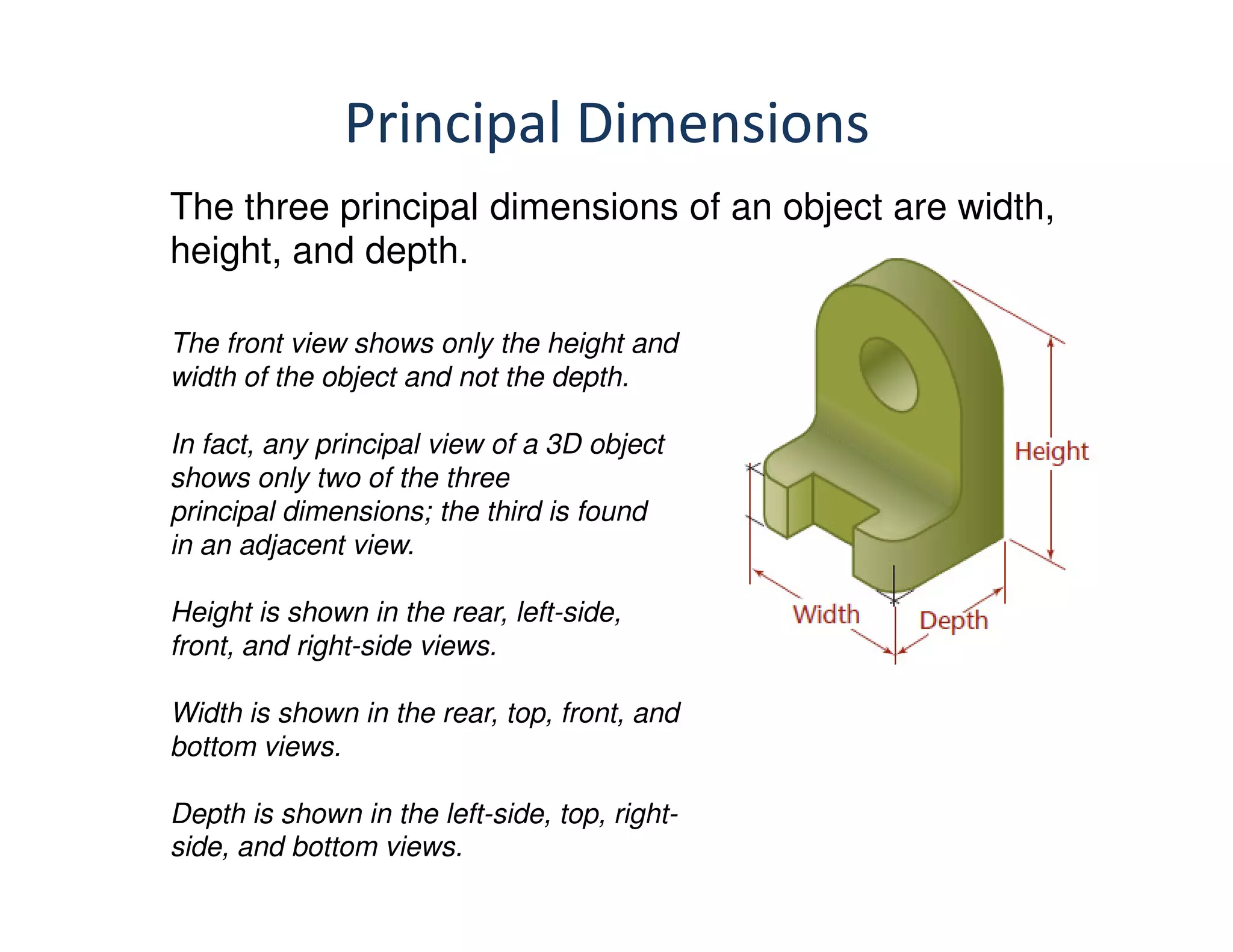
PPrriinncciippaall DDiimmeennssiioonnss 
The three principal dimensions of an object are width, 
height, and depth. 
The front view shows only the height and 
width of the object and not the depth. 
In fact, any principal view of a 3D object 
shows only two of the three 
principal dimensions; the third is found 
in an adjacent view. 
Height is shown in the rear, left-side, 
front, and right-side views. 
Width is shown in the rear, top, front, and 
bottom views. 
Depth is shown in the left-side, top, right-side, 
and bottom views.
Envision the object iinn aa GGllaassss BBooxx 
To understand the standard arrangement of views on the sheet of paper
To draw the views on a sheet of paper, imagine the 
six planes of the glass box being unfolded to lie flat. 
Note the six standard 
views (front, rear, top, 
bottom, right side, left 
side).
The GGllaassss BBooxx UUnnffoollddeedd 
Lines extend around the glass box from one view to another on the planes of 
projection. These are the projectors from a point in one view to the same point in 
another view.
The Orthographic PPrroojjeeccttiioonn 
The front, top, and right-side views of the object shown now without 
the folding lines.
NNeecceessssaarryy VViieewwss 
The top, front, and right-side views, arranged 
together, are called the three regular views 
because they are the views most frequently used. 
A drawing should contain only the views needed to clearly and 
completely describe the object.
View Selection 
Select the most descriptive views 
Use minimum number of views to 
describe the object
How to project Side Views? 
• Projecting across meter line 
• Projecting through arcs 
• Projecting through 45 degree projectors
Projecting across meter line 
X1 
FV 
LHSV 
45o 
X Y 
Y1 
Meter line 
TV
Projecting through 45o projectors 
X1 
FV 
LHSV 
X Y 
Y1 
45o projectors 
TV
Projecting through arcs 
X1 
FV 
LHSV 
X Y 
Y1 
Arcs 
TV
TopT vihewree basic views (FV, TV, SV) will provide 
complete information about the real object 
TToopp VViieeww
VVIIEEWWSS OOFF SSUURRFFAACCEESS 
The three orientations that a plane surface can have to 
the plane of projection are normal, inclined, and 
oblique. 
A plane surface that is 
perpendicular to a plane of 
projection appears on 
edge as a straight line
Standard Views of Primitive Solids
Ex. 1 & 2: Draw the three 
principal views of the 
objects shown In fig 9.12 
(a) and 9.13 (b)
Ex. 3 & 4: From the pictorial 
view of the objects shown 
In fig 9.14 (a) and 9.15 (b) 
Draw FV, TV, RHSV

6 orthographic proj

  • 1.
    Lecture 6 (06.08.12): Theory of Multi-view Orthographic Projections Dr. Sharad Gokhale Civil Engineering Department, IIT Guwahati 208, M-Block, Academic Complex Email: sharadbg@iitg.ernet.in Telephone #: 2419
  • 2.
  • 3.
    Terms and definition • Projection – image or the act of obtaining an image of an object • In technical drawing – we call it a view • Method – we use projection mmeetthhoodd ttoo oobbttaaiinn a view of an object
  • 4.
    Orthographic Projections •It is a technical drawing in which different views of an object are projected on different reference planes • Different Reference planes (principal planes): – HHoorriizzoonnttaall PPllaannee ((HHPP)),, – Vertical Frontal Plane (VP) – Side Or Profile Plane (PP) • Different views: – Front View (FV), – Top View (TV), – Side View (SV)
  • 5.
  • 6.
    Projection System Projectionlines Plane of Projections (POP) Perspective Parallel
  • 7.
    Projection System Projectionlines Plane of Projections (POP) Perspective (Convergent projection) Parallel Projection Three basic elements: i. Object ii. Observer iii. POP
  • 8.
    Projection ooff aannOObbjjeecctt The outline on the plane of projection shows how the object appears to the observer. In orthographic projection, projections from all points of the object extend parallel to each other and perpendicular to the plane of projection.
  • 9.
  • 10.
    X Y VP 1st 2nd Quad. Quad. X Y Observer HP 3rd Quad. 4th Quad. This quadrant pattern, If observed along x-y line ( in red arrow direction) will exactly appear as shown on right side and hence, It is further used to understand illustration properly.
  • 11.
    Methods of DrawingOrthographic Projections First Angle Projections Method Here views are drawn by placing object in 1st Quadrant Third Angle Projections Method Here views are drawn by placing object in 3rd Quadrant. ( FV above X-Y, TV below X-Y ) ( TV above X-Y, FV below X-Y ) FV TV X Y X Y TV FV G L Symbolic presentation of both methods with an object standing on HP (ground) on it’s base. NOTE:- HP term is used in 1st angle method & ground term is used in 3rd angle method of projections
  • 12.
    Planes PRINCIPAL PLANES HP AND VP Profile Plane (P.P.) AUXILIARY PLANES Auxiliary Vertical Plane (A.V.P.) A.V.P. ^ to HP & Ð to VP Auxiliary Inclined Plane (A.I.P.)
  • 13.
    Planes & Views(first angle method) This is a pictorial set-up of all three planes. Arrow direction is a normal way of observing the object. But in this direction only VP and a view on it (FV) can be seen. The other planes and views on those can not be seen. Procedure to solve above problem:- To make those planes also visible from the arrow direction, i) HP is rotated 900 downward, ii) PP, 900 in right side direction. This way both planes are brought in the same plane containing VP. HP IS ROTATED DOWNWARD 900 AND BROUGHT IN THE PLANE OF VP. X Y PP IS ROTATED AWAY IN RIGHT SIDE 900 AND BROUGHT IN THE PLANE OF VP. VP LSV X Y HP PP FV TV ACTUAL PATTERN OF PLANES & VIEWS OF ORTHOGRAPHIC PROJECTIONS DRAWN IN FIRST ANGLE METHOD OF PROJECTIONS
  • 14.
    FOR T.V. Firstangle projection IN THIS METHOD, THE OBJECT IS ASSUMED TO BE SITUATED IN FIRST QUADRANT MEANS ABOVE HP & INFRONT OF VP. OBJECT IS INBETWEEN OBSERVER & PLANE. PP VP FV LSV X Y HP TV ACTUAL PATTERN OF PLANES & VIEWS IN FIRST ANGLE METHOD OF PROJECTIONS
  • 15.
    FOR T.V. THIRDANGLE PROJECTION IN THIS METHOD, THE OBJECT IS ASSUMED TO BE SITUATED IN THIRD QUADRANT ( BELOW HP & BEHIND OF VP. ) PLANES BEING TRANSPERENT AND INBETWEEN OBSERVER & OBJECT. TV X Y LSV FV ACTUAL PATTERN OF PLANES & VIEWS OF THIRD ANGLE PROJECTIONS
  • 16.
    Orthographic projections -points, lines, planes, and solids • To draw projections of any object, one must have the following information – Object (with it’s description, well defined) – Observer (always observing perpendicular to respective rreeffeerreennccee ppllaannee)) – location of object (means it’s position with reference to HP & VP) • Terms ‘above’ & ‘below’ with respective to HP and terms ‘infront’ & ‘behind’ with respective to VP form 4 quadrants. • Objects can be placed in any one of these 4 quadrants
  • 17.
    UNDERSTANDING PPRROOJJEECCTTIIOONNSS Tomake and interpret drawings you need to know how to create projections and understand the standard arrangement of views. You need to be familiar with the geometry of objects and be able to visualize a 3D object that is represented in a 2D drawing.
  • 18.
    VViieewwss ooff OObbjjeeccttss The system of views is called multi-view projection. Each view provides certain definite information. e.g. a front view shows the true shape and size of surfaces that are parallel to the front of the object.
  • 19.
    PPrriinncciippaall DDiimmeennssiioonnss Thethree principal dimensions of an object are width, height, and depth. The front view shows only the height and width of the object and not the depth. In fact, any principal view of a 3D object shows only two of the three principal dimensions; the third is found in an adjacent view. Height is shown in the rear, left-side, front, and right-side views. Width is shown in the rear, top, front, and bottom views. Depth is shown in the left-side, top, right-side, and bottom views.
  • 20.
    Envision the objectiinn aa GGllaassss BBooxx To understand the standard arrangement of views on the sheet of paper
  • 21.
    To draw theviews on a sheet of paper, imagine the six planes of the glass box being unfolded to lie flat. Note the six standard views (front, rear, top, bottom, right side, left side).
  • 22.
    The GGllaassss BBooxxUUnnffoollddeedd Lines extend around the glass box from one view to another on the planes of projection. These are the projectors from a point in one view to the same point in another view.
  • 23.
    The Orthographic PPrroojjeeccttiioonn The front, top, and right-side views of the object shown now without the folding lines.
  • 24.
    NNeecceessssaarryy VViieewwss Thetop, front, and right-side views, arranged together, are called the three regular views because they are the views most frequently used. A drawing should contain only the views needed to clearly and completely describe the object.
  • 25.
    View Selection Selectthe most descriptive views Use minimum number of views to describe the object
  • 27.
    How to projectSide Views? • Projecting across meter line • Projecting through arcs • Projecting through 45 degree projectors
  • 28.
    Projecting across meterline X1 FV LHSV 45o X Y Y1 Meter line TV
  • 29.
    Projecting through 45oprojectors X1 FV LHSV X Y Y1 45o projectors TV
  • 30.
    Projecting through arcs X1 FV LHSV X Y Y1 Arcs TV
  • 34.
    TopT vihewree basicviews (FV, TV, SV) will provide complete information about the real object TToopp VViieeww
  • 35.
    VVIIEEWWSS OOFF SSUURRFFAACCEESS The three orientations that a plane surface can have to the plane of projection are normal, inclined, and oblique. A plane surface that is perpendicular to a plane of projection appears on edge as a straight line
  • 36.
    Standard Views ofPrimitive Solids
  • 37.
    Ex. 1 &2: Draw the three principal views of the objects shown In fig 9.12 (a) and 9.13 (b)
  • 38.
    Ex. 3 &4: From the pictorial view of the objects shown In fig 9.14 (a) and 9.15 (b) Draw FV, TV, RHSV