Mechanical Sciences-IChapter 7: Orthographic Projections
Introduction to Orthographic ProjectionsIntroducing Orthographic Projections as the language of engineering designers
Orthographic ProjectionsOrthographic projections are an engineer’s language for  conveying the shape and size information about the products he designs.
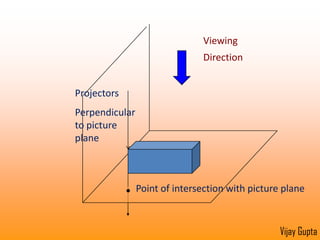
An orthographic projection consists of the view obtained view when the object is viewed from very far away, so that the resulting rays are all parallel.
The parallel rays that are used for constructing the views are called projectors.Vijay Gupta
Orthographic ProjectionsThe three principal views are take on picture planes which are held parallel to the three principal faces of the object, the front, the top and the side.
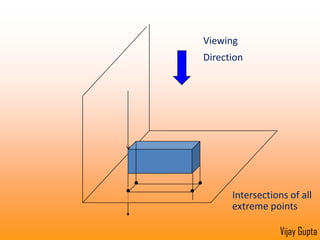
The intersections of the projectors with the picture plane are the projections of the points from which the projectors emanate.
The points are joined to obtain the views.Vijay Gupta
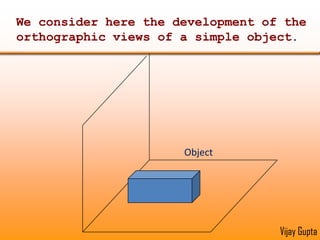
We consider here the development of the orthographic views of a simple object.ObjectVijay Gupta
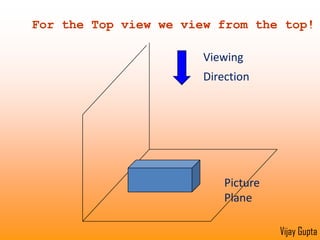
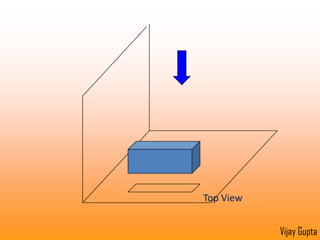
For the Top view we view from the top!ViewingDirectionPicture PlaneVijay Gupta
ViewingDirectionProjectorsPerpendicular to picture planePoint of intersection with picture planeVijay Gupta
ViewingDirectionIntersections of allextreme points Vijay Gupta
Top ViewVijay Gupta
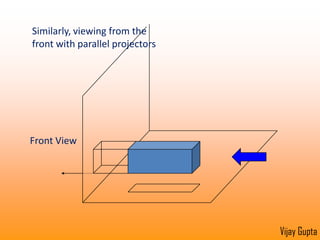
Similarly, viewing from the front with parallel projectorsFront ViewVijay Gupta
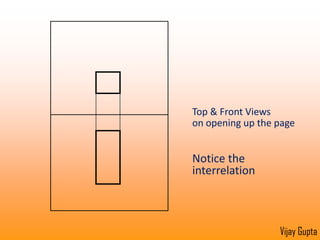
Top & Front Viewson opening up the pageNotice the interrelationVijay Gupta
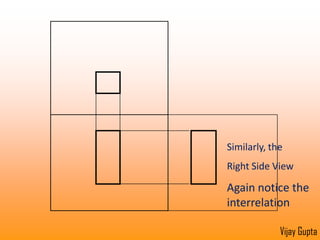
Similarly, theRight Side ViewAgain notice the interrelationVijay Gupta
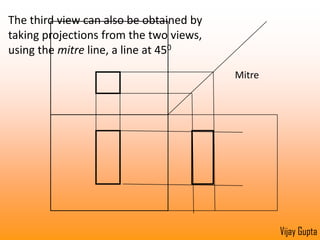
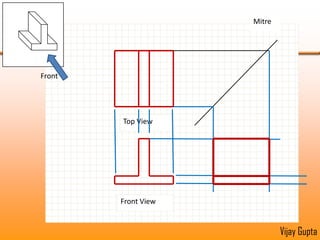
MitreThe third view can also be obtained by taking projections from the two views, using the mitre line, a line at 450Vijay Gupta
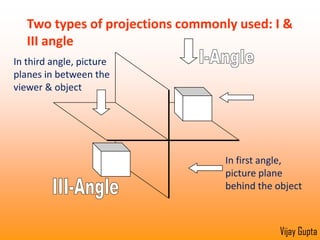
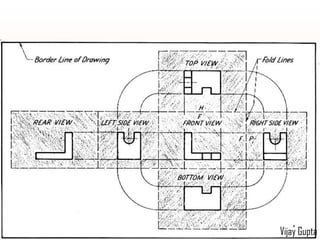
Two types of projections commonly used: I & III angleI-AngleIn third angle, picture planes in between the viewer & objectIn first angle, picture plane behind the objectIII-AngleVijay Gupta
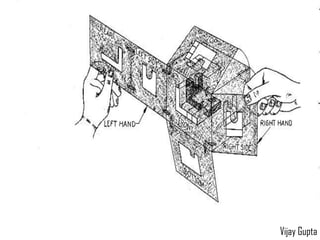
Opening up of the box with the various views in III angleVijay Gupta
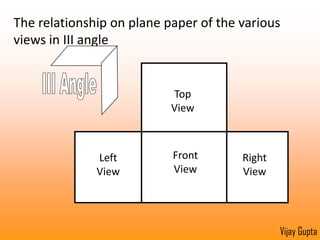
The relationship on plane paper of the various views in III angleIII AngleTopViewFrontViewRightViewLeft ViewVijay Gupta
Vijay Gupta
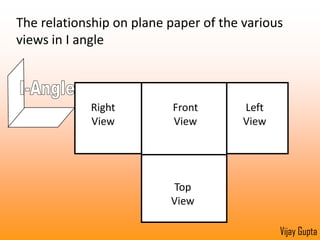
I-AngleThe relationship on plane paper of the various views in I angleFrontViewLeft ViewRightViewTopViewVijay Gupta
Vijay Gupta
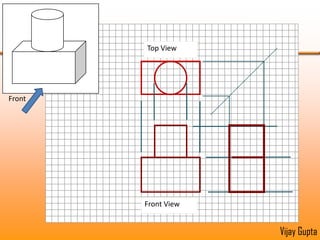
MitreFrontTop ViewFront ViewVijay Gupta
Top ViewFrontFront ViewVijay Gupta
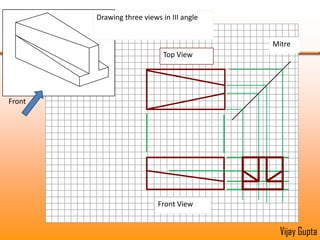
Drawing three views in III angleMitreTop ViewFrontFront ViewVijay Gupta
A VideoEngg_graphics.mpg
A demonstrationVijay GuptaGboxw31.exe
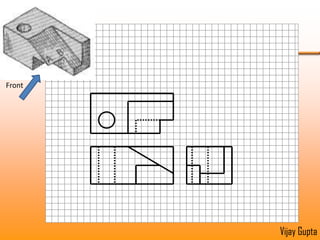
FrontVijay Gupta
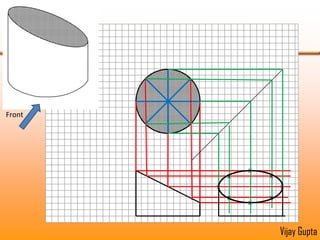
FrontXXXXXXXXVijay Gupta
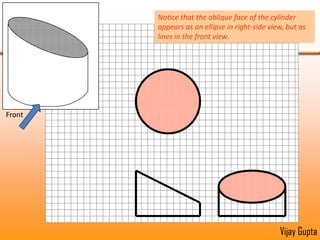
Notice that the oblique face of the cylinder appears as an ellipse in right-side view, but as lines in the front view.FrontVijay Gupta
Hidden Features
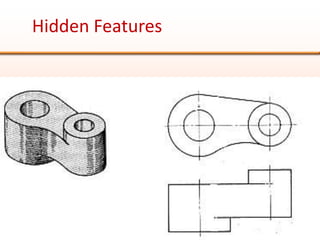
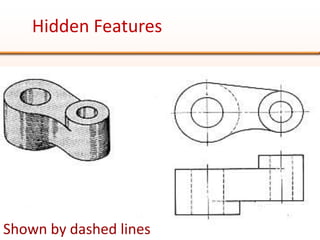
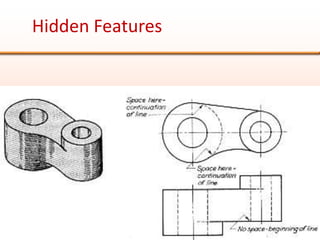
Hidden FeaturesShown by dashed lines
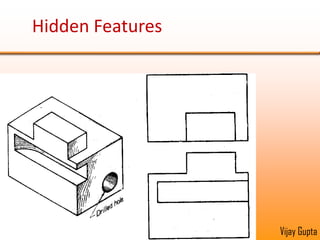
Hidden Features
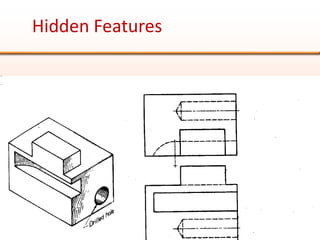
Hidden Features
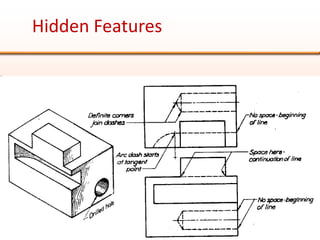
Hidden Features
Hidden Features
Lines and AreasProjections of lines and areas
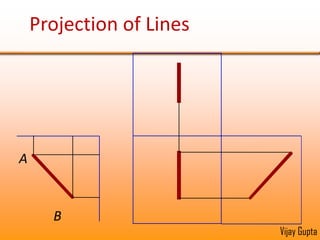
Meaning of lines and areas in    orthographic projectionsProjection of LinesAB
Projection of Lines A line may be projected in its true length
 A line may be fore-shortened
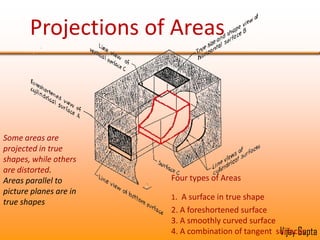
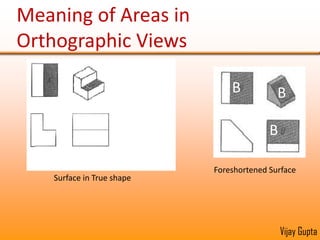
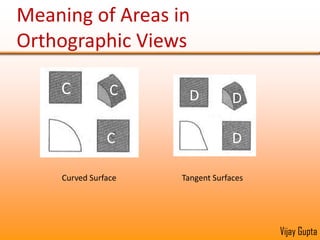
 A line may have a point as its projectionMeaning of Areas in Orthographic Views1. A surface in true shape2. A foreshortened surface3. A smoothly curved surface4. A combination of tangent  surfaces
Meaning of Areas in Orthographic ViewsBBBForeshortened SurfaceSurface in True shape
Meaning of Areas in Orthographic ViewsCCDDCDCurved SurfaceTangent Surfaces
Projections of AreasSome areas are projected in true shapes, while others are distorted.Areas parallel to picture planes are in true shapesFour types of Areas1.A surface in true shape2. A foreshortened surface3. A smoothly curved surface4. A combination of tangent  surfaces
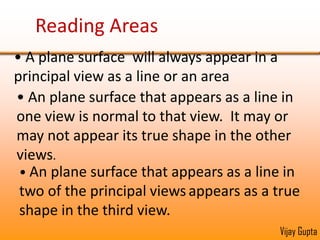
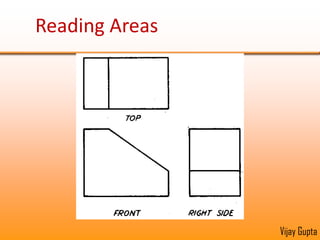
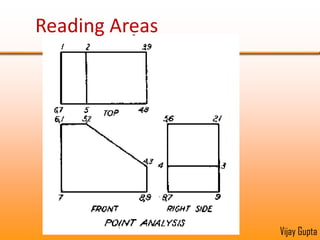
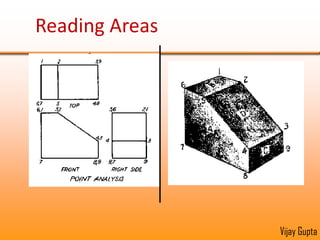
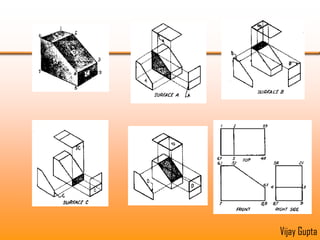
Reading Areas A plane surface  will always appear in a principal view as a line or an area
 An plane surface that appears as a line in one view is normal to that view.  It may or may not appear its true shape in the other views.
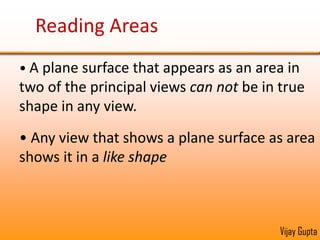
An plane surface that appears as a line in two of the principal viewsappears as a true shape in the third view. Reading AreasA plane surface that appears as an area in two of the principal views can not be in true shape in any view.
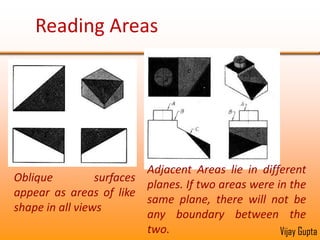
 Any view that shows a plane surface as area shows it in a like shapeReading AreasAdjacent Areas lie in different planes. If two areas were in the same plane, there will not be any boundary between the two.Oblique surfaces appear as areas of like shape in all views
Reading Areas
Reading Areas
Reading Areas
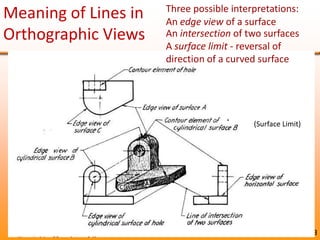
Meaning of Lines in Orthographic ViewsThree possible interpretations:An edge view of a surfaceAn intersection of two surfacesA surface limit - reversal of  direction of a curved surface(Surface Limit)
Meaning of Lines in Orthographic ViewsAn edge view of a surface
An intersection of two surfaces
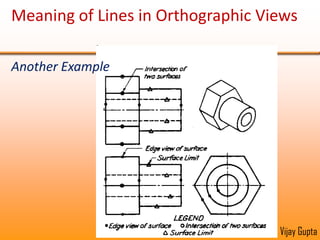
A surface limit - reversal of direction of a  curved surfaceMeaning of Lines in Orthographic ViewsAnother Example
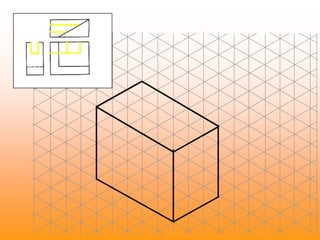
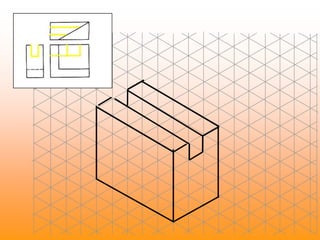
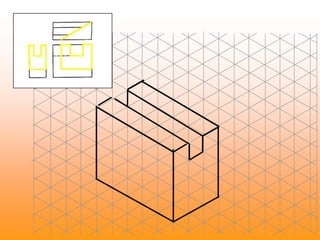
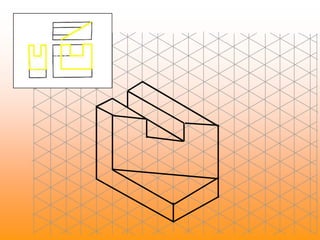
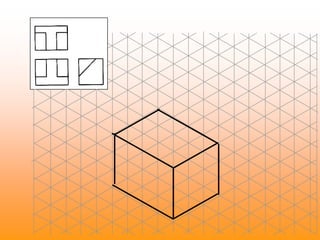
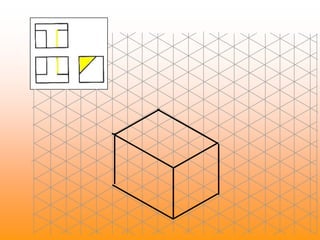
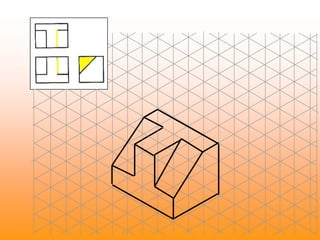
We next illustrate how to read the orthographic drawings.  This is done by interpreting the three view to ‘draw’ the represented by those view.
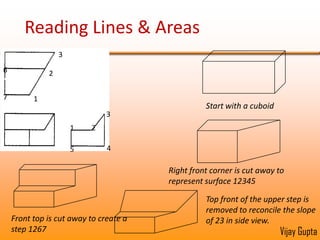
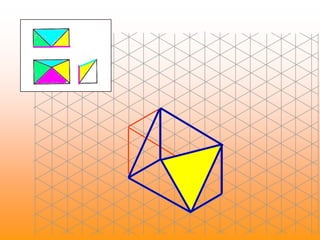
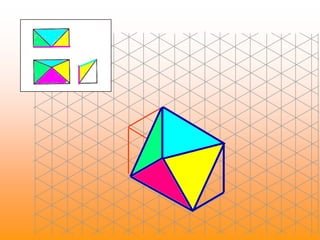
Reading Lines & AreasStart with a cuboid36271Right front corner is cut away to represent surface 12345312Top front of the upper step is removed to reconcile the slope of 23 in side view.45Front top is cut away to create a step 1267
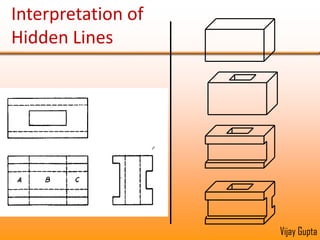
Interpretation of Hidden Lines
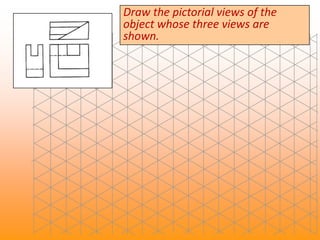
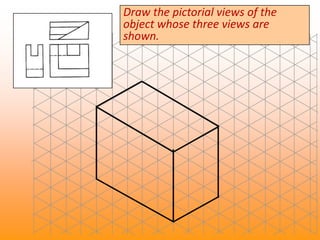
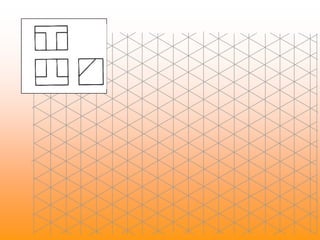
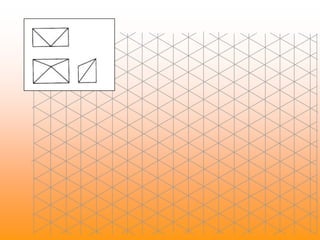
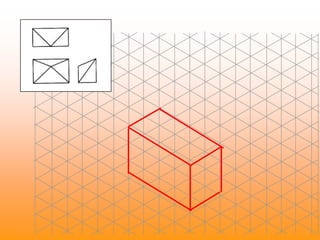
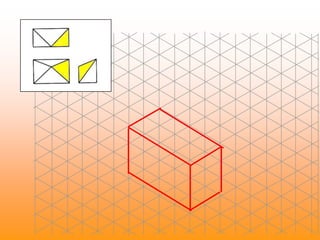
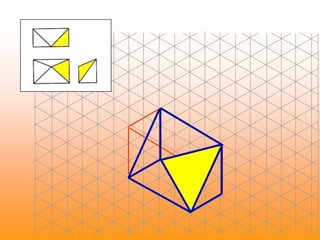
Draw the pictorial views of the object whose three views are shown.
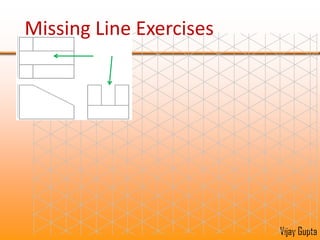
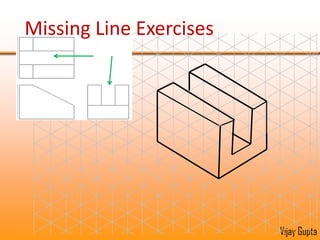
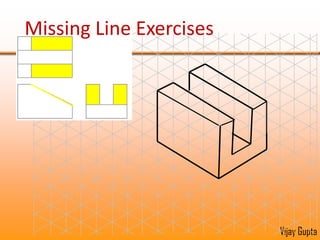
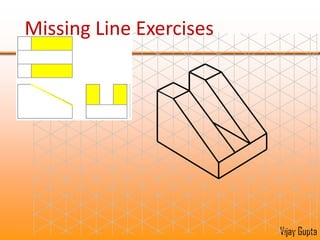
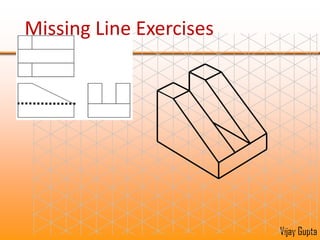
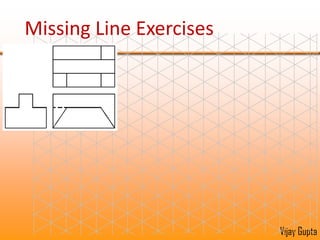
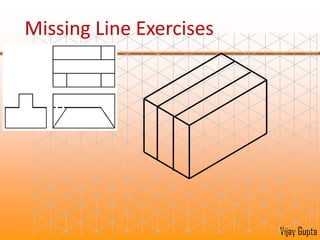
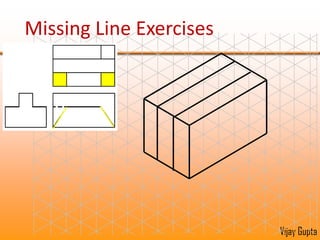
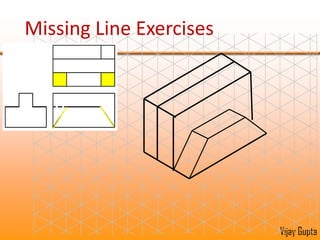
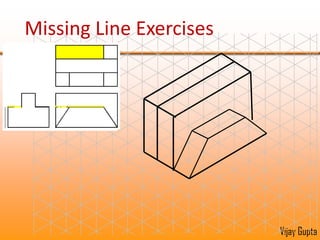
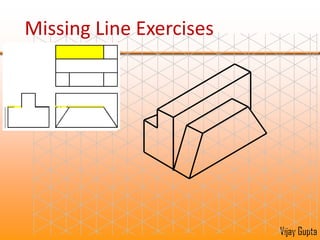
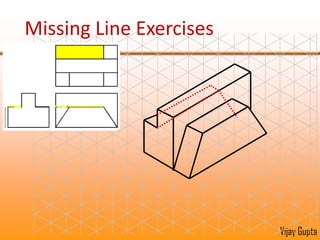
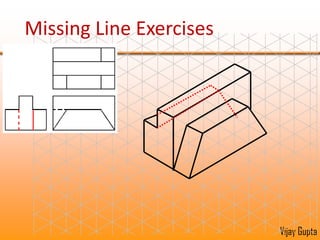
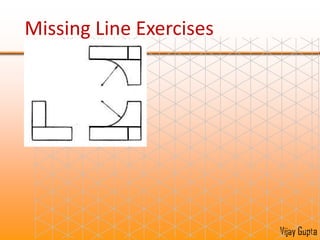
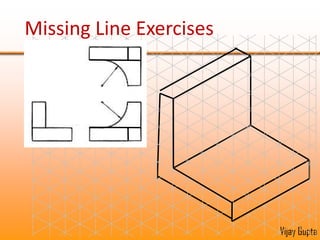
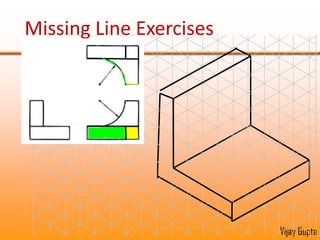
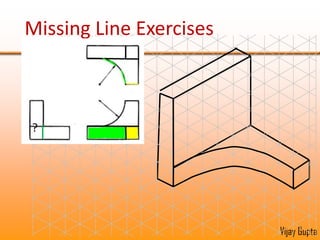
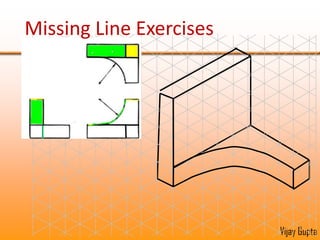
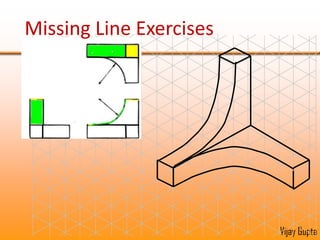
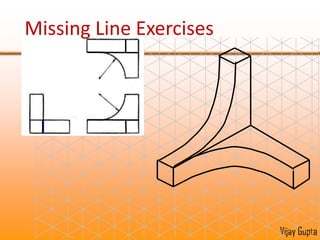
Missing Line ExercisesIn the examples that follow, one or more lines may be missing in (only) one view.  Try constructing a pictorial view to determine what line(s) are missing.
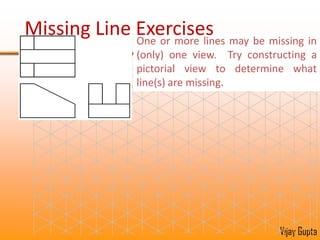
Missing Line ExercisesOne or more lines may be missing in (only) one view.  Try constructing a pictorial view to determine what line(s) are missing.
Missing Line Exercises
Missing Line Exercises?
Missing Line Exercises
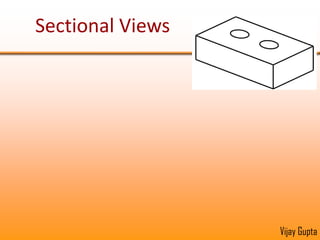
Sectional Views
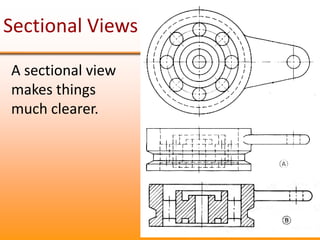
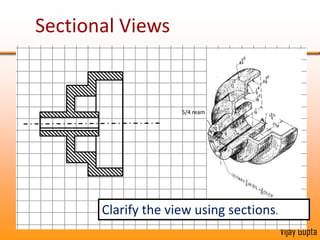
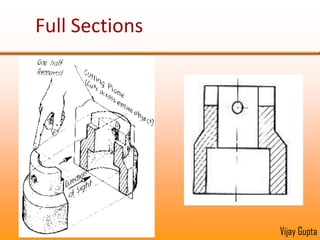
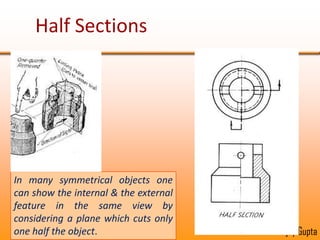
Sectional ViewsWhenever a representation becomes confused due to too many essential hidden details that it is difficult to interpret, sectional views are employed
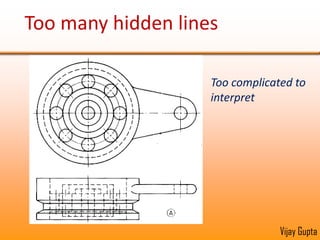
Too many hidden linesToo complicated to interpret
Sectional ViewsA portion of the part is cut away to reveal the interior.
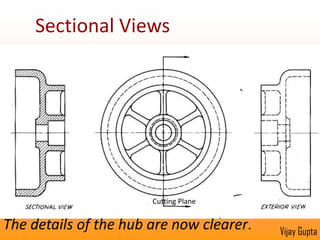
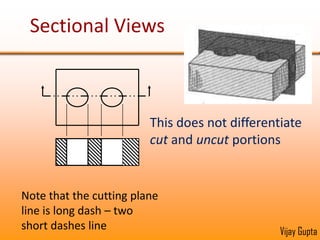
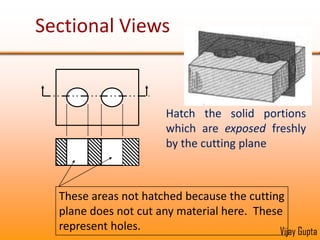
For this purpose a cutting plane is employed. The shape of the object is clarified by distinguishing between the areas where the cutting plane actually cuts the solid material and the areas where it meets voids.
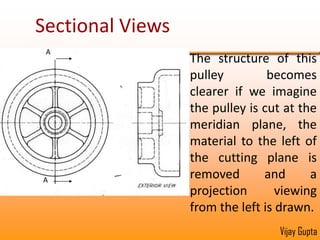
Wherever the cutting plane  cuts the solid material, the area is hatchedSectional ViewsAThe structure of this pulley becomes clearer if we imagine the pulley is cut at the meridian plane, the material to the left of the cutting plane is removed and a projection viewing from the left is drawn.A
Sectional ViewsCutting PlaneThe details of the hub are now clearer.
Sectional ViewsA sectional view makes things much clearer.
14773 chapter 07