2D Essentials


Instructor: Laura Gerold, PE
Catalog #10614113
Class # 22784, 24113, 24136, & 24138
Class Start: January 18, 2012
Class End: May 16, 2012
Reminders
• 50% Project Plans are due next week on April 4th!
  • Grading handout from last week is also on blackboard in the class
    materials / project folder
  • 3 Views with borders and scales due on April 4th for 30 points
• Optional extra credit is due on April 11th
  • Find other countries where 1st and 3rd angle projections are used
    for 5 extra points
  • Details are on blackboard in class materials / extra credit folder
Lingering Questions
from Chapter 6 . . .
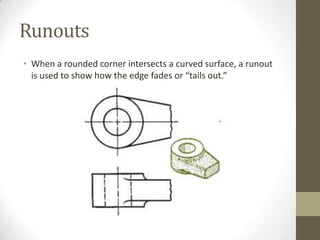
Runouts
• When a rounded corner intersects a curved surface, a runout
  is used to show how the edge fades or “tails out.”
Runouts – Group Projects
• Break into groups
• Look at page 212 in the text, Figure 6.14.
• Answer the following questions as a group:
  • Where are the runouts located on the orthographic sketches?
  • Where are the corresponding points on the isometric sketches
  • Be prepared to present one of the examples to the class.

• Does anyone have an example of a runout to show? Can you
  think of any examples from home, work, in this room?
• Work in groups to sketch example of runouts.
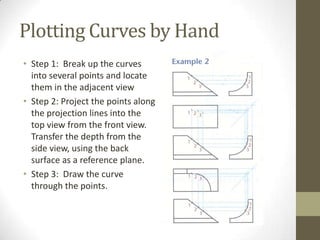
Plotting Curves by Hand
• Step 1: Break up the curves
  into several points and locate
  them in the adjacent view
• Step 2: Project the points along
  the projection lines into the
  top view from the front view.
  Transfer the depth from the
  side view, using the back
  surface as a reference plane.
• Step 3: Draw the curve
  through the points.
Plotting Curves by Hand
• Break into groups and Plot a curve by hand using example one
  on page 207.
• Start with the front and right views and use the method to
  plot the top view.
• How many points do you think you should use for an accurate
  curve?
Chapter 3 – Isometric
Drawing
Why Isometric Drawing?
• Isometric Drawing is used to visualize concepts and to present
  results to a client and the public
Some Key Concepts
• To Understand Isometric Projection and drawing, we need to
  learn a few key concepts first . . .
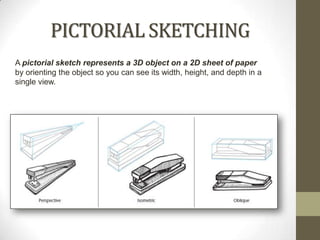
PICTORIAL SKETCHING
A pictorial sketch represents a 3D object on a 2D sheet of paper
by orienting the object so you can see its width, height, and depth in a
single view.
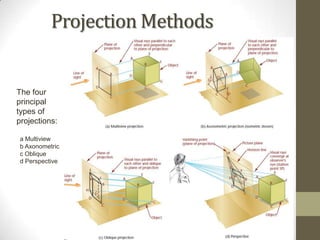
Projection Methods


The four
principal
types of
projections:

 a Multiview
 b Axonometric
 c Oblique
 d Perspective
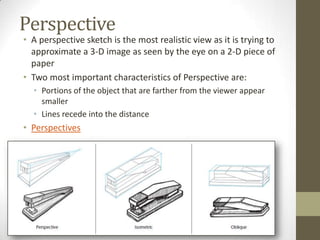
Perspective
• A perspective sketch is the most realistic view as it is trying to
  approximate a 3-D image as seen by the eye on a 2-D piece of
  paper
• Two most important characteristics of Perspective are:
  • Portions of the object that are farther from the viewer appear
    smaller
  • Lines recede into the distance
• Perspectives
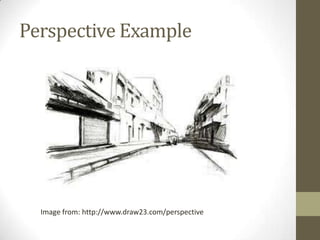
Perspective Example


  Image from: http://www.draw23.com/perspective
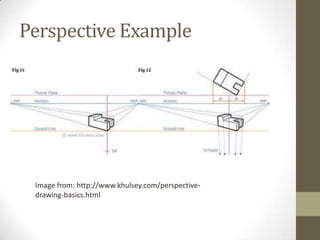
Perspective Example


 Image from: http://www.khulsey.com/perspective-
 drawing-basics.html
Oblique
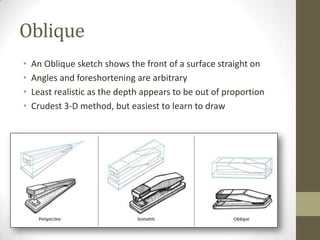
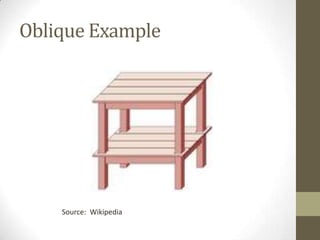
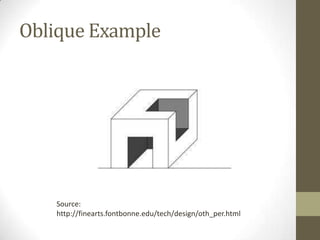
•   An Oblique sketch shows the front of a surface straight on
•   Angles and foreshortening are arbitrary
•   Least realistic as the depth appears to be out of proportion
•   Crudest 3-D method, but easiest to learn to draw
Oblique Example


    Source: Wikipedia
Oblique Example


   Source:
   http://finearts.fontbonne.edu/tech/design/oth_per.html
Isometric
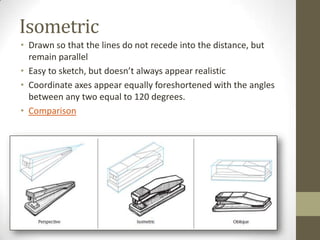
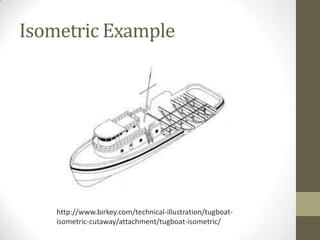
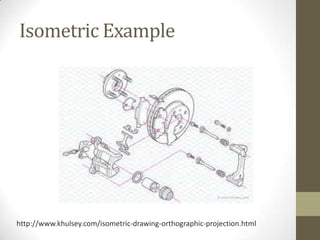
• Drawn so that the lines do not recede into the distance, but
  remain parallel
• Easy to sketch, but doesn’t always appear realistic
• Coordinate axes appear equally foreshortened with the angles
  between any two equal to 120 degrees.
• Comparison
Isometric Example


    http://www.birkey.com/technical-illustration/tugboat-
    isometric-cutaway/attachment/tugboat-isometric/
Isometric Example


http://www.khulsey.com/isometric-drawing-orthographic-projection.html
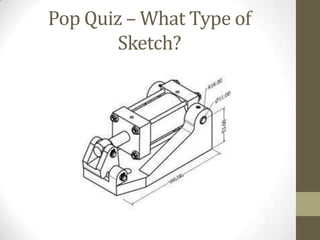
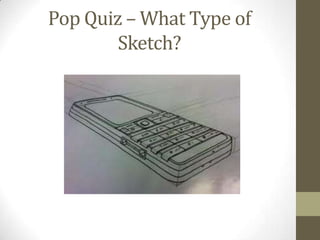
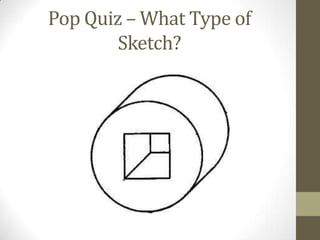
Pop Quiz – What Type of
        Sketch?
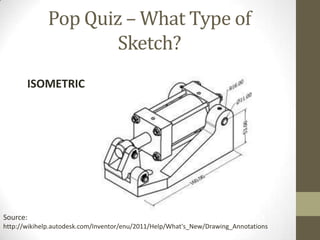
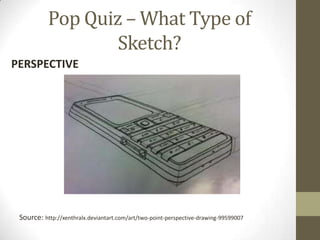
Pop Quiz – What Type of
                     Sketch?
       ISOMETRIC


Source:
http://wikihelp.autodesk.com/Inventor/enu/2011/Help/What's_New/Drawing_Annotations
Pop Quiz – What Type of
        Sketch?
Pop Quiz – What Type of
              Sketch?
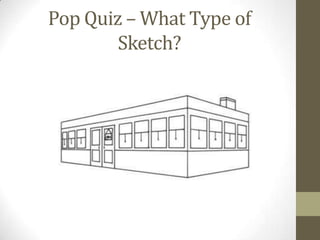
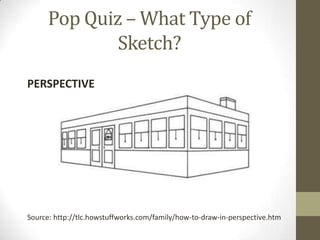
PERSPECTIVE


Source: http://tlc.howstuffworks.com/family/how-to-draw-in-perspective.htm
Pop Quiz – What Type of
        Sketch?
Pop Quiz – What Type of
               Sketch?
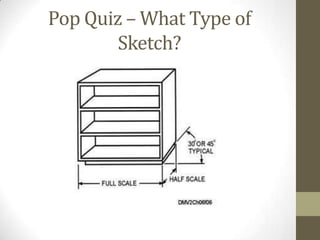
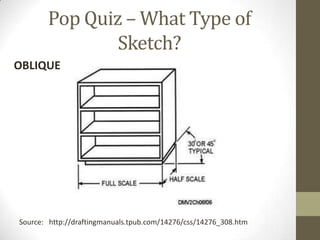
OBLIQUE


Source: http://draftingmanuals.tpub.com/14276/css/14276_308.htm
Pop Quiz – What Type of
        Sketch?
Pop Quiz – What Type of
                   Sketch?
PERSPECTIVE


 Source: http://xenthralx.deviantart.com/art/two-point-perspective-drawing-99599007
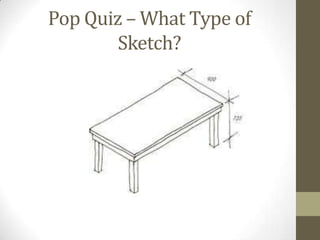
Pop Quiz – What Type of
        Sketch?
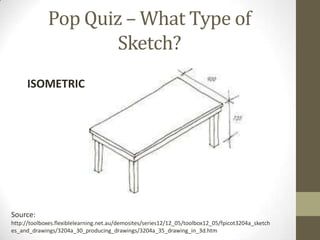
Pop Quiz – What Type of
                     Sketch?
     ISOMETRIC


Source:
http://toolboxes.flexiblelearning.net.au/demosites/series12/12_05/toolbox12_05/fpicot3204a_sketch
es_and_drawings/3204a_30_producing_drawings/3204a_35_drawing_in_3d.htm
Pop Quiz – What Type of
        Sketch?
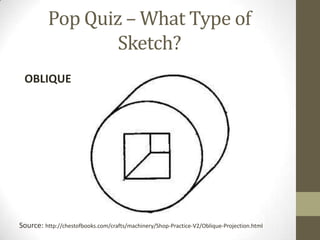
Pop Quiz – What Type of
                  Sketch?
 OBLIQUE


Source: http://chestofbooks.com/crafts/machinery/Shop-Practice-V2/Oblique-Projection.html
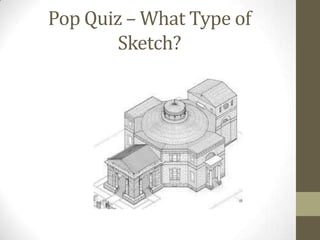
Pop Quiz – What Type of
        Sketch?
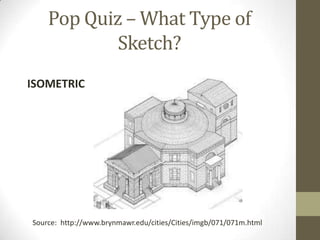
Pop Quiz – What Type of
            Sketch?
ISOMETRIC


Source: http://www.brynmawr.edu/cities/Cities/imgb/071/071m.html
Axonometric Drawings
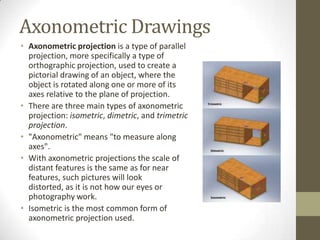
• Axonometric projection is a type of parallel
  projection, more specifically a type of
  orthographic projection, used to create a
  pictorial drawing of an object, where the
  object is rotated along one or more of its
  axes relative to the plane of projection.
• There are three main types of axonometric
  projection: isometric, dimetric, and trimetric
  projection.
• "Axonometric" means "to measure along
  axes".
• With axonometric projections the scale of
  distant features is the same as for near
  features, such pictures will look
  distorted, as it is not how our eyes or
  photography work.
• Isometric is the most common form of
  axonometric projection used.
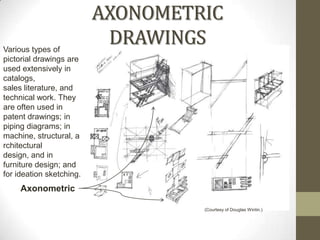
AXONOMETRIC
Various types of
                           DRAWINGS
pictorial drawings are
used extensively in
catalogs,
sales literature, and
technical work. They
are often used in
patent drawings; in
piping diagrams; in
machine, structural, a
rchitectural
design, and in
furniture design; and
for ideation sketching.
     Axonometric

                                   (Courtesy of Douglas Wintin.)
Isometric Projection
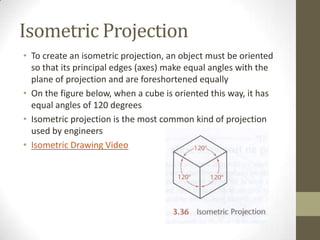
• To create an isometric projection, an object must be oriented
  so that its principal edges (axes) make equal angles with the
  plane of projection and are foreshortened equally
• On the figure below, when a cube is oriented this way, it has
  equal angles of 120 degrees
• Isometric projection is the most common kind of projection
  used by engineers
• Isometric Drawing Video
Isometric Lines
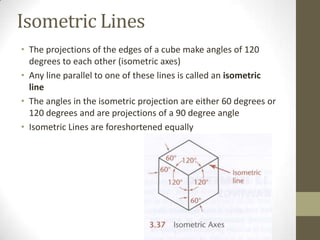
• The projections of the edges of a cube make angles of 120
  degrees to each other (isometric axes)
• Any line parallel to one of these lines is called an isometric
  line
• The angles in the isometric projection are either 60 degrees or
  120 degrees and are projections of a 90 degree angle
• Isometric Lines are foreshortened equally
Non-Isometric Lines
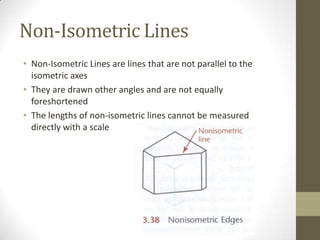
• Non-Isometric Lines are lines that are not parallel to the
  isometric axes
• They are drawn other angles and are not equally
  foreshortened
• The lengths of non-isometric lines cannot be measured
  directly with a scale
Isometric Scales
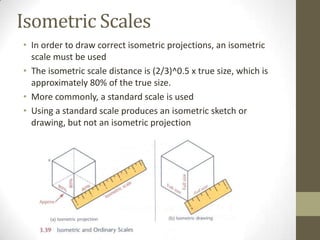
• In order to draw correct isometric projections, an isometric
  scale must be used
• The isometric scale distance is (2/3)^0.5 x true size, which is
  approximately 80% of the true size.
• More commonly, a standard scale is used
• Using a standard scale produces an isometric sketch or
  drawing, but not an isometric projection
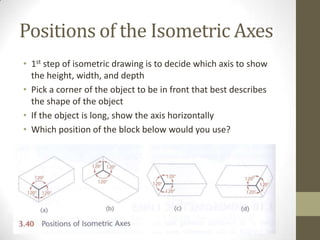
Positions of the Isometric Axes
• 1st step of isometric drawing is to decide which axis to show
  the height, width, and depth
• Pick a corner of the object to be in front that best describes
  the shape of the object
• If the object is long, show the axis horizontally
• Which position of the block below would you use?
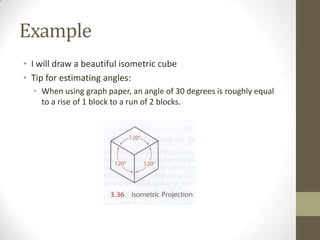
Example
• I will draw a beautiful isometric cube
• Tip for estimating angles:
  • When using graph paper, an angle of 30 degrees is roughly equal
    to a rise of 1 block to a run of 2 blocks.
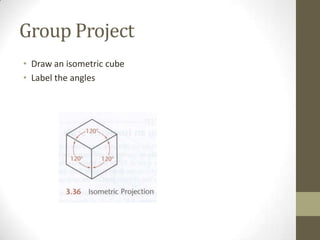
Group Project
• Draw an isometric cube
• Label the angles
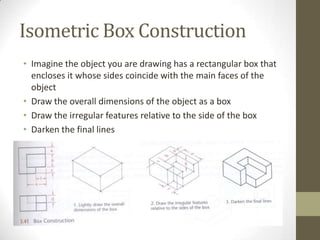
Isometric Box Construction
• Imagine the object you are drawing has a rectangular box that
  encloses it whose sides coincide with the main faces of the
  object
• Draw the overall dimensions of the object as a box
• Draw the irregular features relative to the side of the box
• Darken the final lines
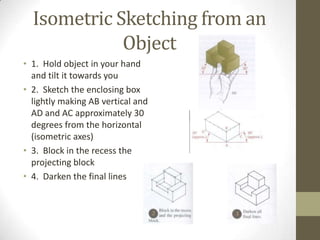
Isometric Sketching from an
             Object
• 1. Hold object in your hand
  and tilt it towards you
• 2. Sketch the enclosing box
  lightly making AB vertical and
  AD and AC approximately 30
  degrees from the horizontal
  (isometric axes)
• 3. Block in the recess the
  projecting block
• 4. Darken the final lines
ISOMETRIC DRAWINGS steps…
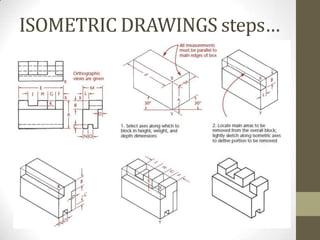
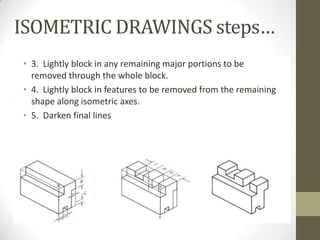
• 3. Lightly block in any remaining major portions to be
  removed through the whole block.
• 4. Lightly block in features to be removed from the remaining
  shape along isometric axes.
• 5. Darken final lines
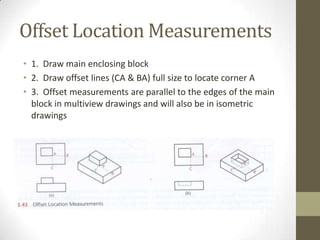
Offset Location Measurements
• 1. Draw main enclosing block
• 2. Draw offset lines (CA & BA) full size to locate corner A
• 3. Offset measurements are parallel to the edges of the main
  block in multiview drawings and will also be in isometric
  drawings
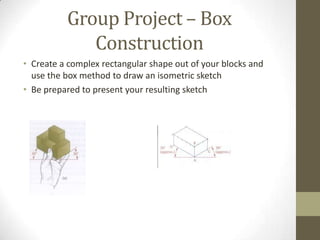
Group Project – Box
             Construction
• Create a complex rectangular shape out of your blocks and
  use the box method to draw an isometric sketch
• Be prepared to present your resulting sketch
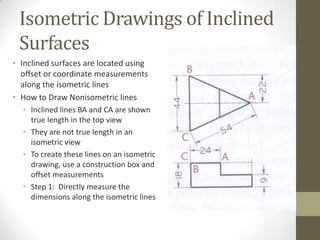
Isometric Drawings of Inclined
 Surfaces
• Inclined surfaces are located using
  offset or coordinate measurements
  along the isometric lines
• How to Draw Nonisometric lines
  • Inclined lines BA and CA are shown
    true length in the top view
  • They are not true length in an
    isometric view
  • To create these lines on an isometric
    drawing, use a construction box and
    offset measurements
  • Step 1: Directly measure the
    dimensions along the isometric lines
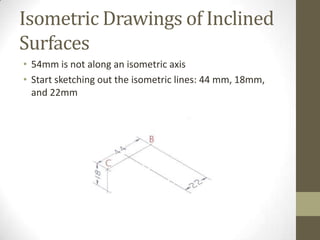
Isometric Drawings of Inclined
Surfaces
• 54mm is not along an isometric axis
• Start sketching out the isometric lines: 44 mm, 18mm,
  and 22mm
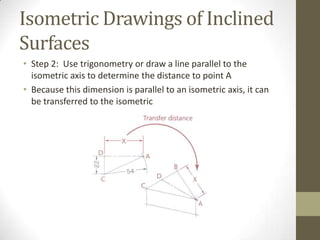
Isometric Drawings of Inclined
Surfaces
• Step 2: Use trigonometry or draw a line parallel to the
  isometric axis to determine the distance to point A
• Because this dimension is parallel to an isometric axis, it can
  be transferred to the isometric
Isometric Drawings of Inclined
Surfaces
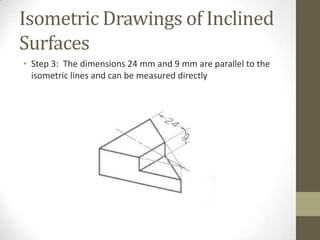
• Step 3: The dimensions 24 mm and 9 mm are parallel to the
  isometric lines and can be measured directly
Group Project - Isometric
Drawings of Inclined Surfaces
• Draw an isometric drawing of an object with an inclined
  surface. Use an object that you brought to class or one of
  mine.
• In your drawing, identify the isometric and non-isometric lines
• Present your results
Oblique Surfaces in Isometric
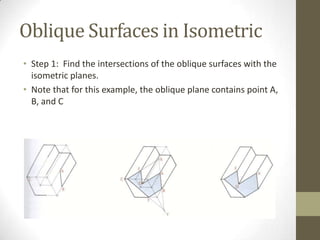
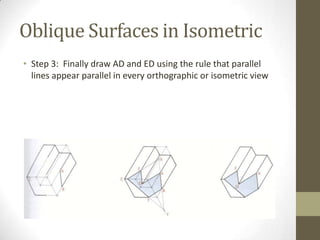
• Step 1: Find the intersections of the oblique surfaces with the
  isometric planes.
• Note that for this example, the oblique plane contains point A,
  B, and C
Oblique Surfaces in Isometric
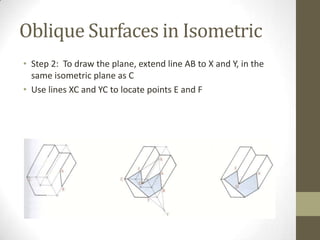
• Step 2: To draw the plane, extend line AB to X and Y, in the
  same isometric plane as C
• Use lines XC and YC to locate points E and F
Oblique Surfaces in Isometric
• Step 3: Finally draw AD and ED using the rule that parallel
  lines appear parallel in every orthographic or isometric view
Group Project - Oblique
        Surfaces in Isometric
• Create a simple isometric sketch of an oblique surface. Use
  items in the room, or go on a quick scavenger hunt around the
  2nd floor
• Label the isometric and non-isometric lines
• Shade in the oblique planes
• Present your drawing as a group to the class
Inclined Surfaces Example
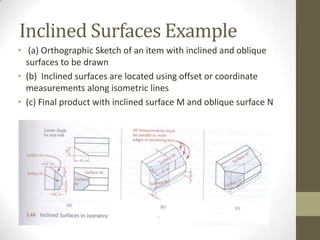
• (a) Orthographic Sketch of an item with inclined and oblique
  surfaces to be drawn
• (b) Inclined surfaces are located using offset or coordinate
  measurements along isometric lines
• (c) Final product with inclined surface M and oblique surface N
Visualization Exercise
• http://www.wisc-
  online.com/objects/ViewObject.aspx?ID=ENG20004
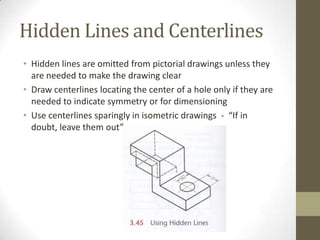
Hidden Lines and Centerlines
• Hidden lines are omitted from pictorial drawings unless they
  are needed to make the drawing clear
• Draw centerlines locating the center of a hole only if they are
  needed to indicate symmetry or for dimensioning
• Use centerlines sparingly in isometric drawings - “If in
  doubt, leave them out”
Group Project - Hidden Lines
       and Centerlines
• As a group, look through the isometric sketches on pages 228
  and 229 of the text.
• When were hidden lines and centerlines used?
• When were they not used?
• Do you agree with the representation?

Look through your sketches from today.
Did you use hidden lines and centerlines.
Where they used appropriately?
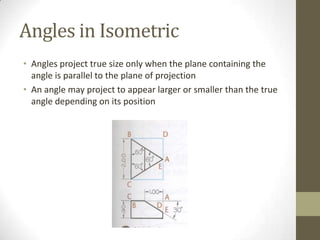
Angles in Isometric
• Angles project true size only when the plane containing the
  angle is parallel to the plane of projection
• An angle may project to appear larger or smaller than the true
  angle depending on its position
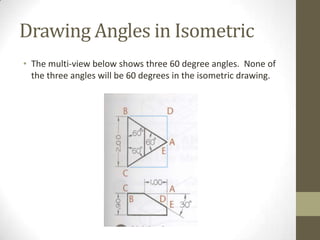
Drawing Angles in Isometric
• The multi-view below shows three 60 degree angles. None of
  the three angles will be 60 degrees in the isometric drawing.
Drawing Angles in Isometric
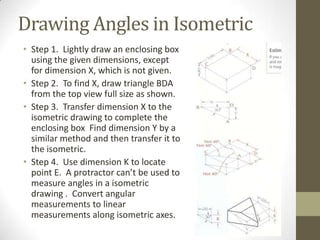
• Step 1. Lightly draw an enclosing box
  using the given dimensions, except
  for dimension X, which is not given.
• Step 2. To find X, draw triangle BDA
  from the top view full size as shown.
• Step 3. Transfer dimension X to the
  isometric drawing to complete the
  enclosing box Find dimension Y by a
  similar method and then transfer it to
  the isometric.
• Step 4. Use dimension K to locate
  point E. A protractor can’t be used to
  measure angles in a isometric
  drawing . Convert angular
  measurements to linear
  measurements along isometric axes.
Group Project - Angles in
            Isometric
• Draw a multi-view (orthographic) sketch of a triangle with
  three angles, 30, 60, and 90 on the front view, with a depth
  and width of your choice.
• Create an isometric drawing using your orthographic sketch
• Present
What’s Next?
• Finish Chapter 3 – Orthographic Sketching
• Start Chapter 7 – Section Views
• Project 50% Plans Due Next Week!!
Questions?
• On one of your sketches, answer the following two questions:
  • What was the most useful thing that you learned today?
  • What do you still have questions about?
Homework
Read Chapter 7
Chapter 3 Exercises: 3.1 (a, g, c, d – isometric sketch only)
Chapter 5 Exercises: 5.6 (1, 8 – isometric sketch only)

Class 9 presentation

  • 1.
    2D Essentials Instructor: LauraGerold, PE Catalog #10614113 Class # 22784, 24113, 24136, & 24138 Class Start: January 18, 2012 Class End: May 16, 2012
  • 2.
    Reminders • 50% ProjectPlans are due next week on April 4th! • Grading handout from last week is also on blackboard in the class materials / project folder • 3 Views with borders and scales due on April 4th for 30 points • Optional extra credit is due on April 11th • Find other countries where 1st and 3rd angle projections are used for 5 extra points • Details are on blackboard in class materials / extra credit folder
  • 3.
  • 4.
    Runouts • When arounded corner intersects a curved surface, a runout is used to show how the edge fades or “tails out.”
  • 5.
    Runouts – GroupProjects • Break into groups • Look at page 212 in the text, Figure 6.14. • Answer the following questions as a group: • Where are the runouts located on the orthographic sketches? • Where are the corresponding points on the isometric sketches • Be prepared to present one of the examples to the class. • Does anyone have an example of a runout to show? Can you think of any examples from home, work, in this room? • Work in groups to sketch example of runouts.
  • 6.
    Plotting Curves byHand • Step 1: Break up the curves into several points and locate them in the adjacent view • Step 2: Project the points along the projection lines into the top view from the front view. Transfer the depth from the side view, using the back surface as a reference plane. • Step 3: Draw the curve through the points.
  • 7.
    Plotting Curves byHand • Break into groups and Plot a curve by hand using example one on page 207. • Start with the front and right views and use the method to plot the top view. • How many points do you think you should use for an accurate curve?
  • 8.
    Chapter 3 –Isometric Drawing
  • 9.
    Why Isometric Drawing? •Isometric Drawing is used to visualize concepts and to present results to a client and the public
  • 10.
    Some Key Concepts •To Understand Isometric Projection and drawing, we need to learn a few key concepts first . . .
  • 11.
    PICTORIAL SKETCHING A pictorialsketch represents a 3D object on a 2D sheet of paper by orienting the object so you can see its width, height, and depth in a single view.
  • 12.
    Projection Methods The four principal typesof projections: a Multiview b Axonometric c Oblique d Perspective
  • 13.
    Perspective • A perspectivesketch is the most realistic view as it is trying to approximate a 3-D image as seen by the eye on a 2-D piece of paper • Two most important characteristics of Perspective are: • Portions of the object that are farther from the viewer appear smaller • Lines recede into the distance • Perspectives
  • 14.
    Perspective Example Image from: http://www.draw23.com/perspective
  • 15.
    Perspective Example Imagefrom: http://www.khulsey.com/perspective- drawing-basics.html
  • 16.
    Oblique • An Oblique sketch shows the front of a surface straight on • Angles and foreshortening are arbitrary • Least realistic as the depth appears to be out of proportion • Crudest 3-D method, but easiest to learn to draw
  • 17.
    Oblique Example Source: Wikipedia
  • 18.
    Oblique Example Source: http://finearts.fontbonne.edu/tech/design/oth_per.html
  • 19.
    Isometric • Drawn sothat the lines do not recede into the distance, but remain parallel • Easy to sketch, but doesn’t always appear realistic • Coordinate axes appear equally foreshortened with the angles between any two equal to 120 degrees. • Comparison
  • 20.
    Isometric Example http://www.birkey.com/technical-illustration/tugboat- isometric-cutaway/attachment/tugboat-isometric/
  • 21.
  • 22.
    Pop Quiz –What Type of Sketch?
  • 23.
    Pop Quiz –What Type of Sketch? ISOMETRIC Source: http://wikihelp.autodesk.com/Inventor/enu/2011/Help/What's_New/Drawing_Annotations
  • 24.
    Pop Quiz –What Type of Sketch?
  • 25.
    Pop Quiz –What Type of Sketch? PERSPECTIVE Source: http://tlc.howstuffworks.com/family/how-to-draw-in-perspective.htm
  • 26.
    Pop Quiz –What Type of Sketch?
  • 27.
    Pop Quiz –What Type of Sketch? OBLIQUE Source: http://draftingmanuals.tpub.com/14276/css/14276_308.htm
  • 28.
    Pop Quiz –What Type of Sketch?
  • 29.
    Pop Quiz –What Type of Sketch? PERSPECTIVE Source: http://xenthralx.deviantart.com/art/two-point-perspective-drawing-99599007
  • 30.
    Pop Quiz –What Type of Sketch?
  • 31.
    Pop Quiz –What Type of Sketch? ISOMETRIC Source: http://toolboxes.flexiblelearning.net.au/demosites/series12/12_05/toolbox12_05/fpicot3204a_sketch es_and_drawings/3204a_30_producing_drawings/3204a_35_drawing_in_3d.htm
  • 32.
    Pop Quiz –What Type of Sketch?
  • 33.
    Pop Quiz –What Type of Sketch? OBLIQUE Source: http://chestofbooks.com/crafts/machinery/Shop-Practice-V2/Oblique-Projection.html
  • 34.
    Pop Quiz –What Type of Sketch?
  • 35.
    Pop Quiz –What Type of Sketch? ISOMETRIC Source: http://www.brynmawr.edu/cities/Cities/imgb/071/071m.html
  • 36.
    Axonometric Drawings • Axonometricprojection is a type of parallel projection, more specifically a type of orthographic projection, used to create a pictorial drawing of an object, where the object is rotated along one or more of its axes relative to the plane of projection. • There are three main types of axonometric projection: isometric, dimetric, and trimetric projection. • "Axonometric" means "to measure along axes". • With axonometric projections the scale of distant features is the same as for near features, such pictures will look distorted, as it is not how our eyes or photography work. • Isometric is the most common form of axonometric projection used.
  • 37.
    AXONOMETRIC Various types of DRAWINGS pictorial drawings are used extensively in catalogs, sales literature, and technical work. They are often used in patent drawings; in piping diagrams; in machine, structural, a rchitectural design, and in furniture design; and for ideation sketching. Axonometric (Courtesy of Douglas Wintin.)
  • 38.
    Isometric Projection • Tocreate an isometric projection, an object must be oriented so that its principal edges (axes) make equal angles with the plane of projection and are foreshortened equally • On the figure below, when a cube is oriented this way, it has equal angles of 120 degrees • Isometric projection is the most common kind of projection used by engineers • Isometric Drawing Video
  • 39.
    Isometric Lines • Theprojections of the edges of a cube make angles of 120 degrees to each other (isometric axes) • Any line parallel to one of these lines is called an isometric line • The angles in the isometric projection are either 60 degrees or 120 degrees and are projections of a 90 degree angle • Isometric Lines are foreshortened equally
  • 40.
    Non-Isometric Lines • Non-IsometricLines are lines that are not parallel to the isometric axes • They are drawn other angles and are not equally foreshortened • The lengths of non-isometric lines cannot be measured directly with a scale
  • 41.
    Isometric Scales • Inorder to draw correct isometric projections, an isometric scale must be used • The isometric scale distance is (2/3)^0.5 x true size, which is approximately 80% of the true size. • More commonly, a standard scale is used • Using a standard scale produces an isometric sketch or drawing, but not an isometric projection
  • 42.
    Positions of theIsometric Axes • 1st step of isometric drawing is to decide which axis to show the height, width, and depth • Pick a corner of the object to be in front that best describes the shape of the object • If the object is long, show the axis horizontally • Which position of the block below would you use?
  • 43.
    Example • I willdraw a beautiful isometric cube • Tip for estimating angles: • When using graph paper, an angle of 30 degrees is roughly equal to a rise of 1 block to a run of 2 blocks.
  • 44.
    Group Project • Drawan isometric cube • Label the angles
  • 45.
    Isometric Box Construction •Imagine the object you are drawing has a rectangular box that encloses it whose sides coincide with the main faces of the object • Draw the overall dimensions of the object as a box • Draw the irregular features relative to the side of the box • Darken the final lines
  • 46.
    Isometric Sketching froman Object • 1. Hold object in your hand and tilt it towards you • 2. Sketch the enclosing box lightly making AB vertical and AD and AC approximately 30 degrees from the horizontal (isometric axes) • 3. Block in the recess the projecting block • 4. Darken the final lines
  • 47.
  • 48.
    ISOMETRIC DRAWINGS steps… •3. Lightly block in any remaining major portions to be removed through the whole block. • 4. Lightly block in features to be removed from the remaining shape along isometric axes. • 5. Darken final lines
  • 49.
    Offset Location Measurements •1. Draw main enclosing block • 2. Draw offset lines (CA & BA) full size to locate corner A • 3. Offset measurements are parallel to the edges of the main block in multiview drawings and will also be in isometric drawings
  • 50.
    Group Project –Box Construction • Create a complex rectangular shape out of your blocks and use the box method to draw an isometric sketch • Be prepared to present your resulting sketch
  • 51.
    Isometric Drawings ofInclined Surfaces • Inclined surfaces are located using offset or coordinate measurements along the isometric lines • How to Draw Nonisometric lines • Inclined lines BA and CA are shown true length in the top view • They are not true length in an isometric view • To create these lines on an isometric drawing, use a construction box and offset measurements • Step 1: Directly measure the dimensions along the isometric lines
  • 52.
    Isometric Drawings ofInclined Surfaces • 54mm is not along an isometric axis • Start sketching out the isometric lines: 44 mm, 18mm, and 22mm
  • 53.
    Isometric Drawings ofInclined Surfaces • Step 2: Use trigonometry or draw a line parallel to the isometric axis to determine the distance to point A • Because this dimension is parallel to an isometric axis, it can be transferred to the isometric
  • 54.
    Isometric Drawings ofInclined Surfaces • Step 3: The dimensions 24 mm and 9 mm are parallel to the isometric lines and can be measured directly
  • 55.
    Group Project -Isometric Drawings of Inclined Surfaces • Draw an isometric drawing of an object with an inclined surface. Use an object that you brought to class or one of mine. • In your drawing, identify the isometric and non-isometric lines • Present your results
  • 56.
    Oblique Surfaces inIsometric • Step 1: Find the intersections of the oblique surfaces with the isometric planes. • Note that for this example, the oblique plane contains point A, B, and C
  • 57.
    Oblique Surfaces inIsometric • Step 2: To draw the plane, extend line AB to X and Y, in the same isometric plane as C • Use lines XC and YC to locate points E and F
  • 58.
    Oblique Surfaces inIsometric • Step 3: Finally draw AD and ED using the rule that parallel lines appear parallel in every orthographic or isometric view
  • 59.
    Group Project -Oblique Surfaces in Isometric • Create a simple isometric sketch of an oblique surface. Use items in the room, or go on a quick scavenger hunt around the 2nd floor • Label the isometric and non-isometric lines • Shade in the oblique planes • Present your drawing as a group to the class
  • 60.
    Inclined Surfaces Example •(a) Orthographic Sketch of an item with inclined and oblique surfaces to be drawn • (b) Inclined surfaces are located using offset or coordinate measurements along isometric lines • (c) Final product with inclined surface M and oblique surface N
  • 61.
    Visualization Exercise • http://www.wisc- online.com/objects/ViewObject.aspx?ID=ENG20004
  • 62.
    Hidden Lines andCenterlines • Hidden lines are omitted from pictorial drawings unless they are needed to make the drawing clear • Draw centerlines locating the center of a hole only if they are needed to indicate symmetry or for dimensioning • Use centerlines sparingly in isometric drawings - “If in doubt, leave them out”
  • 63.
    Group Project -Hidden Lines and Centerlines • As a group, look through the isometric sketches on pages 228 and 229 of the text. • When were hidden lines and centerlines used? • When were they not used? • Do you agree with the representation? Look through your sketches from today. Did you use hidden lines and centerlines. Where they used appropriately?
  • 64.
    Angles in Isometric •Angles project true size only when the plane containing the angle is parallel to the plane of projection • An angle may project to appear larger or smaller than the true angle depending on its position
  • 65.
    Drawing Angles inIsometric • The multi-view below shows three 60 degree angles. None of the three angles will be 60 degrees in the isometric drawing.
  • 66.
    Drawing Angles inIsometric • Step 1. Lightly draw an enclosing box using the given dimensions, except for dimension X, which is not given. • Step 2. To find X, draw triangle BDA from the top view full size as shown. • Step 3. Transfer dimension X to the isometric drawing to complete the enclosing box Find dimension Y by a similar method and then transfer it to the isometric. • Step 4. Use dimension K to locate point E. A protractor can’t be used to measure angles in a isometric drawing . Convert angular measurements to linear measurements along isometric axes.
  • 67.
    Group Project -Angles in Isometric • Draw a multi-view (orthographic) sketch of a triangle with three angles, 30, 60, and 90 on the front view, with a depth and width of your choice. • Create an isometric drawing using your orthographic sketch • Present
  • 68.
    What’s Next? • FinishChapter 3 – Orthographic Sketching • Start Chapter 7 – Section Views • Project 50% Plans Due Next Week!!
  • 69.
    Questions? • On oneof your sketches, answer the following two questions: • What was the most useful thing that you learned today? • What do you still have questions about?
  • 70.
    Homework Read Chapter 7 Chapter3 Exercises: 3.1 (a, g, c, d – isometric sketch only) Chapter 5 Exercises: 5.6 (1, 8 – isometric sketch only)