Isometric Projections   In order to draw an isometric projection of an object, isometric dot paper is used. All the dots on isometric dot paper are spaced an equal distance apart. When an object is drawn on isometric dot paper, the vertical lines remain vertical but the horizontal lines are drawn at a 30º angle to the horizontal. Unit 2 – Design & Measurement
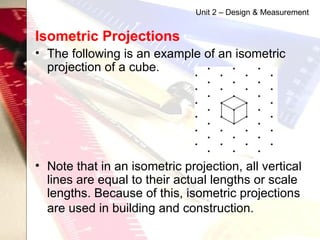
Isometric Projections   The following is an example of an isometric projection of a cube. Note that in an isometric projection, all vertical lines are equal to their actual lengths or scale lengths. Because of this, isometric projections are used in building and construction.   Unit 2 – Design & Measurement
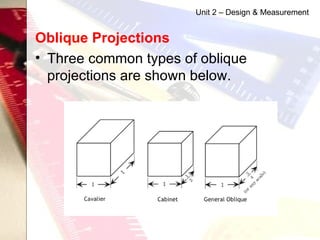
Oblique Projections   Oblique projections  are pictorial representations showing the depth of an object. The face of the object is drawn exactly to scale. The oblique, or slanted line, is best drawn using graph paper, and moving diagonally from one corner to the opposite corner on a 45º angle. The actual measurements should be labeled along the sides, indicating exactly how long each measurement will be in the actual object. The scale of the drawing should also be included.  Unit 2 – Design & Measurement
Oblique Projections   Three common types of oblique projections are shown below.   Unit 2 – Design & Measurement
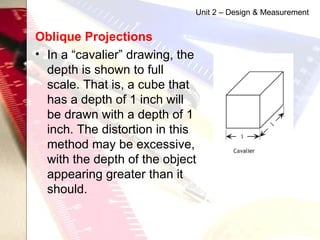
Oblique Projections   In a “cavalier” drawing, the depth is shown to full scale. That is, a cube that has a depth of 1 inch will be drawn with a depth of 1 inch. The distortion in this method may be excessive, with the depth of the object appearing greater than it should.  Unit 2 – Design & Measurement
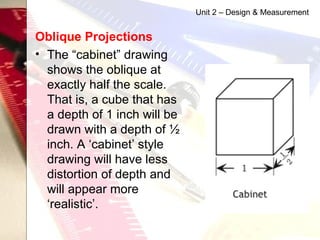
Oblique Projections   The “cabinet” drawing shows the oblique at exactly half the scale. That is, a cube that has a depth of 1 inch will be drawn with a depth of ½ inch. A ‘cabinet’ style drawing will have less distortion of depth and will appear more ‘realistic’.  Unit 2 – Design & Measurement
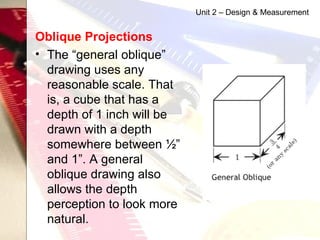
Oblique Projections   The “general oblique” drawing uses any reasonable scale. That is, a cube that has a depth of 1 inch will be drawn with a depth somewhere between ½” and 1”. A general oblique drawing also allows the depth perception to look more natural.  Unit 2 – Design & Measurement
Notebook Assignments Page 93 – Q. 1 – 2 Unit 2 – Design & Measurement

Pictorial Drawings

  • 1.
    Isometric Projections In order to draw an isometric projection of an object, isometric dot paper is used. All the dots on isometric dot paper are spaced an equal distance apart. When an object is drawn on isometric dot paper, the vertical lines remain vertical but the horizontal lines are drawn at a 30º angle to the horizontal. Unit 2 – Design & Measurement
  • 2.
    Isometric Projections The following is an example of an isometric projection of a cube. Note that in an isometric projection, all vertical lines are equal to their actual lengths or scale lengths. Because of this, isometric projections are used in building and construction. Unit 2 – Design & Measurement
  • 3.
    Oblique Projections Oblique projections are pictorial representations showing the depth of an object. The face of the object is drawn exactly to scale. The oblique, or slanted line, is best drawn using graph paper, and moving diagonally from one corner to the opposite corner on a 45º angle. The actual measurements should be labeled along the sides, indicating exactly how long each measurement will be in the actual object. The scale of the drawing should also be included. Unit 2 – Design & Measurement
  • 4.
    Oblique Projections Three common types of oblique projections are shown below. Unit 2 – Design & Measurement
  • 5.
    Oblique Projections In a “cavalier” drawing, the depth is shown to full scale. That is, a cube that has a depth of 1 inch will be drawn with a depth of 1 inch. The distortion in this method may be excessive, with the depth of the object appearing greater than it should. Unit 2 – Design & Measurement
  • 6.
    Oblique Projections The “cabinet” drawing shows the oblique at exactly half the scale. That is, a cube that has a depth of 1 inch will be drawn with a depth of ½ inch. A ‘cabinet’ style drawing will have less distortion of depth and will appear more ‘realistic’. Unit 2 – Design & Measurement
  • 7.
    Oblique Projections The “general oblique” drawing uses any reasonable scale. That is, a cube that has a depth of 1 inch will be drawn with a depth somewhere between ½” and 1”. A general oblique drawing also allows the depth perception to look more natural. Unit 2 – Design & Measurement
  • 8.
    Notebook Assignments Page93 – Q. 1 – 2 Unit 2 – Design & Measurement