ORTHOGRAPHIC PROJECTION
ISSUE’S TO BE DISCUSSED
• PROJECTIONS AND ITS TYPES
• ORTHOGRAPHIC PROJECTION
• 1ST
AND 3RD
ANGLE PROJECTION
PROJECTION
• Any kind of representation of an object on a
paper, screen or similar surface by drawing
is called projection of that object.
3
TYPES OF PROJECTION
• Pictorial Projection : Length, breadth and
height of an object is shown in one view.
• Orthographic Projection : Projection
obtained when projectors are parallel to
each other but perpendicular to the plane of
projection.
4
• An orthographic projection consists of the view
obtained view when the object is viewed from
very far away, so that the resulting rays are all
parallel.
• The parallel rays that are used for constructing the
views are called projectors.
Orthographic Projections
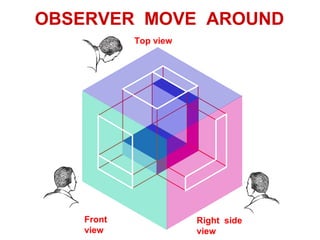
OBSERVER MOVE AROUND
Front
view
Right side
view
Top view
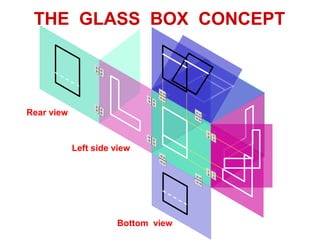
THE GLASS BOX CONCEPT
Bottom view
Left side view
Rear view
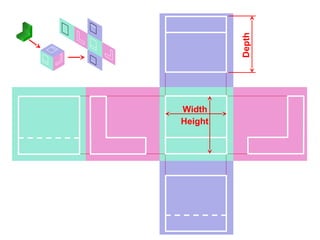
Height
Width
Depth
History
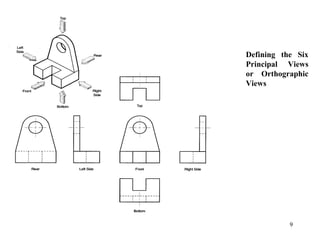
Defining the Six
Principal Views
or Orthographic
Views
9
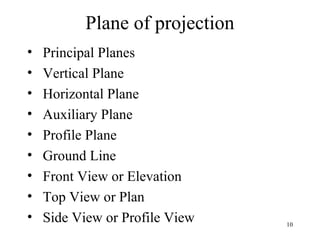
Plane of projection
• Principal Planes
• Vertical Plane
• Horizontal Plane
• Auxiliary Plane
• Profile Plane
• Ground Line
• Front View or Elevation
• Top View or Plan
• Side View or Profile View 10
11
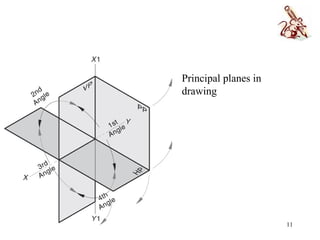
Principal planes in
drawing
12
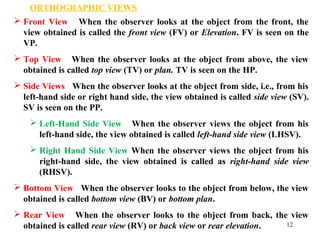
 Front View When the observer looks at the object from the front, the
view obtained is called the front view (FV) or Elevation. FV is seen on the
VP.
 Top View When the observer looks at the object from above, the view
obtained is called top view (TV) or plan. TV is seen on the HP.
 Side Views When the observer looks at the object from side, i.e., from his
left-hand side or right hand side, the view obtained is called side view (SV).
SV is seen on the PP.
 Left-Hand Side View When the observer views the object from his
left-hand side, the view obtained is called left-hand side view (LHSV).
 Right Hand Side View When the observer views the object from his
right-hand side, the view obtained is called as right-hand side view
(RHSV).
 Bottom View When the observer looks to the object from below, the view
obtained is called bottom view (BV) or bottom plan.
 Rear View When the observer looks to the object from back, the view
obtained is called rear view (RV) or back view or rear elevation.
ORTHOGRAPHIC VIEWS
13
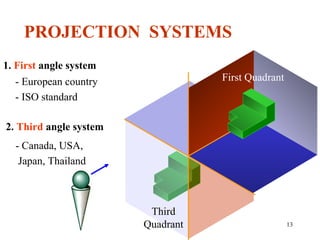
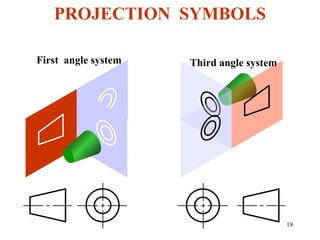
PROJECTION SYSTEMS
1. First angle system
2. Third angle system
First Quadrant
Third
Quadrant
- European country
- ISO standard
- Canada, USA,
Japan, Thailand
14
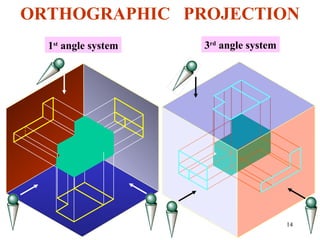
ORTHOGRAPHIC PROJECTION
1st
angle system 3rd
angle system
15
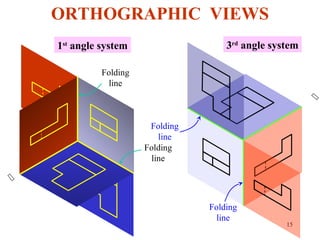
ORTHOGRAPHIC VIEWS
1st
angle system 3rd
angle system
Folding
line
Folding
line
Folding
line
Folding
line


16
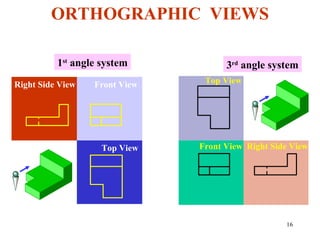
ORTHOGRAPHIC VIEWS
1st
angle system 3rd
angle system
Front View
Front View
Right Side View
Right Side View
Top View
Top View
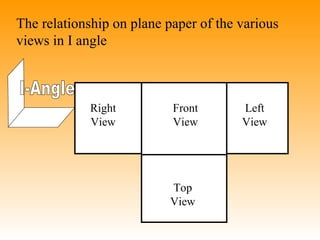
The relationship on plane paper of the various
views in I angle
Top
View
Front
View
Left
View
Right
View
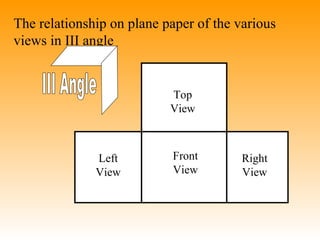
The relationship on plane paper of the various
views in III angle
Top
View
Front
View
Right
View
Left
View
19
First angle system Third angle system
PROJECTION SYMBOLS
20
20
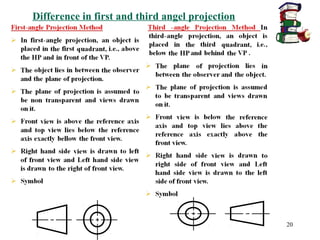
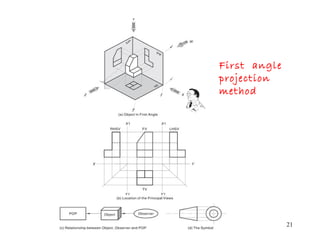
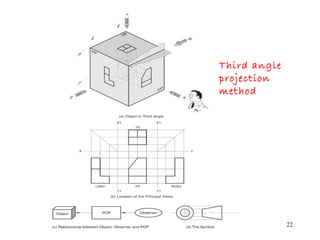
Difference in first and third angel projection
21
First angle
projection
method
22
Third angle
projection
method
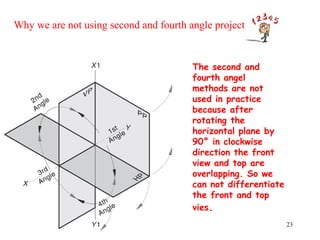
23
The second and
fourth angel
methods are not
used in practice
because after
rotating the
horizontal plane by
90° in clockwise
direction the front
view and top are
overlapping. So we
can not differentiate
the front and top
vies.
Why we are not using second and fourth angle projections ?
Orthographic Writing
Steps
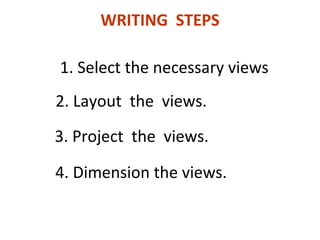
WRITING STEPS
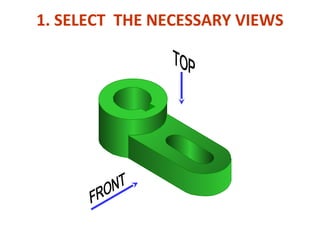
1. Select the necessary views
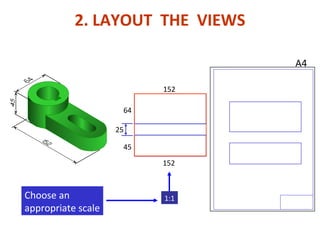
2. Layout the views.
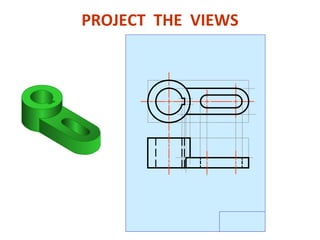
3. Project the views.
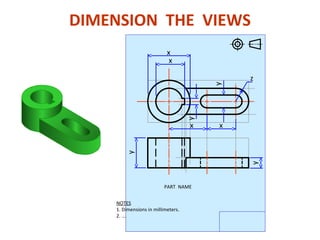
4. Dimension the views.
1. SELECT THE NECESSARY VIEWS
45
152
152
64
2. LAYOUT THE VIEWS
A4
25
Choose an
appropriate scale
1:1
PROJECT THE VIEWS
DIMENSION THE VIEWS
NOTES
1. Dimensions in millimeters.
2. ….
PART NAME
x
x
x x
y
y
y
y
z
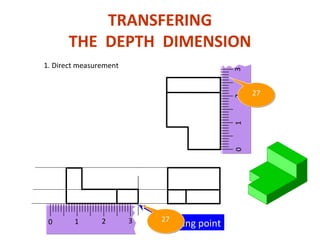
TRANSFERING
THE DEPTH DIMENSION
1. Direct measurement
0123
27
0 1 2 3 Starting point27
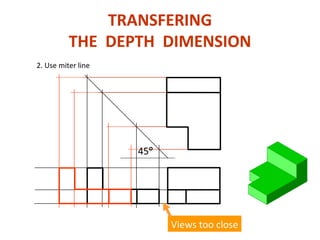
TRANSFERING
THE DEPTH DIMENSION
2. Use miter line
45°
Views too close
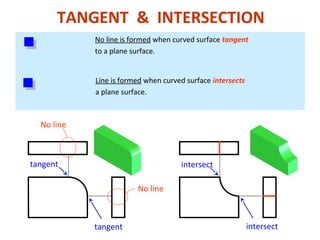
No line is formed when curved surface tangent
to a plane surface.
No line
No line
TANGENT & INTERSECTION
Line is formed when curved surface intersects
a plane surface.
tangent
tangent
intersect
intersect
Orthographic
Projection
of Object Features
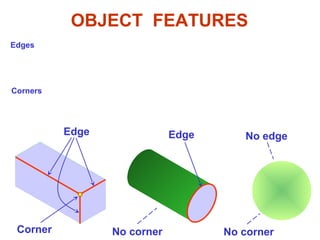
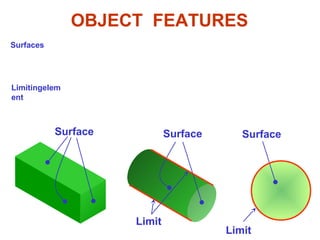
OBJECT FEATURES
Edges are lines that represent the boundary
between two faces.
Corners Represent the intersection of two or
more edges.
Edge
Corner
Edge No edge
No corner No corner
Surfaces are areas that are bounded by edges
or limiting element.
Limitingelem
ent
is a line that represents the last visible
part of the curve surface.
Surface Surface Surface
Limit
Limit
OBJECT FEATURES
Line Convention
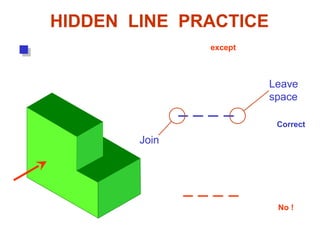
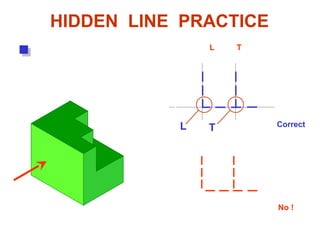
HIDDEN LINE PRACTICE
Hidden line should join a visible line, except it
extended from the visible line.
Correct
No !
Join
Leave
space
Hidden line should intersect to form L and T
corners.
Correct
No !
L T
HIDDEN LINE PRACTICE
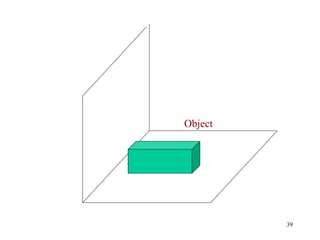
39
Object
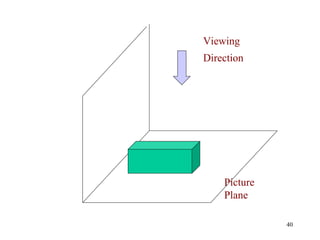
40
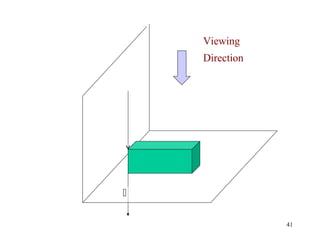
Viewing
Direction
Picture
Plane
41
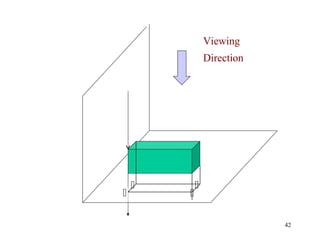
Viewing
Direction

42
Viewing
Direction
 
 
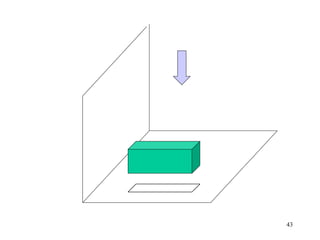
43
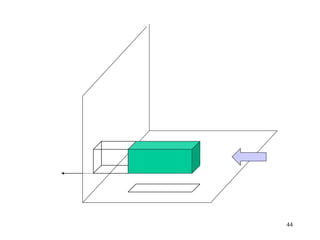
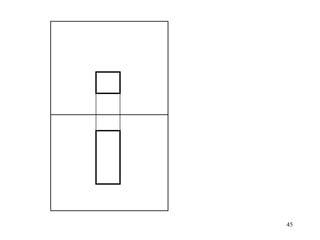
44
45
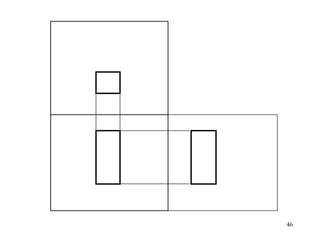
46
47
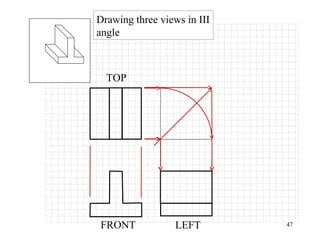
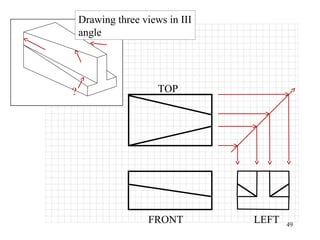
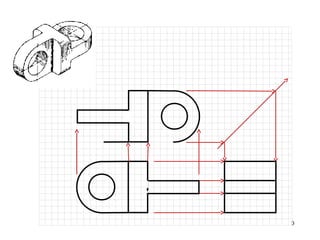
Drawing three views in III
angle
FRONT
TOP
LEFT
48
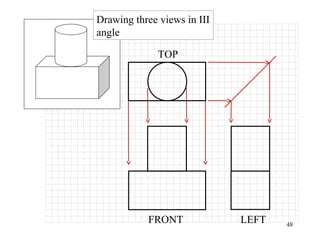
Drawing three views in III
angle
FRONT
TOP
LEFT
49
Drawing three views in III
angle
?
FRONT
TOP
LEFT
50
51
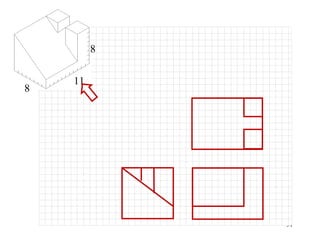
11
8
8
52
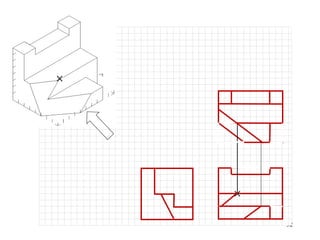
×
×

Ortho.ppt