
PRESENTED BY
ANUSHA JANI
YASH MEHTA
 A complex inst ruct ion set comput er
(CI SC, pronounced like "sisk") is a
microprocessor inst ruct ion set
archit ect ure (I SA) in which each
inst ruct ion can execut e several low-
level operat ions, such as a load f rom
memory, an arit hmet ic operat ion, and
a memory st ore, all in a single
inst ruct ion. 2
 The philosophy behind it is, t hat
har dwar e is always f ast er t han
sof t war e, t heref or e one should make a
powerf ul inst r uct ion set , which
provides programmer s wit h assembly
inst r uct ions t o do a lot wit h shor t
programs.
 So t he pr imar y goal of t he Cisc is t o
complet e a t ask in f ew lines of
assembly inst ruct ion as possible.
3
Memory in t hose days was expensive
 bigger program->more st orage-
>more money
Hence needed t o reducethenumberofinstructionsperprogram
Number of inst ruct ions are reduced by
having multipleoperations
wit hin a single inst ruct ion
Mult iple operat ions lead t o many
dif f erent kinds of inst ruct ions t hat
access memory
 I n t urn making inst ruct ion lengt h
variable and f et ch-decodeexecut e
t ime unpredict able – making it more 4
5
 Usemicrocode
• Used a simplified microcode instruction
set to control the data path logic. This
type of implementation is known as a
micro programmed implementation.
 Build rich instruction sets
• Consequences of using a micro
programmed design is that designers
could build more functionality into each
instruction.
 Build high-level instruction sets
• The logical next step was to build
 Regist er t o regist er, regist er t o
memory, and memory t o regist er
commands.
 Uses Mult iple addressing modes .
 Variable lengt h inst ruct ions where t he
lengt h of t en varies according t o t he
addressing mode
 I nst ruct ions which require mult iple
clock cycles t o execut e.
6
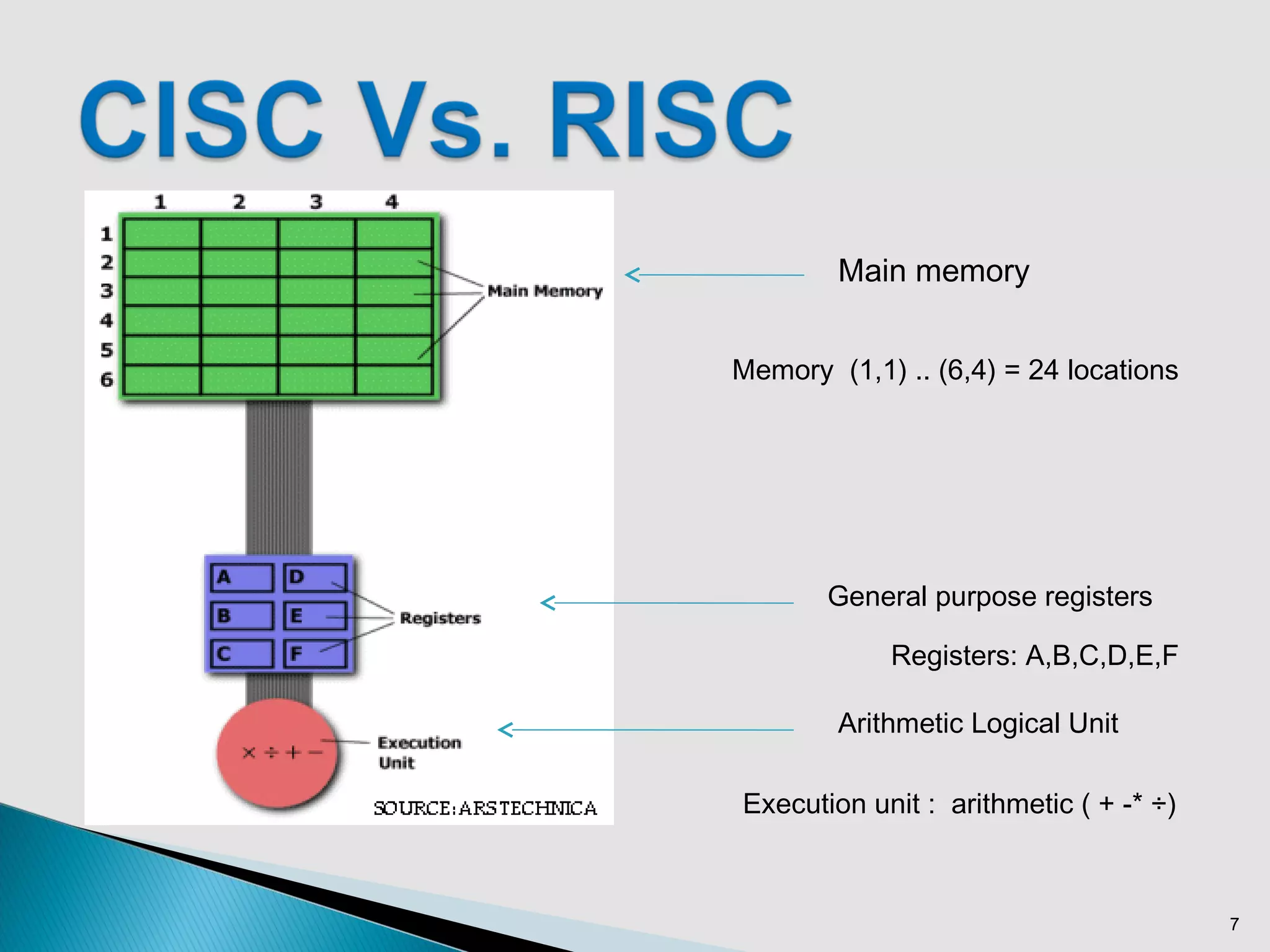
7
General purpose registers
Arithmetic Logical Unit
Main memory
Memory (1,1) .. (6,4) = 24 locations
Registers: A,B,C,D,E,F
Execution unit : arithmetic ( + -* ÷)
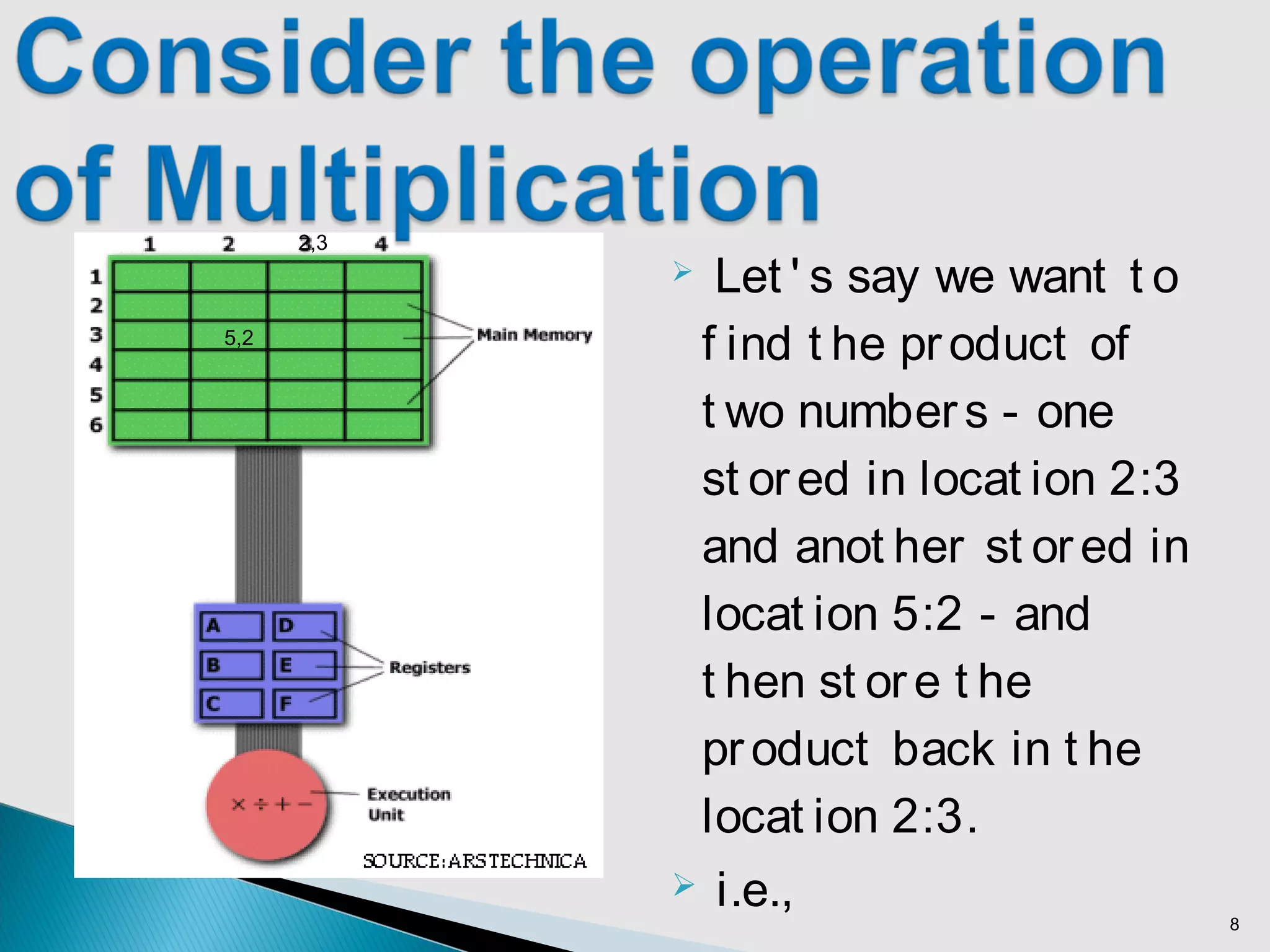
 Let ' s say we want t o
f ind t he product of
t wo numbers - one
st ored in locat ion 2:3
and anot her st ored in
locat ion 5:2 - and
t hen st ore t he
product back in t he
locat ion 2:3.
 i.e.,
8
2,3
5,2
For t his part icular t ask, a CI SC
 processor would come prepared wit h a specif ic
inst ruct ion (we' ll call it "MULT").
MULT A,B
When execut ed, t his inst ruct ion
 loads t he t wo values int o separ at e r egist ers,
 mult iplies t he operands in t he execut ion unit , and
t hen
 st or es t he product in t he appr opr iat e regist er .
Thus, t he ent ire t ask of mult iplying t wo numbers can
be complet ed wit h one inst r uct ion
 MULT is what is known as a "complex inst ruct ion."
9
10
I t operat es direct ly on t he
comput er' s memory banks and does
not require t he programmer t o
explicit ly call any loading or st oring
f unct ions.
I t closely resembles a command in
a higher level language,ident ical t o
t he C st at ement "a = a * b."minimizes t he number of inst ruct ions
per program (2)
sacrif icing t he number of cycles per
inst ruct ion. (1)
 RI SC processors only use simple inst ruct ions
t hat can be execut ed wit hin one clock cycle.
 The "MULT" command described above could be
divided int o t hree separat e commands:
LOAD A, 2:3
LOAD B, 5:2
PROD A, B ("PROD,"f inds t he product
of t wo operands )
STORE 2:3, A ("STORE,“ moves dat a f rom a
regist er t o t he memory
banks)
11
(LOAD, which moves dat a
f rom t he memory bank t o a
regist er)
 Primar y goal is t o
complet e a t ask in as
f ew lines of
assembly as possible
 Emphasis on
har dwar e
 I ncludes mult i-clock
complex inst r uct ions
 Memor y-t o-memor y:
"LOAD" and
"STORE"
incor porat ed in
inst ruct ions
 Pr imary goal is t o
speedup individual
inst r uct ion
 Emphasis on
sof t war e
 Single-clock,
r educed inst r uct ion
only
 Regist er t o r egist er :
"LOAD" and
"STORE"
are independent
inst r uct ions 12
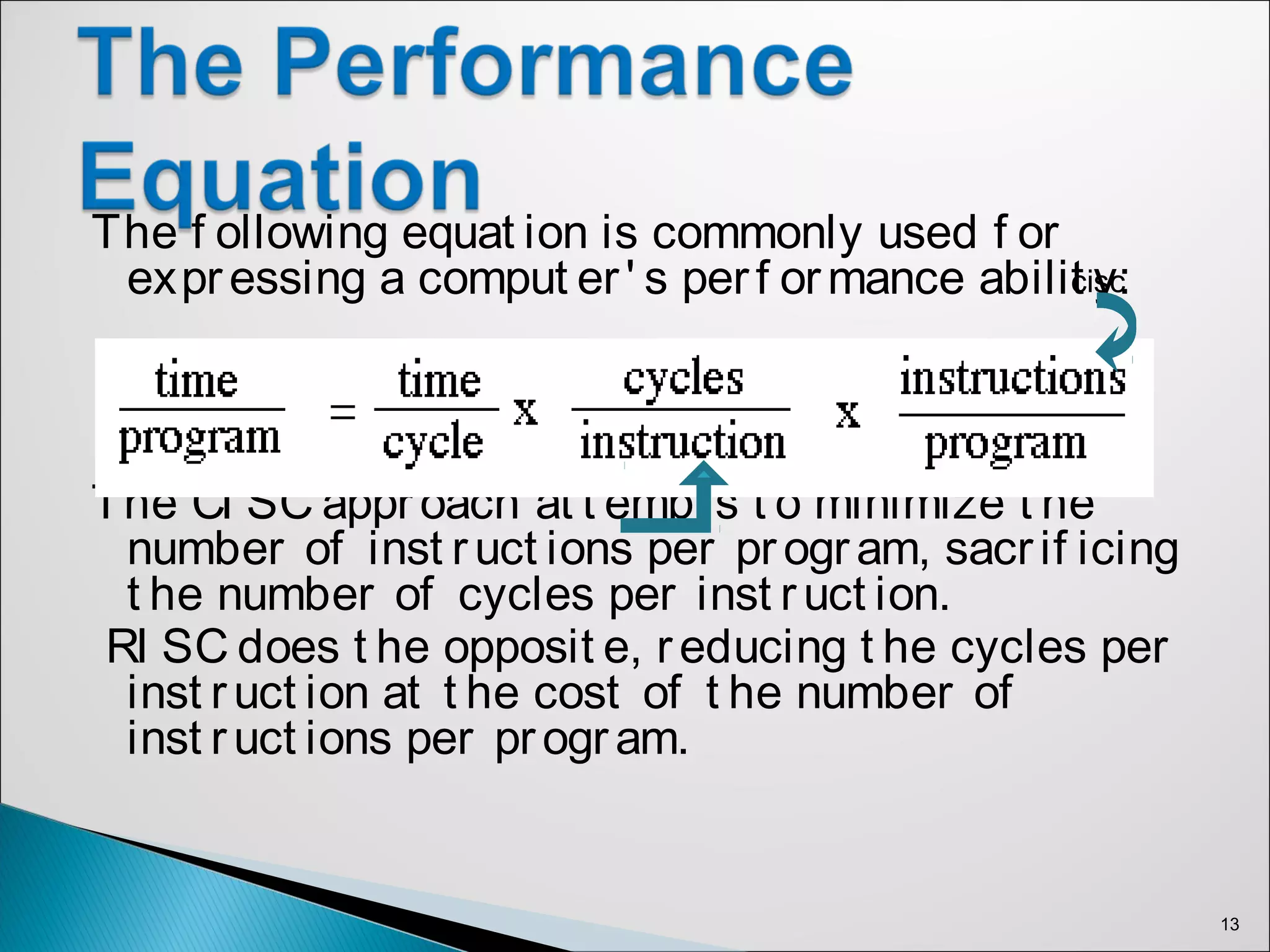
The f ollowing equat ion is commonly used f or
expressing a comput er' s perf ormance abilit y:
Risc
The CI SC approach at t empt s t o minimize t he
number of inst ruct ions per program, sacrif icing
t he number of cycles per inst ruct ion.
RI SC does t he opposit e, reducing t he cycles per
inst ruct ion at t he cost of t he number of
inst ruct ions per program.
13
cisc
There is st ill considerable cont roversy
among expert s about which
archit ect ure is bet t er.
Some say t hat RI SC is cheaper and
f ast er and t heref ore t he archit ect ure
of t he f ut ure.
Ot hers not e t hat by making t he
hardware simpler, RI SC put s a great er
burden on t he sof t ware. Sof t ware
needs t o become more complex.
14
RI SC and CI SC archit ect ures are
becoming more and more alike.
 Many of t oday' s RI SC chips support
j ust as many inst ruct ions as yest erday' s
CI SC chips. The PowerPC 601, f or
example, support s more inst ruct ions t han
t he Pent ium. Yet t he 601 is considered a
RI SC chip, while t he Pent ium is
def init ely CI SC.
 Furt her more t oday' s CI SC chips use
15
EPIC :
 The biggest t hreat f or CI SC and RI SC
might not be each ot her, but a new
t echnology called EPI C.
 EPI C st ands f or Explicitly Parallel
Instruction Computing. EPI C can do
many inst ruct ion execut ions in parallel
t o one anot her.
 EPI C is a creat ed by I nt el and is in a
way a combinat ion of bot h CI SC and
RI SC. This will in t heory allow t he
processing of Windows-based as well as
UNI X-based applicat ions by t he same
CPU.

16
 ht t p:/ / www.pcguide.com/ ref / cpu/ arch/ int / inst
Complexit y-c.ht ml
 ht t p:/ / arst echnica.com/ cpu/ 4q99/ risc-
cisc/ rvc-1.ht ml
 ht t p:/ / www.bookrags.com/ research/ cisc-
complex-inst ruct ion-set -comput -wcs
 ht t p:/ / www.hit equest .com/ Kiss/ risc_cisc.ht m
 ht t p:/ / en.wikipedia.org/ wiki/ Complex_inst ruct i
on_set _comput er
 ht t p:/ / en.wikipedia.org/ wiki/ X86 17
18

Cisc(a022& a023)

  • 1.
  • 2.
     A complexinst ruct ion set comput er (CI SC, pronounced like "sisk") is a microprocessor inst ruct ion set archit ect ure (I SA) in which each inst ruct ion can execut e several low- level operat ions, such as a load f rom memory, an arit hmet ic operat ion, and a memory st ore, all in a single inst ruct ion. 2
  • 3.
     The philosophybehind it is, t hat har dwar e is always f ast er t han sof t war e, t heref or e one should make a powerf ul inst r uct ion set , which provides programmer s wit h assembly inst r uct ions t o do a lot wit h shor t programs.  So t he pr imar y goal of t he Cisc is t o complet e a t ask in f ew lines of assembly inst ruct ion as possible. 3
  • 4.
    Memory in those days was expensive  bigger program->more st orage- >more money Hence needed t o reducethenumberofinstructionsperprogram Number of inst ruct ions are reduced by having multipleoperations wit hin a single inst ruct ion Mult iple operat ions lead t o many dif f erent kinds of inst ruct ions t hat access memory  I n t urn making inst ruct ion lengt h variable and f et ch-decodeexecut e t ime unpredict able – making it more 4
  • 5.
    5  Usemicrocode • Useda simplified microcode instruction set to control the data path logic. This type of implementation is known as a micro programmed implementation.  Build rich instruction sets • Consequences of using a micro programmed design is that designers could build more functionality into each instruction.  Build high-level instruction sets • The logical next step was to build
  • 6.
     Regist ert o regist er, regist er t o memory, and memory t o regist er commands.  Uses Mult iple addressing modes .  Variable lengt h inst ruct ions where t he lengt h of t en varies according t o t he addressing mode  I nst ruct ions which require mult iple clock cycles t o execut e. 6
  • 7.
    7 General purpose registers ArithmeticLogical Unit Main memory Memory (1,1) .. (6,4) = 24 locations Registers: A,B,C,D,E,F Execution unit : arithmetic ( + -* ÷)
  • 8.
     Let 's say we want t o f ind t he product of t wo numbers - one st ored in locat ion 2:3 and anot her st ored in locat ion 5:2 - and t hen st ore t he product back in t he locat ion 2:3.  i.e., 8 2,3 5,2
  • 9.
    For t hispart icular t ask, a CI SC  processor would come prepared wit h a specif ic inst ruct ion (we' ll call it "MULT"). MULT A,B When execut ed, t his inst ruct ion  loads t he t wo values int o separ at e r egist ers,  mult iplies t he operands in t he execut ion unit , and t hen  st or es t he product in t he appr opr iat e regist er . Thus, t he ent ire t ask of mult iplying t wo numbers can be complet ed wit h one inst r uct ion  MULT is what is known as a "complex inst ruct ion." 9
  • 10.
    10 I t operates direct ly on t he comput er' s memory banks and does not require t he programmer t o explicit ly call any loading or st oring f unct ions. I t closely resembles a command in a higher level language,ident ical t o t he C st at ement "a = a * b."minimizes t he number of inst ruct ions per program (2) sacrif icing t he number of cycles per inst ruct ion. (1)
  • 11.
     RI SCprocessors only use simple inst ruct ions t hat can be execut ed wit hin one clock cycle.  The "MULT" command described above could be divided int o t hree separat e commands: LOAD A, 2:3 LOAD B, 5:2 PROD A, B ("PROD,"f inds t he product of t wo operands ) STORE 2:3, A ("STORE,“ moves dat a f rom a regist er t o t he memory banks) 11 (LOAD, which moves dat a f rom t he memory bank t o a regist er)
  • 12.
     Primar ygoal is t o complet e a t ask in as f ew lines of assembly as possible  Emphasis on har dwar e  I ncludes mult i-clock complex inst r uct ions  Memor y-t o-memor y: "LOAD" and "STORE" incor porat ed in inst ruct ions  Pr imary goal is t o speedup individual inst r uct ion  Emphasis on sof t war e  Single-clock, r educed inst r uct ion only  Regist er t o r egist er : "LOAD" and "STORE" are independent inst r uct ions 12
  • 13.
    The f ollowingequat ion is commonly used f or expressing a comput er' s perf ormance abilit y: Risc The CI SC approach at t empt s t o minimize t he number of inst ruct ions per program, sacrif icing t he number of cycles per inst ruct ion. RI SC does t he opposit e, reducing t he cycles per inst ruct ion at t he cost of t he number of inst ruct ions per program. 13 cisc
  • 14.
    There is still considerable cont roversy among expert s about which archit ect ure is bet t er. Some say t hat RI SC is cheaper and f ast er and t heref ore t he archit ect ure of t he f ut ure. Ot hers not e t hat by making t he hardware simpler, RI SC put s a great er burden on t he sof t ware. Sof t ware needs t o become more complex. 14
  • 15.
    RI SC andCI SC archit ect ures are becoming more and more alike.  Many of t oday' s RI SC chips support j ust as many inst ruct ions as yest erday' s CI SC chips. The PowerPC 601, f or example, support s more inst ruct ions t han t he Pent ium. Yet t he 601 is considered a RI SC chip, while t he Pent ium is def init ely CI SC.  Furt her more t oday' s CI SC chips use 15
  • 16.
    EPIC :  Thebiggest t hreat f or CI SC and RI SC might not be each ot her, but a new t echnology called EPI C.  EPI C st ands f or Explicitly Parallel Instruction Computing. EPI C can do many inst ruct ion execut ions in parallel t o one anot her.  EPI C is a creat ed by I nt el and is in a way a combinat ion of bot h CI SC and RI SC. This will in t heory allow t he processing of Windows-based as well as UNI X-based applicat ions by t he same CPU.  16
  • 17.
     ht tp:/ / www.pcguide.com/ ref / cpu/ arch/ int / inst Complexit y-c.ht ml  ht t p:/ / arst echnica.com/ cpu/ 4q99/ risc- cisc/ rvc-1.ht ml  ht t p:/ / www.bookrags.com/ research/ cisc- complex-inst ruct ion-set -comput -wcs  ht t p:/ / www.hit equest .com/ Kiss/ risc_cisc.ht m  ht t p:/ / en.wikipedia.org/ wiki/ Complex_inst ruct i on_set _comput er  ht t p:/ / en.wikipedia.org/ wiki/ X86 17
  • 18.