Page Replacement Algorithms
FIFO, NRU, LRU, NFU...
Index
S. No. Topic
1. Paging
2. Page Replacement
3. Algorithms
a. Optimal
b. FIFO
c. NFU
d. NRU
e. LRU
f. Second Chance
g. CLOCK
h. Random
i. Working Set
4. Conclusion
5. References
Plan of Action
• What is paging?
• What is page replacement?
• What are the types of page replacement?
• Why we need a page replacement algorithm?
• What are the algorithms?
What is Paging?
• The OS divides virtual memory and the main
memory into units, called pages.
• Each used page can be either in secondary
memory or in a page frame in main memory.
• A frame does not have to comprise a single
physically contiguous region in secondary
storage.
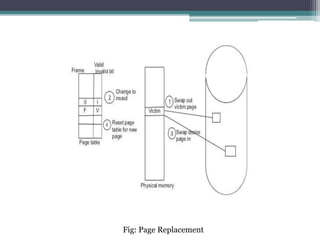
What is page replacement?
• When memory located in secondary memory is
needed, it can be retrieved back to main memory.
• Process of storing data from main memory to
secondary memory ->swapping out
• Retrieving data back to main memory ->swapping
in
Fig: Page Replacement
What are Page Replacement
Algorithms?
• Deals with which pages need to be swapped out
and which are the ones that need to be swapped
in
• The efficiency lies in the least time that is wasted
for a page to be paged in
Types
• Local Page Replacement Strategy
• Global Page Replacement Strategy
Why we need a page replacement
algorithm?
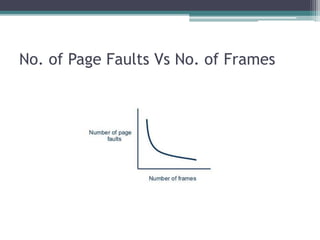
• The main goal of page replacement algorithms is
to provide lowest page fault rate.
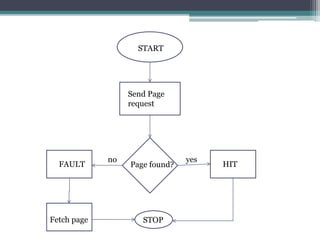
START
Send Page
request
Page found?
yesno
HITFAULT
STOPFetch page
No. of Page Faults Vs No. of Frames
Algorithms
• First In First Out
• Optimal Replacement
• Not Recently Used
• Second Chance
• CLOCK
• Not Frequently Used
• Least Recently Used
• Random Replacement
• Working Set Replacement
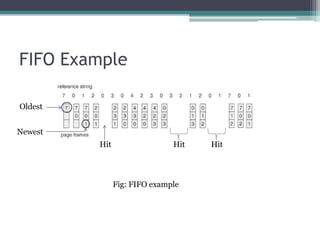
First-In First-Out (FIFO)
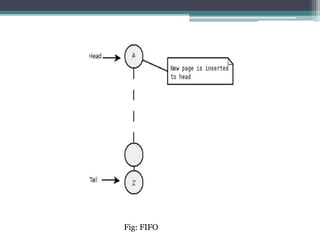
• Pages in main memory are kept in a list
• Newest page is in head and the oldest in tail
• It does not take advantage of page access
patterns or frequency
Fig: FIFO
FIFO Example
Oldest
Hit Hit Hit
Newest
Fig: FIFO example
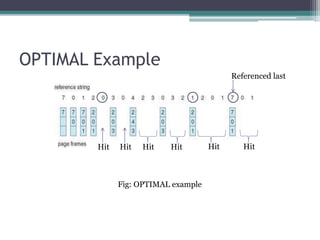
Optimal Replacement (OPT)
• When the memory is full, evict a page that will
be unreferenced for the longest time
• The OS keeps track of all pages referenced by the
program
• Only if the program's memory reference pattern
is relatively consistent
OPTIMAL Example
Referenced last
Hit Hit HitHit Hit Hit
Fig: OPTIMAL example
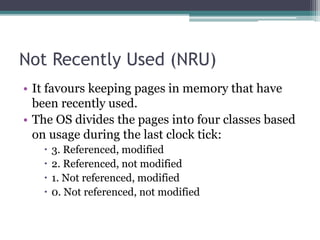
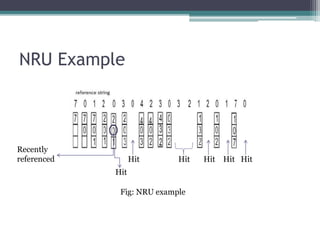
Not Recently Used (NRU)
• It favours keeping pages in memory that have
been recently used.
• The OS divides the pages into four classes based
on usage during the last clock tick:
 3. Referenced, modified
 2. Referenced, not modified
 1. Not referenced, modified
 0. Not referenced, not modified
NRU
• Pick a random page from the lowest category for
removal
• i.e. the not referenced, not modified page
NRU Example
Fig: NRU example
Recently
referenced
Hit
Hit Hit Hit Hit Hit
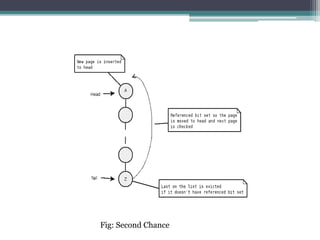
Second Chance
• Modified version of FIFO
• Instead of swapping out the last page, the
referenced bit is checked
• Gives every page a "second-chance"
Fig: Second Chance
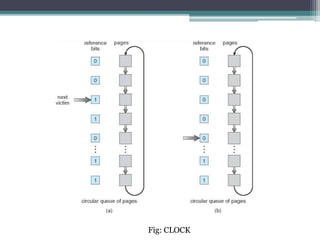
Clock
• Modified version of FIFO
• The set of frame candidates for replacement is
considered as a circular buffer.
Fig: CLOCK
Least Recently Used (LRU)
• It swaps the pages that have been used the least
over a period of time.
• It is free from Belady’s anomaly.
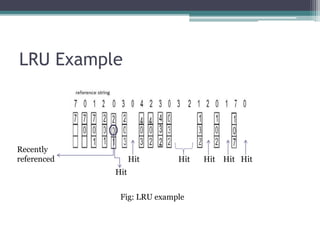
LRU Example
Recently
referenced
Hit
Hit Hit Hit Hit Hit
Fig: LRU example
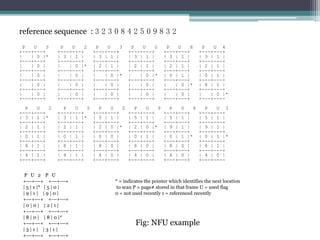
Not frequently used (NFU)
• This page replacement algorithm requires a
counter
• The counters keep track of how frequently a
page has been used
• The page with the lowest counter can be
swapped out
reference sequence : 3 2 3 0 8 4 2 5 0 9 8 3 2
P U 3 P U 2 P U 3 P U 0 P U 8 P U 4
+---+---+ +---+---+ +---+---+ +---+---+ +---+---+ +---+---+
| | 0 |* | 3 | 1 | | 3 | 1 | | 3 | 1 | | 3 | 1 | | 3 | 1 |
+---+---+ +---+---+ +---+---+ +---+---+ +---+---+ +---+---+
| | 0 | | | 0 |* | 2 | 1 | | 2 | 1 | | 2 | 1 | | 2 | 1 |
+---+---+ +---+---+ +---+---+ +---+---+ +---+---+ +---+---+
| | 0 | | | 0 | | | 0 |* | | 0 |* | 0 | 1 | | 0 | 1 |
+---+---+ +---+---+ +---+---+ +---+---+ +---+---+ +---+---+
| | 0 | | | 0 | | | 0 | | | 0 | | | 0 |* | 8 | 1 |
+---+---+ +---+---+ +---+---+ +---+---+ +---+---+ +---+---+
| | 0 | | | 0 | | | 0 | | | 0 | | | 0 | | | 0 |*
+---+---+ +---+---+ +---+---+ +---+---+ +---+---+ +---+----
P U 2 P U 5 P U 0 P U 9 P U 8 P U 3
+---+---+ +---+---+ +---+---+ +---+---+ +---+---+ +---+---+
| 3 | 1 |* | 3 | 1 |* | 5 | 1 | | 5 | 1 | | 5 | 1 | | 5 | 1 |
+---+---+ +---+---+ +---+---+ +---+---+ +---+---+ +---+---+
| 2 | 1 | | 2 | 1 | | 2 | 0 |* | 2 | 0 |* | 9 | 1 | | 9 | 1 |
+---+---+ +---+---+ +---+---+ +---+---+ +---+---+ +---+---+
| 0 | 1 | | 0 | 1 | | 0 | 0 | | 0 | 1 | | 0 | 1 |* | 0 | 1 |*
+---+---+ +---+---+ +---+---+ +---+---+ +---+---+ +---+---+
| 8 | 1 | | 8 | 1 | | 8 | 0 | | 8 | 0 | | 8 | 0 | | 8 | 1 |
+---+---+ +---+---+ +---+---+ +---+---+ +---+---+ +---+---+
| 4 | 1 | | 4 | 1 | | 4 | 0 | | 4 | 0 | | 4 | 0 | | 4 | 0 |
+---+---+ +---+---+ +---+---+ +---+---+ +---+---+ +---+----
P U 2 P U
+---+---+ +---+---+ * = indicates the pointer which identifies the next location
| 5 | 1 |* | 5 | 0 | to scan P = page# stored in that frame U = used flag
| 9 | 1 | | 9 | 0 | 0 = not used recently 1 = referenced recently
+---+---+ +---+---+
| 0 | 0 | | 2 | 1 |
+---+---+ +---+---+
| 8 | 0 | | 8 | 0 |*
+---+---+ +---+---+
| 3 | 1 | | 3 | 1 |
+---+---+ +---+---+
Fig: NFU example
Random
• This algorithm replaces a random page in
memory.
• It fares better than FIFO.
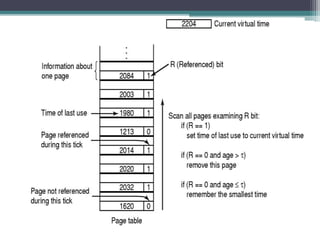
Working set page replacement
• The set of pages that a process is currently using
is called the working set.
• The working set algorithm is based on
determining a working set and evicting any page
that is not in the current working set upon a
page fault.
Conclusion
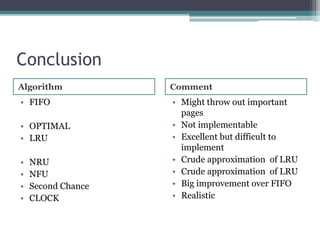
Algorithm Comment
• FIFO
• OPTIMAL
• LRU
• NRU
• NFU
• Second Chance
• CLOCK
• Might throw out important
pages
• Not implementable
• Excellent but difficult to
implement
• Crude approximation of LRU
• Big improvement over FIFO
• Realistic
References
• Web Links
 www.wikipedia.com
 www.youtube.com
 www.vbForum.com
• Papers
 Operating System Page Replacement Algorithms by
A. Frank C. Wersberg
• Books
 Computer Organization & Architecture by William
Stallings
Thank You

Page replacement algorithms

  • 1.
  • 2.
    Index S. No. Topic 1.Paging 2. Page Replacement 3. Algorithms a. Optimal b. FIFO c. NFU d. NRU e. LRU f. Second Chance g. CLOCK h. Random i. Working Set 4. Conclusion 5. References
  • 3.
    Plan of Action •What is paging? • What is page replacement? • What are the types of page replacement? • Why we need a page replacement algorithm? • What are the algorithms?
  • 4.
    What is Paging? •The OS divides virtual memory and the main memory into units, called pages. • Each used page can be either in secondary memory or in a page frame in main memory. • A frame does not have to comprise a single physically contiguous region in secondary storage.
  • 5.
    What is pagereplacement? • When memory located in secondary memory is needed, it can be retrieved back to main memory. • Process of storing data from main memory to secondary memory ->swapping out • Retrieving data back to main memory ->swapping in
  • 6.
  • 7.
    What are PageReplacement Algorithms? • Deals with which pages need to be swapped out and which are the ones that need to be swapped in • The efficiency lies in the least time that is wasted for a page to be paged in
  • 8.
    Types • Local PageReplacement Strategy • Global Page Replacement Strategy
  • 9.
    Why we needa page replacement algorithm? • The main goal of page replacement algorithms is to provide lowest page fault rate.
  • 10.
  • 11.
    No. of PageFaults Vs No. of Frames
  • 12.
    Algorithms • First InFirst Out • Optimal Replacement • Not Recently Used • Second Chance • CLOCK • Not Frequently Used • Least Recently Used • Random Replacement • Working Set Replacement
  • 13.
    First-In First-Out (FIFO) •Pages in main memory are kept in a list • Newest page is in head and the oldest in tail • It does not take advantage of page access patterns or frequency
  • 14.
  • 15.
    FIFO Example Oldest Hit HitHit Newest Fig: FIFO example
  • 16.
    Optimal Replacement (OPT) •When the memory is full, evict a page that will be unreferenced for the longest time • The OS keeps track of all pages referenced by the program • Only if the program's memory reference pattern is relatively consistent
  • 17.
    OPTIMAL Example Referenced last HitHit HitHit Hit Hit Fig: OPTIMAL example
  • 18.
    Not Recently Used(NRU) • It favours keeping pages in memory that have been recently used. • The OS divides the pages into four classes based on usage during the last clock tick:  3. Referenced, modified  2. Referenced, not modified  1. Not referenced, modified  0. Not referenced, not modified
  • 19.
    NRU • Pick arandom page from the lowest category for removal • i.e. the not referenced, not modified page
  • 20.
    NRU Example Fig: NRUexample Recently referenced Hit Hit Hit Hit Hit Hit
  • 21.
    Second Chance • Modifiedversion of FIFO • Instead of swapping out the last page, the referenced bit is checked • Gives every page a "second-chance"
  • 22.
  • 23.
    Clock • Modified versionof FIFO • The set of frame candidates for replacement is considered as a circular buffer.
  • 24.
  • 25.
    Least Recently Used(LRU) • It swaps the pages that have been used the least over a period of time. • It is free from Belady’s anomaly.
  • 26.
    LRU Example Recently referenced Hit Hit HitHit Hit Hit Fig: LRU example
  • 27.
    Not frequently used(NFU) • This page replacement algorithm requires a counter • The counters keep track of how frequently a page has been used • The page with the lowest counter can be swapped out
  • 28.
    reference sequence :3 2 3 0 8 4 2 5 0 9 8 3 2 P U 3 P U 2 P U 3 P U 0 P U 8 P U 4 +---+---+ +---+---+ +---+---+ +---+---+ +---+---+ +---+---+ | | 0 |* | 3 | 1 | | 3 | 1 | | 3 | 1 | | 3 | 1 | | 3 | 1 | +---+---+ +---+---+ +---+---+ +---+---+ +---+---+ +---+---+ | | 0 | | | 0 |* | 2 | 1 | | 2 | 1 | | 2 | 1 | | 2 | 1 | +---+---+ +---+---+ +---+---+ +---+---+ +---+---+ +---+---+ | | 0 | | | 0 | | | 0 |* | | 0 |* | 0 | 1 | | 0 | 1 | +---+---+ +---+---+ +---+---+ +---+---+ +---+---+ +---+---+ | | 0 | | | 0 | | | 0 | | | 0 | | | 0 |* | 8 | 1 | +---+---+ +---+---+ +---+---+ +---+---+ +---+---+ +---+---+ | | 0 | | | 0 | | | 0 | | | 0 | | | 0 | | | 0 |* +---+---+ +---+---+ +---+---+ +---+---+ +---+---+ +---+---- P U 2 P U 5 P U 0 P U 9 P U 8 P U 3 +---+---+ +---+---+ +---+---+ +---+---+ +---+---+ +---+---+ | 3 | 1 |* | 3 | 1 |* | 5 | 1 | | 5 | 1 | | 5 | 1 | | 5 | 1 | +---+---+ +---+---+ +---+---+ +---+---+ +---+---+ +---+---+ | 2 | 1 | | 2 | 1 | | 2 | 0 |* | 2 | 0 |* | 9 | 1 | | 9 | 1 | +---+---+ +---+---+ +---+---+ +---+---+ +---+---+ +---+---+ | 0 | 1 | | 0 | 1 | | 0 | 0 | | 0 | 1 | | 0 | 1 |* | 0 | 1 |* +---+---+ +---+---+ +---+---+ +---+---+ +---+---+ +---+---+ | 8 | 1 | | 8 | 1 | | 8 | 0 | | 8 | 0 | | 8 | 0 | | 8 | 1 | +---+---+ +---+---+ +---+---+ +---+---+ +---+---+ +---+---+ | 4 | 1 | | 4 | 1 | | 4 | 0 | | 4 | 0 | | 4 | 0 | | 4 | 0 | +---+---+ +---+---+ +---+---+ +---+---+ +---+---+ +---+---- P U 2 P U +---+---+ +---+---+ * = indicates the pointer which identifies the next location | 5 | 1 |* | 5 | 0 | to scan P = page# stored in that frame U = used flag | 9 | 1 | | 9 | 0 | 0 = not used recently 1 = referenced recently +---+---+ +---+---+ | 0 | 0 | | 2 | 1 | +---+---+ +---+---+ | 8 | 0 | | 8 | 0 |* +---+---+ +---+---+ | 3 | 1 | | 3 | 1 | +---+---+ +---+---+ Fig: NFU example
  • 29.
    Random • This algorithmreplaces a random page in memory. • It fares better than FIFO.
  • 30.
    Working set pagereplacement • The set of pages that a process is currently using is called the working set. • The working set algorithm is based on determining a working set and evicting any page that is not in the current working set upon a page fault.
  • 32.
    Conclusion Algorithm Comment • FIFO •OPTIMAL • LRU • NRU • NFU • Second Chance • CLOCK • Might throw out important pages • Not implementable • Excellent but difficult to implement • Crude approximation of LRU • Crude approximation of LRU • Big improvement over FIFO • Realistic
  • 33.
    References • Web Links www.wikipedia.com  www.youtube.com  www.vbForum.com • Papers  Operating System Page Replacement Algorithms by A. Frank C. Wersberg • Books  Computer Organization & Architecture by William Stallings
  • 34.

Editor's Notes

  • #5 may exceed the amount of main memory-> virtual memory active part in main memory and the rest in secondary memory Data read in pages
  • #9  a local page replacement algorithm selects for replacement some page that belongs to that same process (or a group of processes sharing a memory partition). A global replacement algorithm is free to select any page in memory.
  • #12 Belady’s anamoly-page fault inc with no. of frames
  • #16 Disadvantage->page that is referenced frequently also gets replaced->doesn’t take care of that belady’s anamoly
  • #17 Covers up the disadvantage of FIFO Unreferenced for the longest time->replace that page Os will keep track->pattern should be consistent
  • #18 Free of belady’s anamoly
  • #19 Covers up the disadvantage of FIFO Instead of
  • #21 Free from belady’s anamoly
  • #26 LRU keeps track of page usage over a short period of time, while NRU just looks at the usage in the last clock interval.
  • #27 Free from belady’s anamoly