Compiled by:-
Namrata Poddar(14)
Sankalp dubey(15)
Content
 Introduction.
 History.
 Flow chart.
 Example for unsigned multiplication.
 Example for signed multiplication.
Objectives:-
 To provide knowledge on signed and
unsigned multiplications
 To solve problems on booth’s algorithm.
 To teach procedure for binary
multiplication using booth’s algorithm.
What is booth’s algorithm?
 Booth's multiplication algorithm is an
algorithm which multiplies 2 signed or
unsigned integers in 2's complement.
 This approach uses fewer additions and
subtractions than more straightforward
algorithms.
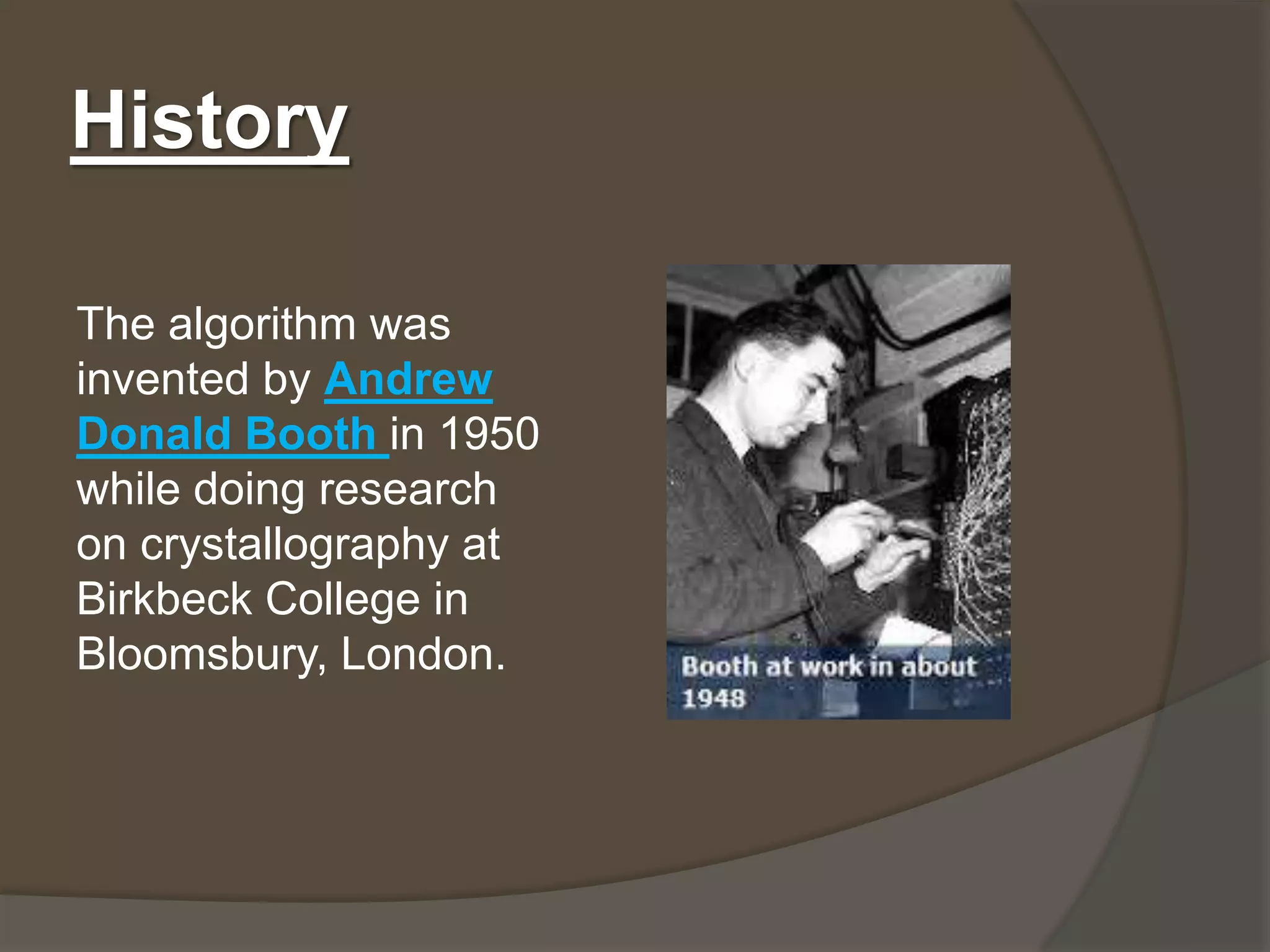
History
The algorithm was
invented by Andrew
Donald Booth in 1950
while doing research
on crystallography at
Birkbeck College in
Bloomsbury, London.
Points to remember(for
unsigned)
 Firstly take two registers Q and M
 Load multiplicand and multiplier in this
registers
 For eg., In 4 * 5 , 4 is multiplicand and 5
is multiplier.
Points to remember(for
unsigned)
 We also need third register A, which is
initialize to 0(zero).
 We also need a register to store carry bit
resulting from addtion . Hence, we take
one bit register Q-1
Points to remember(for
unsigned)
 Multiplicand(M) is added to register Q
and the result is stored in register A
 Then all bits of the A,Q,Q-1 are shifted
to the right one bit.
 Depending upon last bit of Q and single
bit of Q-1 following arithmetic operations
are performed.
Points to remember(for
unsigned)
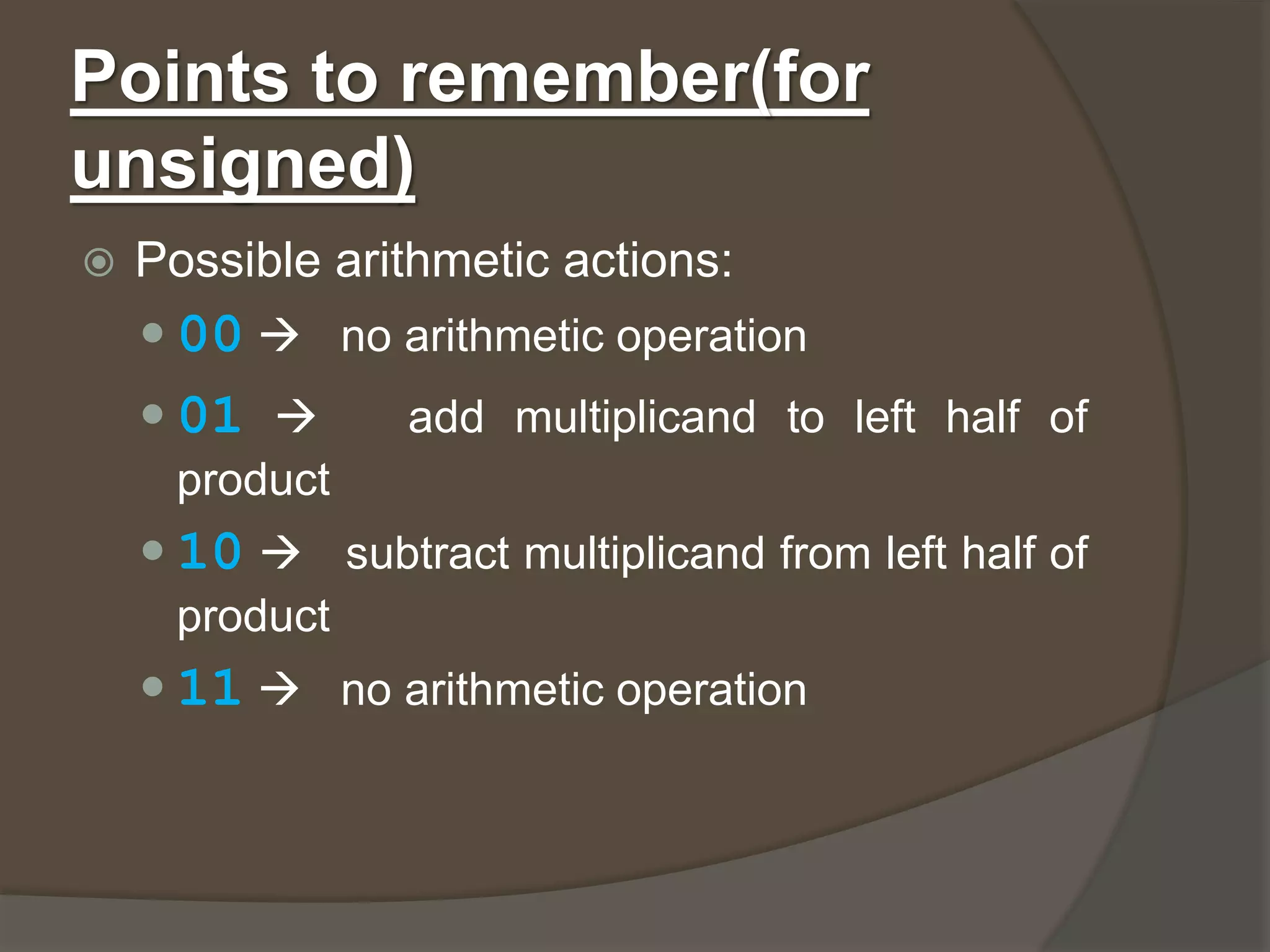
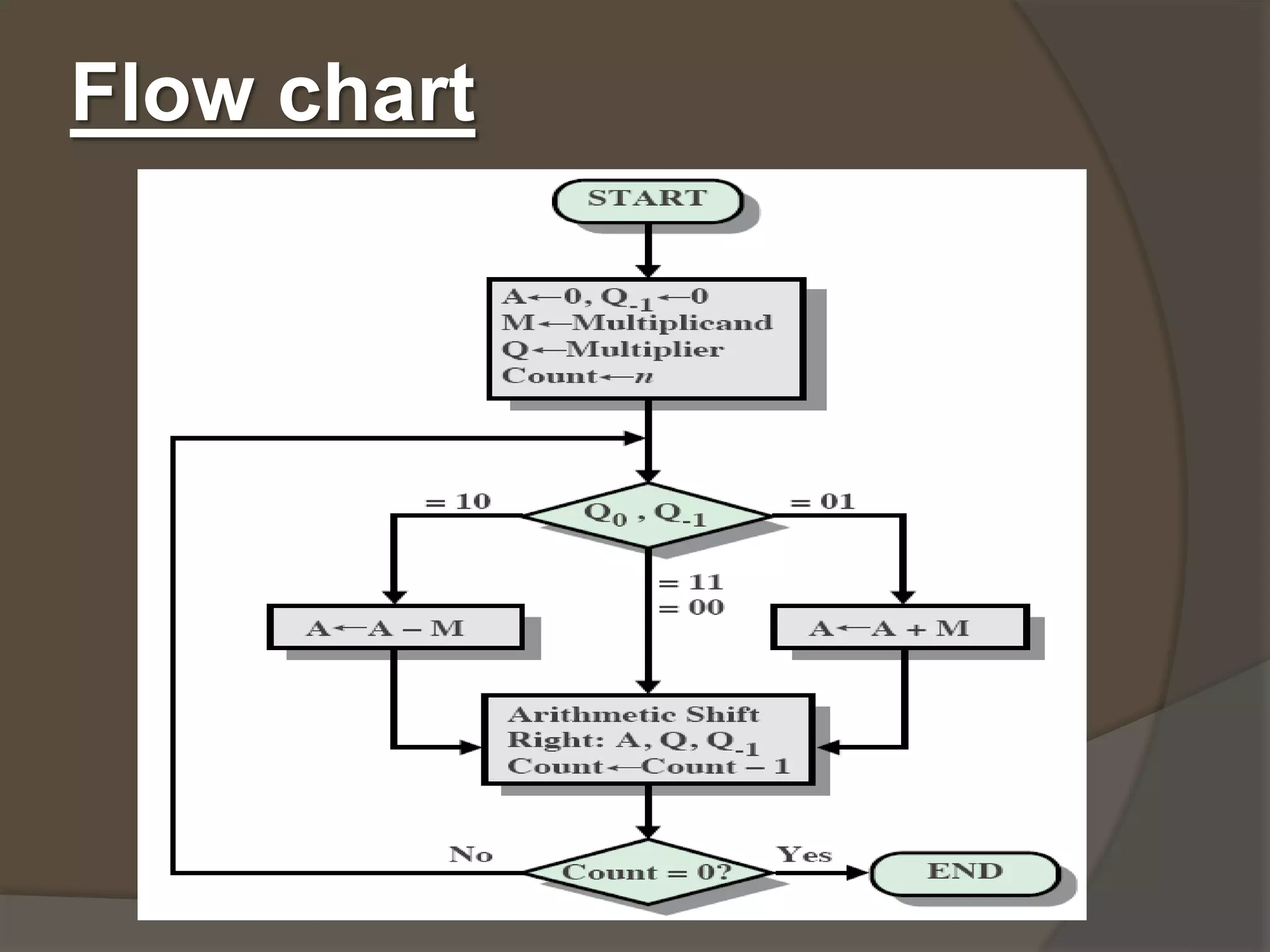
 Possible arithmetic actions:
 00  no arithmetic operation
 01  add multiplicand to left half of
product
 10  subtract multiplicand from left half of
product
 11  no arithmetic operation
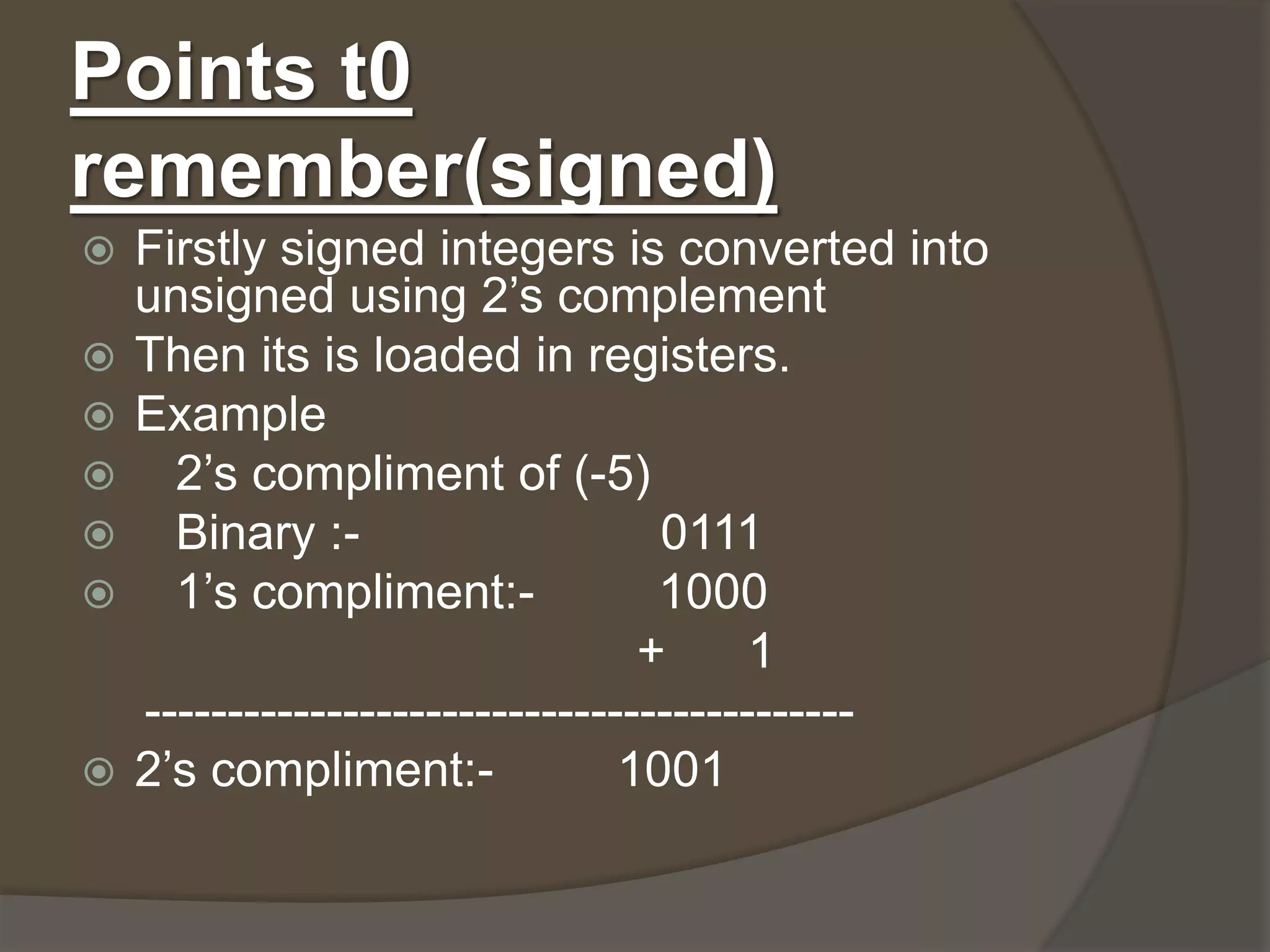
Points t0
remember(signed)
 Firstly signed integers is converted into
unsigned using 2’s complement
 Then its is loaded in registers.
 Example
 2’s compliment of (-5)
 Binary :- 0111
 1’s compliment:- 1000
+ 1
-------------------------------------------
 2’s compliment:- 1001
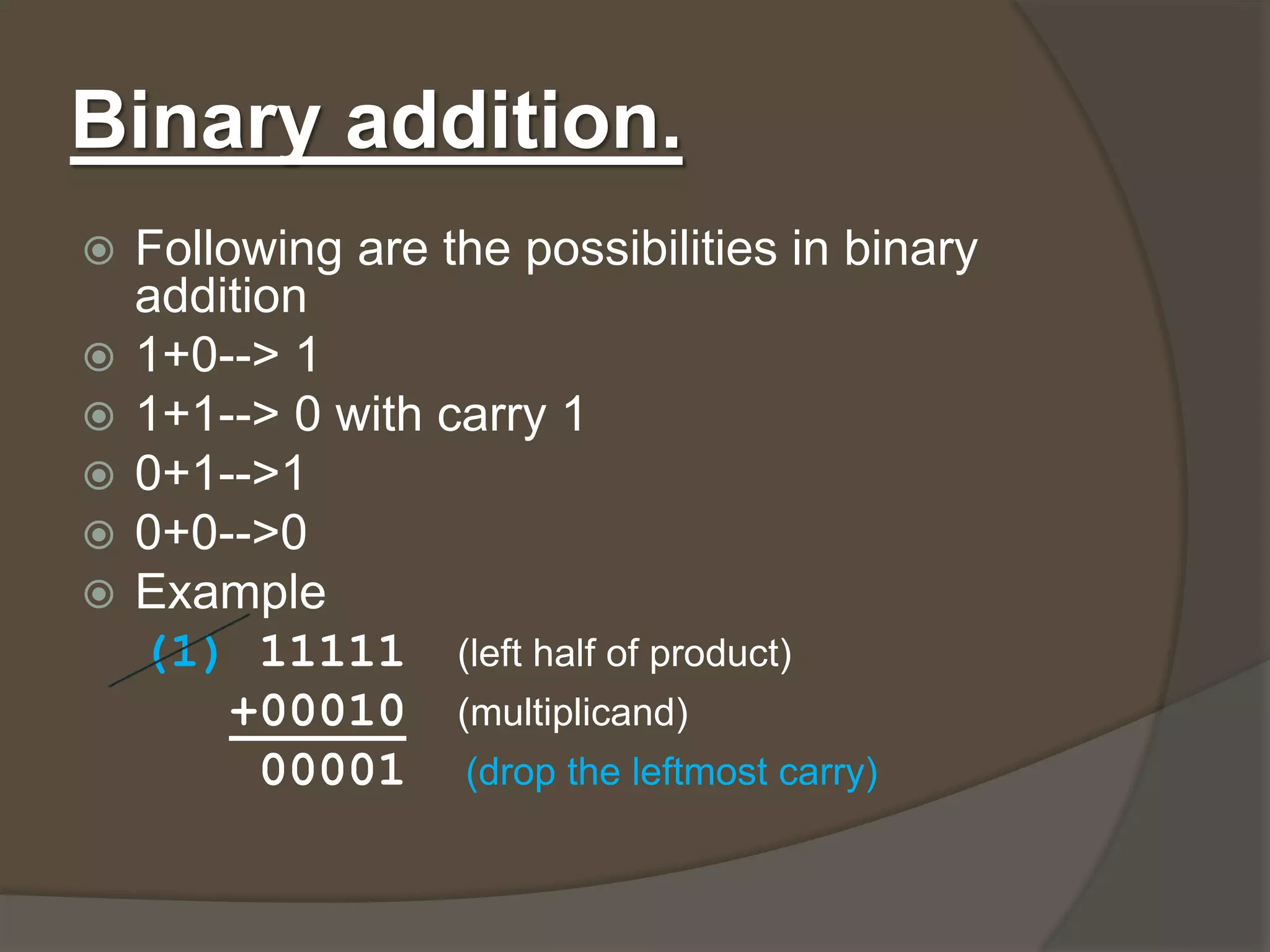
Binary addition.
 Following are the possibilities in binary
addition
 1+0--> 1
 1+1--> 0 with carry 1
 0+1-->1
 0+0-->0
 Example
(1) 11111 (left half of product)
+00010 (multiplicand)
00001 (drop the leftmost carry)
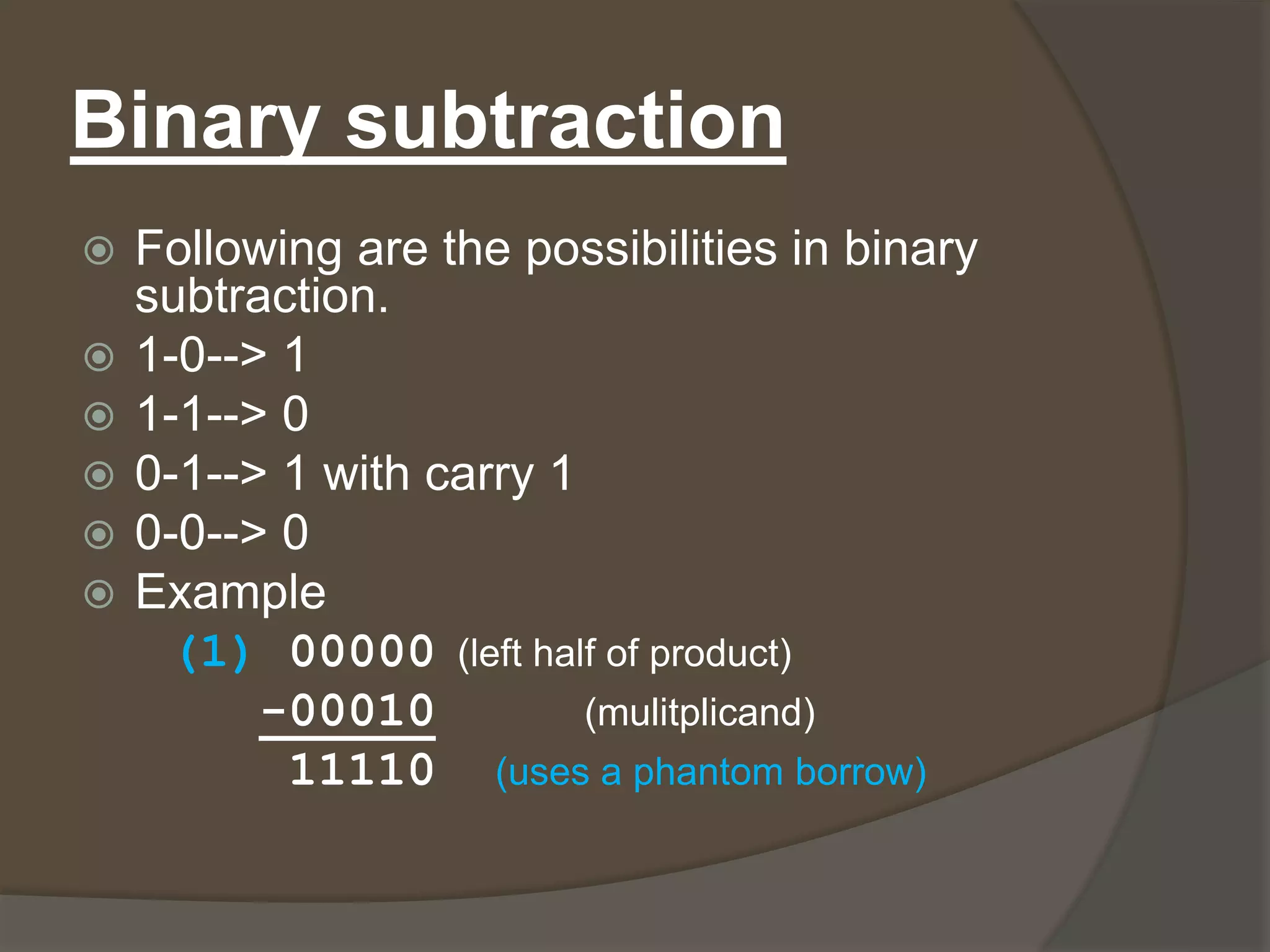
Binary subtraction
 Following are the possibilities in binary
subtraction.
 1-0--> 1
 1-1--> 0
 0-1--> 1 with carry 1
 0-0--> 0
 Example
(1) 00000 (left half of product)
-00010 (mulitplicand)
11110 (uses a phantom borrow)
Flow chart
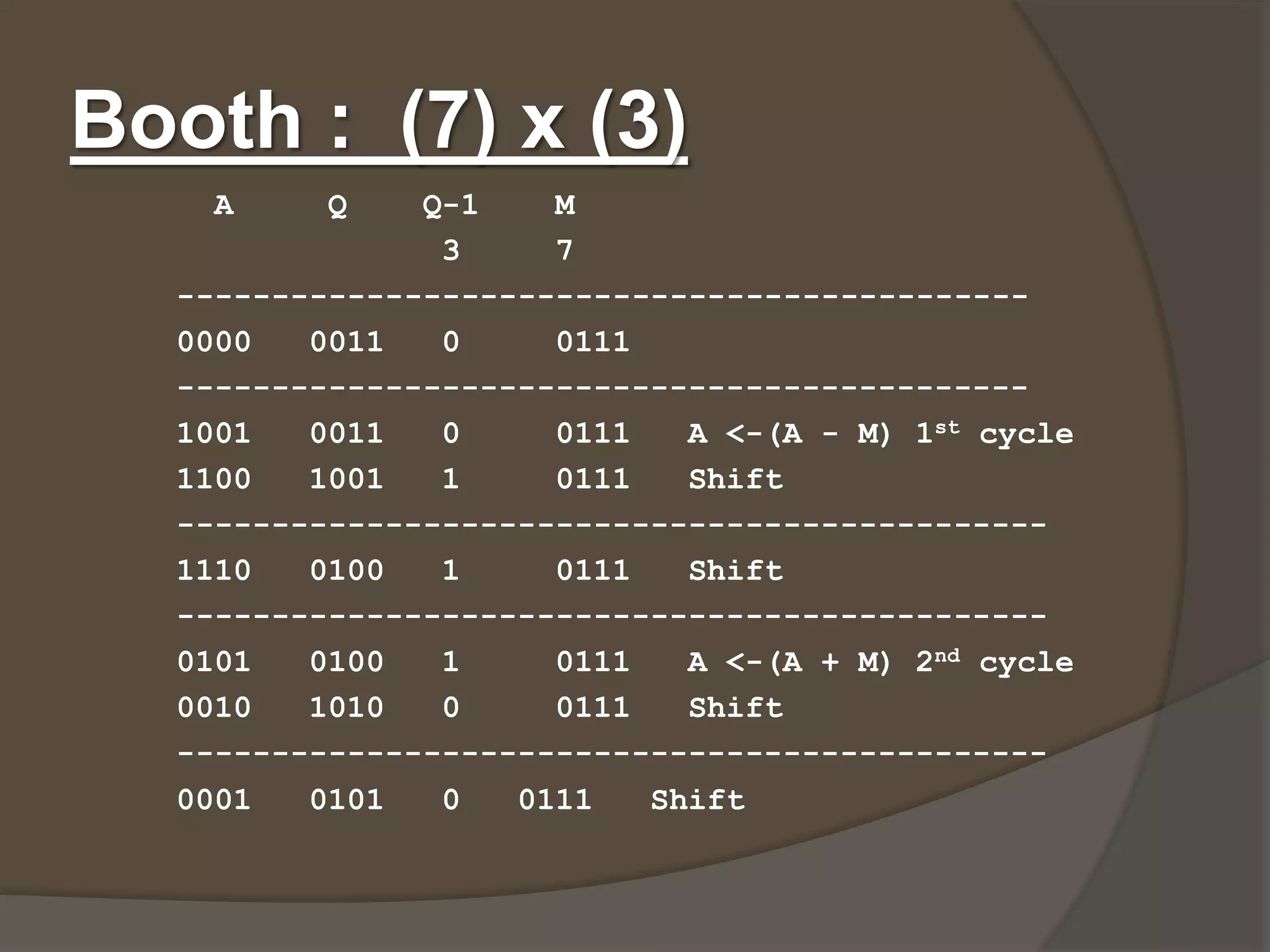
Booth : (7) x (3)
A Q Q-1 M
3 7
---------------------------------------------
0000 0011 0 0111
---------------------------------------------
1001 0011 0 0111 A <-(A - M) 1st cycle
1100 1001 1 0111 Shift
----------------------------------------------
1110 0100 1 0111 Shift
----------------------------------------------
0101 0100 1 0111 A <-(A + M) 2nd cycle
0010 1010 0 0111 Shift
----------------------------------------------
0001 0101 0 0111 Shift
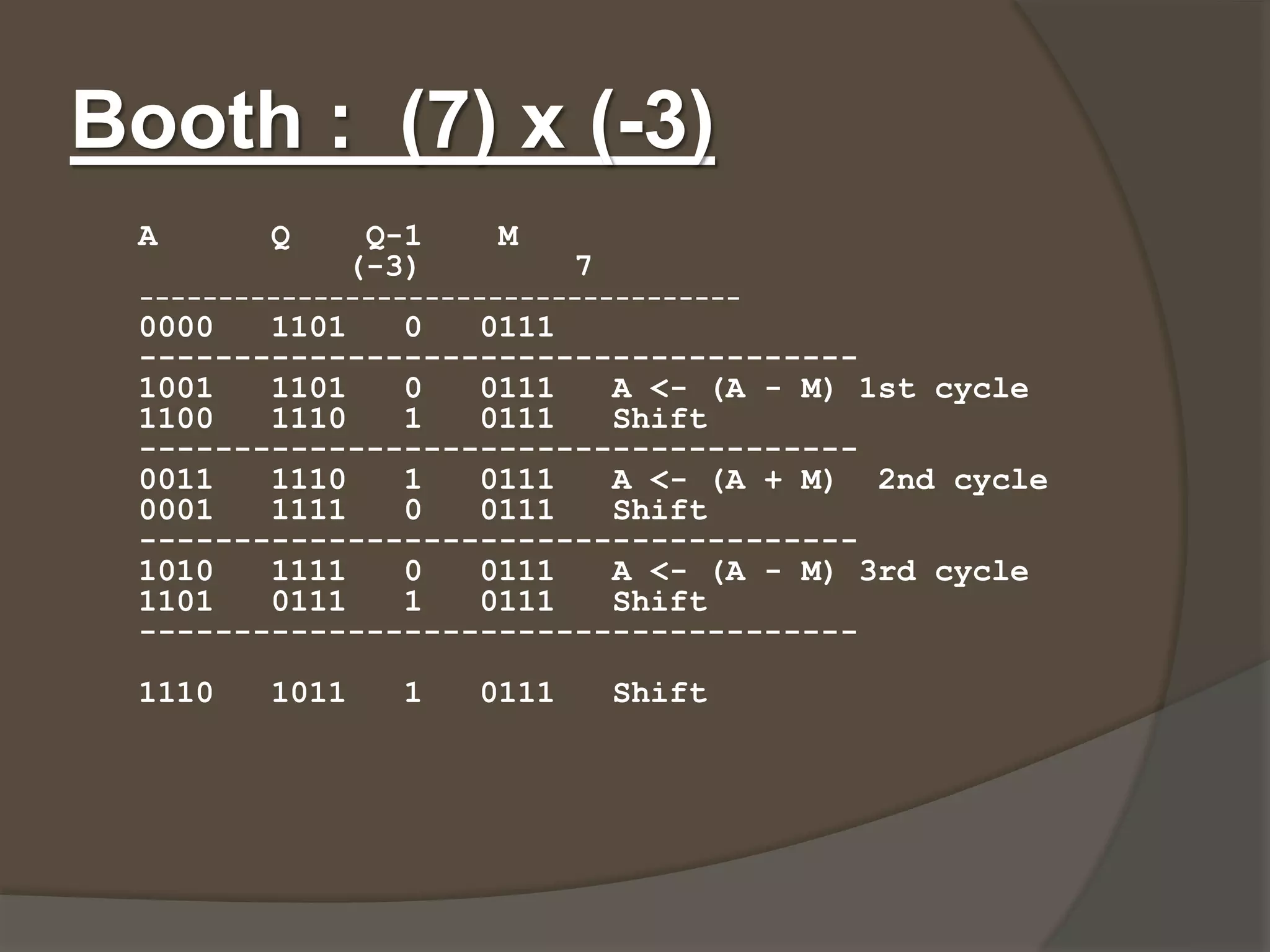
Booth : (7) x (-3)
A Q Q-1 M
(-3) 7
--------------------------------------
0000 1101 0 0111
--------------------------------------
1001 1101 0 0111 A <- (A - M) 1st cycle
1100 1110 1 0111 Shift
--------------------------------------
0011 1110 1 0111 A <- (A + M) 2nd cycle
0001 1111 0 0111 Shift
--------------------------------------
1010 1111 0 0111 A <- (A - M) 3rd cycle
1101 0111 1 0111 Shift
--------------------------------------
1110 1011 1 0111 Shift
References
 www.slideshare.net
 http://www.csci.csusb.edu
 Computer organization and architecture
-Williamstallings.
THANK YOU 
Booth’s algorithm.(a014& a015)

Booth’s algorithm.(a014& a015)

  • 1.
  • 2.
    Content  Introduction.  History. Flow chart.  Example for unsigned multiplication.  Example for signed multiplication.
  • 3.
    Objectives:-  To provideknowledge on signed and unsigned multiplications  To solve problems on booth’s algorithm.  To teach procedure for binary multiplication using booth’s algorithm.
  • 4.
    What is booth’salgorithm?  Booth's multiplication algorithm is an algorithm which multiplies 2 signed or unsigned integers in 2's complement.  This approach uses fewer additions and subtractions than more straightforward algorithms.
  • 5.
    History The algorithm was inventedby Andrew Donald Booth in 1950 while doing research on crystallography at Birkbeck College in Bloomsbury, London.
  • 6.
    Points to remember(for unsigned) Firstly take two registers Q and M  Load multiplicand and multiplier in this registers  For eg., In 4 * 5 , 4 is multiplicand and 5 is multiplier.
  • 7.
    Points to remember(for unsigned) We also need third register A, which is initialize to 0(zero).  We also need a register to store carry bit resulting from addtion . Hence, we take one bit register Q-1
  • 8.
    Points to remember(for unsigned) Multiplicand(M) is added to register Q and the result is stored in register A  Then all bits of the A,Q,Q-1 are shifted to the right one bit.  Depending upon last bit of Q and single bit of Q-1 following arithmetic operations are performed.
  • 9.
    Points to remember(for unsigned) Possible arithmetic actions:  00  no arithmetic operation  01  add multiplicand to left half of product  10  subtract multiplicand from left half of product  11  no arithmetic operation
  • 10.
    Points t0 remember(signed)  Firstlysigned integers is converted into unsigned using 2’s complement  Then its is loaded in registers.  Example  2’s compliment of (-5)  Binary :- 0111  1’s compliment:- 1000 + 1 -------------------------------------------  2’s compliment:- 1001
  • 11.
    Binary addition.  Followingare the possibilities in binary addition  1+0--> 1  1+1--> 0 with carry 1  0+1-->1  0+0-->0  Example (1) 11111 (left half of product) +00010 (multiplicand) 00001 (drop the leftmost carry)
  • 12.
    Binary subtraction  Followingare the possibilities in binary subtraction.  1-0--> 1  1-1--> 0  0-1--> 1 with carry 1  0-0--> 0  Example (1) 00000 (left half of product) -00010 (mulitplicand) 11110 (uses a phantom borrow)
  • 13.
  • 14.
    Booth : (7)x (3) A Q Q-1 M 3 7 --------------------------------------------- 0000 0011 0 0111 --------------------------------------------- 1001 0011 0 0111 A <-(A - M) 1st cycle 1100 1001 1 0111 Shift ---------------------------------------------- 1110 0100 1 0111 Shift ---------------------------------------------- 0101 0100 1 0111 A <-(A + M) 2nd cycle 0010 1010 0 0111 Shift ---------------------------------------------- 0001 0101 0 0111 Shift
  • 15.
    Booth : (7)x (-3) A Q Q-1 M (-3) 7 -------------------------------------- 0000 1101 0 0111 -------------------------------------- 1001 1101 0 0111 A <- (A - M) 1st cycle 1100 1110 1 0111 Shift -------------------------------------- 0011 1110 1 0111 A <- (A + M) 2nd cycle 0001 1111 0 0111 Shift -------------------------------------- 1010 1111 0 0111 A <- (A - M) 3rd cycle 1101 0111 1 0111 Shift -------------------------------------- 1110 1011 1 0111 Shift
  • 16.
    References  www.slideshare.net  http://www.csci.csusb.edu Computer organization and architecture -Williamstallings.
  • 17.