COME321: Computer Organization
(Fall 2019)
Dr. Eng. Ghada Abozaid
Ghada.abozaid@aswu.edu.eg
Electrical Engineering Dept.
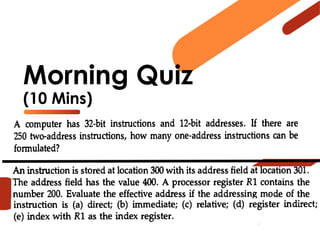
Morning Quiz
(10 Mins)
ggggggg
Previous Lecture: CENTRAL PROCESSING UNIT
• General Register Organization
• Stack Organization
• Instruction Formats
• Addressing Modes
• Data Transfer and Manipulation
Program
Control
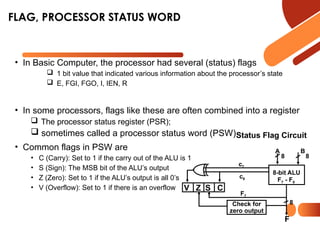
• In Basic Computer, the processor had several (status) flags
 1 bit value that indicated various information about the processor’s state
 E, FGI, FGO, I, IEN, R
• In some processors, flags like these are often combined into a register
 The processor status register (PSR);
 sometimes called a processor status word (PSW)
• Common flags in PSW are
• C (Carry): Set to 1 if the carry out of the ALU is 1
• S (Sign): The MSB bit of the ALU’s output
• Z (Zero): Set to 1 if the ALU’s output is all 0’s
• V (Overflow): Set to 1 if there is an overflow
FLAG, PROCESSOR STATUS WORD
Status Flag Circuit
c7
c8
A B
8 8
8-bit ALU
V Z S C
F7
F7 - F0
8
F
Check for
zero output
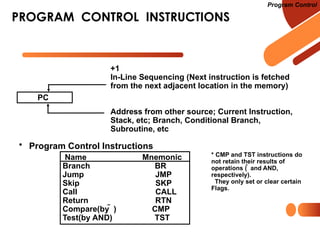
PROGRAM CONTROL INSTRUCTIONS
Program Control
PC
+1
In-Line Sequencing (Next instruction is fetched
from the next adjacent location in the memory)
Address from other source; Current Instruction,
Stack, etc; Branch, Conditional Branch,
Subroutine, etc
• Program Control Instructions
Name Mnemonic
Branch BR
Jump JMP
Skip SKP
Call CALL
Return RTN
Compare(by  ) CMP
Test(by AND) TST
* CMP and TST instructions do
not retain their results of
operations (  and AND,
respectively).
They only set or clear certain
Flags.
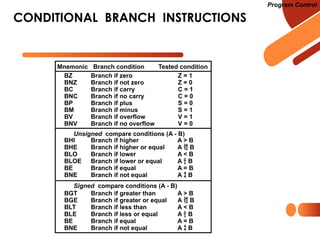
CONDITIONAL BRANCH INSTRUCTIONS
BZ Branch if zero Z = 1
BNZ Branch if not zero Z = 0
BC Branch if carry C = 1
BNC Branch if no carry C = 0
BP Branch if plus S = 0
BM Branch if minus S = 1
BV Branch if overflow V = 1
BNV Branch if no overflow V = 0
BHI Branch if higher A > B
BHE Branch if higher or equal A  B
BLO Branch if lower A < B
BLOE Branch if lower or equal A  B
BE Branch if equal A = B
BNE Branch if not equal A  B
BGT Branch if greater than A > B
BGE Branch if greater or equal A  B
BLT Branch if less than A < B
BLE Branch if less or equal A  B
BE Branch if equal A = B
BNE Branch if not equal A  B
Unsigned compare conditions (A - B)
Signed compare conditions (A - B)
Mnemonic Branch condition Tested condition
Program Control
SUBROUTINE CALL AND RETURN
Call subroutine
Jump to subroutine
Branch to subroutine
Branch and save return address
• Fixed Location in the subroutine (Memory)
• Fixed Location in memory
• In a processor Register
• In memory stack
- most efficient way
Program Control
• Subroutine Call
• Two Most Important Operations are Implied;
* Branch to the beginning of the Subroutine
- Same as the Branch or Conditional Branch
* Save the Return Address to get the address
of the location in the Calling Program upon
exit from the Subroutine
• Locations for storing Return Address
CALL
SP  SP - 1
M[SP]  PC
PC  EA
RTN
PC  M[SP]
SP  SP + 1
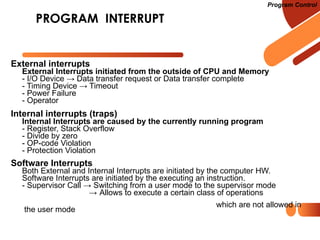
PROGRAM INTERRUPT
External interrupts
External Interrupts initiated from the outside of CPU and Memory
- I/O Device → Data transfer request or Data transfer complete
- Timing Device → Timeout
- Power Failure
- Operator
Internal interrupts (traps)
Internal Interrupts are caused by the currently running program
- Register, Stack Overflow
- Divide by zero
- OP-code Violation
- Protection Violation
Software Interrupts
Both External and Internal Interrupts are initiated by the computer HW.
Software Interrupts are initiated by the executing an instruction.
- Supervisor Call → Switching from a user mode to the supervisor mode
→ Allows to execute a certain class of operations
which are not allowed in
the user mode
Program Control
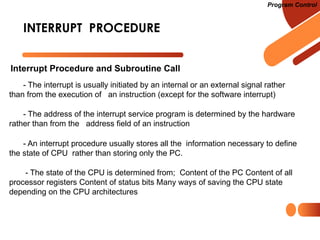
INTERRUPT PROCEDURE
- The interrupt is usually initiated by an internal or an external signal rather
than from the execution of an instruction (except for the software interrupt)
- The address of the interrupt service program is determined by the hardware
rather than from the address field of an instruction
- An interrupt procedure usually stores all the information necessary to define
the state of CPU rather than storing only the PC.
- The state of the CPU is determined from; Content of the PC Content of all
processor registers Content of status bits Many ways of saving the CPU state
depending on the CPU architectures
Program Control
Interrupt Procedure and Subroutine Call
CISC vs RISC
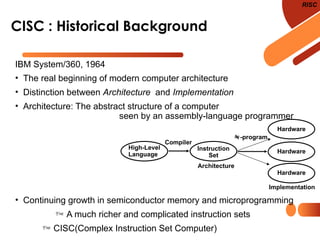
IBM System/360, 1964
• The real beginning of modern computer architecture
• Distinction between Architecture and Implementation
• Architecture: The abstract structure of a computer
seen by an assembly-language programmer
• Continuing growth in semiconductor memory and microprogramming
 A much richer and complicated instruction sets
 CISC(Complex Instruction Set Computer)
CISC : Historical Background
RISC
High-Level
Language
Instruction
Set
Hardware
Compiler
-program
Architecture
Implementation
Hardware
Hardware
• Richer instruction sets would simplify compilers
• Richer instruction sets would alleviate the software crisis
• move as much functions to the hardware as possible
• Richer instruction sets would improve architecture quality
ARGUMENTS ADVANCED AT THAT TIME
ARCHITECTURE DESIGN PRINCIPLES - IN 70’s -
RISC
• Large microprograms would add little or nothing
to the cost of the machine
 Rapid growth of memory technology
 Large General Purpose Instruction Set
• Microprogram is much faster than the machine instructions
 Microprogram memory is much faster than main memory
 Moving the software functions into microprogram for the high
performance machines
• Execution speed is proportional to the program size
 Architectural techniques that led to small program
 High performance instruction set
• Number of registers in CPU has limitations
 Very costly
 Difficult to utilize them efficiently
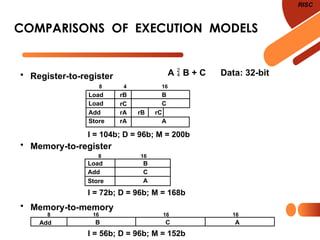
COMPARISONS OF EXECUTION MODELS
A  B + C Data: 32-bit
RISC
Load rB B
Load rC C
Add rA
Store rA A
rB rC
Load B
Add C
Store A
Add B C A
• Register-to-register
• Memory-to-register
• Memory-to-memory
I = 104b; D = 96b; M = 200b
I = 72b; D = 96b; M = 168b
I = 56b; D = 96b; M = 152b
8 4 16
8 16
8 16 16 16
RISC
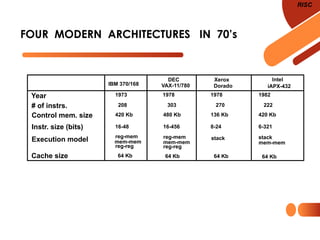
FOUR MODERN ARCHITECTURES IN 70’s
Year
# of instrs.
Control mem. size
Instr. size (bits)
Execution model
Cache size
1973
208
420 Kb
16-48
reg-mem
mem-mem
reg-reg
64 Kb
1978
303
480 Kb
16-456
reg-mem
mem-mem
reg-reg
64 Kb
1978
270
136 Kb
8-24
stack
64 Kb
1982
222
420 Kb
6-321
stack
mem-mem
64 Kb
IBM 370/168 VAX-11/780 Dorado iAPX-432
DEC Xerox Intel
• These computers with many instructions and addressing modes
came to be known as Complex Instruction Set Computers (CISC)
• One goal for CISC machines was to have a machine language
instruction to match each high-level language statement type
COMPLEX INSTRUCTION SET COMPUTER
• The large number of instructions and addressing modes led CISC
machines to have variable length instruction formats
• The large number of instructions means a greater number of bits to
specify them
• In order to manage this large number of opcodes efficiently, they were
encoded with different lengths:
• More frequently used instructions were encoded using short opcodes.
• Less frequently used ones were assigned longer opcodes.
VARIABLE LENGTH INSTRUCTIONS
• Also, multiple operand instructions could specify different addressing
modes for each operand
• For example,
• Operand 1 could be a directly addressed register,
• Operand 2 could be an indirectly addressed memory location,
• Operand 3 (the destination) could be an indirectly addressed register.
• All of this led to the need to have different length instructions in different
situations, depending on the opcode and operands used
VARIABLE LENGTH INSTRUCTIONS
• For example, an instruction that only specifies register operands may
only be two bytes in length
• One byte to specify the instruction and addressing mode
• One byte to specify the source and destination registers.
• An instruction that specifies memory addresses for operands may
need five bytes
• One byte to specify the instruction and addressing mode
• Two bytes to specify each memory address
• Maybe more if there’s a large amount of memory.
• Variable length instructions greatly complicate the fetch and decode
problem for a processor
• The circuitry to recognize the various instructions and to properly
fetch the required number of bytes for operands is very complex
VARIABLE LENGTH INSTRUCTIONS
• Another characteristic of CISC computers is that they have instructions
that act directly on memory addresses
• For example,
ADD L1, L2, L3
that takes the contents of M[L1] adds it to the contents of M[L2] and stores the result
in location M[L3]
• An instruction like this takes three memory access cycles to execute
• That makes for a potentially very long instruction execution cycle
• The problems with CISC computers are
• The complexity of the design may slow down the processor,
• The complexity of the design may result in costly errors in the processor design and
implementation,
• Many of the instructions and addressing modes are used rarely, if ever
COMPLEX INSTRUCTION SET COMPUTER
SUMMARY: CRITICISMS ON CISC
RISC
High Performance General Purpose Instructions
- Complex Instruction
→ Format, Length, Addressing Modes
→ Complicated instruction cycle control due to the complex
decoding HW and decoding process
- Multiple memory cycle instructions
→ Operations on memory data
→ Multiple memory accesses/instruction
- Microprogrammed control is necessity
→ Microprogram control storage takes substantial portion of CPU chip area
→ Semantic Gap is large between machine instruction and microinstruction
- General purpose instruction set includes all the features
required by individually different applications
→ When any one application is running, all the features required by the
other applications are extra burden to the application
RISC: Reduced Instruction Set Computer
RISC
• Relatively few instructions
• Relatively few addressing modes
• Memory access limited to load store instructions
• All operations are done within the registers of CPU
• Fixed-length instruction format. (easily decoded)
• Single cycle instruction execution
• Hardwired rather than microprogrammed control
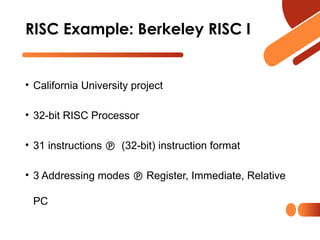
• California University project
• 32-bit RISC Processor
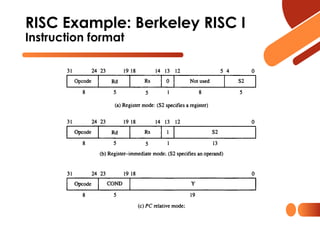
• 31 instructions  (32-bit) instruction format
• 3 Addressing modes  Register, Immediate, Relative
PC
RISC Example: Berkeley RISC I
Instruction format
11/23/2024 26

2024_lecture12_come321.pptx..................

  • 1.
    COME321: Computer Organization (Fall2019) Dr. Eng. Ghada Abozaid Ghada.abozaid@aswu.edu.eg Electrical Engineering Dept.
  • 2.
  • 3.
    Previous Lecture: CENTRALPROCESSING UNIT • General Register Organization • Stack Organization • Instruction Formats • Addressing Modes • Data Transfer and Manipulation
  • 4.
  • 5.
    • In BasicComputer, the processor had several (status) flags  1 bit value that indicated various information about the processor’s state  E, FGI, FGO, I, IEN, R • In some processors, flags like these are often combined into a register  The processor status register (PSR);  sometimes called a processor status word (PSW) • Common flags in PSW are • C (Carry): Set to 1 if the carry out of the ALU is 1 • S (Sign): The MSB bit of the ALU’s output • Z (Zero): Set to 1 if the ALU’s output is all 0’s • V (Overflow): Set to 1 if there is an overflow FLAG, PROCESSOR STATUS WORD Status Flag Circuit c7 c8 A B 8 8 8-bit ALU V Z S C F7 F7 - F0 8 F Check for zero output
  • 6.
    PROGRAM CONTROL INSTRUCTIONS ProgramControl PC +1 In-Line Sequencing (Next instruction is fetched from the next adjacent location in the memory) Address from other source; Current Instruction, Stack, etc; Branch, Conditional Branch, Subroutine, etc • Program Control Instructions Name Mnemonic Branch BR Jump JMP Skip SKP Call CALL Return RTN Compare(by  ) CMP Test(by AND) TST * CMP and TST instructions do not retain their results of operations (  and AND, respectively). They only set or clear certain Flags.
  • 7.
    CONDITIONAL BRANCH INSTRUCTIONS BZBranch if zero Z = 1 BNZ Branch if not zero Z = 0 BC Branch if carry C = 1 BNC Branch if no carry C = 0 BP Branch if plus S = 0 BM Branch if minus S = 1 BV Branch if overflow V = 1 BNV Branch if no overflow V = 0 BHI Branch if higher A > B BHE Branch if higher or equal A  B BLO Branch if lower A < B BLOE Branch if lower or equal A  B BE Branch if equal A = B BNE Branch if not equal A  B BGT Branch if greater than A > B BGE Branch if greater or equal A  B BLT Branch if less than A < B BLE Branch if less or equal A  B BE Branch if equal A = B BNE Branch if not equal A  B Unsigned compare conditions (A - B) Signed compare conditions (A - B) Mnemonic Branch condition Tested condition Program Control
  • 8.
    SUBROUTINE CALL ANDRETURN Call subroutine Jump to subroutine Branch to subroutine Branch and save return address • Fixed Location in the subroutine (Memory) • Fixed Location in memory • In a processor Register • In memory stack - most efficient way Program Control • Subroutine Call • Two Most Important Operations are Implied; * Branch to the beginning of the Subroutine - Same as the Branch or Conditional Branch * Save the Return Address to get the address of the location in the Calling Program upon exit from the Subroutine • Locations for storing Return Address CALL SP  SP - 1 M[SP]  PC PC  EA RTN PC  M[SP] SP  SP + 1
  • 9.
    PROGRAM INTERRUPT External interrupts ExternalInterrupts initiated from the outside of CPU and Memory - I/O Device → Data transfer request or Data transfer complete - Timing Device → Timeout - Power Failure - Operator Internal interrupts (traps) Internal Interrupts are caused by the currently running program - Register, Stack Overflow - Divide by zero - OP-code Violation - Protection Violation Software Interrupts Both External and Internal Interrupts are initiated by the computer HW. Software Interrupts are initiated by the executing an instruction. - Supervisor Call → Switching from a user mode to the supervisor mode → Allows to execute a certain class of operations which are not allowed in the user mode Program Control
  • 10.
    INTERRUPT PROCEDURE - Theinterrupt is usually initiated by an internal or an external signal rather than from the execution of an instruction (except for the software interrupt) - The address of the interrupt service program is determined by the hardware rather than from the address field of an instruction - An interrupt procedure usually stores all the information necessary to define the state of CPU rather than storing only the PC. - The state of the CPU is determined from; Content of the PC Content of all processor registers Content of status bits Many ways of saving the CPU state depending on the CPU architectures Program Control Interrupt Procedure and Subroutine Call
  • 11.
  • 12.
    IBM System/360, 1964 •The real beginning of modern computer architecture • Distinction between Architecture and Implementation • Architecture: The abstract structure of a computer seen by an assembly-language programmer • Continuing growth in semiconductor memory and microprogramming  A much richer and complicated instruction sets  CISC(Complex Instruction Set Computer) CISC : Historical Background RISC High-Level Language Instruction Set Hardware Compiler -program Architecture Implementation Hardware Hardware
  • 13.
    • Richer instructionsets would simplify compilers • Richer instruction sets would alleviate the software crisis • move as much functions to the hardware as possible • Richer instruction sets would improve architecture quality ARGUMENTS ADVANCED AT THAT TIME
  • 14.
    ARCHITECTURE DESIGN PRINCIPLES- IN 70’s - RISC • Large microprograms would add little or nothing to the cost of the machine  Rapid growth of memory technology  Large General Purpose Instruction Set • Microprogram is much faster than the machine instructions  Microprogram memory is much faster than main memory  Moving the software functions into microprogram for the high performance machines • Execution speed is proportional to the program size  Architectural techniques that led to small program  High performance instruction set • Number of registers in CPU has limitations  Very costly  Difficult to utilize them efficiently
  • 15.
    COMPARISONS OF EXECUTIONMODELS A  B + C Data: 32-bit RISC Load rB B Load rC C Add rA Store rA A rB rC Load B Add C Store A Add B C A • Register-to-register • Memory-to-register • Memory-to-memory I = 104b; D = 96b; M = 200b I = 72b; D = 96b; M = 168b I = 56b; D = 96b; M = 152b 8 4 16 8 16 8 16 16 16
  • 16.
    RISC FOUR MODERN ARCHITECTURESIN 70’s Year # of instrs. Control mem. size Instr. size (bits) Execution model Cache size 1973 208 420 Kb 16-48 reg-mem mem-mem reg-reg 64 Kb 1978 303 480 Kb 16-456 reg-mem mem-mem reg-reg 64 Kb 1978 270 136 Kb 8-24 stack 64 Kb 1982 222 420 Kb 6-321 stack mem-mem 64 Kb IBM 370/168 VAX-11/780 Dorado iAPX-432 DEC Xerox Intel
  • 17.
    • These computerswith many instructions and addressing modes came to be known as Complex Instruction Set Computers (CISC) • One goal for CISC machines was to have a machine language instruction to match each high-level language statement type COMPLEX INSTRUCTION SET COMPUTER
  • 18.
    • The largenumber of instructions and addressing modes led CISC machines to have variable length instruction formats • The large number of instructions means a greater number of bits to specify them • In order to manage this large number of opcodes efficiently, they were encoded with different lengths: • More frequently used instructions were encoded using short opcodes. • Less frequently used ones were assigned longer opcodes. VARIABLE LENGTH INSTRUCTIONS
  • 19.
    • Also, multipleoperand instructions could specify different addressing modes for each operand • For example, • Operand 1 could be a directly addressed register, • Operand 2 could be an indirectly addressed memory location, • Operand 3 (the destination) could be an indirectly addressed register. • All of this led to the need to have different length instructions in different situations, depending on the opcode and operands used VARIABLE LENGTH INSTRUCTIONS
  • 20.
    • For example,an instruction that only specifies register operands may only be two bytes in length • One byte to specify the instruction and addressing mode • One byte to specify the source and destination registers. • An instruction that specifies memory addresses for operands may need five bytes • One byte to specify the instruction and addressing mode • Two bytes to specify each memory address • Maybe more if there’s a large amount of memory. • Variable length instructions greatly complicate the fetch and decode problem for a processor • The circuitry to recognize the various instructions and to properly fetch the required number of bytes for operands is very complex VARIABLE LENGTH INSTRUCTIONS
  • 21.
    • Another characteristicof CISC computers is that they have instructions that act directly on memory addresses • For example, ADD L1, L2, L3 that takes the contents of M[L1] adds it to the contents of M[L2] and stores the result in location M[L3] • An instruction like this takes three memory access cycles to execute • That makes for a potentially very long instruction execution cycle • The problems with CISC computers are • The complexity of the design may slow down the processor, • The complexity of the design may result in costly errors in the processor design and implementation, • Many of the instructions and addressing modes are used rarely, if ever COMPLEX INSTRUCTION SET COMPUTER
  • 22.
    SUMMARY: CRITICISMS ONCISC RISC High Performance General Purpose Instructions - Complex Instruction → Format, Length, Addressing Modes → Complicated instruction cycle control due to the complex decoding HW and decoding process - Multiple memory cycle instructions → Operations on memory data → Multiple memory accesses/instruction - Microprogrammed control is necessity → Microprogram control storage takes substantial portion of CPU chip area → Semantic Gap is large between machine instruction and microinstruction - General purpose instruction set includes all the features required by individually different applications → When any one application is running, all the features required by the other applications are extra burden to the application
  • 23.
    RISC: Reduced InstructionSet Computer RISC • Relatively few instructions • Relatively few addressing modes • Memory access limited to load store instructions • All operations are done within the registers of CPU • Fixed-length instruction format. (easily decoded) • Single cycle instruction execution • Hardwired rather than microprogrammed control
  • 24.
    • California Universityproject • 32-bit RISC Processor • 31 instructions  (32-bit) instruction format • 3 Addressing modes  Register, Immediate, Relative PC RISC Example: Berkeley RISC I
  • 25.
    RISC Example: BerkeleyRISC I Instruction format
  • 26.