Presented by :
RICHA sharma
Chronic periodontitis formerly known as “adult periodontitis “
or “chronic adult periodontitis” is the most prevalent form
of periodontitis Although it is most frequently seen in adults,
but in some cases can also be present in children and in
adolescents in response to chronic plaque and calculus
accumulation.
It is defined as an inflammatory disease of supporting tissues of
teeth caused by specific micro-organism or group of specific
micro-organisms resulting in progressive destruction of
periodontal ligament and alveolar bone with pocket formation,
recession or both.
It is an infectious disease in inflammation within the supporting
tissues of the teeth, progressive attachment loss and bone loss.
(Carranza 11th edition , Fleming TF)
HISTORICAL PERSPECTIVE
Late 1800s
 Chronic periodontitis was clinically characterized as a slowly
progressive destruction of the periodontium due to the
accumulation of Lime Deposits on the teeth (Davis, 1879) .
 Known as Rigg’s disease.
 Throughout most of the 20th century, this form of periodontitis
had been considered an inflammatory disease associated
with local irritants and the formation of dental plaque
(biofilms) on tooth surfaces. This concept prevails today.
AAP (1999)- based on current clinical and scientific
data.
General clinical manifestation of periodontitis.
1. Chronic periodontitis
 localized
 generalized
2. Aggressive periodontitis
 localized
 generalized
3.Periodontitis as manifestation of systemic disease
4. Two forms of necrotizing disease have been described:
 NUG
 NUP
5. Abscesses of the periodontium
 Gingival abscess
 Periodontal abscess
 Pericoronal abscess
6. Periodontitis associated with endodontic lesions
Clinical charateristics (Flemming,mombelli; periodontol
1992)
 Prevalent in adults, but can occur in children.
 Amount of destruction consistent with local
factors.
 Associated with variable microbial pattern.
 Subgingival calculus frequently found.
 Slow to moderate rate of disease progression with
possible periods of rapid destruction.
 Possibly modified or associated with the following:
 Systemic diseases such as diabetes mellitus and HIV
 Local factors predisposing to periodontitis.
 Environmental factors such as smoking
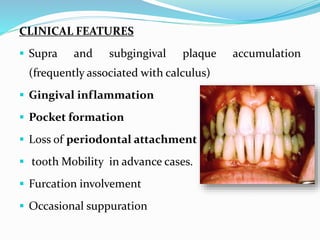
CLINICAL FEATURES
 Supra and subgingival plaque accumulation
(frequently associated with calculus)
 Gingival inflammation
 Pocket formation
 Loss of periodontal attachment
 tooth Mobility in advance cases.
 Furcation involvement
 Occasional suppuration
 Blunted or rolled gingival margins and Flattened or
cratered papillae.
 Gingival bleeding- either spontaneous or in response
to probing.
 In some cases, due to long standing, Low grade
inflammation, thickened fibrotic marginal tissues
may obscure the underlying inflammatory
changes.
 Both horizontal and vertical bone loss is evident
radiographically.
Radiographic signs
 The following characteristic are indicative of periodontal tissue
change.
 1. The crest of interdental bone will be 2 mm or more apical to the
CEJ; this is very important to determine if there is bone loss.
 2. The crest of alveolar bone will appear fuzzy in appearance.
 3. Lamina dura will be ill-defined .
 4. Density of interdental bone will be decreased .
• 5. Furcation areas of molar areas will be involved, and you
will find radiolucency in that area.
Pattern of bone loss may be vertical or horizontal
VERTICAL HORIZONTAL
When attachment & bone loss on one tooth
surface is greater than that on an adjacent
surface.
When attachment and bone loss proceeds at
an uniform rate on the majority of tooth
surfaces.
Vertical bone loss is usually associated with
angular bony defects & infrabony pocket
formation.
Horizontal bone loss is usually associated
with suprabony pockets.
PATHOGENESIS OF PERIODONTAL DISEASE
Disease distribution
 Site specific disease
 It may occur on one surface and other may be free of
symptom.
14
15
LOCALIZED
When < 30%of the sites are involved.
GENERALIZED
When > 30% sites are involved.
DISEASE SEVERITY
MILD- 2-3 mm of CAL loss
MODERATE- 3-5 mm of CAL loss
SEVERE- more than 5mm of CAL loss
Disease progression
Usually slow rate of progression: In the few studies that have been
performed on the natural history of progression of chronic
periodontitis, the disease was found to progress at a full-mouth average
rate of approximately 0.2 mm ⁄ year. (Brown, Loe 1996; Lindhe
Hafajee 1983 et al.)
In a longitudinal study by Loe H, Anerud A, Boysen H, Morrison E
(1986) of Sri Lankan workers on a tea plantation, one group of
individuals lost, on a full-mouth basis, an average of 0.46 mm ⁄ year .
This group was referred to as rapidly progressive, and would probably
be classified as generalized aggressive periodontitis using the current
system of nomenclature.
 Several models have been proposed to describe the rate of
progression by Socransky ,Goodson 1984. These models
progression is measured by determining the amount of
attachment loss at a given time. This was termed as “BURST
HYPOTHESIS” of disease progression.
 1- Continuous Models
 2- Random or Episodic burst model
 3- Asynchronous , multiple burst model
 Continuous model – slow and continuous, constantly
progressive rate of destruction throughout the duration of
the disease.
 Random / episodic-burst model – short bursts of
destruction followed by periods of no destruction, random
pattern of disease w.r.t the tooth sites affected.
 Asynchronous, multiple-burst model – periodontal
destruction occurs in bursts, around affected teeth during
defined periods of life. The chronology of these bursts of
disease is asynchronous for individual teeth or groups of
teeth.
PERIODS OF DESTRUCTION
 1- Bursts of destructive activity are associated with sub
gingival ulceration, acute inflammatory reaction resulting
in rapid bone loss.
 2- Conversion of T –lymphocyte lesion to B- Lymphocyte
plasma cell infiltrates
 3- Increase in loose unattached motile Gram –ve anaerobic
pocket flora and remission with dense unaltered non
motile Gram +ve flora. Tissue invasion by one or several
bacterial species followed by an advanced local host
defense that controls the attack (Saglie RF, et al 1987)
Categories of Risk Elements for Periodontal Disease
Risk
Defined as is the probability that an individual will get a
specific disease in a given period.
RISK FACTORS:
Tobacco smoking
Diabetes
Pathogenic bacteria
Microbial tooth deposits
RISK DETERMINANTS:
Genetic factors
Age
Gender
Socioeconomic status
stress
RISK INDICATORS:
HIV/Aids
Osteoporosis
Infrequent dental visits
RISK
MARKERS/PREDICTORS:
Previous history of periodontal
disease
Bleeding on probing
Smoking
 Undoubtedly one of the main and most prevalent, risk factors for chronic
periodontitis, risk calculations suggesting 40% of the cases of chronic
periodontitis may be attributable to smoking...
 Several cross sectional and longitudnal studies performed over the years by
Kinane & Chestnutt 2000 have found that tobacco is a risk factor for
chronic periodontitis.
 It is not only the risk of developing the disease that is enhanced by smoking
but also response to periodontal therapy is impaired in smokers.
 A further feature in smokers is that their signs and symptoms of both
gingivitis and chronic periodontitis, mainly gingival redness and bleeding
on probing , are masked by the dampening of inflammation seen in
smokers as compared to non-smokers.
MECHANISM
 Vascular alterations
 Altered neutrophil function
 Decreased IgG production
 Decreased lymphocyte proliferation
 Increased prevalence of periopathogens
 Altered fibroblast attachment and function
 Difficulty in eliminating pathogens by mechanical therapy
 Negative local effects on cytokine and growth factor products
When combined with plaque-induced chronic periodontitis, an increase in the
rate of periodontal destruction may be observed in patients who smoke and
have chronic periodontitis.
As a result, smokers with chronic periodontitis have more attachment and bone
loss, more furcation involvements and deeper pockets. In addition they
appear to form more supragingival than sub-gingival calculus and
demonstrate less bleeding on probing than non-smokers.
DIABETES
 Diabetes can increase the severity of the disease.
 NIDDM or type II is the most prevalent factor.
 In addition, Type II diabetes is most likely to develop in an adult population
at the same time as chronic periodontitis.
 The synergistic effect of plaque accumulation and modulation of an
effective host response through the effect of diabetes can lead to severe and
extensive periodontal destruction that may be difficult to manage with
standard clinical techniques without controlling the systemic condition.
 In 2001, Taylor conducted a comprehensive Medline search of studies
examining periodontal diseases as a complication of diabetes and the
effect of periodontal therapy on glycemic control.
 Most reports indicated that subjects with diabetes have increased
prevalence, extent, severity or progression of periodontal diseases.
Micro vascular changes
Hyperglycemia
Glycosylation of basement membrane proteins
Thickening of basement membrane
Altered structural and physical properties of BM
Disruption of collagen fibers in BM, swelling of
endothelium
Impedes oxygen diffusion, metabolic waste
elimination, PMN migration diffusion of serum
factor including antibodies
Susceptibility to infection
(Brownlee et al 1994)
MECHANISM
Hyperglycemia + collagen
AGEs
Increases cross linking between collagen
molecules
Reduced solubility and turnover of
collagen
Failure in periodontal repair and
regeneration
 In addition, type 1 diabetes, or insulin-dependent diabetes
mellitus, is observed in children, teenagers, and young
adults and may lead to increased periodontal destruction
when it is uncontrolled.
 It is likely that chronic periodontitis, aggravated by the
complications of type1 and type 2 diabetes, will increase
in prevalence in the near future and will provide
therapeutic challenges to the clinician.
MICROORGANISMS
Chronic periodontitis is generally progressive, with some patients having
increased susceptibility to attachment and bone loss and pocketing. A
specific group of micro-organisms is seen in sub-gingival bio-film of
patients with ongoing bone associated with chronic periodontitis, including
Porphyromonas gingivalis, Tannerella forsythia, and Treponema denticola.
The identification and characterization of these and other pathogenic micro-
organisms and their association with attachment and bone loss have led to
the specific-plaque hypothesis for development of chronic periodontitis.
This hypothesis implies that although a general increase occurs in the
proportion of gram-negative micro-organisms in the sub-gingival plaque in
periodontitis, it is the presence of increased proportion of members of gram-
negative micro-organisms, that precipitate attachment and bone loss.
World Workshop in Periodontology consensus report 1996
Designated A.a., P.gingivalis and B. forsythus as periodontal pathogens
1)A.a- small, non-motile, gram negative, sacchrolytic, capnophilic rond ended
rod
- It has ability to invade the epithelial and endothelial cells.
2) P. gingivalis
- Gram negative, anaerobic, non-motile, asaccharolytic rod
- -member of black bacteriods brown black colonies on blood agar group.
- - elaborate a variety of proteolytic enzymes to invade host defense
mechanism to cause tissue destruction.
- Various proteases:-
- Gingipains
- Prolyl tripeptidase
- Prolyl dipeptidase
- collagenase
3) Bacteroid forsythus
It was first described in 1979 as fusiform bacteroids
- Difficult to grow
- - gram negative anaerobic
- - spindle shape
- Highly pleomorphic rod
- - its growth get enhanced by co cultivation with F. nuceatum
- - shows trypsin like proteolytic activity
- - detected more frequently and in higher no. in active periodontal leions
than inactive lesions.
Local contributing factors
Anatomical factors
 Proximal contact
 Cervical enamel projection
 Intermediate bifurcation ridges
 Cemental tear
 Accessory canals
 Root proximity.
 Intermediate bifurcation ridges
 Accessory canals
 Root anatomy- palatogingival groove, attachment area, root trunk
length
31
Restorative contributing factors
 Overhanging restoration
 Margin location
 Crown contours
 Pontic form
 Restorative materials
 Orthodontic contributing factors
 Crowding, malocclusion, bands and brackets
32
Risk determinants/background
characteristics
Genetics
Multifactorial disease
In contrast to aggressive periodontitis , chronic periodontitis does not typically
follow a simple pattern of familial transmission.
Twin studies – it has familial component but transmission of bacteria among family
members and due to common environmental factors is difficult to interpret.
Polymorphism in genes encoding for IL-1alpha and beta is associated with
aggressive form of chronic periodontitis in Northern America. (Korman1998)
 A study by McGuire et al,1999 suggested that patients with the IL-1
genotype increased the risk for tooth loss by 2.7 times; those who were
heavy smokers and IL-1 genotype negative increased the risk for tooth loss
by 2.9 times.
 The combined effect of the IL-1 genotype and smoking increased the risk
of tooth loss by 7.7 times ( McGuire et al 1999).
As it is accepted that the immune system plays an important role in the
pathogenesis of periodontitis, most genes that are considered to be
responsible for the development of periodontitis are also linked to the
immune response.
These include that genes that affect the expression of interlukin-1, interlukin-6,
TNF, interlukin-10, toll-like receptors.
AGE
 Both the prevalence and severity of periodontal disease increases with age.
(Burt 1994, Papapanou 1994, 1998).
 Lindhe (1991, 1992)
Minimal loss of attachment in aging subjects enrolled in preventive programs
throughout their lives.
PREGNANCY
Hormonal changes during pregnancy can aggravate existing gingivitis, which
typically worsens around the second month and reaches a peak in the
eighth month.
Pregnancy itself does not cause disease, and simple preventive oral hygiene can
help maintain healthy gums. Any pregnancy-related gingivitis usually resolves
within a few months of delivery. (Offenbacher et al.)
Stress
Psycho physiological response of the organism to a
perceived challenge or threat.” (Breivik et al 1996).
 Has direct anti-inflammatory or anti immune effects on body
defenses.
 Increasing evidence suggest that emotional stress may also influence
the extent and severity of chronic periodontitis.(Glaser et al.2002)
 However, stress is currently considered as a risk indicator for
periodontal disease (Genco RJ.1996).
The mechanisms by which stress could affect
periodontal disease progression and wound healing
have been divided into two main categories:
Psychosocial stress
Behaviour change
Poor Oral Hygiene
Poor compliance
Bacterial infection
Periodontal disease
Smoking Over-eating
Cortisol
i) health-impairing behaviours such as poor oral hygiene, increased tobacco
and alcohol consumption and poor nutritional intake;
ii) patho-physiological factors that lead to higher glucocorticoid and
catecholamine levels which indirectly affect hormonal, inflammatory and
immunological profiles, leading to an increased susceptibility to periodontal
disease (Boyapati L, 2007)
Treatment planning
I. Preliminary phase/ emergency phase
II. Phase I therapy
 Plaque control and patient education
 Removal of calculus and root planing
 Occlusal therapy, orthodontic movement
 Re evaluation
III. Surgical Phase ( Phase II therapy)
IV. Restorative phase (Phase III)
V. Maintenance Phase ( Phase IV)
TREATMENT OF MILD CHRONIC PERIODONTITIS
Scaling and root planing
Closed curettage and
Subgingival scaling
Oral hygiene measure
TREATMENT OF MODERATE CHRONIC
PERIODONTITIS
 Plaque control
 Scaling and root planing procedures
 Probing depth reduction procedures
 Gingivectomy
 Repositioned flaps
1.Apically positioned flap without osseous resection
2.Apically positioned flap with osseous resection
SEVERE CHRONIC
 Chemical agents that modify the root surface, while promoting
new attachment, have shown variable results when used in
humans.
 Bone grafting and guided tissue regeneration techniques, with
or without bone replacement grafts, may be successful when
used at selected sites with advanced attachment loss.
 The use of biologically engineered tissue inductive proteins
(eg, growth factors, extracellular matrix proteins, and bone
morphogenic proteins) to stimulate periodontal or osseous
regeneration has also shown promising results.
• Bone grafting with a variety of materials has been
estimated to decrease probing depths and lead to gains in
clinical attachment of 0.5–1 mm beyond that of surgical
debridement alone (Reynolds MA,2003).
• A comprehensive meta-analysis of regeneration studies by
(Laurell L,1998) found that guided tissue regeneration
generally improved attachment levels and bone fill by 2.7
and 2.1 mm respectively, beyond surgical debridement
alone.
CONCLUSION
 The effective management of periodontal diseases in clinical
practice presents many challenges to the clinician, some of
which can not be over come by clinical treatment alone.
 It is increasingly recognized that periodontal disease
cannot at present be cured but rather must be controlled in
order to stabilize the progression of the destructive process
in the long term.

Chronic periodontitis (1)

  • 1.
  • 2.
    Chronic periodontitis formerlyknown as “adult periodontitis “ or “chronic adult periodontitis” is the most prevalent form of periodontitis Although it is most frequently seen in adults, but in some cases can also be present in children and in adolescents in response to chronic plaque and calculus accumulation. It is defined as an inflammatory disease of supporting tissues of teeth caused by specific micro-organism or group of specific micro-organisms resulting in progressive destruction of periodontal ligament and alveolar bone with pocket formation, recession or both. It is an infectious disease in inflammation within the supporting tissues of the teeth, progressive attachment loss and bone loss. (Carranza 11th edition , Fleming TF)
  • 3.
    HISTORICAL PERSPECTIVE Late 1800s Chronic periodontitis was clinically characterized as a slowly progressive destruction of the periodontium due to the accumulation of Lime Deposits on the teeth (Davis, 1879) .  Known as Rigg’s disease.  Throughout most of the 20th century, this form of periodontitis had been considered an inflammatory disease associated with local irritants and the formation of dental plaque (biofilms) on tooth surfaces. This concept prevails today.
  • 4.
    AAP (1999)- basedon current clinical and scientific data. General clinical manifestation of periodontitis. 1. Chronic periodontitis  localized  generalized 2. Aggressive periodontitis  localized  generalized 3.Periodontitis as manifestation of systemic disease 4. Two forms of necrotizing disease have been described:  NUG  NUP
  • 5.
    5. Abscesses ofthe periodontium  Gingival abscess  Periodontal abscess  Pericoronal abscess 6. Periodontitis associated with endodontic lesions
  • 6.
    Clinical charateristics (Flemming,mombelli;periodontol 1992)  Prevalent in adults, but can occur in children.  Amount of destruction consistent with local factors.  Associated with variable microbial pattern.  Subgingival calculus frequently found.  Slow to moderate rate of disease progression with possible periods of rapid destruction.
  • 7.
     Possibly modifiedor associated with the following:  Systemic diseases such as diabetes mellitus and HIV  Local factors predisposing to periodontitis.  Environmental factors such as smoking
  • 8.
    CLINICAL FEATURES  Supraand subgingival plaque accumulation (frequently associated with calculus)  Gingival inflammation  Pocket formation  Loss of periodontal attachment  tooth Mobility in advance cases.  Furcation involvement  Occasional suppuration
  • 9.
     Blunted orrolled gingival margins and Flattened or cratered papillae.  Gingival bleeding- either spontaneous or in response to probing.  In some cases, due to long standing, Low grade inflammation, thickened fibrotic marginal tissues may obscure the underlying inflammatory changes.  Both horizontal and vertical bone loss is evident radiographically.
  • 10.
    Radiographic signs  Thefollowing characteristic are indicative of periodontal tissue change.  1. The crest of interdental bone will be 2 mm or more apical to the CEJ; this is very important to determine if there is bone loss.  2. The crest of alveolar bone will appear fuzzy in appearance.  3. Lamina dura will be ill-defined .  4. Density of interdental bone will be decreased . • 5. Furcation areas of molar areas will be involved, and you will find radiolucency in that area.
  • 12.
    Pattern of boneloss may be vertical or horizontal VERTICAL HORIZONTAL When attachment & bone loss on one tooth surface is greater than that on an adjacent surface. When attachment and bone loss proceeds at an uniform rate on the majority of tooth surfaces. Vertical bone loss is usually associated with angular bony defects & infrabony pocket formation. Horizontal bone loss is usually associated with suprabony pockets.
  • 13.
  • 14.
    Disease distribution  Sitespecific disease  It may occur on one surface and other may be free of symptom. 14
  • 15.
    15 LOCALIZED When < 30%ofthe sites are involved. GENERALIZED When > 30% sites are involved. DISEASE SEVERITY MILD- 2-3 mm of CAL loss MODERATE- 3-5 mm of CAL loss SEVERE- more than 5mm of CAL loss
  • 16.
    Disease progression Usually slowrate of progression: In the few studies that have been performed on the natural history of progression of chronic periodontitis, the disease was found to progress at a full-mouth average rate of approximately 0.2 mm ⁄ year. (Brown, Loe 1996; Lindhe Hafajee 1983 et al.) In a longitudinal study by Loe H, Anerud A, Boysen H, Morrison E (1986) of Sri Lankan workers on a tea plantation, one group of individuals lost, on a full-mouth basis, an average of 0.46 mm ⁄ year . This group was referred to as rapidly progressive, and would probably be classified as generalized aggressive periodontitis using the current system of nomenclature.
  • 17.
     Several modelshave been proposed to describe the rate of progression by Socransky ,Goodson 1984. These models progression is measured by determining the amount of attachment loss at a given time. This was termed as “BURST HYPOTHESIS” of disease progression.  1- Continuous Models  2- Random or Episodic burst model  3- Asynchronous , multiple burst model
  • 18.
     Continuous model– slow and continuous, constantly progressive rate of destruction throughout the duration of the disease.  Random / episodic-burst model – short bursts of destruction followed by periods of no destruction, random pattern of disease w.r.t the tooth sites affected.  Asynchronous, multiple-burst model – periodontal destruction occurs in bursts, around affected teeth during defined periods of life. The chronology of these bursts of disease is asynchronous for individual teeth or groups of teeth.
  • 19.
    PERIODS OF DESTRUCTION 1- Bursts of destructive activity are associated with sub gingival ulceration, acute inflammatory reaction resulting in rapid bone loss.  2- Conversion of T –lymphocyte lesion to B- Lymphocyte plasma cell infiltrates  3- Increase in loose unattached motile Gram –ve anaerobic pocket flora and remission with dense unaltered non motile Gram +ve flora. Tissue invasion by one or several bacterial species followed by an advanced local host defense that controls the attack (Saglie RF, et al 1987)
  • 20.
    Categories of RiskElements for Periodontal Disease Risk Defined as is the probability that an individual will get a specific disease in a given period. RISK FACTORS: Tobacco smoking Diabetes Pathogenic bacteria Microbial tooth deposits RISK DETERMINANTS: Genetic factors Age Gender Socioeconomic status stress RISK INDICATORS: HIV/Aids Osteoporosis Infrequent dental visits RISK MARKERS/PREDICTORS: Previous history of periodontal disease Bleeding on probing
  • 21.
    Smoking  Undoubtedly oneof the main and most prevalent, risk factors for chronic periodontitis, risk calculations suggesting 40% of the cases of chronic periodontitis may be attributable to smoking...  Several cross sectional and longitudnal studies performed over the years by Kinane & Chestnutt 2000 have found that tobacco is a risk factor for chronic periodontitis.  It is not only the risk of developing the disease that is enhanced by smoking but also response to periodontal therapy is impaired in smokers.  A further feature in smokers is that their signs and symptoms of both gingivitis and chronic periodontitis, mainly gingival redness and bleeding on probing , are masked by the dampening of inflammation seen in smokers as compared to non-smokers.
  • 22.
    MECHANISM  Vascular alterations Altered neutrophil function  Decreased IgG production  Decreased lymphocyte proliferation  Increased prevalence of periopathogens  Altered fibroblast attachment and function  Difficulty in eliminating pathogens by mechanical therapy  Negative local effects on cytokine and growth factor products When combined with plaque-induced chronic periodontitis, an increase in the rate of periodontal destruction may be observed in patients who smoke and have chronic periodontitis. As a result, smokers with chronic periodontitis have more attachment and bone loss, more furcation involvements and deeper pockets. In addition they appear to form more supragingival than sub-gingival calculus and demonstrate less bleeding on probing than non-smokers.
  • 23.
    DIABETES  Diabetes canincrease the severity of the disease.  NIDDM or type II is the most prevalent factor.  In addition, Type II diabetes is most likely to develop in an adult population at the same time as chronic periodontitis.  The synergistic effect of plaque accumulation and modulation of an effective host response through the effect of diabetes can lead to severe and extensive periodontal destruction that may be difficult to manage with standard clinical techniques without controlling the systemic condition.  In 2001, Taylor conducted a comprehensive Medline search of studies examining periodontal diseases as a complication of diabetes and the effect of periodontal therapy on glycemic control.  Most reports indicated that subjects with diabetes have increased prevalence, extent, severity or progression of periodontal diseases.
  • 24.
    Micro vascular changes Hyperglycemia Glycosylationof basement membrane proteins Thickening of basement membrane Altered structural and physical properties of BM Disruption of collagen fibers in BM, swelling of endothelium Impedes oxygen diffusion, metabolic waste elimination, PMN migration diffusion of serum factor including antibodies Susceptibility to infection (Brownlee et al 1994)
  • 26.
    MECHANISM Hyperglycemia + collagen AGEs Increasescross linking between collagen molecules Reduced solubility and turnover of collagen Failure in periodontal repair and regeneration
  • 27.
     In addition,type 1 diabetes, or insulin-dependent diabetes mellitus, is observed in children, teenagers, and young adults and may lead to increased periodontal destruction when it is uncontrolled.  It is likely that chronic periodontitis, aggravated by the complications of type1 and type 2 diabetes, will increase in prevalence in the near future and will provide therapeutic challenges to the clinician.
  • 28.
    MICROORGANISMS Chronic periodontitis isgenerally progressive, with some patients having increased susceptibility to attachment and bone loss and pocketing. A specific group of micro-organisms is seen in sub-gingival bio-film of patients with ongoing bone associated with chronic periodontitis, including Porphyromonas gingivalis, Tannerella forsythia, and Treponema denticola. The identification and characterization of these and other pathogenic micro- organisms and their association with attachment and bone loss have led to the specific-plaque hypothesis for development of chronic periodontitis. This hypothesis implies that although a general increase occurs in the proportion of gram-negative micro-organisms in the sub-gingival plaque in periodontitis, it is the presence of increased proportion of members of gram- negative micro-organisms, that precipitate attachment and bone loss.
  • 29.
    World Workshop inPeriodontology consensus report 1996 Designated A.a., P.gingivalis and B. forsythus as periodontal pathogens 1)A.a- small, non-motile, gram negative, sacchrolytic, capnophilic rond ended rod - It has ability to invade the epithelial and endothelial cells. 2) P. gingivalis - Gram negative, anaerobic, non-motile, asaccharolytic rod - -member of black bacteriods brown black colonies on blood agar group. - - elaborate a variety of proteolytic enzymes to invade host defense mechanism to cause tissue destruction. - Various proteases:- - Gingipains - Prolyl tripeptidase - Prolyl dipeptidase - collagenase
  • 30.
    3) Bacteroid forsythus Itwas first described in 1979 as fusiform bacteroids - Difficult to grow - - gram negative anaerobic - - spindle shape - Highly pleomorphic rod - - its growth get enhanced by co cultivation with F. nuceatum - - shows trypsin like proteolytic activity - - detected more frequently and in higher no. in active periodontal leions than inactive lesions.
  • 31.
    Local contributing factors Anatomicalfactors  Proximal contact  Cervical enamel projection  Intermediate bifurcation ridges  Cemental tear  Accessory canals  Root proximity.  Intermediate bifurcation ridges  Accessory canals  Root anatomy- palatogingival groove, attachment area, root trunk length 31
  • 32.
    Restorative contributing factors Overhanging restoration  Margin location  Crown contours  Pontic form  Restorative materials  Orthodontic contributing factors  Crowding, malocclusion, bands and brackets 32
  • 33.
  • 34.
    Genetics Multifactorial disease In contrastto aggressive periodontitis , chronic periodontitis does not typically follow a simple pattern of familial transmission. Twin studies – it has familial component but transmission of bacteria among family members and due to common environmental factors is difficult to interpret. Polymorphism in genes encoding for IL-1alpha and beta is associated with aggressive form of chronic periodontitis in Northern America. (Korman1998)
  • 35.
     A studyby McGuire et al,1999 suggested that patients with the IL-1 genotype increased the risk for tooth loss by 2.7 times; those who were heavy smokers and IL-1 genotype negative increased the risk for tooth loss by 2.9 times.  The combined effect of the IL-1 genotype and smoking increased the risk of tooth loss by 7.7 times ( McGuire et al 1999). As it is accepted that the immune system plays an important role in the pathogenesis of periodontitis, most genes that are considered to be responsible for the development of periodontitis are also linked to the immune response. These include that genes that affect the expression of interlukin-1, interlukin-6, TNF, interlukin-10, toll-like receptors.
  • 36.
    AGE  Both theprevalence and severity of periodontal disease increases with age. (Burt 1994, Papapanou 1994, 1998).  Lindhe (1991, 1992) Minimal loss of attachment in aging subjects enrolled in preventive programs throughout their lives. PREGNANCY Hormonal changes during pregnancy can aggravate existing gingivitis, which typically worsens around the second month and reaches a peak in the eighth month. Pregnancy itself does not cause disease, and simple preventive oral hygiene can help maintain healthy gums. Any pregnancy-related gingivitis usually resolves within a few months of delivery. (Offenbacher et al.)
  • 37.
    Stress Psycho physiological responseof the organism to a perceived challenge or threat.” (Breivik et al 1996).  Has direct anti-inflammatory or anti immune effects on body defenses.  Increasing evidence suggest that emotional stress may also influence the extent and severity of chronic periodontitis.(Glaser et al.2002)  However, stress is currently considered as a risk indicator for periodontal disease (Genco RJ.1996).
  • 38.
    The mechanisms bywhich stress could affect periodontal disease progression and wound healing have been divided into two main categories: Psychosocial stress Behaviour change Poor Oral Hygiene Poor compliance Bacterial infection Periodontal disease Smoking Over-eating Cortisol
  • 39.
    i) health-impairing behaviourssuch as poor oral hygiene, increased tobacco and alcohol consumption and poor nutritional intake; ii) patho-physiological factors that lead to higher glucocorticoid and catecholamine levels which indirectly affect hormonal, inflammatory and immunological profiles, leading to an increased susceptibility to periodontal disease (Boyapati L, 2007)
  • 40.
    Treatment planning I. Preliminaryphase/ emergency phase II. Phase I therapy  Plaque control and patient education  Removal of calculus and root planing  Occlusal therapy, orthodontic movement  Re evaluation III. Surgical Phase ( Phase II therapy) IV. Restorative phase (Phase III) V. Maintenance Phase ( Phase IV)
  • 41.
    TREATMENT OF MILDCHRONIC PERIODONTITIS Scaling and root planing Closed curettage and Subgingival scaling Oral hygiene measure
  • 42.
    TREATMENT OF MODERATECHRONIC PERIODONTITIS  Plaque control  Scaling and root planing procedures  Probing depth reduction procedures  Gingivectomy  Repositioned flaps 1.Apically positioned flap without osseous resection 2.Apically positioned flap with osseous resection
  • 43.
    SEVERE CHRONIC  Chemicalagents that modify the root surface, while promoting new attachment, have shown variable results when used in humans.  Bone grafting and guided tissue regeneration techniques, with or without bone replacement grafts, may be successful when used at selected sites with advanced attachment loss.  The use of biologically engineered tissue inductive proteins (eg, growth factors, extracellular matrix proteins, and bone morphogenic proteins) to stimulate periodontal or osseous regeneration has also shown promising results.
  • 44.
    • Bone graftingwith a variety of materials has been estimated to decrease probing depths and lead to gains in clinical attachment of 0.5–1 mm beyond that of surgical debridement alone (Reynolds MA,2003). • A comprehensive meta-analysis of regeneration studies by (Laurell L,1998) found that guided tissue regeneration generally improved attachment levels and bone fill by 2.7 and 2.1 mm respectively, beyond surgical debridement alone.
  • 45.
    CONCLUSION  The effectivemanagement of periodontal diseases in clinical practice presents many challenges to the clinician, some of which can not be over come by clinical treatment alone.  It is increasingly recognized that periodontal disease cannot at present be cured but rather must be controlled in order to stabilize the progression of the destructive process in the long term.