CHRONIC
PERIODONTITIS
Presented By :
Dr. Vartika Srivastava
1
CONTENTS
 Introduction
 History
 Classification
 Prevalence
 Clinical features
 Symptom
 Disease distribution
 Disease severity
 Disease progression
 Risk factors
 Pathogenesis
 Diagnosis
Clinical
Radiographic
 Prognosis
 Treatment
Non surgical
Surgical
 Conclusion
 References
2
PART I PART II
Introduction
 It is inflammatory disease of supporting tissues of teeth caused by specific micro-
organism or group of specific micro-organisms resulting in progressive destruction of
periodontal ligament and alveolar bone with pocket formation, recession or both.
 “As an infectious disease resulting in inflammation within the supporting tissues of the
teeth , progressive attachment loss and bone loss” (Flemmig TF 1999)
3
• Chronic – (Greek – Kronos means time) long lasting
• Chronic periodontitis, formerly known as “adult periodontitis” or “chronic
adult periodontitis” is the most prevalent form of periodontitis.
• Most commonly seen in adults.
• Age associated but not age relate.
4
History
• Fauchard recognized the relationship
between oral hygiene and the etiology
of periodontal disease
John W. Riggs (1811-85) - periodontitis or alveolar
pyorrhea was known as ‘Riggs disease’ and he have
been first individual to limit his practice to
periodontics.
5
CLASSIFICATION
6
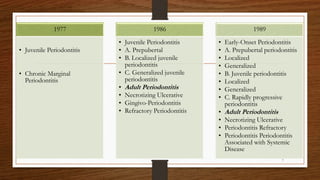
1977
• Juvenile Periodontitis
• Chronic Marginal
Periodontitis
1986
• Juvenile Periodontitis
• A. Prepubertal
• B. Localized juvenile
periodontitis
• C. Generalized juvenile
periodontitis
• Adult Periodontitis
• Necrotizing Ulcerative
• Gingivo-Periodontitis
• Refractory Periodontitis
1989
• Early-Onset Periodontitis
• A. Prepubertal periodontitis
• Localized
• Generalized
• B. Juvenile periodontitis
• Localized
• Generalized
• C. Rapidly progressive
periodontitis
• Adult Periodontitis
• Necrotizing Ulcerative
• Periodontitis Refractory
• Periodontitis Periodontitis
Associated with Systemic
Disease
7
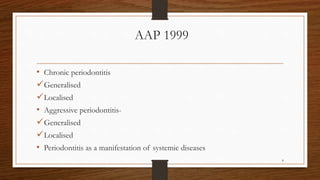
AAP 1999
• Chronic periodontitis
Generalised
Localised
• Aggressive periodontitis-
Generalised
Localised
• Periodontitis as a manifestation of systemic diseases
8
Change in terminology……….?
(Wiebe et al 2000)
Age-dependent nature of the adult periodontitis designation was felt to be somewhat
arbitrary as similar bone loss patterns can also be seen in adolescents and even in the
primary dentition of children.
Another difficulty lay in the fact that the age at which a patient presents for treatment does
not necessarily reflect the age at which the disease began.
“Chronic” periodontitis refers to progression of the disease over time without treatment
and does not suggest that the disease is “untreatable
9
Prevalence
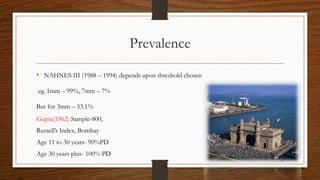
• NAHNES III (1988 – 1994) depends upon threshold chosen
eg. 1mm – 99%, 7mm – 7%
But for 3mm – 53.1%
Gupta(1962) Sample-800,
Russell’s Index, Bombay
Age 11 to 30 years- 90%PD
Age 30 years plus- 100% PD
10
Clinical features
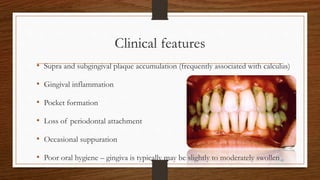
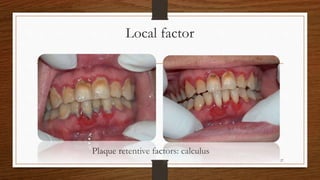
• Supra and subgingival plaque accumulation (frequently associated with calculus)
• Gingival inflammation
• Pocket formation
• Loss of periodontal attachment
• Occasional suppuration
• Poor oral hygiene – gingiva is typically may be slightly to moderately swollen11
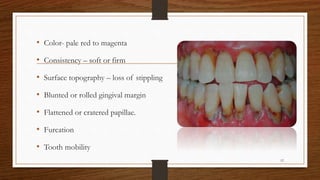
• Color- pale red to magenta
• Consistency – soft or firm
• Surface topography – loss of stippling
• Blunted or rolled gingival margin
• Flattened or cratered papillae.
• Furcation
• Tooth mobility
12
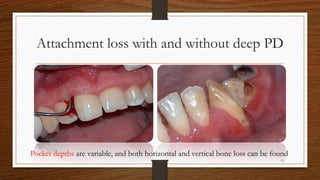
Attachment loss with and without deep PD
Pocket depths are variable, and both horizontal and vertical bone loss can be found
13
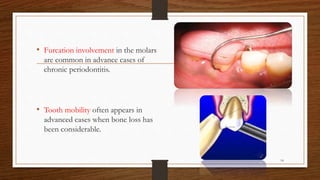
• Furcation involvement in the molars
are common in advance cases of
chronic periodontitis.
• Tooth mobility often appears in
advanced cases when bone loss has
been considerable.
14
SYMPTOMS
Bleeding gums during brushing or eating
Increasing spacing between their teeth
Loose teeth
Usually painless, but sometimes localized dull pain radiating deep into the jaw
Sensitivity due to exposed roots
Food impaction
Halitosis
Gingival tenderness or itching
15
DISEASE DISTRIBUTION
• Chronic periodontitis is considered a site-specific disease.
• The clinical sign of Chronic periodontitis , namely inflammation pocket
formation, attachment loss, and bone loss are considered to be due to the
direct, site specific effect of subginigival plaque accumulation.
• It may occur on one surface and other may be free of symptom.
16
In addition to being site specific, chronic periodontitis may be described as
being localized when few sites demonstrate attachment and bone loss or generalized
when many sites around the mouth are affected.
17
Disease Severity
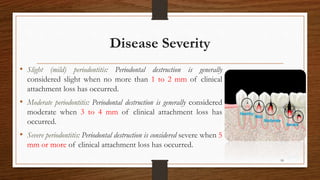
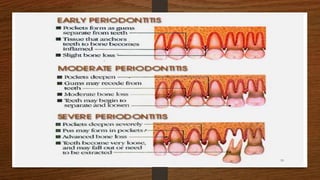
• Slight (mild) periodontitis: Periodontal destruction is generally
considered slight when no more than 1 to 2 mm of clinical
attachment loss has occurred.
• Moderate periodontitis: Periodontal destruction is generally considered
moderate when 3 to 4 mm of clinical attachment loss has
occurred.
• Severe periodontitis: Periodontal destruction is considered severe when 5
mm or more of clinical attachment loss has occurred.
18
19
Disease Progression
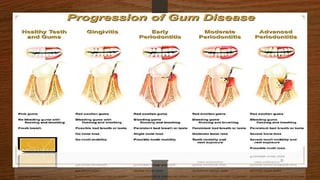
• The rate of disease progression is usually slow but may be modified by
systemic and/or environmental and behavioral factors.
• Chronic periodontitis does not progress at an equal rate in all affected sites
throughout the mouth.
• Rapidly progressive lesions occur most frequently in interproximal areas' and
are usually associated with areas of greater plaque accumulation and
inaccessibility to plaque control measures (e.g., furcation areas, overhanging
margins, sites of malposed teeth, or areas of food impaction).
20
21
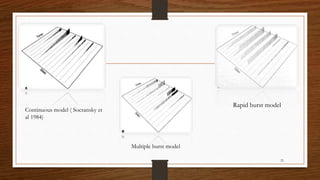
• Several models have been proposed to describe the rate of disease
progression.
• In these models, progression is measured by determining the amount of
attachment loss during a given period, as follows-
1. The Continuous Model.( SOCRANSKY et al 1984)
2. The Random Model or Episodic Burst Model.
3. The Asynchronous, Multiple-Burst Model. 22
23
Continuous model ( Socransky et
al 1984)
Rapid burst model
Multiple burst model
RISK FACTORS
Risk - is the probability that an individual will get a specific disease in a given
period. The risk of developing the disease will vary from individual to
individual.
Risk factor - is a characteristic, an aspect of behavior, or an environmental
exposure that is associated with destructive periodontitis
24
RISK FACTORS FOR DISEASE
• Prior History of Periodontitis
• Local Factors
• Systemic Factors
• Environmental and Behavioral Factors
• Genetic Factors
25
Prior History Of Periodontitis
Although not a true risk factor for disease but rather a disease predictor, a
prior history of periodontitis puts patients at greater risk for developing further
loss of attachment and bone, given a challenge from bacterial plaque
accumulation.
26
Local factor
Plaque retentive factors: calculus
27
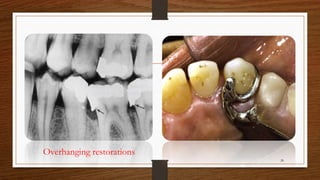
Overhanging restorations
28
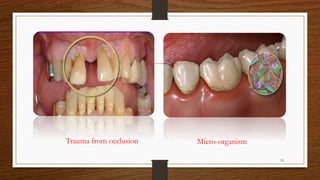
Trauma from occlusion Micro-organism
29
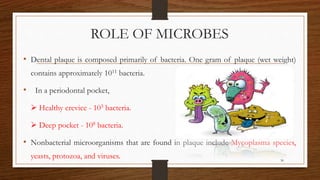
ROLE OF MICROBES
• Dental plaque is composed primarily of bacteria. One gram of plaque (wet weight)
contains approximately 1011 bacteria.
• In a periodontal pocket,
 Healthy crevice - 103 bacteria.
 Deep pocket - 108 bacteria.
• Nonbacterial microorganisms that are found in plaque include Mycoplasma species,
yeasts, protozoa, and viruses. 30
Significance Of Microbial Community
These include:
(a) A broader habitat range for growth.
(b) An increased metabolic diversity and efficiency.
(c) An enhanced resistance to environmental stress, antimicrobial agents and the
host defenses.
Shapiro (1998), Marsh & Bowden (2000).
31
32
SOCRANSKY ,HAFFAJEE 1998
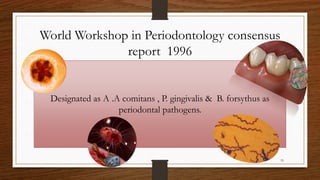
World Workshop in Periodontology consensus
report 1996
Designated as A .A comitans , P. gingivalis & B. forsythus as
periodontal pathogens.
33
ROLE OF VIRUSES
• More recently, viruses including cytomegalo , Epstein Barr, Papilloma and
herpes simplex have been proposed to play a role in the etiology of
periodontal diseases, possibly by changing the host response to the local
subgingival microbiota.
(Contreras & Slots 2000).
34
ROLE OF FUNGI
• Hannula J, Dogan B, Slots (2001) showed geographical differences in the
subgingival distribution of C. albicans serotypes and genotypes and suggested
geographic clustering of C. albicans clones in Subgingival samples of Chronic
Periodontitis patients.
35
Systemic and environmental risk factors
Uncontrolled diabetes mellitus (types I and II)
Smoking
Emotional stress
Oral hygiene habit
Environmental factor and Nutrition
Osteoporosis
HIV
36
37
DIABETES
• Diabetes mellitus is a disease of metabolic dysregulation.
• About 37-40million Indians have diabetes and is expected to double
by 2025. India is having maximum number of diabetic patients.
38
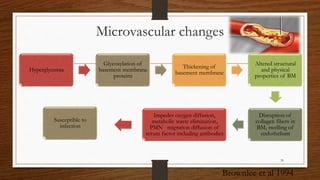
Microvascular changes
Hyperglycemia
Glycosylation of
basement membrane
proteins
Thickening of
basement membrane
Altered structural
and physical
properties of BM
Disruption of
collagen fibers in
BM, swelling of
endothelium
Impedes oxygen diffusion,
metabolic waste elimination,
PMN migration diffusion of
serum factor including antibodies
Susceptible to
infection
Brownlee et al 1994
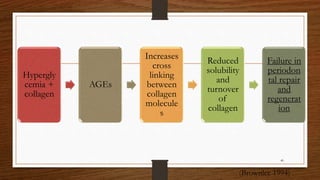
39
Hypergly
cemia +
collagen
AGEs
Increases
cross
linking
between
collagen
molecule
s
Reduced
solubility
and
turnover
of
collagen
Failure in
periodon
tal repair
and
regenerat
ion
(Brownlee 1994)
40
SMOKING
• Undoubtedly one of the main and most prevalent, risk factors for
chronic periodontitis, risk calculations suggesting 40% of the cases of
chronic periodontitis may be attributable to smoking.
• It has been estimated that there are 1.1 billlion are smokers worldwide
and 182 million (16.6%) of them live in India.
41
• The International Classification of Disease (ICD-10) has
recognized that “Tobacco Dependence” is a disease .
• The negative effect of cigarette smoking on the
Periodontium is Cumulative and Dose dependent. (Sreedhar,
Shobha P 2006)
42
MECHANISM
Vascular alterations
Altered neutrophil function
Decreased IgG production
Decreased lymphocyte proliferation
Increased prevalence of periopathogens
Altered fibroblast attachment and function
Difficulty in eliminating pathogens by mechanical therapy
Negative local effects on cytokine and growth factor products 43
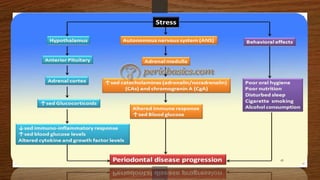
Psychophysiological
response of the organism
to a perceived challenge or
threat.” (Breivik et al 1996)
44
45
NUTRITION
Vitamin C or ascorbic acid is essential for the formation of collagen and intercellular
material, bone and teeth.
 Anti oxidant that reduces free radicals that cause DNA damage to immune cells.
↓ phagocytic function of neutrophils and macrophages
↓ antibody response
↓ cytotoxic T-cell activity
46
AGE
Both the prevalence and severity of periodontal disease increases with age.
(Burt 1994, Papapanou 1994, 1998).
• Lindhe (1991, 1992) – minimal loss of attachment in aging subjects enrolled
in preventive programs throughout their lives.
Intake of medications,
Decreased immune function, and
Altered nutritional status interaction
47
GENDER
• United States national surveys..
• Abdellatif et al (1987) have shown that males have poorer oral hygiene…
• Gender differences in prevalence and severity of chronic periodontitis are
related to preventive practices rather than any genetic factor.
48
RACE
• In USA – prevalence, severity and extent of chronic periodontitis is more in
Black, intermediate in Mexican African and least in Whites.
CAL
• Whites – more on facial aspect and associated with gingival recession.
• Blacks – interproximal areas
49
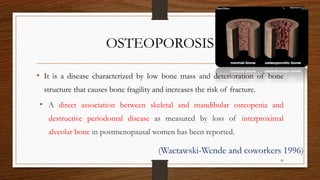
OSTEOPOROSIS
• It is a disease characterized by low bone mass and deterioration of bone
structure that causes bone fragility and increases the risk of fracture.
• A direct association between skeletal and mandibular osteopenia and
destructive periodontal disease as measured by loss of interproximal
alveolar bone in postmenopausal women has been reported.
(Wactawski-Wende and coworkers 1996)
50
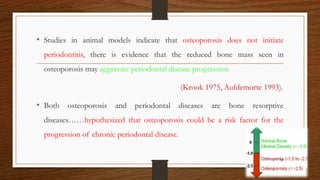
• Studies in animal models indicate that osteoporosis does not initiate
periodontitis, there is evidence that the reduced bone mass seen in
osteoporosis may aggravate periodontal disease progression
(Krook 1975, Aufdemorte 1993).
• Both osteoporosis and periodontal diseases are bone resorptive
diseases……hypothesized that osteoporosis could be a risk factor for the
progression of chronic periodontal disease.
51
HIV
AIDS epidemics in US suggests HIV positive patients
especially those with AIDS and low count of T
Lymphocytes(CD4 <200 cells/ml) were at increased risk
of chronic periodontitis.
Recent – HIV infection alone does not increases the risk
for periodontitis.
(Smith et al 1995) 52
GENETICS
• Multifactorial disease………………..?
• Twin studies – it has familial component but transmission of bacteria among
family members and due to common environmental factors it is difficult to
interpret.
• Polymorphism in genes encoding for IL-1alpha and beta is associated with
aggressive form of chronic periodontitis in Northen America.
(Korman1998)
53
Effect of chronic
periodontitis on systemic
disease
54
55
Chronic
periodo
ntitis
Diabetes
Renal
disease
Respirat
ory
disease
Preterm
birth
Cardiova
scular
disease
Stroke
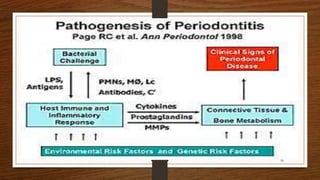
PATHOGENESIS
CP is initiated and sustained by bacterial plaque, but host
defense mechanism plays an integral role on its pathogenesis.
56
57
58
59
CHRONIC
PERIODONTITIS
Part II
60
CONTENT
Diagnosis
A. Clinical
B. Radiographic
Prognosis
Treatment
A. Non surgical
B. Surgical
Conclusion
References
61
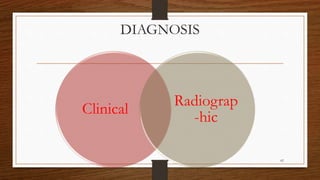
DIAGNOSIS
Clinical
Radiograp
-hic
62
Clinical diagnosis
• Clinical parameters, such as pocket probing depths, bleeding on probing
(BOP) and suppuration (Badersten et al. 1985) or micro- biological
parameters using dark-field microscopy (Listgarten & Levin 1981, Listgarten
& Schifter 1982) with or without adjunctive culturing techniques (Rosling et
al. 1984) as indicator tests for disease "activity".
63
DISEASE ACTIVITY
Consistent with the view of periodontitis as a highly localized infection of the
periodontium, disease activity is perceived as the condition under which
periodontal attachment loss increases abruptly at discrete sites over a relatively
short period of time in a small percentage of sites (Socransky et al 1984).
64
How to Diagnose ?
65
Probing pocket depth– walking of probe.
G.V.Black was first to describe systematic use of probe to explore periodontal
pocket.
Periodontal probing is done on all surfaces of every tooth in the dentition.
During probing, a thin periodontal probe should be used with gentle pressure
and it should be ‘‘walked’’ around the entire circumference of each tooth.
66
• Increased probing depth and loss of clinical attachment are pathognomonic
for periodontitis.
• Therefore, pocket probing is a crucial and mandatory procedure in
diagnosing periodontitis and evaluating periodontal therapy.
• Reduction of pocket depth and gain of clinical attachment are the major
clinical outcome measurements used to determine success of treatment.
67
• Although recent increases in probing depth and clinical attachment loss are
evidence of disease activity in the recent past, but not necessarily of on
going disease, they are highly indicative of diseased pockets, active lesions,
and further loss of attachment.
68
Clinical attachment loss
• Clinical attachment loss is the distance from the cemento-enamel junction to
the apical extent of the pocket and represents the best clinical measure of
disease severity in terms of loss of support for the teeth.
• Clinical attachment level greater than 1 mm should be considered in
establishment of periodontitis.
• Ramfjord et al. proposed that loss of attachment was considered the best
measure of disease progression.
69
• Gingival recession is recorded during periodontal probing as the
distance of the free gingival margin to the cemento-enamel junction .
• Miller’s classification is widely accepted classification to determine the
gingival recession:
• Class I: Recession that does not extend to the mucogingival junction
and is not associated with loss of bone or gingival tissue in the
interdental area;
• Class II: Recession that extends to the mucogingival junction and is
not associated with loss of bone or soft tissue in the interdental area;
• Class III: Recession that extends to or beyond the mucogingival
junction with loss of bone or soft tissue in the interdental area; and
• Class IV :Recession extending to or beyond the mucogingival
junction with severe loss of inter- dental bone and/or soft tissue
and/or severe tooth malposition.
70
BLEEDING ON PROBING
• Gingival bleeding has universally been considered an
indicator of gingival inflammation and by some investigation,
an indicator of disease activity (Polson 1985).
• Although bleeding on probing alone …………may serve as
an excellent predictor for future loss of attachment.
• Lack of bleeding on probing does appear to serve as an
excellent indicator of periodontal health.
71
• Lang NP and Joss A et al (1986) reported Bleeding on probing is A
predictor for the progression of periodontal disease.
• They reported that pockets with a probing depth of > 5 mm had a
significantly higher incidence of BOP.
• They conclude that BOP is a limited but yet useful prognostic indicator in
clinical diagnosis for patients in periodontal maintenance phase.
72
SUPPURATION
• Gingival suppuration : weak predictor of active periodontal destruction, but
better than bleeding.
• Suppuration upon probing is associated with probing attachment loss.(Anita
Bmjersten 1985)
Journal of Clinical Periodontology 1985: 12: 432-40
73
• A strong association with the risk of disease progression was reported by
Armitage et al (1994).
• The sites with suppuration at baseline (25% of the total sites) were at a
threefold higher risk of further bone loss during the following 6 months.
74
J Periodontol.1994 Feb;65
SUBGINGIVAL TEMPERATURE
• Elevated temperature is one of 4 cardinal inflammatory signs.
• Subgingival temperature is thought to directly reflect the subgingival
inflammatory state (Hoithius et al. 1981)
• In a study by Fedi and Killoy (1992), the temperature of pockets more than
5mm deep with bleeding on probing was 1.00C to 1.80C higher than that of
pockets less than 3mm deep without bleeding.
75
• Haffajee et al used this probe to asses its predictability in identifying loss of
attachment, concluding that sites with a red (higher) temperature indication
had more than twice the risk for future attachment loss than did those with a
green indication.
• Subgingival temperature like other signs of inflammation has good specifity
but poor sensitivity when considered as marker for progressive periodontitis
76
MOBILITY
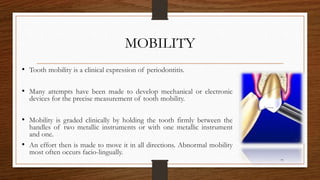
• Tooth mobility is a clinical expression of periodontitis.
• Many attempts have been made to develop mechanical or electronic
devices for the precise measurement of tooth mobility.
• Mobility is graded clinically by holding the tooth firmly between the
handles of two metallic instruments or with one metallic instrument
and one.
• An effort then is made to move it in all directions. Abnormal mobility
most often occurs facio-lingually.
77
Mobility is graded according to the ease and extent of tooth movement as
follows:
• Normal mobility
• Grade I: Slightly more than normal.
• Grade II: Moderately more than normal.
• Grade III: Severe mobility faciolingually and/or mesiodistally, combined
with vertical displacement
78
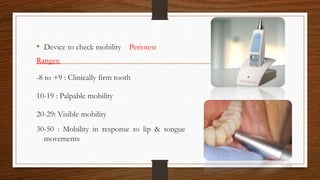
• Device to check mobility – Periotest
Ranges:
-8 to +9 : Clinically firm tooth
10-19 : Palpable mobility
20-29: Visible mobility
30-50 : Mobility in response to lip & tongue
movements
79
FURCATION
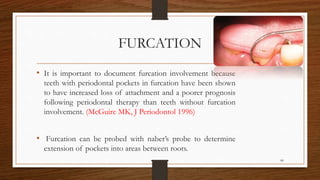
• It is important to document furcation involvement because
teeth with periodontal pockets in furcation have been shown
to have increased loss of attachment and a poorer prognosis
following periodontal therapy than teeth without furcation
involvement. (McGuire MK, J Periodontol 1996)
• Furcation can be probed with naber’s probe to determine
extension of pockets into areas between roots.
80
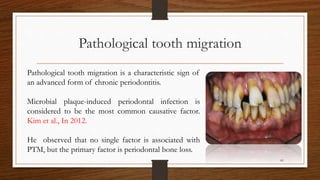
Pathological tooth migration
81
Pathological tooth migration is a characteristic sign of
an advanced form of chronic periodontitis.
Microbial plaque-induced periodontal infection is
considered to be the most common causative factor.
Kim et al., In 2012.
He observed that no single factor is associated with
PTM, but the primary factor is periodontal bone loss.
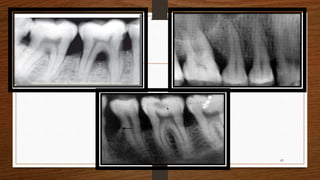
Radio graphical Diagnosis
Widening of PDL space
Loss of corticated interdental crestal margin
Localised or generalized loss of alveolar supporting bone.
Blunting of the alveolar crest due to beginning of bone resorption
Bone loss may be either horizontal or vertical.
82
83
• Numerous cross sectional and longitudinal epidemiologic studies have used
radiographs as the principal method of determining the presence or absence
of periodontal destruction.
• The primary criterion for bone loss in these studies was the distance from
the cementoenamel junction (CEJ) to the alveolar crest, The threshold
distance of bone loss has varied from 1 mm to 3 mm, although most of the
studies have used > 2 mm as the criterion for bone loss.
84
CHAIR SIDE DIAGNOSTIC KITS
85
86
Quantitative.
Highly sensitive method capable of analyzing a single periodontal site in health as well as disease.
Reproducible.
Highly specific.
Simple to perform.
A rapid, one or two stage procedure.
Non-invasive.
Versatile in terms of sample handling, storage and transport.
Amendable to chairside use.
Economical.
THE IDEAL DIAGNOSTIC TEST SHOULD BE
Chairside periodontal test kits can be categorized as
87
Microbiological test
kits
Biochemical test kits Genetic kits
Various chair side kits
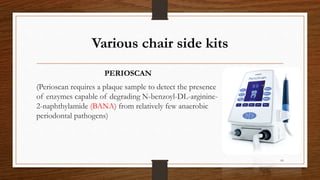
PERIOSCAN
(Perioscan requires a plaque sample to detect the presence
of enzymes capable of degrading N-benzoyl-DL-arginine-
2-naphthylamide (BANA) from relatively few anaerobic
periodontal pathogens)
88
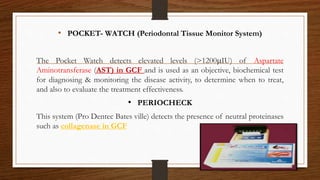
• POCKET- WATCH (Periodontal Tissue Monitor System)
The Pocket Watch detects elevated levels (>1200IU) of Aspartate
Aminotransferase (AST) in GCF and is used as an objective, biochemical test
for diagnosing & monitoring the disease activity, to determine when to treat,
and also to evaluate the treatment effectiveness.
• PERIOCHECK
This system (Pro Dentec Bates ville) detects the presence of neutral proteinases
such as collagenase in GCF
89
• PROGNOSTIK [Dentsply]
It detects the presence of serine proteinase and elastase in
GCF samples.
• PERIOGARD [Colgate]
It detects the presence of Aspartate Aminotransferase in GCF
sample.
• EVALUSITE
This chair side immunoassay detects periodontal pathogens
such as Aa commitans , P gingivalis , P intermedia .
90
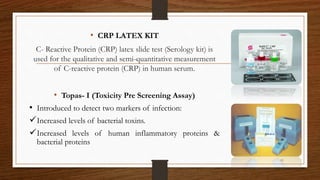
• CRP LATEX KIT
C- Reactive Protein (CRP) latex slide test (Serology kit) is
used for the qualitative and semi-quantitative measurement
of C-reactive protein (CRP) in human serum.
• Topas- I (Toxicity Pre Screening Assay)
• Introduced to detect two markers of infection:
Increased levels of bacterial toxins.
Increased levels of human inflammatory proteins &
bacterial proteins
91
• PERIODONTAL SUSCEPTIBILITY
TEST, IL GENETICS INC.
WALTHAM.MASS
Detects the presence of a specific form of 2 IL
genes; Allele 2 at IL1A+4845 & IL1B+3954.
Test also used to correlate the IL-1 production
with other clinical parameters; BOP, Bone &
attachment loss and tooth & implant loss.
92
• BIOLISE
Recently a software has been made Biolise [SLT-Lab instruments, Craitsheim,
Germany] which is used to detect the elastase activity in GCF.
[Hermann et al 2001].
• GLUCOMETER
It is used for Blood glucose measurements using gingival crevicular blood.
93
PROGNOSIS
• Slight-to-moderate periodontitis, the prognosis is generally good, provided
the inflammation can be controlled through good oral hygiene and the
removal of local plaque-retentive factors .
• In patients with more severe periodontitis, as evidenced by furcation
involvement and increasing clinical mobility, or in patients who are
noncompliant with oral hygiene practices, the prognosis may be downgraded
to fair to poor.
94
TREATMENT PLANNING
95
Treatment for periodontitis generally falls into two
categories:
1) Procedures designed to halt the progression of disease.
2) Procedures designed to regenerate structures destroyed
by disease.
Pihlstrom BL, Committee of the American Academy of Periodontology. J Periodontol 1997: 68
Non
surgical
Surgical
96
Successful periodontal therapy is dependent on anti-
infective procedures aimed at eliminating pathogenic
organisms found in dental plaque associated with the
tooth surface and within other niches in the oral
cavity.
97
Slots J. Subgingival microflora and periodontal disease. J Clin Periodontol 1979: 6: 351–382
• Since periodontal disease is a plaque-induced infection and most patients are
not skilled in mechanical plaque removal, professional cleaning is almost
universally indicated to sustain long-term stability of the periodontium .
• Anti-infective therapy includes both mechanical and chemotherapeutic
approaches to minimize or eliminate microbial biofilm (bacterial plaque), the
primary etiology of gingivitis and periodontitis..
98
MECHANICAL
APPROACH
99
• Mechanical therapy consists of debridement of the roots by the meticulous
use of hand or power-driven scalers to remove plaque, endotoxin, calculus
and other plaque-retentive local factors.
• The term mechanical therapy refers to both supra-gingival and sub-gingival
scaling as well as root planing.
100
• The term periodontal debridement was suggested by Smart et al. to describe
the light overlapping strokes used for instrumenting the root with a sonic or
ultrasonic scaler.
• The endpoint of all periodontal debridement is to produce a root that is
biologically acceptable for a healthy attachment.
101
• Numerous studies since the 1950’s have indicated that manual instrument
tation in general takes from 20% to 50% longer to achieve the same clinical
end-points than that of sonic and/or ultrasonic scalers (Badersten A et al
1981).
• When manual instrumentation or sonic/ultra- sonic scalers are used for the
treatment of the sub- gingival pockets, profound shifts in the composition
of the microbial flora are observed (Bollen CML et al 1998)
102
• Mechanical therapy is usually the first mode of treatment recommended for
most periodontal infections (Cobb CM.1996)
• The American Academy of Periodontology 1996 World Workshop
consensus report states that ultrasonic and sonic instrumentation have
shown similar clinical effects as manual scaling and root planing.
103
• According to recent systematic reviews (Tunkel et al. 2002, van der Weijden
& Timmerman 2002, Hallmon & Rees 2003), there is no major difference in
the efficacy of debridement techniques using hand or power-driven
instruments in terms of pocket reduction and gain in clinical attachment.
• While Tunkel et al. (2002) concluded, based on their systematic review, that
the use of ultrasonic/sonic devices requires less treatment time than manual
instrumentation,
104
• The traditional modality as an initial periodontal treatment phase has been to
perform scaling and root planing by jaw quadrant (Q-SRP) at a series of
appointments (Badersten et al. 1984).
• More recently, Quirynen et al. (1995) advocated the benefit of performing
full- mouth SRP within 24h in order to prevent re-infection of the treated
sites from the remaining untreated periodontal pockets.
105
CHEMICAL
APPROACH
106
Chemotherapeutic approaches include topical
application of antiseptics or sustained-release local
drug delivery agents that are designed to prevent
plaque accumulation and to disinfect the root
surfaces and adjacent periodontal tissues.
107
Rationale for adjunctive topical or systemic
antimicrobial agents
Mechanical therapy alone may not effectively control infection, particularly in deep
pockets.
Poor plaque control increases the rate of reinfection of the pocket
Root surface, tongue, tonsils and within other niches in the oral mucosa harbor
pathogenic bacteria that recolonize the periodontal pocket and can act as sources for
reinfection
Actinobacillus actinomycetemcomitans and other tissue-invasive organisms are not easily
irradicated without concomitant antibiotic therapy
108
• Vandekerckhove et al. were among the first to report a new innovative
treatment for periodontal infections using a partial-mouth disinfection
protocol that consisted of a thorough supragingival and subgingival
chlorhexidine application (rinses, irrigation and tongue brush) followed by
four quadrants of scaling and root planing within 24 hours.
109
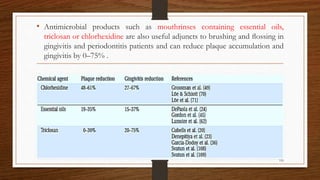
• Antimicrobial products such as mouthrinses containing essential oils,
triclosan or chlorhexidine are also useful adjuncts to brushing and flossing in
gingivitis and periodontitis patients and can reduce plaque accumulation and
gingivitis by 0–75% .
110
• In disease sites that are more difficult to control, local drug delivery devices
such as chlorhexidine chips (PerioChipTM) or 10% doxycycline gel (Atri-
doxTM) may be placed directly adjacent to the infected site.
• By placing an antibiotic or antiseptic in direct contact with the root surface,
pathogenic organisms that were not accessible to mechanical removal by
hand or power-driven instruments can be reduced or eliminated.
111
• Radvar et al. and Kinane et al. compared three types of local delivery
devices, tetracycline fiber, metronidazole gel, and minocycline gel in
combination with scaling and root planing, to scaling and root planing alone.
All treatments improved attachment levels over the 6-month testing period,
but there were no significant differences between treatment.
112
• Another new nonsurgical approach includes using a systemic
subantimicrobial dose of doxycycline (PeriostatA) that targets tissue
breakdown by blocking bacterial and host-derived enzymes associated with
loss of alveolar bone and connective tissue .
• Ashley has reported in a summary of several studies that as an adjunct to
either scaling or root planing or supra-gingival scaling and dental prophylaxis,
subantimicrobial doses of doxycycline were shown to reduce collagenase
levels in both gingival crevicular fluid and gingival biopsies.
113
SURGICAL THERAPY
114
• Nonsurgical therapy is performed prior to surgical treatment for periodontitis.
Surgery is indicated where nonsurgical methods fail.
• Advantages of periodontal surgery :
 Improved visualization of the root surface
 More accurate determination of prognosis
 Improved pocket reduction or elimination
 Improved regeneration of lost periodontal structures
 An improved environment for restorative dentistry
 Improved access for oral hygiene and supportive periodontal treatment
115
• Pocket elimination procedures gave the greatest probing depth
reduction.
• Pocket elimination was defined as gingivectomy or a flap
procedure with or without osseous re-contouring.
116
Surgical techniques includes
Gingivectomy
Undisplaced flap
Modified Widman flap with and without osseous re- contouring
Apically positioned flap with and without osseous re-contouring
117
CONCLUSION
• Chronic periodontitis an infectious disease resulting in
inflammation with in supporting tissues of the teeth,
progressive attachment loss and bone loss”. With all
emerging technologies, a successful diagnosis and
treatment will only be achieved through open sharing of
ideas, research findings and thorough testing .
118
REFERENCES
Carranza. Clinical periodontology 9th , 10th and 11th edition
Outline of periodontics Manson, Eley, 4th edition.
Relationship between periodontal disease and systemic health Periodontology 2000, Vol. 25,
2001, 21–36
Periodontal risk assessment, diagnosis and treatment planning Periodontology 2000, Vol. 25,
2001, 37–58
Non-surgical periodontal therapy Periodontology 2000, Vol. 25, 2001, 77–88
Surgical periodontal therapy Periodontology 2000, Vol. 25, 2001, 89–99
119
Bleeding on probing. A predictor for the progression of periodontal disease? J Clin
Periodontol 1986; 13: 590-596.
"Critical probing depths" in periodontal therapy Journal of Clinical Periodontology 1982: 9:
323-336
Periodontal diagnosis and treatment – where does the future lie? Periodontology 2000, Vol. 51,
2009, 9–24
Indicators of periodontal disease activity: an evaluation. J Clin Periodontol 1986; 13: 533-546
Effect of nonsurgicail periodontal therapy VII. Bleeding, suppuration and probing depth in
sites with probing attachment loss Journal of Clinical Periodontology 1985: 12: 432^40
Sub-gingival temperature as a gingival inflammatory indicator. J Clin Periodontol-1995- 22- 04-
509
Subgingival temperature (I). Re- lation to baseline clinical parameters. J Clin Periodontol 1992;
19: 401-40
Tooth mobility and periodonlal disease. J Clin Periodontol 1997; 24; 785-795.
120
121

chronic periodontitis.pptx

  • 1.
  • 2.
    CONTENTS  Introduction  History Classification  Prevalence  Clinical features  Symptom  Disease distribution  Disease severity  Disease progression  Risk factors  Pathogenesis  Diagnosis Clinical Radiographic  Prognosis  Treatment Non surgical Surgical  Conclusion  References 2 PART I PART II
  • 3.
    Introduction  It isinflammatory disease of supporting tissues of teeth caused by specific micro- organism or group of specific micro-organisms resulting in progressive destruction of periodontal ligament and alveolar bone with pocket formation, recession or both.  “As an infectious disease resulting in inflammation within the supporting tissues of the teeth , progressive attachment loss and bone loss” (Flemmig TF 1999) 3
  • 4.
    • Chronic –(Greek – Kronos means time) long lasting • Chronic periodontitis, formerly known as “adult periodontitis” or “chronic adult periodontitis” is the most prevalent form of periodontitis. • Most commonly seen in adults. • Age associated but not age relate. 4
  • 5.
    History • Fauchard recognizedthe relationship between oral hygiene and the etiology of periodontal disease John W. Riggs (1811-85) - periodontitis or alveolar pyorrhea was known as ‘Riggs disease’ and he have been first individual to limit his practice to periodontics. 5
  • 6.
  • 7.
    1977 • Juvenile Periodontitis •Chronic Marginal Periodontitis 1986 • Juvenile Periodontitis • A. Prepubertal • B. Localized juvenile periodontitis • C. Generalized juvenile periodontitis • Adult Periodontitis • Necrotizing Ulcerative • Gingivo-Periodontitis • Refractory Periodontitis 1989 • Early-Onset Periodontitis • A. Prepubertal periodontitis • Localized • Generalized • B. Juvenile periodontitis • Localized • Generalized • C. Rapidly progressive periodontitis • Adult Periodontitis • Necrotizing Ulcerative • Periodontitis Refractory • Periodontitis Periodontitis Associated with Systemic Disease 7
  • 8.
    AAP 1999 • Chronicperiodontitis Generalised Localised • Aggressive periodontitis- Generalised Localised • Periodontitis as a manifestation of systemic diseases 8
  • 9.
    Change in terminology……….? (Wiebeet al 2000) Age-dependent nature of the adult periodontitis designation was felt to be somewhat arbitrary as similar bone loss patterns can also be seen in adolescents and even in the primary dentition of children. Another difficulty lay in the fact that the age at which a patient presents for treatment does not necessarily reflect the age at which the disease began. “Chronic” periodontitis refers to progression of the disease over time without treatment and does not suggest that the disease is “untreatable 9
  • 10.
    Prevalence • NAHNES III(1988 – 1994) depends upon threshold chosen eg. 1mm – 99%, 7mm – 7% But for 3mm – 53.1% Gupta(1962) Sample-800, Russell’s Index, Bombay Age 11 to 30 years- 90%PD Age 30 years plus- 100% PD 10
  • 11.
    Clinical features • Supraand subgingival plaque accumulation (frequently associated with calculus) • Gingival inflammation • Pocket formation • Loss of periodontal attachment • Occasional suppuration • Poor oral hygiene – gingiva is typically may be slightly to moderately swollen11
  • 12.
    • Color- palered to magenta • Consistency – soft or firm • Surface topography – loss of stippling • Blunted or rolled gingival margin • Flattened or cratered papillae. • Furcation • Tooth mobility 12
  • 13.
    Attachment loss withand without deep PD Pocket depths are variable, and both horizontal and vertical bone loss can be found 13
  • 14.
    • Furcation involvementin the molars are common in advance cases of chronic periodontitis. • Tooth mobility often appears in advanced cases when bone loss has been considerable. 14
  • 15.
    SYMPTOMS Bleeding gums duringbrushing or eating Increasing spacing between their teeth Loose teeth Usually painless, but sometimes localized dull pain radiating deep into the jaw Sensitivity due to exposed roots Food impaction Halitosis Gingival tenderness or itching 15
  • 16.
    DISEASE DISTRIBUTION • Chronicperiodontitis is considered a site-specific disease. • The clinical sign of Chronic periodontitis , namely inflammation pocket formation, attachment loss, and bone loss are considered to be due to the direct, site specific effect of subginigival plaque accumulation. • It may occur on one surface and other may be free of symptom. 16
  • 17.
    In addition tobeing site specific, chronic periodontitis may be described as being localized when few sites demonstrate attachment and bone loss or generalized when many sites around the mouth are affected. 17
  • 18.
    Disease Severity • Slight(mild) periodontitis: Periodontal destruction is generally considered slight when no more than 1 to 2 mm of clinical attachment loss has occurred. • Moderate periodontitis: Periodontal destruction is generally considered moderate when 3 to 4 mm of clinical attachment loss has occurred. • Severe periodontitis: Periodontal destruction is considered severe when 5 mm or more of clinical attachment loss has occurred. 18
  • 19.
  • 20.
    Disease Progression • Therate of disease progression is usually slow but may be modified by systemic and/or environmental and behavioral factors. • Chronic periodontitis does not progress at an equal rate in all affected sites throughout the mouth. • Rapidly progressive lesions occur most frequently in interproximal areas' and are usually associated with areas of greater plaque accumulation and inaccessibility to plaque control measures (e.g., furcation areas, overhanging margins, sites of malposed teeth, or areas of food impaction). 20
  • 21.
  • 22.
    • Several modelshave been proposed to describe the rate of disease progression. • In these models, progression is measured by determining the amount of attachment loss during a given period, as follows- 1. The Continuous Model.( SOCRANSKY et al 1984) 2. The Random Model or Episodic Burst Model. 3. The Asynchronous, Multiple-Burst Model. 22
  • 23.
    23 Continuous model (Socransky et al 1984) Rapid burst model Multiple burst model
  • 24.
    RISK FACTORS Risk -is the probability that an individual will get a specific disease in a given period. The risk of developing the disease will vary from individual to individual. Risk factor - is a characteristic, an aspect of behavior, or an environmental exposure that is associated with destructive periodontitis 24
  • 25.
    RISK FACTORS FORDISEASE • Prior History of Periodontitis • Local Factors • Systemic Factors • Environmental and Behavioral Factors • Genetic Factors 25
  • 26.
    Prior History OfPeriodontitis Although not a true risk factor for disease but rather a disease predictor, a prior history of periodontitis puts patients at greater risk for developing further loss of attachment and bone, given a challenge from bacterial plaque accumulation. 26
  • 27.
    Local factor Plaque retentivefactors: calculus 27
  • 28.
  • 29.
    Trauma from occlusionMicro-organism 29
  • 30.
    ROLE OF MICROBES •Dental plaque is composed primarily of bacteria. One gram of plaque (wet weight) contains approximately 1011 bacteria. • In a periodontal pocket,  Healthy crevice - 103 bacteria.  Deep pocket - 108 bacteria. • Nonbacterial microorganisms that are found in plaque include Mycoplasma species, yeasts, protozoa, and viruses. 30
  • 31.
    Significance Of MicrobialCommunity These include: (a) A broader habitat range for growth. (b) An increased metabolic diversity and efficiency. (c) An enhanced resistance to environmental stress, antimicrobial agents and the host defenses. Shapiro (1998), Marsh & Bowden (2000). 31
  • 32.
  • 33.
    World Workshop inPeriodontology consensus report 1996 Designated as A .A comitans , P. gingivalis & B. forsythus as periodontal pathogens. 33
  • 34.
    ROLE OF VIRUSES •More recently, viruses including cytomegalo , Epstein Barr, Papilloma and herpes simplex have been proposed to play a role in the etiology of periodontal diseases, possibly by changing the host response to the local subgingival microbiota. (Contreras & Slots 2000). 34
  • 35.
    ROLE OF FUNGI •Hannula J, Dogan B, Slots (2001) showed geographical differences in the subgingival distribution of C. albicans serotypes and genotypes and suggested geographic clustering of C. albicans clones in Subgingival samples of Chronic Periodontitis patients. 35
  • 36.
    Systemic and environmentalrisk factors Uncontrolled diabetes mellitus (types I and II) Smoking Emotional stress Oral hygiene habit Environmental factor and Nutrition Osteoporosis HIV 36
  • 37.
  • 38.
    DIABETES • Diabetes mellitusis a disease of metabolic dysregulation. • About 37-40million Indians have diabetes and is expected to double by 2025. India is having maximum number of diabetic patients. 38
  • 39.
    Microvascular changes Hyperglycemia Glycosylation of basementmembrane proteins Thickening of basement membrane Altered structural and physical properties of BM Disruption of collagen fibers in BM, swelling of endothelium Impedes oxygen diffusion, metabolic waste elimination, PMN migration diffusion of serum factor including antibodies Susceptible to infection Brownlee et al 1994 39
  • 40.
  • 41.
    SMOKING • Undoubtedly oneof the main and most prevalent, risk factors for chronic periodontitis, risk calculations suggesting 40% of the cases of chronic periodontitis may be attributable to smoking. • It has been estimated that there are 1.1 billlion are smokers worldwide and 182 million (16.6%) of them live in India. 41
  • 42.
    • The InternationalClassification of Disease (ICD-10) has recognized that “Tobacco Dependence” is a disease . • The negative effect of cigarette smoking on the Periodontium is Cumulative and Dose dependent. (Sreedhar, Shobha P 2006) 42
  • 43.
    MECHANISM Vascular alterations Altered neutrophilfunction Decreased IgG production Decreased lymphocyte proliferation Increased prevalence of periopathogens Altered fibroblast attachment and function Difficulty in eliminating pathogens by mechanical therapy Negative local effects on cytokine and growth factor products 43
  • 44.
    Psychophysiological response of theorganism to a perceived challenge or threat.” (Breivik et al 1996) 44
  • 45.
  • 46.
    NUTRITION Vitamin C orascorbic acid is essential for the formation of collagen and intercellular material, bone and teeth.  Anti oxidant that reduces free radicals that cause DNA damage to immune cells. ↓ phagocytic function of neutrophils and macrophages ↓ antibody response ↓ cytotoxic T-cell activity 46
  • 47.
    AGE Both the prevalenceand severity of periodontal disease increases with age. (Burt 1994, Papapanou 1994, 1998). • Lindhe (1991, 1992) – minimal loss of attachment in aging subjects enrolled in preventive programs throughout their lives. Intake of medications, Decreased immune function, and Altered nutritional status interaction 47
  • 48.
    GENDER • United Statesnational surveys.. • Abdellatif et al (1987) have shown that males have poorer oral hygiene… • Gender differences in prevalence and severity of chronic periodontitis are related to preventive practices rather than any genetic factor. 48
  • 49.
    RACE • In USA– prevalence, severity and extent of chronic periodontitis is more in Black, intermediate in Mexican African and least in Whites. CAL • Whites – more on facial aspect and associated with gingival recession. • Blacks – interproximal areas 49
  • 50.
    OSTEOPOROSIS • It isa disease characterized by low bone mass and deterioration of bone structure that causes bone fragility and increases the risk of fracture. • A direct association between skeletal and mandibular osteopenia and destructive periodontal disease as measured by loss of interproximal alveolar bone in postmenopausal women has been reported. (Wactawski-Wende and coworkers 1996) 50
  • 51.
    • Studies inanimal models indicate that osteoporosis does not initiate periodontitis, there is evidence that the reduced bone mass seen in osteoporosis may aggravate periodontal disease progression (Krook 1975, Aufdemorte 1993). • Both osteoporosis and periodontal diseases are bone resorptive diseases……hypothesized that osteoporosis could be a risk factor for the progression of chronic periodontal disease. 51
  • 52.
    HIV AIDS epidemics inUS suggests HIV positive patients especially those with AIDS and low count of T Lymphocytes(CD4 <200 cells/ml) were at increased risk of chronic periodontitis. Recent – HIV infection alone does not increases the risk for periodontitis. (Smith et al 1995) 52
  • 53.
    GENETICS • Multifactorial disease………………..? •Twin studies – it has familial component but transmission of bacteria among family members and due to common environmental factors it is difficult to interpret. • Polymorphism in genes encoding for IL-1alpha and beta is associated with aggressive form of chronic periodontitis in Northen America. (Korman1998) 53
  • 54.
    Effect of chronic periodontitison systemic disease 54
  • 55.
  • 56.
    PATHOGENESIS CP is initiatedand sustained by bacterial plaque, but host defense mechanism plays an integral role on its pathogenesis. 56
  • 57.
  • 58.
  • 59.
  • 60.
  • 61.
    CONTENT Diagnosis A. Clinical B. Radiographic Prognosis Treatment A.Non surgical B. Surgical Conclusion References 61
  • 62.
  • 63.
    Clinical diagnosis • Clinicalparameters, such as pocket probing depths, bleeding on probing (BOP) and suppuration (Badersten et al. 1985) or micro- biological parameters using dark-field microscopy (Listgarten & Levin 1981, Listgarten & Schifter 1982) with or without adjunctive culturing techniques (Rosling et al. 1984) as indicator tests for disease "activity". 63
  • 64.
    DISEASE ACTIVITY Consistent withthe view of periodontitis as a highly localized infection of the periodontium, disease activity is perceived as the condition under which periodontal attachment loss increases abruptly at discrete sites over a relatively short period of time in a small percentage of sites (Socransky et al 1984). 64
  • 65.
  • 66.
    Probing pocket depth–walking of probe. G.V.Black was first to describe systematic use of probe to explore periodontal pocket. Periodontal probing is done on all surfaces of every tooth in the dentition. During probing, a thin periodontal probe should be used with gentle pressure and it should be ‘‘walked’’ around the entire circumference of each tooth. 66
  • 67.
    • Increased probingdepth and loss of clinical attachment are pathognomonic for periodontitis. • Therefore, pocket probing is a crucial and mandatory procedure in diagnosing periodontitis and evaluating periodontal therapy. • Reduction of pocket depth and gain of clinical attachment are the major clinical outcome measurements used to determine success of treatment. 67
  • 68.
    • Although recentincreases in probing depth and clinical attachment loss are evidence of disease activity in the recent past, but not necessarily of on going disease, they are highly indicative of diseased pockets, active lesions, and further loss of attachment. 68
  • 69.
    Clinical attachment loss •Clinical attachment loss is the distance from the cemento-enamel junction to the apical extent of the pocket and represents the best clinical measure of disease severity in terms of loss of support for the teeth. • Clinical attachment level greater than 1 mm should be considered in establishment of periodontitis. • Ramfjord et al. proposed that loss of attachment was considered the best measure of disease progression. 69
  • 70.
    • Gingival recessionis recorded during periodontal probing as the distance of the free gingival margin to the cemento-enamel junction . • Miller’s classification is widely accepted classification to determine the gingival recession: • Class I: Recession that does not extend to the mucogingival junction and is not associated with loss of bone or gingival tissue in the interdental area; • Class II: Recession that extends to the mucogingival junction and is not associated with loss of bone or soft tissue in the interdental area; • Class III: Recession that extends to or beyond the mucogingival junction with loss of bone or soft tissue in the interdental area; and • Class IV :Recession extending to or beyond the mucogingival junction with severe loss of inter- dental bone and/or soft tissue and/or severe tooth malposition. 70
  • 71.
    BLEEDING ON PROBING •Gingival bleeding has universally been considered an indicator of gingival inflammation and by some investigation, an indicator of disease activity (Polson 1985). • Although bleeding on probing alone …………may serve as an excellent predictor for future loss of attachment. • Lack of bleeding on probing does appear to serve as an excellent indicator of periodontal health. 71
  • 72.
    • Lang NPand Joss A et al (1986) reported Bleeding on probing is A predictor for the progression of periodontal disease. • They reported that pockets with a probing depth of > 5 mm had a significantly higher incidence of BOP. • They conclude that BOP is a limited but yet useful prognostic indicator in clinical diagnosis for patients in periodontal maintenance phase. 72
  • 73.
    SUPPURATION • Gingival suppuration: weak predictor of active periodontal destruction, but better than bleeding. • Suppuration upon probing is associated with probing attachment loss.(Anita Bmjersten 1985) Journal of Clinical Periodontology 1985: 12: 432-40 73
  • 74.
    • A strongassociation with the risk of disease progression was reported by Armitage et al (1994). • The sites with suppuration at baseline (25% of the total sites) were at a threefold higher risk of further bone loss during the following 6 months. 74 J Periodontol.1994 Feb;65
  • 75.
    SUBGINGIVAL TEMPERATURE • Elevatedtemperature is one of 4 cardinal inflammatory signs. • Subgingival temperature is thought to directly reflect the subgingival inflammatory state (Hoithius et al. 1981) • In a study by Fedi and Killoy (1992), the temperature of pockets more than 5mm deep with bleeding on probing was 1.00C to 1.80C higher than that of pockets less than 3mm deep without bleeding. 75
  • 76.
    • Haffajee etal used this probe to asses its predictability in identifying loss of attachment, concluding that sites with a red (higher) temperature indication had more than twice the risk for future attachment loss than did those with a green indication. • Subgingival temperature like other signs of inflammation has good specifity but poor sensitivity when considered as marker for progressive periodontitis 76
  • 77.
    MOBILITY • Tooth mobilityis a clinical expression of periodontitis. • Many attempts have been made to develop mechanical or electronic devices for the precise measurement of tooth mobility. • Mobility is graded clinically by holding the tooth firmly between the handles of two metallic instruments or with one metallic instrument and one. • An effort then is made to move it in all directions. Abnormal mobility most often occurs facio-lingually. 77
  • 78.
    Mobility is gradedaccording to the ease and extent of tooth movement as follows: • Normal mobility • Grade I: Slightly more than normal. • Grade II: Moderately more than normal. • Grade III: Severe mobility faciolingually and/or mesiodistally, combined with vertical displacement 78
  • 79.
    • Device tocheck mobility – Periotest Ranges: -8 to +9 : Clinically firm tooth 10-19 : Palpable mobility 20-29: Visible mobility 30-50 : Mobility in response to lip & tongue movements 79
  • 80.
    FURCATION • It isimportant to document furcation involvement because teeth with periodontal pockets in furcation have been shown to have increased loss of attachment and a poorer prognosis following periodontal therapy than teeth without furcation involvement. (McGuire MK, J Periodontol 1996) • Furcation can be probed with naber’s probe to determine extension of pockets into areas between roots. 80
  • 81.
    Pathological tooth migration 81 Pathologicaltooth migration is a characteristic sign of an advanced form of chronic periodontitis. Microbial plaque-induced periodontal infection is considered to be the most common causative factor. Kim et al., In 2012. He observed that no single factor is associated with PTM, but the primary factor is periodontal bone loss.
  • 82.
    Radio graphical Diagnosis Wideningof PDL space Loss of corticated interdental crestal margin Localised or generalized loss of alveolar supporting bone. Blunting of the alveolar crest due to beginning of bone resorption Bone loss may be either horizontal or vertical. 82
  • 83.
  • 84.
    • Numerous crosssectional and longitudinal epidemiologic studies have used radiographs as the principal method of determining the presence or absence of periodontal destruction. • The primary criterion for bone loss in these studies was the distance from the cementoenamel junction (CEJ) to the alveolar crest, The threshold distance of bone loss has varied from 1 mm to 3 mm, although most of the studies have used > 2 mm as the criterion for bone loss. 84
  • 85.
  • 86.
    86 Quantitative. Highly sensitive methodcapable of analyzing a single periodontal site in health as well as disease. Reproducible. Highly specific. Simple to perform. A rapid, one or two stage procedure. Non-invasive. Versatile in terms of sample handling, storage and transport. Amendable to chairside use. Economical. THE IDEAL DIAGNOSTIC TEST SHOULD BE
  • 87.
    Chairside periodontal testkits can be categorized as 87 Microbiological test kits Biochemical test kits Genetic kits
  • 88.
    Various chair sidekits PERIOSCAN (Perioscan requires a plaque sample to detect the presence of enzymes capable of degrading N-benzoyl-DL-arginine- 2-naphthylamide (BANA) from relatively few anaerobic periodontal pathogens) 88
  • 89.
    • POCKET- WATCH(Periodontal Tissue Monitor System) The Pocket Watch detects elevated levels (>1200IU) of Aspartate Aminotransferase (AST) in GCF and is used as an objective, biochemical test for diagnosing & monitoring the disease activity, to determine when to treat, and also to evaluate the treatment effectiveness. • PERIOCHECK This system (Pro Dentec Bates ville) detects the presence of neutral proteinases such as collagenase in GCF 89
  • 90.
    • PROGNOSTIK [Dentsply] Itdetects the presence of serine proteinase and elastase in GCF samples. • PERIOGARD [Colgate] It detects the presence of Aspartate Aminotransferase in GCF sample. • EVALUSITE This chair side immunoassay detects periodontal pathogens such as Aa commitans , P gingivalis , P intermedia . 90
  • 91.
    • CRP LATEXKIT C- Reactive Protein (CRP) latex slide test (Serology kit) is used for the qualitative and semi-quantitative measurement of C-reactive protein (CRP) in human serum. • Topas- I (Toxicity Pre Screening Assay) • Introduced to detect two markers of infection: Increased levels of bacterial toxins. Increased levels of human inflammatory proteins & bacterial proteins 91
  • 92.
    • PERIODONTAL SUSCEPTIBILITY TEST,IL GENETICS INC. WALTHAM.MASS Detects the presence of a specific form of 2 IL genes; Allele 2 at IL1A+4845 & IL1B+3954. Test also used to correlate the IL-1 production with other clinical parameters; BOP, Bone & attachment loss and tooth & implant loss. 92
  • 93.
    • BIOLISE Recently asoftware has been made Biolise [SLT-Lab instruments, Craitsheim, Germany] which is used to detect the elastase activity in GCF. [Hermann et al 2001]. • GLUCOMETER It is used for Blood glucose measurements using gingival crevicular blood. 93
  • 94.
    PROGNOSIS • Slight-to-moderate periodontitis,the prognosis is generally good, provided the inflammation can be controlled through good oral hygiene and the removal of local plaque-retentive factors . • In patients with more severe periodontitis, as evidenced by furcation involvement and increasing clinical mobility, or in patients who are noncompliant with oral hygiene practices, the prognosis may be downgraded to fair to poor. 94
  • 95.
    TREATMENT PLANNING 95 Treatment forperiodontitis generally falls into two categories: 1) Procedures designed to halt the progression of disease. 2) Procedures designed to regenerate structures destroyed by disease. Pihlstrom BL, Committee of the American Academy of Periodontology. J Periodontol 1997: 68
  • 96.
  • 97.
    Successful periodontal therapyis dependent on anti- infective procedures aimed at eliminating pathogenic organisms found in dental plaque associated with the tooth surface and within other niches in the oral cavity. 97 Slots J. Subgingival microflora and periodontal disease. J Clin Periodontol 1979: 6: 351–382
  • 98.
    • Since periodontaldisease is a plaque-induced infection and most patients are not skilled in mechanical plaque removal, professional cleaning is almost universally indicated to sustain long-term stability of the periodontium . • Anti-infective therapy includes both mechanical and chemotherapeutic approaches to minimize or eliminate microbial biofilm (bacterial plaque), the primary etiology of gingivitis and periodontitis.. 98
  • 99.
  • 100.
    • Mechanical therapyconsists of debridement of the roots by the meticulous use of hand or power-driven scalers to remove plaque, endotoxin, calculus and other plaque-retentive local factors. • The term mechanical therapy refers to both supra-gingival and sub-gingival scaling as well as root planing. 100
  • 101.
    • The termperiodontal debridement was suggested by Smart et al. to describe the light overlapping strokes used for instrumenting the root with a sonic or ultrasonic scaler. • The endpoint of all periodontal debridement is to produce a root that is biologically acceptable for a healthy attachment. 101
  • 102.
    • Numerous studiessince the 1950’s have indicated that manual instrument tation in general takes from 20% to 50% longer to achieve the same clinical end-points than that of sonic and/or ultrasonic scalers (Badersten A et al 1981). • When manual instrumentation or sonic/ultra- sonic scalers are used for the treatment of the sub- gingival pockets, profound shifts in the composition of the microbial flora are observed (Bollen CML et al 1998) 102
  • 103.
    • Mechanical therapyis usually the first mode of treatment recommended for most periodontal infections (Cobb CM.1996) • The American Academy of Periodontology 1996 World Workshop consensus report states that ultrasonic and sonic instrumentation have shown similar clinical effects as manual scaling and root planing. 103
  • 104.
    • According torecent systematic reviews (Tunkel et al. 2002, van der Weijden & Timmerman 2002, Hallmon & Rees 2003), there is no major difference in the efficacy of debridement techniques using hand or power-driven instruments in terms of pocket reduction and gain in clinical attachment. • While Tunkel et al. (2002) concluded, based on their systematic review, that the use of ultrasonic/sonic devices requires less treatment time than manual instrumentation, 104
  • 105.
    • The traditionalmodality as an initial periodontal treatment phase has been to perform scaling and root planing by jaw quadrant (Q-SRP) at a series of appointments (Badersten et al. 1984). • More recently, Quirynen et al. (1995) advocated the benefit of performing full- mouth SRP within 24h in order to prevent re-infection of the treated sites from the remaining untreated periodontal pockets. 105
  • 106.
  • 107.
    Chemotherapeutic approaches includetopical application of antiseptics or sustained-release local drug delivery agents that are designed to prevent plaque accumulation and to disinfect the root surfaces and adjacent periodontal tissues. 107
  • 108.
    Rationale for adjunctivetopical or systemic antimicrobial agents Mechanical therapy alone may not effectively control infection, particularly in deep pockets. Poor plaque control increases the rate of reinfection of the pocket Root surface, tongue, tonsils and within other niches in the oral mucosa harbor pathogenic bacteria that recolonize the periodontal pocket and can act as sources for reinfection Actinobacillus actinomycetemcomitans and other tissue-invasive organisms are not easily irradicated without concomitant antibiotic therapy 108
  • 109.
    • Vandekerckhove etal. were among the first to report a new innovative treatment for periodontal infections using a partial-mouth disinfection protocol that consisted of a thorough supragingival and subgingival chlorhexidine application (rinses, irrigation and tongue brush) followed by four quadrants of scaling and root planing within 24 hours. 109
  • 110.
    • Antimicrobial productssuch as mouthrinses containing essential oils, triclosan or chlorhexidine are also useful adjuncts to brushing and flossing in gingivitis and periodontitis patients and can reduce plaque accumulation and gingivitis by 0–75% . 110
  • 111.
    • In diseasesites that are more difficult to control, local drug delivery devices such as chlorhexidine chips (PerioChipTM) or 10% doxycycline gel (Atri- doxTM) may be placed directly adjacent to the infected site. • By placing an antibiotic or antiseptic in direct contact with the root surface, pathogenic organisms that were not accessible to mechanical removal by hand or power-driven instruments can be reduced or eliminated. 111
  • 112.
    • Radvar etal. and Kinane et al. compared three types of local delivery devices, tetracycline fiber, metronidazole gel, and minocycline gel in combination with scaling and root planing, to scaling and root planing alone. All treatments improved attachment levels over the 6-month testing period, but there were no significant differences between treatment. 112
  • 113.
    • Another newnonsurgical approach includes using a systemic subantimicrobial dose of doxycycline (PeriostatA) that targets tissue breakdown by blocking bacterial and host-derived enzymes associated with loss of alveolar bone and connective tissue . • Ashley has reported in a summary of several studies that as an adjunct to either scaling or root planing or supra-gingival scaling and dental prophylaxis, subantimicrobial doses of doxycycline were shown to reduce collagenase levels in both gingival crevicular fluid and gingival biopsies. 113
  • 114.
  • 115.
    • Nonsurgical therapyis performed prior to surgical treatment for periodontitis. Surgery is indicated where nonsurgical methods fail. • Advantages of periodontal surgery :  Improved visualization of the root surface  More accurate determination of prognosis  Improved pocket reduction or elimination  Improved regeneration of lost periodontal structures  An improved environment for restorative dentistry  Improved access for oral hygiene and supportive periodontal treatment 115
  • 116.
    • Pocket eliminationprocedures gave the greatest probing depth reduction. • Pocket elimination was defined as gingivectomy or a flap procedure with or without osseous re-contouring. 116
  • 117.
    Surgical techniques includes Gingivectomy Undisplacedflap Modified Widman flap with and without osseous re- contouring Apically positioned flap with and without osseous re-contouring 117
  • 118.
    CONCLUSION • Chronic periodontitisan infectious disease resulting in inflammation with in supporting tissues of the teeth, progressive attachment loss and bone loss”. With all emerging technologies, a successful diagnosis and treatment will only be achieved through open sharing of ideas, research findings and thorough testing . 118
  • 119.
    REFERENCES Carranza. Clinical periodontology9th , 10th and 11th edition Outline of periodontics Manson, Eley, 4th edition. Relationship between periodontal disease and systemic health Periodontology 2000, Vol. 25, 2001, 21–36 Periodontal risk assessment, diagnosis and treatment planning Periodontology 2000, Vol. 25, 2001, 37–58 Non-surgical periodontal therapy Periodontology 2000, Vol. 25, 2001, 77–88 Surgical periodontal therapy Periodontology 2000, Vol. 25, 2001, 89–99 119
  • 120.
    Bleeding on probing.A predictor for the progression of periodontal disease? J Clin Periodontol 1986; 13: 590-596. "Critical probing depths" in periodontal therapy Journal of Clinical Periodontology 1982: 9: 323-336 Periodontal diagnosis and treatment – where does the future lie? Periodontology 2000, Vol. 51, 2009, 9–24 Indicators of periodontal disease activity: an evaluation. J Clin Periodontol 1986; 13: 533-546 Effect of nonsurgicail periodontal therapy VII. Bleeding, suppuration and probing depth in sites with probing attachment loss Journal of Clinical Periodontology 1985: 12: 432^40 Sub-gingival temperature as a gingival inflammatory indicator. J Clin Periodontol-1995- 22- 04- 509 Subgingival temperature (I). Re- lation to baseline clinical parameters. J Clin Periodontol 1992; 19: 401-40 Tooth mobility and periodonlal disease. J Clin Periodontol 1997; 24; 785-795. 120
  • 121.