Binaya Subedi
BDS, 4TH BATCH
Chitwan Medical College
Introduction
It is a severe and rapidly progressing form of
periodontitis .
Clinical presentation :
age : 18-19 yrs
gender : F>M
TYPES
localized aggressive
periodontitis
Generalized aggressive
periodontitis
 In LAP , the involved teeth are at least two permanent
teeth ,in which one is central incisor and the other is 1st
molar
 Whereas , in GAP the involved teeth are at least 3
permanent teeth except central incisor and 1st molar
Localized aggressive periodontitis
History
In 1923 : Gottlieb reported as “Diffuse atrophy of the
alveolar bone”
In 1928 : Gottlieb termed as “Deep cementopathia”
because of continuous cementum formation
In 1938 : Wannemacher termed as “Paradontitis
marginalis progressiva”
In 1966 : World Workshop in Periodontics
Eliminated the term Periodontosis from
periodontal nomenclature
The term Juvenile Periodontitis was introduced by
Chaput and colleaugues in 1967 and by Bulter in 1969
In 1971 : Baer defined it as “ a disease of the
periodontium occurring in an otherwise healthy
adolescent which is characterized by a rapid loss of
alveolar bone about more than one teeth of the
permanent dentition
In 1989 : World workshop in clinical periodontics
categorized this disease as Localized juvenile
periodontitis, a subset of board classification of “early
onset periodontitis”
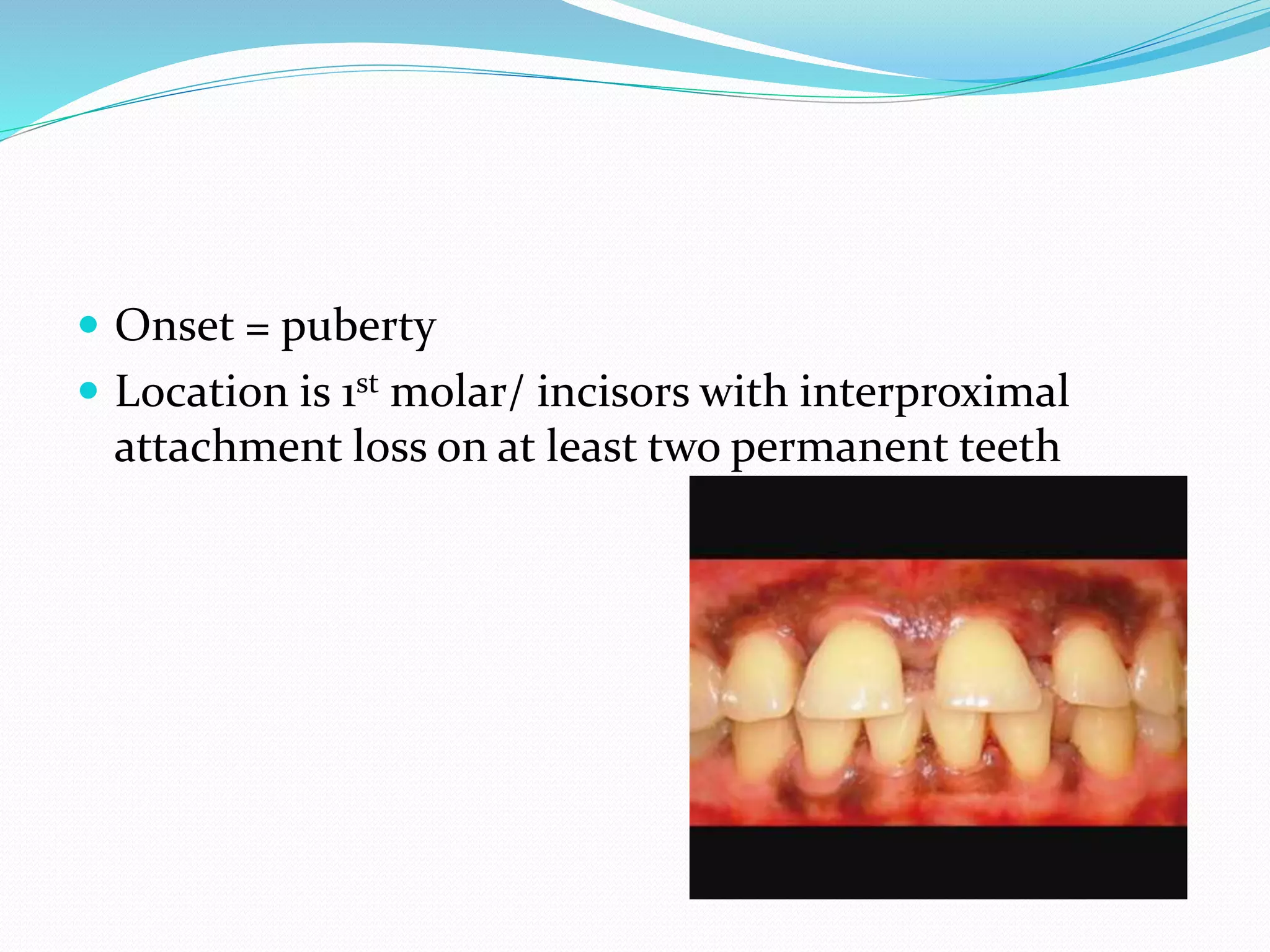
 Onset = puberty
 Location is 1st molar/ incisors with interproximal
attachment loss on at least two permanent teeth
Reasons for localization are :
After initial colonization of 1st permanent teeth to
erupt (1st molars and incisors) A.a. (Actinobacillus
actinomycetemcomitans) evades the host defences by
different mechanism ,including :
 Production of PMN chemotaxis inhibiting factors
 Endotoxin
 Collagenases
 Leukotoxin and other factors that allow bacterial
colonization and destruction of periodontal tissues
 After initial attack ,immune defences are stimulated to
produce opsonic antibodies to enhance the clearance
and phagocytosis of invading bacteria and neutralize
leucotoxic activity so, colonization of other sites is
prevented
 Attachment of A.a. to tooth surface is prevented by
mucopeptide
Bacteria antagonists to A.a colonize the periodontal
tissue and inhibit A.a from further colonization in the
mouth. This would localize A.a infection and tissue
destruction.
A.a may lose its leukotoxin producing ability for
unknown reasons so destruction of periodontal tissue
arrested and colonization of new periodontal sites
averted
A defect in cementum formation may be responsible
for the localization of the lesion
Clinical features
 Age : around puberty
 Characterized as inter-proximal attachment loss on at
least 2 permanent teeth, one of which is 1st molar and
other is incisor
 Striking feature of LAP
- lack of clinical inflammation
- absence of deep periodontal pockets
 The amount of plaque 0n affected teeth is minimal
which seems inconsistent with the amount of
periodontal destruction present
 The plaque that present forms a thin biofilm on teeth
rarely mineralizes to form calculus
 Plaque contains elevated levels of A.a and P.g
(Prophyromonas gingivalis)
 LAP ,progress rapidly ,Rate of bone loss is about three
to four times faster than in chronic periodontitis
 LAP, may include
Distolabial migration of the maxillary incisors with
concomitant diastema formation increasing mobility
of 1st molar
[also known as pathological migration]
Sensitivity of denuded root surfaces of thermal and
tactile stimuli
Deep,dull ,radiating pain during mastication probably
because of irritation of supporting structure by mobile
teeth and impacted teeth
• Periodontal abscess may form and regional LN
enlargement may occur
Radiographic findings
 Classical sign : vertical bone loss around incisors and
1st molar in puberty
 Arc shaped bone loss extending from distal of 2nd
premolar to mesial surface of 2nd molar
 Bone defects wider than chronic periodontitis
 Mirror image pattern –bilateral symmetrical pattern of
bone loss
 Discontinuity of lamina dura
 Widening of periodontal space
 Angular bone loss is evident on the mesial aspect of
46
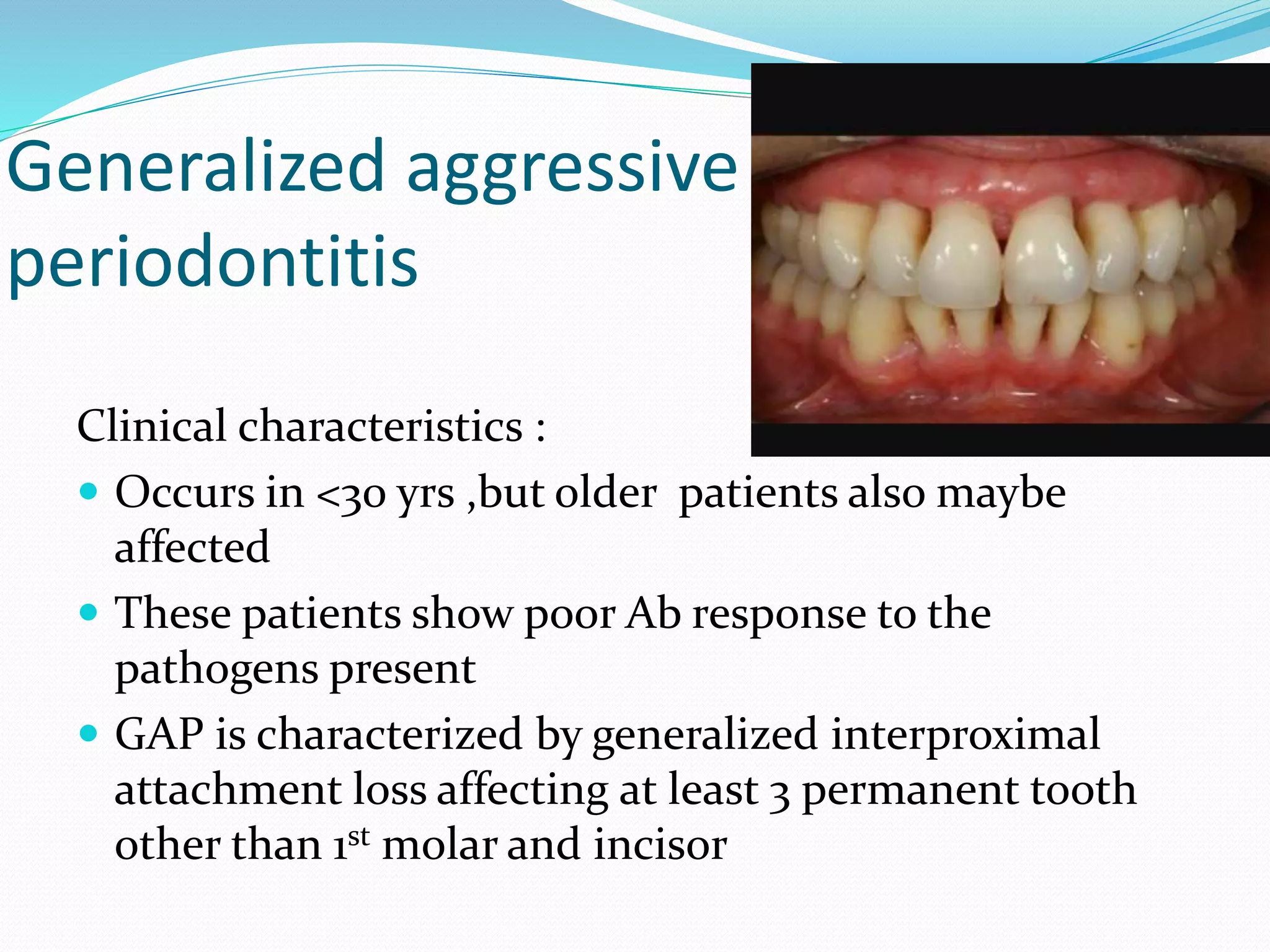
Generalized aggressive
periodontitis
Clinical characteristics :
 Occurs in <30 yrs ,but older patients also maybe
affected
 These patients show poor Ab response to the
pathogens present
 GAP is characterized by generalized interproximal
attachment loss affecting at least 3 permanent tooth
other than 1st molar and incisor
 GAP has small amount of bacterial plaque associated
with affected teeth
 Quantitatively amount of plaque seems inconsistent
with amount of PDL destruction
 Two gingival tissue response can be found here ;
i) one is a severe acutely inflammed tissue often
proliferating, ulcerated and fiery red, bleeding may
occur spontaneously or with slight stimulation
-attachment and bone are actively lost, suppurative
may be an important feature
ii) in other cases, the gingival tissue may appear pink,
free of inflammation, and occasionally with some
doses of stippling feature may be
present . Bone level remains stationary
 Some patients with GAP may have systemic
manifestations such as weight loss, mental depression,
and general malaise
Radiographic findings
 GAP can range from severe bone loss associated with
the minimal number of teeth to advanced bone loss
affecting the majority of teeth in the dentition
Risk factors for aggressive
periodontitis
1) Microbiologic factors
-Actinobacillus actinomyctemcomitans is found in high
frequency (appro.90%) in lesions characteristic of LAP
-primary pathogen also include Prophyromonas
gingivalis, campylobacter,
Fusobacterium nucleatum , Treponema denticola
2) Immunological factors
-function defects of PMNs monocytes or both
-hyper responsiveness of monocytes
-strong Ab response to A.a
3) Genetic factors
-familial pattern of bone loss is one the risk factor
4) Environmental factors
-smoking(amount and duration)
Prognosis
Prognosis depends upon
- disease condition whether localized or generalized
-degree of destruction at the time of diagnosis
-ability to control future progression
 LAP in general => fair prognosis
 If severe => poor prognosis
 In age of puberty, if diagnosed earlier => excellent
prognosis and treated with systemic antibiotic therapy
and oral hygiene instructions
 Young patient with GAP doesnot respond well to
conventional periodontal therapy therefore, patient
often have fair, poor, or questionable prognosis
Treatment
Non-surgical therapy
Antimicrobial therapy
-systemic tetracycline: 250mg 4 times daily at least for
1week
combination of oral drugs:
-doxycycline 100mg BD for 1st day followed by OD for
14days
-amoxycillin and metronidazole given
-augmentin (amoxycillin + clavulanate)
 Local drug delivery
-placed directly in the site
-formulated in form of solutions,gels,fibers,chips
 Standard periodontal therapy
-scaling and root planning
-curettage
Therapeutic modulation
-early detection
-educate patient and family members
Conventional periodontal therapy
-patient education about oral hygiene
-scaling and root planning
-regular recall and maintenance
Full mouth disinfection
-for removal of all plaque and calculus
-consists of full mouth debridement completed in two
appointment within 24hrs period
-tongue is brushed with a CHX gel 1% for 1min
-mouth is rinsed with a CHX solution (0.2%) for 2min
-periodontal pockets are irrigated with a CHX
solution
Host modulation
-sub antimicrobial dose of doxycycline
(anticollagenase effect)
treatment planning and restorative consideration
-severely compromised teeth are extracted
-transplantation of teeth from one site to another
-transplantation of developing 3rd molar to sockets of
previously extracted 1st molar has to be attempted
-dental implants
Surgical therapy
1. flap surgery with or without bone grafts, root
amputation
2. hemi sections
3. occlusal adjustments
4. strict plaque control
5. extraction
-involved teeth usually 1st molar are extracted
Maintenance
-periodontal condition must be stable i.e. no clinical
sign of disease
-it consists of :
• medical history review
• comprehensive periodontal and oral examination
• thorough root debridement and prophylaxis
• frequent maintenance resists no longer than 3months
interval
features LAP GAP
Age of onset circumpubertal Mostly under 30 yrs of age
Microorga. Predominantly A.a Predominantly P.g
Local factors Minimal amount of local
factors at the site of
destruction
Abundant amount of plaque and
calculus
Familial
aggregation
Strong association Not very clear
Pattern of
destruction
Localized 1st molar/incisor
involvement with
interproximal attachment
loss on at least two
permanent teeth
Generalized interproximal
attachment loss affecting at least 3
permanent teeth other than 1st
molar and incisors
Serum Ab
response
Rapid and severe loss of
alveolar bone
Episodic in nature
Radiographic
findings
Vertical or arc-shaped bone
loss around 1st molar and
incisors
There is generalized extensive bone
loss
THANK YOU

Aggressive periodontitis

  • 1.
    Binaya Subedi BDS, 4THBATCH Chitwan Medical College
  • 2.
    Introduction It is asevere and rapidly progressing form of periodontitis . Clinical presentation : age : 18-19 yrs gender : F>M
  • 3.
  • 4.
     In LAP, the involved teeth are at least two permanent teeth ,in which one is central incisor and the other is 1st molar  Whereas , in GAP the involved teeth are at least 3 permanent teeth except central incisor and 1st molar
  • 5.
    Localized aggressive periodontitis History In1923 : Gottlieb reported as “Diffuse atrophy of the alveolar bone” In 1928 : Gottlieb termed as “Deep cementopathia” because of continuous cementum formation In 1938 : Wannemacher termed as “Paradontitis marginalis progressiva”
  • 6.
    In 1966 :World Workshop in Periodontics Eliminated the term Periodontosis from periodontal nomenclature The term Juvenile Periodontitis was introduced by Chaput and colleaugues in 1967 and by Bulter in 1969 In 1971 : Baer defined it as “ a disease of the periodontium occurring in an otherwise healthy adolescent which is characterized by a rapid loss of alveolar bone about more than one teeth of the permanent dentition
  • 7.
    In 1989 :World workshop in clinical periodontics categorized this disease as Localized juvenile periodontitis, a subset of board classification of “early onset periodontitis”
  • 8.
     Onset =puberty  Location is 1st molar/ incisors with interproximal attachment loss on at least two permanent teeth
  • 9.
    Reasons for localizationare : After initial colonization of 1st permanent teeth to erupt (1st molars and incisors) A.a. (Actinobacillus actinomycetemcomitans) evades the host defences by different mechanism ,including :  Production of PMN chemotaxis inhibiting factors  Endotoxin  Collagenases  Leukotoxin and other factors that allow bacterial colonization and destruction of periodontal tissues
  • 10.
     After initialattack ,immune defences are stimulated to produce opsonic antibodies to enhance the clearance and phagocytosis of invading bacteria and neutralize leucotoxic activity so, colonization of other sites is prevented  Attachment of A.a. to tooth surface is prevented by mucopeptide
  • 11.
    Bacteria antagonists toA.a colonize the periodontal tissue and inhibit A.a from further colonization in the mouth. This would localize A.a infection and tissue destruction. A.a may lose its leukotoxin producing ability for unknown reasons so destruction of periodontal tissue arrested and colonization of new periodontal sites averted A defect in cementum formation may be responsible for the localization of the lesion
  • 12.
    Clinical features  Age: around puberty  Characterized as inter-proximal attachment loss on at least 2 permanent teeth, one of which is 1st molar and other is incisor  Striking feature of LAP - lack of clinical inflammation - absence of deep periodontal pockets
  • 13.
     The amountof plaque 0n affected teeth is minimal which seems inconsistent with the amount of periodontal destruction present  The plaque that present forms a thin biofilm on teeth rarely mineralizes to form calculus  Plaque contains elevated levels of A.a and P.g (Prophyromonas gingivalis)
  • 14.
     LAP ,progressrapidly ,Rate of bone loss is about three to four times faster than in chronic periodontitis  LAP, may include Distolabial migration of the maxillary incisors with concomitant diastema formation increasing mobility of 1st molar [also known as pathological migration] Sensitivity of denuded root surfaces of thermal and tactile stimuli
  • 15.
    Deep,dull ,radiating painduring mastication probably because of irritation of supporting structure by mobile teeth and impacted teeth • Periodontal abscess may form and regional LN enlargement may occur
  • 16.
    Radiographic findings  Classicalsign : vertical bone loss around incisors and 1st molar in puberty  Arc shaped bone loss extending from distal of 2nd premolar to mesial surface of 2nd molar  Bone defects wider than chronic periodontitis  Mirror image pattern –bilateral symmetrical pattern of bone loss
  • 17.
     Discontinuity oflamina dura  Widening of periodontal space  Angular bone loss is evident on the mesial aspect of 46
  • 18.
    Generalized aggressive periodontitis Clinical characteristics:  Occurs in <30 yrs ,but older patients also maybe affected  These patients show poor Ab response to the pathogens present  GAP is characterized by generalized interproximal attachment loss affecting at least 3 permanent tooth other than 1st molar and incisor
  • 19.
     GAP hassmall amount of bacterial plaque associated with affected teeth  Quantitatively amount of plaque seems inconsistent with amount of PDL destruction  Two gingival tissue response can be found here ; i) one is a severe acutely inflammed tissue often proliferating, ulcerated and fiery red, bleeding may occur spontaneously or with slight stimulation -attachment and bone are actively lost, suppurative may be an important feature
  • 20.
    ii) in othercases, the gingival tissue may appear pink, free of inflammation, and occasionally with some doses of stippling feature may be present . Bone level remains stationary  Some patients with GAP may have systemic manifestations such as weight loss, mental depression, and general malaise
  • 21.
    Radiographic findings  GAPcan range from severe bone loss associated with the minimal number of teeth to advanced bone loss affecting the majority of teeth in the dentition
  • 22.
    Risk factors foraggressive periodontitis 1) Microbiologic factors -Actinobacillus actinomyctemcomitans is found in high frequency (appro.90%) in lesions characteristic of LAP -primary pathogen also include Prophyromonas gingivalis, campylobacter, Fusobacterium nucleatum , Treponema denticola
  • 23.
    2) Immunological factors -functiondefects of PMNs monocytes or both -hyper responsiveness of monocytes -strong Ab response to A.a 3) Genetic factors -familial pattern of bone loss is one the risk factor 4) Environmental factors -smoking(amount and duration)
  • 24.
    Prognosis Prognosis depends upon -disease condition whether localized or generalized -degree of destruction at the time of diagnosis -ability to control future progression
  • 25.
     LAP ingeneral => fair prognosis  If severe => poor prognosis  In age of puberty, if diagnosed earlier => excellent prognosis and treated with systemic antibiotic therapy and oral hygiene instructions  Young patient with GAP doesnot respond well to conventional periodontal therapy therefore, patient often have fair, poor, or questionable prognosis
  • 26.
  • 27.
    Non-surgical therapy Antimicrobial therapy -systemictetracycline: 250mg 4 times daily at least for 1week combination of oral drugs: -doxycycline 100mg BD for 1st day followed by OD for 14days -amoxycillin and metronidazole given -augmentin (amoxycillin + clavulanate)
  • 28.
     Local drugdelivery -placed directly in the site -formulated in form of solutions,gels,fibers,chips
  • 29.
     Standard periodontaltherapy -scaling and root planning -curettage
  • 30.
    Therapeutic modulation -early detection -educatepatient and family members Conventional periodontal therapy -patient education about oral hygiene -scaling and root planning -regular recall and maintenance
  • 31.
    Full mouth disinfection -forremoval of all plaque and calculus -consists of full mouth debridement completed in two appointment within 24hrs period -tongue is brushed with a CHX gel 1% for 1min -mouth is rinsed with a CHX solution (0.2%) for 2min -periodontal pockets are irrigated with a CHX solution
  • 32.
    Host modulation -sub antimicrobialdose of doxycycline (anticollagenase effect) treatment planning and restorative consideration -severely compromised teeth are extracted -transplantation of teeth from one site to another -transplantation of developing 3rd molar to sockets of previously extracted 1st molar has to be attempted -dental implants
  • 33.
    Surgical therapy 1. flapsurgery with or without bone grafts, root amputation 2. hemi sections 3. occlusal adjustments 4. strict plaque control 5. extraction -involved teeth usually 1st molar are extracted
  • 35.
    Maintenance -periodontal condition mustbe stable i.e. no clinical sign of disease -it consists of : • medical history review • comprehensive periodontal and oral examination • thorough root debridement and prophylaxis • frequent maintenance resists no longer than 3months interval
  • 36.
    features LAP GAP Ageof onset circumpubertal Mostly under 30 yrs of age Microorga. Predominantly A.a Predominantly P.g Local factors Minimal amount of local factors at the site of destruction Abundant amount of plaque and calculus Familial aggregation Strong association Not very clear Pattern of destruction Localized 1st molar/incisor involvement with interproximal attachment loss on at least two permanent teeth Generalized interproximal attachment loss affecting at least 3 permanent teeth other than 1st molar and incisors Serum Ab response Rapid and severe loss of alveolar bone Episodic in nature Radiographic findings Vertical or arc-shaped bone loss around 1st molar and incisors There is generalized extensive bone loss
  • 37.