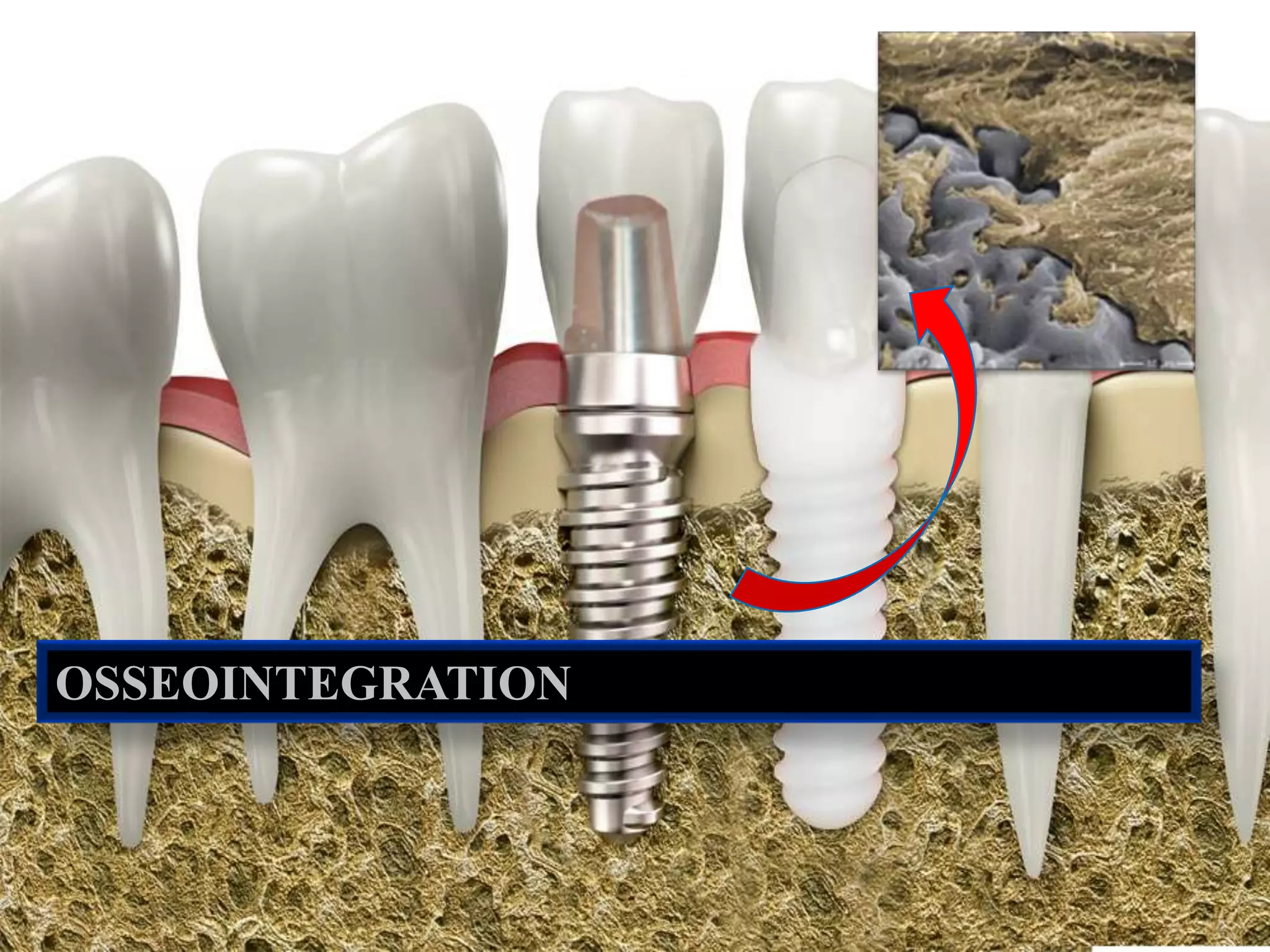
OSSEOINTEGRATION
INTRODUCTIO
N
HISTORICAL
REVIEW
DEFINITION
S
MECHANISM OF
OSSEOINTEGRATI
ON
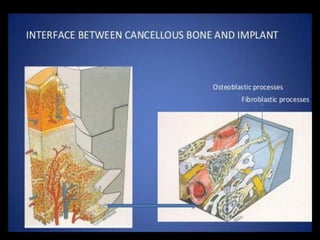
BONE TO
IMPLANT
INTERFACE
HISTORY OF
BRANEMARK
SYSTEM
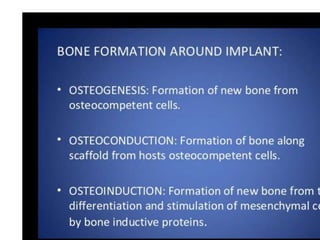
BONE FORMATION
AROUND IMPLANTS
STAGES
BONETISSU
E
RESPONSE
BIOLOGICAL
ATTACHMENT
BIOLOGICAL PROCESS
OF INTEGRATION
MECHANISM OF
INTEGRATION
FACTORS THAT
INFLUENCE
OSSEOINTEGRATI
ON
FAILURESCONCLUSION
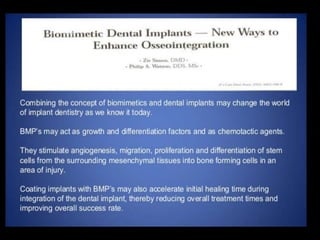
FUTURISTIC
CONCEPTS
INTRODUCTION
Osseointegration derives from ‘osteon,’
the Greek word for bone and the Latin
word for ‘to make whole’ which is
integrate.
This refers to the process that will take
place between the living bone and the
surface of implant.
HISTORICAL REVIEW
The concept of
Osseointegration was
developed and the term
was coined by Dr. Per-
Ingvar Branemark,
Professor at the institute
for Applied
Biotechnology, University
of Goteborg, Sweden .
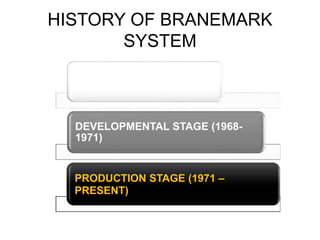
HISTORY OF BRANEMARK
SYSTEM
EARLY STAGE (1965-1968)
DEVELOPMENTAL STAGE (1968-
1971)
PRODUCTION STAGE (1971 –
PRESENT)
DEFINITIONS
Structurally oriented definition “Direct structural
and functional connection between the
ordered, living bone and the surface of load
carrying implants”. - Branemark and associates
(1977)
“The apparent direct attachment or connection
of osseous tissue to an inert, alloplastic material
without intervening connective tissue”. - GPT 8
“It is a process where by clinically asymptomatic rigid
fixation of alloplastic material is achieved and
maintained in bone during functional loading” - Zarb
and T Albrektsson (1986)
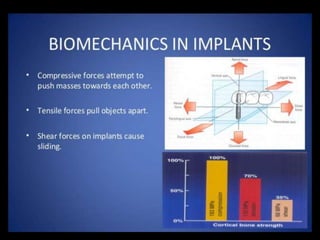
Biomechanically oriented definition
“Attachment resistant to shear as well
as tensile forces” - Steinmann et al
(1986).
BONE TO IMPLANT
INTERFACE
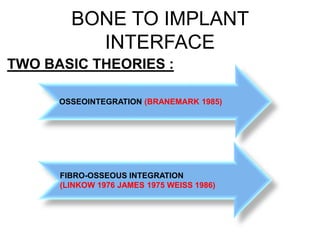
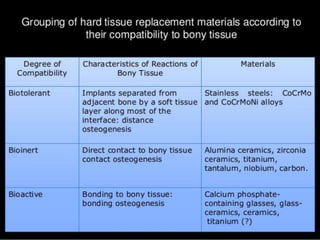
TWO BASIC THEORIES :
OSSEOINTEGRATION (BRANEMARK 1985)
FIBRO-OSSEOUS INTEGRATION
(LINKOW 1976 JAMES 1975 WEISS 1986)
BONE TO IMPLANT
INTERFACE
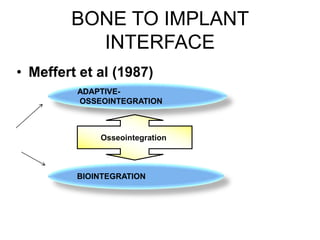
• Meffert et al (1987)
ADAPTIVE-
OSSEOINTEGRATION
BIOINTEGRATION
Osseointegration
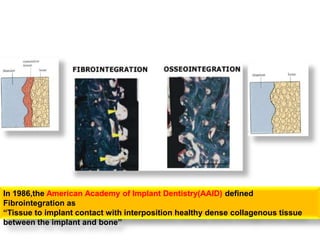
In 1986,the American Academy of Implant Dentistry(AAID) defined
Fibrointegration as
“Tissue to implant contact with interposition healthy dense collagenous tissue
between the implant and bone’’
FIBRO-OSSEOUS INTEGRATION
Presence of connective tissue between the
implant and bone .
Collagen fibers functions similarly to Sharpey’s
fibers found in natural dentition.
The fibers are arranged irregularly, parallel to
the implant body, when forces are applied they
are not transmitted through the fibers.
“Pseudoligament”, “Periimplant ligament”, “Periimplant
membrane”.
FAILURE OF FIBRO-OSSEOUS
THEORY
• No real evidence
• Forces are not transmitted through the fibers
- remodeling was not expected .
• Forces applied resulted in widening fibrous
encapsulation, inflammatory reactions, and
gradual bone resorption there by leading to
failure.
MECHANISM OF
OSSEOINTEGRATION
• Healing process may be primary bone healing
or secondary bone healing.
• In primary bone healing, there is well organized
bone formation with minimal granulation tissue
formation - ideal
• Secondary bone healing may have granulation
tissue formation and infection at the site,
prolonging healing period. (Fibrocartilage is
sometimes formed instead of bone –
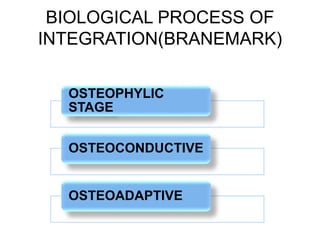
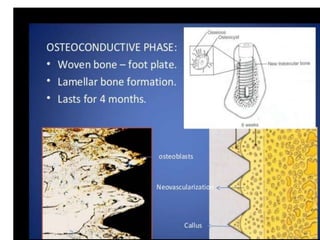
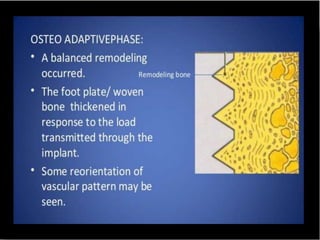
BIOLOGICAL PROCESS OF
INTEGRATION(BRANEMARK)
OSTEOPHYLIC
STAGE
OSTEOCONDUCTIVE
OSTEOADAPTIVE
STAGES OF
OSSEOINTEGRATION
• According to Misch,
there are two stages in osseointegration,
• Each stage been again divided into two
substages.
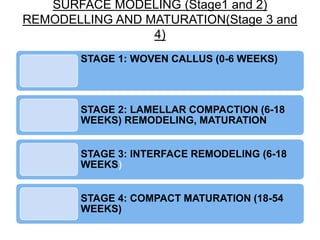
SURFACE MODELING (Stage1 and 2)
REMODELLING AND MATURATION(Stage 3 and
4)
STAGE 1: WOVEN CALLUS (0-6 WEEKS)
STAGE 2: LAMELLAR COMPACTION (6-18
WEEKS) REMODELING, MATURATION
STAGE 3: INTERFACE REMODELING (6-18
WEEKS)
STAGE 4: COMPACT MATURATION (18-54
WEEKS)
Stage 1:
• Woven callus
Woven bone is formed at implant site.
• Primitive type of bone tissue and
characterized Random, felt-like orientation
of collagen fibrils
• Numerous irregularly shaped osteocytes
• Relatively low mineral density
Stage 2:
• Lamellar compaction
• The woven callus matures as it is replaced
by lamellar bone.
• This stage helps in achieving sufficient
strength for loading.
Stage 3:
• Interface remodeling
• This stage begins at the same time when
woven callus is completing lamellar
compaction.
• During this stage callus starts to resorb,
and remodeling of devitalized interface
begins.
• The interface remodeling helps in
establishing a viable interface between the
implant and original bone.
Stage 4:
• Compact bone maturation
• During this stage compact bone matures
by series of modeling and remodeling
processes.
• The callus volume is decreased and
interface remodeling continues.
BONE TISSUE RESPONSE
Osborn and Newesley (1980) : Proposed 2 different phenomena
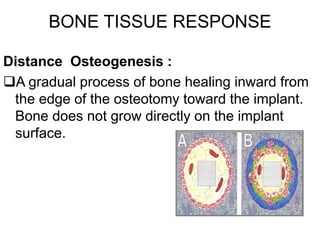
Distance Osteogenesis :
A gradual process of bone healing inward from
the edge of the osteotomy toward the implant.
Bone does not grow directly on the implant
surface.
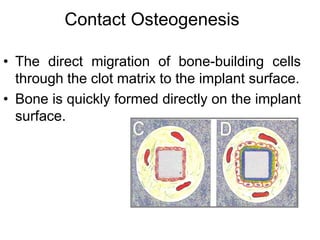
Contact Osteogenesis
• The direct migration of bone-building cells
through the clot matrix to the implant surface.
• Bone is quickly formed directly on the implant
surface.
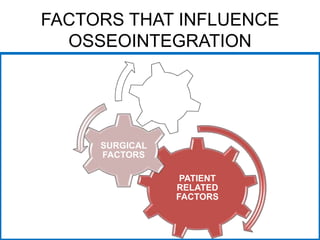
FACTORS THAT INFLUENCE
OSSEOINTEGRATION
PATIENT
RELATED
FACTORS
SURGICAL
FACTORS
IMPLANT
RELATED
FACTORS
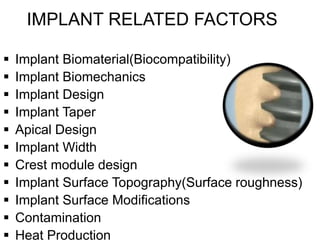
IMPLANT RELATED FACTORS
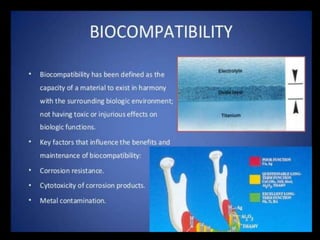
 Implant Biomaterial(Biocompatibility)
 Implant Biomechanics
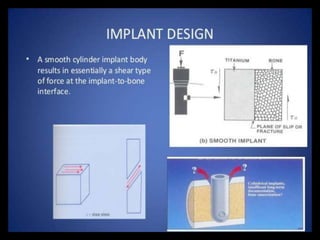
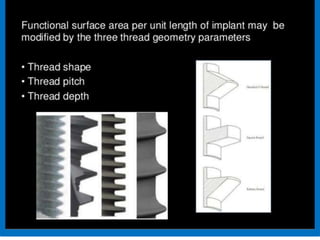
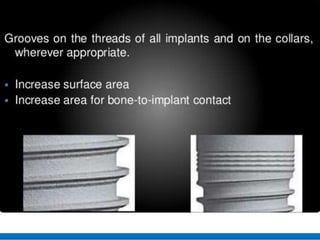
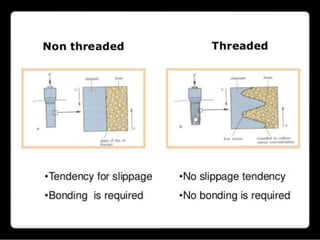
 Implant Design
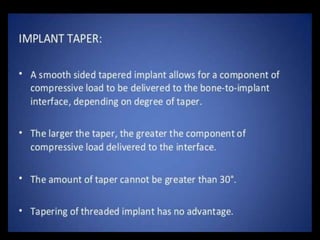
 Implant Taper
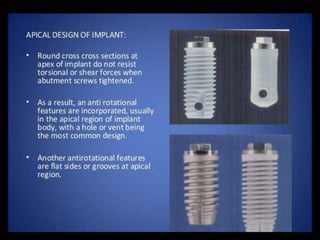
 Apical Design
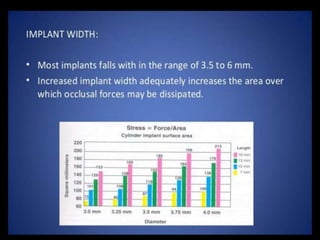
 Implant Width
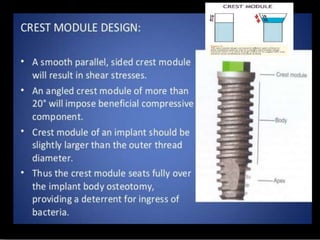
 Crest module design
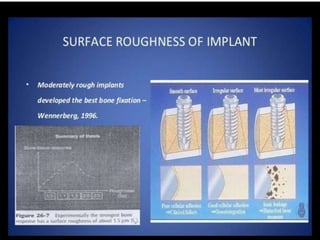
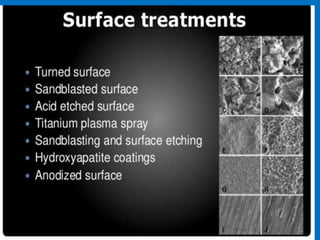
 Implant Surface Topography(Surface roughness)
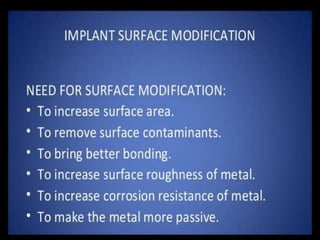
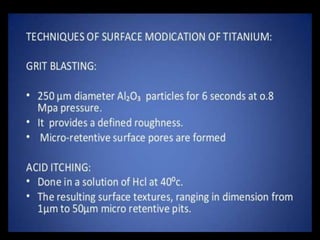
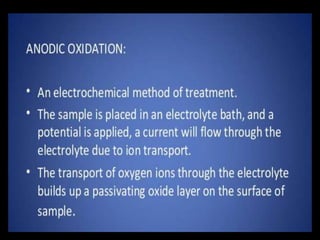
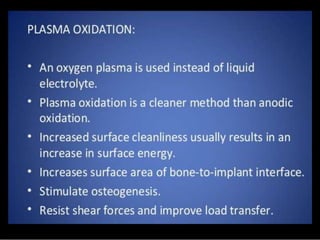
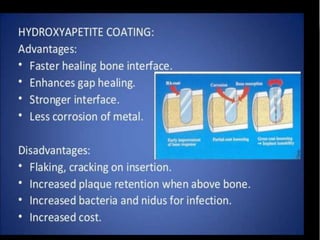
 Implant Surface Modifications
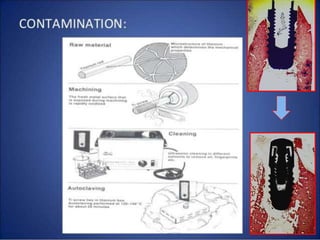
 Contamination
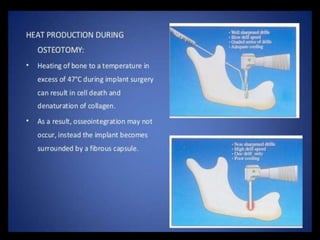
 Heat Production
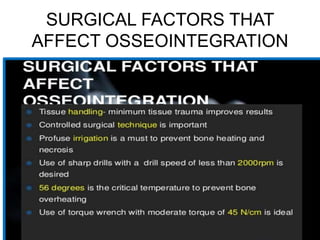
SURGICAL FACTORS THAT
AFFECT OSSEOINTEGRATION
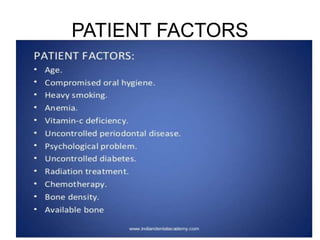
PATIENT FACTORS
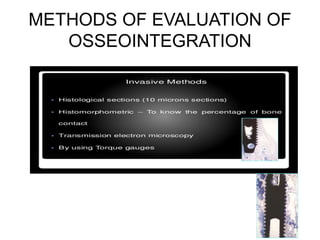
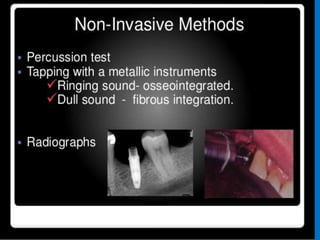
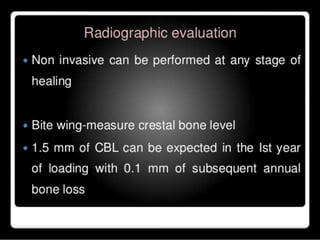
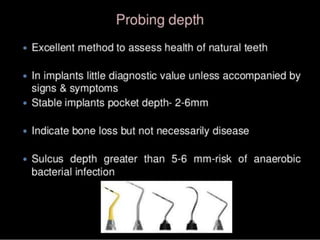
METHODS OF EVALUATION OF
OSSEOINTEGRATION
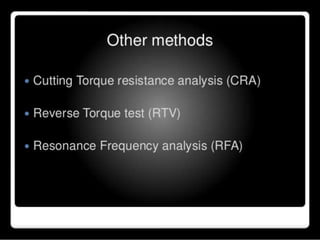
OTHER METHODS TO
ASSESS OSSEOINTEGRATION
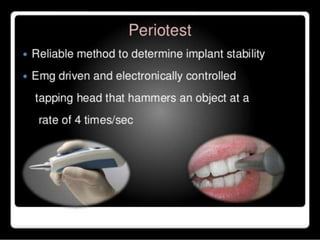
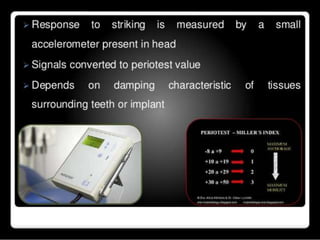
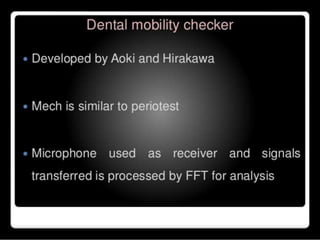
 Cone beam CT Periotest
 Dynamic model testing
 Impulse testing
FAILURES OF
OSSEOINTEGRATION
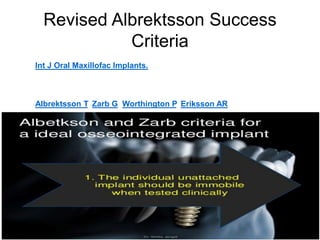
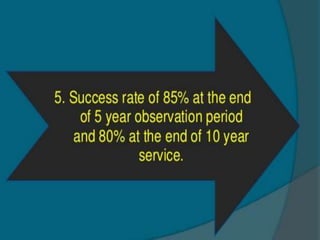
Revised Albrektsson Success
Criteria
Int J Oral Maxillofac Implants. 1986 Summer;1(1):11-
25.
The long-term efficacy of currently used dental
implants: a review and proposed criteria of success.
Albrektsson T, Zarb G, Worthington P, Eriksson AR.
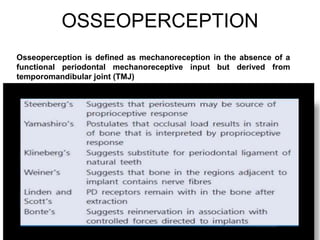
OSSEOPERCEPTION
Osseoperception is defined as mechanoreception in the absence of a
functional periodontal mechanoreceptive input but derived from
temporomandibular joint (TMJ)
CONCLUSION
• The “osseointegration” is a multifactorial entity.
• Achieving the osseointegration of the endosteal
dental implants needs understanding of the many
clinical parameters.
•Thorough understanding and application of factors
affecting the osseointegration and biological
process of osseointegration in clinical practice is the
key factor for success.
REFERENCES
– Hobo, Ichida, Garcia “Osseointegration and
occlusal rehabilitation” Quintessence Publishing.
– Jan Lindhe “Clinical periodontology and implant
dentistry” 4th edition, Blackwell Publishing.
– Elaine McClarence “Branemark and the
development of osseointegration” Quintessence
publication
– Carl E. Misch “Implant dentistry” 2nd edition,
Mosby.
– Charles M.Weis “Principles and practice of
implant dentistry” Mosby.
– Per Ingvar Branemark “Osseointegration and its
experimental background” JPD 1983 Vol. 50, 399-
410.
– Hanson, Alberktson “Structural aspects of the
interface between tissue and titanium implants”
JPD 1983 vol. 50, 108-113.
– T. Alberktson “Osseointegrated dental implants”
DCNA Vol. 30, Jan 1986, 151-189.
– Richard Palmer “Introduction to dental implants” BDJ,
Vol. 187, 1999, 127-132.
– Geroge A. Zarb “Osseointegrated dental implants:
Preliminary report on a replication study”. JPD 1983,
Vol 50, 271-276.
– Bergman “Evaluation of the results of treatment with
osseointegrated implants by the Swedish National
Board of Health and Welfare”. JPD 1983, vol. 50, 114-
116.
THANK
YOU

Osseointegration

  • 1.
  • 2.
    INTRODUCTIO N HISTORICAL REVIEW DEFINITION S MECHANISM OF OSSEOINTEGRATI ON BONE TO IMPLANT INTERFACE HISTORYOF BRANEMARK SYSTEM BONE FORMATION AROUND IMPLANTS STAGES BONETISSU E RESPONSE BIOLOGICAL ATTACHMENT BIOLOGICAL PROCESS OF INTEGRATION MECHANISM OF INTEGRATION FACTORS THAT INFLUENCE OSSEOINTEGRATI ON FAILURESCONCLUSION FUTURISTIC CONCEPTS
  • 3.
    INTRODUCTION Osseointegration derives from‘osteon,’ the Greek word for bone and the Latin word for ‘to make whole’ which is integrate. This refers to the process that will take place between the living bone and the surface of implant.
  • 4.
    HISTORICAL REVIEW The conceptof Osseointegration was developed and the term was coined by Dr. Per- Ingvar Branemark, Professor at the institute for Applied Biotechnology, University of Goteborg, Sweden .
  • 5.
    HISTORY OF BRANEMARK SYSTEM EARLYSTAGE (1965-1968) DEVELOPMENTAL STAGE (1968- 1971) PRODUCTION STAGE (1971 – PRESENT)
  • 6.
    DEFINITIONS Structurally oriented definition“Direct structural and functional connection between the ordered, living bone and the surface of load carrying implants”. - Branemark and associates (1977) “The apparent direct attachment or connection of osseous tissue to an inert, alloplastic material without intervening connective tissue”. - GPT 8
  • 7.
    “It is aprocess where by clinically asymptomatic rigid fixation of alloplastic material is achieved and maintained in bone during functional loading” - Zarb and T Albrektsson (1986)
  • 8.
    Biomechanically oriented definition “Attachmentresistant to shear as well as tensile forces” - Steinmann et al (1986).
  • 9.
    BONE TO IMPLANT INTERFACE TWOBASIC THEORIES : OSSEOINTEGRATION (BRANEMARK 1985) FIBRO-OSSEOUS INTEGRATION (LINKOW 1976 JAMES 1975 WEISS 1986)
  • 10.
    BONE TO IMPLANT INTERFACE •Meffert et al (1987) ADAPTIVE- OSSEOINTEGRATION BIOINTEGRATION Osseointegration
  • 11.
    In 1986,the AmericanAcademy of Implant Dentistry(AAID) defined Fibrointegration as “Tissue to implant contact with interposition healthy dense collagenous tissue between the implant and bone’’
  • 12.
    FIBRO-OSSEOUS INTEGRATION Presence ofconnective tissue between the implant and bone . Collagen fibers functions similarly to Sharpey’s fibers found in natural dentition. The fibers are arranged irregularly, parallel to the implant body, when forces are applied they are not transmitted through the fibers. “Pseudoligament”, “Periimplant ligament”, “Periimplant membrane”.
  • 13.
    FAILURE OF FIBRO-OSSEOUS THEORY •No real evidence • Forces are not transmitted through the fibers - remodeling was not expected . • Forces applied resulted in widening fibrous encapsulation, inflammatory reactions, and gradual bone resorption there by leading to failure.
  • 14.
    MECHANISM OF OSSEOINTEGRATION • Healingprocess may be primary bone healing or secondary bone healing. • In primary bone healing, there is well organized bone formation with minimal granulation tissue formation - ideal • Secondary bone healing may have granulation tissue formation and infection at the site, prolonging healing period. (Fibrocartilage is sometimes formed instead of bone –
  • 18.
  • 23.
    STAGES OF OSSEOINTEGRATION • Accordingto Misch, there are two stages in osseointegration, • Each stage been again divided into two substages.
  • 24.
    SURFACE MODELING (Stage1and 2) REMODELLING AND MATURATION(Stage 3 and 4) STAGE 1: WOVEN CALLUS (0-6 WEEKS) STAGE 2: LAMELLAR COMPACTION (6-18 WEEKS) REMODELING, MATURATION STAGE 3: INTERFACE REMODELING (6-18 WEEKS) STAGE 4: COMPACT MATURATION (18-54 WEEKS)
  • 25.
    Stage 1: • Wovencallus Woven bone is formed at implant site. • Primitive type of bone tissue and characterized Random, felt-like orientation of collagen fibrils • Numerous irregularly shaped osteocytes • Relatively low mineral density
  • 26.
    Stage 2: • Lamellarcompaction • The woven callus matures as it is replaced by lamellar bone. • This stage helps in achieving sufficient strength for loading.
  • 27.
    Stage 3: • Interfaceremodeling • This stage begins at the same time when woven callus is completing lamellar compaction. • During this stage callus starts to resorb, and remodeling of devitalized interface begins. • The interface remodeling helps in establishing a viable interface between the implant and original bone.
  • 28.
    Stage 4: • Compactbone maturation • During this stage compact bone matures by series of modeling and remodeling processes. • The callus volume is decreased and interface remodeling continues.
  • 33.
    BONE TISSUE RESPONSE Osbornand Newesley (1980) : Proposed 2 different phenomena Distance Osteogenesis : A gradual process of bone healing inward from the edge of the osteotomy toward the implant. Bone does not grow directly on the implant surface.
  • 34.
    Contact Osteogenesis • Thedirect migration of bone-building cells through the clot matrix to the implant surface. • Bone is quickly formed directly on the implant surface.
  • 35.
  • 36.
    IMPLANT RELATED FACTORS Implant Biomaterial(Biocompatibility)  Implant Biomechanics  Implant Design  Implant Taper  Apical Design  Implant Width  Crest module design  Implant Surface Topography(Surface roughness)  Implant Surface Modifications  Contamination  Heat Production
  • 67.
  • 68.
  • 69.
    METHODS OF EVALUATIONOF OSSEOINTEGRATION
  • 82.
    OTHER METHODS TO ASSESSOSSEOINTEGRATION  Cone beam CT Periotest  Dynamic model testing  Impulse testing
  • 83.
  • 84.
    Revised Albrektsson Success Criteria IntJ Oral Maxillofac Implants. 1986 Summer;1(1):11- 25. The long-term efficacy of currently used dental implants: a review and proposed criteria of success. Albrektsson T, Zarb G, Worthington P, Eriksson AR.
  • 91.
    OSSEOPERCEPTION Osseoperception is definedas mechanoreception in the absence of a functional periodontal mechanoreceptive input but derived from temporomandibular joint (TMJ)
  • 95.
    CONCLUSION • The “osseointegration”is a multifactorial entity. • Achieving the osseointegration of the endosteal dental implants needs understanding of the many clinical parameters. •Thorough understanding and application of factors affecting the osseointegration and biological process of osseointegration in clinical practice is the key factor for success.
  • 96.
    REFERENCES – Hobo, Ichida,Garcia “Osseointegration and occlusal rehabilitation” Quintessence Publishing. – Jan Lindhe “Clinical periodontology and implant dentistry” 4th edition, Blackwell Publishing. – Elaine McClarence “Branemark and the development of osseointegration” Quintessence publication – Carl E. Misch “Implant dentistry” 2nd edition, Mosby.
  • 97.
    – Charles M.Weis“Principles and practice of implant dentistry” Mosby. – Per Ingvar Branemark “Osseointegration and its experimental background” JPD 1983 Vol. 50, 399- 410. – Hanson, Alberktson “Structural aspects of the interface between tissue and titanium implants” JPD 1983 vol. 50, 108-113.
  • 98.
    – T. Alberktson“Osseointegrated dental implants” DCNA Vol. 30, Jan 1986, 151-189. – Richard Palmer “Introduction to dental implants” BDJ, Vol. 187, 1999, 127-132. – Geroge A. Zarb “Osseointegrated dental implants: Preliminary report on a replication study”. JPD 1983, Vol 50, 271-276. – Bergman “Evaluation of the results of treatment with osseointegrated implants by the Swedish National Board of Health and Welfare”. JPD 1983, vol. 50, 114- 116.
  • 99.