GUIDED BY: PRESENTED BY:
DR DIVYA JAGGI DR ANKITA DADWAL
HOST MODULATION THERAPY
CONTENTS
 INTRODUCTION
 PATHOGENESIS OF PERIODONTITIS AND HOST
RESPONSE
 HOST MODULATORY THERAPY
 HOST MODULATING AGENTS
 LOCALLYADMINISTERED HOST MODULATION
THERAPY
 NEW AGENTS IN HOST MODULATION
 CONCLUSION
 REFRENCES
1/38
INTRODUCTION
 Periodontitis is a complex infection initiated by
bacteria –tissue destruction.
Host: the organism from which a
parasite obtains its nourishment/ an
individual who receives a graft.
Modulation: the alteration of function or
status of something in response to a
stimulus or an altered physical or
chemical environment2/38
PATHOGENESIS OF PERIODONTITIS
AND HOST RESPONSE
3/38
HOST MODULATION THERAPY
Treatment concept that aims to reduce the tissue destruction
and stabilize or even regenerate the periodontium by
modifying or down regulating destructive aspects of the host
response and up regulating protective or regenerative
responses.
- 1st introduced in dentistry – William’s (1990) and Golub
et al (1992)
4/38
RATIONALE
To restore the balance of pro-inflammatory and anti-inflammatory
mediators
As Adjunctive treatment options
To decrease pt. susceptibility
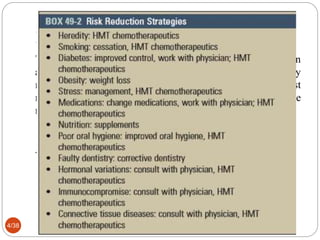
To aid in risk assessment & risk reduction strategy
To facilitate regeneration
5/38
CLASSIFICATION
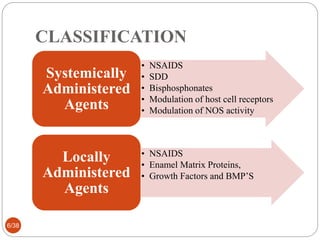
• NSAIDS
• SDD
• Bisphosphonates
• Modulation of host cell receptors
• Modulation of NOS activity
Systemically
Administered
Agents
• NSAIDS
• Enamel Matrix Proteins,
• Growth Factors and BMP’S
Locally
Administered
Agents
6/38
HOST MODULATING AGENTS
 INHIBITION OF ARACHADONIC ACID
METABOLITE:
A) COX-1 INHIBITOR: indomethacin
B) cox-2 INHIBITOR : Rofecoxi
C) COX and LOX inhibitors: Triclosan, topical ketoprofen
D) LOX INHIBITOR: lipoxins
 MODULATION OF MMPs:
A) TETRACYCLINE
B) CMT
C) SDD
D) BISPHOSPHONATES7/38
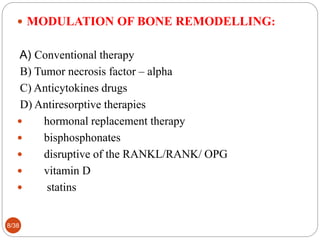
 MODULATION OF BONE REMODELLING:
A) Conventional therapy
B) Tumor necrosis factor – alpha
C) Anticytokines drugs
D) Antiresorptive therapies
 hormonal replacement therapy
 bisphosphonates
 disruptive of the RANKL/RANK/ OPG
 vitamin D
 statins
8/38
 REGULATION OF IMMUNE AND
INFLAMMATORY RESPONSE:
A) Supressing proinflammatory cytokines: IL1 and
TNF alpha antagonist
B) modulation of nitric oxide activity
 OTHER AGENTS:
A) probiotics
B) nutrients
 LOCALLYADMINISTERED HMT
 NEW EMERGING HOSTS:
Azithromycin
paratyroid
9/38
MODULATION OF ARACHIDONIC
ACID METABOLITE
NSAIDS
10/38
 NSAIDs such as indomethacin (williams RC jp 1987),
flurbiprofen (jeffcoat MK JP 1989), and naproxen(Howell TH
1993) administered daily for up to 3 years, significantly slowed
the rate of alveolar bone loss compared with placebo.
 DISADVANTAGES OF NSAIDS AS HMT:
 gastrointestinal problems,
 hemorrhage (from decreased platelet aggregation),
 and renal and hepatic impairment
 REBOUND EFFECT
11/38
TOPICAL NSAIDS IN PERIODONTICS
 NSAIDS : KETOROLAC TRIMETHAMINE RINSE
S- KETOPROFEN DENTRIFICE
 chronic periodontitis who received topical ketorolac mouthrinse
reported that gingival crevicular fluid (GCF) levels of PGE2 were
reduced by approximately half over 6 months and that bone loss
was halted ( Jeffcoat MK et al:. J Periodontol 1995).
 Ketoprofene block both CO and LO pathways.
12/38
LIPOXINS, RESOLVINS, PROTECTINS
 Biosynthesized during the resolution phase of acute
inflammation.
 Pouliot et al (1999), lipoxins blocked IL1 beta
secretion from PMNs.
 LIPOXIN A4
 LIPOXIN B4
13/38
INHIBITION OF MMPs
MMP inhibitor
endogenous
TIMP
Alpha
macroglobulins
exogenous
Tetracyclines
Bisphosphonates
CMT
14/38
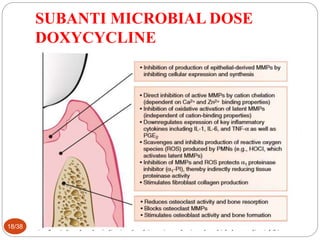
TETRACYCLINES
Mediated by cellular
mechanisms
• decrease cytokines,
inducible nitric oxide
synthase,
phospholipase A2,
prostaglandin
synthase
• Effects on protein
kinase C, calmodulin
Mediated by
extracellular
mechanisms
• Direct inhibition of active
MMPs
• Inhibition of oxidative
activation of pro-MMPs
• Tetracyclines disrupt
activation by promoting
excessive proteolysis of pro-
MMPs into enzymatically-
inactive fragments
• Inhibition of MMPs protects
α1-proteinase inhibitor, thus
indirectly decrease serine
proteinase (elastase)
activity
Mediated by pro-
anabolic effects
• Tetracyclines
increase collagen
production
• Tetracyclines
increase osteoblast
activity and bone
formation
CHEMICALY MODIFIED
TETRACYCLINES
16/38
ADVANTAGES OVER
TETRACYCLINES
 No development of bacterial resistance that is found with the
traditional tetracyclines.
 Less incidence of adverse effects such as GIT disturbances,
superinfection.
 It has anticollagenase property that is very important to inhibit
the periodontal tissue destruction.
 Substantivity of the drug, high concentration in GCF.
 Rifkin et al reported that CMT could also inhibit PTH induced
bone resorption.
17/38
SUBANTI MICROBIAL DOSE
DOXYCYCLINE
 At present SDD (Periostat) is the only systemically administered
HMT specifically indicated for the treatment of chronic
periodontitis that is approved by the US Food and Drug
Administration (FDA) and accepted by the American Dental
Association (ADA).
 Studies conducted by Preshaw et al in J
Periodontol 2008 utilizing this same modified-release SDD
versus placebo with periodontitis as an adjunct to SRP resulted
in significantly greater clinical benefits than SRP alone in the
treatment of periodontitis.
18/38
 Golub et al 1985 reported that a 2-week regimen of SDD reduced
collagenase in GCF and in the adjacent gingival tissues surgically
excised for therapeutic purposes.
 He found using SDD therapy adjunctive to routine scaling and
prophylaxis cause continued reductions in the excessive levels of
collagenase in the GCF after 1 month of treatment.
 After cessation of SDD administration, however, there was a rapid
rebound of collagenase activity , suggesting that a 1-month
treatment regimen with this host modulation agent was insufficient
to produce a long-term benefit(Ashley RA 1999)
 In contrast, during the same study, a 3-month regimen produced a
prolonged drug effect without a rebound in collagenase levels to
baseline during the no-treatment phase of the study.
these reductions in collagenase levels were gains in the relative
attachment levels in the SDD group( Ashley RA 1999)
19/38
Sequencing Prescription With Periodontal
Treatment
 Not used as monotherapy, Used as an adjunct to SRP. To be
prescribed to coincide with the first episode of SRP.
 Taken as 20mg twice daily for 3 months and up to a maximum of 9
months of continuous dosing.
 After initial periodontal treatment, the patient is enrolled into an
intensive maintanence program. (re evaluation of probing depths,
reinforcement of oral hygiene, SRP, remotivation of the patient).
20/38
INDICATIONS
Motivated
patients
Chronic and
aggressive
periodontitis
patients treated
non surgically.
(Caton J et al,
2000,Preshaw
et al 2005)
Patients
traditionally
considered
resistant to
periodontal
treatment
(smokers).
Cases
considered
refractory to
treatment and
those with
risk factors
like diabetes
and smoking.
21/38
CONTRAINDICATIONS
History of
allergy or
hypersensitivity
Pregnant and
lactating
women or
children less
than 12 yrs of
age
conditions like
gingivitis and
periodontal
abscess or when
an antibiotic
regimen is
necessary
May reduce the
effectiveness of
oral
contraceptives
22/38
BISPHOSPHONATES
 The bisphosphonates are bone-seeking agents . inhibit bone
resorption by disrupting osteoclast activity.
 interfere with osteoclastic metabolism and secretion of
lysosomal enzymes (Weinreb M et al J Periodontal 1994)
possess anticollagenase properties (Nakaya H et al J
Periodontol 2000)
 treatment with the bisphosphonate significantly increased bone
density compared with placebo ( Reddy MS et al J
Periodontol 1995)
23/38
MECHANISM OF ACTION
TISSUE LEVEL
• ↓ bone turnover
due to ↓ bone
resorption
• ↓ number of new
bone
• multicellular units
• Net positive
whole
• body bone
balance
CELLULAR
LEVEL
• ↓ osteoclast recruitment
• ↑ osteoclast apoptosis
• ↓ osteoclast adhesion
• ↓ depth of resorption
site
• ↓ release of cytokines
by
• macrophages
• ↑ osteoblast
differentiation and
number
MOLECULAR LEVEL
• ↓ post-translational
prenylation
• of GTP-binding
proteins
24/38
DISADVANTAGES OF BISPHOSPHONATES
 inhibiting bone calcification
 inducing changes in white blood cell counts.
 avascular necrosis of the jaws following bisphosphonate
therapy, with the resultant risk of bone necrosis following
dental extractions (Carter G, Goss AN Med J Aust 2005)
 As with NSAIDs, at present there are no bisphosphonate drugs
that are approved and indicated for treatment of periodontal
diseases
 BRONJ
25/38
MODULATION OF BONE REMODELLING
 TUMOR NECROSIS FACTOR – ALPHA :
 indirect and direct bone resorption.
 TNF alpha antagonist drugs –
 Infliximab
 Golimumab
 centrolizumab
26/38
ANTICYTOKINES DRUGS
IL-1 Receptor
antagonist
Anakinra
AMG714
Monoclonal
Antibody to
TNF alpha
Infliximab
Adalimumab
27/38
DISRUPTIVE RANK/RANKL/OPG
 Expression of the RANKL gene in osteoblasts/stromal cells is
enhanced by
1. Vitamin D3
2. PTH
3. IL-1, IL-6, IL- 17
4. TNF-α
5. BMP-2
6. PGE2
RANKL inhibitor : Denosumab
28
CATHEPSIN K INHIBITOR
 It has role in degradation of type I and II collagen. So it can be
viewd as a target for modulation bone resorption.
 VIT D has anti inflammatory and immunomodulatory
properties.
 STATINS - SIMVASTATIN
29/38
NO SYNTHETASE INHIBITOR
 L-NG-monomethyl arginine
 L-arginie methyl ester
 Mercapto ethyle guanidine:
 blocks inducible NOS, scavenges peroxy nitrite &
 inhibits COX production.
 N-iminoethyl-L-lysine:
 reduce MMP activity in cartilage
 reduce production of IL-1β
30/38
ANTIOXIDANT
TYPES EXAMPLES
31/38
 PREVENTIVE
ANTIOXIDANTS
 RADICAL
SCAVENGING
ANTIOXIDANTS
 DNA REPAIR
ENZYMES
 CATALASE
 GPX
 VIT A
 VIT E
 VIT C
 PROTEASES
 TRANSFERASES
 LIPASES
LOCALLY ADMINISTERD AGENTS
 NONSTEROIDAL ANTIINFLAMMATORY DRUGS
 ENAMEL MATRIX PROTEINS
 BONE MORPHOGENETIC PROTEINS (BMP-2, BMP-7),
 GROWTH FACTORS (PLATELET-DERIVED
GROWTH FACTOR,
 INSULIN LIKE GROWTH FACTOR.
 TETRACYCLINES
32/38
 The initial local host modulatory agent approved by the
FDA for adjunctive use during surgery to assist with
clinical attachment gain and wound healing was
EMDOGAIN
 PLATELET-DERIVED GROWTH FACTOR combined
with a resorbable synthetic bone matrix (GEM 21S) to
assist in regenerative procedures , wound healing,
particularly in patients with diabetes
 rhBMP-2 (INFUSE) soaked on to an absorbable collagen
sponge to assist with ridge and sinus augmentation and
healing of fractures by the orthopedic community
33/38
PROBIOTICS
34/38
 A preparation or a product containing viabale, defined
microorganism in sufficient number, which can alter
the microflora in a compartment of the host.
 Can be becteria , yeast or moulds.
 Eg: yougurt, cheese, lozenges
NEW AGENTS FOR HOST
MODULATION
AZITHROMYCIN, a type of macrolide antibiotic.
- Suppress periodontopathogens
- Anti inflammatory activity
- Healing through persistence at low levels in macrophages and
fibroblasts
- Suppress the production of pro-inflammatory cytokines and
increase the production of anti inflammatory cytokines.
35/38
PARATHYROID HORMONE
 TERIPARATIDE, a biosynthetic human parathyroid hormone, is
an anabolic agent.
 Fibroblast growth factor 2, production is upregulated.
 It regulates the proliferation and differentiation of osteoblast
progenitors
 Reduce sclerostin, a potent inhibtor of bone formation, could
account for part of the anabolic response to PTH.
36/38
CONCLUSION
 Plaque bacteria are essential for periodontitis to occur but are
insufficient by themselves to cause the disease. For periodontitis
to develop, a susceptible host is also required.
 As we know the majority of periodontal destruction is caused by
host immuno-inflammatory response, various advanced
treatment modalities have been introduced in the recent years
including HMT.
 Though various agents are there to modulate host response,
only few have shown successful result in humans.
37/38
REFRENCES
 Carranza 12th edition
 Newman M, Takei H, Klokkevold P, Carranza F. “Clinical
Periodontology”,10,11th, Edition. Saunders, Elsevier. Preshaw PM. Host
response modulation in periodontics. Periodontol 2000. 2008;48:92-
110. Review.
 D W Paquette & R C. Williams. Modulation of host inflammatory
mediators as a treatment strategy for periodontal diseases.
 Minkle Gulati, Vishal Anand, Vivek Govila, and Nikil Jain. Host
modulation therapy: An indispensable part of perioceutics. JIndian Soc
Periodontol. 2014 MayJun;18(3): 282–28838/38
`
40

Host modulation therapy

  • 1.
    GUIDED BY: PRESENTEDBY: DR DIVYA JAGGI DR ANKITA DADWAL HOST MODULATION THERAPY
  • 2.
    CONTENTS  INTRODUCTION  PATHOGENESISOF PERIODONTITIS AND HOST RESPONSE  HOST MODULATORY THERAPY  HOST MODULATING AGENTS  LOCALLYADMINISTERED HOST MODULATION THERAPY  NEW AGENTS IN HOST MODULATION  CONCLUSION  REFRENCES 1/38
  • 3.
    INTRODUCTION  Periodontitis isa complex infection initiated by bacteria –tissue destruction. Host: the organism from which a parasite obtains its nourishment/ an individual who receives a graft. Modulation: the alteration of function or status of something in response to a stimulus or an altered physical or chemical environment2/38
  • 4.
  • 5.
    HOST MODULATION THERAPY Treatmentconcept that aims to reduce the tissue destruction and stabilize or even regenerate the periodontium by modifying or down regulating destructive aspects of the host response and up regulating protective or regenerative responses. - 1st introduced in dentistry – William’s (1990) and Golub et al (1992) 4/38
  • 6.
    RATIONALE To restore thebalance of pro-inflammatory and anti-inflammatory mediators As Adjunctive treatment options To decrease pt. susceptibility To aid in risk assessment & risk reduction strategy To facilitate regeneration 5/38
  • 7.
    CLASSIFICATION • NSAIDS • SDD •Bisphosphonates • Modulation of host cell receptors • Modulation of NOS activity Systemically Administered Agents • NSAIDS • Enamel Matrix Proteins, • Growth Factors and BMP’S Locally Administered Agents 6/38
  • 8.
    HOST MODULATING AGENTS INHIBITION OF ARACHADONIC ACID METABOLITE: A) COX-1 INHIBITOR: indomethacin B) cox-2 INHIBITOR : Rofecoxi C) COX and LOX inhibitors: Triclosan, topical ketoprofen D) LOX INHIBITOR: lipoxins  MODULATION OF MMPs: A) TETRACYCLINE B) CMT C) SDD D) BISPHOSPHONATES7/38
  • 9.
     MODULATION OFBONE REMODELLING: A) Conventional therapy B) Tumor necrosis factor – alpha C) Anticytokines drugs D) Antiresorptive therapies  hormonal replacement therapy  bisphosphonates  disruptive of the RANKL/RANK/ OPG  vitamin D  statins 8/38
  • 10.
     REGULATION OFIMMUNE AND INFLAMMATORY RESPONSE: A) Supressing proinflammatory cytokines: IL1 and TNF alpha antagonist B) modulation of nitric oxide activity  OTHER AGENTS: A) probiotics B) nutrients  LOCALLYADMINISTERED HMT  NEW EMERGING HOSTS: Azithromycin paratyroid 9/38
  • 11.
    MODULATION OF ARACHIDONIC ACIDMETABOLITE NSAIDS 10/38
  • 12.
     NSAIDs suchas indomethacin (williams RC jp 1987), flurbiprofen (jeffcoat MK JP 1989), and naproxen(Howell TH 1993) administered daily for up to 3 years, significantly slowed the rate of alveolar bone loss compared with placebo.  DISADVANTAGES OF NSAIDS AS HMT:  gastrointestinal problems,  hemorrhage (from decreased platelet aggregation),  and renal and hepatic impairment  REBOUND EFFECT 11/38
  • 13.
    TOPICAL NSAIDS INPERIODONTICS  NSAIDS : KETOROLAC TRIMETHAMINE RINSE S- KETOPROFEN DENTRIFICE  chronic periodontitis who received topical ketorolac mouthrinse reported that gingival crevicular fluid (GCF) levels of PGE2 were reduced by approximately half over 6 months and that bone loss was halted ( Jeffcoat MK et al:. J Periodontol 1995).  Ketoprofene block both CO and LO pathways. 12/38
  • 14.
    LIPOXINS, RESOLVINS, PROTECTINS Biosynthesized during the resolution phase of acute inflammation.  Pouliot et al (1999), lipoxins blocked IL1 beta secretion from PMNs.  LIPOXIN A4  LIPOXIN B4 13/38
  • 15.
    INHIBITION OF MMPs MMPinhibitor endogenous TIMP Alpha macroglobulins exogenous Tetracyclines Bisphosphonates CMT 14/38
  • 16.
    TETRACYCLINES Mediated by cellular mechanisms •decrease cytokines, inducible nitric oxide synthase, phospholipase A2, prostaglandin synthase • Effects on protein kinase C, calmodulin Mediated by extracellular mechanisms • Direct inhibition of active MMPs • Inhibition of oxidative activation of pro-MMPs • Tetracyclines disrupt activation by promoting excessive proteolysis of pro- MMPs into enzymatically- inactive fragments • Inhibition of MMPs protects α1-proteinase inhibitor, thus indirectly decrease serine proteinase (elastase) activity Mediated by pro- anabolic effects • Tetracyclines increase collagen production • Tetracyclines increase osteoblast activity and bone formation
  • 17.
  • 18.
    ADVANTAGES OVER TETRACYCLINES  Nodevelopment of bacterial resistance that is found with the traditional tetracyclines.  Less incidence of adverse effects such as GIT disturbances, superinfection.  It has anticollagenase property that is very important to inhibit the periodontal tissue destruction.  Substantivity of the drug, high concentration in GCF.  Rifkin et al reported that CMT could also inhibit PTH induced bone resorption. 17/38
  • 19.
    SUBANTI MICROBIAL DOSE DOXYCYCLINE At present SDD (Periostat) is the only systemically administered HMT specifically indicated for the treatment of chronic periodontitis that is approved by the US Food and Drug Administration (FDA) and accepted by the American Dental Association (ADA).  Studies conducted by Preshaw et al in J Periodontol 2008 utilizing this same modified-release SDD versus placebo with periodontitis as an adjunct to SRP resulted in significantly greater clinical benefits than SRP alone in the treatment of periodontitis. 18/38
  • 20.
     Golub etal 1985 reported that a 2-week regimen of SDD reduced collagenase in GCF and in the adjacent gingival tissues surgically excised for therapeutic purposes.  He found using SDD therapy adjunctive to routine scaling and prophylaxis cause continued reductions in the excessive levels of collagenase in the GCF after 1 month of treatment.  After cessation of SDD administration, however, there was a rapid rebound of collagenase activity , suggesting that a 1-month treatment regimen with this host modulation agent was insufficient to produce a long-term benefit(Ashley RA 1999)  In contrast, during the same study, a 3-month regimen produced a prolonged drug effect without a rebound in collagenase levels to baseline during the no-treatment phase of the study. these reductions in collagenase levels were gains in the relative attachment levels in the SDD group( Ashley RA 1999) 19/38
  • 21.
    Sequencing Prescription WithPeriodontal Treatment  Not used as monotherapy, Used as an adjunct to SRP. To be prescribed to coincide with the first episode of SRP.  Taken as 20mg twice daily for 3 months and up to a maximum of 9 months of continuous dosing.  After initial periodontal treatment, the patient is enrolled into an intensive maintanence program. (re evaluation of probing depths, reinforcement of oral hygiene, SRP, remotivation of the patient). 20/38
  • 22.
    INDICATIONS Motivated patients Chronic and aggressive periodontitis patients treated nonsurgically. (Caton J et al, 2000,Preshaw et al 2005) Patients traditionally considered resistant to periodontal treatment (smokers). Cases considered refractory to treatment and those with risk factors like diabetes and smoking. 21/38
  • 23.
    CONTRAINDICATIONS History of allergy or hypersensitivity Pregnantand lactating women or children less than 12 yrs of age conditions like gingivitis and periodontal abscess or when an antibiotic regimen is necessary May reduce the effectiveness of oral contraceptives 22/38
  • 24.
    BISPHOSPHONATES  The bisphosphonatesare bone-seeking agents . inhibit bone resorption by disrupting osteoclast activity.  interfere with osteoclastic metabolism and secretion of lysosomal enzymes (Weinreb M et al J Periodontal 1994) possess anticollagenase properties (Nakaya H et al J Periodontol 2000)  treatment with the bisphosphonate significantly increased bone density compared with placebo ( Reddy MS et al J Periodontol 1995) 23/38
  • 25.
    MECHANISM OF ACTION TISSUELEVEL • ↓ bone turnover due to ↓ bone resorption • ↓ number of new bone • multicellular units • Net positive whole • body bone balance CELLULAR LEVEL • ↓ osteoclast recruitment • ↑ osteoclast apoptosis • ↓ osteoclast adhesion • ↓ depth of resorption site • ↓ release of cytokines by • macrophages • ↑ osteoblast differentiation and number MOLECULAR LEVEL • ↓ post-translational prenylation • of GTP-binding proteins 24/38
  • 26.
    DISADVANTAGES OF BISPHOSPHONATES inhibiting bone calcification  inducing changes in white blood cell counts.  avascular necrosis of the jaws following bisphosphonate therapy, with the resultant risk of bone necrosis following dental extractions (Carter G, Goss AN Med J Aust 2005)  As with NSAIDs, at present there are no bisphosphonate drugs that are approved and indicated for treatment of periodontal diseases  BRONJ 25/38
  • 27.
    MODULATION OF BONEREMODELLING  TUMOR NECROSIS FACTOR – ALPHA :  indirect and direct bone resorption.  TNF alpha antagonist drugs –  Infliximab  Golimumab  centrolizumab 26/38
  • 28.
  • 29.
    DISRUPTIVE RANK/RANKL/OPG  Expressionof the RANKL gene in osteoblasts/stromal cells is enhanced by 1. Vitamin D3 2. PTH 3. IL-1, IL-6, IL- 17 4. TNF-α 5. BMP-2 6. PGE2 RANKL inhibitor : Denosumab 28
  • 30.
    CATHEPSIN K INHIBITOR It has role in degradation of type I and II collagen. So it can be viewd as a target for modulation bone resorption.  VIT D has anti inflammatory and immunomodulatory properties.  STATINS - SIMVASTATIN 29/38
  • 31.
    NO SYNTHETASE INHIBITOR L-NG-monomethyl arginine  L-arginie methyl ester  Mercapto ethyle guanidine:  blocks inducible NOS, scavenges peroxy nitrite &  inhibits COX production.  N-iminoethyl-L-lysine:  reduce MMP activity in cartilage  reduce production of IL-1β 30/38
  • 32.
    ANTIOXIDANT TYPES EXAMPLES 31/38  PREVENTIVE ANTIOXIDANTS RADICAL SCAVENGING ANTIOXIDANTS  DNA REPAIR ENZYMES  CATALASE  GPX  VIT A  VIT E  VIT C  PROTEASES  TRANSFERASES  LIPASES
  • 33.
    LOCALLY ADMINISTERD AGENTS NONSTEROIDAL ANTIINFLAMMATORY DRUGS  ENAMEL MATRIX PROTEINS  BONE MORPHOGENETIC PROTEINS (BMP-2, BMP-7),  GROWTH FACTORS (PLATELET-DERIVED GROWTH FACTOR,  INSULIN LIKE GROWTH FACTOR.  TETRACYCLINES 32/38
  • 34.
     The initiallocal host modulatory agent approved by the FDA for adjunctive use during surgery to assist with clinical attachment gain and wound healing was EMDOGAIN  PLATELET-DERIVED GROWTH FACTOR combined with a resorbable synthetic bone matrix (GEM 21S) to assist in regenerative procedures , wound healing, particularly in patients with diabetes  rhBMP-2 (INFUSE) soaked on to an absorbable collagen sponge to assist with ridge and sinus augmentation and healing of fractures by the orthopedic community 33/38
  • 35.
    PROBIOTICS 34/38  A preparationor a product containing viabale, defined microorganism in sufficient number, which can alter the microflora in a compartment of the host.  Can be becteria , yeast or moulds.  Eg: yougurt, cheese, lozenges
  • 36.
    NEW AGENTS FORHOST MODULATION AZITHROMYCIN, a type of macrolide antibiotic. - Suppress periodontopathogens - Anti inflammatory activity - Healing through persistence at low levels in macrophages and fibroblasts - Suppress the production of pro-inflammatory cytokines and increase the production of anti inflammatory cytokines. 35/38
  • 37.
    PARATHYROID HORMONE  TERIPARATIDE,a biosynthetic human parathyroid hormone, is an anabolic agent.  Fibroblast growth factor 2, production is upregulated.  It regulates the proliferation and differentiation of osteoblast progenitors  Reduce sclerostin, a potent inhibtor of bone formation, could account for part of the anabolic response to PTH. 36/38
  • 38.
    CONCLUSION  Plaque bacteriaare essential for periodontitis to occur but are insufficient by themselves to cause the disease. For periodontitis to develop, a susceptible host is also required.  As we know the majority of periodontal destruction is caused by host immuno-inflammatory response, various advanced treatment modalities have been introduced in the recent years including HMT.  Though various agents are there to modulate host response, only few have shown successful result in humans. 37/38
  • 39.
    REFRENCES  Carranza 12thedition  Newman M, Takei H, Klokkevold P, Carranza F. “Clinical Periodontology”,10,11th, Edition. Saunders, Elsevier. Preshaw PM. Host response modulation in periodontics. Periodontol 2000. 2008;48:92- 110. Review.  D W Paquette & R C. Williams. Modulation of host inflammatory mediators as a treatment strategy for periodontal diseases.  Minkle Gulati, Vishal Anand, Vivek Govila, and Nikil Jain. Host modulation therapy: An indispensable part of perioceutics. JIndian Soc Periodontol. 2014 MayJun;18(3): 282–28838/38
  • 40.

Editor's Notes

  • #4 Periodontitis is a multifactorial disease in which not only the bacteria but also viruses and host immune system plays a very imp role.
  • #6 Concept of HMT was applied by physicians for treatment of many chronic diseases such as Arthritis and Osteoporosis.
  • #12 Produced by neutrophils, macrophages, fibroblasts, and gingival epithelial cells in response to lipopolysaccaride(LPS). Inhihbit fibroblast function and inhibit/modulate host immune response Upregulates bone resorption by osteoclasts;(Heasman PA and Collins j p 1993) Levels of PGE2 are elevated in pts with periodontitis ( Plamondon and sorsa jp 2002) It also inhibits fibroblasts function and has inhibitory effects on the immune response Topical NSAIDs have shown benefit in the treatment of periodontitis. chronic periodontitis who received topical ketorolac mouthrinse reported that gingival crevicular fluid (GCF) levels of PGE2 were reduced by approximately half over 6 months and that bone loss was halted ( Jeffcoat MK et al:. J Periodontol  1995.. topically administered NSAIDs have not been approved as local HMTs for the management of periodontitis.
  • #13  research shows that the periodontal benefits of taking long-term NSAIDs are lost when patients stop taking the drugs, with a return to or even an acceleration of the rate of bone loss seen before NSAID therapy, often referred to as a “rebound effect.”[ (William RC j dent res 1991)
  • #15  Lipid meditors of resolution of inflammation. Lipoxin is formed from arachdonic acid Protectin reduces level of TNF alpha, IF gamma. Maresins are produced by macrophages Resolvin , protectin is formed from omega 3 fatty acids Resolvins and protectins, together with lipoxins and maresins, promote resolution of the inflammation through removal of the leukocytes together with cellular debris, ideally without leaving remnants of the host defences or of the invading microorganisms or other inflammatory initiators
  • #16 28 mmps are classified. MMPs – family of zinc and calcium dependent endopeptidases. Capable of degrading ECM including collagen, gelatin, proteoglycans, fibronectin, laminin and elastin
  • #18 it is devoid of antibacterial activity due to the removal of the dimethylamino group from the carbon-4 position of the ‘‘A’’ ring of the drug molecule but which retains its anticollagenase activity.
  • #20 Golub et al (J Periodont Res  1985). reported that the semisynthetic compound (e.g., doxycycline) was more effective than the parent compound tetracycline in reducing excessive collagenase activity in the GCF of chronic periodontitis patients because of its safety profile, pharmacokinetic properties, and ready systemic absorption. to eliminate the side effects of long-term tetracycline therapy, especially the emergence of tetracycline-resistant organisms, SDD capsules were prepared and tested( Golub LM1985
  • #25 Etidronate Alendronate & pamidronate Risedronate
  • #27 Bisphosphonate-related osteonecrosis of the jaw, although primarily associated with intravenous administration of bisphosphonates rather than oral administration. The long-term use of bisphosphonates has been related to - BRONJ
  • #28 Produced by macrophages and conn. tissue , fibroblasts. Acts diectly on osteoclasts or indirectly by inducing RANKL production.
  • #29 Certain agents are used to reduce inflammation/pro inflammatory cytokines When administered for therapeutic purposes, these antagonists can reduce inflammation
  • #30 Can inc bone mineral density and decr bone resorption.
  • #31 At present no agent has been reported on the effect of cathepsin k inhibitor Statin is used to prevent cvs diseases for lipid metabolism
  • #32 NO activates MMP, pro inflammatory cytokines, High NO causes :- DNA damage Lipid peroxidation Protein damage Stimulation of cytokine release Lietao et al (2005) reported that nitric oxide synthase (NOS) inhibitors have protective effects against bone resorption and inflammatory process in periodontitis in rats.
  • #35 local HMTs used as adjuncts to surgical procedures, not only to improve wound healing but also to stimulate regeneration of lost bone, periodontal ligament, and cementum, restoring the complete periodontal attachment apparatus
  • #36 Lactobacilli. Bacillus, propionibacter, coccobacilli Modulate bacteria by preventing adhesion, colonization and maturation Modulate host by decreasing collagenases, pro inflammatory cytokines,
  • #37 Accumulate in neutrophils, macrophages Release antimicrobes slowly