GROIN HERNIAS
Include-
Indirect inguinal hernia
Direct inguinal hernia
Femoral hernia
Dr. G S Randhawa
Associate professor of surgery
Punjab institute of medical scienc
es, Jalandhar,punjab,India.
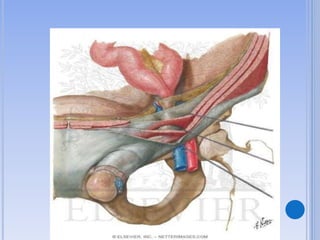
INDIRECT INGUINAL HERNIA
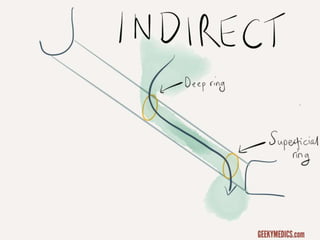
 Definition- hernia, of which sac passes through
deep inguinal ring to superficial inguinal ring.
 Mostly preformed sac due to defect in development
of processes vaginalis.
 Most common type(65%)
 Common in younger age group.
 More common on right side in first decade of life.
Equal incidence in second decade.
INDIRECT...
 Bilateral in 30% of cases
 Neck is thin hence more prone to strangulation.
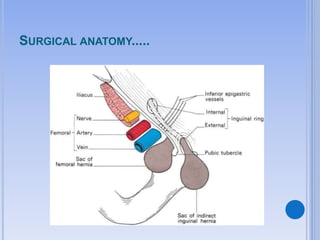
 Neck lies lateral to deep inferior epigastric vessels.
 In children sometimes sac is so narrow in the
middle that it admits only peritoneal fluid behaves
like hourglass.
 Often associated with undescended testis
INDIRECT ...
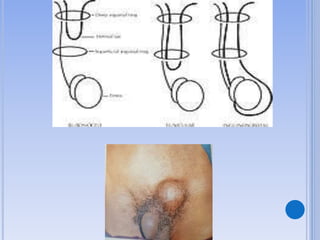
 Types –
 Bubonocele-when the hernia is limited to inguinal
canal.
 Funicular- processes closes just above the
epididymis. Hernia and testicle can be felt
separately.
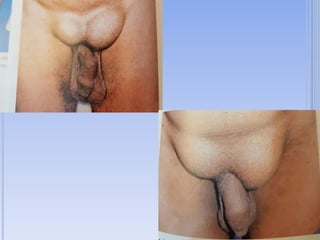
 Complete(inguinoscrotal)- here testicle appears
lying in hernial sac. Occurs in completely open
processes.
INDIRECT...
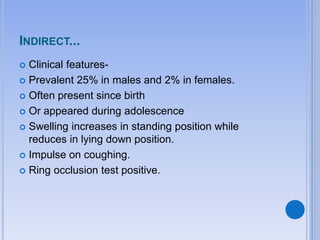
 Clinical features-
 Prevalent 25% in males and 2% in females.
 Often present since birth
 Or appeared during adolescence
 Swelling increases in standing position while
reduces in lying down position.
 Impulse on coughing.
 Ring occlusion test positive.
INDIRECT....
 Differential diagnosis-
 Hydrocele
 Undescended testis
 Femoral hernia
 Lipoma of the cord
 Hydrocele of the canal of Nuck in females
 Inguinal lymphadenopathy
 Inguinal abscess
INDIRECT....
 Investigations-
 Routines
 X-ray chest
 u/s abdomen
 Tests relevant for precipitating causes like-chronic
cough,contipation,urinary obstruction, ascites, intra-
abdominal mass cyst etc.,
 Herniography(Gullmo)
INDIRECT....
 Treatment-
 In children- simple herniotomy
 In adults- herniotomy + reinforcement of posterior
wall by-
 Bassini’s repair.
 Lichtenstein tensionfree mesh repair
 Kugel’s repair(open or laparoscopic)
 Surgery can be done under local anaesthesia as
outpatient daycare procedure.
INDIRECT..TREATMENT
 Read-Rives repair-mesh sutured directly over
peritoneum after herniotomy and invasion of stump.
 Stoppa repair- mesh placed between peritoneum
and transversalis fascia.
 TEP
 TAPP
INDIRECT...
 Related/special conditions
 Hernia-en-glisade- non-mesentry content
 Richter’s hernia- partial strangulation of gut
 Littre’s hernia- meckel’s diverticulum as content
 Pantaloon hernia- two sacs saddled over inferior
epigastric vessels
 Maydl’s hernia- double loop(hernia-en-W)
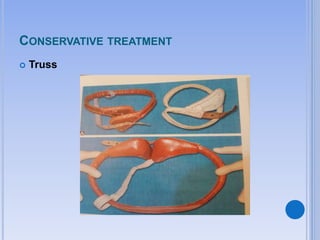
CONSERVATIVE TREATMENT
 Truss
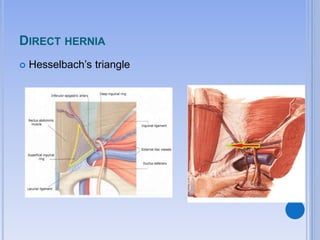
DIRECT HERNIA
 Hesselbach’s triangle
DIRECT ....
 10-15% hernias are direct.
 35% inguinal hernias are direct.
 50% direct h.are bilateral.
 Rare in females and children.
 Always acquired, due to weakness of posterior wall
of inguinal canal.
 Medial to inferior epigastric vessels; wide neck and
thick walled sac.
DIRECT.....
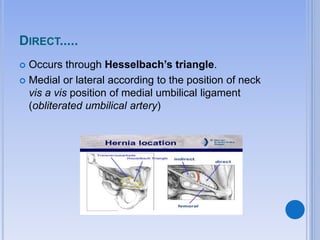
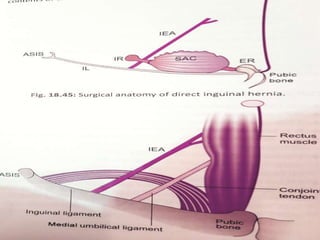
 Occurs through Hesselbach’s triangle.
 Medial or lateral according to the position of neck
vis a vis position of medial umbilical ligament
(obliterated umbilical artery)
DIRECT....
 Coverings- from inside out
 Extra-peritoneal tissue
 Fascia transversalis
 Conjoint tendon
 External spermatic fascia
 skin
DIRECT.....
 Predisposing factors-
 Chronic cough, smoking
 Straining at stool or urine
 Heavy weight lifting
 Appendicectomy (on right side)
 Malgaigne bulgings- soft supple bulges near
external ring on raising legs show weak
musculature of inguinal region.
DIRECT....
 Rarely descends into scrotum.
 When descends usually massive. Strangulation
may occur.
 Treatment-
 Mesh repair without herniotomy in most cases.
Herniotomy needed only when inguinoscrotal. Sac
dissected and invaginated and a prolene mesh
fixed over it. Bilateral problem can be dealt with
single suprapubic incision(pfennsteil’s)
COMPLICATIONS OF HERNIAS
 Most common esp. In indirect hernia is
strangulation
 Obstruction
 Incarcenation
 Intestinal obsruction
COMPLICATIONS OF SURGERY
 Injury to- ilioinguinal n.,spermatic artery leading to
testicular atrophy, vas deferens, inferior epigastric
vessels, femoral vessels, external illiac vessels (in
cases of endoscopic repair), urinary bladder esp. In
children.
 Haematoma formation
 Infection.
 Recurrence (10%) within 3yrs early;after 3yrs late.
 Chronic groin-pain syndrome.
 Infertility due to entrappement of vas in cases with
single functioning testicle.
FEMORAL HERNIA
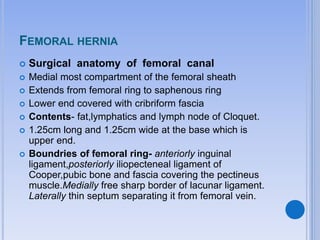
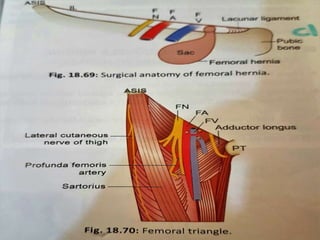
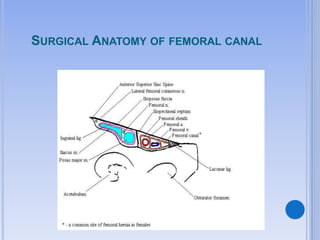
 Surgical anatomy of femoral canal
 Medial most compartment of the femoral sheath
 Extends from femoral ring to saphenous ring
 Lower end covered with cribriform fascia
 Contents- fat,lymphatics and lymph node of Cloquet.
 1.25cm long and 1.25cm wide at the base which is
upper end.
 Boundries of femoral ring- anteriorly inguinal
ligament,posteriorly iliopecteneal ligament of
Cooper,pubic bone and fascia covering the pectineus
muscle.Medially free sharp border of lacunar ligament.
Laterally thin septum separating it from femoral vein.
SURGICAL ANATOMY OF FEMORAL CANAL
SURGICAL ANATOMY.....
FEMORAL...
 Surgical pathology
 Femoral canal>vercally descends upto saphenous
ring>escapes out in loose areolar tissue to expand
and assumes the shape of a retort.
 Due to arduos path and narrow neck more prone
to obsruction and strangulation
 During surgery utmost precaution should be taken
to prevent injury to femoral vein and pubic branch
of obturator artery. An alarming haemorrage takes
place otherwise.
FEMORAL HERNIA
 Clinical features
 Common in females 2:1
 Most patients multiparous females
 Rare before puberty, 20% bilateral; common on
right side
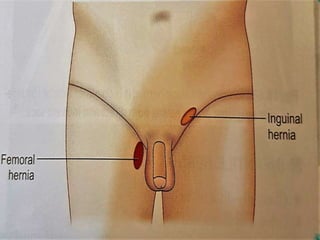
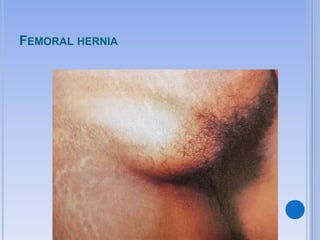
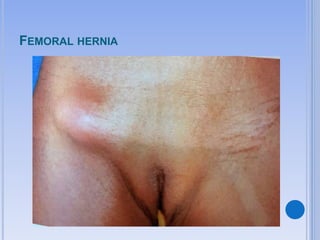
 Presents as a swelling below and lateral to the
pubic tubercle in contrast to inguinal hernia, which
is above and medial to pubic tubercle.
 Swelling, impulse on coughing, reducibility and
gurgling sound while being reduced.
 Dragging pain.
FEMORAL HERNIA
FEMORAL HERNIA
FEMORAL HERNIA
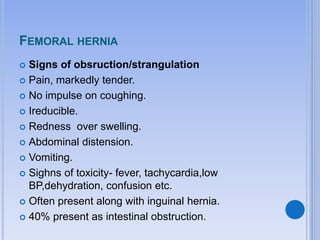
 Signs of obsruction/strangulation
 Pain, markedly tender.
 No impulse on coughing.
 Ireducible.
 Redness over swelling.
 Abdominal distension.
 Vomiting.
 Sighns of toxicity- fever, tachycardia,low
BP,dehydration, confusion etc.
 Often present along with inguinal hernia.
 40% present as intestinal obstruction.
FEMORAL HERNIA
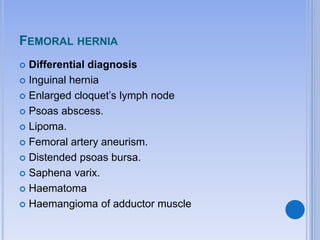
 Differential diagnosis
 Inguinal hernia
 Enlarged cloquet’s lymph node
 Psoas abscess.
 Lipoma.
 Femoral artery aneurism.
 Distended psoas bursa.
 Saphena varix.
 Haematoma
 Haemangioma of adductor muscle
FEMORAL HERNIA
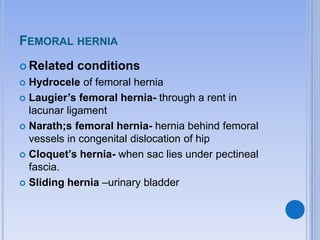
 Related conditions
 Hydrocele of femoral hernia
 Laugier’s femoral hernia- through a rent in
lacunar ligament
 Narath;s femoral hernia- hernia behind femoral
vessels in congenital dislocation of hip
 Cloquet’s hernia- when sac lies under pectineal
fascia.
 Sliding hernia –urinary bladder
FEMORAL HERNIA- TREATMENT
 Treament includes various surgical repair
techniques
 Lockwood low operation- approached from below.
Inguinal ligament sutured to Cooper’s
ligament(ideal and common)
 Mc’Evedy high operation- vertical incision across
inguinal ligament over swelling. Good exposure.
Ideal for strangulated hernia
 Lutheissen’s operation- conjoint tendon to
iliopectineal ligament
 AK Henery’s operation- repair of b/l hernia
through pfennsteil incision.
 Laparoscopic mesh repair-TEP/TAPP
FEMORAL HERNIA
 Complications-
 Of hernia- obsruction, strangulation, intestinal
obstruction.
 Of surgery- injury to femoral vein or artery, urinary
bladder, obturator artery
 Sequele-recurrence, ch groin-pain
syndrome,restricted hip flexion.
THANK ....YOU

Groin hernias

  • 1.
    GROIN HERNIAS Include- Indirect inguinalhernia Direct inguinal hernia Femoral hernia Dr. G S Randhawa Associate professor of surgery Punjab institute of medical scienc es, Jalandhar,punjab,India.
  • 2.
    INDIRECT INGUINAL HERNIA Definition- hernia, of which sac passes through deep inguinal ring to superficial inguinal ring.  Mostly preformed sac due to defect in development of processes vaginalis.  Most common type(65%)  Common in younger age group.  More common on right side in first decade of life. Equal incidence in second decade.
  • 4.
    INDIRECT...  Bilateral in30% of cases  Neck is thin hence more prone to strangulation.  Neck lies lateral to deep inferior epigastric vessels.  In children sometimes sac is so narrow in the middle that it admits only peritoneal fluid behaves like hourglass.  Often associated with undescended testis
  • 6.
    INDIRECT ...  Types–  Bubonocele-when the hernia is limited to inguinal canal.  Funicular- processes closes just above the epididymis. Hernia and testicle can be felt separately.  Complete(inguinoscrotal)- here testicle appears lying in hernial sac. Occurs in completely open processes.
  • 8.
    INDIRECT...  Clinical features- Prevalent 25% in males and 2% in females.  Often present since birth  Or appeared during adolescence  Swelling increases in standing position while reduces in lying down position.  Impulse on coughing.  Ring occlusion test positive.
  • 9.
    INDIRECT....  Differential diagnosis- Hydrocele  Undescended testis  Femoral hernia  Lipoma of the cord  Hydrocele of the canal of Nuck in females  Inguinal lymphadenopathy  Inguinal abscess
  • 10.
    INDIRECT....  Investigations-  Routines X-ray chest  u/s abdomen  Tests relevant for precipitating causes like-chronic cough,contipation,urinary obstruction, ascites, intra- abdominal mass cyst etc.,  Herniography(Gullmo)
  • 11.
    INDIRECT....  Treatment-  Inchildren- simple herniotomy  In adults- herniotomy + reinforcement of posterior wall by-  Bassini’s repair.  Lichtenstein tensionfree mesh repair  Kugel’s repair(open or laparoscopic)  Surgery can be done under local anaesthesia as outpatient daycare procedure.
  • 12.
    INDIRECT..TREATMENT  Read-Rives repair-meshsutured directly over peritoneum after herniotomy and invasion of stump.  Stoppa repair- mesh placed between peritoneum and transversalis fascia.  TEP  TAPP
  • 13.
    INDIRECT...  Related/special conditions Hernia-en-glisade- non-mesentry content  Richter’s hernia- partial strangulation of gut  Littre’s hernia- meckel’s diverticulum as content  Pantaloon hernia- two sacs saddled over inferior epigastric vessels  Maydl’s hernia- double loop(hernia-en-W)
  • 14.
  • 15.
  • 16.
    DIRECT ....  10-15%hernias are direct.  35% inguinal hernias are direct.  50% direct h.are bilateral.  Rare in females and children.  Always acquired, due to weakness of posterior wall of inguinal canal.  Medial to inferior epigastric vessels; wide neck and thick walled sac.
  • 17.
    DIRECT.....  Occurs throughHesselbach’s triangle.  Medial or lateral according to the position of neck vis a vis position of medial umbilical ligament (obliterated umbilical artery)
  • 19.
    DIRECT....  Coverings- frominside out  Extra-peritoneal tissue  Fascia transversalis  Conjoint tendon  External spermatic fascia  skin
  • 20.
    DIRECT.....  Predisposing factors- Chronic cough, smoking  Straining at stool or urine  Heavy weight lifting  Appendicectomy (on right side)  Malgaigne bulgings- soft supple bulges near external ring on raising legs show weak musculature of inguinal region.
  • 22.
    DIRECT....  Rarely descendsinto scrotum.  When descends usually massive. Strangulation may occur.  Treatment-  Mesh repair without herniotomy in most cases. Herniotomy needed only when inguinoscrotal. Sac dissected and invaginated and a prolene mesh fixed over it. Bilateral problem can be dealt with single suprapubic incision(pfennsteil’s)
  • 23.
    COMPLICATIONS OF HERNIAS Most common esp. In indirect hernia is strangulation  Obstruction  Incarcenation  Intestinal obsruction
  • 24.
    COMPLICATIONS OF SURGERY Injury to- ilioinguinal n.,spermatic artery leading to testicular atrophy, vas deferens, inferior epigastric vessels, femoral vessels, external illiac vessels (in cases of endoscopic repair), urinary bladder esp. In children.  Haematoma formation  Infection.  Recurrence (10%) within 3yrs early;after 3yrs late.  Chronic groin-pain syndrome.  Infertility due to entrappement of vas in cases with single functioning testicle.
  • 25.
    FEMORAL HERNIA  Surgicalanatomy of femoral canal  Medial most compartment of the femoral sheath  Extends from femoral ring to saphenous ring  Lower end covered with cribriform fascia  Contents- fat,lymphatics and lymph node of Cloquet.  1.25cm long and 1.25cm wide at the base which is upper end.  Boundries of femoral ring- anteriorly inguinal ligament,posteriorly iliopecteneal ligament of Cooper,pubic bone and fascia covering the pectineus muscle.Medially free sharp border of lacunar ligament. Laterally thin septum separating it from femoral vein.
  • 27.
    SURGICAL ANATOMY OFFEMORAL CANAL
  • 28.
  • 29.
    FEMORAL...  Surgical pathology Femoral canal>vercally descends upto saphenous ring>escapes out in loose areolar tissue to expand and assumes the shape of a retort.  Due to arduos path and narrow neck more prone to obsruction and strangulation  During surgery utmost precaution should be taken to prevent injury to femoral vein and pubic branch of obturator artery. An alarming haemorrage takes place otherwise.
  • 30.
    FEMORAL HERNIA  Clinicalfeatures  Common in females 2:1  Most patients multiparous females  Rare before puberty, 20% bilateral; common on right side  Presents as a swelling below and lateral to the pubic tubercle in contrast to inguinal hernia, which is above and medial to pubic tubercle.  Swelling, impulse on coughing, reducibility and gurgling sound while being reduced.  Dragging pain.
  • 32.
  • 33.
  • 34.
    FEMORAL HERNIA  Signsof obsruction/strangulation  Pain, markedly tender.  No impulse on coughing.  Ireducible.  Redness over swelling.  Abdominal distension.  Vomiting.  Sighns of toxicity- fever, tachycardia,low BP,dehydration, confusion etc.  Often present along with inguinal hernia.  40% present as intestinal obstruction.
  • 35.
    FEMORAL HERNIA  Differentialdiagnosis  Inguinal hernia  Enlarged cloquet’s lymph node  Psoas abscess.  Lipoma.  Femoral artery aneurism.  Distended psoas bursa.  Saphena varix.  Haematoma  Haemangioma of adductor muscle
  • 36.
    FEMORAL HERNIA  Relatedconditions  Hydrocele of femoral hernia  Laugier’s femoral hernia- through a rent in lacunar ligament  Narath;s femoral hernia- hernia behind femoral vessels in congenital dislocation of hip  Cloquet’s hernia- when sac lies under pectineal fascia.  Sliding hernia –urinary bladder
  • 37.
    FEMORAL HERNIA- TREATMENT Treament includes various surgical repair techniques  Lockwood low operation- approached from below. Inguinal ligament sutured to Cooper’s ligament(ideal and common)  Mc’Evedy high operation- vertical incision across inguinal ligament over swelling. Good exposure. Ideal for strangulated hernia  Lutheissen’s operation- conjoint tendon to iliopectineal ligament  AK Henery’s operation- repair of b/l hernia through pfennsteil incision.  Laparoscopic mesh repair-TEP/TAPP
  • 38.
    FEMORAL HERNIA  Complications- Of hernia- obsruction, strangulation, intestinal obstruction.  Of surgery- injury to femoral vein or artery, urinary bladder, obturator artery  Sequele-recurrence, ch groin-pain syndrome,restricted hip flexion.
  • 39.