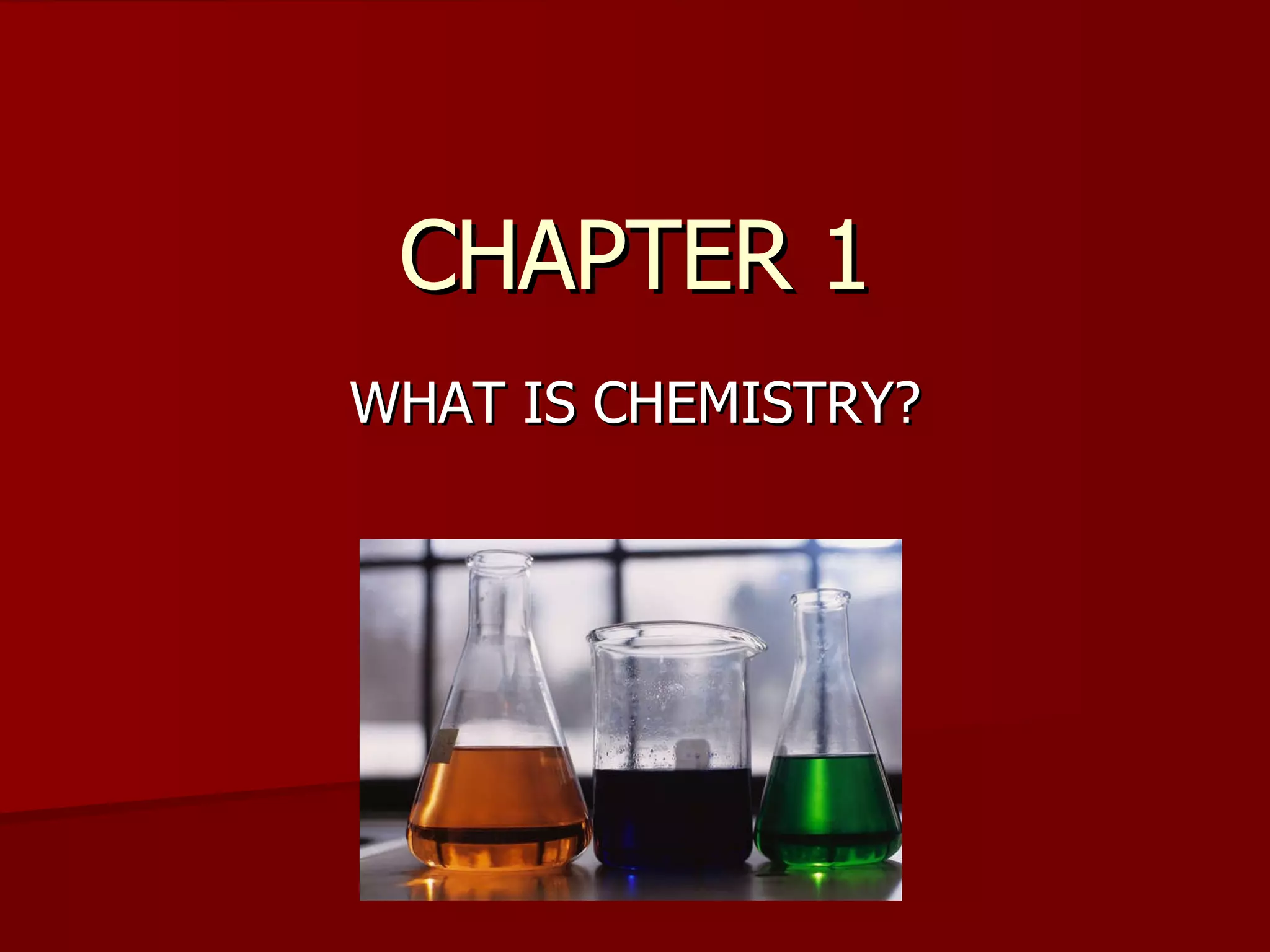
CHAPTER 1 WHAT IS CHEMISTRY?
WHAT IS CHEMISTRY? Chemistry is the study of matter and the transformations it undergoes. What is matter? Anything that has mass and takes up space.
IMPORTANCE OF CHEMISTRY Chemistry is all around you.  Air you breathe Food you digest Clothes you wear Textbook you read Chemistry is often said to be the central science.
SCIENCE V.S. TECHNOLOGY How is science different from technology? Science:   Experimental investigation and exploration of natural phenomena Pursues knowledge for its own sake Does not cause change in itself Technology The practical application of scientific knowledge Leads to change (for better or for worse)
SCIENCE V.S. TECHNOLOGY (Cont) Examples of science: What causes the flu? How are atoms put together? How is genetic information stored and transmitted? Examples of technology Flu vaccine Atomic bomb Genetic engineering
SCIENTIFIC METHOD Step 1:  Make observations Example:  I am sick with a stomachache. Step 2:  Develop a hypothesis Example:  I am sick due to the spoiled food I ate   for lunch. Step 3:  Test hypothesis through experiments Example:  Ask others who ate the same food for lunch if they got sick.
SCIENTIFIC METHOD (Cont) Step 4:  Develop a law Law:   Summarizes the outcome of several experiments that occur repeatedly and consistently. Example:  The spoiled food served at lunch makes people sick with a stomachache. Step 5:  Develop a theory Theory:   Explanation for a why a law exists. Example:  It is the bacteria in the spoiled food that makes people ill.
SCIENTIFIC METHOD (Cont) Theories Are never completely certain  May change as more experiments are performed. A  model  is a physical picture or mathematical expression of a theory. Example:  Model of the atom The scientific method must be free of bias.
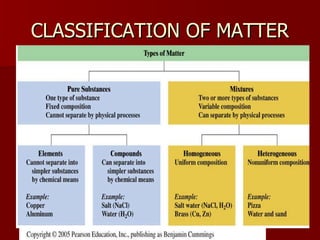
CLASSIFICATION OF MATTER
ELEMENTS Elemental substances contain only one type of atom Elements are the building blocks of matter There are 115 known elements today, 90 which occur naturally The periodic table displays the elements
ELEMENTS (Cont) Each element has a unique symbol The first letter is always capitalized, the second letter is always lower case Fluorine is F,  not f Cobalt is Co, not CO (which is carbon monoxide) The smallest unit of an element is the atom
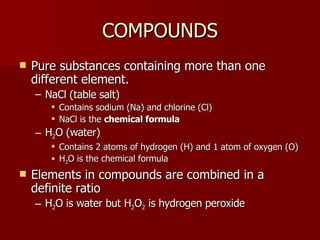
COMPOUNDS Pure substances containing more than one different element. NaCl (table salt)  Contains sodium (Na) and chlorine (Cl) NaCl is the  chemical formula H 2 O (water) Contains 2 atoms of hydrogen (H) and 1 atom of oxygen (O) H 2 O is the chemical formula Elements in compounds are combined in a definite ratio H 2 O is water but H 2 O 2  is hydrogen peroxide
COMPOUNDS (cont) Are H 2  and O 3  considered elements or compounds?  Why?
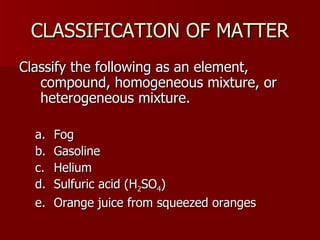
CLASSIFICATION OF MATTER Classify the following as an element, compound, homogeneous mixture, or heterogeneous mixture. Fog Gasoline Helium Sulfuric acid (H 2 SO 4 ) Orange juice from squeezed oranges
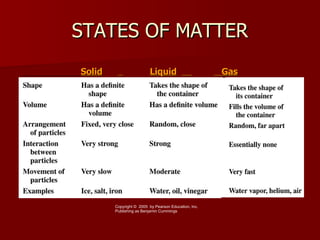
STATES OF MATTER Solid   Liquid     Gas Copyright ©  2005  by Pearson Education, Inc. Publishing as Benjamin Cummings
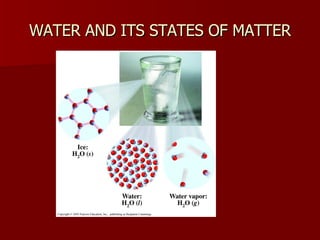
WATER AND ITS STATES OF MATTER
CHANGES IN STATE Melting:  Solid to liquid Boiling:  Liquid to gas Sublimation:  Solid to gas The above three require input of energy Condensation:  Gas to liquid Freezing:  Liquid to solid Deposition:  Gas to solid The above three release energy
PHYSICAL CHANGES Do not alter the chemical identity of the substance Examples include: Any change in the state of matter (e.g. freezing or boiling water) Sawing wood Crushing a tablet Bending a wire Dissolving salt in water
PHYSICAL PROPERTIES Characterize the physical state and physical behavior of a substance Each substance has unique physical properties Examples Sulfur appears as a yellow powder The boiling point of water is 100  o C Carbon monoxide is odorless
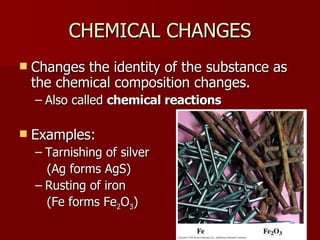
CHEMICAL CHANGES Changes the identity of the substance as the chemical composition changes. Also called  chemical reactions Examples: Tarnishing of silver  (Ag forms AgS)  Rusting of iron  (Fe forms Fe 2 O 3 )
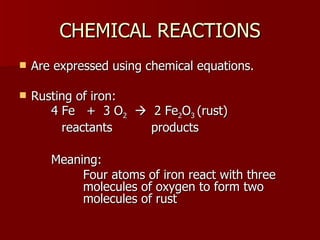
CHEMICAL REACTIONS Are expressed using chemical equations. Rusting of iron: 4 Fe  +  3 O 2      2 Fe 2 O 3  (rust) reactants  products Meaning:  Four atoms of iron react with three  molecules of oxygen to form two  molecules of rust
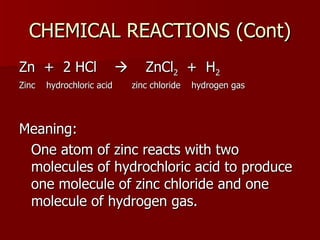
CHEMICAL REACTIONS (Cont) Zn  +  2 HCl     ZnCl 2   +  H 2 Zinc  hydrochloric acid  zinc chloride  hydrogen gas Meaning:  One atom of zinc reacts with two molecules of hydrochloric acid to produce one molecule of zinc chloride and one molecule of hydrogen gas.
CHEMICAL PROPERTIES Describe ways pure substances behave when interacting with other pure substances. Examples Iron reacts with oxygen to form rust. Platinum does not react with oxygen at room temperature.
PRACTICE PROBLEM Identify the following properties and changes as physical or chemical. The copper sheets that form the “skin” of the Statue of Liberty have acquired a greenish coating over the years. Carbon appears as black powder. Adding food coloring to water. Wood burns in air.

Introductory Chemistry Chapter 1 Power Point

  • 1.
    CHAPTER 1 WHATIS CHEMISTRY?
  • 2.
    WHAT IS CHEMISTRY?Chemistry is the study of matter and the transformations it undergoes. What is matter? Anything that has mass and takes up space.
  • 3.
    IMPORTANCE OF CHEMISTRYChemistry is all around you. Air you breathe Food you digest Clothes you wear Textbook you read Chemistry is often said to be the central science.
  • 4.
    SCIENCE V.S. TECHNOLOGYHow is science different from technology? Science: Experimental investigation and exploration of natural phenomena Pursues knowledge for its own sake Does not cause change in itself Technology The practical application of scientific knowledge Leads to change (for better or for worse)
  • 5.
    SCIENCE V.S. TECHNOLOGY(Cont) Examples of science: What causes the flu? How are atoms put together? How is genetic information stored and transmitted? Examples of technology Flu vaccine Atomic bomb Genetic engineering
  • 6.
    SCIENTIFIC METHOD Step1: Make observations Example: I am sick with a stomachache. Step 2: Develop a hypothesis Example: I am sick due to the spoiled food I ate for lunch. Step 3: Test hypothesis through experiments Example: Ask others who ate the same food for lunch if they got sick.
  • 7.
    SCIENTIFIC METHOD (Cont)Step 4: Develop a law Law: Summarizes the outcome of several experiments that occur repeatedly and consistently. Example: The spoiled food served at lunch makes people sick with a stomachache. Step 5: Develop a theory Theory: Explanation for a why a law exists. Example: It is the bacteria in the spoiled food that makes people ill.
  • 8.
    SCIENTIFIC METHOD (Cont)Theories Are never completely certain May change as more experiments are performed. A model is a physical picture or mathematical expression of a theory. Example: Model of the atom The scientific method must be free of bias.
  • 9.
  • 10.
    ELEMENTS Elemental substancescontain only one type of atom Elements are the building blocks of matter There are 115 known elements today, 90 which occur naturally The periodic table displays the elements
  • 11.
    ELEMENTS (Cont) Eachelement has a unique symbol The first letter is always capitalized, the second letter is always lower case Fluorine is F, not f Cobalt is Co, not CO (which is carbon monoxide) The smallest unit of an element is the atom
  • 12.
    COMPOUNDS Pure substancescontaining more than one different element. NaCl (table salt) Contains sodium (Na) and chlorine (Cl) NaCl is the chemical formula H 2 O (water) Contains 2 atoms of hydrogen (H) and 1 atom of oxygen (O) H 2 O is the chemical formula Elements in compounds are combined in a definite ratio H 2 O is water but H 2 O 2 is hydrogen peroxide
  • 13.
    COMPOUNDS (cont) AreH 2 and O 3 considered elements or compounds? Why?
  • 14.
    CLASSIFICATION OF MATTERClassify the following as an element, compound, homogeneous mixture, or heterogeneous mixture. Fog Gasoline Helium Sulfuric acid (H 2 SO 4 ) Orange juice from squeezed oranges
  • 15.
    STATES OF MATTERSolid Liquid Gas Copyright © 2005 by Pearson Education, Inc. Publishing as Benjamin Cummings
  • 16.
    WATER AND ITSSTATES OF MATTER
  • 17.
    CHANGES IN STATEMelting: Solid to liquid Boiling: Liquid to gas Sublimation: Solid to gas The above three require input of energy Condensation: Gas to liquid Freezing: Liquid to solid Deposition: Gas to solid The above three release energy
  • 18.
    PHYSICAL CHANGES Donot alter the chemical identity of the substance Examples include: Any change in the state of matter (e.g. freezing or boiling water) Sawing wood Crushing a tablet Bending a wire Dissolving salt in water
  • 19.
    PHYSICAL PROPERTIES Characterizethe physical state and physical behavior of a substance Each substance has unique physical properties Examples Sulfur appears as a yellow powder The boiling point of water is 100 o C Carbon monoxide is odorless
  • 20.
    CHEMICAL CHANGES Changesthe identity of the substance as the chemical composition changes. Also called chemical reactions Examples: Tarnishing of silver (Ag forms AgS) Rusting of iron (Fe forms Fe 2 O 3 )
  • 21.
    CHEMICAL REACTIONS Areexpressed using chemical equations. Rusting of iron: 4 Fe + 3 O 2  2 Fe 2 O 3 (rust) reactants products Meaning: Four atoms of iron react with three molecules of oxygen to form two molecules of rust
  • 22.
    CHEMICAL REACTIONS (Cont)Zn + 2 HCl  ZnCl 2 + H 2 Zinc hydrochloric acid zinc chloride hydrogen gas Meaning: One atom of zinc reacts with two molecules of hydrochloric acid to produce one molecule of zinc chloride and one molecule of hydrogen gas.
  • 23.
    CHEMICAL PROPERTIES Describeways pure substances behave when interacting with other pure substances. Examples Iron reacts with oxygen to form rust. Platinum does not react with oxygen at room temperature.
  • 24.
    PRACTICE PROBLEM Identifythe following properties and changes as physical or chemical. The copper sheets that form the “skin” of the Statue of Liberty have acquired a greenish coating over the years. Carbon appears as black powder. Adding food coloring to water. Wood burns in air.