Chapter 6
Electrochemistry
A. Electrolytes & Non-electrolytes
Electrolytes
Substances that can conduct electricity and
undergo chemical changes
Non-electrolytes
Substances that cannot conduct electricity
Electrolyte
Non-electrolyte
Why electrolyte at molten and aqueous state
can conduct electricity?
BECAUSE
There presence of free moving ions in the
electrolyte
B. Electrolysis of Molten Compounds
Electrolysis
A process where compounds in molten or
aqueous state are broken down into their
constituent elements by passing electricity
through them
Electrolytic cell
The set of apparatus needed to conduct
electrolysis
Electrolyte
CathodeAnode
+ -
STEPS OCCUR DURING
ELECTROLYSIS
 Movement of ions to the
electrodes.
 Discharges of ions at the
electrodes.
Graphite or platinum
is usually used as
electrodes because
they are inert.
Important note: Observation
Anode (positive electrode)
Electrolysis product Observation Confirmatory test
Chlorine gas Greenish-yellow gas
bubbles released
Place moist blue litmus
paper into test tube
Moist blue litmus paper
turn redBromine gas Brown gas released
Iodine Purple gas released
Oxygen gas Colourless gas bubble
released
Place a glow wooden
splinter near the mouth
of test tube
The glowing wooden
splinter light up
Metal (all metal) The mass of electrode decreased
Copper metal Brown solid formed
Important note: Observation
Cathode (negative electrode)
Electrolysis product Observation Confirmatory test
Almost all metal
(except copper metal)
Grey solid formed
The mass of electrode
increase
No test for metals
Copper metal Brown solid formed
Hydrogen gas Colourless gas bubbles
released
Place a lighted wooden
splinter near the mouth
of test tube
A “pop” sound
heard/produced
Electrolysis of molten compound
• PbBr2
• LiCl
• MgBr2
• PbI2
• ZnO
• CuCl2
• Molten Potassium oxide
• Molten Magnesium oxide
• Molten Potassium iodide
Electrolysis of Aqueous Solutions
Factors that affect the electrolysis of an
aqueous solution
• Position of ions in the Electrochemical
Series
• Concentration of ions in the electrolytes
• Types of electrodes used in the electrolysis
Position of ions in
the Electrochemical Series
• The ions that are lower in the electrochemical
series will be selected discharged
K+
Na+
Ca2+
Mg2+
Al3+
Zn2+
Fe2+
Sn2+
Pb2+
H+
Cu2+
Ag+
F-
SO4
2-
NO3
-
Cl-
Br-
I-
OH-
The Electrochemical Series
Ease of discharge
increases
0.01 mol dm-3 of copper(II) sulphate
using carbon as electrodes
1 mol dm-3 of
copper(II) sulphate
solution
CarbonCarbon
Concentration of ions
• If the concentration of a particular ions is
high, the ions is selectively discharged
TIPS:
ANODE
Ion selectively discharged based on CONCENTRATION of
ions
CATHODE
Ion selectively discharged based on position of ions in
Electrochemical Series
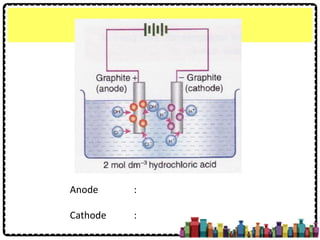
2 mol dm-3 of hydrochloric acid, HCl
using platinum as electrodes
2 mol dm-3 of
hydrochloric acid, HCl
PlatinumPlatinum
Anode :
Cathode :
Types of electrodes
• Electrolysis of copper(II) sulphate, CuSO4
solution using copper electrode
• Electrolysis of silver nitrate, AgNO3 solution
using silver electrode
0.02 mol dm-3 of copper(II) sulphate, CuSO4
using copper as electrodes
0.02 mol dm-3 of
copper(II) sulphate,
CuSO4
CopperCopper
Anode :
Cathode :
0.02 mol dm-3 of silver nitrate, AgNO3
using silver as electrodes
0.02 mol dm-3 of silver
nitrate, AgNO3
SilverSilver
D. Electrolysis in Industries
• The most industrial application of electrolysis:
1. extraction
2. purification
3. electroplating of metals
E. Voltaic Cells
• Chemical energy to electrical energy
• Examples of chemical cell:
 simple voltaic cell
 Daniell cell
 dry cell
 alkaline cell
 lead-acid accumulator
Simple Voltaic Cell
Two different metals being immersed into an
electrolyte and connected by wire
V
Daniell cell – has two types
• Use porous pot
• Use salt bridge
Use porous pot
Use salt bridge
F. The Electrochemical Series
• The Electrochemical Series is series of
element, arranged according to the order of
decreasing tendency to released electrons.
• Or the greater the tendency to donate
electrons, the more electropositive is the
metal and the higher it is in the
Electrochemical Series.
Principles Used:
• Metals are arranged according to the tendency of
their atoms to release electron.
• More the tendency of their atoms to release
electron, the higher located it is in the series.
• Elements located at HIGHER part of the
Electrochemical Series are more electropositive
and have higher tendencies to release electrons
to form positive ions.
• Example : magnesium is more electropositive
than copper in Electrochemical Series
The Electrochemical Series can be
constructed based on:
Metals are arranged according to their tendency
to release electrons to form positive ion (cation).
• metal has a higher tendency to release
electron placed a the higher position in
Electrochemical Series.
• the metal act as negative terminal
The ability of a metal to displace another metal
from its salt solution.
• If metal is able to displace another metal
from its salt solution, this metal is placed
at the higher position in Electrochemical
Series
The potential difference between two metals.
• The further apart between two metals in
the Electrochemical Series, the greater the
potential difference between them.
• The greater the voltage produced by the
cell.

Chapter 6 Electrochemistry

  • 1.
  • 2.
    A. Electrolytes &Non-electrolytes Electrolytes Substances that can conduct electricity and undergo chemical changes Non-electrolytes Substances that cannot conduct electricity
  • 3.
  • 4.
    Why electrolyte atmolten and aqueous state can conduct electricity? BECAUSE There presence of free moving ions in the electrolyte
  • 5.
    B. Electrolysis ofMolten Compounds Electrolysis A process where compounds in molten or aqueous state are broken down into their constituent elements by passing electricity through them
  • 6.
    Electrolytic cell The setof apparatus needed to conduct electrolysis Electrolyte CathodeAnode + - STEPS OCCUR DURING ELECTROLYSIS  Movement of ions to the electrodes.  Discharges of ions at the electrodes. Graphite or platinum is usually used as electrodes because they are inert.
  • 7.
    Important note: Observation Anode(positive electrode) Electrolysis product Observation Confirmatory test Chlorine gas Greenish-yellow gas bubbles released Place moist blue litmus paper into test tube Moist blue litmus paper turn redBromine gas Brown gas released Iodine Purple gas released Oxygen gas Colourless gas bubble released Place a glow wooden splinter near the mouth of test tube The glowing wooden splinter light up Metal (all metal) The mass of electrode decreased Copper metal Brown solid formed
  • 8.
    Important note: Observation Cathode(negative electrode) Electrolysis product Observation Confirmatory test Almost all metal (except copper metal) Grey solid formed The mass of electrode increase No test for metals Copper metal Brown solid formed Hydrogen gas Colourless gas bubbles released Place a lighted wooden splinter near the mouth of test tube A “pop” sound heard/produced
  • 9.
  • 10.
    Electrolysis of moltencompound • PbBr2 • LiCl • MgBr2 • PbI2 • ZnO • CuCl2 • Molten Potassium oxide • Molten Magnesium oxide • Molten Potassium iodide
  • 11.
    Electrolysis of AqueousSolutions Factors that affect the electrolysis of an aqueous solution • Position of ions in the Electrochemical Series • Concentration of ions in the electrolytes • Types of electrodes used in the electrolysis
  • 12.
    Position of ionsin the Electrochemical Series • The ions that are lower in the electrochemical series will be selected discharged
  • 13.
  • 14.
    0.01 mol dm-3of copper(II) sulphate using carbon as electrodes 1 mol dm-3 of copper(II) sulphate solution CarbonCarbon
  • 16.
    Concentration of ions •If the concentration of a particular ions is high, the ions is selectively discharged TIPS: ANODE Ion selectively discharged based on CONCENTRATION of ions CATHODE Ion selectively discharged based on position of ions in Electrochemical Series
  • 17.
    2 mol dm-3of hydrochloric acid, HCl using platinum as electrodes 2 mol dm-3 of hydrochloric acid, HCl PlatinumPlatinum
  • 18.
  • 19.
    Types of electrodes •Electrolysis of copper(II) sulphate, CuSO4 solution using copper electrode • Electrolysis of silver nitrate, AgNO3 solution using silver electrode
  • 20.
    0.02 mol dm-3of copper(II) sulphate, CuSO4 using copper as electrodes 0.02 mol dm-3 of copper(II) sulphate, CuSO4 CopperCopper
  • 21.
  • 22.
    0.02 mol dm-3of silver nitrate, AgNO3 using silver as electrodes 0.02 mol dm-3 of silver nitrate, AgNO3 SilverSilver
  • 23.
    D. Electrolysis inIndustries • The most industrial application of electrolysis: 1. extraction 2. purification 3. electroplating of metals
  • 24.
    E. Voltaic Cells •Chemical energy to electrical energy • Examples of chemical cell:  simple voltaic cell  Daniell cell  dry cell  alkaline cell  lead-acid accumulator
  • 25.
    Simple Voltaic Cell Twodifferent metals being immersed into an electrolyte and connected by wire V
  • 26.
    Daniell cell –has two types • Use porous pot • Use salt bridge
  • 27.
  • 28.
  • 29.
    F. The ElectrochemicalSeries • The Electrochemical Series is series of element, arranged according to the order of decreasing tendency to released electrons. • Or the greater the tendency to donate electrons, the more electropositive is the metal and the higher it is in the Electrochemical Series.
  • 30.
    Principles Used: • Metalsare arranged according to the tendency of their atoms to release electron. • More the tendency of their atoms to release electron, the higher located it is in the series. • Elements located at HIGHER part of the Electrochemical Series are more electropositive and have higher tendencies to release electrons to form positive ions. • Example : magnesium is more electropositive than copper in Electrochemical Series
  • 31.
    The Electrochemical Seriescan be constructed based on: Metals are arranged according to their tendency to release electrons to form positive ion (cation). • metal has a higher tendency to release electron placed a the higher position in Electrochemical Series. • the metal act as negative terminal
  • 32.
    The ability ofa metal to displace another metal from its salt solution. • If metal is able to displace another metal from its salt solution, this metal is placed at the higher position in Electrochemical Series
  • 33.
    The potential differencebetween two metals. • The further apart between two metals in the Electrochemical Series, the greater the potential difference between them. • The greater the voltage produced by the cell.