NURUL ASHIKIN BT. ABD RAHMAN   PART 6
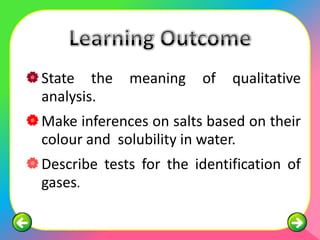
 State the    meaning     of   qualitative
  analysis.
 Make inferences on salts based on their
  colour and solubility in water.
 Describe tests for the identification of
  gases.
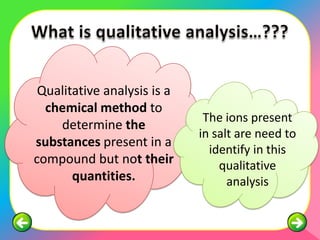
Qualitative analysis is a
  chemical method to
                              The ions present
    determine the
                             in salt are need to
substances present in a
                               identify in this
compound but not their           qualitative
       quantities.                 analysis
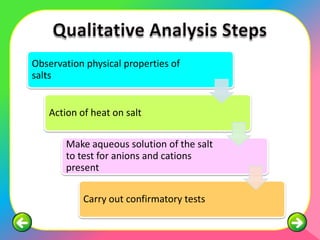
Observation physical properties of
salts


   Action of heat on salt

       Make aqueous solution of the salt
       to test for anions and cations
       present

           Carry out confirmatory tests
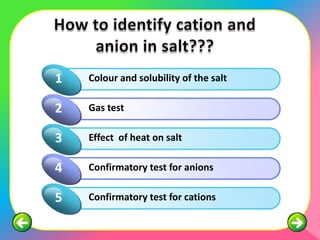
1
1   Click to add Title
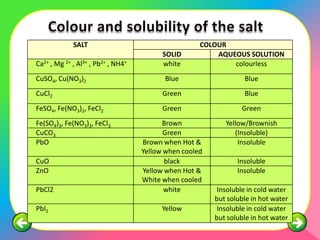
     Colour and solubility of the salt

2
2   Click to add Title
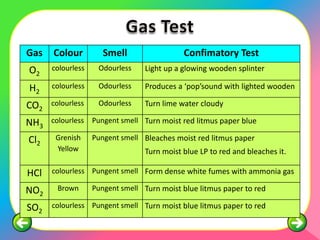
     Gas test

1
3   Click to add Title salt
     Effect of heat on

2
4   Click to add Title for anions
     Confirmatory test

1
5   Click to add Title for cations
     Confirmatory test
SALT                                    COLOUR
                                          SOLID          AQUEOUS SOLUTION
Ca2+ , Mg 2+ , Al3+ , Pb2+ , NH4+         white              colourless
CuSO4, Cu(NO3)2                            Blue                   Blue
CuCl2                                     Green                   Blue
FeSO4, Fe(NO3)2, FeCl2                    Green                  Green
Fe(SO4)3, Fe(NO3)3, FeCl3                 Brown             Yellow/Brownish
CuCO3                                      Green               (Insoluble)
PbO                                 Brown when Hot &            Insoluble
                                    Yellow when cooled
CuO                                        black                Insoluble
ZnO                                 Yellow when Hot &           Insoluble
                                    White when cooled
PbCl2                                      white          Insoluble in cold water
                                                         but soluble in hot water
PbI2                                      Yellow          Insoluble in cold water
                                                         but soluble in hot water
Gas   Colour          Smell                 Confimatory Test
O2    colourless    Odourless    Light up a glowing wooden splinter

H2    colourless    Odourless    Produces a ‘pop’sound with lighted wooden

CO2   colourless    Odourless    Turn lime water cloudy

NH3   colourless   Pungent smell Turn moist red litmus paper blue

Cl2    Grenish     Pungent smell Bleaches moist red litmus paper
       Yellow                    Turn moist blue LP to red and bleaches it.

HCl   colourless Pungent smell Form dense white fumes with ammonia gas

NO2    Brown       Pungent smell Turn moist blue litmus paper to red

SO2   colourless Pungent smell Turn moist blue litmus paper to red
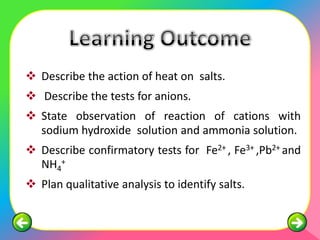
 Describe the action of heat on salts.
 Describe the tests for anions.
 State observation of reaction of cations with
  sodium hydroxide solution and ammonia solution.
 Describe confirmatory tests for Fe2+ , Fe3+ ,Pb2+ and
  NH4+
 Plan qualitative analysis to identify salts.
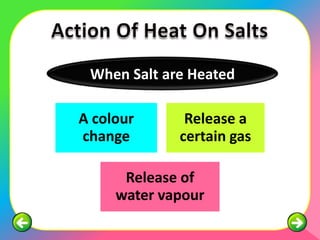
When Salt are Heated

A colour      Release a
change       certain gas

      Release of
     water vapour
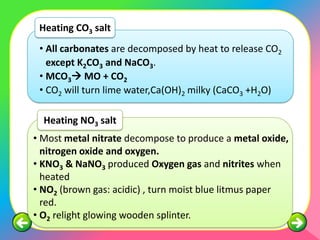
Heating CO3 salt
 • All carbonates are decomposed by heat to release CO2
   except K2CO3 and NaCO3.
 • MCO3 MO + CO2
 • CO2 will turn lime water,Ca(OH)2 milky (CaCO3 +H2O)

  Heating NO3 salt
• Most metal nitrate decompose to produce a metal oxide,
  nitrogen oxide and oxygen.
• KNO3 & NaNO3 produced Oxygen gas and nitrites when
  heated
• NO2 (brown gas: acidic) , turn moist blue litmus paper
  red.
• O2 relight glowing wooden splinter.
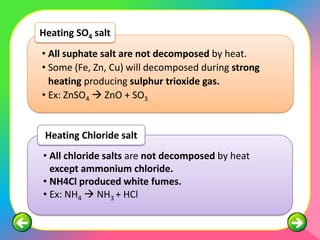
Heating SO4 salt
• All suphate salt are not decomposed by heat.
• Some (Fe, Zn, Cu) will decomposed during strong
  heating producing sulphur trioxide gas.
• Ex: ZnSO4  ZnO + SO3


 Heating Chloride salt
• All chloride salts are not decomposed by heat
  except ammonium chloride.
• NH4Cl produced white fumes.
• Ex: NH4  NH3 + HCl
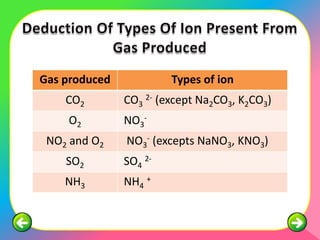
Gas produced            Types of ion
    CO2        CO3 2- (except Na2CO3, K2CO3)
    O2         NO3-
 NO2 and O2    NO3- (excepts NaNO3, KNO3)
    SO2        SO4 2-
    NH3        NH4 +
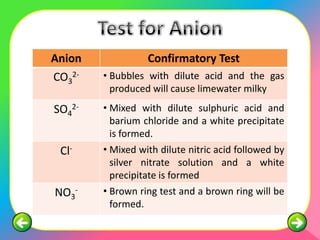
Anion             Confirmatory Test
CO32-   • Bubbles with dilute acid and the gas
          produced will cause limewater milky
SO42-   • Mixed with dilute sulphuric acid and
          barium chloride and a white precipitate
          is formed.
 Cl-    • Mixed with dilute nitric acid followed by
          silver nitrate solution and a white
          precipitate is formed
NO3-    • Brown ring test and a brown ring will be
          formed.
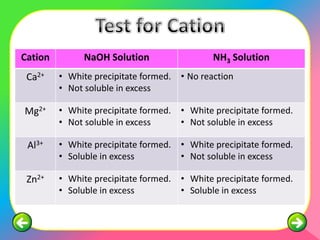
Cation         NaOH Solution                  NH3 Solution
 Ca2+    • White precipitate formed.   • No reaction
         • Not soluble in excess

Mg2+     • White precipitate formed.   • White precipitate formed.
         • Not soluble in excess       • Not soluble in excess

 Al3+    • White precipitate formed.   • White precipitate formed.
         • Soluble in excess           • Not soluble in excess

 Zn2+    • White precipitate formed.   • White precipitate formed.
         • Soluble in excess           • Soluble in excess
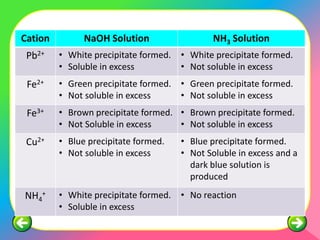
Cation         NaOH Solution                   NH3 Solution
 Pb2+    • White precipitate formed.   • White precipitate formed.
         • Soluble in excess           • Not soluble in excess
 Fe2+    • Green precipitate formed. • Green precipitate formed.
         • Not soluble in excess     • Not soluble in excess
 Fe3+    • Brown precipitate formed. • Brown precipitate formed.
         • Not Soluble in excess     • Not soluble in excess
 Cu2+    • Blue precipitate formed.    • Blue precipitate formed.
         • Not soluble in excess       • Not Soluble in excess and a
                                         dark blue solution is
                                         produced
NH4+     • White precipitate formed.   • No reaction
         • Soluble in excess
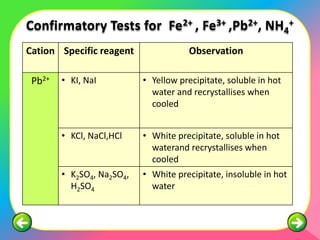
Confirmatory Tests for Fe 2+ , Fe3+ ,Pb2+, NH4+
Cation Specific reagent                Observation

 Pb2+   • KI, NaI          • Yellow precipitate, soluble in hot
                             water and recrystallises when
                             cooled


        • KCl, NaCl,HCl    • White precipitate, soluble in hot
                             waterand recrystallises when
                             cooled
        • K2SO4, Na2SO4,   • White precipitate, insoluble in hot
          H2SO4              water
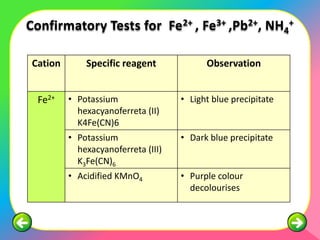
Confirmatory Tests for Fe 2+ , Fe3+ ,Pb2+, NH4+

 Cation       Specific reagent             Observation


  Fe2+    • Potassium                • Light blue precipitate
            hexacyanoferreta (II)
            K4Fe(CN)6
          • Potassium                • Dark blue precipitate
            hexacyanoferreta (III)
            K3Fe(CN)6
          • Acidified KMnO4          • Purple colour
                                       decolourises
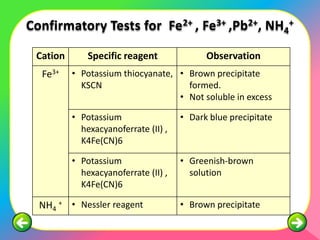
Confirmatory Tests for Fe 2+ , Fe3+ ,Pb2+, NH4+

 Cation       Specific reagent              Observation
  Fe3+    • Potassium thiocyanate, • Brown precipitate
            KSCN                     formed.
                                   • Not soluble in excess

          • Potassium                 • Dark blue precipitate
            hexacyanoferrate (II) ,
            K4Fe(CN)6

          • Potassium                 • Greenish-brown
            hexacyanoferrate (II) ,     solution
            K4Fe(CN)6

  NH4 + • Nessler reagent             • Brown precipitate
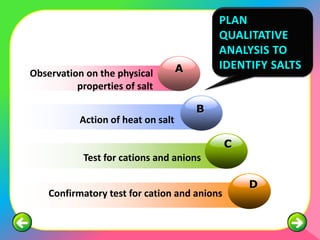
PLAN
                                            QUALITATIVE
                                            ANALYSIS TO
                                    A       IDENTIFY SALTS
Observation on the physical
          properties of salt

                                        B
           Action of heat on salt

                                              C
            Test for cations and anions

                                                  D
    Confirmatory test for cation and anions
Chapter 8 Salt part 6

Chapter 8 Salt part 6

  • 1.
    NURUL ASHIKIN BT.ABD RAHMAN PART 6
  • 2.
     State the meaning of qualitative analysis.  Make inferences on salts based on their colour and solubility in water.  Describe tests for the identification of gases.
  • 3.
    Qualitative analysis isa chemical method to The ions present determine the in salt are need to substances present in a identify in this compound but not their qualitative quantities. analysis
  • 4.
    Observation physical propertiesof salts Action of heat on salt Make aqueous solution of the salt to test for anions and cations present Carry out confirmatory tests
  • 5.
    1 1 Click to add Title Colour and solubility of the salt 2 2 Click to add Title Gas test 1 3 Click to add Title salt Effect of heat on 2 4 Click to add Title for anions Confirmatory test 1 5 Click to add Title for cations Confirmatory test
  • 6.
    SALT COLOUR SOLID AQUEOUS SOLUTION Ca2+ , Mg 2+ , Al3+ , Pb2+ , NH4+ white colourless CuSO4, Cu(NO3)2 Blue Blue CuCl2 Green Blue FeSO4, Fe(NO3)2, FeCl2 Green Green Fe(SO4)3, Fe(NO3)3, FeCl3 Brown Yellow/Brownish CuCO3 Green (Insoluble) PbO Brown when Hot & Insoluble Yellow when cooled CuO black Insoluble ZnO Yellow when Hot & Insoluble White when cooled PbCl2 white Insoluble in cold water but soluble in hot water PbI2 Yellow Insoluble in cold water but soluble in hot water
  • 8.
    Gas Colour Smell Confimatory Test O2 colourless Odourless Light up a glowing wooden splinter H2 colourless Odourless Produces a ‘pop’sound with lighted wooden CO2 colourless Odourless Turn lime water cloudy NH3 colourless Pungent smell Turn moist red litmus paper blue Cl2 Grenish Pungent smell Bleaches moist red litmus paper Yellow Turn moist blue LP to red and bleaches it. HCl colourless Pungent smell Form dense white fumes with ammonia gas NO2 Brown Pungent smell Turn moist blue litmus paper to red SO2 colourless Pungent smell Turn moist blue litmus paper to red
  • 11.
     Describe theaction of heat on salts.  Describe the tests for anions.  State observation of reaction of cations with sodium hydroxide solution and ammonia solution.  Describe confirmatory tests for Fe2+ , Fe3+ ,Pb2+ and NH4+  Plan qualitative analysis to identify salts.
  • 12.
    When Salt areHeated A colour Release a change certain gas Release of water vapour
  • 13.
    Heating CO3 salt • All carbonates are decomposed by heat to release CO2 except K2CO3 and NaCO3. • MCO3 MO + CO2 • CO2 will turn lime water,Ca(OH)2 milky (CaCO3 +H2O) Heating NO3 salt • Most metal nitrate decompose to produce a metal oxide, nitrogen oxide and oxygen. • KNO3 & NaNO3 produced Oxygen gas and nitrites when heated • NO2 (brown gas: acidic) , turn moist blue litmus paper red. • O2 relight glowing wooden splinter.
  • 14.
    Heating SO4 salt •All suphate salt are not decomposed by heat. • Some (Fe, Zn, Cu) will decomposed during strong heating producing sulphur trioxide gas. • Ex: ZnSO4  ZnO + SO3 Heating Chloride salt • All chloride salts are not decomposed by heat except ammonium chloride. • NH4Cl produced white fumes. • Ex: NH4  NH3 + HCl
  • 15.
    Gas produced Types of ion CO2 CO3 2- (except Na2CO3, K2CO3) O2 NO3- NO2 and O2 NO3- (excepts NaNO3, KNO3) SO2 SO4 2- NH3 NH4 +
  • 16.
    Anion Confirmatory Test CO32- • Bubbles with dilute acid and the gas produced will cause limewater milky SO42- • Mixed with dilute sulphuric acid and barium chloride and a white precipitate is formed. Cl- • Mixed with dilute nitric acid followed by silver nitrate solution and a white precipitate is formed NO3- • Brown ring test and a brown ring will be formed.
  • 17.
    Cation NaOH Solution NH3 Solution Ca2+ • White precipitate formed. • No reaction • Not soluble in excess Mg2+ • White precipitate formed. • White precipitate formed. • Not soluble in excess • Not soluble in excess Al3+ • White precipitate formed. • White precipitate formed. • Soluble in excess • Not soluble in excess Zn2+ • White precipitate formed. • White precipitate formed. • Soluble in excess • Soluble in excess
  • 18.
    Cation NaOH Solution NH3 Solution Pb2+ • White precipitate formed. • White precipitate formed. • Soluble in excess • Not soluble in excess Fe2+ • Green precipitate formed. • Green precipitate formed. • Not soluble in excess • Not soluble in excess Fe3+ • Brown precipitate formed. • Brown precipitate formed. • Not Soluble in excess • Not soluble in excess Cu2+ • Blue precipitate formed. • Blue precipitate formed. • Not soluble in excess • Not Soluble in excess and a dark blue solution is produced NH4+ • White precipitate formed. • No reaction • Soluble in excess
  • 19.
    Confirmatory Tests forFe 2+ , Fe3+ ,Pb2+, NH4+ Cation Specific reagent Observation Pb2+ • KI, NaI • Yellow precipitate, soluble in hot water and recrystallises when cooled • KCl, NaCl,HCl • White precipitate, soluble in hot waterand recrystallises when cooled • K2SO4, Na2SO4, • White precipitate, insoluble in hot H2SO4 water
  • 20.
    Confirmatory Tests forFe 2+ , Fe3+ ,Pb2+, NH4+ Cation Specific reagent Observation Fe2+ • Potassium • Light blue precipitate hexacyanoferreta (II) K4Fe(CN)6 • Potassium • Dark blue precipitate hexacyanoferreta (III) K3Fe(CN)6 • Acidified KMnO4 • Purple colour decolourises
  • 21.
    Confirmatory Tests forFe 2+ , Fe3+ ,Pb2+, NH4+ Cation Specific reagent Observation Fe3+ • Potassium thiocyanate, • Brown precipitate KSCN formed. • Not soluble in excess • Potassium • Dark blue precipitate hexacyanoferrate (II) , K4Fe(CN)6 • Potassium • Greenish-brown hexacyanoferrate (II) , solution K4Fe(CN)6 NH4 + • Nessler reagent • Brown precipitate
  • 22.
    PLAN QUALITATIVE ANALYSIS TO A IDENTIFY SALTS Observation on the physical properties of salt B Action of heat on salt C Test for cations and anions D Confirmatory test for cation and anions