Indicators:
 An indicator is a dye that changes colour with acids and bases
 Natural indicators
(litmus, turmeric)
 Synthetic indicators
(methyl orange, phenolphthalein)
 Olfactory indicators
( vanilla, onion, clove )
Sample Blue litmus Red litmus
Phenolptha
lein
Methyl
Orange
acid red no change colourless red
base no change
blue pink yellow
Acids and Bases in the laboratory
Acid
 It has sour taste
 It turns blue litmus to red
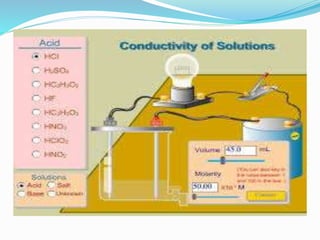
 Acid solutions conduct
current
 Strong Acids: HCL, H2SO4
 Weak Acids : CH3COOH
Base
 It has bitter taste
 It turns red litmus to blue
 Bases are electrolytes
 Strong Base: NaOH, KOH
 Weak Base: NH4OH
Action of Acids & Bases with Metals
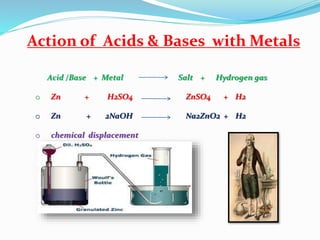
Acid /Base + Metal Salt + Hydrogen gas
o Zn + H2SO4 ZnSO4 + H2
o Zn + 2NaOH Na2ZnO2 + H2
o chemical displacement
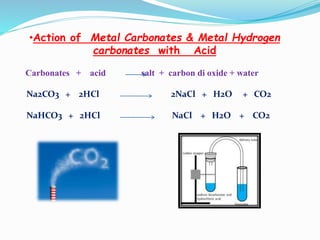
•Action of Metal Carbonates & Metal Hydrogen
carbonates with Acid
Carbonates + acid salt + carbon di oxide + water
Na2CO3 + 2HCl 2NaCl + H2O + CO2
NaHCO3 + 2HCl NaCl + H2O + CO2
Reaction of Metallic/Non metallic Oxides with Acids
# Metal Oxide + Acid Salt + Water
CuO + 2HCl CuCl2 + H2O
# Non metallic Oxide + base Salt + Water
Ca(OH)2 + CO2 CaCO3 + H2O
* products are similar to the products of neutralisation
• Metallic oxides are known as basic oxides
•Non-Metallic Oxides are called acidic oxides
What Happens to an Acid or a Base in a water solution?
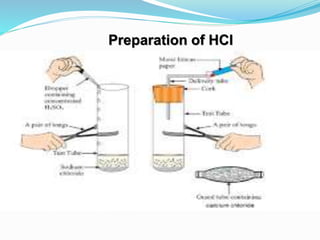
Preparation of HCl
Acid and Bases in a water solution
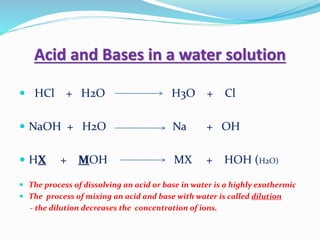
 HCl + H2O H3O + Cl
 NaOH + H2O Na + OH
 HX + MOH MX + HOH (H2O)
 The process of dissolving an acid or base in water is a highly exothermic
 The process of mixing an acid and base with water is called dilution
- the dilution decreases the concentration of ions.
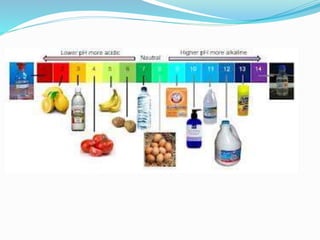
Strength of an acid and a base
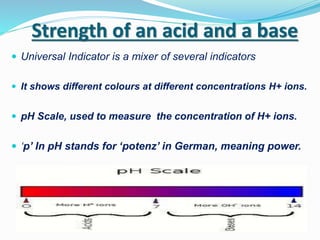
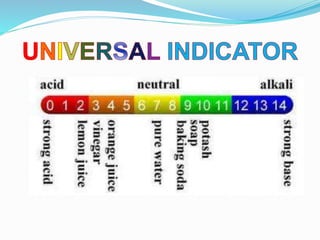
 Universal Indicator is a mixer of several indicators
 It shows different colours at different concentrations H+ ions.
 pH Scale, used to measure the concentration of H+ ions.
 ‘p’ In pH stands for ‘potenz’ in German, meaning power.
Importance of pH in everyday life
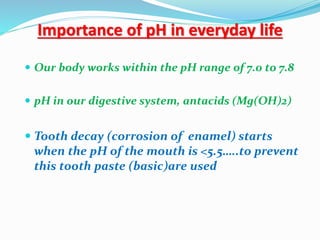
 Our body works within the pH range of 7.0 to 7.8
 pH in our digestive system, antacids (Mg(OH)2)
 Tooth decay (corrosion of enamel) starts
when the pH of the mouth is <5.5…..to prevent
this tooth paste (basic)are used
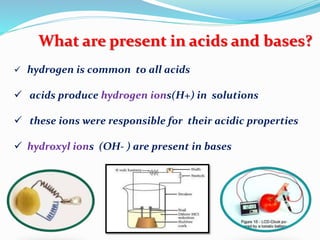
What are present in acids and bases?
 hydrogen is common to all acids
 acids produce hydrogen ions(H+) in solutions
 these ions were responsible for their acidic properties
 hydroxyl ions (OH- ) are present in bases
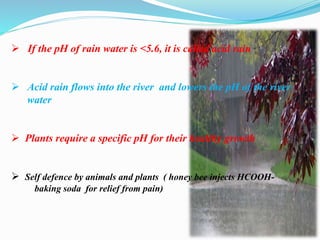
 If the pH of rain water is <5.6, it is called acid rain
 Acid rain flows into the river and lowers the pH of the river
water
 Plants require a specific pH for their healthy growth
 Self defence by animals and plants ( honey bee injects HCOOH-
baking soda for relief from pain)
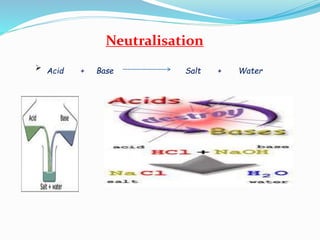
Neutralisation
Acid + Base Salt + Water
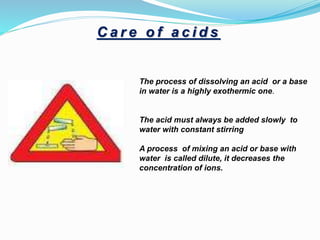
The process of dissolving an acid or a base
in water is a highly exothermic one.
The acid must always be added slowly to
water with constant stirring
A process of mixing an acid or base with
water is called dilute, it decreases the
concentration of ions.
C a r e o f a c i d s
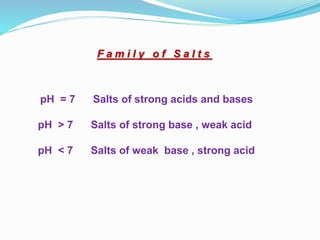
F a m i l y o f S a l t s
pH = 7 Salts of strong acids and bases
pH > 7 Salts of strong base , weak acid
pH < 7 Salts of weak base , strong acid
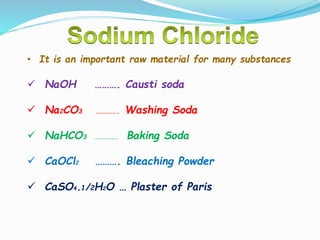
• It is an important raw material for many substances
 NaOH ………. Causti soda
 Na2CO3 ……………. Washing Soda
 NaHCO3 ……………. Baking Soda
 CaOCl2 ………. Bleaching Powder
 CaSO4.1/2H2O … Plaster of Paris
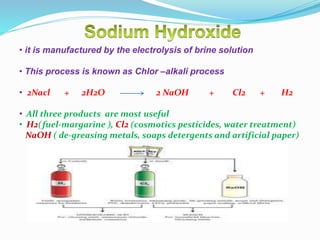
• it is manufactured by the electrolysis of brine solution
• This process is known as Chlor –alkali process
• 2Nacl + 2H2O 2 NaOH + Cl2 + H2
• All three products are most useful
• H2(fuel-margarine ), Cl2 (cosmotics pesticides, water treatment)
NaOH ( de-greasing metals, soaps detergents and artificial paper)
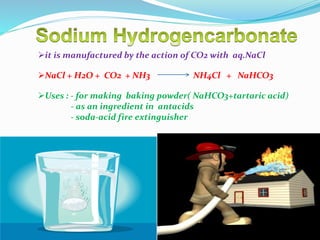
it is manufactured by the action of CO2 with aq.NaCl
NaCl + H2O + CO2 + NH3 NH4Cl + NaHCO3
Uses : - for making baking powder( NaHCO3+tartaric acid)
- as an ingredient in antacids
- soda-acid fire extinguisher
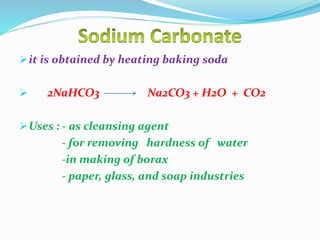
it is obtained by heating baking soda
 2NaHCO3 Na2CO3 + H2O + CO2
Uses : - as cleansing agent
- for removing hardness of water
-in making of borax
- paper, glass, and soap industries
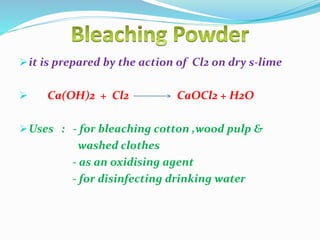
it is prepared by the action of Cl2 on dry s-lime
 Ca(OH)2 + Cl2 CaOCl2 + H2O
Uses : - for bleaching cotton ,wood pulp &
washed clothes
- as an oxidising agent
- for disinfecting drinking water
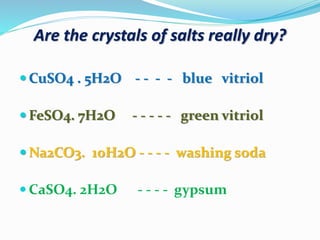
Are the crystals of salts really dry?
 CuSO4 . 5H2O - - - - blue vitriol
 FeSO4. 7H2O - - - - - green vitriol
 Na2CO3. 10H2O - - - - washing soda
 CaSO4. 2H2O - - - - gypsum
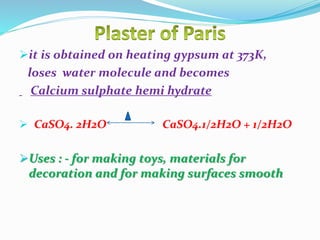
it is obtained on heating gypsum at 373K,
loses water molecule and becomes
Calcium sulphate hemi hydrate
 CaSO4. 2H2O CaSO4.1/2H2O + 1/2H2O
Uses : - for making toys, materials for
decoration and for making surfaces smooth
ACIDS - BASES- SALTS

ACIDS - BASES- SALTS

  • 2.
    Indicators:  An indicatoris a dye that changes colour with acids and bases  Natural indicators (litmus, turmeric)  Synthetic indicators (methyl orange, phenolphthalein)  Olfactory indicators ( vanilla, onion, clove )
  • 3.
    Sample Blue litmusRed litmus Phenolptha lein Methyl Orange acid red no change colourless red base no change blue pink yellow
  • 4.
    Acids and Basesin the laboratory Acid  It has sour taste  It turns blue litmus to red  Acid solutions conduct current  Strong Acids: HCL, H2SO4  Weak Acids : CH3COOH Base  It has bitter taste  It turns red litmus to blue  Bases are electrolytes  Strong Base: NaOH, KOH  Weak Base: NH4OH
  • 5.
    Action of Acids& Bases with Metals Acid /Base + Metal Salt + Hydrogen gas o Zn + H2SO4 ZnSO4 + H2 o Zn + 2NaOH Na2ZnO2 + H2 o chemical displacement
  • 6.
    •Action of MetalCarbonates & Metal Hydrogen carbonates with Acid Carbonates + acid salt + carbon di oxide + water Na2CO3 + 2HCl 2NaCl + H2O + CO2 NaHCO3 + 2HCl NaCl + H2O + CO2
  • 7.
    Reaction of Metallic/Nonmetallic Oxides with Acids # Metal Oxide + Acid Salt + Water CuO + 2HCl CuCl2 + H2O # Non metallic Oxide + base Salt + Water Ca(OH)2 + CO2 CaCO3 + H2O * products are similar to the products of neutralisation • Metallic oxides are known as basic oxides •Non-Metallic Oxides are called acidic oxides
  • 9.
    What Happens toan Acid or a Base in a water solution?
  • 10.
  • 11.
    Acid and Basesin a water solution  HCl + H2O H3O + Cl  NaOH + H2O Na + OH  HX + MOH MX + HOH (H2O)  The process of dissolving an acid or base in water is a highly exothermic  The process of mixing an acid and base with water is called dilution - the dilution decreases the concentration of ions.
  • 12.
    Strength of anacid and a base  Universal Indicator is a mixer of several indicators  It shows different colours at different concentrations H+ ions.  pH Scale, used to measure the concentration of H+ ions.  ‘p’ In pH stands for ‘potenz’ in German, meaning power.
  • 14.
    Importance of pHin everyday life  Our body works within the pH range of 7.0 to 7.8  pH in our digestive system, antacids (Mg(OH)2)  Tooth decay (corrosion of enamel) starts when the pH of the mouth is <5.5…..to prevent this tooth paste (basic)are used
  • 15.
    What are presentin acids and bases?  hydrogen is common to all acids  acids produce hydrogen ions(H+) in solutions  these ions were responsible for their acidic properties  hydroxyl ions (OH- ) are present in bases
  • 16.
     If thepH of rain water is <5.6, it is called acid rain  Acid rain flows into the river and lowers the pH of the river water  Plants require a specific pH for their healthy growth  Self defence by animals and plants ( honey bee injects HCOOH- baking soda for relief from pain)
  • 18.
  • 19.
    The process ofdissolving an acid or a base in water is a highly exothermic one. The acid must always be added slowly to water with constant stirring A process of mixing an acid or base with water is called dilute, it decreases the concentration of ions. C a r e o f a c i d s
  • 20.
    F a mi l y o f S a l t s pH = 7 Salts of strong acids and bases pH > 7 Salts of strong base , weak acid pH < 7 Salts of weak base , strong acid
  • 21.
    • It isan important raw material for many substances  NaOH ………. Causti soda  Na2CO3 ……………. Washing Soda  NaHCO3 ……………. Baking Soda  CaOCl2 ………. Bleaching Powder  CaSO4.1/2H2O … Plaster of Paris
  • 22.
    • it ismanufactured by the electrolysis of brine solution • This process is known as Chlor –alkali process • 2Nacl + 2H2O 2 NaOH + Cl2 + H2 • All three products are most useful • H2(fuel-margarine ), Cl2 (cosmotics pesticides, water treatment) NaOH ( de-greasing metals, soaps detergents and artificial paper)
  • 23.
    it is manufacturedby the action of CO2 with aq.NaCl NaCl + H2O + CO2 + NH3 NH4Cl + NaHCO3 Uses : - for making baking powder( NaHCO3+tartaric acid) - as an ingredient in antacids - soda-acid fire extinguisher
  • 24.
    it is obtainedby heating baking soda  2NaHCO3 Na2CO3 + H2O + CO2 Uses : - as cleansing agent - for removing hardness of water -in making of borax - paper, glass, and soap industries
  • 25.
    it is preparedby the action of Cl2 on dry s-lime  Ca(OH)2 + Cl2 CaOCl2 + H2O Uses : - for bleaching cotton ,wood pulp & washed clothes - as an oxidising agent - for disinfecting drinking water
  • 26.
    Are the crystalsof salts really dry?  CuSO4 . 5H2O - - - - blue vitriol  FeSO4. 7H2O - - - - - green vitriol  Na2CO3. 10H2O - - - - washing soda  CaSO4. 2H2O - - - - gypsum
  • 27.
    it is obtainedon heating gypsum at 373K, loses water molecule and becomes Calcium sulphate hemi hydrate  CaSO4. 2H2O CaSO4.1/2H2O + 1/2H2O Uses : - for making toys, materials for decoration and for making surfaces smooth