Acids,bases and
salts
ACIDS
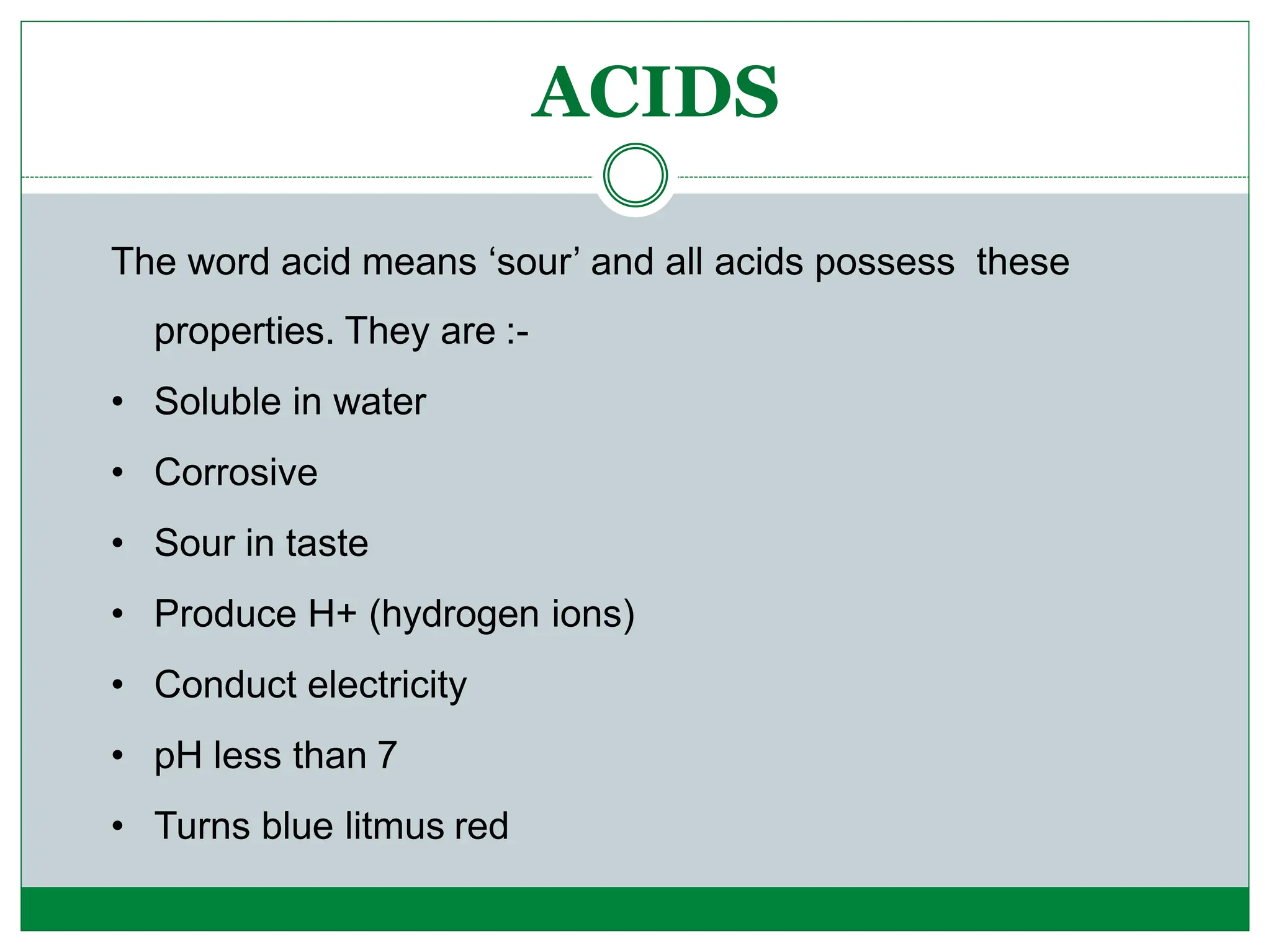
The word acid means ‘sour’ and all acids possess these
properties. They are :-
• Soluble in water
• Corrosive
• Sour in taste
• Produce H+ (hydrogen ions)
• Conduct electricity
• pH less than 7
• Turns blue litmus red
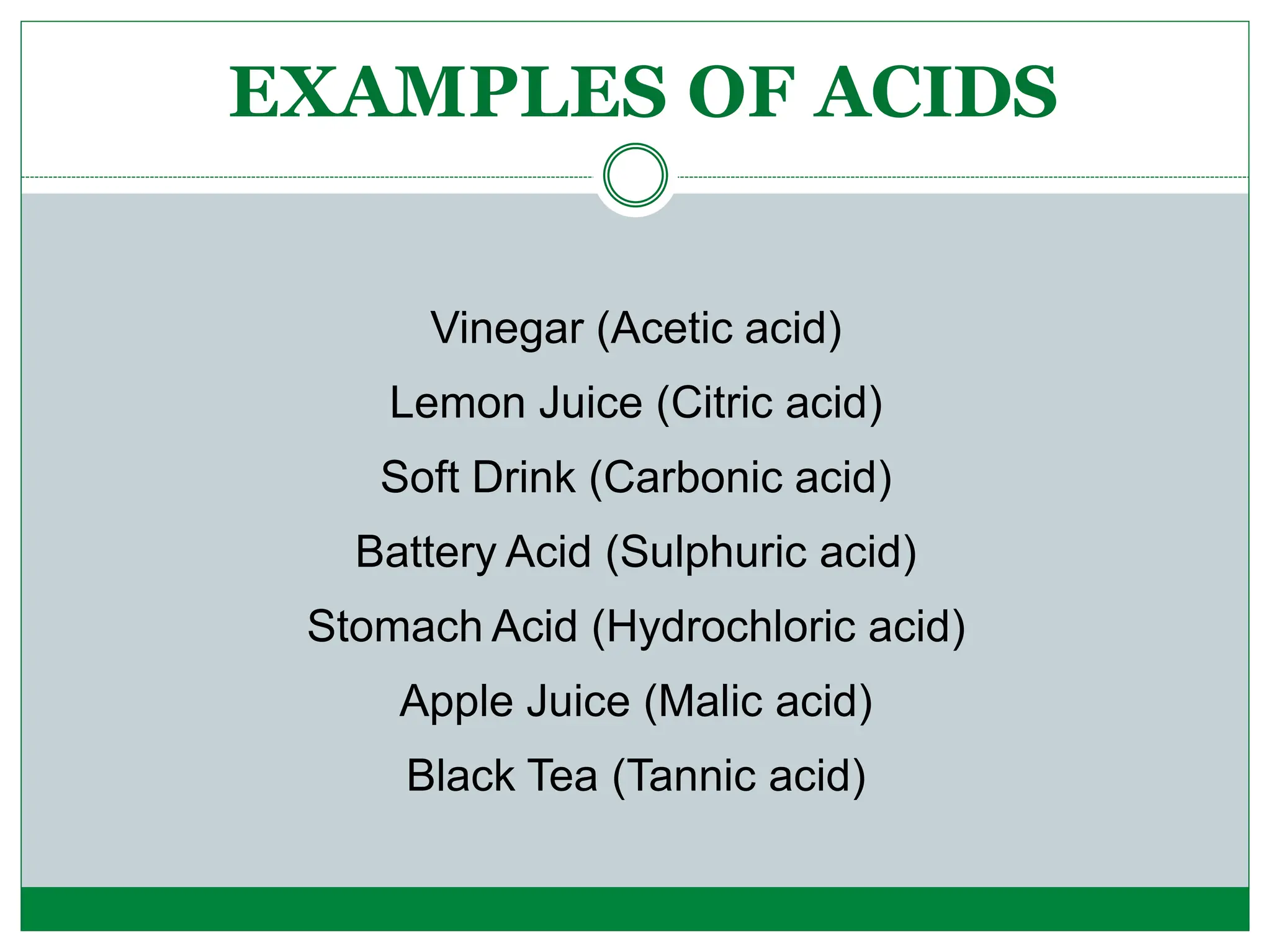
EXAMPLES OF ACIDS
Vinegar (Acetic acid)
Lemon Juice (Citric acid)
Soft Drink (Carbonic acid)
Battery Acid (Sulphuric acid)
Stomach Acid (Hydrochloric acid)
Apple Juice (Malic acid)
Black Tea (Tannic acid)
BASES
• pH greater than 7.
• Usually forms OH-
ions in solution.
• Neutralize acids.
• Corrosive
• Bitter in taste.
• They have a soapy feel.
• Water soluble bases are called alkali.
• All alkalis are bases but all bases are not alkalis.
• Turns red litmus blue, phenolphthalein to pink and
methyl orange to yellow.
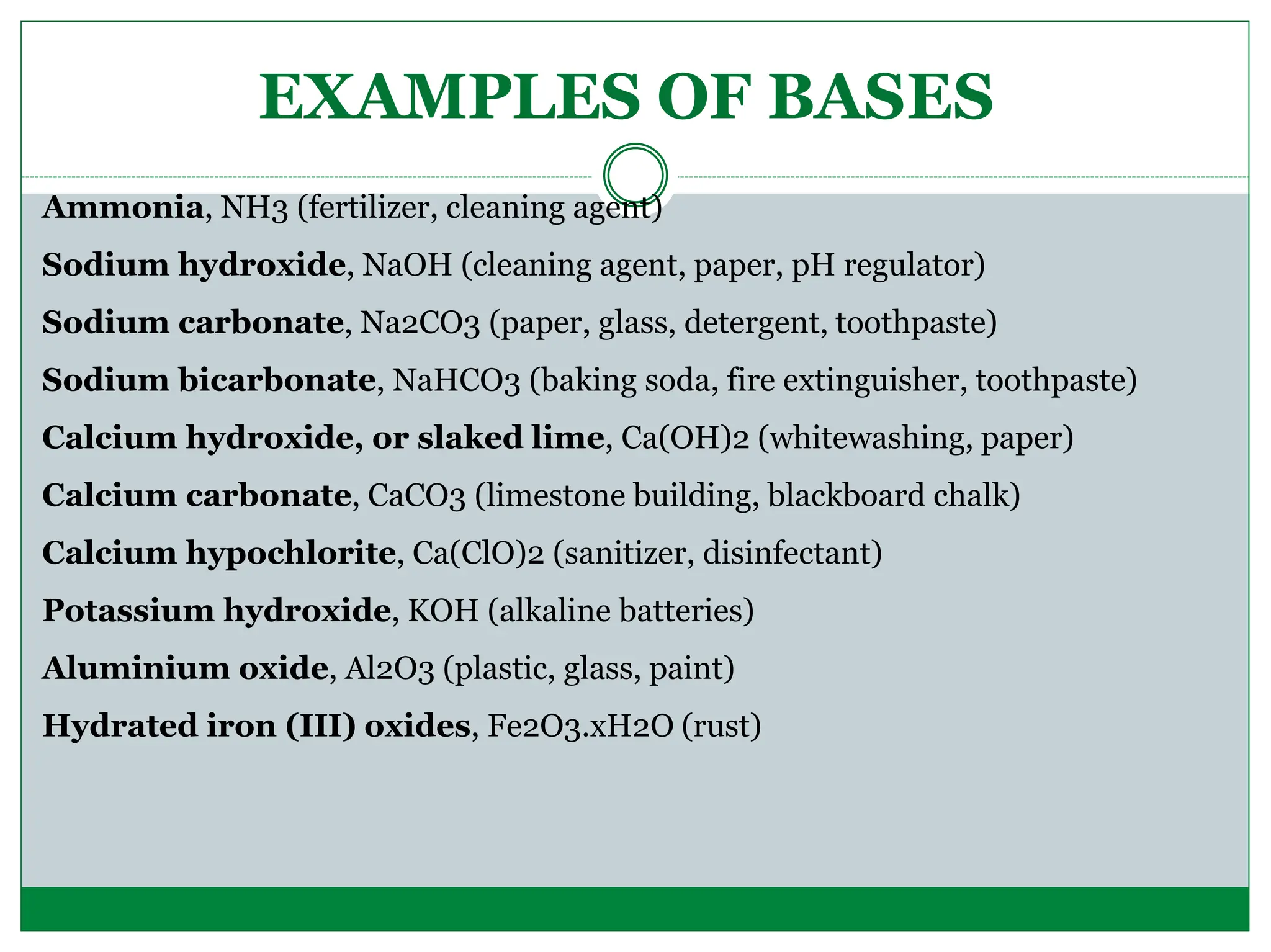
EXAMPLES OF BASES
Ammonia, NH3 (fertilizer, cleaning agent)
Sodium hydroxide, NaOH (cleaning agent, paper, pH regulator)
Sodium carbonate, Na2CO3 (paper, glass, detergent, toothpaste)
Sodium bicarbonate, NaHCO3 (baking soda, fire extinguisher, toothpaste)
Calcium hydroxide, or slaked lime, Ca(OH)2 (whitewashing, paper)
Calcium carbonate, CaCO3 (limestone building, blackboard chalk)
Calcium hypochlorite, Ca(ClO)2 (sanitizer, disinfectant)
Potassium hydroxide, KOH (alkaline batteries)
Aluminium oxide, Al2O3 (plastic, glass, paint)
Hydrated iron (III) oxides, Fe2O3.xH2O (rust)
TESTING ACID AND BASE WITH
LITMUS PAPER
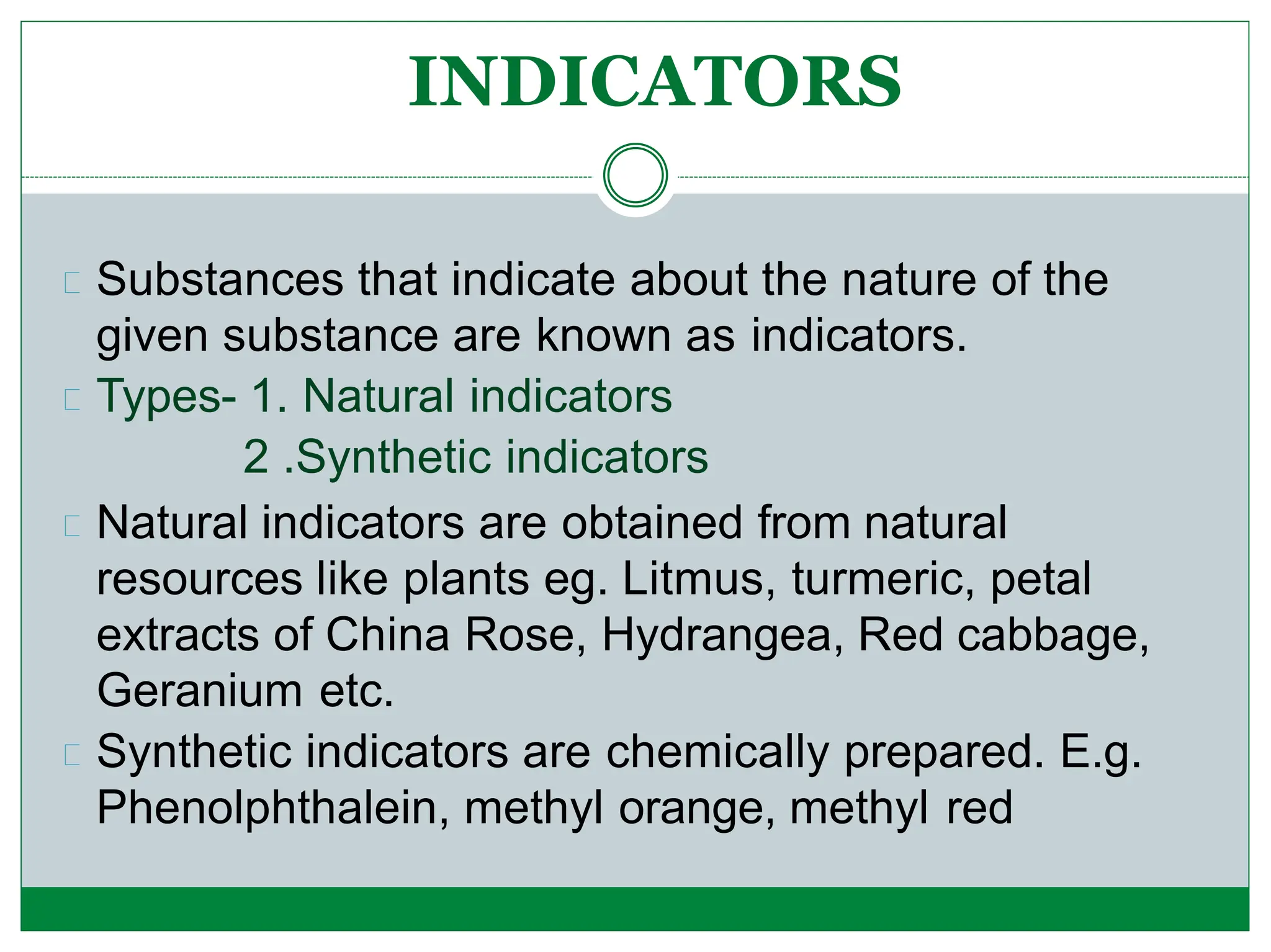
Substances that indicate about the nature of the
given substance are known as indicators.
Types- 1. Natural indicators
2 .Synthetic indicators
Natural indicators are obtained from natural
resources like plants eg. Litmus, turmeric, petal
extracts of China Rose, Hydrangea, Red cabbage,
Geranium etc.
Synthetic indicators are chemically prepared. E.g.
Phenolphthalein, methyl orange, methyl red
INDICATORS
RED CABBAGE INDICATOR
TURMERIC INDICATOR
METHYL ORANGE INDICATOR
PHENOLPHTHALEIN
ACID BASE
OLFACTORY INDICATORS
Indicators that change their smell on coming in contact with an
acid or a base.
TRY THIS OUT !
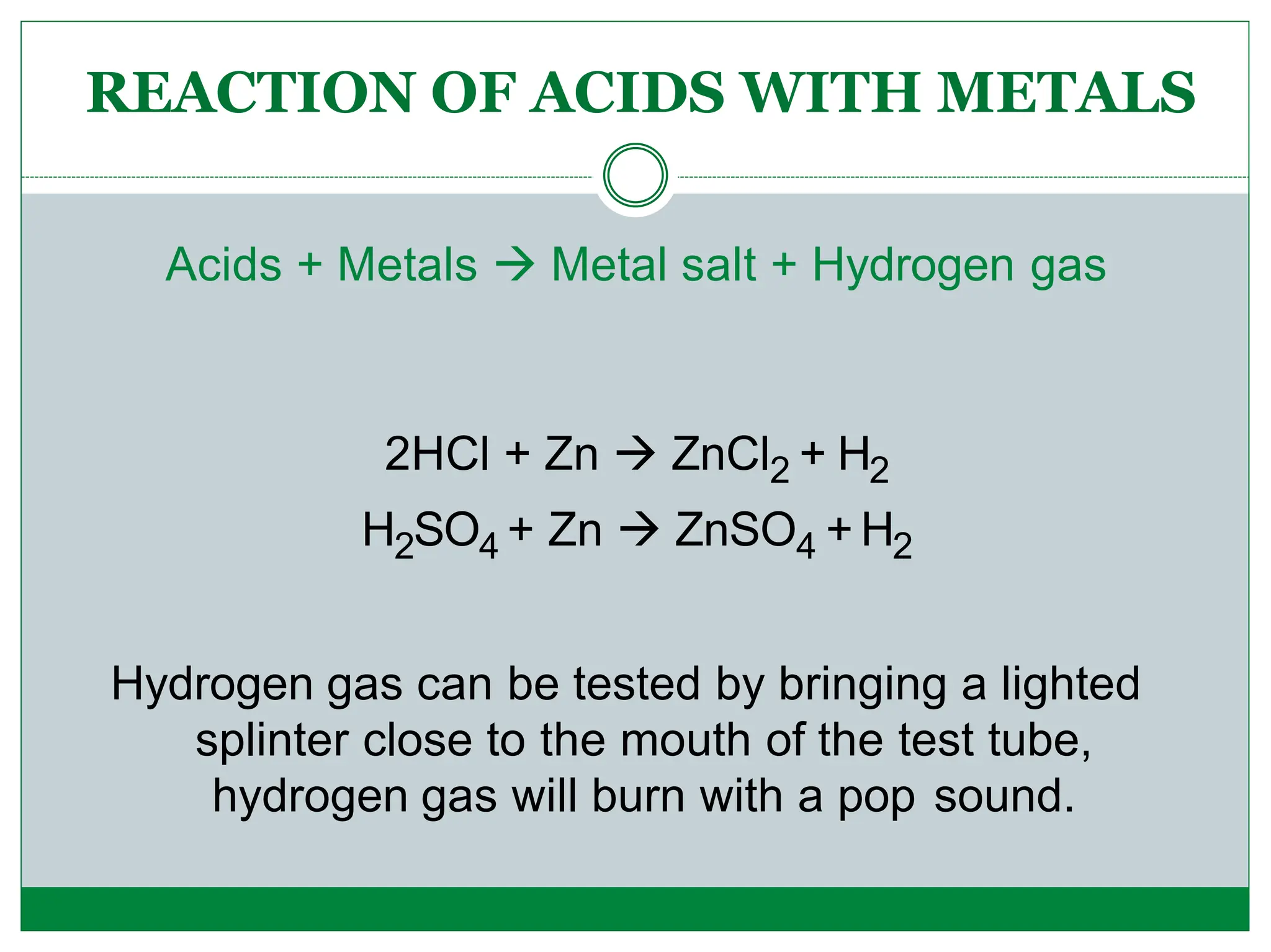
Acids + Metals  Metal salt + Hydrogen gas
2HCl + Zn  ZnCl2 + H2
H2SO4 + Zn  ZnSO4 + H2
Hydrogen gas can be tested by bringing a lighted
splinter close to the mouth of the test tube,
hydrogen gas will burn with a pop sound.
REACTION OF ACIDS WITH METALS
REACTION OF
ACIDS WITH
METALS
Reaction of zinc
granules with
dilute sulphuric
acid and testing
hydrogen gas by
burning
Base + Metal  Metal salt + Hydrogen gas
Zn(s)+ NaOH(aq)  Na2ZnO2 (aq) + H2(g)
sodium hydrogen gas
zincate
REACTION OF BASES WITH METALS
Metal carbonate + acid  Metal salt +carbon dioxide + water
Na2CO3 (s)+2 HCl(aq)  2NaCl (aq) +H2O(l) +CO2(g)
NaHCO3 (s) +HCl(aq)  NaCl(aq) +H2O(l) +CO2 (g)
Brisk effervescence is observed due to the evolution of carbon-di-oxide
Test for CO2
Lime water turns milky on passing CO2 through it. Milkiness is due to the
formation of insoluble calcium carbonate.
Ca(OH)2 + CO2  CaCO3 +H2O
When excess of CO2 is passed, milkiness will disappear
CaCO3 + CO2 +H2O  Ca(HCO3)2 ( Calcium Bicarbonate)
REACTION OF ACIDS WITH METAL
CARBONATES & BICARBONATES
Acids and bases react with each other to form
salt and water. These reactions are called
neutralization reaction.
HCl(aq) +NaOH(aq)  NaCl(aq) + H2O(l)
H2SO4 (aq) + KOH (aq)  K2SO4 (aq) + H2O(l)
REACTION BETWEEN ACIDS & BASES
Metal oxide + Acid Metal salt + water
Metal oxides are usually basic in nature, so this
reaction is also a neutralization reaction.
CuO(s) + 2HCl(aq)  CuCl2 (aq) + H2O(l)
Black colour changes to bluish green
REACTION BETWEEN METAL
OXIDES & ACIDS
Non metal oxide + Base  salt + water
Non metal oxides are usually acidic in nature, so it
is also a neutralization reaction.
CO2(g) +Ca(OH) 2 (aq) CaCO3(s) + H2O(l)
REACTION OF A NON-METALLIC
OXIDE WITH BASES
TRY THESE OUT !
CaCO3 + 2HCl  CaCl2 + CO2 + H2O
Ca(HCO3)2 + 2HCl  CaCl2 + 2CO2 +2 H2O
Solution of ethanol and glucose will not conduct electricity as
they do not produce ions. Non- Electrolytes, strong
electrolytes, weak electrolytes
Acids and base produce ions in the presence of water so they
are able to conduct electricity.
WHAT IS COMMON BETWEEN ALL
ACIDS AND BASES ?
Acids produce H+ ions in the presence of water.
HCl H+ +Cl‾ (monoprotic acid)
4
H2SO4 2H+ + SO2- (diprotic acid)
3
HNO3  H+ + NO‾ (monoprotic acid)
Hydrogen ion does not exist alone, due to astrong
positive field it combines with a molecule ofwater
and exists as hydronium ion. H3O+ is hydrated
hydrogen ion .
H+ + H2O  H3O+ ( Hydronium ion)
IONS PRODUCED BY ACIDS
Dry HCl does not show acidic properties as HCl does not dissociate into
ions in the absence of water.
Bases produce OH- ions in the presence of water.
E.g NaOH  Na+ + OH-
KOH  K+ +OH-
Ca(OH)2  Ca2+ +2OH-
4
NH4OH  NH + + OH-
All bases are not soluble in water. Bases that are
water soluble are called alkalis
During a neutralization reaction,
H+ + OH-  H2O
(from acid) (from base)
IONS PRODUCED BY BASES
Acids and bases are highly corrosive so it should be
handled carefully.
During dilution water should not be added to acid
rather acid should be added to water with constant
stirring because dissolution of acids is a highly
exothermic process. The heat evolved may cause
the mixture to splash and cause burn injuries.
Temporary heating may also cause the apparatus to
break.
During dilution concentration of H+ ions decreases
per unit volume, so the strength of acids will also
decrease.
DILUTION OF ACIDS
Strong acids dissociate completely in the solution. It will
generate large number of hydrogen ions.
Eg. HCl, H2SO4, HNO3, HClO4
Weak acids dissociate partially in the solution. It will
generate lesser number of hydrogen ions.
Eg. CH3COOH  (CH3COO- ) + H+, HCOOH, HCN
Strong bases dissociate completely in the solution. It will
generate large number of hydroxide ions.
Eg. NaOH, KOH, Ca(OH)2,Mg(OH)2
Weak bases dissociate partially in the solution. It will
generate lesser number of hydroxide ions
Eg. NH4OH
STRONG AND WEAK ELECTROLYTES
TRY THESE OUT !
UNIVERSAL INDICATOR
This indicator is a mixture of many other indicators. The
colour shown by this indicator can be matched against a
pH Scale.
pH = - log [H+]
Potent of hydrogen ion
|---------Acids----------------|Neutral|----------- Bases---------|
pH SCALE
Acidic solutions have greater concentration of hydrogen ions.
Basic solutions have greater concentration of hydroxide ions.
pH value less than 7 – Acidic
pH value 7- Neutral
pH value more than 7 - Basic
• Plants need optimum pH of the soil for proper growth
Living organisms can survive in a very narrow range of pH . Due to acid
rain when pH of the water resources decreases , it becomes very difficult
for the survival of aquatic organisms.
• Our stomach produces hydrochloric acid for the digestion of food. Due to
indigestion stomach produces excess of acid which causes acidity i.e
pain and irritation. By taking Antacids, the excess acid in the stomach
gets neutralized . Milk of magnesia , baking soda solution can be taken
for this purpose.
• Tooth decay starts when pH of the mouth is less than 5.5. Due to
bacterial action on food remains between the teeth, acids are produced.
These acids will lead to cavities on reaction with enamel (calcium
phosphate). So toothpastes are generally basic in nature which helps to
neutralize the excess acid present in the mouth.
IMPORTANCE OF pH IN
EVERYDAY LIFE
IMPORTANCE OF pH IN EVERYDAY LIFE
 Bee stings/stings by red ants inject methanoic acid into our body
causing pain and irritation. By applying basic substances like baking
soda solution or tooth paste one can get relief from pain as it will
neutralize the effect of acid.
 Stinging hair of nettle leaves also injects methanoic acid. By
applying the extract of dock plants, one can get relief from pain.
Weak acids dissociate partially in the solution. It will generate lesser
number of hydrogen ions.
Substance Acid
Tamarind Tartaric acid
Lemon, Orange Citric acid
Tomato ,Guava Oxalic acid
curd Lactic acid
Ant sting Methanoic acid
Nettle leaf sting Methanoic acid
Vinegar Acetic acid
apple Malic acid
SOME NATURALLY OCCURING ACIDS
TRY THESE OUT !
What are the formulae of the following salts?
Potassium sulphate, sodium sulphate,calcium
sulphate, magnesium sulphate, copper sulphate,
sodium chloride, sodium nitrate, sodium carbonate,
ammonium chloride
Identify the acid and the base from which these salts
have been derived.
• NaCl ----- ?
• NH4Cl ----- ?
SALTS
pH OF SALT
 Strong acid + Strong base – Neutral salt, pH value is 7
E.g. NaCl – NaOH + HCl
 Strong acid + weak base – Acidic salt ,pH value is less
than 7
E.g. NH4Cl- NH4OH + HCl
 Strong base + weak acid – Basic salt, pH value is more
than 7
E.g. CH3COONa – CH3COOH + NaOH
Sodium acetate
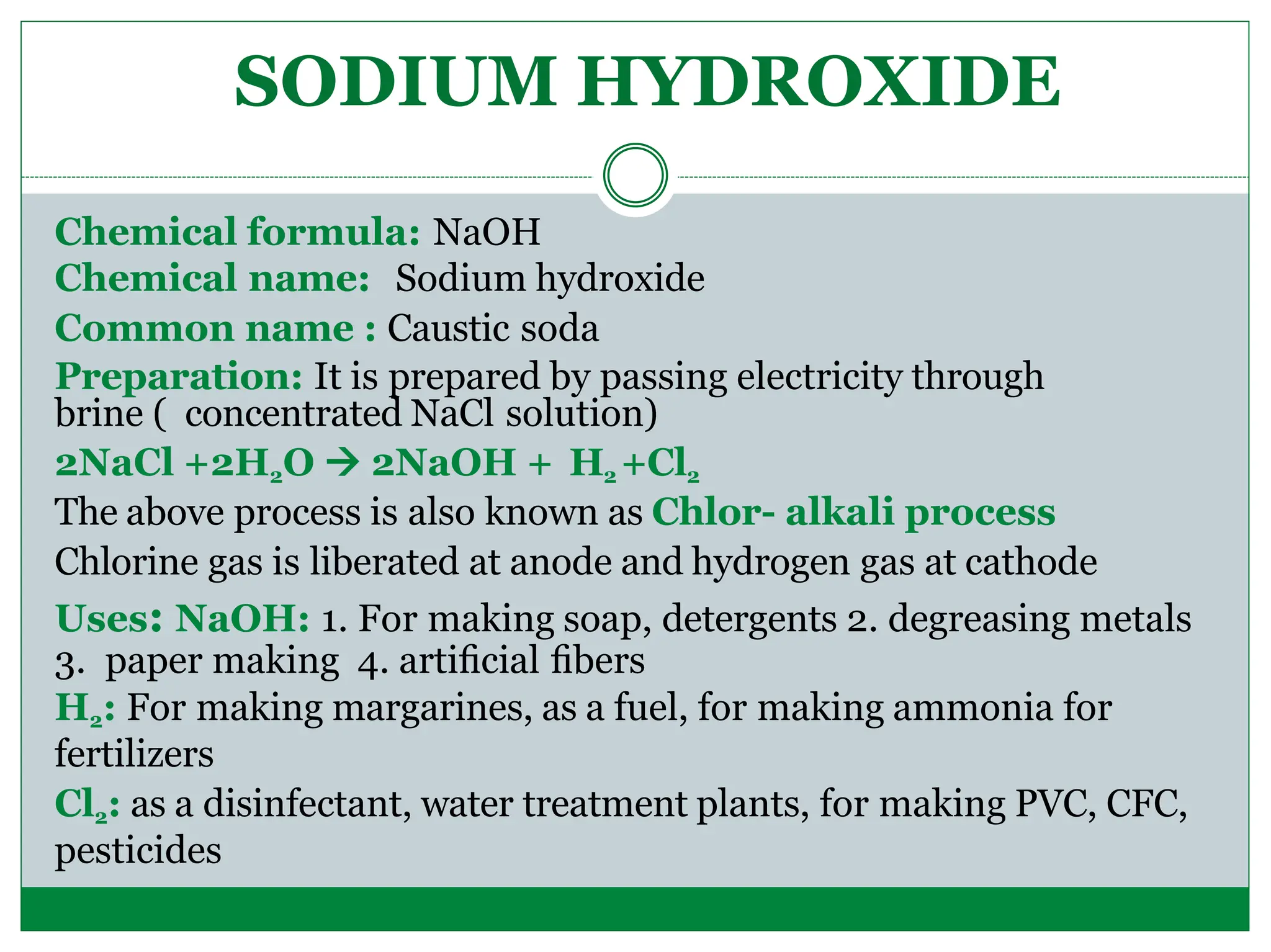
Chemical formula: NaOH
Chemical name: Sodium hydroxide
Common name : Caustic soda
Preparation: It is prepared by passing electricity through
brine ( concentrated NaCl solution)
2NaCl +2H2O  2NaOH + H2 +Cl2
The above process is also known as Chlor- alkali process
Chlorine gas is liberated at anode and hydrogen gas at cathode
Uses: NaOH: 1. For making soap, detergents 2. degreasing metals
3. paper making 4. artificial fibers
H2: For making margarines, as a fuel, for making ammonia for
fertilizers
Cl2: as a disinfectant, water treatment plants, for making PVC, CFC,
pesticides
SODIUM HYDROXIDE
CHLOR- ALKALI PROCESS
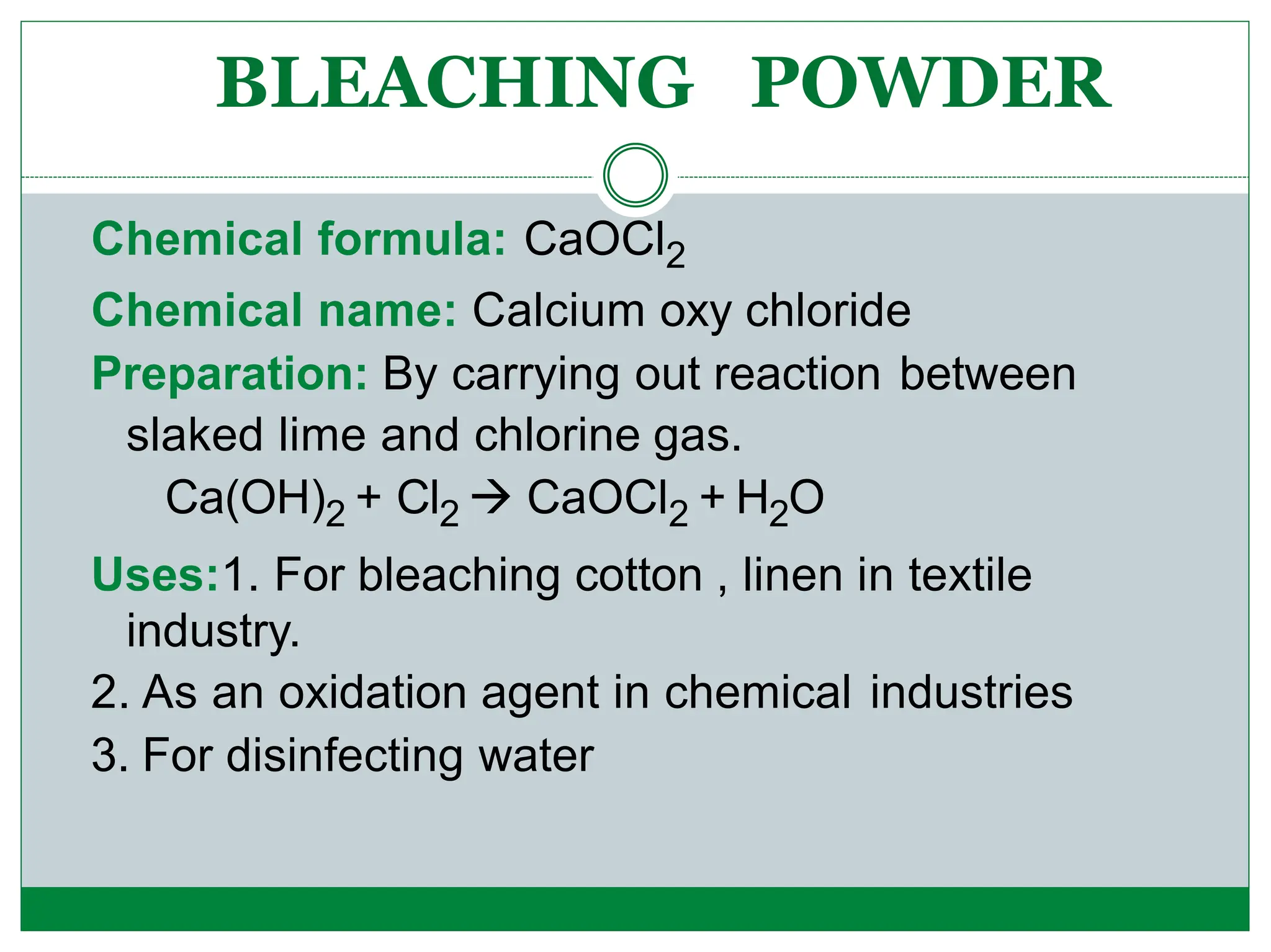
Chemical formula: CaOCl2
Chemical name: Calcium oxy chloride
Preparation: By carrying out reaction between
slaked lime and chlorine gas.
Ca(OH)2 + Cl2  CaOCl2 + H2O
Uses:1. For bleaching cotton , linen in textile
industry.
2. As an oxidation agent in chemical industries
3. For disinfecting water
BLEACHING POWDER
Chemical formula: NaHCO3
Chemical name: Sodium bicarbonate
Preparation: Solvay’s process
Raw materials required: NaCl, CO2, H2O, NH3
NaCl + CO2+H2O+ NH3  NaHCO3 + NH4Cl
Uses: 1. Baking soda is used to prepare baking powder. Baking powder
is a mixture of baking soda and tartaric acid. Tartaric acid neutralizes
the effect of sodium carbonate formed during the reaction.
2. It is used for making cakes and breads soft and spongy
2NaHCO3( heat) Na2CO3 + H2O + CO2
CO2 released makes the cake soft and fluffy
3. Being basic in nature , baking soda solution is used as an antacid.
It neutralizes the excess present in the stomach.
4. For making soda acid fire extinguisher
BAKING SODA
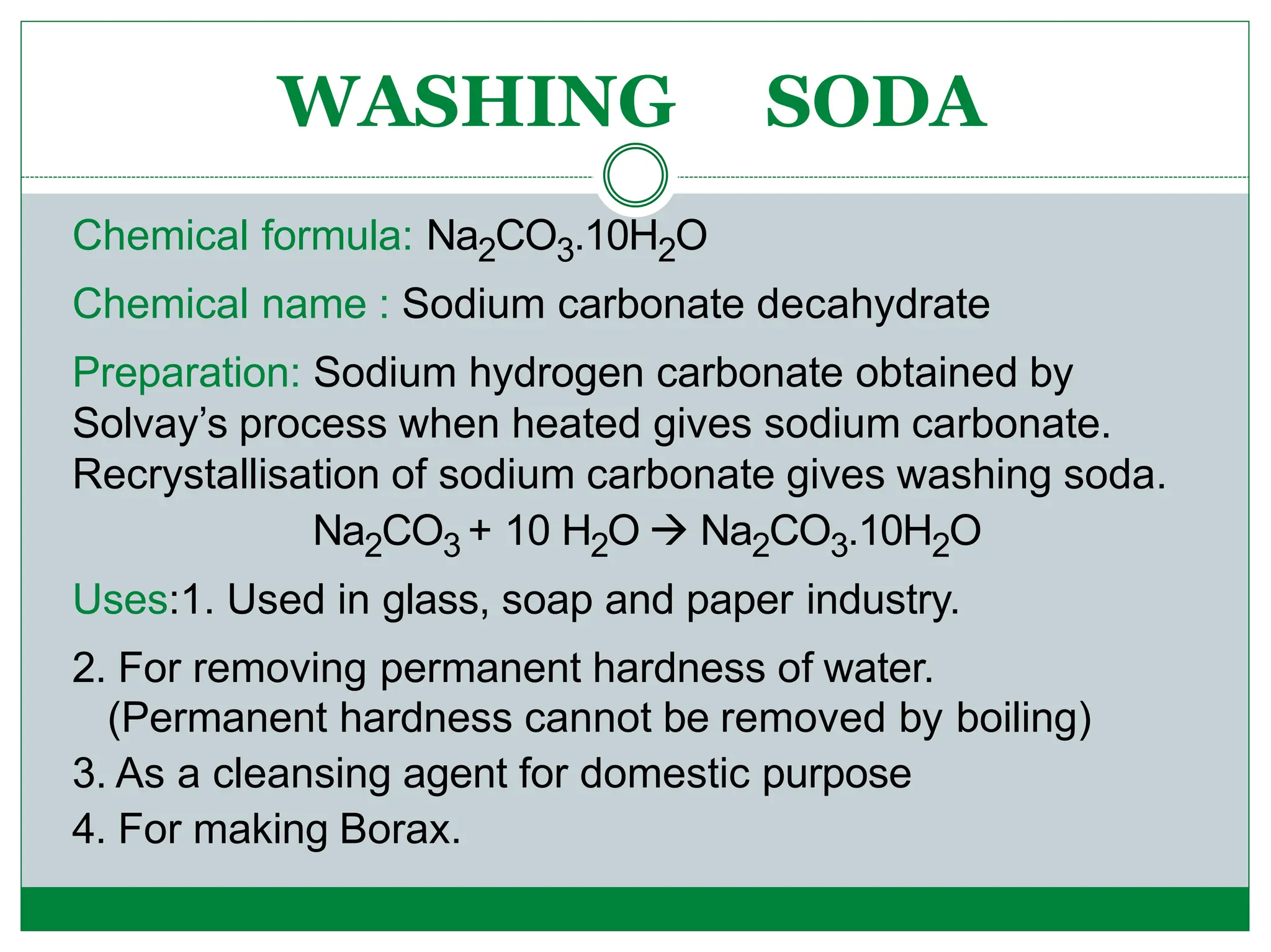
Chemical formula: Na2CO3.10H2O
Chemical name : Sodium carbonate decahydrate
Preparation: Sodium hydrogen carbonate obtained by
Solvay’s process when heated gives sodium carbonate.
Recrystallisation of sodium carbonate gives washing soda.
Na2CO3 + 10 H2O  Na2CO3.10H2O
Uses:1. Used in glass, soap and paper industry.
2. For removing permanent hardness of water.
(Permanent hardness cannot be removed by boiling)
3. As a cleansing agent for domestic purpose
4. For making Borax.
WASHING SODA
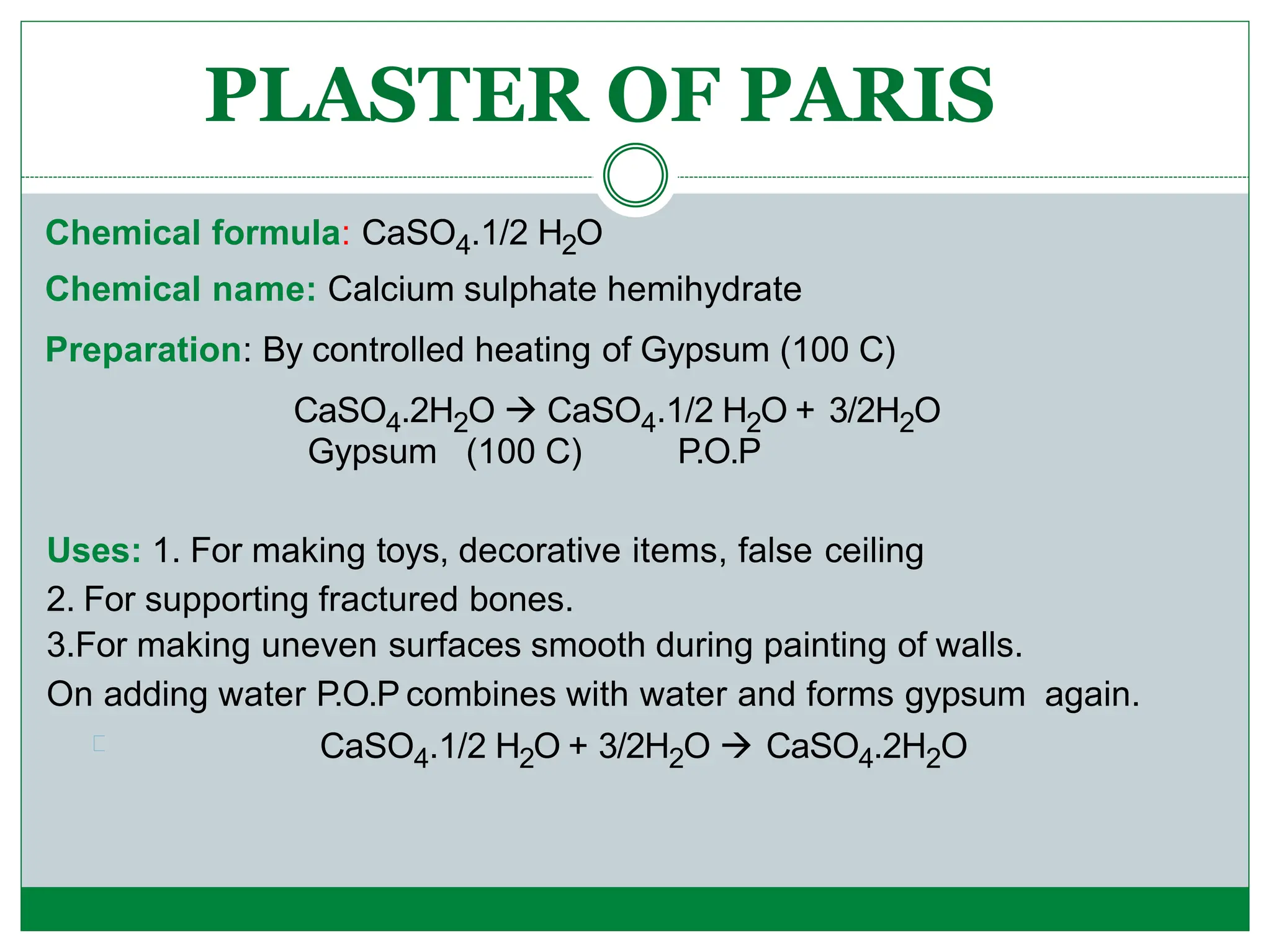
Chemical formula: CaSO4.1/2 H2O
Chemical name: Calcium sulphate hemihydrate
Preparation: By controlled heating of Gypsum (100 C)
CaSO4.2H2O  CaSO4.1/2 H2O + 3/2H2O
Gypsum (100 C) P.O.P
Uses: 1. For making toys, decorative items, false ceiling
2. For supporting fractured bones.
3.For making uneven surfaces smooth during painting of walls.
On adding water P.O.P combines with water and forms gypsum again.
CaSO4.1/2 H2O + 3/2H2O  CaSO4.2H2O
PLASTER OF PARIS
Water of crystallization is the fixed number of water molecules present
in one formula unit of a salt.
E.g. CuSO4.5H2O, FeSO4.7H2O, Na2CO3.10H2O, CaSO4.1/2H2O
Upon heating blue coloured crystals of copper sulphate , it turns
white due to loss of water of crystallization.
WATER OF CRYSTALLISATION
TRY THESE OUT !

acidsbasesandsaltsppt-converted-220918134444-a932f293.pdf

  • 1.
  • 2.
    ACIDS The word acidmeans ‘sour’ and all acids possess these properties. They are :- • Soluble in water • Corrosive • Sour in taste • Produce H+ (hydrogen ions) • Conduct electricity • pH less than 7 • Turns blue litmus red
  • 3.
    EXAMPLES OF ACIDS Vinegar(Acetic acid) Lemon Juice (Citric acid) Soft Drink (Carbonic acid) Battery Acid (Sulphuric acid) Stomach Acid (Hydrochloric acid) Apple Juice (Malic acid) Black Tea (Tannic acid)
  • 4.
    BASES • pH greaterthan 7. • Usually forms OH- ions in solution. • Neutralize acids. • Corrosive • Bitter in taste. • They have a soapy feel. • Water soluble bases are called alkali. • All alkalis are bases but all bases are not alkalis. • Turns red litmus blue, phenolphthalein to pink and methyl orange to yellow.
  • 5.
    EXAMPLES OF BASES Ammonia,NH3 (fertilizer, cleaning agent) Sodium hydroxide, NaOH (cleaning agent, paper, pH regulator) Sodium carbonate, Na2CO3 (paper, glass, detergent, toothpaste) Sodium bicarbonate, NaHCO3 (baking soda, fire extinguisher, toothpaste) Calcium hydroxide, or slaked lime, Ca(OH)2 (whitewashing, paper) Calcium carbonate, CaCO3 (limestone building, blackboard chalk) Calcium hypochlorite, Ca(ClO)2 (sanitizer, disinfectant) Potassium hydroxide, KOH (alkaline batteries) Aluminium oxide, Al2O3 (plastic, glass, paint) Hydrated iron (III) oxides, Fe2O3.xH2O (rust)
  • 6.
    TESTING ACID ANDBASE WITH LITMUS PAPER
  • 7.
    Substances that indicateabout the nature of the given substance are known as indicators. Types- 1. Natural indicators 2 .Synthetic indicators Natural indicators are obtained from natural resources like plants eg. Litmus, turmeric, petal extracts of China Rose, Hydrangea, Red cabbage, Geranium etc. Synthetic indicators are chemically prepared. E.g. Phenolphthalein, methyl orange, methyl red INDICATORS
  • 8.
  • 9.
  • 10.
  • 11.
  • 12.
    OLFACTORY INDICATORS Indicators thatchange their smell on coming in contact with an acid or a base.
  • 13.
  • 14.
    Acids + Metals Metal salt + Hydrogen gas 2HCl + Zn  ZnCl2 + H2 H2SO4 + Zn  ZnSO4 + H2 Hydrogen gas can be tested by bringing a lighted splinter close to the mouth of the test tube, hydrogen gas will burn with a pop sound. REACTION OF ACIDS WITH METALS
  • 15.
    REACTION OF ACIDS WITH METALS Reactionof zinc granules with dilute sulphuric acid and testing hydrogen gas by burning
  • 16.
    Base + Metal Metal salt + Hydrogen gas Zn(s)+ NaOH(aq)  Na2ZnO2 (aq) + H2(g) sodium hydrogen gas zincate REACTION OF BASES WITH METALS
  • 17.
    Metal carbonate +acid  Metal salt +carbon dioxide + water Na2CO3 (s)+2 HCl(aq)  2NaCl (aq) +H2O(l) +CO2(g) NaHCO3 (s) +HCl(aq)  NaCl(aq) +H2O(l) +CO2 (g) Brisk effervescence is observed due to the evolution of carbon-di-oxide Test for CO2 Lime water turns milky on passing CO2 through it. Milkiness is due to the formation of insoluble calcium carbonate. Ca(OH)2 + CO2  CaCO3 +H2O When excess of CO2 is passed, milkiness will disappear CaCO3 + CO2 +H2O  Ca(HCO3)2 ( Calcium Bicarbonate) REACTION OF ACIDS WITH METAL CARBONATES & BICARBONATES
  • 18.
    Acids and basesreact with each other to form salt and water. These reactions are called neutralization reaction. HCl(aq) +NaOH(aq)  NaCl(aq) + H2O(l) H2SO4 (aq) + KOH (aq)  K2SO4 (aq) + H2O(l) REACTION BETWEEN ACIDS & BASES
  • 19.
    Metal oxide +Acid Metal salt + water Metal oxides are usually basic in nature, so this reaction is also a neutralization reaction. CuO(s) + 2HCl(aq)  CuCl2 (aq) + H2O(l) Black colour changes to bluish green REACTION BETWEEN METAL OXIDES & ACIDS
  • 20.
    Non metal oxide+ Base  salt + water Non metal oxides are usually acidic in nature, so it is also a neutralization reaction. CO2(g) +Ca(OH) 2 (aq) CaCO3(s) + H2O(l) REACTION OF A NON-METALLIC OXIDE WITH BASES
  • 21.
    TRY THESE OUT! CaCO3 + 2HCl  CaCl2 + CO2 + H2O Ca(HCO3)2 + 2HCl  CaCl2 + 2CO2 +2 H2O
  • 22.
    Solution of ethanoland glucose will not conduct electricity as they do not produce ions. Non- Electrolytes, strong electrolytes, weak electrolytes Acids and base produce ions in the presence of water so they are able to conduct electricity. WHAT IS COMMON BETWEEN ALL ACIDS AND BASES ?
  • 23.
    Acids produce H+ions in the presence of water. HCl H+ +Cl‾ (monoprotic acid) 4 H2SO4 2H+ + SO2- (diprotic acid) 3 HNO3  H+ + NO‾ (monoprotic acid) Hydrogen ion does not exist alone, due to astrong positive field it combines with a molecule ofwater and exists as hydronium ion. H3O+ is hydrated hydrogen ion . H+ + H2O  H3O+ ( Hydronium ion) IONS PRODUCED BY ACIDS
  • 24.
    Dry HCl doesnot show acidic properties as HCl does not dissociate into ions in the absence of water.
  • 25.
    Bases produce OH-ions in the presence of water. E.g NaOH  Na+ + OH- KOH  K+ +OH- Ca(OH)2  Ca2+ +2OH- 4 NH4OH  NH + + OH- All bases are not soluble in water. Bases that are water soluble are called alkalis During a neutralization reaction, H+ + OH-  H2O (from acid) (from base) IONS PRODUCED BY BASES
  • 26.
    Acids and basesare highly corrosive so it should be handled carefully. During dilution water should not be added to acid rather acid should be added to water with constant stirring because dissolution of acids is a highly exothermic process. The heat evolved may cause the mixture to splash and cause burn injuries. Temporary heating may also cause the apparatus to break. During dilution concentration of H+ ions decreases per unit volume, so the strength of acids will also decrease. DILUTION OF ACIDS
  • 27.
    Strong acids dissociatecompletely in the solution. It will generate large number of hydrogen ions. Eg. HCl, H2SO4, HNO3, HClO4 Weak acids dissociate partially in the solution. It will generate lesser number of hydrogen ions. Eg. CH3COOH  (CH3COO- ) + H+, HCOOH, HCN Strong bases dissociate completely in the solution. It will generate large number of hydroxide ions. Eg. NaOH, KOH, Ca(OH)2,Mg(OH)2 Weak bases dissociate partially in the solution. It will generate lesser number of hydroxide ions Eg. NH4OH STRONG AND WEAK ELECTROLYTES
  • 28.
  • 29.
    UNIVERSAL INDICATOR This indicatoris a mixture of many other indicators. The colour shown by this indicator can be matched against a pH Scale. pH = - log [H+] Potent of hydrogen ion |---------Acids----------------|Neutral|----------- Bases---------|
  • 30.
    pH SCALE Acidic solutionshave greater concentration of hydrogen ions. Basic solutions have greater concentration of hydroxide ions. pH value less than 7 – Acidic pH value 7- Neutral pH value more than 7 - Basic
  • 31.
    • Plants needoptimum pH of the soil for proper growth Living organisms can survive in a very narrow range of pH . Due to acid rain when pH of the water resources decreases , it becomes very difficult for the survival of aquatic organisms. • Our stomach produces hydrochloric acid for the digestion of food. Due to indigestion stomach produces excess of acid which causes acidity i.e pain and irritation. By taking Antacids, the excess acid in the stomach gets neutralized . Milk of magnesia , baking soda solution can be taken for this purpose. • Tooth decay starts when pH of the mouth is less than 5.5. Due to bacterial action on food remains between the teeth, acids are produced. These acids will lead to cavities on reaction with enamel (calcium phosphate). So toothpastes are generally basic in nature which helps to neutralize the excess acid present in the mouth. IMPORTANCE OF pH IN EVERYDAY LIFE
  • 32.
    IMPORTANCE OF pHIN EVERYDAY LIFE  Bee stings/stings by red ants inject methanoic acid into our body causing pain and irritation. By applying basic substances like baking soda solution or tooth paste one can get relief from pain as it will neutralize the effect of acid.  Stinging hair of nettle leaves also injects methanoic acid. By applying the extract of dock plants, one can get relief from pain. Weak acids dissociate partially in the solution. It will generate lesser number of hydrogen ions.
  • 33.
    Substance Acid Tamarind Tartaricacid Lemon, Orange Citric acid Tomato ,Guava Oxalic acid curd Lactic acid Ant sting Methanoic acid Nettle leaf sting Methanoic acid Vinegar Acetic acid apple Malic acid SOME NATURALLY OCCURING ACIDS
  • 34.
  • 35.
    What are theformulae of the following salts? Potassium sulphate, sodium sulphate,calcium sulphate, magnesium sulphate, copper sulphate, sodium chloride, sodium nitrate, sodium carbonate, ammonium chloride Identify the acid and the base from which these salts have been derived. • NaCl ----- ? • NH4Cl ----- ? SALTS
  • 36.
    pH OF SALT Strong acid + Strong base – Neutral salt, pH value is 7 E.g. NaCl – NaOH + HCl  Strong acid + weak base – Acidic salt ,pH value is less than 7 E.g. NH4Cl- NH4OH + HCl  Strong base + weak acid – Basic salt, pH value is more than 7 E.g. CH3COONa – CH3COOH + NaOH Sodium acetate
  • 37.
    Chemical formula: NaOH Chemicalname: Sodium hydroxide Common name : Caustic soda Preparation: It is prepared by passing electricity through brine ( concentrated NaCl solution) 2NaCl +2H2O  2NaOH + H2 +Cl2 The above process is also known as Chlor- alkali process Chlorine gas is liberated at anode and hydrogen gas at cathode Uses: NaOH: 1. For making soap, detergents 2. degreasing metals 3. paper making 4. artificial fibers H2: For making margarines, as a fuel, for making ammonia for fertilizers Cl2: as a disinfectant, water treatment plants, for making PVC, CFC, pesticides SODIUM HYDROXIDE
  • 38.
  • 39.
    Chemical formula: CaOCl2 Chemicalname: Calcium oxy chloride Preparation: By carrying out reaction between slaked lime and chlorine gas. Ca(OH)2 + Cl2  CaOCl2 + H2O Uses:1. For bleaching cotton , linen in textile industry. 2. As an oxidation agent in chemical industries 3. For disinfecting water BLEACHING POWDER
  • 40.
    Chemical formula: NaHCO3 Chemicalname: Sodium bicarbonate Preparation: Solvay’s process Raw materials required: NaCl, CO2, H2O, NH3 NaCl + CO2+H2O+ NH3  NaHCO3 + NH4Cl Uses: 1. Baking soda is used to prepare baking powder. Baking powder is a mixture of baking soda and tartaric acid. Tartaric acid neutralizes the effect of sodium carbonate formed during the reaction. 2. It is used for making cakes and breads soft and spongy 2NaHCO3( heat) Na2CO3 + H2O + CO2 CO2 released makes the cake soft and fluffy 3. Being basic in nature , baking soda solution is used as an antacid. It neutralizes the excess present in the stomach. 4. For making soda acid fire extinguisher BAKING SODA
  • 41.
    Chemical formula: Na2CO3.10H2O Chemicalname : Sodium carbonate decahydrate Preparation: Sodium hydrogen carbonate obtained by Solvay’s process when heated gives sodium carbonate. Recrystallisation of sodium carbonate gives washing soda. Na2CO3 + 10 H2O  Na2CO3.10H2O Uses:1. Used in glass, soap and paper industry. 2. For removing permanent hardness of water. (Permanent hardness cannot be removed by boiling) 3. As a cleansing agent for domestic purpose 4. For making Borax. WASHING SODA
  • 42.
    Chemical formula: CaSO4.1/2H2O Chemical name: Calcium sulphate hemihydrate Preparation: By controlled heating of Gypsum (100 C) CaSO4.2H2O  CaSO4.1/2 H2O + 3/2H2O Gypsum (100 C) P.O.P Uses: 1. For making toys, decorative items, false ceiling 2. For supporting fractured bones. 3.For making uneven surfaces smooth during painting of walls. On adding water P.O.P combines with water and forms gypsum again. CaSO4.1/2 H2O + 3/2H2O  CaSO4.2H2O PLASTER OF PARIS
  • 43.
    Water of crystallizationis the fixed number of water molecules present in one formula unit of a salt. E.g. CuSO4.5H2O, FeSO4.7H2O, Na2CO3.10H2O, CaSO4.1/2H2O Upon heating blue coloured crystals of copper sulphate , it turns white due to loss of water of crystallization. WATER OF CRYSTALLISATION
  • 44.