Chapter 8 Acids, Bases and Salts
Saturday, April 11, 2020
By
Sir. Muhammad Abdul Mageid
for
CIE - IGCSE Chemistry
Contents
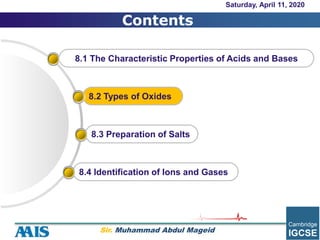
8.2 Types of Oxides
8.1 The Characteristic Properties of Acids and Bases
8.4 Identification of Ions and Gases
8.3 Preparation of Salts
Saturday, April 11, 2020
Sir. Muhammad Abdul Mageid
Saturday, April 11, 2020
8.2 Types of Oxides
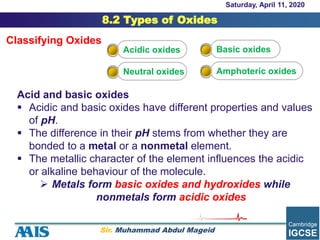
Classifying Oxides
Acid and basic oxides
 Acidic and basic oxides have different properties and values
of pH.
 The difference in their pH stems from whether they are
bonded to a metal or a nonmetal element.
 The metallic character of the element influences the acidic
or alkaline behaviour of the molecule.
 Metals form basic oxides and hydroxides while
nonmetals form acidic oxides
Acidic oxides Basic oxides
Neutral oxides Amphoteric oxides
Sir. Muhammad Abdul Mageid
Saturday, April 11, 2020
8.2 Types of Oxides
Classifying Oxides
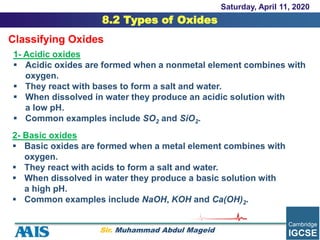
1- Acidic oxides
 Acidic oxides are formed when a nonmetal element combines with
oxygen.
 They react with bases to form a salt and water.
 When dissolved in water they produce an acidic solution with
a low pH.
 Common examples include SO2 and SiO2.
2- Basic oxides
 Basic oxides are formed when a metal element combines with
oxygen.
 They react with acids to form a salt and water.
 When dissolved in water they produce a basic solution with
a high pH.
 Common examples include NaOH, KOH and Ca(OH)2.
Sir. Muhammad Abdul Mageid
Saturday, April 11, 2020
8.2 Types of Oxides
Classifying Oxides
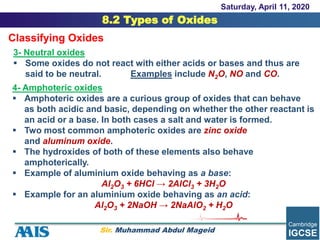
3- Neutral oxides
 Some oxides do not react with either acids or bases and thus are
said to be neutral. Examples include N2O, NO and CO.
4- Amphoteric oxides
 Amphoteric oxides are a curious group of oxides that can behave
as both acidic and basic, depending on whether the other reactant is
an acid or a base. In both cases a salt and water is formed.
 Two most common amphoteric oxides are zinc oxide
and aluminum oxide.
 The hydroxides of both of these elements also behave
amphoterically.
 Example of aluminium oxide behaving as a base:
Al2O3 + 6HCl → 2AlCl3 + 3H2O
 Example for an aluminium oxide behaving as an acid:
Al2O3 + 2NaOH → 2NaAlO2 + H2O
Sir. Muhammad Abdul Mageid
Saturday, April 11, 2020
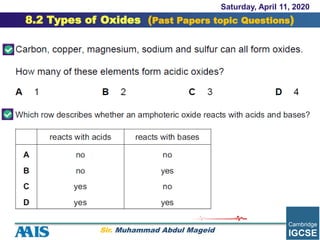
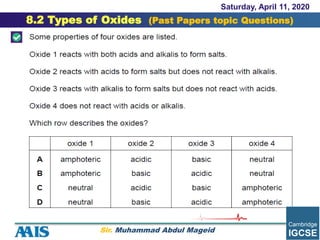
8.2 Types of Oxides (Past Papers topic Questions)
Sir. Muhammad Abdul Mageid
Saturday, April 11, 2020
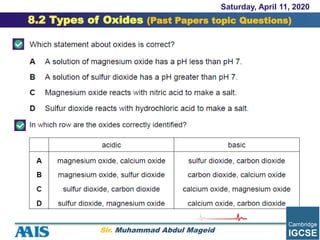
8.2 Types of Oxides (Past Papers topic Questions)
Sir. Muhammad Abdul Mageid
Saturday, April 11, 2020
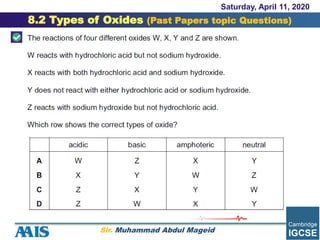
8.2 Types of Oxides (Past Papers topic Questions)
Sir. Muhammad Abdul Mageid
Saturday, April 11, 2020
8.2 Types of Oxides (Past Papers topic Questions)
Sir. Muhammad Abdul Mageid

8.2 types of oxides

  • 1.
    Chapter 8 Acids,Bases and Salts Saturday, April 11, 2020 By Sir. Muhammad Abdul Mageid for CIE - IGCSE Chemistry
  • 2.
    Contents 8.2 Types ofOxides 8.1 The Characteristic Properties of Acids and Bases 8.4 Identification of Ions and Gases 8.3 Preparation of Salts Saturday, April 11, 2020 Sir. Muhammad Abdul Mageid
  • 3.
    Saturday, April 11,2020 8.2 Types of Oxides Classifying Oxides Acid and basic oxides  Acidic and basic oxides have different properties and values of pH.  The difference in their pH stems from whether they are bonded to a metal or a nonmetal element.  The metallic character of the element influences the acidic or alkaline behaviour of the molecule.  Metals form basic oxides and hydroxides while nonmetals form acidic oxides Acidic oxides Basic oxides Neutral oxides Amphoteric oxides Sir. Muhammad Abdul Mageid
  • 4.
    Saturday, April 11,2020 8.2 Types of Oxides Classifying Oxides 1- Acidic oxides  Acidic oxides are formed when a nonmetal element combines with oxygen.  They react with bases to form a salt and water.  When dissolved in water they produce an acidic solution with a low pH.  Common examples include SO2 and SiO2. 2- Basic oxides  Basic oxides are formed when a metal element combines with oxygen.  They react with acids to form a salt and water.  When dissolved in water they produce a basic solution with a high pH.  Common examples include NaOH, KOH and Ca(OH)2. Sir. Muhammad Abdul Mageid
  • 5.
    Saturday, April 11,2020 8.2 Types of Oxides Classifying Oxides 3- Neutral oxides  Some oxides do not react with either acids or bases and thus are said to be neutral. Examples include N2O, NO and CO. 4- Amphoteric oxides  Amphoteric oxides are a curious group of oxides that can behave as both acidic and basic, depending on whether the other reactant is an acid or a base. In both cases a salt and water is formed.  Two most common amphoteric oxides are zinc oxide and aluminum oxide.  The hydroxides of both of these elements also behave amphoterically.  Example of aluminium oxide behaving as a base: Al2O3 + 6HCl → 2AlCl3 + 3H2O  Example for an aluminium oxide behaving as an acid: Al2O3 + 2NaOH → 2NaAlO2 + H2O Sir. Muhammad Abdul Mageid
  • 6.
    Saturday, April 11,2020 8.2 Types of Oxides (Past Papers topic Questions) Sir. Muhammad Abdul Mageid
  • 7.
    Saturday, April 11,2020 8.2 Types of Oxides (Past Papers topic Questions) Sir. Muhammad Abdul Mageid
  • 8.
    Saturday, April 11,2020 8.2 Types of Oxides (Past Papers topic Questions) Sir. Muhammad Abdul Mageid
  • 9.
    Saturday, April 11,2020 8.2 Types of Oxides (Past Papers topic Questions) Sir. Muhammad Abdul Mageid