Testing and Identifying Halide Ions Aim:To identify the conclusive chemical tests for Halide ions.
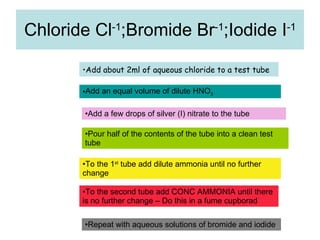
Chloride Cl -1 ;Bromide Br -1 ;Iodide I -1 Add about 2ml of aqueous chloride to a test tube Add an equal volume of dilute HNO 3 Add a few drops of silver (I) nitrate to the tube Pour half of the contents of the tube into a clean test tube To the 1 st  tube add dilute ammonia until no further change To the second tube add CONC AMMONIA until there is no further change – Do this in a fume cupborad Repeat with aqueous solutions of bromide and iodide
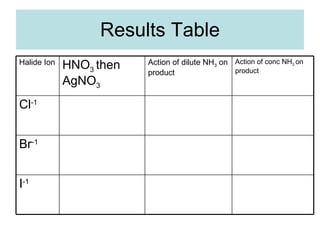
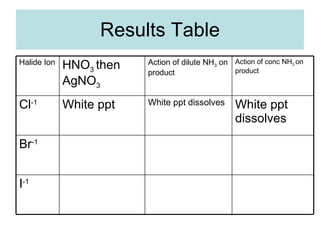
Results Table I -1 Br -1 Cl -1 Action of conc NH 3  on product Action of dilute NH 3  on product HNO 3  then AgNO 3 Halide Ion
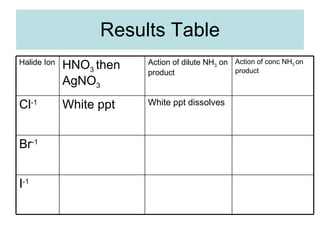
Results Table I -1 Br -1 White ppt dissolves White ppt Cl -1 Action of conc NH 3  on product Action of dilute NH 3  on product HNO 3  then AgNO 3 Halide Ion
Results Table I -1 Br -1 White ppt dissolves White ppt dissolves White ppt Cl -1 Action of conc NH 3  on product Action of dilute NH 3  on product HNO 3  then AgNO 3 Halide Ion
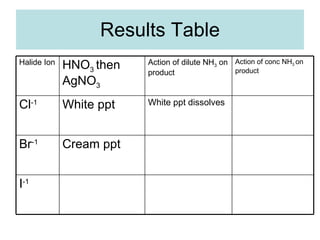
Results Table I -1 Cream ppt Br -1 White ppt dissolves White ppt Cl -1 Action of conc NH 3  on product Action of dilute NH 3  on product HNO 3  then AgNO 3 Halide Ion
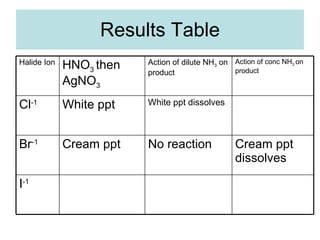
Results Table I -1 Cream ppt dissolves No reaction Cream ppt Br -1 White ppt dissolves White ppt Cl -1 Action of conc NH 3  on product Action of dilute NH 3  on product HNO 3  then AgNO 3 Halide Ion
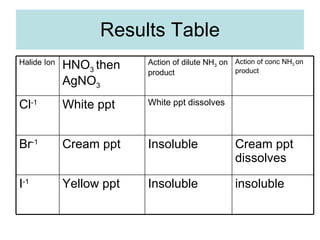
Results Table insoluble Insoluble Yellow ppt I -1 Cream ppt dissolves Insoluble Cream ppt Br -1 White ppt dissolves White ppt Cl -1 Action of conc NH 3  on product Action of dilute NH 3  on product HNO 3  then AgNO 3 Halide Ion
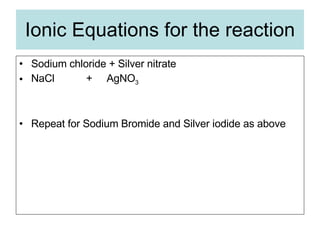
Ionic Equations for the reaction Sodium chloride + Silver nitrate NaCl  +  AgNO 3 Repeat for Sodium Bromide and Silver iodide as above
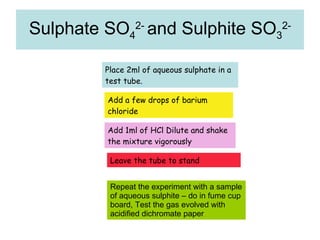
Sulphate SO 4 2-  and Sulphite SO 3 2- Place 2ml of aqueous sulphate in a test tube. Add a few drops of barium chloride Add 1ml of HCl Dilute and shake the mixture vigorously Leave the tube to stand Repeat the experiment with a sample of aqueous sulphite – do in fume cup board, Test the gas evolved with acidified dichromate paper
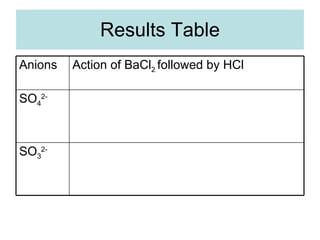
Results Table SO 3 2- SO 4 2- Action of BaCl 2  followed by HCl Anions
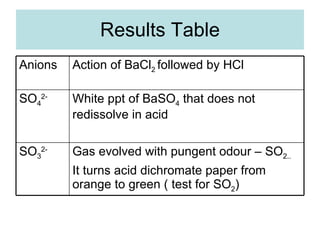
Results Table Gas evolved with pungent odour – SO 2.. It turns acid dichromate paper from orange to green ( test for SO 2 ) SO 3 2- White ppt of BaSO 4  that does not redissolve in acid  SO 4 2- Action of BaCl 2  followed by HCl Anions
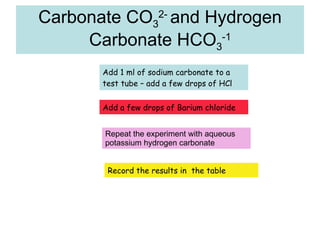
Carbonate CO 3 2-  and Hydrogen Carbonate HCO 3 -1 Add 1 ml of sodium carbonate to a test tube – add a few drops of HCl Repeat the experiment with aqueous potassium hydrogen carbonate  Record the results in  the table Add a few drops of Barium chloride
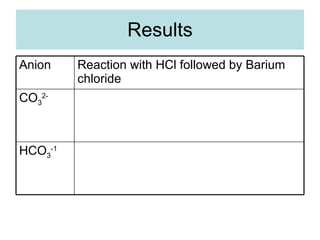
Results HCO 3 -1 CO 3 2- Reaction with HCl followed by Barium chloride Anion
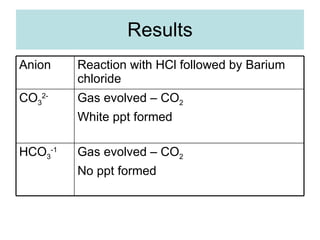
Results Gas evolved – CO 2 No ppt formed HCO 3 -1 Gas evolved – CO 2 White ppt formed CO 3 2- Reaction with HCl followed by Barium chloride Anion
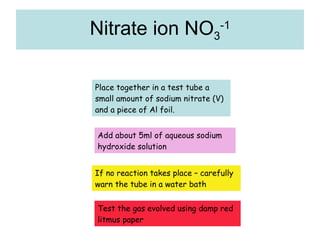
Nitrate ion NO 3 -1 Place together in a test tube a small amount of sodium nitrate (V) and a piece of Al foil. Add about 5ml of aqueous sodium hydroxide solution If no reaction takes place – carefully warn the tube in a water bath Test the gas evolved using damp red litmus paper
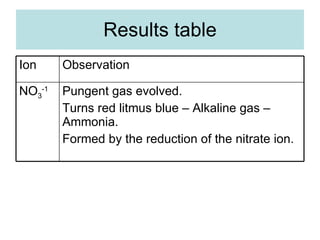
Results table Pungent gas evolved. Turns red litmus blue – Alkaline gas – Ammonia. Formed by the reduction of the nitrate ion. NO 3 -1 Observation Ion
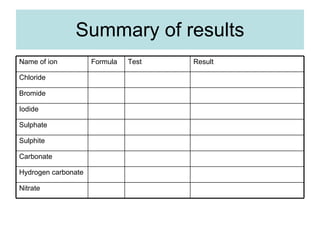
Summary of results Nitrate Hydrogen carbonate Carbonate Sulphite Sulphate Iodide Bromide Chloride Result Test Formula Name of ion
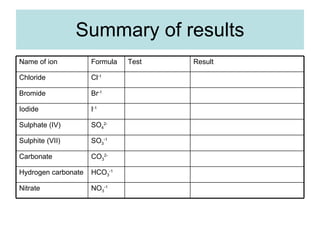
Summary of results NO 3 -1 Nitrate HCO 3 -1 Hydrogen carbonate CO 3 2- Carbonate SO 3 -1 Sulphite (VII) SO 4 2- Sulphate (IV) I -1 Iodide Br -1 Bromide Cl -1 Chloride Result Test Formula Name of ion
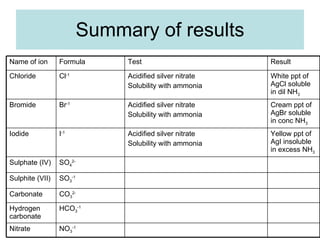
Summary of results NO 3 -1 Nitrate HCO 3 -1 Hydrogen carbonate CO 3 2- Carbonate SO 3 -1 Sulphite (VII) SO 4 2- Sulphate (IV) Yellow ppt of AgI insoluble in excess NH 3 Acidified silver nitrate Solubility with ammonia I -1 Iodide Cream ppt of AgBr soluble in conc NH 3 Acidified silver nitrate Solubility with ammonia Br -1 Bromide White ppt of AgCl soluble in dil NH 3 Acidified silver nitrate Solubility with ammonia Cl -1 Chloride Result Test Formula Name of ion
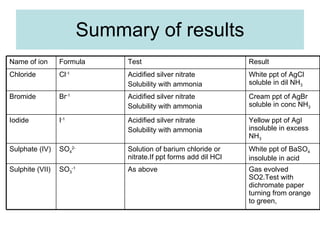
Summary of results Gas evolved SO2.Test with dichromate paper turning from orange to green, As above SO 3 -1 Sulphite (VII) White ppt of BaSO 4  insoluble in acid Solution of barium chloride or nitrate.If ppt forms add dil HCl SO 4 2- Sulphate (IV) Yellow ppt of AgI insoluble in excess NH 3 Acidified silver nitrate Solubility with ammonia I -1 Iodide Cream ppt of AgBr soluble in conc NH 3 Acidified silver nitrate Solubility with ammonia Br -1 Bromide White ppt of AgCl soluble in dil NH 3 Acidified silver nitrate Solubility with ammonia Cl -1 Chloride Result Test Formula Name of ion
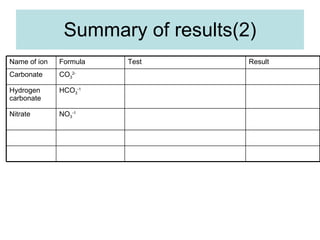
Summary of results(2) NO 3 -1 Nitrate HCO 3 -1 Hydrogen carbonate CO 3 2- Carbonate Result Test Formula Name of ion
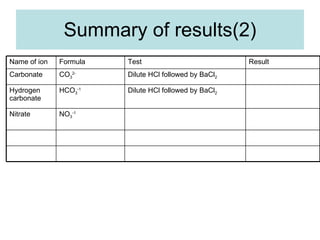
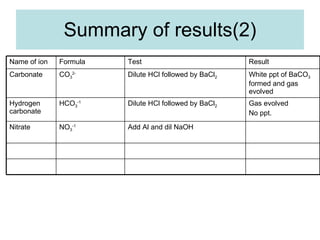
Summary of results(2) NO 3 -1 Nitrate Dilute HCl followed by BaCl 2 HCO 3 -1 Hydrogen carbonate Dilute HCl followed by BaCl 2 CO 3 2- Carbonate Result Test Formula Name of ion
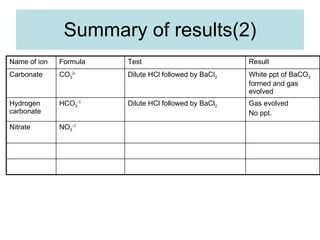
Summary of results(2) NO 3 -1 Nitrate Gas evolved  No ppt. Dilute HCl followed by BaCl 2 HCO 3 -1 Hydrogen carbonate White ppt of BaCO 3  formed and gas evolved Dilute HCl followed by BaCl 2 CO 3 2- Carbonate Result Test Formula Name of ion
Summary of results(2) Add Al and dil NaOH NO 3 -1 Nitrate Gas evolved  No ppt. Dilute HCl followed by BaCl 2 HCO 3 -1 Hydrogen carbonate White ppt of BaCO 3  formed and gas evolved Dilute HCl followed by BaCl 2 CO 3 2- Carbonate Result Test Formula Name of ion
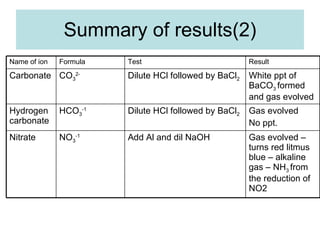
Summary of results(2) Gas evolved – turns red litmus blue – alkaline gas – NH 3  from the reduction of NO2 Add Al and dil NaOH NO 3 -1 Nitrate Gas evolved  No ppt. Dilute HCl followed by BaCl 2 HCO 3 -1 Hydrogen carbonate White ppt of BaCO 3  formed and gas evolved Dilute HCl followed by BaCl 2 CO 3 2- Carbonate Result Test Formula Name of ion
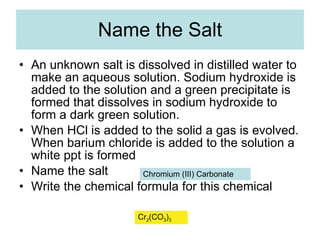
Name the Salt An unknown salt is dissolved in distilled water to make an aqueous solution. Sodium hydroxide is added to the solution and a green precipitate is formed that dissolves in sodium hydroxide to form a dark green solution.  When HCl is added to the solid a gas is evolved. When barium chloride is added to the solution a white ppt is formed Name the salt Write the chemical formula for this chemical  Chromium (III) Carbonate Cr 2 (CO 3 ) 3

Testing And Identifying Anions

  • 1.
    Testing and IdentifyingHalide Ions Aim:To identify the conclusive chemical tests for Halide ions.
  • 2.
    Chloride Cl -1;Bromide Br -1 ;Iodide I -1 Add about 2ml of aqueous chloride to a test tube Add an equal volume of dilute HNO 3 Add a few drops of silver (I) nitrate to the tube Pour half of the contents of the tube into a clean test tube To the 1 st tube add dilute ammonia until no further change To the second tube add CONC AMMONIA until there is no further change – Do this in a fume cupborad Repeat with aqueous solutions of bromide and iodide
  • 3.
    Results Table I-1 Br -1 Cl -1 Action of conc NH 3 on product Action of dilute NH 3 on product HNO 3 then AgNO 3 Halide Ion
  • 4.
    Results Table I-1 Br -1 White ppt dissolves White ppt Cl -1 Action of conc NH 3 on product Action of dilute NH 3 on product HNO 3 then AgNO 3 Halide Ion
  • 5.
    Results Table I-1 Br -1 White ppt dissolves White ppt dissolves White ppt Cl -1 Action of conc NH 3 on product Action of dilute NH 3 on product HNO 3 then AgNO 3 Halide Ion
  • 6.
    Results Table I-1 Cream ppt Br -1 White ppt dissolves White ppt Cl -1 Action of conc NH 3 on product Action of dilute NH 3 on product HNO 3 then AgNO 3 Halide Ion
  • 7.
    Results Table I-1 Cream ppt dissolves No reaction Cream ppt Br -1 White ppt dissolves White ppt Cl -1 Action of conc NH 3 on product Action of dilute NH 3 on product HNO 3 then AgNO 3 Halide Ion
  • 8.
    Results Table insolubleInsoluble Yellow ppt I -1 Cream ppt dissolves Insoluble Cream ppt Br -1 White ppt dissolves White ppt Cl -1 Action of conc NH 3 on product Action of dilute NH 3 on product HNO 3 then AgNO 3 Halide Ion
  • 9.
    Ionic Equations forthe reaction Sodium chloride + Silver nitrate NaCl + AgNO 3 Repeat for Sodium Bromide and Silver iodide as above
  • 10.
    Sulphate SO 42- and Sulphite SO 3 2- Place 2ml of aqueous sulphate in a test tube. Add a few drops of barium chloride Add 1ml of HCl Dilute and shake the mixture vigorously Leave the tube to stand Repeat the experiment with a sample of aqueous sulphite – do in fume cup board, Test the gas evolved with acidified dichromate paper
  • 11.
    Results Table SO3 2- SO 4 2- Action of BaCl 2 followed by HCl Anions
  • 12.
    Results Table Gasevolved with pungent odour – SO 2.. It turns acid dichromate paper from orange to green ( test for SO 2 ) SO 3 2- White ppt of BaSO 4 that does not redissolve in acid SO 4 2- Action of BaCl 2 followed by HCl Anions
  • 13.
    Carbonate CO 32- and Hydrogen Carbonate HCO 3 -1 Add 1 ml of sodium carbonate to a test tube – add a few drops of HCl Repeat the experiment with aqueous potassium hydrogen carbonate Record the results in the table Add a few drops of Barium chloride
  • 14.
    Results HCO 3-1 CO 3 2- Reaction with HCl followed by Barium chloride Anion
  • 15.
    Results Gas evolved– CO 2 No ppt formed HCO 3 -1 Gas evolved – CO 2 White ppt formed CO 3 2- Reaction with HCl followed by Barium chloride Anion
  • 16.
    Nitrate ion NO3 -1 Place together in a test tube a small amount of sodium nitrate (V) and a piece of Al foil. Add about 5ml of aqueous sodium hydroxide solution If no reaction takes place – carefully warn the tube in a water bath Test the gas evolved using damp red litmus paper
  • 17.
    Results table Pungentgas evolved. Turns red litmus blue – Alkaline gas – Ammonia. Formed by the reduction of the nitrate ion. NO 3 -1 Observation Ion
  • 18.
    Summary of resultsNitrate Hydrogen carbonate Carbonate Sulphite Sulphate Iodide Bromide Chloride Result Test Formula Name of ion
  • 19.
    Summary of resultsNO 3 -1 Nitrate HCO 3 -1 Hydrogen carbonate CO 3 2- Carbonate SO 3 -1 Sulphite (VII) SO 4 2- Sulphate (IV) I -1 Iodide Br -1 Bromide Cl -1 Chloride Result Test Formula Name of ion
  • 20.
    Summary of resultsNO 3 -1 Nitrate HCO 3 -1 Hydrogen carbonate CO 3 2- Carbonate SO 3 -1 Sulphite (VII) SO 4 2- Sulphate (IV) Yellow ppt of AgI insoluble in excess NH 3 Acidified silver nitrate Solubility with ammonia I -1 Iodide Cream ppt of AgBr soluble in conc NH 3 Acidified silver nitrate Solubility with ammonia Br -1 Bromide White ppt of AgCl soluble in dil NH 3 Acidified silver nitrate Solubility with ammonia Cl -1 Chloride Result Test Formula Name of ion
  • 21.
    Summary of resultsGas evolved SO2.Test with dichromate paper turning from orange to green, As above SO 3 -1 Sulphite (VII) White ppt of BaSO 4 insoluble in acid Solution of barium chloride or nitrate.If ppt forms add dil HCl SO 4 2- Sulphate (IV) Yellow ppt of AgI insoluble in excess NH 3 Acidified silver nitrate Solubility with ammonia I -1 Iodide Cream ppt of AgBr soluble in conc NH 3 Acidified silver nitrate Solubility with ammonia Br -1 Bromide White ppt of AgCl soluble in dil NH 3 Acidified silver nitrate Solubility with ammonia Cl -1 Chloride Result Test Formula Name of ion
  • 22.
    Summary of results(2)NO 3 -1 Nitrate HCO 3 -1 Hydrogen carbonate CO 3 2- Carbonate Result Test Formula Name of ion
  • 23.
    Summary of results(2)NO 3 -1 Nitrate Dilute HCl followed by BaCl 2 HCO 3 -1 Hydrogen carbonate Dilute HCl followed by BaCl 2 CO 3 2- Carbonate Result Test Formula Name of ion
  • 24.
    Summary of results(2)NO 3 -1 Nitrate Gas evolved No ppt. Dilute HCl followed by BaCl 2 HCO 3 -1 Hydrogen carbonate White ppt of BaCO 3 formed and gas evolved Dilute HCl followed by BaCl 2 CO 3 2- Carbonate Result Test Formula Name of ion
  • 25.
    Summary of results(2)Add Al and dil NaOH NO 3 -1 Nitrate Gas evolved No ppt. Dilute HCl followed by BaCl 2 HCO 3 -1 Hydrogen carbonate White ppt of BaCO 3 formed and gas evolved Dilute HCl followed by BaCl 2 CO 3 2- Carbonate Result Test Formula Name of ion
  • 26.
    Summary of results(2)Gas evolved – turns red litmus blue – alkaline gas – NH 3 from the reduction of NO2 Add Al and dil NaOH NO 3 -1 Nitrate Gas evolved No ppt. Dilute HCl followed by BaCl 2 HCO 3 -1 Hydrogen carbonate White ppt of BaCO 3 formed and gas evolved Dilute HCl followed by BaCl 2 CO 3 2- Carbonate Result Test Formula Name of ion
  • 27.
    Name the SaltAn unknown salt is dissolved in distilled water to make an aqueous solution. Sodium hydroxide is added to the solution and a green precipitate is formed that dissolves in sodium hydroxide to form a dark green solution. When HCl is added to the solid a gas is evolved. When barium chloride is added to the solution a white ppt is formed Name the salt Write the chemical formula for this chemical Chromium (III) Carbonate Cr 2 (CO 3 ) 3