NURUL ASHIKIN BT. ABD RAHMAN   PART 5
LEARNING OUTCOMES

 Construct ionic equations through
  the continuous variation method.
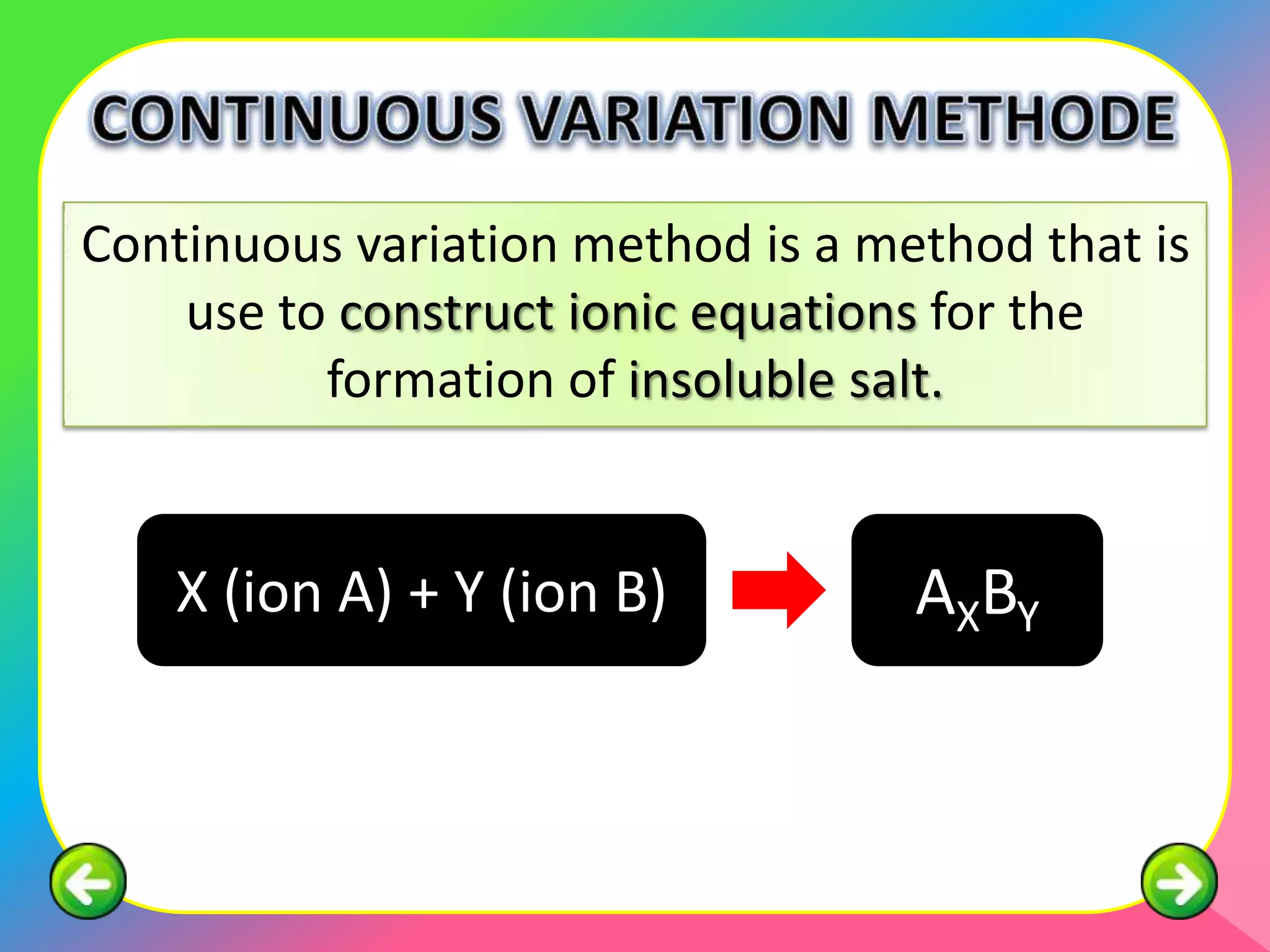
Continuous variation method is a method that is
    use to construct ionic equations for the
          formation of insoluble salt.


    X (ion A) + Y (ion B)          AXBY
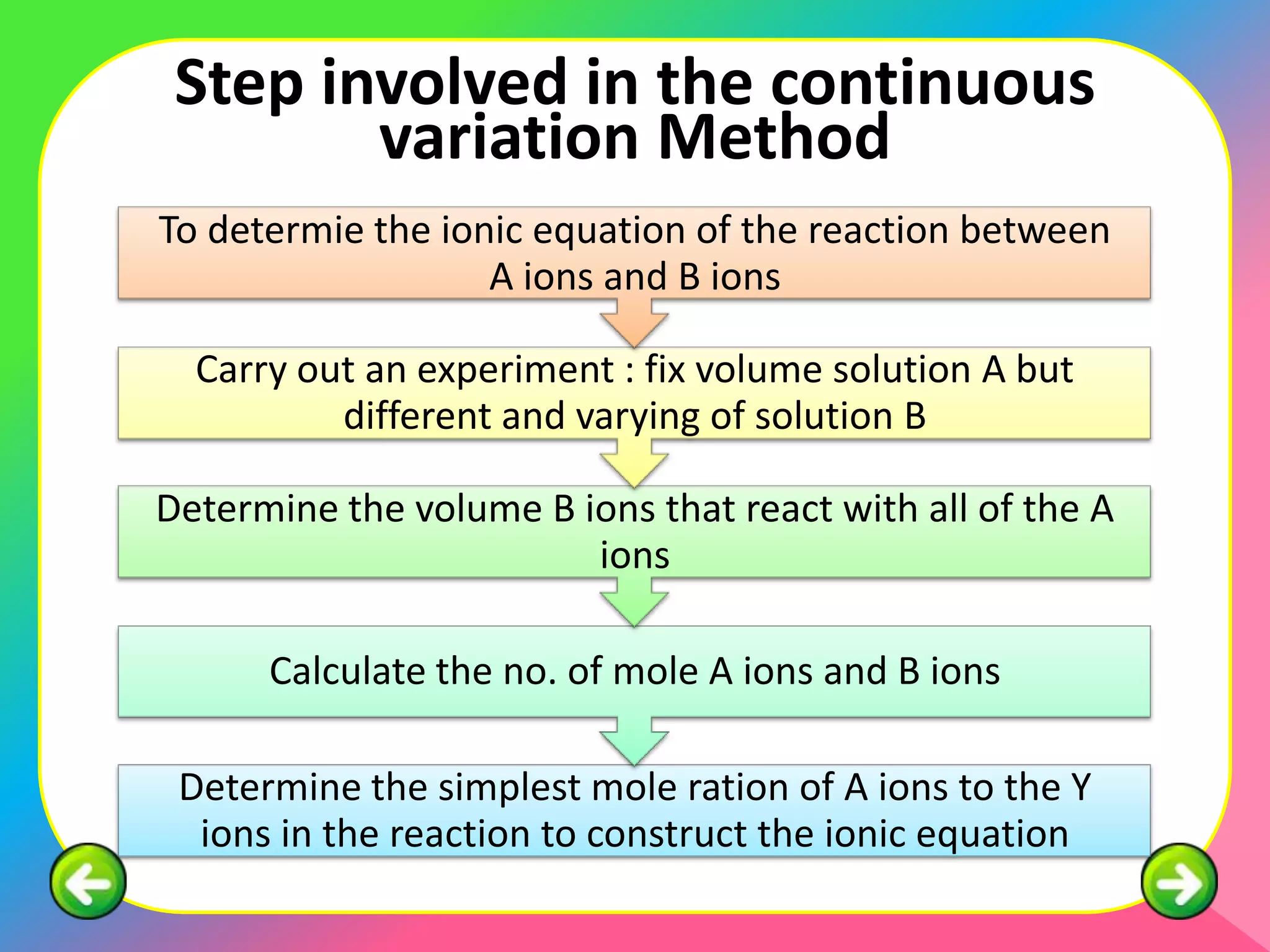
Step involved in the continuous
        variation Method
To determie the ionic equation of the reaction between
                   A ions and B ions

  Carry out an experiment : fix volume solution A but
          different and varying of solution B

Determine the volume B ions that react with all of the A
                        ions

      Calculate the no. of mole A ions and B ions

 Determine the simplest mole ration of A ions to the Y
  ions in the reaction to construct the ionic equation
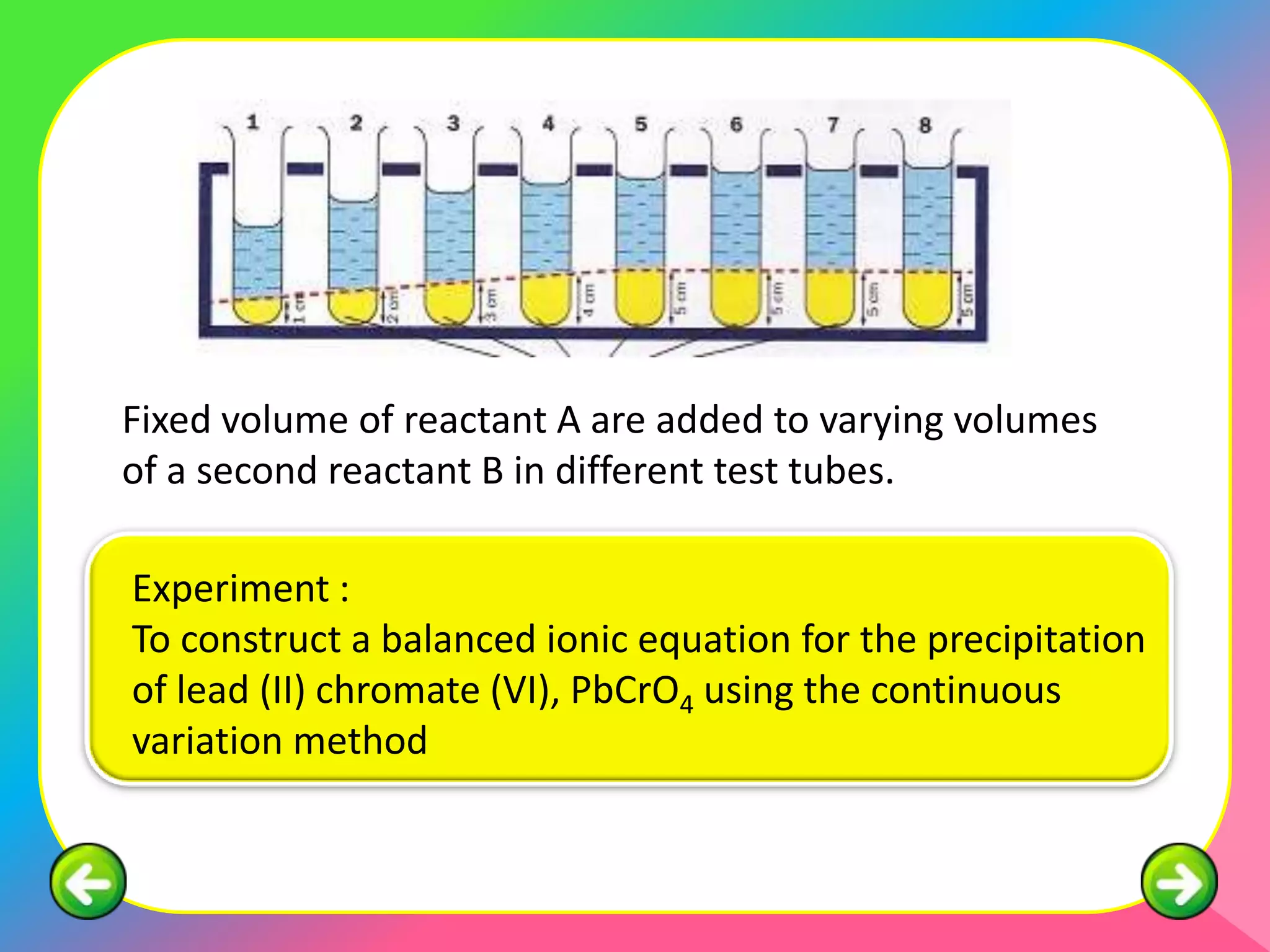
Fixed volume of reactant A are added to varying volumes
of a second reactant B in different test tubes.

Experiment :
To construct a balanced ionic equation for the precipitation
of lead (II) chromate (VI), PbCrO4 using the continuous
variation method
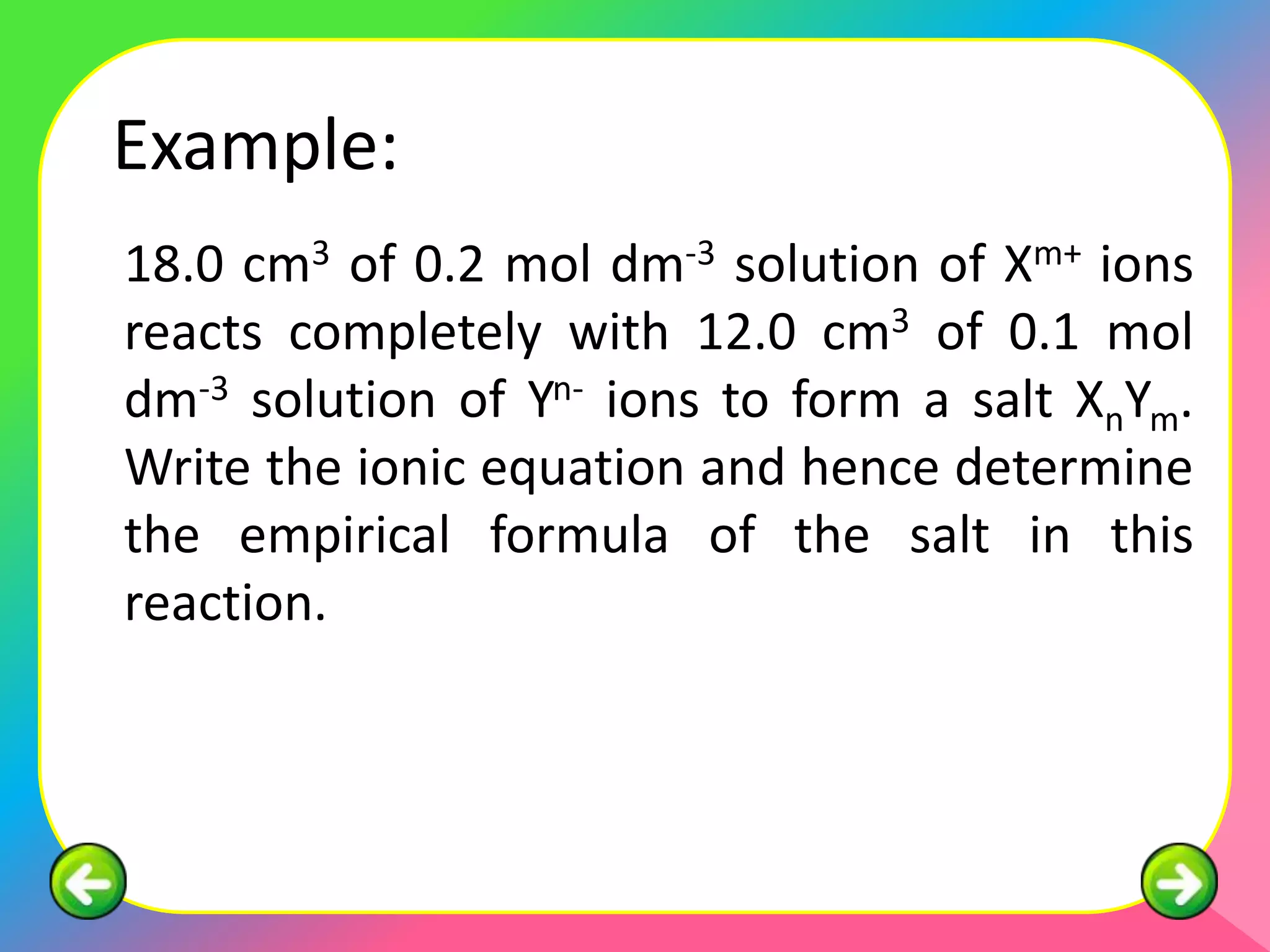
Example:
18.0 cm3 of 0.2 mol dm-3 solution of Xm+ ions
reacts completely with 12.0 cm3 of 0.1 mol
dm-3 solution of Yn- ions to form a salt XnYm.
Write the ionic equation and hence determine
the empirical formula of the salt in this
reaction.
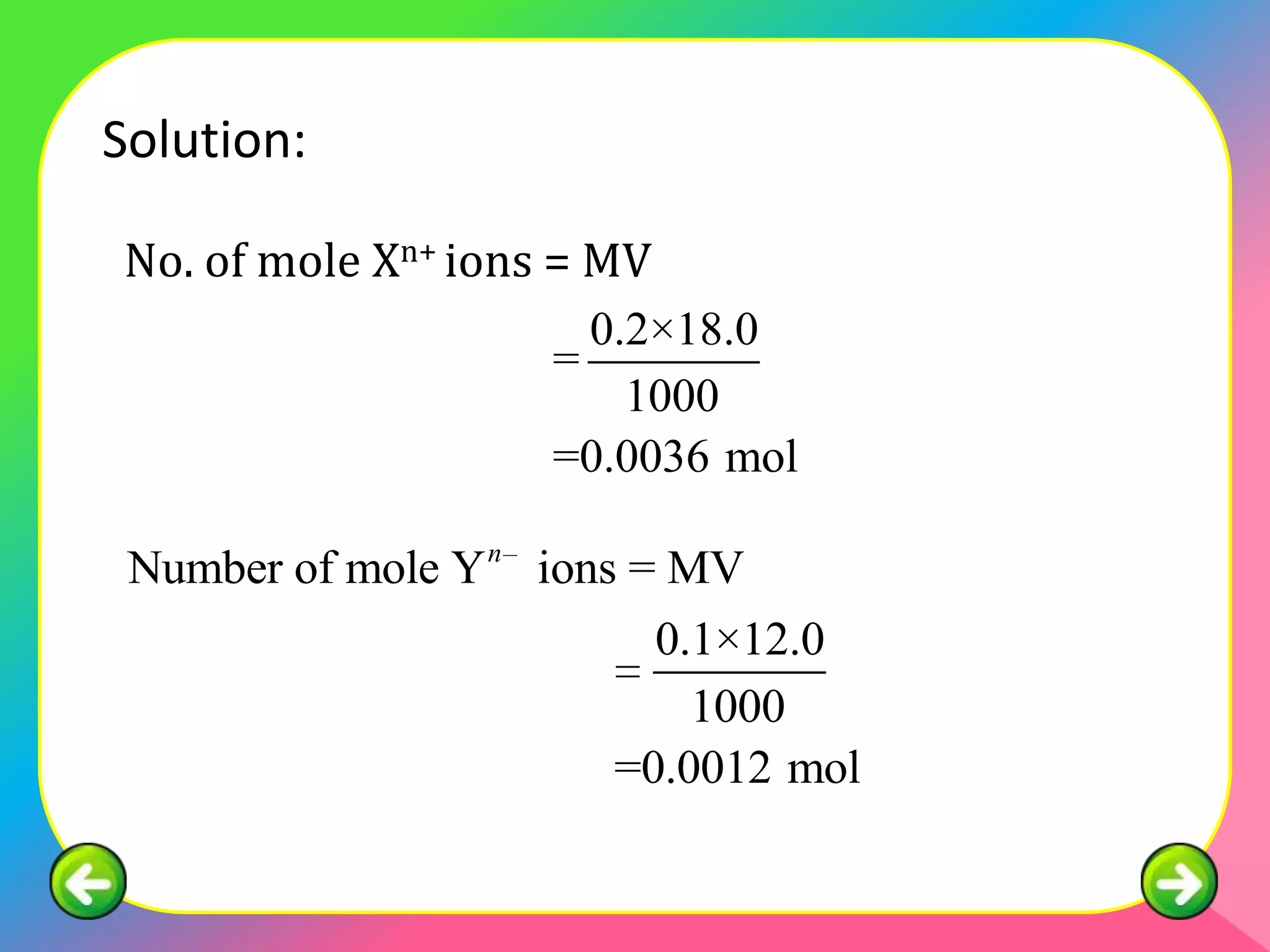
Solution:

No. of mole Xn+ ions = MV
                       0.2×18.0
                     =
                         1000
                     =0.0036 mol

 Number of mole Y n ions = MV
                         0.1×12.0
                           1000
                       =0.0012 mol
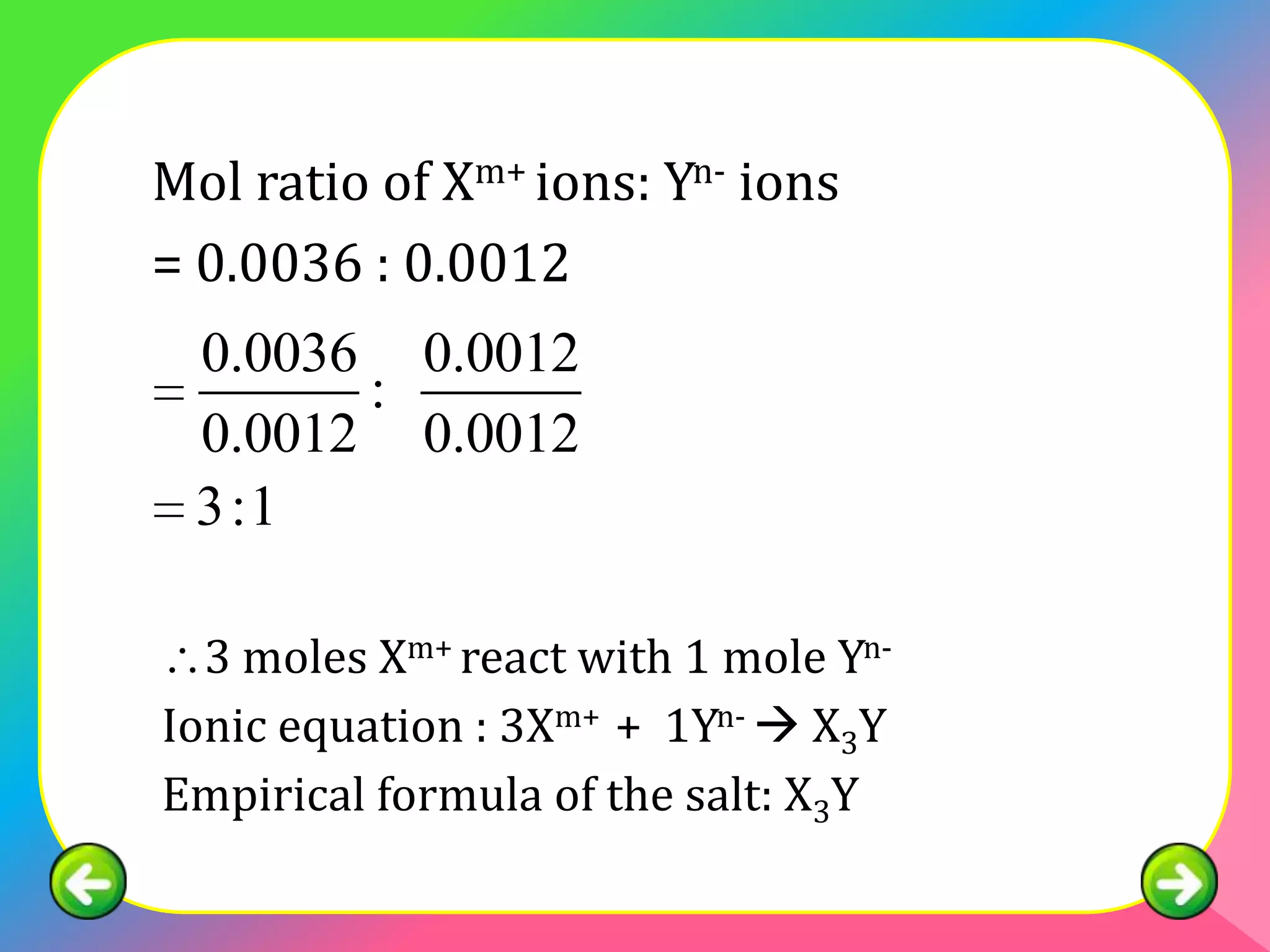
Mol ratio of Xm+ ions: Yn- ions
= 0.0036 : 0.0012
 0.0036 0.0012
       :
 0.0012 0.0012
 3:1

  3 moles Xm+ react with 1 mole Yn-
Ionic equation : 3Xm+ + 1Yn-  X3Y
Empirical formula of the salt: X3Y
Chapter 8 salt part 5

Chapter 8 salt part 5

  • 1.
    NURUL ASHIKIN BT.ABD RAHMAN PART 5
  • 2.
    LEARNING OUTCOMES  Constructionic equations through the continuous variation method.
  • 3.
    Continuous variation methodis a method that is use to construct ionic equations for the formation of insoluble salt. X (ion A) + Y (ion B) AXBY
  • 4.
    Step involved inthe continuous variation Method To determie the ionic equation of the reaction between A ions and B ions Carry out an experiment : fix volume solution A but different and varying of solution B Determine the volume B ions that react with all of the A ions Calculate the no. of mole A ions and B ions Determine the simplest mole ration of A ions to the Y ions in the reaction to construct the ionic equation
  • 5.
    Fixed volume ofreactant A are added to varying volumes of a second reactant B in different test tubes. Experiment : To construct a balanced ionic equation for the precipitation of lead (II) chromate (VI), PbCrO4 using the continuous variation method
  • 6.
    Example: 18.0 cm3 of0.2 mol dm-3 solution of Xm+ ions reacts completely with 12.0 cm3 of 0.1 mol dm-3 solution of Yn- ions to form a salt XnYm. Write the ionic equation and hence determine the empirical formula of the salt in this reaction.
  • 7.
    Solution: No. of moleXn+ ions = MV 0.2×18.0 = 1000 =0.0036 mol Number of mole Y n ions = MV 0.1×12.0 1000 =0.0012 mol
  • 8.
    Mol ratio ofXm+ ions: Yn- ions = 0.0036 : 0.0012 0.0036 0.0012 : 0.0012 0.0012 3:1 3 moles Xm+ react with 1 mole Yn- Ionic equation : 3Xm+ + 1Yn-  X3Y Empirical formula of the salt: X3Y